#performance Startups & Tools
Discover the best performance startups, tools, and products on SellWithBoost.
Catching database performance regressions before they reach users requires both visibility into query execution and the discipline to enforce latency budgets. Queryd addresses this gap by instrumenting SQL queries in Node.js applications with measurable performance guardrails. The tool wraps database clients at multiple levels—supporting postgres.js tagged templates, raw query functions, or Prisma—to intercept queries and measure their execution time against configurable thresholds. The product solves a real pain point for teams building latency-sensitive applications. Query performance degrades gradually, and without systematic detection, slow queries often go unnoticed until they cause visible impact. Queryd brings three mechanisms to prevent this: per-query latency thresholds that flag individual slow queries, per-request query budgets that set cumulative limits on database work within a single user request, and sampling controls that keep observability costs minimal in production. What distinguishes queryd is its pragmatic design philosophy. Rather than requiring a complete database abstraction or architectural restructuring, it integrates at the query execution layer across multiple driver APIs. The sampling-first approach acknowledges that continuous monitoring of all queries in high-traffic applications becomes prohibitively expensive; instead, teams can set sampling rates to stay within their observability budget while still surfacing meaningful regressions. Optional EXPLAIN ANALYZE integration allows deeper investigation of offending queries when needed, shifting between cheap signal and expensive detail. The implementation provides useful context awareness through request-scoped budgets—tracking not just individual query times but also cumulative query volume and duration within a single request. This catches a different class of performance issues: endpoints that perform many quick queries instead of fewer optimized ones. The configurable sink architecture suggests thoughtful extensibility, allowing teams to route alerts to their existing monitoring systems rather than forcing a new workflow. As an early-stage open-source project, queryd makes a modest but useful contribution to the Node.js observability ecosystem. It fills a specific niche—SQL query latency monitoring with minimal overhead—without attempting to be a comprehensive database performance platform. Teams already running SQL databases in production and concerned with query regressions will find the tool immediately applicable to their latency budgeting workflow.
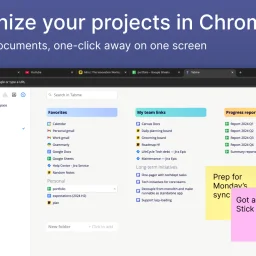
Organizing browser tabs has long been a point of friction for users who accumulate dozens of open pages and bookmarks scattered across multiple locations. Tabme, a Chrome extension, addresses this by consolidating tab management, bookmarking, and note-taking into a single interface with straightforward drag-and-drop controls. The extension handles several common browser headaches. Users can save individual tabs or entire sessions into folders with a single drag-and-drop action, reducing friction compared to manual bookmarking. Duplicate tab detection removes redundant pages with one click, directly addressing browser memory bloat that slows performance. Search functionality spans across open tabs, saved bookmarks, and recently closed tabs, eliminating the need to manually scroll through dozens of entries. A sticky notes feature lets users attach quick annotations directly to projects or collections. The product operates on a straightforward freemium model. The free tier maintains all data locally on the device, preserving privacy for users who prefer to avoid cloud dependencies. The Pro plan enables cross-device cloud synchronization and includes a web application for accessing bookmarks from any browser or phone. This structure caters to both casual users managing tabs on a single device and power users working across multiple machines. The "Mini" variant offers all features without overriding the new tab page, giving users control over how prominently the extension integrates with their workflow. User reviews emphasize simplicity and effectiveness. Comments praise the ease of organization, clean interface design, and productivity improvements. Reddit mentions suggest organic adoption and word-of-mouth traction. The extension maintains a top rating in the Chrome Store, reflecting consistent positive reception. Dark mode support and web-based access round out the feature set. Tabme serves both light organizers managing a handful of bookmarks and power users juggling dozens of projects across multiple devices.