
BLACK FRIDAY Premium $99 $69 Ends in 6 days 11 hours See the deal →

Best Search Startups & Tools

Search tools collect and rank information across apps, websites, and maps to find files, places, and answers fast.

Recently Listed

22 launches

Sort
TG App Market

TG App Market is an independent directory of Telegram bots, mini apps and games. Visitors can search by task, browse categories and collections, compare listing information and open a selected app in Telegram. The directory helps users find candidates; the listed services perform their own functions under their own conditions. Functions, prices, limits and availability must be checked with each provider. Listing descriptions preserve source information and distinguish publisher claims from independently tested functionality. TG App Market is not affiliated with Telegram.
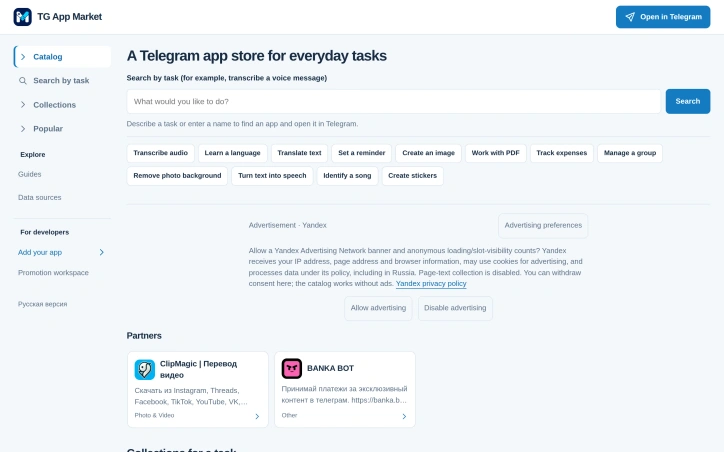

TG App Market is an independent directory of Telegram bots, mini apps and games. Visitors can search by task, browse categories and collections, compare listing information and open a selected app in Telegram. The directory helps users find candidates; the listed services perform their own functions under their own conditions. Functions, prices, limits and availability must be checked with each provider. Listing descriptions preserve source information and distinguish publisher claims from independently tested functionality. TG App Market is not affiliated with Telegram.

TG App Market preview

Key features

  • Task-Based Discovery: Lets visitors find bots and mini apps by the job they want done rather than by bot name.
  • Curated Collections: Highlights curated collections built around specific tasks.
See full listing
SecureTools

Software discovery platforms for security tools typically struggle with comprehensiveness and trustworthiness. SecureTools.live addresses this by centralizing comparisons and research across more than twenty-five security-focused categories, from cloud storage and file sharing to document management and e-signatures. The platform targets security-conscious businesses and individuals who need reliable guidance when evaluating tools with meaningful encryption or access controls. The directory organizes its catalog into clear product types—web and desktop applications, open-source projects, browser extensions, and AI integrations—making it straightforward to filter by software category or security use case. Each listing includes categorization such as "Secure File Sharing" or "Encrypted Cloud Storage" and describes core capabilities. The range is substantial: the platform features everything from enterprise solutions like DocuSign and Box to privacy-forward alternatives like Proton Drive and Tresorit, plus infrastructure-level tools like VeraCrypt and Cryptomator. What distinguishes SecureTools.live from a generic directory is its vendor enablement model. The platform invites software makers to list their products, positioning itself as a marketplace for discovery. By consolidating security tools across use cases, it reduces the friction that normally accompanies security tool research—users avoid piecemeal Google searches and vendor-specific comparisons. The platform's business model includes sponsored listing slots. The website indicates limited advertising availability, suggesting a freemium approach where basic directory inclusion is available but premium visibility requires payment. This model aligns with how similar B2B discovery platforms operate. For security teams, the value lies in having a pre-curated set of options across distinct security categories all in one place. The categorization itself—separating document security from cloud storage, distinguishing e-signatures from file transfer—reduces decision friction. For vendors, listing on SecureTools.live provides an alternative channel to reach buyers actively shopping for security solutions. The main limitation is inherent to any directory: it functions as a listing service and does not perform hands-on product audits or certification. Users still evaluate each tool independently, but the platform provides the scaffolding to do so systematically rather than haphazardly. For the fragmented security tools landscape, that structure fills a real gap.
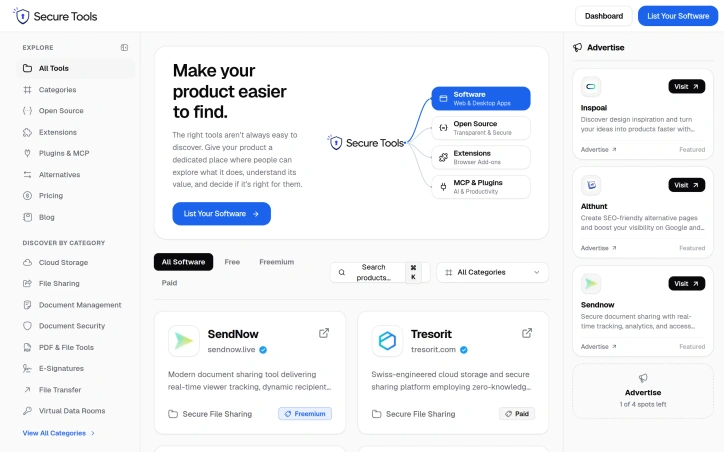

Software discovery platforms for security tools typically struggle with comprehensiveness and trustworthiness. SecureTools.live addresses this by centralizing comparisons and research across more than twenty-five security-focused categories, from cloud storage and file sharing to document management and e-signatures. The platform targets security-conscious businesses and individuals who need reliable guidance when evaluating tools with meaningful encryption or access controls. The directory organizes its catalog into clear product types—web and desktop applications, open-source projects, browser extensions, and AI integrations—making it straightforward to filter by software category or security use case. Each listing includes categorization such as "Secure File Sharing" or "Encrypted Cloud Storage" and describes core capabilities. The range is substantial: the platform features everything from enterprise solutions like DocuSign and Box to privacy-forward alternatives like Proton Drive and Tresorit, plus infrastructure-level tools like VeraCrypt and Cryptomator. What distinguishes SecureTools.live from a generic directory is its vendor enablement model. The platform invites software makers to list their products, positioning itself as a marketplace for discovery. By consolidating security tools across use cases, it reduces the friction that normally accompanies security tool research—users avoid piecemeal Google searches and vendor-specific comparisons. The platform's business model includes sponsored listing slots. The website indicates limited advertising availability, suggesting a freemium approach where basic directory inclusion is available but premium visibility requires payment. This model aligns with how similar B2B discovery platforms operate. For security teams, the value lies in having a pre-curated set of options across distinct security categories all in one place. The categorization itself—separating document security from cloud storage, distinguishing e-signatures from file transfer—reduces decision friction. For vendors, listing on SecureTools.live provides an alternative channel to reach buyers actively shopping for security solutions. The main limitation is inherent to any directory: it functions as a listing service and does not perform hands-on product audits or certification. Users still evaluate each tool independently, but the platform provides the scaffolding to do so systematically rather than haphazardly. For the fragmented security tools landscape, that structure fills a real gap.

SecureTools preview

Key features

  • Centralized Comparisons: Organizes security tool comparisons across more than twenty-five security-focused categories
  • Multi-Format Directory: Catalogs web and desktop applications, open-source projects, browser extensions, and AI integrations
See full listing
ModGenie

Finding the perfect mod for a PC game typically requires knowing the right search terms—a frustrating barrier when you know exactly what you want but lack the vocabulary to locate it. ModGenie addresses this gap by letting players describe their desired modifications in natural language, then using AI to identify relevant mods and explain their functionality. The service targets PC gamers across a wide range of titles, from massive communities like Minecraft and Project Zomboid to more niche games like Valheim and Kenshi. The breadth is impressive: ModGenie catalogs tens of thousands of mods across dozens of games, reflecting genuine demand. Minecraft alone shows over 54,000 tracked mods with nearly 1.5 billion downloads recorded through the platform. What distinguishes ModGenie is its focus on search and discovery as the core problem. Rather than building a new mod hosting platform or competing with existing repositories, it acts as an intelligent intermediary that translates player intent into specific recommendations. The interface appears straightforward: describe the change you want—more inventory slots, ore through portals, a minimap with waypoints—and receive curated suggestions with clear explanations of what each mod does. The product launched in late October 2026 and has already indexed substantial catalogs across popular modding communities. Beyond search, ModGenie offers mod pack exports for supported games, bundling multiple mods into shareable configurations. This appeals to players who want to distribute entire mod collections rather than individual recommendations, adding practical value for group play or streaming scenarios. The founder's background as a full-stack developer who builds and operates complete products shows in the execution. The service identifies a real friction point in gaming without requiring players to navigate the quirks of individual mod sites or master esoteric search conventions. For casual players intimidated by mod installation or veterans optimizing their time, this translation layer delivers genuine value. The business model remains undisclosed, and the platform is too new to assess long-term sustainability. Still, ModGenie demonstrates sharp product thinking: it solves a specific, articulate problem for an engaged audience with measurable demand. Whether it evolves into a full gaming discovery platform or remains a focused utility, it represents the kind of targeted solution that emerges when developers build tools for their own pain points.


Finding the perfect mod for a PC game typically requires knowing the right search terms—a frustrating barrier when you know exactly what you want but lack the vocabulary to locate it. ModGenie addresses this gap by letting players describe their desired modifications in natural language, then using AI to identify relevant mods and explain their functionality. The service targets PC gamers across a wide range of titles, from massive communities like Minecraft and Project Zomboid to more niche games like Valheim and Kenshi. The breadth is impressive: ModGenie catalogs tens of thousands of mods across dozens of games, reflecting genuine demand. Minecraft alone shows over 54,000 tracked mods with nearly 1.5 billion downloads recorded through the platform. What distinguishes ModGenie is its focus on search and discovery as the core problem. Rather than building a new mod hosting platform or competing with existing repositories, it acts as an intelligent intermediary that translates player intent into specific recommendations. The interface appears straightforward: describe the change you want—more inventory slots, ore through portals, a minimap with waypoints—and receive curated suggestions with clear explanations of what each mod does. The product launched in late October 2026 and has already indexed substantial catalogs across popular modding communities. Beyond search, ModGenie offers mod pack exports for supported games, bundling multiple mods into shareable configurations. This appeals to players who want to distribute entire mod collections rather than individual recommendations, adding practical value for group play or streaming scenarios. The founder's background as a full-stack developer who builds and operates complete products shows in the execution. The service identifies a real friction point in gaming without requiring players to navigate the quirks of individual mod sites or master esoteric search conventions. For casual players intimidated by mod installation or veterans optimizing their time, this translation layer delivers genuine value. The business model remains undisclosed, and the platform is too new to assess long-term sustainability. Still, ModGenie demonstrates sharp product thinking: it solves a specific, articulate problem for an engaged audience with measurable demand. Whether it evolves into a full gaming discovery platform or remains a focused utility, it represents the kind of targeted solution that emerges when developers build tools for their own pain points.

ModGenie preview

Key features

  • Natural Language Search: Players describe desired modifications in everyday language instead of using specialized search terms.
  • AI-Powered Discovery: Artificial intelligence identifies relevant mods and explains their functionality based on player descriptions.
See full listing
NexusAi

Starting a business with AI tools today means wading through thousands of options scattered across the internet. NexusAi consolidates this fragmented landscape into a single discovery platform designed for founders, developers, and teams evaluating AI software. The core problem is real: the AI tool market has exploded faster than any traditional directory can keep pace. Rather than bouncing between review sites, product hunt, and scattered vendor websites, users can now explore curated categories, compare offerings side by side, and access a library of ready-to-use prompts and workflows. The platform currently indexes over 700 AI tools across more than 1000 categories, with daily updates to keep pace with new launches. What distinguishes NexusAi is the workflow-first approach embedded in its design. The service goes beyond simple product listings by bundling in expert-crafted prompts and practical workflows that show users how to actually apply these tools to real problems. Someone searching for content creation solutions doesn't just see tool options—they also find validated workflows and prompt templates that reduce the setup friction. The directory segments tools by use case and industry vertical: productivity, development, marketing, content, data, automation, and operations. A trending section highlights the month's fastest-growing AI applications with engagement metrics. This removes the guesswork from which tools are actually gaining traction versus which ones peaked in a Reddit thread. The platform maintains a 50,000 monthly visitor base and offers free-tier discovery access. Revenue comes from sponsored listings and premium partnerships, with companies like CodeRabbit and getimg.ai featured as paid placements within the directory. The main limitation is scale. NexusAi claims daily curation, but as the AI tool market doubles every few months, human-curated directories inevitably lag behind the pace of launches. The 1000-plus category structure, while comprehensive, risks becoming unwieldy for users trying to navigate to their specific need rather than browse discovery mode. For teams managing AI tool sprawl across an organization, or founders evaluating the landscape before committing engineering resources to integration, NexusAi cuts meaningful time off the research phase. It trades the chaos of unlimited searching for the constraints of a curated subset—a worthwhile exchange for those who value speed over exhaustiveness.
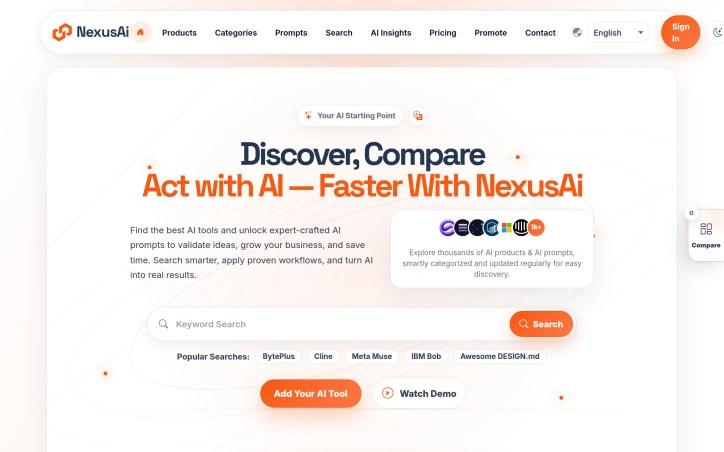

Starting a business with AI tools today means wading through thousands of options scattered across the internet. NexusAi consolidates this fragmented landscape into a single discovery platform designed for founders, developers, and teams evaluating AI software. The core problem is real: the AI tool market has exploded faster than any traditional directory can keep pace. Rather than bouncing between review sites, product hunt, and scattered vendor websites, users can now explore curated categories, compare offerings side by side, and access a library of ready-to-use prompts and workflows. The platform currently indexes over 700 AI tools across more than 1000 categories, with daily updates to keep pace with new launches. What distinguishes NexusAi is the workflow-first approach embedded in its design. The service goes beyond simple product listings by bundling in expert-crafted prompts and practical workflows that show users how to actually apply these tools to real problems. Someone searching for content creation solutions doesn't just see tool options—they also find validated workflows and prompt templates that reduce the setup friction. The directory segments tools by use case and industry vertical: productivity, development, marketing, content, data, automation, and operations. A trending section highlights the month's fastest-growing AI applications with engagement metrics. This removes the guesswork from which tools are actually gaining traction versus which ones peaked in a Reddit thread. The platform maintains a 50,000 monthly visitor base and offers free-tier discovery access. Revenue comes from sponsored listings and premium partnerships, with companies like CodeRabbit and getimg.ai featured as paid placements within the directory. The main limitation is scale. NexusAi claims daily curation, but as the AI tool market doubles every few months, human-curated directories inevitably lag behind the pace of launches. The 1000-plus category structure, while comprehensive, risks becoming unwieldy for users trying to navigate to their specific need rather than browse discovery mode. For teams managing AI tool sprawl across an organization, or founders evaluating the landscape before committing engineering resources to integration, NexusAi cuts meaningful time off the research phase. It trades the chaos of unlimited searching for the constraints of a curated subset—a worthwhile exchange for those who value speed over exhaustiveness.

NexusAi preview

Key features

  • AI Tool Directory: Indexes over 700 AI tools across 1000+ categories with daily updates
  • Workflow Integration: Bundles expert-crafted prompts and workflows showing practical applications to real problems
See full listing
AiToolsList.Tools

Finding the right AI tool for a specific task has become increasingly difficult as the technology landscape expands rapidly. AiToolsList.Tools addresses this problem by functioning as a centralized, curated directory that consolidates information about thousands of AI applications, SaaS products, and productivity software in one searchable location. The platform serves entrepreneurs, developers, product teams, and business professionals who need to identify and evaluate tools relevant to their work without spending hours searching across scattered reviews and vendor websites. The directory distinguishes itself through its breadth and curation approach. With nearly 2,850 tools organized across more than 20 specialized categories—ranging from generative code and image improvement to voice modulation and podcast creation—the platform acknowledges the diversification of AI capabilities beyond simple text generation. Rather than presenting an unfiltered dump of every submission, the site highlights hand-picked featured selections with visual previews before the full directory listing, which helps users quickly identify the most popular or recommended options. The platform's core features reflect a practical approach to tool discovery. Users can browse tools by category, view trending options, and access featured tools that receive prominent visual treatment. The interface is designed for quick scanning rather than deep dives, with concise descriptions and relevant categorization helping users narrow their search. A blog suggests ongoing content development around AI tooling trends, which provides context for evaluating which tools matter most. One notable strength is the user contribution model, which allows the community to submit new tools. This crowdsourced approach keeps the directory current as new products emerge, though it also raises questions about quality control. The prominence given to featured, curated selections indicates an editorial layer exists to filter noise and highlight the most significant options. The platform's business model remains unclear from the publicly available information. No pricing tiers, subscription requirements, or revenue mechanisms are mentioned, leaving the monetization strategy unknown. What is clear is that AiToolsList.Tools fills a specific need in a fragmented landscape where AI tooling has proliferated faster than reliable discovery mechanisms can keep pace. For anyone actively evaluating, comparing, or learning about available AI solutions, this directory offers a more efficient starting point than generic search engines or scattered blog posts.
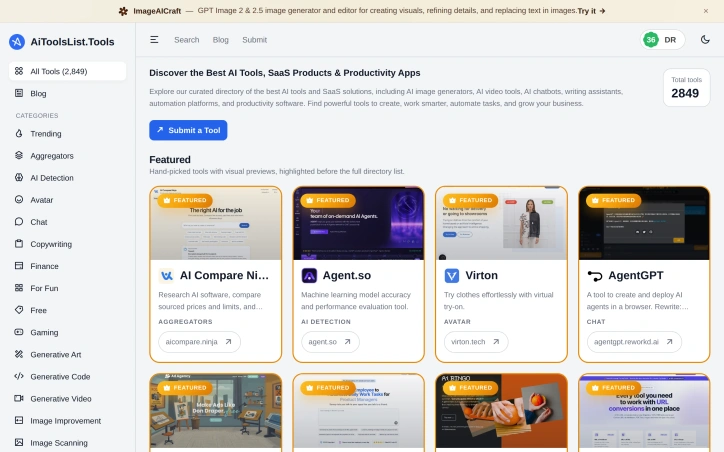

Finding the right AI tool for a specific task has become increasingly difficult as the technology landscape expands rapidly. AiToolsList.Tools addresses this problem by functioning as a centralized, curated directory that consolidates information about thousands of AI applications, SaaS products, and productivity software in one searchable location. The platform serves entrepreneurs, developers, product teams, and business professionals who need to identify and evaluate tools relevant to their work without spending hours searching across scattered reviews and vendor websites. The directory distinguishes itself through its breadth and curation approach. With nearly 2,850 tools organized across more than 20 specialized categories—ranging from generative code and image improvement to voice modulation and podcast creation—the platform acknowledges the diversification of AI capabilities beyond simple text generation. Rather than presenting an unfiltered dump of every submission, the site highlights hand-picked featured selections with visual previews before the full directory listing, which helps users quickly identify the most popular or recommended options. The platform's core features reflect a practical approach to tool discovery. Users can browse tools by category, view trending options, and access featured tools that receive prominent visual treatment. The interface is designed for quick scanning rather than deep dives, with concise descriptions and relevant categorization helping users narrow their search. A blog suggests ongoing content development around AI tooling trends, which provides context for evaluating which tools matter most. One notable strength is the user contribution model, which allows the community to submit new tools. This crowdsourced approach keeps the directory current as new products emerge, though it also raises questions about quality control. The prominence given to featured, curated selections indicates an editorial layer exists to filter noise and highlight the most significant options. The platform's business model remains unclear from the publicly available information. No pricing tiers, subscription requirements, or revenue mechanisms are mentioned, leaving the monetization strategy unknown. What is clear is that AiToolsList.Tools fills a specific need in a fragmented landscape where AI tooling has proliferated faster than reliable discovery mechanisms can keep pace. For anyone actively evaluating, comparing, or learning about available AI solutions, this directory offers a more efficient starting point than generic search engines or scattered blog posts.

AiToolsList.Tools preview

Key features

  • Centralized Directory: Consolidates thousands of AI applications, SaaS products, and productivity software in one searchable location
  • Curated Selections: Hand-picked featured tools with visual previews to help users identify popular and recommended options
See full listing
Image Search with AI

Finding images across the vast internet and identifying their sources has long been a tedious process requiring multiple tools and manual searching. CopyChecker's reverse image search platform tackles this problem with an AI-powered approach that requires no account creation for basic usage. The service distinguishes itself by combining several search capabilities into a single interface. Users can upload images directly, drag and drop files, or search by providing a URL. The underlying AI analyzes photos and compares them against millions of indexed images to locate duplicates, visually similar matches, and their web sources. Results are automatically categorized, allowing users to quickly jump to relevant matches whether they're looking for exact duplicates or similar variations. The platform extends beyond simple image matching. Its AI engine detects faces within images and enables targeted searches to find people online. Logo detection identifies brand marks and symbols, returning both logo names and related images. The service also includes optical character recognition to extract text from images, useful for many workflows. For users concerned about privacy, searches are encrypted and photos are automatically deleted from servers after processing. CopyChecker offers a free tier to get started, with paid upgrades for power users. The Pro plan costs $8.99 monthly when billed annually and provides 6,000 credited searches alongside unlimited image link sources and text extraction. The Ultimate tier at $16.99 monthly adds 18,000 credited searches plus additional capabilities including geotagging from images and automatic brand name detection. Both paid tiers remove watermarks and advertisements. The product targets content creators, photographers, marketers, and anyone needing to track where their images appear online or verify the provenance of photos they encounter. It also serves practical use cases like identifying counterfeit products by detecting logos across the web or finding individuals in photos. The straightforward three-step process—upload, analyze, retrieve results—removes friction compared to juggling multiple specialized tools. The combination of multiple search modalities, granular result categorization, and privacy assurances positions this as a focused alternative to broader image search platforms that prioritize advertising and data collection over user privacy.
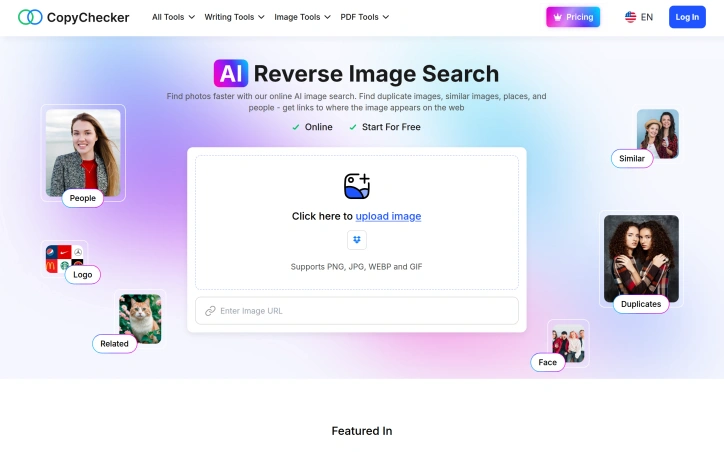
Finding images across the vast internet and identifying their sources has long been a tedious process requiring multiple tools and manual searching. CopyChecker's reverse image search platform tackles this problem with an AI-powered approach that requires no account creation for basic usage. The service distinguishes itself by combining several search capabilities into a single interface. Users can upload images directly, drag and drop files, or search by providing a URL. The underlying AI analyzes photos and compares them against millions of indexed images to locate duplicates, visually similar matches, and their web sources. Results are automatically categorized, allowing users to quickly jump to relevant matches whether they're looking for exact duplicates or similar variations. The platform extends beyond simple image matching. Its AI engine detects faces within images and enables targeted searches to find people online. Logo detection identifies brand marks and symbols, returning both logo names and related images. The service also includes optical character recognition to extract text from images, useful for many workflows. For users concerned about privacy, searches are encrypted and photos are automatically deleted from servers after processing. CopyChecker offers a free tier to get started, with paid upgrades for power users. The Pro plan costs $8.99 monthly when billed annually and provides 6,000 credited searches alongside unlimited image link sources and text extraction. The Ultimate tier at $16.99 monthly adds 18,000 credited searches plus additional capabilities including geotagging from images and automatic brand name detection. Both paid tiers remove watermarks and advertisements. The product targets content creators, photographers, marketers, and anyone needing to track where their images appear online or verify the provenance of photos they encounter. It also serves practical use cases like identifying counterfeit products by detecting logos across the web or finding individuals in photos. The straightforward three-step process—upload, analyze, retrieve results—removes friction compared to juggling multiple specialized tools. The combination of multiple search modalities, granular result categorization, and privacy assurances positions this as a focused alternative to broader image search platforms that prioritize advertising and data collection over user privacy.

Image Search with AI preview

Key features

  • Reverse Image Search: Analyzes and compares photos against millions of indexed images to locate duplicates and their web sources.
  • Face Detection: Detects faces within images to enable targeted searches for finding people online.
See full listing
F

Finding quality tools across the internet often means wading through marketing noise and outdated comparisons. FWFW tackles this by offering a hand-curated directory of websites and software tools indexed across the globe. The platform is built for anyone hunting for vetted solutions—developers scouting new utilities, entrepreneurs researching competitors or supporting tools, and business owners seeking category-specific resources—without wanting to wade through endless search results or trust algorithmic rankings alone. What distinguishes the directory is its geographic dimension. Rather than assuming a universal web, FWFW lets users browse by continent, country, and region, surfacing region-specific tools alongside global ones. This matters for startups finding local alternatives or businesses looking for solutions suited to their geography. The directory covers categories ranging from AI and productivity to development and design, with entries featuring editorial descriptions rather than just titles and links. A listing for CrawlTide, for instance, explains both what the SEO tool does and its specific capabilities—rank tracking, AI visibility monitoring, and included free tools—giving browsers immediate context. The product layers in practical utility through a free Ahrefs Domain Rating checker, adding genuine value for users evaluating the credibility of listed tools. Full-text search removes friction from discovery, while filtering by tags, categories, and sortable price points help users narrow thousands of options to what matters. The inclusion of pricing information in listings means researchers can quickly identify free, paid, or freemium solutions. The entries visible span recognizable categories—an AI demo agent, image-to-video tools, SEO audits, fitness apps—suggesting genuine curation rather than spam or placeholder content. Tools are indexed from major regions including North America, Asia, and Europe, preventing the regional bias common in startup directories. There is clear business logic here: a human-curated repository solves a real discovery problem, especially for anyone tired of algorithmic recommendations or marketing-driven listings. The free access to search and the domain rating checker create immediate utility without paywalls. Whether monetization comes later through featured listings, premium filters, or other channels remains to be seen. For now, the directory's strength lies in removing friction from global tool discovery through genuine curation, geographic intelligence, and straightforward organization.
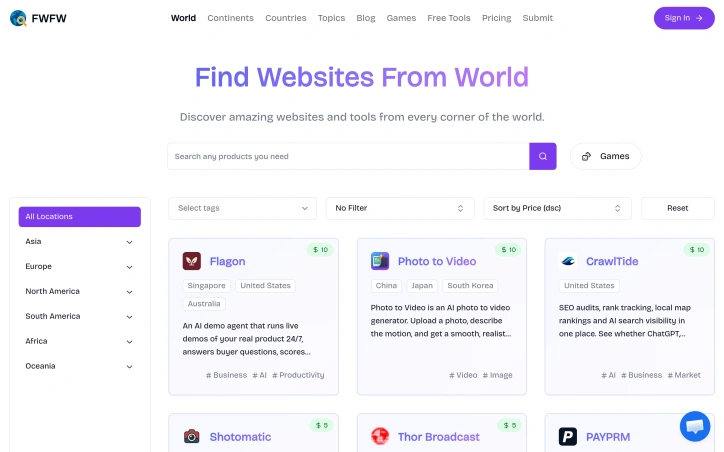

Finding quality tools across the internet often means wading through marketing noise and outdated comparisons. FWFW tackles this by offering a hand-curated directory of websites and software tools indexed across the globe. The platform is built for anyone hunting for vetted solutions—developers scouting new utilities, entrepreneurs researching competitors or supporting tools, and business owners seeking category-specific resources—without wanting to wade through endless search results or trust algorithmic rankings alone. What distinguishes the directory is its geographic dimension. Rather than assuming a universal web, FWFW lets users browse by continent, country, and region, surfacing region-specific tools alongside global ones. This matters for startups finding local alternatives or businesses looking for solutions suited to their geography. The directory covers categories ranging from AI and productivity to development and design, with entries featuring editorial descriptions rather than just titles and links. A listing for CrawlTide, for instance, explains both what the SEO tool does and its specific capabilities—rank tracking, AI visibility monitoring, and included free tools—giving browsers immediate context. The product layers in practical utility through a free Ahrefs Domain Rating checker, adding genuine value for users evaluating the credibility of listed tools. Full-text search removes friction from discovery, while filtering by tags, categories, and sortable price points help users narrow thousands of options to what matters. The inclusion of pricing information in listings means researchers can quickly identify free, paid, or freemium solutions. The entries visible span recognizable categories—an AI demo agent, image-to-video tools, SEO audits, fitness apps—suggesting genuine curation rather than spam or placeholder content. Tools are indexed from major regions including North America, Asia, and Europe, preventing the regional bias common in startup directories. There is clear business logic here: a human-curated repository solves a real discovery problem, especially for anyone tired of algorithmic recommendations or marketing-driven listings. The free access to search and the domain rating checker create immediate utility without paywalls. Whether monetization comes later through featured listings, premium filters, or other channels remains to be seen. For now, the directory's strength lies in removing friction from global tool discovery through genuine curation, geographic intelligence, and straightforward organization.

FWFW preview
F

Key features

  • Hand-Curated Directory: A vetted collection of websites and software tools indexed globally, eliminating marketing noise and outdated comparisons.
  • Geographic Browsing: Users can filter tools by continent, country, and region to discover location-specific solutions and avoid regional bias.
See full listing
ToolSuite Pro

Browsing for online tools that actually work without friction remains a frustration for many users. ToolSuite Pro addresses this by curating a hand-picked directory of free, browser-based tools designed for immediate use. The service targets productivity-conscious professionals, content creators, and business users who prioritize speed and accessibility over feature-rich but cumbersome desktop applications. The product's core strength lies in its minimalist philosophy. Rather than aggregating every tool available online, the founder has selected a focused collection and organized it by category. Each tool requires no installation or account creation—users simply open them in a browser and begin working immediately. This friction-free approach directly counters the problem that sparked its creation: wasting time navigating paywalls, sign-up walls, and software installations just to accomplish basic tasks. Currently, the directory contains eleven tools spread across multiple categories. Productivity tools dominate the collection, followed by offerings in marketing and SEO, writing, and business software. Developer tools, chatbots, text utilities, and 3D viewers round out the selection. Notably, several categories featured prominently in the platform's positioning—including PDF, image, AI, and social media tools—contain no entries at all, revealing either rigorous curation standards or a directory still in its early stages. The site accepts user submissions, inviting the community to propose tools for inclusion. The platform's business model is transparent: the directory is completely free to access with no subscription fees, premium tiers, or upselling. This commitment aligns with the founder's stated mission to eliminate barriers between users and useful tools. What distinguishes ToolSuite Pro from broad tool aggregators and directories is its ruthless selectivity and resistance to bloat. Rather than attempting an exhaustive catalog of every available web tool, the site prioritizes quality through human curation. The interface reflects this philosophy: straightforward categorization, no recommendation algorithms, no feature-stuffing. The current catalog's modest size functions as both limitation and potential quality signal. As the directory expands and attracts more submissions, the sustainability of hand-picked curation will become its defining challenge. For now, ToolSuite Pro serves users seeking immediate, frictionless access to a vetted starter set of productivity tools.
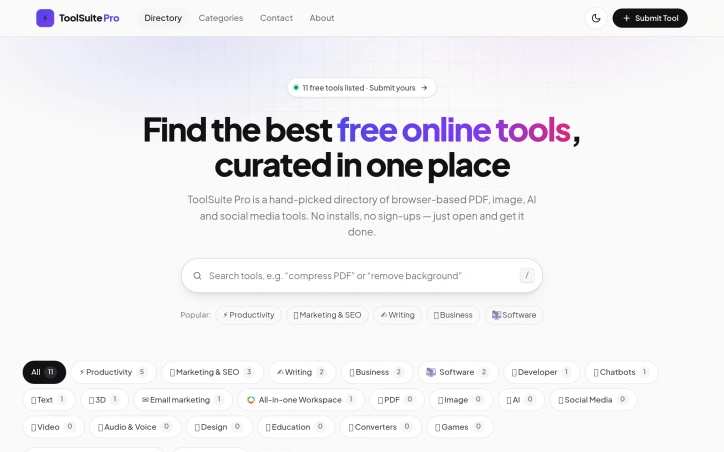

Browsing for online tools that actually work without friction remains a frustration for many users. ToolSuite Pro addresses this by curating a hand-picked directory of free, browser-based tools designed for immediate use. The service targets productivity-conscious professionals, content creators, and business users who prioritize speed and accessibility over feature-rich but cumbersome desktop applications. The product's core strength lies in its minimalist philosophy. Rather than aggregating every tool available online, the founder has selected a focused collection and organized it by category. Each tool requires no installation or account creation—users simply open them in a browser and begin working immediately. This friction-free approach directly counters the problem that sparked its creation: wasting time navigating paywalls, sign-up walls, and software installations just to accomplish basic tasks. Currently, the directory contains eleven tools spread across multiple categories. Productivity tools dominate the collection, followed by offerings in marketing and SEO, writing, and business software. Developer tools, chatbots, text utilities, and 3D viewers round out the selection. Notably, several categories featured prominently in the platform's positioning—including PDF, image, AI, and social media tools—contain no entries at all, revealing either rigorous curation standards or a directory still in its early stages. The site accepts user submissions, inviting the community to propose tools for inclusion. The platform's business model is transparent: the directory is completely free to access with no subscription fees, premium tiers, or upselling. This commitment aligns with the founder's stated mission to eliminate barriers between users and useful tools. What distinguishes ToolSuite Pro from broad tool aggregators and directories is its ruthless selectivity and resistance to bloat. Rather than attempting an exhaustive catalog of every available web tool, the site prioritizes quality through human curation. The interface reflects this philosophy: straightforward categorization, no recommendation algorithms, no feature-stuffing. The current catalog's modest size functions as both limitation and potential quality signal. As the directory expands and attracts more submissions, the sustainability of hand-picked curation will become its defining challenge. For now, ToolSuite Pro serves users seeking immediate, frictionless access to a vetted starter set of productivity tools.

ToolSuite Pro preview

Key features

  • Free Browser-Based Tools: instant access without installation or account setup
  • Hand-Picked Curation: quality-focused selection of tools organized by category
See full listing
AOPX

Routing decisions for AI agents don't need to be baked into code. AOPX offers a consultation layer that sits between agent applications and search providers, recommending which provider to use for each request and supplying fallback paths when the primary choice becomes unavailable. The platform targets developers of AI agents and workflow systems that currently hardcode single search provider dependencies. By introducing a routing decision point, AOPX lets agents defer provider selection to a policy layer, avoiding the brittleness that comes from fixed integrations. The core insight is straightforward: when agents need reliable search capabilities, flexibility and fallback resilience should not be sacrificed for simplicity. What distinguishes AOPX is its feedback mechanism. After an agent executes a recommended provider and receives results, it can report back on what actually happened in production. AOPX ingests these reported outcomes and incorporates them into its routing policies, creating a system that evolves based on real-world performance rather than operating solely on frozen benchmarks. This design pattern is notably different from static provider comparison tools that offer one-time recommendations with no learning loop. The service operates as pure consultation. AOPX receives a category and mode parameter, returns a recommendation_id along with a primary and fallback provider, and agents handle the actual API calls themselves. This architecture sidesteps the need to become a proxy layer or payment processor and keeps operational complexity minimal. Currently, the platform covers one category: SEARCH, with integrations to Brave Search and Tavily Search. A third candidate, Serper, sits under evaluation. Three integration surfaces exist: a REST API available live, an MCP protocol implementation for agent clients, and a beta n8n connector. Discovery metadata appears in both the MCP Registry and Glama.ai. Pricing remains undefined during the public pilot phase. Documentation explicitly states that billing is disabled, suggesting that commercial terms either have not yet solidified or await a future phase. The service positions itself around an opinionated view of agent architecture: providers should be swappable, selection decisions should track evidence, and failure should have structured fallbacks. Whether this routing abstraction justifies the additional latency and API call in practice depends on individual deployment requirements and tolerance for added complexity.
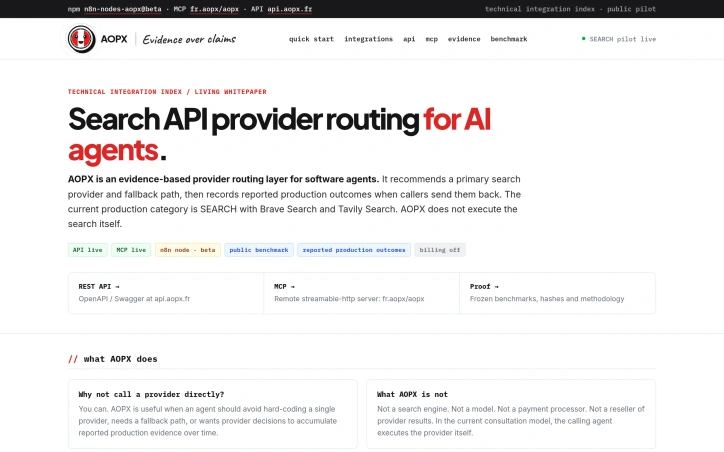

Routing decisions for AI agents don't need to be baked into code. AOPX offers a consultation layer that sits between agent applications and search providers, recommending which provider to use for each request and supplying fallback paths when the primary choice becomes unavailable. The platform targets developers of AI agents and workflow systems that currently hardcode single search provider dependencies. By introducing a routing decision point, AOPX lets agents defer provider selection to a policy layer, avoiding the brittleness that comes from fixed integrations. The core insight is straightforward: when agents need reliable search capabilities, flexibility and fallback resilience should not be sacrificed for simplicity. What distinguishes AOPX is its feedback mechanism. After an agent executes a recommended provider and receives results, it can report back on what actually happened in production. AOPX ingests these reported outcomes and incorporates them into its routing policies, creating a system that evolves based on real-world performance rather than operating solely on frozen benchmarks. This design pattern is notably different from static provider comparison tools that offer one-time recommendations with no learning loop. The service operates as pure consultation. AOPX receives a category and mode parameter, returns a recommendation_id along with a primary and fallback provider, and agents handle the actual API calls themselves. This architecture sidesteps the need to become a proxy layer or payment processor and keeps operational complexity minimal. Currently, the platform covers one category: SEARCH, with integrations to Brave Search and Tavily Search. A third candidate, Serper, sits under evaluation. Three integration surfaces exist: a REST API available live, an MCP protocol implementation for agent clients, and a beta n8n connector. Discovery metadata appears in both the MCP Registry and Glama.ai. Pricing remains undefined during the public pilot phase. Documentation explicitly states that billing is disabled, suggesting that commercial terms either have not yet solidified or await a future phase. The service positions itself around an opinionated view of agent architecture: providers should be swappable, selection decisions should track evidence, and failure should have structured fallbacks. Whether this routing abstraction justifies the additional latency and API call in practice depends on individual deployment requirements and tolerance for added complexity.

AOPX preview

Key features

  • Dynamic Provider Routing: Recommends the optimal search provider for each request based on configurable policies
  • Feedback-Based Learning: Incorporates real-world performance outcomes to continuously evolve routing decisions
See full listing
FeaturedLane

Noise drowns discovery in the tool marketplace. Developers, makers, and early adopters struggle to distinguish production-ready SaaS and AI solutions from marketplace hype. FeaturedLane operates as a hand-reviewed directory designed to surface legitimate tools through human editorial judgment rather than algorithmic ranking. The core differentiator is mandatory human curation. Each tool submission undergoes manual review before appearing in the directory. This gatekeeping approach creates friction for submissions but establishes credibility with audiences grown skeptical of automated recommendations. The product functions as a ranked listing of recent tool launches organized by category: Productivity, Developer Tools, Analytics, Marketing, Media, and Finance. Entries display concise descriptions, direct links, launch timestamps, vote counts, and comment threads. Recent additions span form builders, market research platforms, AI-powered document management systems, and content creation tools. This breadth indicates the directory pursues multiple verticals while maintaining consistent quality standards. Community voting shapes visibility. Tools accumulate votes as users signal value, creating a popularity layer atop the editorial foundation. This hybrid model—human filtering combined with crowd feedback—separates FeaturedLane from purely algorithmic alternatives and self-promotional marketplaces. The interface prioritizes scanability and direct product access. Categories organize logically, descriptions provide sufficient evaluation context, and the combination of editorial gatekeeping with voting creates genuine momentum. Tools gain visibility through reviewer credibility rather than marketing spend. FeaturedLane occupies a specific niche within discovery infrastructure. While narrower than horizontal marketplaces, it avoids the noise multiplication plaguing broader platforms. Competition exists from vertical directories focused on specific tool categories, and the hand-review process constrains scaling—submission volume growth directly impacts review capacity. The business model remains undisclosed. The directory operates as a free service with no stated pricing or monetization mechanism in available materials. For tool creators, FeaturedLane provides direct access to early adopters actively seeking new solutions. For those adopters, the directory delivers daily curation without independent research overhead. It stands as a genuine alternative to algorithmic feeds and sponsored recommendations dominating broader tool discovery.
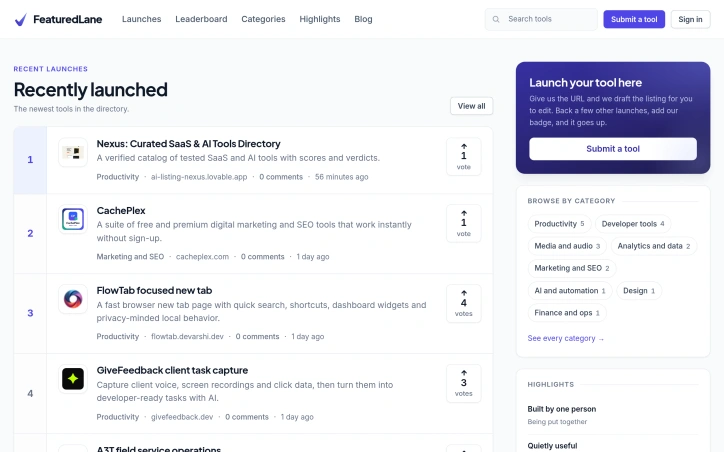

Noise drowns discovery in the tool marketplace. Developers, makers, and early adopters struggle to distinguish production-ready SaaS and AI solutions from marketplace hype. FeaturedLane operates as a hand-reviewed directory designed to surface legitimate tools through human editorial judgment rather than algorithmic ranking. The core differentiator is mandatory human curation. Each tool submission undergoes manual review before appearing in the directory. This gatekeeping approach creates friction for submissions but establishes credibility with audiences grown skeptical of automated recommendations. The product functions as a ranked listing of recent tool launches organized by category: Productivity, Developer Tools, Analytics, Marketing, Media, and Finance. Entries display concise descriptions, direct links, launch timestamps, vote counts, and comment threads. Recent additions span form builders, market research platforms, AI-powered document management systems, and content creation tools. This breadth indicates the directory pursues multiple verticals while maintaining consistent quality standards. Community voting shapes visibility. Tools accumulate votes as users signal value, creating a popularity layer atop the editorial foundation. This hybrid model—human filtering combined with crowd feedback—separates FeaturedLane from purely algorithmic alternatives and self-promotional marketplaces. The interface prioritizes scanability and direct product access. Categories organize logically, descriptions provide sufficient evaluation context, and the combination of editorial gatekeeping with voting creates genuine momentum. Tools gain visibility through reviewer credibility rather than marketing spend. FeaturedLane occupies a specific niche within discovery infrastructure. While narrower than horizontal marketplaces, it avoids the noise multiplication plaguing broader platforms. Competition exists from vertical directories focused on specific tool categories, and the hand-review process constrains scaling—submission volume growth directly impacts review capacity. The business model remains undisclosed. The directory operates as a free service with no stated pricing or monetization mechanism in available materials. For tool creators, FeaturedLane provides direct access to early adopters actively seeking new solutions. For those adopters, the directory delivers daily curation without independent research overhead. It stands as a genuine alternative to algorithmic feeds and sponsored recommendations dominating broader tool discovery.

FeaturedLane preview

Key features

  • Hand-Reviewed Directory: Each tool submission undergoes mandatory manual review before listing to ensure credibility
  • Category Organization: Tools organized by Productivity, Developer Tools, Analytics, Marketing, Media, and Finance
See full listing
toolbout

Navigating the crowded AI tool marketplace means wading through marketing materials designed to obscure genuine trade-offs. Toolbout cuts through this noise by presenting direct head-to-head comparisons of popular AI platforms across writing, video, voice, and other categories. The site targets decision-makers and individual users who want to evaluate tools based on capability and fit rather than promotional volume. The product's core strength lies in its commitment to transparency. Every feature claim links back to the vendor's own documentation, preventing the kind of misrepresentation that plagues many tool reviews. The site explicitly decouples its recommendations from sponsorship, meaning a tool wins a comparison when it best suits a particular use case, not when it offers affiliate commission or has paid for visibility. This structural honesty addresses a genuine friction point for buyers tired of seeing the same tools promoted everywhere regardless of context. Comparisons follow a "bout" format that pits two tools directly against each other rather than offering broad category overviews. Current matchups include Jasper versus Copy.ai for AI writing, Synthesia versus HeyGen for avatar video, and ElevenLabs versus Murf for voice synthesis. Each comparison evaluates features, pricing, and practical fit for the reader's situation. The decision criteria emphasize which tool serves specific user workflows best rather than which is objectively superior. A secondary commitment distinguishes the platform from static comparisons: the site refreshes its analyses as tools evolve. This maintenance-first approach acknowledges that feature sets and pricing shift rapidly in the AI space, so a comparison that accurately represented the landscape months ago may mislead today. The responsibility to re-verify keeps information current. Coverage spans multiple categories including Dev and Cloud infrastructure options like DigitalOcean, Vercel, and AWS Lightsail, plus design and presentation tools. This breadth suggests the site aims to serve broader purchasing decisions beyond AI content creation alone. The business model remains unclear from available information, though the site's emphasis on vendor-sourced verification and skepticism toward affiliate influence suggests the team maintains structural independence. For users fatigued by marketing-first tool reviews, Toolbout represents a pragmatic alternative grounded in methodology rather than hype. It converts the opaque art of tool selection into something more defensible.


Navigating the crowded AI tool marketplace means wading through marketing materials designed to obscure genuine trade-offs. Toolbout cuts through this noise by presenting direct head-to-head comparisons of popular AI platforms across writing, video, voice, and other categories. The site targets decision-makers and individual users who want to evaluate tools based on capability and fit rather than promotional volume. The product's core strength lies in its commitment to transparency. Every feature claim links back to the vendor's own documentation, preventing the kind of misrepresentation that plagues many tool reviews. The site explicitly decouples its recommendations from sponsorship, meaning a tool wins a comparison when it best suits a particular use case, not when it offers affiliate commission or has paid for visibility. This structural honesty addresses a genuine friction point for buyers tired of seeing the same tools promoted everywhere regardless of context. Comparisons follow a "bout" format that pits two tools directly against each other rather than offering broad category overviews. Current matchups include Jasper versus Copy.ai for AI writing, Synthesia versus HeyGen for avatar video, and ElevenLabs versus Murf for voice synthesis. Each comparison evaluates features, pricing, and practical fit for the reader's situation. The decision criteria emphasize which tool serves specific user workflows best rather than which is objectively superior. A secondary commitment distinguishes the platform from static comparisons: the site refreshes its analyses as tools evolve. This maintenance-first approach acknowledges that feature sets and pricing shift rapidly in the AI space, so a comparison that accurately represented the landscape months ago may mislead today. The responsibility to re-verify keeps information current. Coverage spans multiple categories including Dev and Cloud infrastructure options like DigitalOcean, Vercel, and AWS Lightsail, plus design and presentation tools. This breadth suggests the site aims to serve broader purchasing decisions beyond AI content creation alone. The business model remains unclear from available information, though the site's emphasis on vendor-sourced verification and skepticism toward affiliate influence suggests the team maintains structural independence. For users fatigued by marketing-first tool reviews, Toolbout represents a pragmatic alternative grounded in methodology rather than hype. It converts the opaque art of tool selection into something more defensible.

toolbout preview

Key features

  • Head-to-Head Comparisons: Direct comparison of two tools rather than broad category overviews.
  • Vendor-Verified Claims: Every feature claim links to vendor documentation to prevent misrepresentation.
See full listing
amaze.directory

Finding quality AI tools amid a sea of low-quality directories has become a real problem for product builders and creators. Too many tool aggregators prioritize paid placements over actual utility, leaving users to sift through untested offerings. Amaze.directory tackles this by taking a radically simple approach: only list tools that the curator has genuinely used. The difference is immediately apparent. Rather than trying to be comprehensive, the directory restricts itself to a small number of hand-checked products—currently six tools across categories like research, content creation, coding, and audio processing. Each listing includes a candid one-sentence assessment of what makes that tool worth using, stripped of marketing language. Perplexity gets credit for citation behavior over a standard chat interface. ElevenLabs is noted for producing synthetic speech that sounds unremarkable. Cursor receives praise for feeling like an editor that happens to include AI, rather than an AI product forced into an editor. These descriptions reflect genuine usage rather than promotional copy. The vetting process reinforces this commitment to substance. Every tool must be actively used for an extended period before listing. Dead links are purged every Friday. The operator explicitly refuses paid placements, a decision that fundamentally shapes the trust equation. You're not browsing a paid ranking—you're seeing what someone actually uses and recommends. The interface itself is straightforward. Search functionality lets users find tools by job type. Filters handle category and pricing, which amaze.directory presents honestly: some tools operate on freemium models while others require payment. This transparency about cost and access prevents the surprise of discovering a tool's hidden paywall after investing time. What limits the directory is also its strength. With only a handful of listings, this isn't a comprehensive resource for every use case. New categories like video generation appear but show no entries. The directory is growing—six tools were added in the last week—but it remains deliberately sparse. The business model is implicit: curation as editorial service. By maintaining independence and refusing vendor payments, amaze.directory positions itself as a source of genuine opinion rather than a marketplace. This appeals to builders who want tools that work over tools that are well-marketed. For creators and developers tired of hollow tool directories, amaze.directory offers something increasingly rare: honest product assessment backed by actual use.
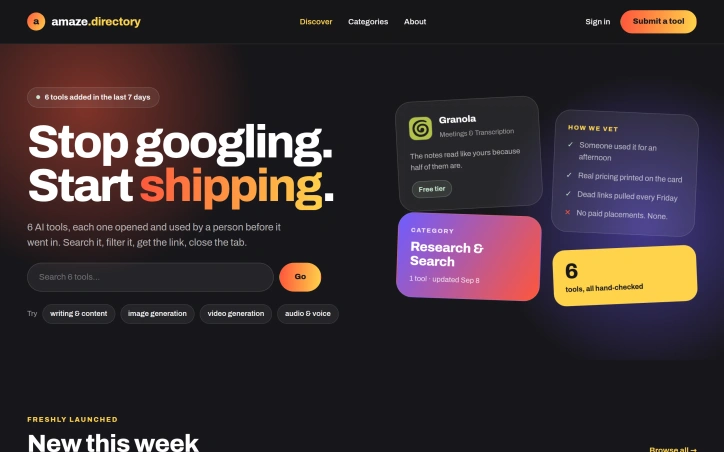

Finding quality AI tools amid a sea of low-quality directories has become a real problem for product builders and creators. Too many tool aggregators prioritize paid placements over actual utility, leaving users to sift through untested offerings. Amaze.directory tackles this by taking a radically simple approach: only list tools that the curator has genuinely used. The difference is immediately apparent. Rather than trying to be comprehensive, the directory restricts itself to a small number of hand-checked products—currently six tools across categories like research, content creation, coding, and audio processing. Each listing includes a candid one-sentence assessment of what makes that tool worth using, stripped of marketing language. Perplexity gets credit for citation behavior over a standard chat interface. ElevenLabs is noted for producing synthetic speech that sounds unremarkable. Cursor receives praise for feeling like an editor that happens to include AI, rather than an AI product forced into an editor. These descriptions reflect genuine usage rather than promotional copy. The vetting process reinforces this commitment to substance. Every tool must be actively used for an extended period before listing. Dead links are purged every Friday. The operator explicitly refuses paid placements, a decision that fundamentally shapes the trust equation. You're not browsing a paid ranking—you're seeing what someone actually uses and recommends. The interface itself is straightforward. Search functionality lets users find tools by job type. Filters handle category and pricing, which amaze.directory presents honestly: some tools operate on freemium models while others require payment. This transparency about cost and access prevents the surprise of discovering a tool's hidden paywall after investing time. What limits the directory is also its strength. With only a handful of listings, this isn't a comprehensive resource for every use case. New categories like video generation appear but show no entries. The directory is growing—six tools were added in the last week—but it remains deliberately sparse. The business model is implicit: curation as editorial service. By maintaining independence and refusing vendor payments, amaze.directory positions itself as a source of genuine opinion rather than a marketplace. This appeals to builders who want tools that work over tools that are well-marketed. For creators and developers tired of hollow tool directories, amaze.directory offers something increasingly rare: honest product assessment backed by actual use.

amaze.directory preview

Key features

  • Hand-Curated Listings: Only includes tools the curator has genuinely used and tested
  • Honest Assessments: Candid one-sentence descriptions stripped of marketing language
See full listing
Mini PC Price

Buying a mini computer typically demands opening dozens of retailer tabs, copying specifications into spreadsheets, and cross-referencing prices across multiple platforms. Mini PC Price eliminates this friction by consolidating every available listing into a single searchable, filterable database where buyers compare specifications and prices without context switching. The tool serves multiple buyer personas with distinct research patterns. Office managers seeking budget systems with specific RAM and storage configurations can layer filters by price and memory specifications. Gamers hunting high-performance compact systems prioritize GPU capabilities and CPU boost clocks. Those interested in upgrading components can compare RAM maximums and storage interfaces. Rather than forcing a universal view, the tool lets each cohort toggle only the columns that matter for their decision. Several design choices distinguish Mini PC Price from conventional price comparison sites. It functions as a comprehensive parameter database rather than a curated top-ten list, capturing the full catalog across brands including Beelink, Minisforum, Intel NUC, ASUS, Lenovo, and HP. Listings source from real marketplace data with daily price refreshes. Specifications undergo manual verification where it matters—RAM type, GPU classification, OS bundling, and upgrade paths—rather than relying on auto-scraped data prone to inconsistency. The feature set prioritizes rapid discovery and precision. Search operates on type-ahead, accepting brand names, chip identifiers like 7840HS or N100, port counts, or product title fragments. Structured filters stack together, enabling queries like "mini computer under $600 with discrete GPU" without requiring review aggregator browsing. Sorting defaults to price but pivots to RAM, storage capacity, or processor speed on demand. Condition filtering toggles between new, used, renewed, and refurbished inventory without disrupting the filtered view. A sharing mechanism enables users to save groups and distribute links, particularly useful for forum recommendations or team purchasing scenarios. The emphasis on customization—column selection, filter stacking, search precision—reflects a product built around actual buyer workflows rather than editorial taste-making. The free model removes acquisition barriers for individual shoppers and procurement professionals alike. Without explicit monetization details in available materials, the zero-cost entry positions Mini PC Price as a utility resource for anyone shopping mini computers.
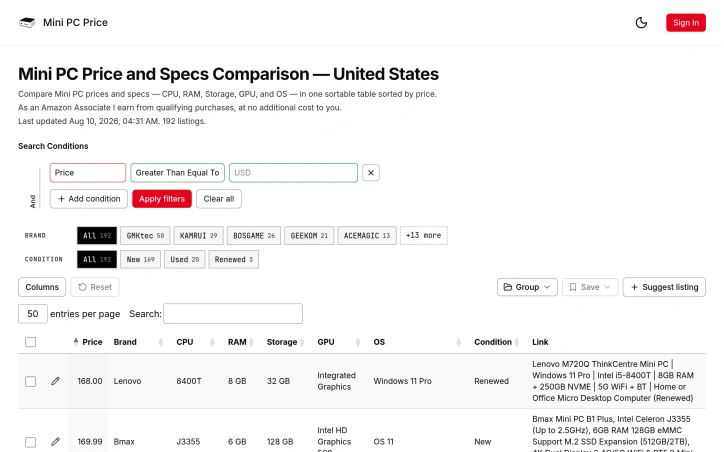

Buying a mini computer typically demands opening dozens of retailer tabs, copying specifications into spreadsheets, and cross-referencing prices across multiple platforms. Mini PC Price eliminates this friction by consolidating every available listing into a single searchable, filterable database where buyers compare specifications and prices without context switching. The tool serves multiple buyer personas with distinct research patterns. Office managers seeking budget systems with specific RAM and storage configurations can layer filters by price and memory specifications. Gamers hunting high-performance compact systems prioritize GPU capabilities and CPU boost clocks. Those interested in upgrading components can compare RAM maximums and storage interfaces. Rather than forcing a universal view, the tool lets each cohort toggle only the columns that matter for their decision. Several design choices distinguish Mini PC Price from conventional price comparison sites. It functions as a comprehensive parameter database rather than a curated top-ten list, capturing the full catalog across brands including Beelink, Minisforum, Intel NUC, ASUS, Lenovo, and HP. Listings source from real marketplace data with daily price refreshes. Specifications undergo manual verification where it matters—RAM type, GPU classification, OS bundling, and upgrade paths—rather than relying on auto-scraped data prone to inconsistency. The feature set prioritizes rapid discovery and precision. Search operates on type-ahead, accepting brand names, chip identifiers like 7840HS or N100, port counts, or product title fragments. Structured filters stack together, enabling queries like "mini computer under $600 with discrete GPU" without requiring review aggregator browsing. Sorting defaults to price but pivots to RAM, storage capacity, or processor speed on demand. Condition filtering toggles between new, used, renewed, and refurbished inventory without disrupting the filtered view. A sharing mechanism enables users to save groups and distribute links, particularly useful for forum recommendations or team purchasing scenarios. The emphasis on customization—column selection, filter stacking, search precision—reflects a product built around actual buyer workflows rather than editorial taste-making. The free model removes acquisition barriers for individual shoppers and procurement professionals alike. Without explicit monetization details in available materials, the zero-cost entry positions Mini PC Price as a utility resource for anyone shopping mini computers.

Mini PC Price preview

Key features

  • Consolidated Database: Aggregates mini PC listings from multiple brands into a single searchable, filterable database.
  • Type-Ahead Search: Search accepts brand names, chip identifiers like 7840HS or N100, port counts, and product fragments.
See full listing
DigMyName

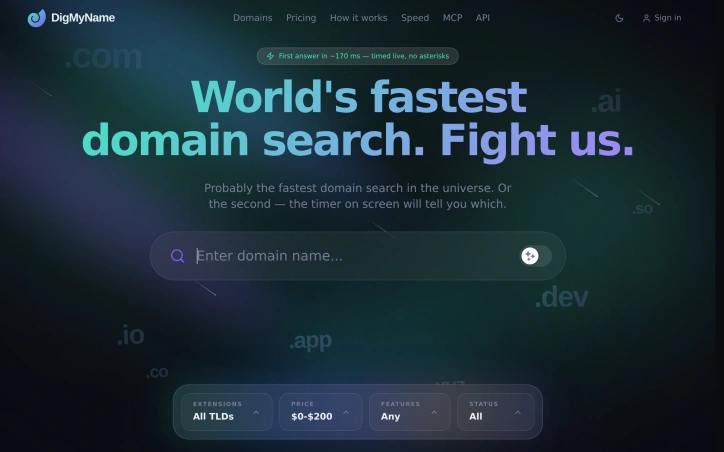
Domain acquisition remains a friction point for anyone launching a startup or brand. DigMyName targets the inefficiency that emerges when searchers need to check availability across multiple domain extensions and registrars simultaneously. Rather than bouncing between registrar websites or using disconnected tools, the platform consolidates the process by querying over 50 top-level domains and comparing pricing across multiple registration services in a single interface. The core value proposition hinges on speed. The site explicitly claims to offer the fastest domain search the company has measured, suggesting a direct response to the tedium of manual lookups. For someone trying to lock down a domain name quickly—whether for a business launch, personal brand, or creative project—this acceleration matters. The ability to see both availability and price variations across registrars and TLDs simultaneously eliminates the need for multiple searches and manual price tracking. The feature set focuses on breadth and comparison. By indexing 50+ TLDs rather than restricting users to the handful of most common extensions, the platform opens possibilities for finding available alternatives when a .com or .net is already taken. The instant price comparison across registrars addresses a real pain point: registrar pricing can vary significantly for the same domain, and discovering the best deal typically requires switching between sites. DigMyName consolidates this competitive pricing into a single view. The positioning suggests an audience spanning individual founders and small businesses who need to move quickly without getting bogged down in registrar navigation. The emphasis on speed and ease indicates the founders recognized that domain acquisition should be a solved problem—a quick decision rather than an hours-long research session. The company's narrative about simplifying domain discovery identifies a clear market frustration with existing workflows. The product spots a genuine gap between the importance of finding the right domain and the poor experience of actually doing so. Whether the search speed claim withstands comparison against dedicated registrar searches, and whether the tool integrates smoothly into actual purchase workflows, would shape real-world utility. But the core premise stands: domain hunting deserves better tools than the fragmented landscape currently offers.

Search
K
Kir

Domain acquisition remains a friction point for anyone launching a startup or brand. DigMyName targets the inefficiency that emerges when searchers need to check availability across multiple domain extensions and registrars simultaneously. Rather than bouncing between registrar websites or using disconnected tools, the platform consolidates the process by querying over 50 top-level domains and comparing pricing across multiple registration services in a single interface. The core value proposition hinges on speed. The site explicitly claims to offer the fastest domain search the company has measured, suggesting a direct response to the tedium of manual lookups. For someone trying to lock down a domain name quickly—whether for a business launch, personal brand, or creative project—this acceleration matters. The ability to see both availability and price variations across registrars and TLDs simultaneously eliminates the need for multiple searches and manual price tracking. The feature set focuses on breadth and comparison. By indexing 50+ TLDs rather than restricting users to the handful of most common extensions, the platform opens possibilities for finding available alternatives when a .com or .net is already taken. The instant price comparison across registrars addresses a real pain point: registrar pricing can vary significantly for the same domain, and discovering the best deal typically requires switching between sites. DigMyName consolidates this competitive pricing into a single view. The positioning suggests an audience spanning individual founders and small businesses who need to move quickly without getting bogged down in registrar navigation. The emphasis on speed and ease indicates the founders recognized that domain acquisition should be a solved problem—a quick decision rather than an hours-long research session. The company's narrative about simplifying domain discovery identifies a clear market frustration with existing workflows. The product spots a genuine gap between the importance of finding the right domain and the poor experience of actually doing so. Whether the search speed claim withstands comparison against dedicated registrar searches, and whether the tool integrates smoothly into actual purchase workflows, would shape real-world utility. But the core premise stands: domain hunting deserves better tools than the fragmented landscape currently offers.

DigMyName preview

Key features

  • Four-signal availability check: Every domain is verified against RDAP, DNS-over-HTTPS, and the Fastly Domain Research API — not a single lookup that guesses.
  • Honest uncertainty: When a domain can't be confirmed, DigMyName shows "couldn't verify" instead of selling an unverified name as available.
See full listing
Tools Network

Finding the right AI tool has become genuinely difficult. With hundreds of options launching monthly, researchers and business teams waste considerable time evaluating scattered reviews, outdated comparisons, and fragmented recommendations across multiple sources. Tools Network consolidates the AI tool landscape into a searchable, regularly updated directory designed for rapid discovery and comparison. The product indexes 157 tools across 25 categories, spanning chatbots and code assistants to video generation and SEO platforms. What distinguishes Tools Network from a static list is its commitment to daily updates and user-generated ratings. Each tool carries star ratings alongside vote counts from thousands of reviews, creating both numerical assessment and market consensus signals. The featured and trending sections help users identify momentum in product development without needing to independently predict or evaluate emerging options. This curation layer saves time for teams overwhelmed by the sheer volume of launches. The interface emphasizes practical comparison. Users browse by category, search the directory, and review multiple tools side by side. Rating data across thousands of reviews per tool creates a filtering mechanism that surfaces genuinely popular options rather than marketing-driven positioning. Daily updates address a core pain point: the AI tools landscape shifts remarkably quickly as new capabilities launch and incumbent products evolve their positioning. Yesterday's cutting-edge becomes outdated within weeks. The business model remains unspecified in available materials, though users encounter no apparent paywall browsing tools or filtering by category. This accessibility reduces friction for discovery, particularly valuable for teams and creators evaluating tools for the first time. The primary trade-off is one of scale and curation. With 157 tools across 25 categories, the directory remains selective rather than exhaustive. This is arguably deliberate, since comprehensive coverage of every AI tool released daily would recreate the very discovery problem the product addresses. Teams seeking obscure or highly specialized tools may need to look elsewhere. Tools Network targets anyone experiencing decision fatigue in the AI tools market. For teams tired of scattered reviews and outdated comparisons, the consolidated, regularly updated directory offers a more efficient path to finding the right choice.
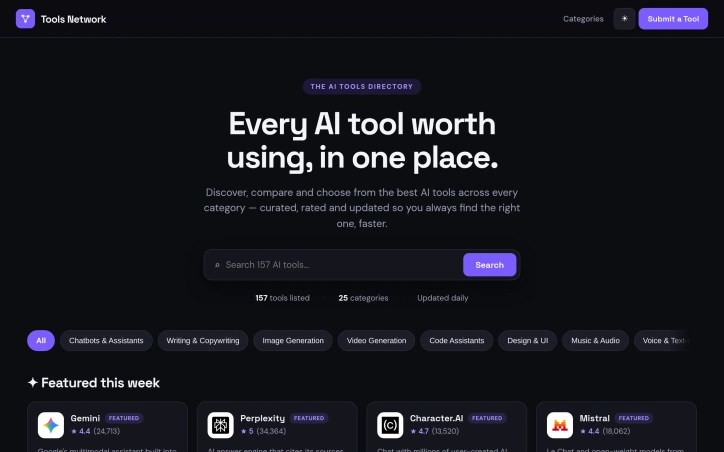

Finding the right AI tool has become genuinely difficult. With hundreds of options launching monthly, researchers and business teams waste considerable time evaluating scattered reviews, outdated comparisons, and fragmented recommendations across multiple sources. Tools Network consolidates the AI tool landscape into a searchable, regularly updated directory designed for rapid discovery and comparison. The product indexes 157 tools across 25 categories, spanning chatbots and code assistants to video generation and SEO platforms. What distinguishes Tools Network from a static list is its commitment to daily updates and user-generated ratings. Each tool carries star ratings alongside vote counts from thousands of reviews, creating both numerical assessment and market consensus signals. The featured and trending sections help users identify momentum in product development without needing to independently predict or evaluate emerging options. This curation layer saves time for teams overwhelmed by the sheer volume of launches. The interface emphasizes practical comparison. Users browse by category, search the directory, and review multiple tools side by side. Rating data across thousands of reviews per tool creates a filtering mechanism that surfaces genuinely popular options rather than marketing-driven positioning. Daily updates address a core pain point: the AI tools landscape shifts remarkably quickly as new capabilities launch and incumbent products evolve their positioning. Yesterday's cutting-edge becomes outdated within weeks. The business model remains unspecified in available materials, though users encounter no apparent paywall browsing tools or filtering by category. This accessibility reduces friction for discovery, particularly valuable for teams and creators evaluating tools for the first time. The primary trade-off is one of scale and curation. With 157 tools across 25 categories, the directory remains selective rather than exhaustive. This is arguably deliberate, since comprehensive coverage of every AI tool released daily would recreate the very discovery problem the product addresses. Teams seeking obscure or highly specialized tools may need to look elsewhere. Tools Network targets anyone experiencing decision fatigue in the AI tools market. For teams tired of scattered reviews and outdated comparisons, the consolidated, regularly updated directory offers a more efficient path to finding the right choice.

Tools Network preview

Key features

  • Searchable Directory: Indexes 157 AI tools across 25 categories for rapid discovery and comparison.
  • Daily Updates: Directory updates daily to keep pace with new capabilities and evolving product positioning.
See full listing
Geppetto

Navigating the robotics market has long been a fragmented experience, with specifications, pricing, and performance data scattered across manufacturer websites and trade publications. Geppetto addresses this fragmentation by consolidating information on over 800 robot models spanning 30+ categories into a single discovery platform. The service targets both commercial buyers evaluating robotic solutions and researchers mapping the landscape of available automation technology. The core value proposition centers on comparison and discovery. Rather than cobbling together information from multiple sources, users can access standardized specifications and pricing data across a broad range of robots. This centralization eliminates the manual research burden that typically precedes robotic procurement decisions. The platform's coverage across dozens of categories reflects an effort to serve diverse segments of the robotics market, from manufacturing and logistics to service and research applications. What distinguishes Geppetto from a simple product listing is its explicit focus on comparison functionality. The platform positions itself not merely as a directory but as an active research tool where users can meaningfully evaluate options side by side. This approach recognizes that robotic systems purchasing decisions involve complex technical tradeoffs and that buyers need structured data to compare performance characteristics and costs effectively. Rather than relying on isolated product pages, the platform enables systematic evaluation across multiple dimensions. The breadth of the catalog—800+ robots across 30+ categories—represents substantial curation work. Maintaining current specifications and pricing across such a range requires ongoing relationships with manufacturers and regular data verification. The platform must navigate the continuous product cycles that characterize robotics, where new models and capabilities emerge regularly. Staying current is essential to maintaining user value. The consolidation strategy addresses a genuine market need. Fragmentation currently forces buyers and researchers to conduct labor-intensive searches across disparate sources, consuming time and increasing the risk of incomplete evaluation. For anyone in the robotics procurement workflow, Geppetto offers a centralized alternative. In a market expanding rapidly with new entrants and capabilities, a unified reference point carries particular value.
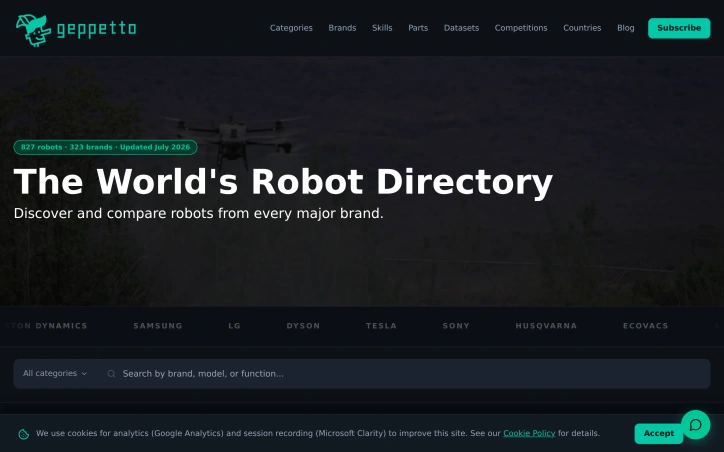

Navigating the robotics market has long been a fragmented experience, with specifications, pricing, and performance data scattered across manufacturer websites and trade publications. Geppetto addresses this fragmentation by consolidating information on over 800 robot models spanning 30+ categories into a single discovery platform. The service targets both commercial buyers evaluating robotic solutions and researchers mapping the landscape of available automation technology. The core value proposition centers on comparison and discovery. Rather than cobbling together information from multiple sources, users can access standardized specifications and pricing data across a broad range of robots. This centralization eliminates the manual research burden that typically precedes robotic procurement decisions. The platform's coverage across dozens of categories reflects an effort to serve diverse segments of the robotics market, from manufacturing and logistics to service and research applications. What distinguishes Geppetto from a simple product listing is its explicit focus on comparison functionality. The platform positions itself not merely as a directory but as an active research tool where users can meaningfully evaluate options side by side. This approach recognizes that robotic systems purchasing decisions involve complex technical tradeoffs and that buyers need structured data to compare performance characteristics and costs effectively. Rather than relying on isolated product pages, the platform enables systematic evaluation across multiple dimensions. The breadth of the catalog—800+ robots across 30+ categories—represents substantial curation work. Maintaining current specifications and pricing across such a range requires ongoing relationships with manufacturers and regular data verification. The platform must navigate the continuous product cycles that characterize robotics, where new models and capabilities emerge regularly. Staying current is essential to maintaining user value. The consolidation strategy addresses a genuine market need. Fragmentation currently forces buyers and researchers to conduct labor-intensive searches across disparate sources, consuming time and increasing the risk of incomplete evaluation. For anyone in the robotics procurement workflow, Geppetto offers a centralized alternative. In a market expanding rapidly with new entrants and capabilities, a unified reference point carries particular value.

Geppetto preview

Key features

  • Consolidated Database: aggregates over 800 robot models from 30+ categories into a single discovery platform
  • Comparison Functionality: enables side-by-side evaluation of robotic solutions across multiple technical dimensions
See full listing
Package Pal

Developers frequently face a significant hurdle when switching between programming languages, namely finding equivalent libraries and packages. Package Pal addresses this challenge by providing a platform that instantly suggests alternatives across multiple languages. The tool is specifically designed for developers who need to migrate projects, refactor legacy services, or learn new frameworks. What stands out about Package Pal is its use of state-of-the-art AI to bridge the gap between different package ecosystems. By leveraging this technology, it enables developers to map their existing knowledge from one language to another seamlessly. The tool's ability to provide instant translations, complete with documentation URLs, installation commands, and usage examples, is particularly noteworthy. The key features of Package Pal include cross-language support for over 15 popular languages, an IDE extension that allows for in-editor package discovery, and the option to run queries client-side using a user's own Gemini API key. This last feature is especially useful for users who require higher rate limits. Additionally, the tool provides a sidebar explorer that automatically scans the active file and lists all dependencies and their alternatives in a clean tree view. Package Pal is available as a free VS Code extension, with a clear emphasis on privacy. The tool is committed to protecting user data and provides transparent information about its data collection practices and use of third-party cookies. Users have control over their data, and the option to opt out of personalized advertising is available through Google Ad Settings or aboutads.info. Overall, Package Pal is a valuable resource for developers navigating the complexities of cross-language development.
Developers frequently face a significant hurdle when switching between programming languages, namely finding equivalent libraries and packages. Package Pal addresses this challenge by providing a platform that instantly suggests alternatives across multiple languages. The tool is specifically designed for developers who need to migrate projects, refactor legacy services, or learn new frameworks. What stands out about Package Pal is its use of state-of-the-art AI to bridge the gap between different package ecosystems. By leveraging this technology, it enables developers to map their existing knowledge from one language to another seamlessly. The tool's ability to provide instant translations, complete with documentation URLs, installation commands, and usage examples, is particularly noteworthy. The key features of Package Pal include cross-language support for over 15 popular languages, an IDE extension that allows for in-editor package discovery, and the option to run queries client-side using a user's own Gemini API key. This last feature is especially useful for users who require higher rate limits. Additionally, the tool provides a sidebar explorer that automatically scans the active file and lists all dependencies and their alternatives in a clean tree view. Package Pal is available as a free VS Code extension, with a clear emphasis on privacy. The tool is committed to protecting user data and provides transparent information about its data collection practices and use of third-party cookies. Users have control over their data, and the option to opt out of personalized advertising is available through Google Ad Settings or aboutads.info. Overall, Package Pal is a valuable resource for developers navigating the complexities of cross-language development.

Package Pal preview

Key features

  • Cross-Language Support: Supports over 13 popular languages
  • IDE Extension: Allows for in-editor package discovery
See full listing
I

Organizations operating industrial control systems and operational technology infrastructure face a pressing concern: identifying and monitoring internet-exposed devices that could be vulnerable to cyber threats. ICS Tracker's solution directly addresses this issue by scanning the internet for exposed ICS and OT devices, effectively creating a digital fingerprint of these assets. This intelligence is crucial for entities responsible for securing critical infrastructure, as it enables them to pinpoint potential entry points for attackers. What distinguishes ICS Tracker is its methodical approach to detecting industrial protocols and subsequently examining web applications associated with these devices. By doing so, it provides a detailed insight into the online presence of ICS and OT infrastructure, a critical step in managing and mitigating associated risks. The product's capability to identify specific industrial protocol responses and then comprehensively scan associated web applications stands out as a key feature. This level of scrutiny suggests a thorough understanding of the complexities involved in securing industrial infrastructure, where the stakes are high due to the potential for significant disruption or damage. Unfortunately, the available information does not detail the pricing or business model adopted by ICS Tracker, making it difficult to assess its accessibility to potential users. Nonetheless, the focus on delivering actionable intelligence on internet-exposed ICS and OT devices positions ICS Tracker as a valuable resource for those tasked with safeguarding critical infrastructure against cyber threats. Its unique scanning and monitoring capabilities make it a noteworthy solution in the industrial cybersecurity landscape.
Organizations operating industrial control systems and operational technology infrastructure face a pressing concern: identifying and monitoring internet-exposed devices that could be vulnerable to cyber threats. ICS Tracker's solution directly addresses this issue by scanning the internet for exposed ICS and OT devices, effectively creating a digital fingerprint of these assets. This intelligence is crucial for entities responsible for securing critical infrastructure, as it enables them to pinpoint potential entry points for attackers. What distinguishes ICS Tracker is its methodical approach to detecting industrial protocols and subsequently examining web applications associated with these devices. By doing so, it provides a detailed insight into the online presence of ICS and OT infrastructure, a critical step in managing and mitigating associated risks. The product's capability to identify specific industrial protocol responses and then comprehensively scan associated web applications stands out as a key feature. This level of scrutiny suggests a thorough understanding of the complexities involved in securing industrial infrastructure, where the stakes are high due to the potential for significant disruption or damage. Unfortunately, the available information does not detail the pricing or business model adopted by ICS Tracker, making it difficult to assess its accessibility to potential users. Nonetheless, the focus on delivering actionable intelligence on internet-exposed ICS and OT devices positions ICS Tracker as a valuable resource for those tasked with safeguarding critical infrastructure against cyber threats. Its unique scanning and monitoring capabilities make it a noteworthy solution in the industrial cybersecurity landscape.

ICSTracker  search and monitor internet-exposed ICS and OT infrastructure intelligence preview
I

Key features

  • Industrial Protocol Detection: identifies specific industrial protocol responses
  • Web Application Scanning: comprehensively scans associated web applications
See full listing
AIToolsRecap

Navigating the rapidly expanding landscape of artificial intelligence tools is a daunting task for both practitioners and founders. AIToolsRecap addresses this challenge by serving as a central hub for discovery, comparison, and review of AI tools. The platform is geared towards two primary audiences: AI founders looking to showcase their tools and practitioners seeking to evaluate and stay updated on the latest AI technologies. What stands out about AIToolsRecap is its commitment to independence, in-depth analysis, and practitioner-tested reviews. The platform claims over 2 million Google impressions, underscoring its visibility and influence within the AI community. Its citation by prominent AI search platforms like ChatGPT, Copilot, and Grok further solidifies its credibility. The website showcases a diverse array of AI tools across various categories, with a notable emphasis on newly launched tools. AIToolsRecap's key features include a comprehensive directory of AI tools, detailed comparison guides, and editorial coverage. The platform allows AI founders to list their tools for free, making it an accessible resource for emerging technologies. For reviewers, it offers incentives such as credits for contributing reviews. The content is rich in insights, as demonstrated by in-depth guides comparing specific AI models and tools, providing readers with nuanced understanding and practical information. While the platform's business model isn't explicitly detailed, the presence of sponsored content and premium services for subscribers (as indicated by the "X Premium+" mention in one of the guides) suggests a multi-faceted approach to revenue generation. The specific guide comparing free and paid versions of Grok provides a clear example of the platform's nuanced analysis, highlighting the value proposition of paid upgrades and demonstrating its capability to deliver actionable insights to its readers. Overall, AIToolsRecap is a valuable resource for both AI practitioners and founders, offering a well-curated and insightful exploration of the AI tool landscape.


Navigating the rapidly expanding landscape of artificial intelligence tools is a daunting task for both practitioners and founders. AIToolsRecap addresses this challenge by serving as a central hub for discovery, comparison, and review of AI tools. The platform is geared towards two primary audiences: AI founders looking to showcase their tools and practitioners seeking to evaluate and stay updated on the latest AI technologies. What stands out about AIToolsRecap is its commitment to independence, in-depth analysis, and practitioner-tested reviews. The platform claims over 2 million Google impressions, underscoring its visibility and influence within the AI community. Its citation by prominent AI search platforms like ChatGPT, Copilot, and Grok further solidifies its credibility. The website showcases a diverse array of AI tools across various categories, with a notable emphasis on newly launched tools. AIToolsRecap's key features include a comprehensive directory of AI tools, detailed comparison guides, and editorial coverage. The platform allows AI founders to list their tools for free, making it an accessible resource for emerging technologies. For reviewers, it offers incentives such as credits for contributing reviews. The content is rich in insights, as demonstrated by in-depth guides comparing specific AI models and tools, providing readers with nuanced understanding and practical information. While the platform's business model isn't explicitly detailed, the presence of sponsored content and premium services for subscribers (as indicated by the "X Premium+" mention in one of the guides) suggests a multi-faceted approach to revenue generation. The specific guide comparing free and paid versions of Grok provides a clear example of the platform's nuanced analysis, highlighting the value proposition of paid upgrades and demonstrating its capability to deliver actionable insights to its readers. Overall, AIToolsRecap is a valuable resource for both AI practitioners and founders, offering a well-curated and insightful exploration of the AI tool landscape.

AIToolsRecap preview

Key features

  • Comprehensive Directory: A diverse array of AI tools across various categories
  • Detailed Comparison Guides: In-depth guides comparing specific AI models and tools
See full listing
Japanese Name Finder

Finding a Japanese name with the right meaning, sound, and cultural weight has traditionally meant juggling multiple resources or relying on family knowledge. Japanese Name Finder consolidates this fragmented search into a single directory designed for people naming babies, developing fictional characters, or exploring Japanese naming traditions. The product's core strength lies in its multi-path discovery model. Rather than forcing users into a single search funnel, the platform offers parallel routes: a 3,000-entry directory searchable by meaning (fire, water, moon), an A-Z browsing system across 26 filtered categories, a name generator with use-case presets, and thematic landing pages built around semantic queries. This approach acknowledges that someone seeking a baby name approaches the task differently than someone creating an anime character or naming a pet. The generator is the product's most distinctive feature, letting users input their English name for personalized suggestions and then customize results by gender, thematic elements, and intended use. The preset categories—Baby, Anime Character, Cat, Dog, Warrior, and Elegant—signal that the tool is built from observation of actual naming patterns rather than generic filters. Users can draw from nine thematic filters (Nature, Strength, Beauty, Love, Wisdom, Fire, Water, Moon, Flower) and control output volume, accommodating both quick decisions and comprehensive exploration. The directory includes kanji, pronunciation guidance, and cultural meaning for each entry, addressing a real barrier for non-native speakers or those unfamiliar with character selection conventions. The internal linking architecture transforms what could be a static list into a topic cluster, where users encountering a name can navigate to related entries by theme or gender rather than hitting dead ends. What's notably absent is any attempt to position the product as a generative AI tool. In an era where LLM-based alternatives proliferate, Japanese Name Finder's commitment to a curated database with structural navigation feels almost contrarian—and pragmatic. A 3,000-name directory can be browsed, internalized, and reasoned about in ways that procedurally generated alternatives struggle to match. The product targets a distinct niche, separate from general baby-name directories. Its competitive advantage lies in search visibility for high-intent queries (fire names, moon kanji, beauty themes) rather than broad brand recognition.

Finding a Japanese name with the right meaning, sound, and cultural weight has traditionally meant juggling multiple resources or relying on family knowledge. Japanese Name Finder consolidates this fragmented search into a single directory designed for people naming babies, developing fictional characters, or exploring Japanese naming traditions. The product's core strength lies in its multi-path discovery model. Rather than forcing users into a single search funnel, the platform offers parallel routes: a 3,000-entry directory searchable by meaning (fire, water, moon), an A-Z browsing system across 26 filtered categories, a name generator with use-case presets, and thematic landing pages built around semantic queries. This approach acknowledges that someone seeking a baby name approaches the task differently than someone creating an anime character or naming a pet. The generator is the product's most distinctive feature, letting users input their English name for personalized suggestions and then customize results by gender, thematic elements, and intended use. The preset categories—Baby, Anime Character, Cat, Dog, Warrior, and Elegant—signal that the tool is built from observation of actual naming patterns rather than generic filters. Users can draw from nine thematic filters (Nature, Strength, Beauty, Love, Wisdom, Fire, Water, Moon, Flower) and control output volume, accommodating both quick decisions and comprehensive exploration. The directory includes kanji, pronunciation guidance, and cultural meaning for each entry, addressing a real barrier for non-native speakers or those unfamiliar with character selection conventions. The internal linking architecture transforms what could be a static list into a topic cluster, where users encountering a name can navigate to related entries by theme or gender rather than hitting dead ends. What's notably absent is any attempt to position the product as a generative AI tool. In an era where LLM-based alternatives proliferate, Japanese Name Finder's commitment to a curated database with structural navigation feels almost contrarian—and pragmatic. A 3,000-name directory can be browsed, internalized, and reasoned about in ways that procedurally generated alternatives struggle to match. The product targets a distinct niche, separate from general baby-name directories. Its competitive advantage lies in search visibility for high-intent queries (fire names, moon kanji, beauty themes) rather than broad brand recognition.

Japanese Name Finder preview

Key features

  • Multi-Path Discovery: Users can search a 3,000-entry directory by meaning, browse A-Z categories, use a customizable name generator, and explore thematic landing pages.
  • Customizable Name Generator: Personalized suggestions adjustable by gender, thematic elements, and intended use across six preset categories including Baby, Anime Character, Warrior, and Elegant.
See full listing