#privacy Startups & Tools
Discover the best privacy startups, tools, and products on SellWithBoost.

Fragmented AI workflows drain productivity more than the technology itself should. TKCORE AI consolidates what typically demands five browser tabs, three separate subscriptions, and endless copy-pasting into a single workspace—collapsing a two-hour content production cycle into ten minutes. The product targets content teams and marketing departments that produce articles, visuals, and narration from research materials. Rather than shuttling between ChatGPT for writing, a separate image tool, and another service for voiceovers, users attach knowledge files to a project, run prompts across multiple models simultaneously, and route the strongest output into integrated writing, image, and speech tools without ever leaving the platform. What distinguishes TKCORE AI is its explicit commitment to context persistence and privacy. Project knowledge remains attached to a single workspace rather than scattered across disconnected chats. The company promises not to use prompts or outputs for model training, processing content only to deliver service. Data moves over encrypted connections with contractual safeguards. This matters to organizations that cannot risk proprietary briefs or brand guidelines contaminating a training dataset or leaking across competing projects. The multi-model comparison engine stands out operationally. Rather than testing DeepSeek, Qwen, and Kimi sequentially in separate interfaces, users compare outputs from all three against the same prompt on a single screen, then promote the best draft downstream. This transforms model selection from guesswork into deliberate evaluation within a single workflow. The platform supports an expanding roster of models: TkCore-V5.5-Pro, DeepSeek-V4 variants, Qwen models including a vision-enabled version, Kimi K2.5, GLM-5.1, and MiniMax M2.5. This breadth avoids locking users into a single vendor's capabilities. A project generates a research PDF, then produces an SEO blog post, three social posts, and video narration in parallel—all derived from the same knowledge base, all contained within the project boundary. The comparison between traditional fragmented workflows and TKCORE's model is stark: longer, more error-prone, context-bleeding processes versus tighter, single-interface pipelines. For teams currently outsourcing content production or spending disproportionate time on tool switching rather than creation, the efficiency gain is tangible. The product does not claim to replace human editorial judgment, only to eliminate the logistical overhead that prevents teams from reaching content velocity. That's a narrower and more credible promise than most AI publishing tools make.

Developers who have grown weary of subscription-based AI coding assistants and the associated data privacy concerns now have an alternative. Bodega One Code addresses the issue of costly and proprietary coding tools by offering a local-first AI coding IDE that runs on the user's own hardware. What stands out about this product is its commitment to user ownership and control. By allowing users to choose their preferred large language model (LLM) and run it locally, Bodega One Code eliminates the need for reliance on third-party servers and the associated risks of data exposure. The product's air-gap mode ensures that sensitive information remains on the user's machine. The IDE itself is fully-featured, incorporating an AI chat and an autonomous agent that reviews its own work before completing tasks. Users can hand off tasks to the agent, which runs in the background on its own git worktree, allowing for parallel processing and isolated task management. The "Loops" feature enables users to automate recurring tasks, such as doc syncs and dead-code sweeps, on a scheduled basis. Notably, the product is available for download at no cost, with no forced subscriptions. Users have the flexibility to choose from over 10 LLM providers or run models locally using tools like Ollama or LM Studio. By decoupling the coding tool from subscription fees and proprietary infrastructure, Bodega One Code offers a compelling alternative for developers seeking a more autonomous and cost-effective solution. The product's design and features suggest that it is geared towards developers who value control over their coding environment and are looking for a customizable and extensible tool. By providing a local-first AI coding IDE, Bodega One Code is poised to appeal to developers who prioritize data privacy and are seeking a more flexible and cost-effective coding solution.

Content analysis tools have become essential for anyone publishing online, whether for search engine optimization, social media, or academic purposes. This word counter addresses a genuine need: writers and creators want instant feedback on their text's metrics without surrendering their privacy to cloud storage. The tool's core strength lies in its comprehensive real-time analysis. It delivers word, character, sentence, and paragraph counts as users type or paste content. Beyond basic metrics, it estimates both reading time using a standard 200 words per minute rate and speaking time at 130 words per minute. This dual-time feature proves particularly valuable for podcasters, presenters, and audiobook creators planning content duration. The readability scoring employs the Flesch-Kincaid scale, helping writers gauge text accessibility on a 0-100 scale where higher scores indicate easier comprehension. Combined with the character-limit tracking for Twitter/X posts, meta descriptions, and meta titles, the tool directly serves SEO practitioners optimizing content for search visibility and social media distribution. The word frequency analysis adds another layer, identifying repeated terms and helping refine content for both readability and keyword targeting. What distinguishes this offering is its commitment to privacy. The application processes all analysis client-side, meaning users' text never touches external servers. For writers working with sensitive material, confidential documents, or simply those concerned about data collection, this approach removes a significant barrier to adoption. The interface includes thoughtfully chosen shortcuts for power users: Ctrl+H for find and replace, Ctrl+Shift+C to copy, and Ctrl+Shift+D to download. The dark and light theme options accommodate different working environments and preferences. Mobile responsiveness ensures the tool functions equally well on phones and tablets, matching how many writers actually compose content today. The product positions itself at the intersection of multiple audiences. Casual Twitter users benefit from character counting. SEO professionals leverage the meta description and title length trackers alongside readability metrics. Students writing essays rely on word count verification. This multi-use approach broadens appeal without diluting focus. No pricing information appears on the site, suggesting the tool operates as a free offering, though the presence of ad space indicates an advertising-supported model rather than a premium subscription approach. For anyone seeking a straightforward, privacy-preserving text analysis solution with solid feature depth, this counter delivers practical value without friction.

Video call fatigue drives the design of MeetingGlass, a meeting application built on a counterintuitive premise: that everyone appearing equally obscured creates a more relaxed environment than selective blur or individual privacy filters. The product addresses the specific discomfort people experience being constantly watched on camera during remote work or study sessions, offering a shared frosted glass layer that obscures all participants uniformly. What distinguishes MeetingGlass from existing video conferencing software is its emphasis on mutual consent for visibility. Participants request to see someone clearly, and that person must accept before both see each other unobstructed. This mutual unfrosting replaces the asymmetry of traditional one-way viewing, where someone might monitor others while remaining unseen. By default, everyone appears frosted, eliminating the social awkwardness that accompanies being the only person with a camera off. The product targets three main use cases: remote work teams seeking stress-free meetings, study groups wanting equal comfort regardless of appearance, and casual gatherings with friends and family. Rather than individual blur filters that fragment the group experience, MeetingGlass creates a genuinely shared environment where every participant occupies the same visual space. From a technical standpoint, the application prioritizes efficiency alongside privacy. It consumes minimal CPU and bandwidth, supporting spontaneous communication without resource overhead. Setup takes approximately one minute, and the service imposes no meeting time limits. Users join without email registration or providing their real name, preserving anonymity while enabling group participation. The design reflects a deliberate choice about what video meetings could be: less surveillance theater, more genuine presence. By obscuring everyone equally and requiring mutual agreement to see clearly, MeetingGlass proposes a different social contract for remote communication. The mutual visibility constraint prevents the dynamic where some participants can observe others without reciprocal awareness. For teams or groups bothered by camera fatigue or the documented discomfort of constant surveillance, this represents a meaningful alternative to mainstream video conferencing platforms that treat clear visibility as the default and only mode.
In an era when our digital traces accumulate silently—searches, draft posts, AI conversations—this application offers a different kind of self-reflection: analyzing your own data to understand patterns about desire, anxiety, and hidden interests. The product targets people curious about what their online behavior reveals about their deeper self, positioning itself squarely as entertainment and personal insight rather than any kind of professional guidance. The core offering is straightforward. Users provide their browser history and can optionally add AI chat logs, social media drafts, diary notes, or email excerpts. The application processes these inputs to generate a personality profile based on repeated patterns and behavioral signals. The technology identifies what matters to you through what you choose to search for, explore, and draft—treating your digital footprint as a window into unstated desires and anxieties. What distinguishes this product is its deliberate privacy stance. Rather than storing input data in a server database, the analysis happens client-side, with results cached only temporarily in the browser itself. This addresses a fundamental tension: people want insights into themselves, but hesitate to upload sensitive material to unknown servers. By keeping data local to the user's device, the tool removes that friction without requiring trust in cloud infrastructure. The application is bilingual, available in both English and Japanese. A clear disclaimer appears throughout the interface, specifying that outputs are for entertainment and self-understanding, not medical, legal, or investment advice. The tool explicitly forbids users from entering passwords, addresses, payment information, or other credentials, recognizing the risks of aggregating sensitive data. Result accuracy depends on input quality. The more concrete and specific the material provided, the sharper the analysis. Thin inputs produce thin outputs. This reflects honest positioning about algorithmic capabilities. The pricing structure remains unspecified in available materials. Whether the tool operates as free, freemium, or paid remains unclear. For now, Ura Persona AI occupies a narrow but distinct space: treating your own digital history as a source of self-knowledge, with privacy built into the architecture rather than as an afterthought.

Offline password management addresses a growing skepticism toward cloud-based vault services: if a company stores encrypted secrets on servers, those servers become targets regardless of encryption quality. Krypt takes this concern seriously, architecting an entirely device-resident vault that never transmits data beyond the iPhone it runs on. The product targets privacy-conscious users and those operating in high-risk contexts—individuals crossing borders, facing coercion, or simply unwilling to grant any organization custody of their digital credentials. iOS users with iOS 17.6 or later can download Krypt and begin securing passwords, files, two-factor authentication codes, and notes without creating an account, providing an email, or enabling any network connectivity. What distinguishes Krypt from typical password managers is twofold. First, its technical architecture excludes not just company servers but Apple's iCloud infrastructure as well. Encryption keys remain device-bound and explicitly excluded from backups, preventing Apple or any third party from accessing vault contents even through OS-level backup mechanisms. Second, the product includes a decoy vault feature that opens with an alternative PIN, displaying a convincing but separate set of dummy credentials. This dual-vault design is rare among commercial offerings and addresses coercion scenarios: an attacker demanding unlock access gets a real-looking fake vault containing no actual secrets. The encryption scheme uses AES-256 authenticated encryption paired with PBKDF2-SHA256 key derivation at 310,000 iterations—matching standards used in banking and government infrastructure. The application offers no analytics, telemetry, or network permissions; iOS Settings can confirm Krypt performs zero network access. Auto-lock thresholds, Face ID integration, and a ten-attempt wipe mechanism round out the security features. Krypt operates as a free application with a lifetime unlock option available. This freemium model positions the core product accessibly while offering users the ability to purchase permanent access without ongoing subscription fees. The trade-off inherent to Krypt's architecture is clear: data portability and synchronization vanish entirely. Users who want their vault on multiple devices must manually export encrypted backups and manage copies themselves—no background syncing, no cloud convenience. For the user base Krypt targets, this is not a limitation but a feature.

Securing online transactions before they happen addresses a real gap in consumer safety. Fraudly tackles the moment between seeing a link or storefront and deciding whether to trust it with money, credentials, or personal information. The product targets everyday internet users—shoppers, email checkers, QR code scanners, social media link-followers—who encounter suspicious websites constantly but lack reliable tools to evaluate legitimacy in seconds. The core differentiator centers on explainability. Rather than hiding behind opaque risk scores, Fraudly breaks down trust signals across specific dimensions like website safety, business reputation, and shopping intelligence. Users see the reasoning behind each assessment, enabling them to make informed judgments rather than blindly accepting automated warnings. This design philosophy extends beyond marketing; the company explicitly positions itself against unnecessary fear-mongering, acknowledging that not every website fits neatly into safe or unsafe categories. The product reaches users across multiple contexts. The web interface handles website checks with one free analysis daily, no signup required. A mobile app extends functionality to pasted links from messages and emails, QR code scanning in parking lots and cafes, and screenshot analysis—catching suspicious links embedded in images users receive. Browser extensions for Chrome and Microsoft Edge offer passive protection, warning users during normal browsing rather than forcing manual checks. Privacy forms another stated pillar. Unlike many security tools that build detailed browsing profiles, Fraudly commits to not tracking users or commercializing their activity data. This matters because trust products themselves become targets if they collect and monetize user behavior. The Trust Profile synthesizes analysis from multiple established security sources using AI, combining rather than inventing conclusions. The company positions this as stronger than manually researching across separate services. The website reveals little about accuracy rates, false positive performance, or how it handles emerging scams. A sample Trust Profile shows a four-star rating with an 84 confidence score, but public examples don't illuminate edge case handling. The free tier caps users at one daily check, which may frustrate power users or security professionals needing unlimited access. No premium pricing appears on the site. For consumers tired of making trust decisions blindly, the product delivers focused value that explains itself.

B2B lead generation is a challenging task, especially when relying on outdated databases that often yield stale or irrelevant results. Surfaced tackles this problem head-on by utilizing AI-powered live web searches to deliver targeted, up-to-date leads. This is particularly beneficial for businesses seeking to connect with newer, niche, or regional companies that may not be listed in traditional databases. What sets Surfaced apart is its ability to search the live web in real-time, rather than relying on static databases that can be months out of date. This approach ensures that the leads generated are current and relevant, giving users a significant advantage in their outreach efforts. The AI-driven search process is also refined through a series of clarifying questions, ensuring that the results closely match the user's specific needs. The platform's functionality is streamlined into a three-step process: describing the target market and industry segment, launching an AI-powered search, and receiving a structured list of leads. The resulting list includes essential company information, such as website, contact details, location, and a relevance score, which can be easily exported to a CRM or cold email sequence. Notably, Surfaced's business model includes a fair pricing structure, where unused credits are returned if a search yields no results, and a built-in mail bounce checker to ensure that only valid email addresses are suggested. Overall, Surfaced offers a robust solution for businesses seeking to identify and connect with their target audience in a more efficient and effective manner.
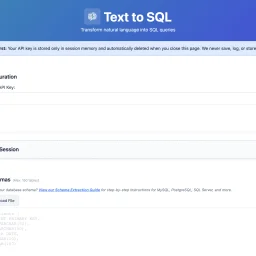
For many organizations, SQL query writing remains a bottleneck. Non-technical team members struggle to access data independently, while developers waste time on complex joins and unfamiliar schemas. Existing AI-powered SQL generators typically demand a trade-off: convenience in exchange for uploading database schemas to third-party servers—a proposition that makes security-conscious teams uncomfortable. Text2SQL breaks this pattern by architecting the problem differently. Rather than accepting user data through its own servers, the tool operates entirely client-side. Users provide their own Anthropic API key, and queries flow directly from their browser to Anthropic's endpoints, bypassing Text2SQL's infrastructure entirely. This architectural choice eliminates a crucial security risk: the company never sees, stores, or logs database schemas, sample data, or query history. For organizations handling sensitive information or operating under compliance constraints, this design addresses a genuine pain point that most competitors ignore. The product itself centers on natural language translation. Users describe their data needs in plain English—"Show me customers who purchased last month"—and receive SQL queries in return. The tool accepts database schemas as CREATE TABLE statements and uses them to generate context-aware queries. An optional feature lets users upload example queries from their codebase; the AI learns naming conventions and join patterns, improving consistency across generated queries. What distinguishes Text2SQL is its completeness without overreach. It includes schema validation, query explanations, and sample data support with a thoughtful reminder that sensitive data should be randomized first. Session management allows users to save and restore configurations across visits. The tool enforces reasonable limits: 150 tables, 300 example queries, 3,000 sample data rows. These constraints prevent runaway complexity while accommodating realistic use cases. The product is entirely free. There's no licensing tier, no gating of core functionality, no hidden costs. This positions Text2SQL less as a revenue-generating product and more as a genuinely useful utility—potentially a customer acquisition strategy for Anthropic API adoption, or simply a commitment to reducing friction around database queries. For teams looking to democratize data access or streamline SQL development without surrendering control of their schemas, Text2SQL delivers on a clear promise. It won't replace domain expertise in complex analytics, but it meaningfully lowers the barrier to ad-hoc querying and frees developers from repetitive query construction.
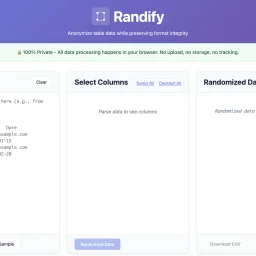
Privacy-conscious organizations managing sensitive data have long faced a troubling choice: anonymize customer or patient information for testing and demonstrations, or upload it to third-party services and accept the compliance and security risks. Randify eliminates that tension by processing all anonymization within the browser, never transmitting anything to external servers. The problem it targets is concrete. Development teams, QA engineers, and data analysts regularly need realistic test datasets without exposing actual customer records. Healthcare organizations must anonymize patient data for testing while maintaining HIPAA compliance. Financial services firms need to randomize customer information for development while staying PCI-compliant. SaaS companies want to demonstrate products with convincing but fabricated data. Randify addresses these scenarios through a single architectural commitment: all data stays local. What distinguishes the tool is its execution of this privacy-first model. It requires no registration and works offline, with zero network requests—users can verify this in their browser's developer console. For organizations subject to data protection regulations, this eliminates an entire class of security and compliance risk. The feature set reflects genuine practical needs. Rather than indiscriminately scrambling content, Randify lets users specify which columns to randomize and which to preserve, maintaining referential integrity so identical input values consistently produce identical outputs. The tool automatically detects PII patterns including email addresses, phone numbers, dates, names, addresses, and company names, applying appropriate formatting rules during randomization so results look realistic rather than obviously synthetic. It accepts data in multiple formats: CSV, TSV, pasted tables from spreadsheets, and SQL INSERT statements. Multi-language support for names and regional data patterns demonstrates attention to genuinely global use cases. The ability to preview changes before applying them reduces mistakes and friction. Randify is free and carries no monetization messaging in available materials, making it an accessible entry point for privacy-conscious teams. For organizations already skeptical of third-party data handling, a purpose-built, client-side-only solution occupies meaningful space in an otherwise server-dependent tooling landscape.
Temporary email services have become an essential tool for managing online signups and trials without cluttering one's primary inbox with unwanted emails. Freetempmail addresses this need by providing a straightforward, ad-free temporary email solution. The platform is geared towards individuals seeking to maintain their online privacy and avoid spam associated with giving out their real email addresses. What distinguishes Freetempmail from its competitors is its commitment to preserving HTML formatting in emails, ensuring that links, images, and buttons function as intended. This is a significant advantage over other temporary email services that strip emails of their formatting, rendering them less useful. The absence of third-party scripts and a clearly published data policy further underscore the service's dedication to user privacy. Generating a temporary email address is a simple, one-click process that doesn't require signup. Users can choose from available domains or have one randomly generated. The service boasts an unlimited session length, outlasting competitors that limit the lifespan of their temporary inboxes. Additionally, Freetempmail offers a suite of privacy-focused tools, including an email privacy checker, QR code generator, UUID generator, and password generator, all of which operate locally within the user's browser, reinforcing the service's privacy-centric ethos. The comparison with other temporary email services highlights Freetempmail's unique strengths, notably its ad-free experience, lack of captchas, and commitment to not tracking users. While the business model isn't explicitly detailed, the absence of ads and third-party scripts suggests that Freetempmail is supported either by its users or through a model not immediately apparent from its website. Overall, Freetempmail is a robust solution for those seeking a hassle-free, private temporary email service.

For users seeking a comprehensive entertainment solution, Smarter IPTV offers a premium subscription service that consolidates live TV, movies, and series into a single, accessible platform. The company's primary objective is to provide an affordable alternative to traditional cable costs, catering to a diverse audience with varied viewing preferences. With a vast library comprising 5000+ movies and 10,000+ series, alongside a broad selection of live channels from around the world, Smarter IPTV's content offering is undeniably extensive. The service's compatibility with multiple devices, including Android, Smart TV, iOS, and PC, ensures that users can stream their preferred content anywhere, anytime. Notable features include a free 24-hour trial, allowing potential subscribers to test the service, and a promise of daily updates to keep the content fresh. A key aspect that stands out about Smarter IPTV is its emphasis on accessibility and flexibility. The service is designed to be device-agnostic, supporting a range of platforms and devices. The variety of subscription plans available, including options for 1, 6, and 12 months, caters to different user needs and budgets. The pricing for these plans is clearly outlined, with costs ranging from €9.99 for a monthly subscription to €49.99 for a yearly commitment, with discounts available for longer-term commitments. Overall, Smarter IPTV's comprehensive content offering, coupled with its compatibility across various devices and flexible subscription plans, positions it as a viable option for those looking to move away from traditional cable television. By providing a broad range of entertainment content at competitive prices, Smarter IPTV directly addresses the needs of users seeking a more flexible and cost-effective entertainment solution.

Email marketing is a crucial aspect of business growth, and managing it effectively can be a daunting task. MailCannon addresses this challenge by providing a comprehensive platform that enables businesses to launch powerful, personalized email campaigns to thousands of contacts. The platform is designed for businesses looking to streamline their email marketing efforts and leverage AI technology to discover new leads and track performance. What stands out about MailCannon is its robust use of AI-powered technology to simplify and enhance email marketing. The platform's AI agent can automatically extract contact information from multiple sources, including websites, Google Maps, and targeted audience criteria. This intelligent contact discovery capability saves businesses hours of manual work and enables them to focus on crafting effective email campaigns. The platform offers a range of key features that make email marketing effortless and effective. These include bulk email campaigns with advanced template customization and merge fields, contact management with CSV import and intelligent segmentation, and real-time analytics and tracking. Additionally, MailCannon allows users to utilize their own SMTP settings for complete control over email delivery and sender reputation. MailCannon offers a free forever plan with no credit card required, and setup can be completed in just two minutes. The platform also provides a range of other plans, with pricing details available on their website. With 10,000+ active users and over 1 million emails sent, MailCannon has established itself as a trusted solution for businesses worldwide. Overall, MailCannon is a powerful email marketing platform that is well-suited to businesses looking to scale their email campaigns and drive growth through AI-powered technology.

For entertainment enthusiasts looking for a comprehensive and flexible viewing experience, SmarterTV FR offers a premium IPTV subscription service that bundles live TV, movies, and series into one convenient package. This solution is particularly suited for individuals seeking to cut the cord on traditional cable services in favor of a more personalized and cost-effective alternative. The standout feature of this service is its broad compatibility with various devices, allowing users to stream their favorite content on Android, iOS, Smart TV, and PC. With access to over 5000 movies and 10,000 series, alongside a wide array of live channels from around the world, users are spoiled for choice. The service also highlights its ability to aggregate content from major streaming platforms, effectively acting as a one-stop-shop for diverse entertainment needs. Key features worth noting include the high-definition streaming quality, with support for HD, FHD, and 4K resolutions, and the daily updates to its content offerings. The service also provides a free 24-hour trial, giving potential subscribers a risk-free opportunity to test its capabilities. Additionally, the option to stream on multiple devices simultaneously is a significant advantage for households with varied viewing preferences. Pricing plans are structured to accommodate different user commitments, ranging from a monthly subscription to a more cost-effective 12-month plan, with prices starting at €9.99 per month and decreasing to €4.17 per month for the annual commitment. The service also boasts a "satisfied or refund" policy, underscoring its confidence in the quality of the viewing experience it provides. Overall, SmarterTV FR presents a compelling alternative to traditional TV viewing, offering a rich content library, broad device compatibility, and flexible pricing.

The frustration of copying something only to have it overwritten by the next item is a universal experience for anyone who works with multiple pieces of text throughout the day. Clipo addresses this issue head-on by providing a premium clipboard experience for both iPhone and Android users. The app is designed for individuals who frequently copy and paste text, such as developers, writers, and students, offering them a searchable history of their clipboard contents. What stands out about Clipo is its commitment to user privacy. The app stores clipboard data locally on the device, eschewing cloud sync and analytics in favor of a private, on-device storage approach. This ensures that sensitive information remains secure and is not shared with third-party services. Clipo also offers a range of features that enhance productivity, including the ability to pin frequently used snippets, search through clipboard history, and access recent items directly from an Android home widget. The app's custom keyboard for both iOS and Android allows users to search and paste from their history without having to switch between apps, streamlining the workflow. Additional features include smart deduplication, secure-field-aware capture behavior, and the option to lock the app with a PIN or biometric authentication. Clipo is available for download on both the App Store and Google Play, and it is offered as a one-time purchase with no subscription or ads. The developer's focus on building a private and secure clipboard manager has resulted in a product that is both functional and trustworthy. Overall, Clipo is a valuable tool for anyone looking to manage their clipboard history in a private and efficient manner.

As concerns about online privacy and internet accessibility continue to grow, individuals seeking secure and unrestricted browsing have turned to virtual private network (VPN) solutions. BullVPN addresses these concerns by providing a highly secure and reliable service that masks users' IP addresses, ensuring anonymous browsing and protection from data security risks. The service is designed for individuals who encounter geographical restrictions, blocked content, and online censorship, particularly those using public networks. What stands out about BullVPN is its ability to provide unlimited bandwidth and high-speed connections, allowing users to access globally restricted websites and streaming platforms without limitations. The service operates over 300 servers across 49 countries, making it a robust solution for users worldwide. Its compatibility with a range of devices, including Windows, Mac, iOS, Android, and Android TV, ensures that users can maintain secure and anonymous internet access across all major platforms. Key features of BullVPN include its use of advanced protocols such as IKEv2 and WireGuard to ensure maximum data protection, a strict no-logs policy, and DNS Leak protection. These features guarantee that users' personal information remains private and secure. The service is also easy to use, with support available through multiple channels, including Line, Wechat, Facebook, and Live Chat. In terms of pricing, BullVPN offers various packages, including a one-month subscription for $6.86, a one-year subscription for $54.56, and a two-year subscription for $102.08. The service also offers a lifetime subscription option, with prices varying depending on the initial subscription period. For example, a one-month initial subscription offers a lifetime subscription with 30+12 days of access, while a two-year initial subscription offers a lifetime subscription with 730+12 days of access. All subscriptions allow connection to up to 4 devices.
Amazon device users have long struggled with limited storage capacity, particularly on the Fire TV Stick. A new app aims to alleviate this issue by enabling seamless file transfers between devices over local WiFi. TransferPro allows users to send files from their Android phones, tablets, or PCs to their Fire TV without relying on cloud uploads or cumbersome USB cables. The app's simple three-step process makes it easy to connect devices and initiate transfers. Notably, the connection process is facilitated by a QR code, eliminating the need to manually enter IP addresses. The app is designed with a TV-optimized interface, making it navigable using the Fire TV remote. Key features include the ability to transfer files of any size, a built-in file manager, and functionality that works offline, making it suitable for travel or areas with poor internet connectivity. By providing a convenient, internet-free file transfer solution, TransferPro has the potential to be a valuable tool for Fire TV users, as well as for individuals in various other contexts, such as cord cutters, travelers, and professionals.

For developers and indie makers looking to launch their products and get discovered, Nick Launches offers a suite of tools and resources to help them succeed. The platform is designed to support those building AI products, providing practical guidance and strategic support to accelerate their launch. What stands out about Nick Launches is its focus on the AI product development community, catering to a specific niche within the broader tech landscape. The website highlights a curated list of recent product launches, showcasing a diverse range of tools and applications across categories like AI, education, content creation, and more. This suggests that the platform not only supports product launches but also fosters a community around emerging technologies. The key features of Nick Launches include its product launch services, which promise to get products in front of thousands of builders and provide a permanent backlink from a high-authority site for SEO benefits. The platform also offers a directory submission service, implying that it helps products gain visibility through targeted listings. Additionally, the website features a collection of tools and resources, including tutorials and reviews, aimed at helping developers build and launch their products more effectively. While the pricing or business model details are not explicitly stated, the platform's revenue streams can be inferred from its services. The directory submission service and product launch offerings suggest that Nick Launches generates revenue through these paid services, potentially catering to a range of budgets and needs within the developer and indie maker community. Overall, Nick Launches positions itself as a valuable resource for those looking to launch and grow their AI products, providing a combination of visibility, community, and practical support.

A collection of purpose-built AI utilities launched in 2026, this service addresses a consistent friction point in the AI tools market: premium functionality gated behind subscription costs that make no sense for creators and small teams. The problem is concrete. A content writer checking readability metrics should not need to commit to a $99 monthly subscription. A student asking for a code explanation should not negotiate an enterprise license. A freelance SEO consultant running keyword research for client work should not be locked into an annual contract just for access to basics. The founding team—Usman Shahid, M. Daniyal Fakahr, and Abdul Rehman—identified this pattern across years of content creation, product work, and engineering. Their response was direct: build a collection of focused, production-quality tools and keep them permanently free. Not a freemium trial. Not a limited-time offer. Actually free—no credit card required, no account creation, no expiration date, no data retention. The platform currently offers 11 tools covering writing, SEO, coding, and content optimization. These include an AI Text Analyzer for sentiment and readability scoring, a Code Explainer for translating technical code into plain language, a Keyword Research tool, a Prompt Generator for improving ChatGPT and Claude inputs, an AI Content Detector, a Text Summarizer, a Tone Rewriter, an AI Paraphraser, a Hashtag Generator, a Meta Tag Generator, and an Alt Text Generator. Each tool is scoped to a single task with no complex setup required—users pick a tool, paste their input, and retrieve results within seconds. What distinguishes this approach is its execution philosophy. Rather than building a bloated all-in-one platform, the founders deliberately created utilities that excel at one specific function. The product roadmap reflects user demand rather than speculative features. When content professionals asked for tone rewriting, it was added. When educators requested AI detection capabilities to identify student submissions, that tool was built. When SEO specialists wanted meta tag generation, it joined the collection. The business model itself is notable: zero cost, zero signup friction, and zero data collection. This removes the traditional barriers that keep individual creators and students from using professional-grade tools. Whether this model sustains long-term or serves as a user acquisition strategy remains to be seen, but in its present form, NexusAI represents a deliberate rejection of the subscription tax on basic AI utilities.

Privacy-conscious writers tired of storing manuscripts in cloud services designed around data extraction will find a different proposition in CipherWrite. The application explicitly positions itself against the surveillance model embedded in mainstream writing tools, offering what the founder describes as a secure sanctuary for creative work—a space where commercial data extraction and AI training harvesting do not occur. Built initially as a personal project to organize private thoughts and early manuscripts, CipherWrite combines a diary, note-taking, and book-writing environment with encryption that locks content on the user's device before transmission. The architecture distinguishes itself through its approach to key management: encryption keys generate locally and never leave the user's machine. The service maintains no server logs, metadata tracking, or search history, and users write anonymously without providing personal information. Beyond its security infrastructure, the product includes a privacy analysis tool that flags potentially sensitive content before publication—addressing a particular concern for writers working with personal or controversial material. The application also features an AI-powered editor that evaluates clarity and depth, plus a reader fatigue predictor that visualizes precisely where reader attention drops within manuscripts. The founder's origin story emphasizes authenticity over growth theater. Developed across weekends and free time, the tool evolved from a personal diary into a comprehensive writing suite as the creator identified his own needs for additional features. This incremental approach, positioned as perpetually unfinished rather than fully optimized, reflects a product built around actual user problems rather than speculated ones. The business model follows a freemium structure, with free access to core writing features and paid upgrades for professional tools. No specific pricing is publicly disclosed. The founder's explicit rejection of what he calls predatory growth hacks and algorithmic surveillance represents a deliberate choice to abandon the dominant monetization model in productivity software—declining data extraction in favor of direct revenue from premium features. CipherWrite occupies a specific market niche rather than pursuing mainstream adoption. Writers who view manuscripts as proprietary intelligence or whose work touches sensitive subjects will recognize the product's utility. For casual writers, the security emphasis represents an expensive solution to an unfelt problem.