Catalyst Healthspan Audit
Personal trainers typically sell training sessions. This startup reversed the equation by building assessment first, mak...
Launchory
We built Launchory to solve the discoverability problem for startups. Our platform offers instant approval, permanent do...
Best AI Workflow Automation Startups & Tools
AI automation tools help design and run workflows that actually take action, not just suggest what to do next, allowing users to automate workflows efficiently. AI workflow automation quietly crossed a line this year. Not because the AI tools became flashier, but because they became dependable. Teams stopped treating them as experiments and started trusting them with real work. Across Product Hunt reviews, the language shifted. Less focus on agents in theory. More focus on what actually happened in practice. Did the workflow run? Did it adapt when inputs were messy? Did it reduce real operational load instead of creating more systems to babysit? This is the first ever Orbit Awards edition. The goal is simple: highlight the products that earned a place in daily workflows, not just attention on launch day. We looked at review volume, review depth, founder participation, momentum over time, and how people described using these tools in real environments. What emerged is a category that has clearly split into lanes. Zapier remains the legacy giant of automation, a category-defining product that existed long before AI workflow automation became a distinct space. Alongside it, newer platforms are building momentum by rethinking how AI fits into real execution.
Recently Listed
18 launches
Voice-to-social-content transformation has historically been one of the more friction-filled workflows for content creators, and SpokenPost addresses this by automating the leap from raw voice memos to polished, platform-specific posts. The product targets founders, consultants, and independent creators who possess strong ideas but struggle to translate them into engaging social media content within realistic time constraints. The core premise is straightforward: record a 60-second voice note, and the tool generates three distinct outputs—a LinkedIn carousel PDF, an optimized text post, and a formatted X thread. The system completes this process in under two minutes without requiring design expertise or manual formatting. Beyond raw speed, the product preserves the speaker's authentic voice and tone rather than flattening ideas into generic marketing language, a distinction the founder emphasizes as critical for building genuine audience connection. What distinguishes SpokenPost from broader content creation tools is its specificity. Rather than offering a general-purpose platform, it narrows to a precise workflow: capturing lightning-in-a-bottle moments that already happen in conversations or running commentary, then packaging them for public distribution. Users can train a custom voice profile by feeding the AI samples of past writing and vocabulary, ensuring generated content remains idiosyncratic rather than algorithmic. The tool also supports white-label branding on carousel footers and offers multiple slide themes for visual customization. The free tier provides meaningful access with three monthly exports and no credit card required, allowing users to test whether capturing ideas via voice genuinely changes their publishing behavior. A Pro tier extends recording length to three minutes instead of sixty seconds, though fuller pricing details remain unspecified on the landing page. The positioning acknowledges a specific founder pain point: time scarcity isn't the real constraint, but format-shifting friction is. By collapsing the repackaging step, the product converts publishing from an additional job into a natural outcome of the thinking work itself. The concept assumes users already generate worthwhile ideas and that the bottleneck is purely mechanical—turning raw speech into styled assets. For creators operating at high idea velocity, this positioning resonates. For those struggling to generate ideas in the first place, the product offers limited utility.


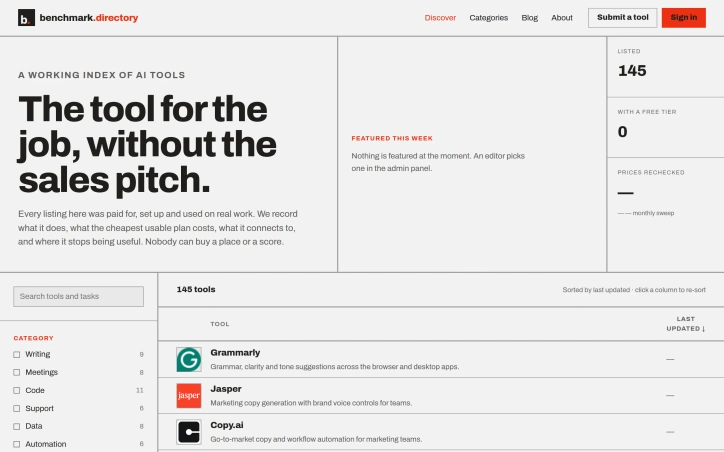
An editorial index of AI tools solves a growing discovery problem in a crowded market. Benchmark.directory addresses the challenge many organizations face when evaluating software: vendor marketing obscures real capabilities and limitations. The directory catalogs 145 tools organized by the practical work they perform rather than technological category, making it genuinely useful for matching problems to solutions. What distinguishes this project is its hands-on editorial approach. Every tool must pass a validation threshold: setup and active use on genuine projects for at least one week before earning inclusion. This practical testing replaces sales collateral with direct experience. The founders document concrete information that typically remains hidden: the actual cost of the cheapest functional plan, what free tiers genuinely permit, which integrations work after setup, and crucially, where each tool's utility boundaries lie. The directory maintains editorial integrity through transparent rejection of pay-to-play arrangements. Listings are completely free, and tools offering payment for placement are documented and declined. This structural decision eliminates the perverse incentive that corrupts most software directories, where prominent positioning correlates with marketing budget rather than usefulness. In 2026 alone, the project rejected 71 submissions and delisted 12 tools, indicating active curation rather than passive accumulation. The categorization strategy reflects how people actually hire software. Rather than grouping by AI methodology or technical architecture, tools appear under practical functions like writing, code, data analysis, and design. This mirrors genuine workflow organization and decision-making patterns. Current coverage spans categories including writing, meetings, code, support, data, automation, design, research, sales, finance, marketing, and specialized domains like legal operations and people management. The interface offers filtering by pricing model and free tier availability, accommodating both individual exploration and organizational procurement processes. The project captures information typically scattered or hidden: training data policies, integration requirements, and usage ceilings. For organizations concerned about whether tools train on proprietary work or evaluating integration feasibility before vendor conversations, this transparency provides tangible value. The regularly updated sort indicates active maintenance of the directory, though opportunity exists for expanded editorial features.

Repetitive business processes drain team productivity and divert focus from strategic work. Innovexa AI addresses this friction point by enabling organizations to build and deploy intelligent agents that automate routine workflows without requiring deep technical expertise. The platform targets teams across marketing, sales, customer support, and operations who want to leverage AI automation but lack the resources to hire specialized AI engineers. Rather than requiring users to understand machine learning fundamentals or write complex code, Innovexa AI abstracts those complexities behind a configuration-driven interface. This democratization of AI agent creation is the core value proposition—making automation accessible to business teams, not just technical ones. Several capabilities distinguish the offering. The platform supports customizable agents designed for specific industries, whether finance, healthcare, or IT, suggesting a modular approach to multi-tenant deployment. Agents can integrate with existing business tools and CRM systems, indicating a focus on fitting into established workflows rather than forcing organizations to rebuild their stacks. The marketing and sales use cases highlight concrete applications: lead qualification, CRM follow-ups, and customer support triage, which are legitimate pain points where automation delivers measurable time savings. The platform emphasizes agent quality and performance, claiming that its automation can match human-level execution on critical tasks. While this is a common benchmark claim in the AI space, the emphasis suggests the product aims for reliability beyond simple task routing—handling nuanced interactions in customer support or lead qualification rather than just parsing simple data. Scalability is positioned as built-in, meaning organizations shouldn't need to rearchitect as they expand agent usage. Innovexa also highlights an active developer community, which can be valuable for troubleshooting and sharing patterns, though this is often a proxy for product maturity. The website text indicates the product handles use cases like generating leads, managing administrative overhead, and freeing up team time for higher-value work. The positioning is straightforward: automate the tedious parts so teams focus on strategy and creativity. One significant gap in the available information is pricing and deployment model. There is no mention of costs, licensing structure, or whether the platform runs on-premise, cloud-hosted, or as a hybrid. For procurement teams evaluating the product, this absence is a notable omission. Overall, Innovexa AI targets a real problem—the usability barrier between AI's promise and business adoption—with a market-focused solution. Whether it delivers on these claims would require testing, but the positioning reflects genuine customer friction points in workflow automation.


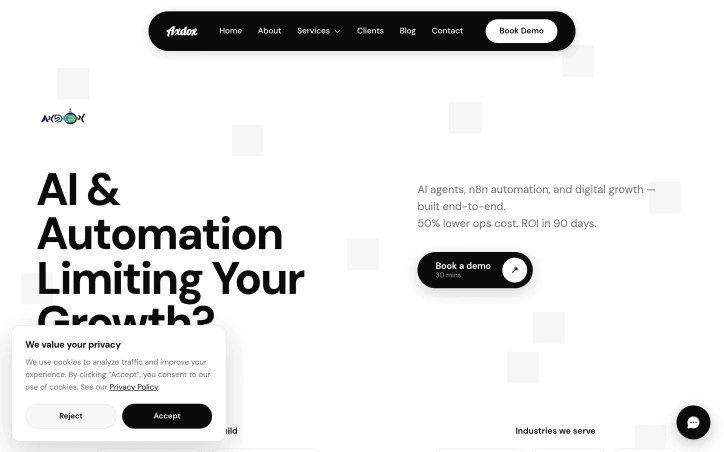
Repetitive operational work drains resources and costs businesses money. Companies struggle to find AI solutions that don't require extensive technical expertise or enormous budgets, leading many teams to maintain manual workflows even when automation could transform their efficiency. Axdox addresses this gap by positioning itself as a practical AI and automation firm focused on helping businesses adopt intelligent technology without complexity or prohibitive costs. The company operates across three core verticals—voice automation, workflow orchestration, and custom AI development—targeting industries like healthcare, fintech, and SaaS that stand to benefit most from operational transformation. The company's value proposition centers on three differentiators. First, it applies AI as a foundational element rather than a superficial addition, building automation into every solution. Second, it handles the entire journey from initial consultation through deployment and ongoing support, reducing friction for clients unfamiliar with AI implementation. Third, it emphasizes data-driven optimization, using analytics and testing to validate that implementations actually deliver promised results. Axdox's service portfolio spans voice agents that handle customer calls and lead qualification, n8n workflow automation for connecting disparate business tools, custom AI agents built for specific operational needs, alongside web development and digital marketing services. The company claims these solutions drive a 50 percent reduction in operational costs with ROI achievable within 90 days, though the achievability of these metrics depends heavily on client circumstances and implementation scope. What distinguishes Axdox from the crowded automation consulting space is its explicit commitment to customization. Rather than selling packaged software, the founders describe approaching each engagement by deeply understanding client processes first, then building tailored solutions. This bespoke model commands premium pricing but promises better fit than generic platforms. The company's founding narrative—bootstrapped by Shri Siva J and Kavitha L out of frustration with the gap between AI capability and practical affordability—suggests alignment with the problem it claims to solve. The emphasis on making AI empower people rather than replace them frames automation as augmentation rather than workforce displacement, a positioning that resonates with businesses cautious about AI adoption. Axdox serves businesses ready to invest in operational transformation but lacking internal AI expertise. It competes on customization and support depth rather than technology novelty, positioning itself as a strategic partner through implementation rather than a vendor of off-the-shelf tools.

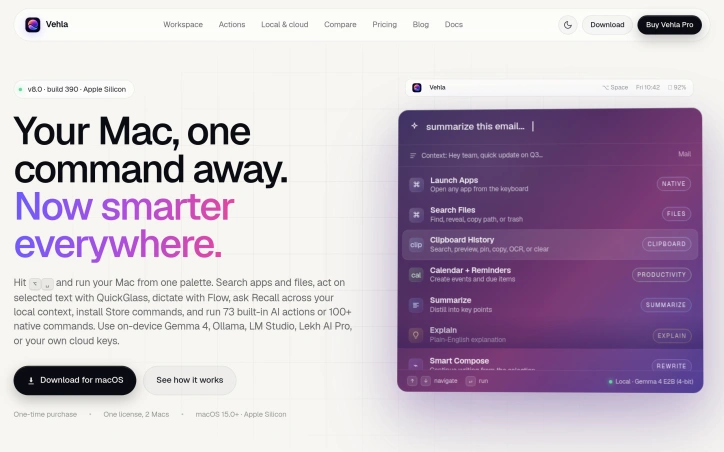
Streamlining workflows on Mac devices is a daunting task, especially when users have to juggle multiple utilities to accomplish various tasks. The solution lies in a comprehensive command center that integrates AI actions, dictation, and native commands, making it easier for users to manage their tasks efficiently. Vehla's product is designed to address this issue by providing a centralized platform that replaces the need for multiple Mac utilities. It is tailored for individuals who value productivity and are looking for a way to simplify their workflow. By doing so, it caters to professionals and power users seeking to maximize their efficiency on Mac devices. One of the standout aspects of Vehla is its integration of AI capabilities directly into the Mac command center. The product utilizes on-device AI models such as Gemma 4, Ollama, and LM Studio, among others, to enable advanced features like Recall, which builds a local search index across various sources, and Smart Compose, which assists in writing tasks. Key features worth noting include the ability to search for apps and files, act on selected text with QuickGlass, dictate with Flow, and access to 73 built-in AI actions or 100+ native commands. Additionally, the product offers functionalities like window management through Snap Wheel, note-taking, and task organization. The product is available for macOS 15.0+ on Apple Silicon devices, making it compatible with the latest Mac technology. The business model is straightforward, with a one-time purchase option that allows users to license the product for use on two Macs. Overall, Vehla presents a compelling solution for Mac users looking to simplify their workflow and enhance productivity. By integrating AI capabilities and native commands into a single command center, it effectively consolidates multiple utilities into one, making it an attractive option for those seeking to streamline their tasks.

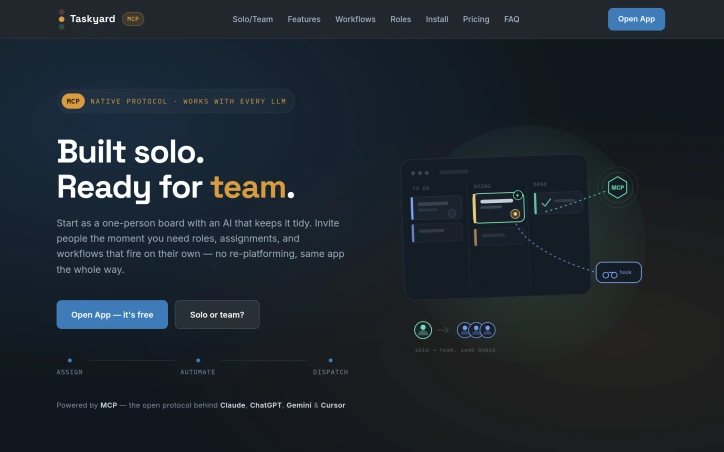
Managing tasks efficiently is a challenge that solo entrepreneurs and teams face daily. The complexity of task management often increases as a solo operation grows into a team, requiring a shift to more sophisticated tools. Taskyard addresses this issue by providing a task management system designed to work seamlessly for both solo users and teams, eliminating the need for migration as the user base expands. At its core, Taskyard offers a kanban board that integrates with Large Language Models (LLMs) through the MCP protocol, allowing users to manage tasks via conversational interfaces. This integration enables a high degree of automation, where tasks can be created, updated, and completed without manual intervention. The platform's strength lies in its ability to scale from a simple, personal task manager to a team-oriented tool with granular roles and permissions, ensuring that each team member has the appropriate level of access and responsibility. One of Taskyard's standout features is its automation capability, which goes beyond basic task management. Users can set up workflows with triggers, conditions, and actions that automate task assignments, status updates, and interactions with other tools, all without requiring human intervention. Additionally, Taskyard's compatibility with various LLMs through a single API key provides flexibility and avoids vendor lock-in. The platform also offers smart reminders, offline capability as a Progressive Web App, and maintained task management through AI-driven updates and cleanups. Taskyard caters to both solo operators and teams by providing a free tier that covers most solo use cases, with the option to upgrade to more comprehensive plans that support unlimited workflows for teams. This tiered approach makes it accessible to a wide range of users, from individuals looking for a personal task manager to teams requiring more advanced collaboration and automation features.

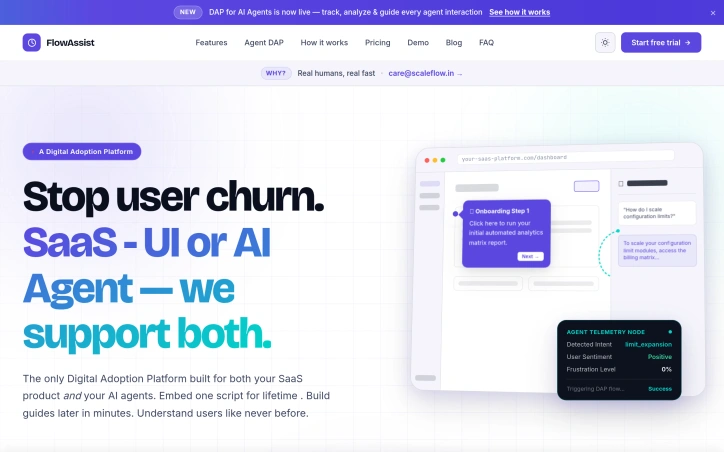
Churn typically results from users feeling lost in unfamiliar software. Digital adoption platforms address this by embedding guided experiences directly into applications, and FlowAssist positions itself as the first such platform built to serve both traditional SaaS products and AI agents. The core offering is straightforward: a single JavaScript snippet provides lifetime access to a dashboard where teams build onboarding flows, product tours, and user surveys without touching code. These guides activate based on user segments, plans, or custom attributes, and they go live instantly without redeployment. The product tours, navigation flows, hotspot overlays, and splash screens function as standard adoption tools. Surveys and NPS collection allow direct feedback collection without leaving the application. What distinguishes FlowAssist is its positioning around AI agent interactions. As AI agents become primary user interfaces for many startups, traditional adoption platforms fall short—they assume click-based UI interactions. FlowAssist adds an agent telemetry layer that claims to detect user intent, sentiment, and frustration levels in real time. The dashboard surfaces these signals through analytics including completion rates, drop-off points, sentiment analysis, and AI-powered session summaries. This addresses a genuine gap: most adoption platforms have no mechanism to track or improve agent conversations before dissatisfied users leave. The implementation model prioritizes simplicity. Users paste a script tag, initialize with a workspace ID, and build everything from the cloud dashboard. The "zero friction setup" claim appears validated by the straightforward integration approach—no SDK installation, no complex configuration. On the business side, FlowAssist offers a 14-day free trial requiring no credit card and pricing starting at $49 per month, suggesting it targets small to mid-market SaaS companies and emerging AI agent platforms. The transparent pricing and trial structure reduce adoption friction. Gaps worth noting: the website provides no user counts, deployment numbers, or retention metrics to substantiate claims of being the "number one" platform. The analytics features sound sophisticated, but actual output and customization depth remain unclear from the public information available. The agent telemetry—arguably the most innovative component—lacks detailed explanation of how sentiment and intent detection actually work or how accurate they are in practice. The dual focus on traditional SaaS and AI agents is strategic timing. For teams building conversational interfaces and agent-first products, the absence of adoption-tracking tools elsewhere makes this differentiation meaningful. The product appears built for a real need; whether execution matches ambition depends on the quality and accuracy of those telemetry features.

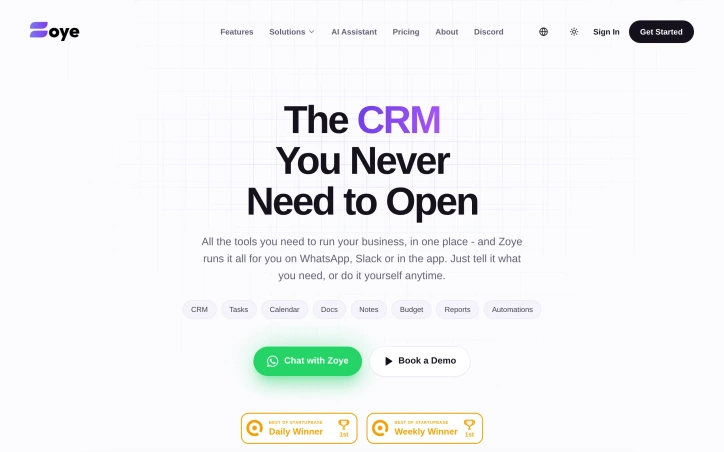
A fundamental frustration among founders and small business operators is the sprawl and complexity of managing multiple specialized software tools. Rather than forcing users to hop between platforms for CRM, task management, calendars, documents, and reporting, Zoye consolidates these functions into a unified interface accessible through conversational channels like WhatsApp and Slack, complemented by a traditional web application. The core innovation is architectural. Instead of requiring users to learn and navigate another complex dashboard, Zoye delegates operational workflows to an AI agent that executes tasks based on natural language instructions or predefined automations. A user can communicate with the system through existing communication channels rather than opening yet another browser tab. This directly addresses a pain point that resonates across the productivity software industry: tool fatigue and the cognitive overhead of context-switching between applications. The platform bundles traditional business functions—customer relationship management, task tracking, calendars, document storage, notes, budgeting, and reporting—alongside automation capabilities. This breadth positions it as a centralized operational hub rather than a single-purpose CRM. The company's blog content reveals vertical-specific marketing efforts, including targeted guides for real estate agents, fitness professionals, legal practitioners, and event organizers, indicating the product has been adapted to support workflows beyond generic sales and customer service. Zoye targets a specific niche: resource-constrained startups and small businesses where hiring dedicated operations staff remains impractical. For this audience, the value proposition is compelling. An AI-managed CRM eliminates the traditional setup and ongoing management burden that discourages many founders from implementing structured customer workflows at all. Notably, the positioning emphasizes what the product does not require: opening the application itself. This inverts the typical software experience where the application is the primary interface. Whether this approach proves sufficient for teams needing deeper analysis, complex custom workflows, or extensive collaboration remains an open question. The reliance on conversational interfaces depends heavily on the quality and consistency of the underlying AI, which directly determines whether the system reliably interprets and executes business-critical operations. The company provides a live preview and demo booking, though no pricing is disclosed publicly, suggesting a sales-driven motion typical of B2B SaaS targeting SMBs.

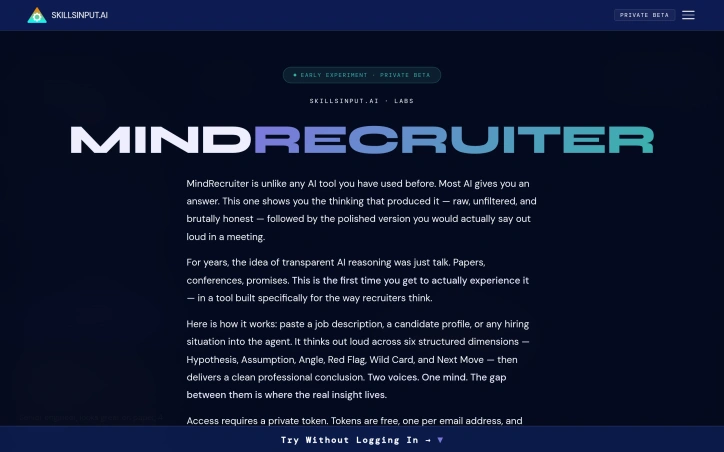
Recruiting decisions rest on incomplete information, yet most AI tools compound the problem by hiding their reasoning under a layer of polish. MindRecruiter addresses the core frustration: recruiters who want to understand why an AI system reached a particular conclusion before trusting it with a hiring decision. The product breaks this down into a two-stage thinking model. First, it surfaces raw reasoning across six structured dimensions: an initial hypothesis, underlying assumptions that might be flawed, an alternative evaluation angle, potential red flags, unexpected considerations, and a recommended next step. Only then does it synthesize these into a professional-grade conclusion suitable for documentation or stakeholder communication. The theory is sound—that gap between unfiltered reasoning and polished output contains the actual decision-making insight. The interface is designed for speed and flexibility. Users paste job descriptions, candidate profiles, or hiring scenarios directly into a web interface. A Chrome extension adds one-click analysis for LinkedIn profiles and job postings without scraping or storing data. File uploads support PDFs, Word documents, and images. The entry barrier is deliberately low: four free analyses available immediately without authentication. For extended use, the token system removes friction while maintaining privacy. Free tokens last 30 days and persist only on the user's device—no account creation, no email tracking, no data transmission. This is a genuine technical choice rather than marketing language. Every session remains local, and the company states it doesn't log or store anything, a rare commitment in an industry where data hoarding has become default practice. The ambitions here are measured rather than grandiose. MindRecruiter is explicitly positioned as a private beta experiment rather than a polished product, which signals genuine research into how AI transparency in hiring could work rather than a rush to market. It's part of a broader free suite under SKILLSINPUT.AI that includes resume generation, salary tools, and career roadmaps. What's genuinely missing are real constraints: evidence of how the reasoning holds up on complex hiring decisions, whether six dimensions exhaust all recruiting scenarios, or what the actual output quality looks like beyond template prompts. The transparency promise is the entire product—if that reasoning is shallow or misses domain-specific nuance, the tool fails immediately. For recruiters skeptical of black-box AI but willing to experiment with something genuinely transparent, this is worth testing. For those seeking a production-ready system, it's still too experimental.

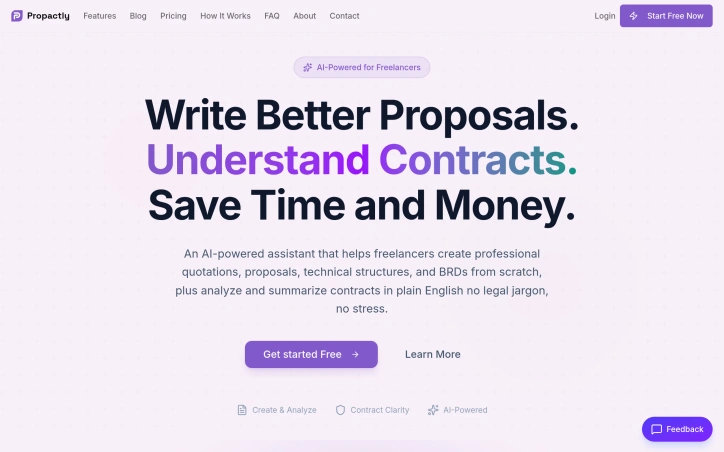
Freelancers often struggle with creating professional proposals and navigating the complexities of contracts, a challenge that can be both time-consuming and costly. Propactly addresses this issue head-on by offering an AI-powered solution tailored specifically to the needs of freelancers. The platform is built by freelancers, for freelancers, ensuring that it meets the unique demands of this profession. What stands out about Propactly is its ability to not only generate professional quotations, proposals, and business requirement documents from scratch but also to analyze and summarize contracts in plain English, stripping away the legal jargon that often confuses. This dual capability is a significant advantage for freelancers who need to both present their services professionally and protect their interests when negotiating contracts. The platform's AI assistance is geared towards understanding freelance business workflows, offering structured proposals, pricing-aware quotations, and contract risk analysis. This is a marked departure from generic AI tools that merely generate text without understanding the context or specific needs of freelancers. Users can create or upload documents, have them analyzed and enhanced by the AI, and then export professional PDFs or summaries. While Propactly's pricing model is not explicitly detailed, the platform invites users to get started for free, suggesting a potentially freemium model or a trial period. The emphasis is on the value it brings to freelancers, including saving time, reducing costly mistakes, and enhancing their professional image. Overall, Propactly is a valuable resource for freelancers at every level, providing them with the tools to create professional documents, understand contracts, and ultimately win more clients. Its focus on the specific needs of freelancers and its user-centric design make it a compelling solution in a market often dominated by one-size-fits-all tools.

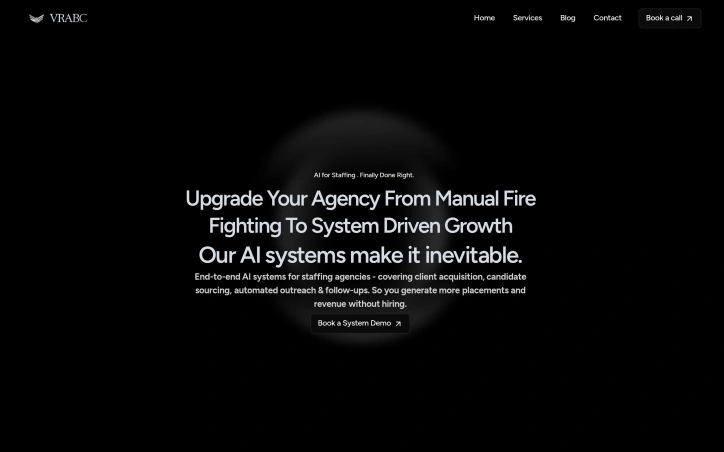
Staffing agencies have a straightforward strength: finding and placing talent. The gap they struggle with is equally clear—converting prospects into consistent, predictable client relationships at scale. Most operate with outdated business development infrastructure, relying on manual cold outreach, unpredictable referrals, and founder-dependent sales efforts that don't scale. VRABC Group targets this specific pain point by building AI-powered outbound systems designed to automate and systematize how staffing firms acquire clients. The platform combines intelligent lead sourcing, company research, multi-channel outreach automation, and meeting booking into a coordinated workflow. Rather than treating client acquisition as a separate, manual department, the system positions it as a repeatable, revenue-focused operation engineered specifically for recruiting firms. What distinguishes the approach is its vertical focus. VRABC explicitly rejects the generic marketing-automation playbook, instead building around staffing-specific workflows and metrics. The emphasis falls on qualified pipeline generation and client meetings—tangible business outcomes—rather than vanity metrics like engagement rates. This is deliberate positioning: revenue-focused, not visibility-focused. The system addresses a real structural problem in the staffing industry. Staffing firms generate revenue from placements, which demands a steady flow of viable job orders from clients. Yet most manage demand generation through individual effort and scattered manual processes rather than systematic, scalable infrastructure. This creates a ceiling on growth: adding capacity requires hiring more salespeople or pushing existing relationships harder, rather than improving productivity through better systems. From the messaging, VRABC bundles several components—lead qualification and ranking, intelligent targeting, automated outreach sequences, and meeting scheduling—into one integrated platform rather than asking agencies to assemble multiple point solutions. For firms drowning in disconnected tools, integration is practical value. The core value proposition is direct: help staffing agencies generate more client meetings and pipeline without proportional headcount increases. This speaks to a genuine bottleneck. Whether the execution delivers on that promise requires evidence of customer results and implementation complexity, which isn't available from the public-facing messaging. But the fundamental problem—that staffing firms lack scalable client acquisition infrastructure—is real and persistent. For staffing agencies stuck with manual business development, this solves a recognized problem with a purpose-built tool. The vertical specialization suggests the founders understand recruiting firms' specific constraints and workflows, which is a stronger position than generic sales automation. Execution and customer outcomes remain the real test.
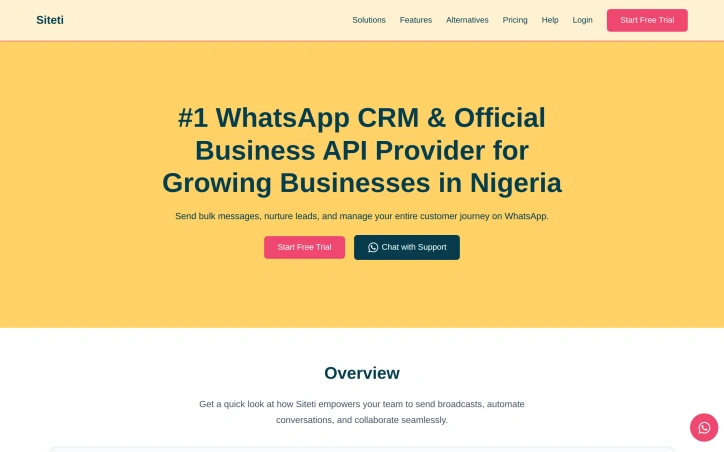
Growing businesses across Nigeria are choking on WhatsApp workflows. Teams juggle multiple devices, conversations slip through the cracks, and customers wait hours for responses. Without proper infrastructure, scaling customer communication on WhatsApp becomes a liability rather than an asset. Siteti tackles this head-on by transforming WhatsApp from a chat app into a unified customer communication platform. The product targets businesses that have outgrown the standard WhatsApp Business app—e-commerce brands, service providers, schools, logistics companies, and any operation where WhatsApp is central to revenue or customer retention. The platform aggregates conversations into a shared team inbox, enabling multiple agents to manage customer chats, assign follow-ups, and maintain continuity even outside business hours. The feature set is comprehensive. Broadcasting allows bulk messaging to segmented audiences without the coordination chaos of group chats. Automation includes a chatbot builder for handling FAQs and data collection through interactive workflows, plus webhook support to funnel customer responses directly into backend systems. Message analytics provide transparency on delivery and engagement, while account health monitoring alerts businesses to compliance risks before their numbers get suspended. What distinguishes Siteti is its pragmatic approach to migration. Many CRM tools force businesses to abandon their existing WhatsApp ecosystem. Siteti's coexistence mode runs the official Business API alongside a business's current WhatsApp setup without losing message history, and supports importing up to six months of past conversations. This reduces adoption friction and acknowledges that Nigerian businesses need working solutions today, not perfect transitions tomorrow. The platform also bundles voice calling directly into the dashboard, eliminating the need for separate PBX or VoIP infrastructure—a meaningful cost and complexity reduction for cash-constrained operations. One gap in the public narrative is pricing. The site mentions a free trial but provides no insight into tiers, per-message costs, or which features live behind paywalls. For procurement-conscious SMBs evaluating WhatsApp solutions, this opacity creates unnecessary friction. Overall, Siteti addresses a genuine problem in the Nigerian SMB market with thoughtful product design. It's built for operators, not aspirational marketers, and the coexistence model and calling integration suggest attention to real deployment challenges. The platform has clear positioning against both generic WhatsApp Business app limitations and purpose-built CRM bloat.

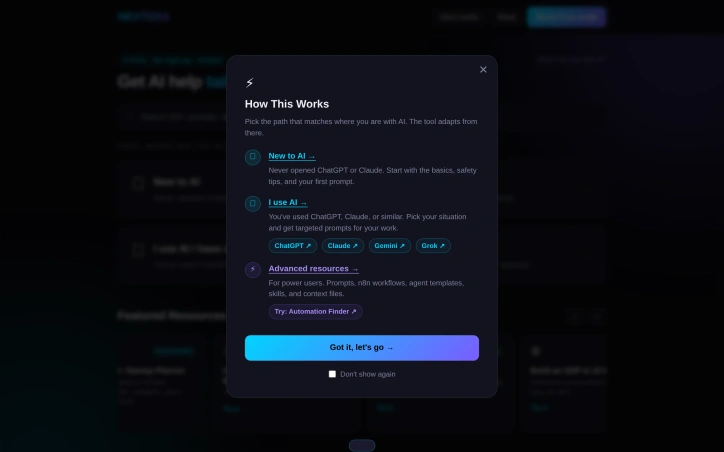
The complexity and confusion surrounding AI adoption can be a significant barrier for individuals looking to leverage its potential. Nextera AI Hub directly addresses this issue by providing a comprehensive resource hub that makes AI accessible and easy to use. The platform is designed for two primary audiences: those new to AI who require a foundational understanding of the technology, and individuals already familiar with AI tools who need targeted resources tailored to their specific situations. What stands out about Nextera AI Hub is its adaptive approach, guiding users through a step-by-step process to determine their current level of AI proficiency and provide relevant resources accordingly. For newcomers, it offers a starter kit that covers the basics, safety tips, and initial prompts. For more experienced users, it delivers customized prompts, workflows, and advanced resources such as n8n workflows and agent templates. The platform's key features include its ability to tailor AI help to individual users, a library of resources, and the capacity to generate specific prompts based on user input. Users can also save their resources for future reference. The fact that the platform is free, with no sign-up required, and offers instant access to its resources is a significant advantage, making it an attractive option for those looking to explore AI without initial commitment or cost. By offering its resources without charge and without requiring users to create an account, Nextera AI Hub demonstrates a commitment to democratizing access to AI. The platform's focus on real people and their specific needs underscores its mission to simplify AI adoption. Overall, Nextera AI Hub is a valuable resource for anyone looking to understand or utilize AI more effectively.

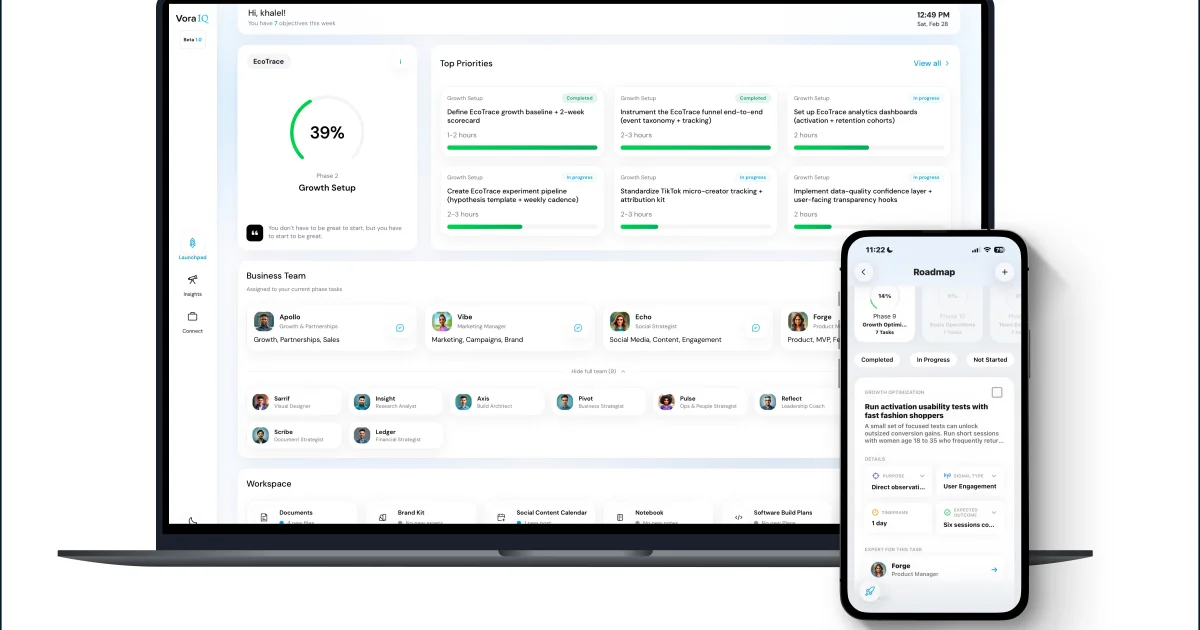
Entrepreneurs often struggle to turn their ideas into tangible businesses, getting bogged down in planning and management tasks. Vora IQ addresses this challenge by providing an AI-driven business team that helps entrepreneurs build and grow their companies. The platform is designed for founders who want to focus on the human aspects of their business, such as strategy, relationships, and creative direction, while leveraging AI to handle more operational and analytical tasks. What stands out about Vora IQ is its comprehensive approach to supporting entrepreneurs, from idea validation to execution. The platform provides a range of capabilities, including market demand analysis, competitor research, and personalized roadmaps that adapt to the business's stage and goals. It also generates daily tasks to help founders stay on track and make progress. The platform's AI business team is a key feature, offering expertise in areas such as strategy, marketing, finance, and operations. This virtual team is tailored to the specific needs of each business, providing relevant guidance and support without the need for human resources. Additionally, the platform's research capabilities help entrepreneurs stay informed about their market and industry. Overall, Vora IQ is a powerful tool for entrepreneurs who want to build and grow successful businesses. By leveraging AI to handle planning, management, and research tasks, founders can focus on what matters most – bringing their ideas to life and driving their businesses forward. While the pricing model is not explicitly stated, the platform's value proposition suggests that it could be a worthwhile investment for entrepreneurs looking to accelerate their growth.

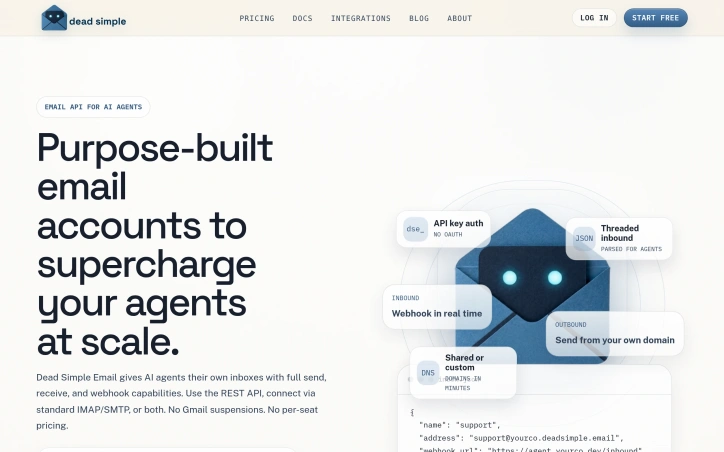
As AI-driven applications become increasingly integral to business operations, the need for reliable, scalable email infrastructure has never been more pressing. Developers of AI agents have long struggled with the limitations of consumer email services, which often suspend or ban bot accounts and impose cumbersome OAuth authentication requirements. Dead Simple Email addresses this pain point head-on, providing a purpose-built email infrastructure designed specifically for AI agents. What stands out about this product is its comprehensive approach to email management. By offering both a REST API and standard IMAP/SMTP access, it caters to a wide range of development needs and workflows. The inclusion of real-time inbound webhooks with structured JSON output and HMAC signing ensures that AI agents can respond promptly and securely to incoming emails. The product's design is centered around the needs of AI-driven applications, providing features such as automatic threading, reply parsing, and bounce handling. It also allows for the creation of custom domains with automated SPF, DKIM, and DMARC setup, giving businesses flexibility and control over their email infrastructure. Notably, the product's pricing model is straightforward and scalable, with 5 free inboxes and a flat monthly fee for larger numbers of inboxes - 100 inboxes cost $29 per month, and 500 inboxes cost $99 per month. This approach eliminates the per-seat pricing that can quickly become prohibitively expensive for large-scale applications. By handling the complexities of email infrastructure, Dead Simple Email enables developers to focus on building and refining their AI agents, without worrying about the underlying email mechanics. Overall, it is a robust solution for businesses looking to integrate AI-driven email capabilities into their operations.

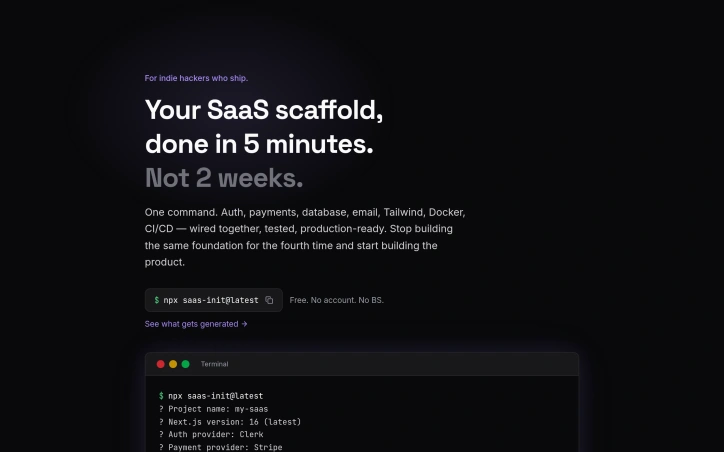
Indie developers encounter a recurring trap: after shipping the third or fourth SaaS product, they find themselves rebuilding authentication flows, subscription billing logic, database migrations, and CI/CD pipelines from scratch. Paid boilerplates promise to solve this by offering pre-built scaffolds, but they often lock developers into black-box abstractions that require archaeological investigation to customize. Free open-source starters suffer the opposite problem—abandoned projects with outdated dependencies and incomplete implementations that skip the genuinely difficult parts like webhook handling and billing lifecycle management. This scaffolding tool addresses that friction by automating the entire foundational setup in a single command. Rather than selling a templated solution, it generates a production-ready Next.js application with authentication, payments processing, transactional email, database schema, and CI/CD configuration already integrated and tested. The process completes in approximately 4.5 minutes. What distinguishes this approach is its breadth. Most boilerplates stop after providing a login page and a basic database schema. This offering includes the components that developers typically find most tedious to wire together: Stripe webhook handling for subscription lifecycle events, multi-provider flexibility (Clerk or NextAuth for authentication, Postgres, SQLite, or Supabase for data storage, Stripe or Lemon Squeezy for payments), and a testing suite of over 250 tests covering core flows. The generated code runs on Next.js 14 with the App Router, includes Tailwind and shadcn/ui components pre-configured, and packages production infrastructure as a Docker container with GitHub Actions workflows. The tool operates as an interactive CLI that prompts developers to select their preferred provider for each major component at initialization time, then generates a fully functional codebase based on those choices. Rather than forcing abstraction layers, the generated code is intended to be readable and modifiable—on the explicit premise that developers should understand and customize their own foundation rather than fight against prescribed patterns. Financially, the product is offered free under an MIT license with no account requirement and no commercial upsell. This positioning directly opposes the typical paid-boilerplate model and targets developers who prioritize speed to first deployment and transparency over premium support. For teams shipping consumer or B2B SaaS applications, the time savings from bootstrapping infrastructure are substantial. The real limitation is whether generated code remains maintainable through real-world scaling scenarios and customization demands beyond the initialization phase.

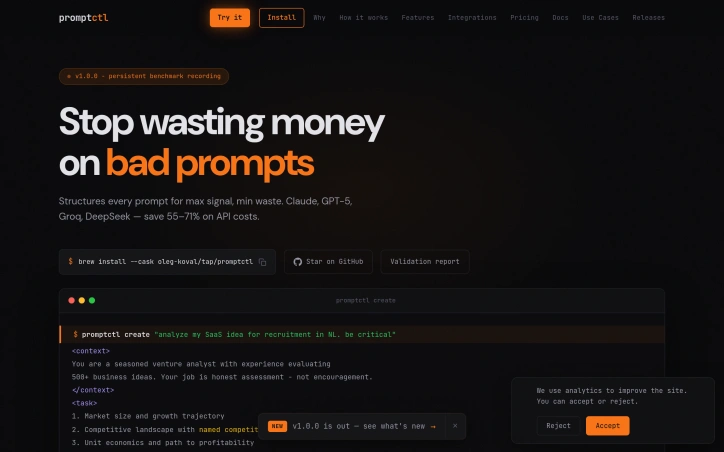
Developers working with large language models face a persistent cost problem: unstructured prompts generate bloated responses that demand multiple rounds of refinement, inflating API bills unnecessarily. Promptctl targets this friction with a command-line tool that converts rough natural language intent into optimized, structured prompts through a rule-based engine. The core insight is straightforward—most prompt failures stem from ambiguity, not capability. Rather than relying on an LLM to fix poorly articulated requests, Promptctl applies established prompting best practices (personas, constraints, structured output formats) automatically, locally, with no API calls required. The tool classifies user input against eleven task categories, automatically assigns expert personas and output structures, and formats everything into XML-tagged, decomposed instructions ready to execute. What distinguishes Promptctl from generic prompt-improvement services is its emphasis on cost visibility and developer workflow integration. The tool supports direct comparison across ten major models including Claude Sonnet, GPT-5 variants, Llama, DeepSeek, and Groq, showing which delivers the best value before any request executes. Cost tracking happens natively; users can send prompts directly through Promptctl, pipe them to the Claude CLI, or copy them for independent use. The engineering is cleanly executed. Promptctl ships as a single compiled binary with no dependencies—no Node.js, Python, or Docker overhead. Homebrew installation works across macOS (Intel and Apple Silicon), Linux, and Windows. Prompt generation happens instantly, deterministically, without external API calls or latency. The product claims that well-structured prompts cost roughly one-third as much as unstructured alternatives per call, with potential total savings of 55 to 71 percent depending on model selection and workload. These benchmarks are stated as validated across ten models. The tool targets developers and teams that use LLMs as production infrastructure and have direct visibility into API spending. Promptctl occupies a narrow but defensible position: it solves a genuine cost problem for a specific audience without feature sprawl. The focus remains laser-focused on three core capabilities—structure prompts efficiently, compare model costs transparently, and reduce token waste through better composition. No pricing or business model details are disclosed.

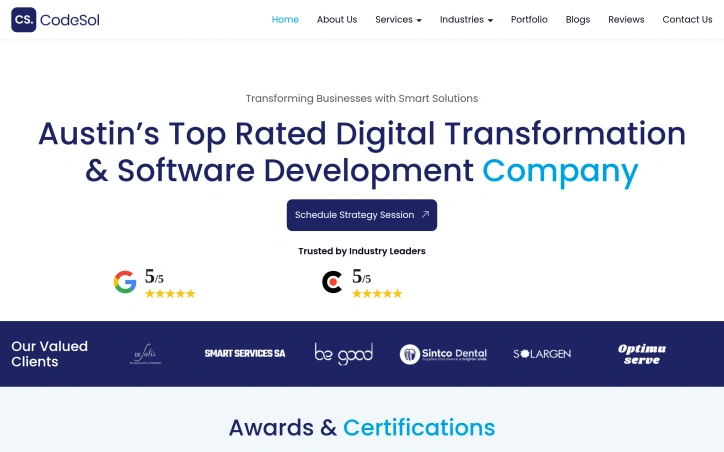
For businesses struggling to manage disconnected tools, repetitive manual processes, and outdated systems, CodeSol Technologies positions itself as a modernization partner for companies across industries. The Austin-based software development firm targets mid-market and enterprise clients seeking to streamline operations through digital transformation, with particular focus on healthcare, professional services, and home improvement sectors, though it claims to serve organizations of all sizes. The company's core offering centers on eliminating operational friction through automation and system consolidation. Rather than positioning itself as a single-product vendor, CodeSol emphasizes custom solutions tailored to specific workflow challenges. Their service portfolio spans custom website development, e-commerce platforms, workflow automation, and cloud infrastructure setup. This breadth suggests they function more as a systems integrator and development shop than a SaaS platform provider. What distinguishes their approach is an explicit emphasis on measurable business outcomes. The company references improvements in e-commerce checkout completion rates of 20 to 30 percent and explicitly frames solutions around efficiency gains and error reduction rather than technology for its own sake. Their marketing language consistently connects technical implementations back to business KPIs—reduced manual work translates to team capacity freed for revenue-generating activities, and data integration enables better decision-making. The company maintains a 5/5 Trustpilot rating, though the website doesn't specify review volume or time period, making this metric difficult to independently verify. Their claimed target regions include Texas and nationwide, suggesting both local and remote engagement capability. One notable limitation is the absence of transparent pricing information. All service offerings are presented as custom engagements requiring a consultation to quote, which is typical for professional services but leaves prospective clients without cost benchmarks. Similarly, the website lacks specific case studies with concrete metrics, customer testimonials beyond ratings, or details on typical project timelines and team composition. The company's positioning as a "data-driven" transformation partner is somewhat generic—most modern development firms make similar claims. However, their focus on workflow-specific automation and system integration rather than off-the-shelf solutions suggests genuine specialization. For businesses with genuine operational inefficiencies and budget for custom development, CodeSol appears to target a real need. Whether they deliver measurable ROI depends on execution and team expertise, factors the marketing materials don't adequately demonstrate.