Catalyst Healthspan Audit
Personal trainers typically sell training sessions. This startup reversed the equation by building assessment first, mak...
Launchory
We built Launchory to solve the discoverability problem for startups. Our platform offers instant approval, permanent do...
Best Finance Startups & Tools
Recently Listed
40 launches
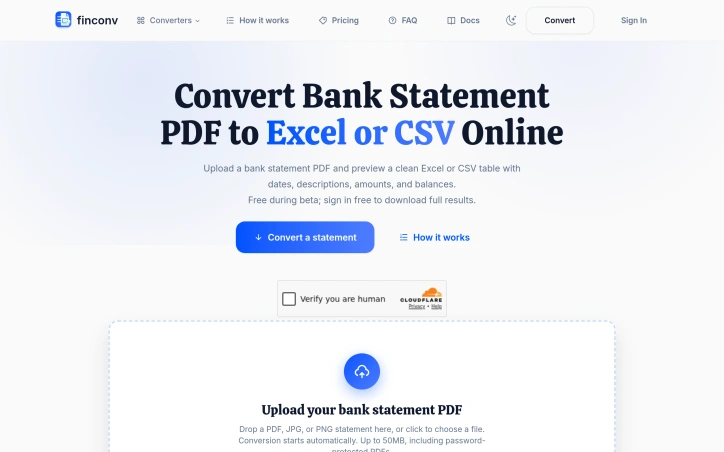
Automating the extraction of bank transaction data from PDFs addresses a genuine friction point for accountants, bookkeepers, and anyone managing business finances. FinConv tackles this by accepting PDF statements—along with scanned images and JPG/PNG photos—and transforming them into structured spreadsheets ready for analysis or import into accounting software. The product's core strength lies in its low barrier to entry. There's no software to install, no complex setup, and initial access requires no account creation. Users can upload a file, preview the extracted data immediately, then decide whether to sign in before downloading. This frictionless preview mechanism signals confidence in accuracy and removes the anxiety of committing to a conversion blind. The platform promises to read dates, descriptions, debits, credits, and running balances—the fundamental columns any accountant needs—and presents them in a clean table format. FinConv's feature set is deliberately broad in format support. Beyond standard PDFs, it handles scanned statements and password-protected files up to 50MB, eliminating the preparatory step of unlocking and re-saving documents before conversion. The export options span Excel, CSV, and JSON, catering to different workflows: Excel for spreadsheet manipulation, CSV for raw data entry into accounting systems, and JSON for developers integrating the output into applications or scripts. Credit card statements receive the same treatment as bank statements, extending utility across financial document types. The privacy stance warrants attention. The company is explicit that uploaded files aren't stored on its servers—data is sent only to an AI provider for extraction. For users handling financial documents containing sensitive account information, this claim of non-persistence is a significant differentiator in a space where data handling practices are often opaque. The business model remains straightforward. FinConv operates under a free beta with free sign-in gated to downloads, suggesting monetization will arrive once the service moves beyond beta testing. This approach buys credibility while the product proves its accuracy and reliability. The product doesn't reinvent the wheel—PDF-to-spreadsheet conversion has existed for years—but it narrows the focus to bank statements specifically and wraps the solution in a modern, user-friendly interface. For the intended audience, that combination of focused scope and accessible design likely translates to genuine time savings over manual entry or wrestling with generic conversion tools.

International freight forwarding from Pakistan traditionally has relied on a fragmented network of agents with varying service standards. XCORE Freight addresses this gap by offering consolidated logistics infrastructure that caters to both individual shippers and commercial operations moving goods from Pakistan to major English-speaking destinations. The company targets a specific but significant market: the Pakistani diaspora spread across the UK, USA, Canada, and Australia, alongside Pakistani businesses requiring reliable international cargo transport. The company's core value proposition rests on operational consistency backed by 18 years in the logistics sector. Where many freight forwarders fragment responsibilities across multiple vendors, XCORE coordinates the entire shipment lifecycle—pickup, documentation, transportation, and final-mile delivery—under one operational umbrella. This end-to-end model removes coordination friction that typically lengthens transit times and complicates tracking for customers. XCORE's service portfolio spans the transportation methods essential for different cargo profiles. Air freight handles time-sensitive shipments, while ocean freight through FCL and LCL options accommodates larger, less time-critical loads. The company explicitly manages customs coordination internally, a critical pain point that many smaller forwarders delegate to third parties, creating delays and miscommunication. Door-to-door delivery options extend beyond traditional port-to-port arrangements, appealing to customers without established infrastructure at destination points. The cargo types handled signal pragmatic positioning: commercial merchandise, household goods, and personal effects. This breadth reflects understanding of the diaspora use case—many shipments are relocations or family parcels rather than industrial supply chain operations. The willingness to handle mixed cargo (business goods alongside personal items in a single shipment) differentiates from carriers that enforce separation by category. Geographically, the company's network reaches beyond the primary diaspora destinations into Europe, Africa, and the Middle East, suggesting infrastructure or partnerships that enable more than point-to-point routing. A notable gap in XCORE's public positioning is transparent pricing. The website mentions rate options but provides no actual rate cards or pricing methodology. This opacity reflects industry norms for forwarders targeting enterprise clients who expect custom quotes rather than published rates, though it may frustrate smaller shippers seeking competitive benchmarking. The company's marketing consistently emphasizes trust and reliability—language that signals the business serves cost-conscious shippers for whom service failure carries significant personal or business consequences. This positioning trades on reputation as a defensible moat in a crowded logistics market where price competition alone proves insufficient.


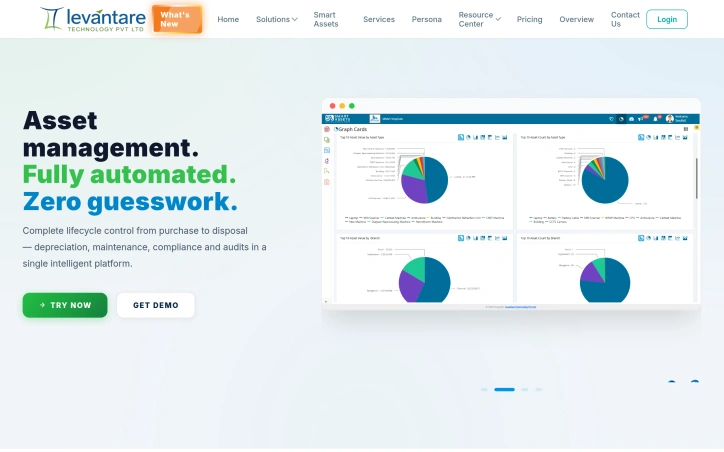
How Smart Assets Software Works? Smart Assets Software provides a centralized platform to manage, track, and monitor assets throughout their lifecycle. Assets are recorded, tagged, verified, and tracked in a single system, enabling organizations to maintain accurate asset data and complete visibility. How It Solves Asset Management Challenges? Centralizes asset information in one place Improves asset visibility and accountability Simplifies asset verification and audits Tracks asset movement and ownership changes Reduces data inaccuracies and duplicate records Provides actionable reports and analytics Strengthens governance and compliance Result: Accurate asset records, improved operational efficiency, and better decision-making through reliable asset data.

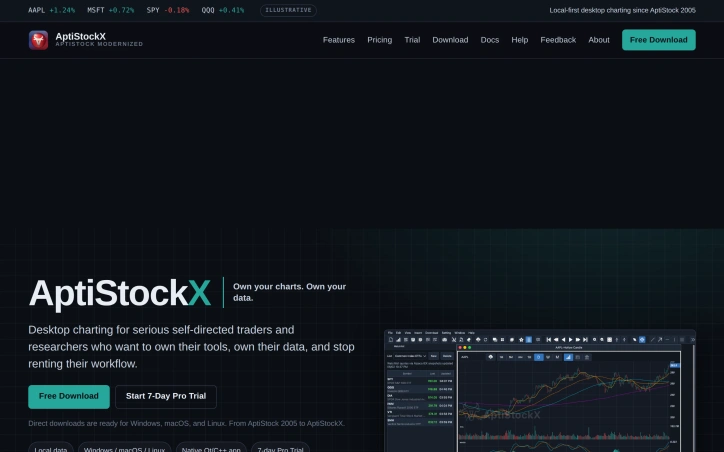
For self-directed traders and researchers tired of renting their trading research environment through browser-based subscription tools, AptiStockX offers a pragmatic alternative built on a simple premise: serious technical analysis deserves dedicated software that runs on your computer, stores your data locally, and doesn't depend on cloud connectivity. The product represents a modernization of AptiStock, which served individual traders for more than two decades beginning in 2005. The new version is engineered as a native desktop application for Windows, macOS, and Linux, targeting investors who prioritize speed, customization, and ownership over convenience bundled with monthly fees. What distinguishes AptiStockX is its uncompromising commitment to local-first operation. Chart files, downloaded market data, watchlists, workspaces, and user credentials never leave the user's computer. The absence of cloud synchronization is by design, not a limitation—it resolves privacy concerns and removes dependency on company infrastructure for core functionality. This approach appeals directly to a segment of traders who distrust centralized platforms and view data control as non-negotiable. The feature set reflects this positioning. AptiStockX delivers customizable technical indicators, drawing tools, multiple chart windows, multi-monitor support, flexible workspaces, and an AI Assistant in its Pro tier. These capabilities are standard across professional charting platforms, but the local desktop implementation means they perform at the responsiveness users expect from workstation software rather than web applications running in browser tabs. AptiStockX follows a freemium model with a Basic edition available at no cost and additional capabilities in Pro. New users can test Pro features through a seven-day trial triggered directly in the app via email verification—no credit card required upfront. Extension requests are handled by support. This trial structure removes friction from initial adoption while preserving genuine product evaluation. The company's explicit positioning around privacy, ownership, and technical rigor sets realistic expectations. AptiStockX does not attempt to be a broker-integrated trading platform or claim real-time data feeds unless its providers genuinely supply them. This restraint in marketing claims differentiates it from products that oversell capabilities and subsequently disappoint. For traders who have outgrown spreadsheets and reject browser-based SaaS, AptiStockX provides a viable path forward with recognizable legacy and clear technical tradeoffs.

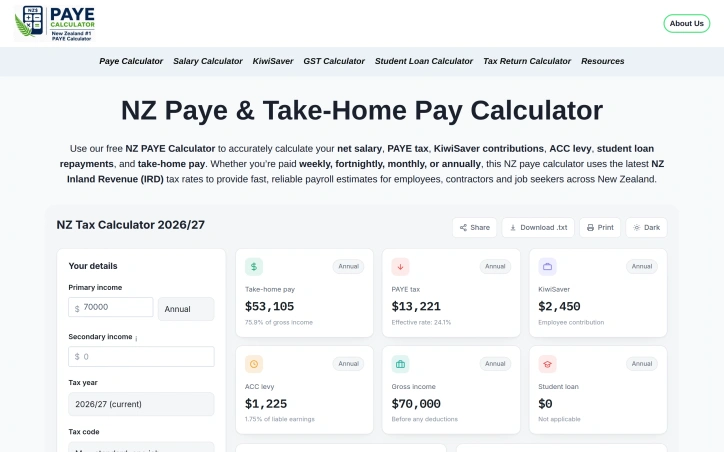
Accurate payroll calculations matter for workers trying to budget their finances. New Zealand's tax system involves multiple moving parts—progressive tax brackets, KiwiSaver deductions, ACC levies, and potential student loan repayments—making it difficult for employees and contractors to determine their actual take-home pay without professional help. The PAYE Calculator NZ addresses this friction by automating these calculations using current Inland Revenue rates and rules. The tool functions as a straightforward income calculator that converts gross salary into net pay after all applicable deductions. Workers input their income, select their payment frequency (weekly, fortnightly, monthly, or annually), and specify relevant details like KiwiSaver contribution rates and tax codes. The calculator supports both primary and secondary income streams, accommodating people with multiple jobs or mixed employment arrangements. What distinguishes this calculator is its coverage of New Zealand's actual tax complexity. Rather than treating income as a flat percentage, it applies the country's progressive tax brackets across the full income range. It incorporates the ACC earners' levy at 1.75%, handles various tax code options including the independent earner credit, and calculates KiwiSaver contributions based on user-selected rates. The tool also factors in student loan deductions where applicable. This comprehensive approach means the results reflect the actual deductions workers see in their payslips. The interface provides both summary totals and detailed breakdowns, showing annual, monthly, and weekly views of gross income, tax paid, ACC contributions, KiwiSaver deductions, and final take-home pay. Users can also see the marginal tax rate that applies to additional earnings, useful for understanding the tax impact of overtime or side work. The calculator uses 2026/27 tax year rates, keeping data current with Inland Revenue updates. The tool is free to access, removing cost barriers for workers seeking payroll clarity. This pricing model makes it particularly valuable for job seekers evaluating offer letters and contractors assessing project rates, who may not have access to employer payroll systems. The primary limitation inherent to any tax calculator is that it cannot provide personalized tax advice, which the site appropriately disclaims. However, for quick payroll estimates and understanding how deductions affect take-home pay, it fills a genuine need in New Zealand's employment landscape.

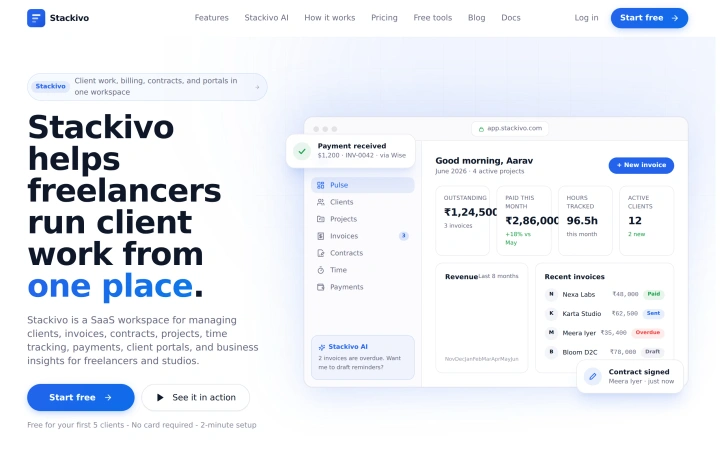
Freelancers and studios operating in India face a common problem: their business processes are spread across a half-dozen disconnected applications. Invoices live in spreadsheets, client communication happens on WhatsApp, contracts sit in Word documents, time tracking happens in notes apps, and payment information stays trapped in banking portals. Each handoff between tools creates friction: invoices don't get sent, follow-ups slip through the cracks, and billable hours disappear without becoming revenue. Stackivo consolidates this fragmented workflow into a single workspace designed specifically for independent professionals—designers, developers, consultants, writers, video editors, architects, and small studios. The platform brings together client management, invoicing, contracts, time tracking, and payments in one place where everything is connected. What distinguishes Stackivo is its deep understanding of the Indian freelancer's specific needs. Rather than forcing a generic global workflow, the product handles GST compliance as a core feature. Freelancers can toggle between simple invoices and GST mode, and Stackivo automatically calculates the correct CGST/SGST/IGST split based on the client's location. This removes a source of constant friction for registered businesses. The workflow integration sets Stackivo apart from generic project tools. A signed contract kicks off a project, hours tracked within the platform automatically become line items on invoices, and payments land back on the dashboard where they're automatically reconciled. Invoices can be created in under a minute, shared via link, email, or WhatsApp, and Stackivo handles payment reminders automatically when invoices become overdue. The core feature set covers the essentials: contracts can be e-signed in the browser, each client gets a branded portal, time tracking integrates with billing, and the platform accepts UPI and card payments. The interface hints at AI-powered assistance, such as drafting payment reminder templates. Stackivo launches with a freemium model where the first five clients are free with no credit card required and roughly two minutes to set up. This structure lets freelancers test the core workflow before committing financially. The specificity of the product—built for independent professionals across India rather than attempting global coverage—signals a focused approach to product-market fit rather than premature scaling.

Transparency into corporate cryptocurrency holdings has been fragmented and delayed—a market gap that CorpStacking fills by automating the tracking of Bitcoin, Ethereum, and Solana movements across public companies, governments, and ETFs. The platform targets investors, analysts, and traders who need to act on institutional treasury changes faster than traditional news cycles allow. The product's core differentiation centers on sourcing and verification rigor. Rather than aggregating secondhand data, CorpStacking traces each transaction to its origin—SEC filings, press releases, or on-chain records—and runs a daily cross-source audit that flags discrepancies before publishing. This approach appeals to analysts and writers who need quotable numbers backed by primary sources, not speculation or inference. Real-time delivery is a second strength. The platform promises alerts within minutes of SEC disclosure, with multiple channels available: email, push notifications, Telegram for free, and Slack or Discord integration for paid subscribers. Users can set size thresholds per company to filter noise, a practical feature for anyone tracking dozens of entities simultaneously. The feature set extends beyond alerts. The platform includes a live terminal showing prices for twelve tokens alongside refreshing corporate holdings, a Treasury Signals feed aggregating SEC purchases and sales alongside wire service announcements in paid tiers, and an AI analyst that answers queries in plain English while citing its data sources. For personal use, the "My Stack" feature lets users track their own holdings alongside the corporate leaderboard, log purchases with cost basis, import from major exchanges, and export tax reports. The platform tracks 239 entities holding over 2.9 million Bitcoin, 13 million Ethereum, and 36 million Solana collectively, with 8,595 transactions logged to date. A 5 percent cross-source tolerance guards against flagging minor discrepancies as errors. Pricing follows a free-to-paid model with no credit card required to start. The free tier includes email, push, and Telegram alerts. Pro adds Slack, Discord, and webhook support. Pro+ unlocks wire news access and an AI analyst with 1,500 monthly queries, alongside extended treasury tracking across all three blockchains. For institutional investors or independent analysts monitoring corporate crypto accumulation closely, the combination of speed, verifiability, and source attribution makes this a functional addition to research workflows rather than a novelty tracker.


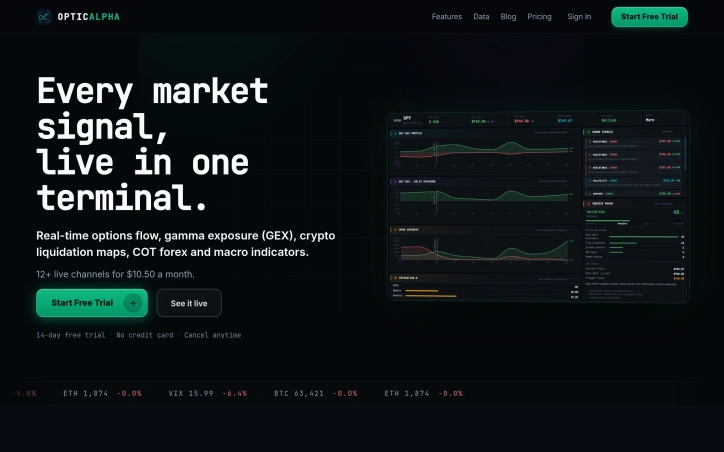
Consolidating market data into a single dashboard has long been a pain point for active traders juggling multiple subscriptions and browser tabs. OpticAlpha tackles this fragmentation by bundling options flow analysis, gamma exposure tracking, cryptocurrency liquidation monitoring, and macroeconomic indicators into one workspace at $10.50 per month. The product targets a specific niche: traders who need real-time insight across options, crypto, foreign exchange, and macro markets without the friction of platform switching. The company positions itself not as a comprehensive all-in-one terminal but as a specialized consolidation layer that pulls the most actionable signals into a unified interface. Several design choices stand out. The options flow module surfaces unusual option prints filtered by size and premium, then ranks tickers by actual flow activity rather than raw volume—a meaningful distinction for traders separating signal from noise. The gamma exposure section maps call and put walls and flags where dealer hedging becomes forced, a feature appealing to volatility traders. On the crypto side, liquidation heatmaps overlay exchange-level leverage data alongside BTC and ETH pricing, with whale alert notifications for large prints. Features extend beyond directional trading. The forex module includes CFTC Commitment of Traders data and a correlation matrix updating weekly, letting traders spot crowded positioning before reversals. Macro traders get a one-minute refresh on the full US Treasury curve plus eighteen FRED economic indicators covering growth, inflation, employment and rates. An analyst ratings feed streams upgrades and downgrades with price-target moves attached. For equities, a Conviction Radar surfaces tickers only after multiple independent signals align. The pricing model is straightforward: a 14-day trial followed by $10.50 monthly. The company claims 12+ live channels and 25+ data streams refresh in real time using the same feeds that power institutional terminals rather than delayed data. The core value proposition rests on consolidation and signal filtering rather than raw feature count. For traders constantly tab-switching between specialized tools, the unified workspace and cross-asset correlation features address a genuine workflow pain. Whether execution delivers on that promise requires hands-on testing, but the product's opinionated feature set and direct pricing point to a focused roadmap.

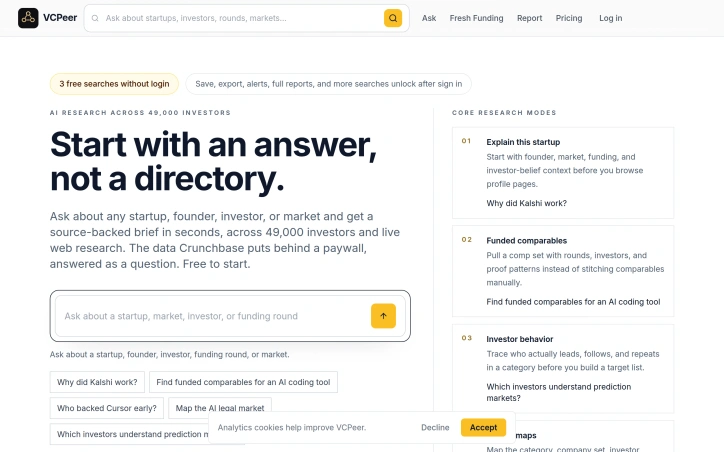
Conducting startup research typically means sifting through expensive directory subscriptions to compile comps, identify investor patterns, and understand market dynamics. VCPeer inverts this workflow by starting with a natural language question rather than database browsing. Users can ask about specific startups, founders, investors, or market segments and receive source-backed answers drawn from coverage of roughly 49,000 investors and live web research in seconds. The product targets founders conducting investor prospecting and VC professionals building investment theses. Rather than manually stitching together comparable companies from fragmented sources, users can request a funded comp set complete with funding rounds and capital patterns. Investors researching category trends get investor behavior maps showing who leads, follows, and repeats in specific domains. The interface positions question-answering as the primary research mode, with traditional directories relegated to secondary validation once the Ask engine has narrowed the most relevant records and patterns. VCPeer's architecture reflects a specific philosophy about research efficiency. The core Ask workspace centralizes the answer thread, source citations, follow-up questions, and export options in one place, reducing context switching. When a question-based answer doesn't suffice, users can escalate directly into a deeper research memo, avoiding the need to export findings into another tool. The freemium model provides three free searches without login, allowing trial users to test whether the engine answers their specific research questions before committing. The company emerged from observing that founders and investors repeatedly ask the same foundational questions: market landscape, comparative funding patterns, investor expertise in specific domains. Rather than iterating on directory design, the founders chose to build an intelligence layer that translates domain questions into evidence synthesis. This represents a genuine alternative to traditional paid research platforms, which typically require users to formulate their own queries against structured databases. Positioning as faster and more accessible compared to incumbents, VCPeer appeals to bootstrapped founders without research budgets and smaller investment firms without institutional research teams. The coverage of 49,000 investors paired with live web research suggests attempts to keep data fresher than point-in-time database snapshots. Whether the engine's answer quality matches specialized human research remains to be validated in practice, but the product architecture solves a real friction point in how startup research typically begins.

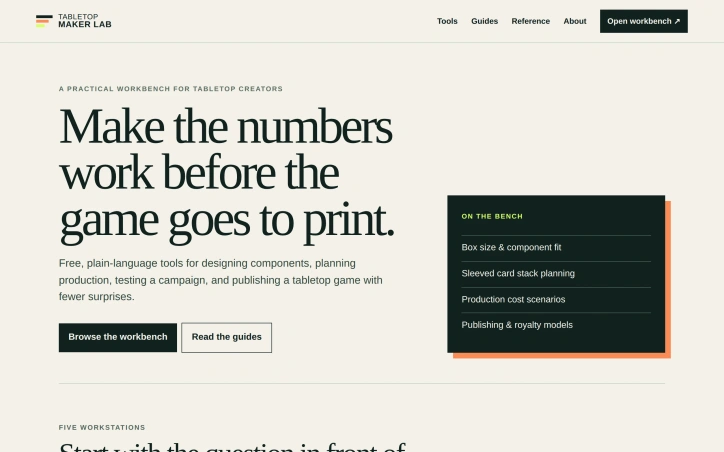
Creators designing board games face a recurring challenge: validating whether their physical designs and economic models make sense before committing to print. Tabletop Maker Lab addresses this friction point by offering free calculators and planning tools built specifically for tabletop creators navigating the decisions between prototype and production. The platform organizes its toolset around five core areas of creator concern: game mechanics testing, component planning, production cost modeling, crowdfunding campaign analysis, and publishing deal structures. Rather than attempting to replace manufacturer quotes or legal contracts, each calculator is anchored in transparent inputs that creators can customize with their own assumptions about manufacturing partners, shipping logistics, and campaign parameters. What distinguishes this offering is its commitment to removing obfuscation. The tools provide no hidden assumptions and no invented scenarios—creators enter their own numbers and see real outputs. This approach reflects a practical understanding that board game economics vary wildly by scale, region, and production method. A launched tool called the Landed Cost Calculator addresses the specific pain of understanding per-copy expenses across manufacturing and logistics. The Box Size Estimator forces creators to think through physical fit before selecting cardboard dimensions. The Board Game Royalty Calculator lets designers compare different publishing deal structures with explicit variables exposed. Beyond the calculators themselves, the platform includes guides and reference materials designed to build creator fluency. These resources teach what metrics matter, what questions to ask manufacturers, and which assumptions warrant deeper scrutiny. This positions the tools not as black boxes but as part of a learning system. The free model is notable. Most game design resources either charge for access or lock advanced features behind paywalls. Making these fundamentals free removes a barrier for independent creators and hobbyists who might otherwise proceed without validated assumptions. For bootstrapped game designers or first-time creators without capital for professional consulting, this represents genuine utility. The positioning avoids the trap of overselling. The lab describes itself as anchoring tools in development—a workbench rather than a complete solution. Creators still need actual manufacturer quotes, legal review of publishing deals, and crowdfunding expertise beyond what any calculator provides. What Tabletop Maker Lab does is collapse the time between having a game idea and having validated assumptions worth building on.

Simplifying complex financial processes is a formidable task, and Treeova tackles one such challenge by automating options trading without requiring users to have coding knowledge. The platform is designed for individuals who want to leverage automation in their trading activities but lack the technical expertise to develop their own systems. By providing a no-code solution, Treeova opens up options trading automation to a broader audience. This is a significant advantage, as it eliminates the barrier that often prevents non-technical individuals from implementing automated trading strategies. The fact that Treeova is described as an AI workspace suggests that it incorporates advanced technologies to support its automation capabilities. One of the standout aspects of Treeova is its focus on making a sophisticated financial tool accessible to users without a programming background. This indicates a clear understanding of the needs of its target market and a commitment to addressing those needs. The platform's AI-driven approach to options trading automation is also noteworthy, as it implies a high degree of sophistication and adaptability. Key features of Treeova include its no-code automation and AI workspace capabilities. These features are central to the platform's value proposition and are likely to be of significant interest to potential users. Unfortunately, the available information does not include details about Treeova's pricing or business model, leaving questions about its cost and revenue structure unanswered. Overall, Treeova presents itself as a powerful tool for automating options trading, leveraging AI to simplify a complex process and make it more accessible. Its focus on a no-code solution is a significant selling point, and its AI-driven approach suggests a high level of capability.

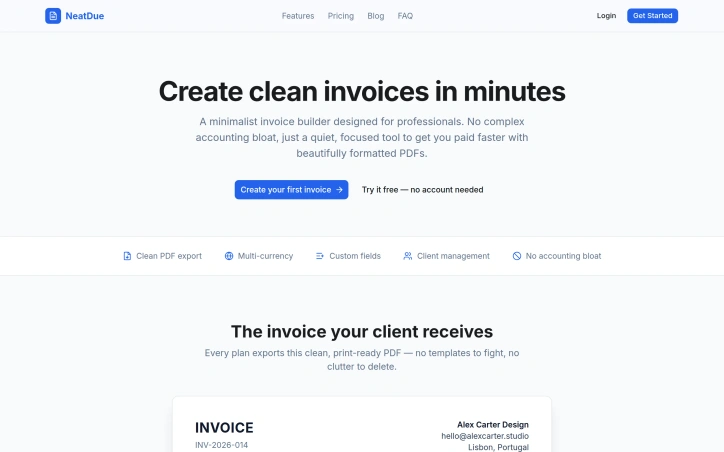
Creating professional invoices can be a tedious task for freelancers and small businesses, often due to the clutter and complexity of accounting software. NeatDue addresses this problem by providing a straightforward and minimalist invoice builder. The tool is designed to help professionals create clean and beautifully formatted invoices in minutes, focusing solely on the task at hand without unnecessary features. What stands out about NeatDue is its emphasis on simplicity and the quality of its output, ensuring that invoices are not only compliant but also visually appealing. NeatDue offers several key features that make it an attractive solution. It allows for multi-currency support, custom fields, and client management, making it versatile for various business needs. The tool also prioritizes data privacy and security, transmitting data over HTTPS and never sharing or selling it for advertising purposes. All plans export invoices to clean, print-ready PDFs, a core functionality that is consistent across NeatDue's offerings. The simplicity of its pricing structure is also noteworthy, with a clear distinction between its free and Pro plans. The free plan is suitable for individuals just starting out, allowing up to 5 invoices per month, while the Pro plan, priced at $9/month or $59/year, offers unlimited invoices, custom branding, and priority support. By stripping away unnecessary accounting features, NeatDue provides a focused solution for creating professional invoices, making it an ideal choice for freelancers and small businesses looking for a hassle-free invoicing experience.

Homeowners tackling renovation projects face a familiar frustration: each calculation requires hunting for a different tool. Paint coverage, tile counts, grout amounts, and cost estimates each live on separate websites, forcing users to juggle tabs and context switch constantly. DIYCalcKit consolidates this scattered experience into one unified platform, offering 34 calculators designed for the most common home improvement tasks. The product targets do-it-yourself homeowners who need quick, reliable estimates without complexity. Its value proposition is straightforward: no account creation, no ads cluttering the interface, instant results presented clearly. The founder identified a real pain point—the repetitive search for relevant calculators—and built a single source of truth. The range of tools spans the typical home project lifecycle. Paint estimators cover gallons needed, cost projections, coverage areas, and primer requirements. Flooring tools address tile placement, carpet seaming, hardwood board counts, and grout quantities. Beyond surfaces, the platform includes roofing calculators, insulation assessments, and renovation cost breakdowns by room and scope. More niche additions like the Christmas lights calculator and home renovation ROI tool show the creator anticipated varied user needs and seasonal projects. What distinguishes DIYCalcKit from building spreadsheets or using generic calculators is the specialization. Each tool bakes in domain knowledge—accounting for pattern repeats in wallpaper, waste allowances in tile, angles in roofing installation. The decision to bundle 20 project guides alongside calculators acknowledges that homeowners don't just need numbers; they need direction. The business model is transparent. The entire platform is free and will remain so indefinitely, with no signup wall gating access. This removes hesitation for casual users and makes the product instantly accessible mid-project, when someone realizes they need an estimate but doesn't have time for lengthy onboarding. For a homeowner planning their first bathroom remodel or calculating materials for a weekend paint job, the platform eliminates the friction of sourcing multiple calculators and consolidates decision-making. It won't appeal to professionals who already have established estimation workflows, but for the DIY segment making project decisions at the hardware store or on the couch with a tape measure, having 34 relevant tools in one place shifts the calculus.


Students navigating college planning encounter fragmentation. High schoolers preparing applications need test score calculators. Those already enrolled need GPA tracking. Students of all stages need financial planning tools for costs and loans. Historically, this has required registering with multiple services and learning different interfaces for each. GPA Vault consolidates this entire workflow into one free platform requiring no signup. The service bundles over 21 calculators across three core domains: academic GPA tracking, student financial planning and loans, and standardized test scores. This breadth supports the student journey from high school admissions through college graduation and repayment. The academic calculator suite is comprehensive. Standard GPA calculators coexist with weighted GPA tools, specialized calculators for high school versus college, and dedicated versions for IB and AP course scales. Additional tools help students determine what final exam scores they need to hit target grades, calculate how many As would raise their cumulative GPA to a target, and track semester GPAs separately from their full record. A grade converter translates between GPA numbers and letter grades across the full 4.0 scale. Financial tools address both costs and debt. Students can estimate four-year total college expenses, calculate monthly loan payments across standard and income-driven repayment plans, see how scholarships reduce lifetime interest, and decode financial aid award letters to distinguish grants from loans. These calculators translate opaque numbers into concrete monthly figures and lifetime totals. Test score components handle SAT and ACT conversion, translating raw scores into scaled scores with percentile rankings that vary by college competitiveness tier. The business model relies on Google AdSense advertising, indicating ad-supported rather than subscription or transaction-based monetization. Users access all tools without payment or account creation. What distinguishes GPA Vault is its refusal to fragment essential student tools. Rather than asking students to maintain multiple accounts, learn separate interfaces, and toggle between apps, it consolidates answers into one coherent platform emphasizing speed and instant access. For students simultaneously navigating college decisions, course performance, and financial realities, this integration delivers tangible efficiency.


When prospective car buyers sit down to make one of the largest purchases of their lives, they face a complexity problem. A vehicle decision isn't simply about the sticker price—it encompasses loan terms, depreciation curves, insurance premiums, fuel consumption, maintenance budgets, and financing alternatives that interact in non-obvious ways. AutoCalcHub addresses this fragmentation by consolidating 24 automotive financial calculators into a single, immediately accessible resource. The platform's core strength lies in its pragmatic approach to removing friction. There's no registration wall, no paywall, and no hidden fees to discover later. Users arrive at the site and can run any of the available calculators within seconds. This unobstructed access stands out in an era when personal finance tools typically demand email addresses or subscription commitments before delivering value. The calculator collection covers the full lifecycle of car ownership. On the purchase side, tools address loan payments, affordability thresholds using the 20/4/10 budgeting rule, down payment scenarios, lease-versus-buy comparisons, and cash-versus-finance trade-offs. A sales tax calculator factors in state-specific rates and trade-in deductions—a detail that many buyers overlook until payment time. For existing owners, the platform offers maintenance cost estimates, trade-in value assessments, refinance scenarios, and early payoff analysis. For the EV-curious, dedicated tools compare total cost of ownership between gas and electric vehicles and estimate charging expenses at home or public stations. Less commonly featured are some of the specialized calculators: a GAP insurance advisor that determines whether underwater loan coverage is worthwhile, a real-world MPG tracker for drivers who want to measure actual efficiency, and a road trip planner that bundles fuel, food, and lodging into a single estimate. These reflect thought about the actual decisions car owners need to make, not just the headline metrics. The business model is straightforward. The site operates on Google AdSense advertising, which the team acknowledges directly. This positioning—free tools supported by advertising rather than extracting user data or premium tiers—creates transparent incentives. The company profits when users find value in returning, not by upselling financial products or harvesting personal information. AutoCalcHub targets drivers who want math-driven decision-making without the sales pitch. It succeeds by avoiding the complexity tax that many fintech platforms impose: no accounts to create, no data to surrender, no friction between question and answer.


Insurance can feel overwhelming. Most people struggle to determine how much coverage they actually need, whether they're shopping for life insurance to protect their family or calculating disability coverage to safeguard their income. My Insurance Calc addresses this friction with a collection of over 20 free calculators designed to demystify insurance requirements across dozens of coverage types. The product serves a broad audience, from renters and homeowners to self-employed professionals and specialty vehicle owners. Each calculator walks users through relevant variables—income, dependents, assets, vehicle specifics, travel destinations—to generate personalized coverage recommendations and premium estimates. The platform covers expected categories like life, home, and car insurance, but also tackles niche needs such as EV insurance impacts, SR-22 requirements after driving violations, and business insurance for entrepreneurs. The specificity of these calculators suggests recognition of how insurance needs vary dramatically based on individual circumstances. What sets this offering apart is its commitment to accessibility. The entire platform is completely free with no account creation requirement, removing barriers that typically exist in insurance research. Results appear instantly, and the emphasis is on straightforward answers without hidden fees or signup obligations. This low-friction approach makes it practical for people making quick decisions or conducting preliminary research before consulting an agent. The breadth of coverage is notable. Beyond standalone calculators, the platform includes comparative tools, such as a term versus whole life comparison, helping users understand cost tradeoffs across insurance products. The addition of newer calculators for health insurance subsidies and EV-specific premiums suggests the tool evolves to address emerging insurance concerns. This responsiveness to market needs indicates active development and an understanding of shifting insurance priorities. For consumers tired of insurance confusion, My Insurance Calc delivers immediate utility without friction. The breadth of calculators and the explicit focus on removing signup barriers make it a practical starting point for anyone trying to understand their coverage needs.


Freelancers waste hours on administrative work that could go toward billable projects. GetSoloTools confronts this friction by providing a free, no-signup invoice generator that transforms business details, client information, and line items into polished PDF invoices within seconds. The platform is built specifically for solo professionals who need speed over complexity. Rather than forcing users through registration workflows or account setup, the generator launches directly into a form. Creators fill in their business name, address, and contact details, add client information, set invoice numbers and dates, then list the services or products being billed. The interface handles subtotals, tax calculations, and currency selection automatically across nine currencies from USD to INR. When finished, users download a clean PDF ready to send without watermarks or branding that signals the invoice was created by a third party. What distinguishes GetSoloTools is its commitment to true zero-friction design. The application works entirely in the browser with no account required, and the creator explicitly markets the tool as free forever with unlimited invoice generation. This model appeals to freelancers and contractors already stretched thin financially, removing a common barrier to professionalization. The platform also supports custom business logos, enabling users to maintain brand consistency in their invoicing without paying for premium features. The broader ecosystem around the core invoice tool strengthens its value proposition. GetSoloTools includes eighteen additional utilities tailored to freelancer workflows, such as late fee calculators, invoice tracking systems, and receipt generators. This suite positioning suggests the tool is designed as a primary hub for freelance administrative needs rather than a single-purpose utility. The automatic form-clearing feature and browser-based auto-saving of drafts reflect thoughtful UX considerations for users who might create invoices on different devices or during interrupted work sessions. The inclusion of guidance on invoice structure, payment terms, and the distinction between invoices and receipts adds educational value that helps users understand best practices rather than assuming competence. GetSoloTools targets the authentic need of freelancers for administrative tools that don't demand payment upfront or long-term commitment. Its zero-friction approach and comprehensive feature set eliminate common obstacles to professional invoicing, making the tool an efficient choice for anyone billing clients without organizational infrastructure.

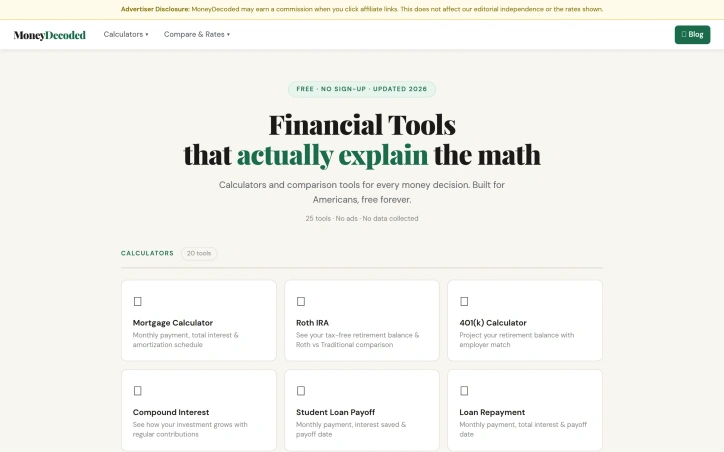
American financial planning often forces an uncomfortable choice: use free calculators that obscure their methodology and monetize through data harvesting, or pay for tools that respect privacy. MoneyDecoded breaks this false binary by offering 25 free financial calculators and comparison tools with no signup required, no ads, and no data collection. The platform directly addresses a real friction point in personal finance: most calculators hide their assumptions and math behind black boxes. MoneyDecoded's commitment to mathematical transparency means users can understand not just the answers they get but why those answers emerge from their inputs. For Americans managing mortgages, retirement accounts, debt payoff strategies, or investment decisions, this pedagogical approach transforms calculators from simple utilities into learning tools. The calculator suite spans the full financial lifecycle. Retirement planning tools cover 401(k) projections with employer match scenarios, Roth IRA analysis, and Social Security benefit estimation across claiming ages. Debt management includes dedicated calculators for mortgages, student loans, personal loans, and car loans, each showing amortization schedules and true borrowing costs. The platform also includes less common but valuable utilities: a Rent vs. Buy calculator with break-even analysis, a FIRE calculator for financial independence tracking, and comparisons between debt payoff strategies like the avalanche versus snowball methods. The comparison section supplements calculators with rates and accounts data, helping users benchmark high-yield savings accounts, certificate of deposit terms, checking accounts, and ETF performance. A Send Money Abroad tool compares fees across Wise, traditional banks, and fintech options. What distinguishes MoneyDecoded from competitors is not feature quantity but accessibility and philosophy. Free tools for personal finance already exist, yet the service's explicit rejection of data monetization and advertising removes common friction. The no-data-collection commitment suggests a creator prioritizing user trust over growth metrics. All tools carry an updated date, signaling ongoing maintenance rather than abandonware. The site's URL indicates this calculator suite sits within a broader financial education ecosystem. For individuals seeking quick, transparent calculations without compromising privacy, the platform delivers. For financial educators or advisors recommending tools to clients, the free-with-explanation model eliminates gatekeeping. The primary limitation is that calculators alone don't constitute comprehensive financial advice, though the transparency-first approach sets a better foundation for independent decision-making than opaque alternatives.

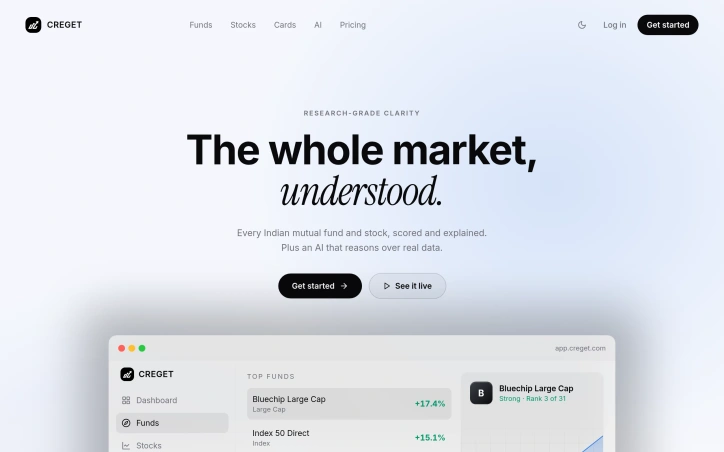
Investors navigating India's mutual fund and stock market often face a fundamental problem: too much data and insufficient guidance. Creget addresses this by providing scored, data-backed analysis of every Indian mutual fund and stock available, dramatically reducing friction in investment research. The platform's core strength lies in its comprehensive scoring system. Each fund and stock receives a 0-to-100 score derived from returns, risk, and stability metrics, with methodology transparently displayed. This transforms abstract financial data into digestible decisions. Funds are ranked within their AMFI categories, while stocks are ranked by sector, giving investors meaningful context. What distinguishes Creget beyond algorithmic scoring is its accessibility orientation. A plain-English glossary demystifies 80 finance terms, explanations accompany every recommendation, and the interface guides users through research in three straightforward steps: search, review the score and reasoning, then decide. This educational layer addresses a real gap for retail investors who cannot access professional advisory. The product bundles practical tools around core research capabilities. A portfolio tracker consolidates funds, stocks, EPF, and gold holdings in one unified view, eliminating manual data stitching across platforms. Calculators for SIPs, lumpsums, EMI, FIRE, and retirement planning add utility beyond pure analytics. Credit card recommendations based on individual spending patterns extend the scope into adjacent financial decisions. Data integrity is central to the value proposition. Creget sources from trusted institutional inputs including AMFI, SEBI, NSE, BSE, RBI, and international feeds like Alpha Vantage and Yahoo Finance, with daily updates. The platform supports live integration with AI assistants via MCP, enabling programmatic queries over market context and personal financial data. For Indian investors seeking research-backed decisions without professional advisory costs, the platform delivers measurable value by compressing weeks of manual research into searchable, scored, comparable data. It reframes investment research from a chore requiring financial expertise into an interactive workflow designed for clarity. The breadth of coverage—spanning Indian and US equities, mutual funds, and broader portfolio assets—positions it as a potential centerpiece for retail wealth management rather than a point tool.

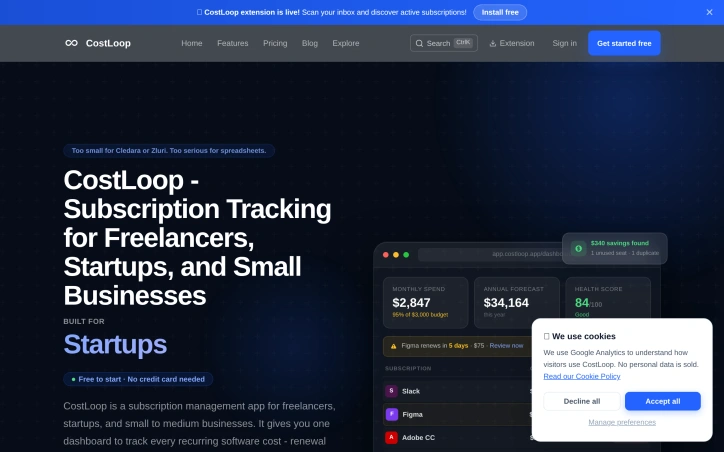
Managing software subscriptions is a daunting task for freelancers and small to medium-sized businesses, often resulting in lost renewal dates and unnecessary costs. CostLoop addresses this issue head-on by providing a straightforward dashboard to monitor recurring software costs. The product is designed specifically for freelancers, startups, and small to medium businesses, offering a simple solution to track SaaS subscriptions and manage spend. By consolidating renewal dates, monthly spend totals, invoice storage, and cancellation links in one place, CostLoop simplifies the process of keeping on top of software expenses. One standout feature is the Chrome extension, which scans the user's inbox to discover active subscriptions, eliminating the need to manually log every SaaS tool. This automation is a significant time-saver, allowing users to quickly gain a clear picture of their monthly and annual spend. Additionally, the platform provides automatic email reminders before subscriptions auto-renew, ensuring users never miss a renewal date. The product's key features include a centralized dashboard for tracking subscriptions, renewal reminders, and invoice storage. It also identifies potential savings opportunities, such as unused seats and duplicate subscriptions. Notably, the platform is free to start, with no credit card required, and setup is accomplished in just two minutes. Users can track over 100 SaaS tools, and the platform has already managed 8,200+ subscriptions, with an average savings of 18% after the first audit. While pricing details beyond the free plan are not explicitly mentioned, the absence of a required credit card upfront is a welcome feature for users hesitant to commit to new services. Overall, CostLoop presents a compelling solution for businesses seeking to streamline their software subscription management and reduce unnecessary expenses.