Catalyst Healthspan Audit
Personal trainers typically sell training sessions. This startup reversed the equation by building assessment first, mak...
Launchory
We built Launchory to solve the discoverability problem for startups. Our platform offers instant approval, permanent do...
Best Marketing & Sales Startups & Tools
Recently Listed
84 launches
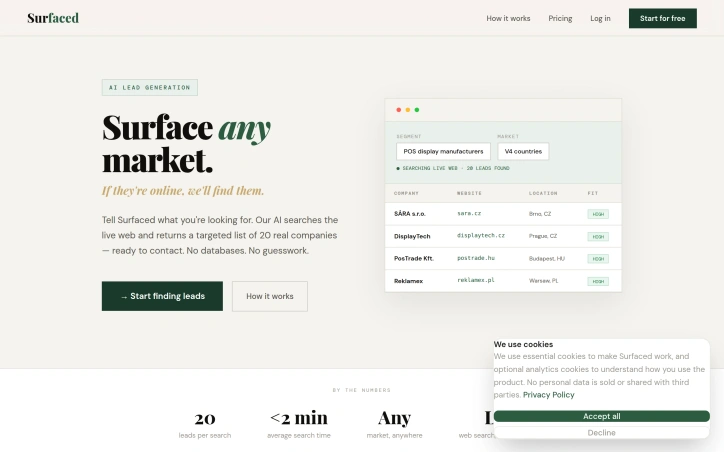
B2B lead generation is a challenging task, especially when relying on outdated databases that often yield stale or irrelevant results. Surfaced tackles this problem head-on by utilizing AI-powered live web searches to deliver targeted, up-to-date leads. This is particularly beneficial for businesses seeking to connect with newer, niche, or regional companies that may not be listed in traditional databases. What sets Surfaced apart is its ability to search the live web in real-time, rather than relying on static databases that can be months out of date. This approach ensures that the leads generated are current and relevant, giving users a significant advantage in their outreach efforts. The AI-driven search process is also refined through a series of clarifying questions, ensuring that the results closely match the user's specific needs. The platform's functionality is streamlined into a three-step process: describing the target market and industry segment, launching an AI-powered search, and receiving a structured list of leads. The resulting list includes essential company information, such as website, contact details, location, and a relevance score, which can be easily exported to a CRM or cold email sequence. Notably, Surfaced's business model includes a fair pricing structure, where unused credits are returned if a search yields no results, and a built-in mail bounce checker to ensure that only valid email addresses are suggested. Overall, Surfaced offers a robust solution for businesses seeking to identify and connect with their target audience in a more efficient and effective manner.

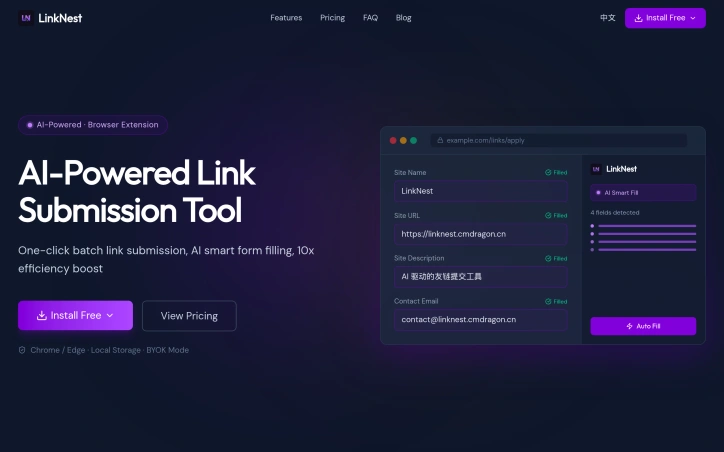
SEO professionals and independent bloggers often waste a significant amount of time manually submitting links to numerous websites, a task that involves tedious repetition of copying and filling out forms. LinkNest addresses this issue by providing an AI-powered browser extension that automates the process of identifying form fields and intelligently filling them with optimized content. The extension is designed to cater to the needs of SEO professionals and independent bloggers who seek to streamline their workflow and reduce the time spent on link submission. What stands out about LinkNest is its ability to significantly reduce the time required for link submission, from hours to mere minutes. Its AI-driven approach enables it to recognize and fill out form fields accurately, eliminating the need for manual data entry. The extension's capability to generate differentiated content and automatically detect the language of the target site further enhances its utility. LinkNest offers a range of features that make it an attractive solution for those involved in link building. Its floating menu allows users to access various capabilities, including filling out site information and generating virtual data. The extension also supports multiple profiles, enabling users to manage different sites and configurations efficiently. Additionally, its BYOK (Bring Your Own Key) mode allows users to utilize their own AI API key, providing flexibility in controlling costs. The pricing model for LinkNest includes a free version with limited functionality, a Pro version at $8 per month, and a Lifetime subscription for a one-time payment of $99. The free version has restrictions on the number of submissions and the number of links that can be managed, while the Pro and Lifetime versions offer unlimited submissions and links, along with additional features such as data import and export capabilities.

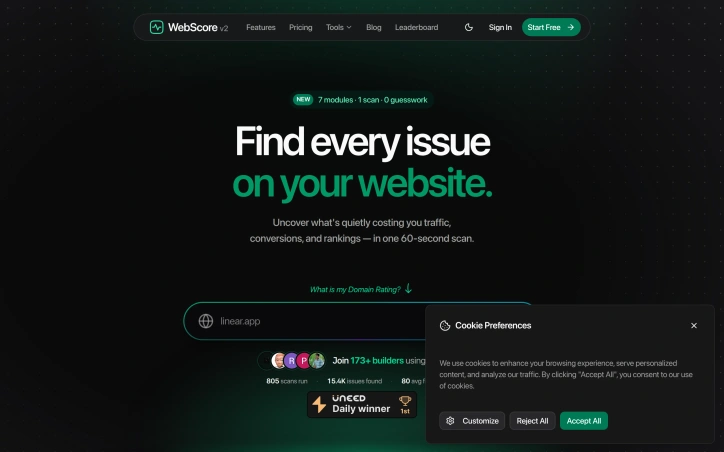
For developers and agencies managing multiple websites, the task of identifying and fixing issues that impact traffic, conversions, and rankings can be overwhelming, requiring the use of multiple tools and piecing together disparate reports. WebScore addresses this challenge by providing a comprehensive website analysis and SEO audit tool that scans a site in 60 seconds, uncovering issues across seven key areas. The tool is particularly suited for teams seeking to streamline their workflow and prioritize fixes based on impact. What stands out about WebScore is its all-encompassing approach, checking not just one aspect of a website but performance, SEO, accessibility, security, best practices, domain metrics, and even AI-powered UI/UX audit. The level of detail provided in its reports is notable, offering actionable recommendations with clear explanations and impact scoring, allowing users to focus on the most critical issues first. The tool's capability to analyze Core Web Vitals with specific identification of slowing factors, along with technical and on-page SEO insights, security vulnerabilities, and accessibility issues, positions it as a versatile solution. The integration of AI for UI/UX audit, analyzing desktop and mobile screenshots to provide design improvement suggestions, further enhances its utility. WebScore offers a straightforward pricing model: users can scan their website for free, pay $3 per report, or opt for a one-time payment of $29.99 for lifetime access, with no credit card required for the initial scan. Overall, WebScore presents a compelling solution for those looking to comprehensively assess and improve their website's performance and standing across multiple dimensions.

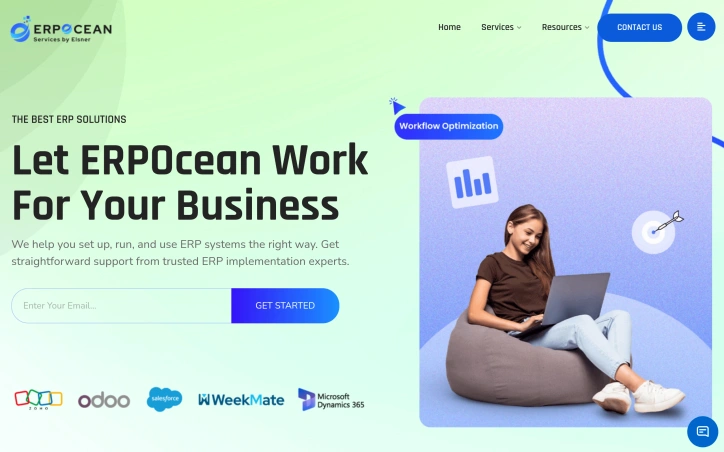
Businesses struggling to maximize the potential of their Enterprise Resource Planning (ERP) systems can find a reliable partner in ERPOcean. The company specializes in helping organizations streamline operations and achieve growth through the effective implementation, customization, and integration of ERP platforms such as Zoho, Odoo, WeekMate, and Microsoft Dynamics. What stands out about ERPOcean is its comprehensive approach to ERP solutions, encompassing not just setup but also ongoing support and tailored customizations to meet the unique needs of each business. By leveraging the expertise of certified ERP consultants, ERPOcean ensures that its clients receive high-quality, personalized service. The company's expertise spans multiple ERP platforms, allowing it to provide a broad range of services including CRM implementation, business automation, and workflow optimization. ERPOcean's team delivers user-friendly ERP dashboards, real-time performance reports, and localized ERP and compliance solutions, all of which contribute to a more efficient and integrated business operation. Key features of ERPOcean's offerings include expert ERP setup, personal support for business process automation, and smart custom solutions designed to build around the client's business. By unifying tasks, teams, and data into a single, clear platform, ERPOcean's ERP systems enable businesses to achieve total control over their operations. While ERPOcean's pricing model is not explicitly detailed on its website, the company's focus on delivering tailored solutions suggests a commitment to flexibility and client satisfaction. Overall, ERPOcean is well-positioned to support businesses seeking to optimize their ERP systems and drive long-term growth.

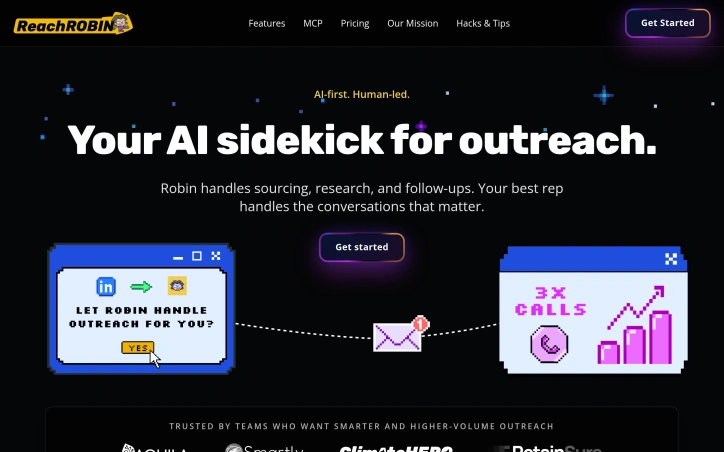
Lean sales teams often struggle with managing high-volume outreach across multiple channels, resulting in manual work, inconsistency, and lost time. Outbound sales efforts are typically fragmented across separate tools, making it challenging to maintain quality and control. ReachRobin's solution addresses this pain point by integrating LinkedIn, email, and WhatsApp outreach into a single workflow. What sets ReachRobin apart is its use of AI-powered personalization to draft messages that incorporate prospect profile data, company signals, and the user's own sales playbook. This enables sales teams to achieve genuine personalization at scale, a crucial aspect of successful outreach. The platform's rate-aware automation ensures that connection requests, messages, and follow-ups are sent in a way that keeps accounts safe, mitigating the risk of being flagged or blocked. The product's key features include automating outreach across multiple channels, tracking conversations, and measuring response rates through built-in analytics. Additionally, CRM sync capabilities allow users to seamlessly move prospects through their pipeline. By streamlining outreach and providing valuable insights, ReachRobin enables sales teams to focus on strategy rather than manual tasks. By bringing multiple outreach channels and AI-assisted personalization together, ReachRobin helps teams execute more effective outbound sales efforts with less manual effort. The platform is designed to maintain quality and control, addressing a critical need for lean sales teams. Unfortunately, the provided information does not detail ReachRobin's pricing or business model, so potential users will need to consult the company's website or sales team for more information on getting started.

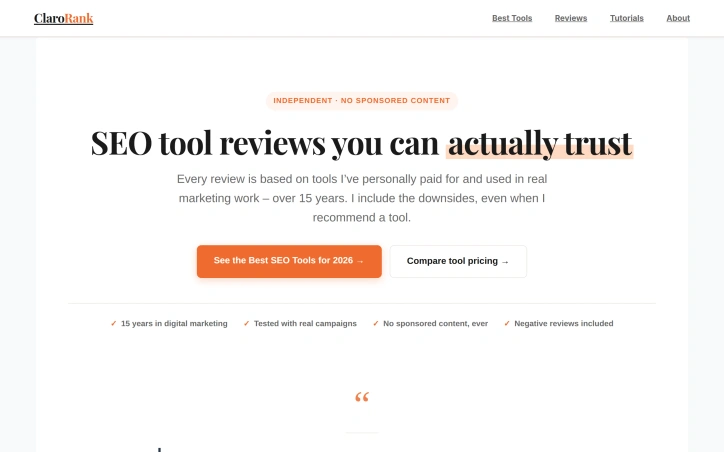
Independent SEO tool reviews are hard to come by, but ClaroRank is addressing this issue head-on. The platform is designed for digital marketers and SEO professionals who need unbiased recommendations for SEO tools that fit their specific needs and budgets. With 15 years of hands-on SEO experience, the founder has created a resource that cuts through the noise of sponsored content and provides genuine insights. What stands out about ClaroRank is its commitment to honesty and transparency. Every review is based on real-world usage and testing on actual client projects, ensuring that the ratings reflect the tools' true capabilities and limitations. The reviews cover a range of popular SEO tools, including SE Ranking, SEMrush, Ahrefs, and Mangools, and provide detailed analysis of their strengths and weaknesses. The platform offers a valuable resource for marketers at different stages of their journey. For those just starting out, it recommends tools like Mangools for keyword research and rank tracking. For agencies, it suggests SE Ranking and SEMrush for more comprehensive SEO needs. The reviews also highlight specific features, such as Ahrefs' extensive backlink index and Content Explorer. ClaroRank's business model is transparent, with clear disclosure of any commissions earned from promoting tools. The platform also keeps its pricing information up to date, verifying prices against the official sources. Some tools offer free trials, such as SE Ranking and SEMrush, which provide 14-day trials, while others, like Ahrefs, do not offer a free trial. Overall, ClaroRank is a trustworthy resource for marketers seeking reliable SEO tool reviews and recommendations.
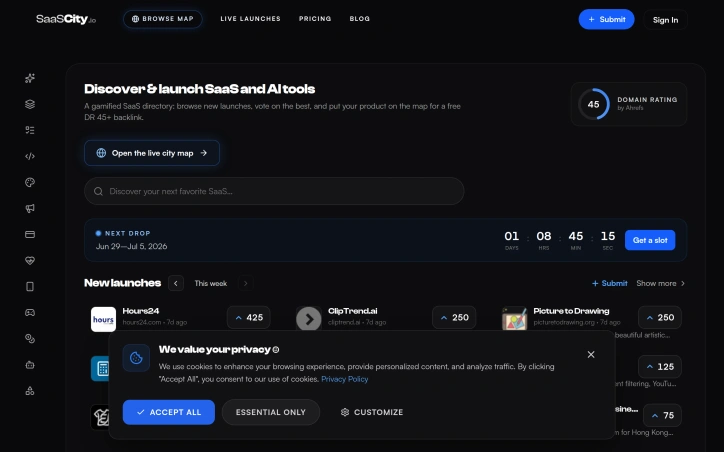
Launching a SaaS product faces a brutal discoverability problem: thousands of tools debut weekly, yet most founders struggle to break through noise and reach investors, early adopters, and media. SaaSCity tackles this by reimagining the startup directory as a gamified marketplace where products compete for attention rather than disappearing into spreadsheets. The core appeal is elegantly visual: each product listing materializes as a 3D building standing on an interactive city map, replacing the sterile table-based directories that dominate the space. This isn't mere aesthetics—it's a mechanism for memorable browsing and social sharing. Founders gain a persistent, indexable landing page with SEO equity (the platform advertises a Domain Rating 45 backlink, using Ahrefs' authority metric to signal value), creating compounding discoverability beyond the launch moment. What distinguishes SaaSCity from static product aggregators is its competitive layer. The "Best SaaS" leaderboard shows products ranked by category—Design Tools, Developer Tools, AI & Machine Learning, Fintech, and others—with vote counts visible next to each entry. This voting mechanic incentivizes community engagement while surfacing quality products to the top. Founders compete not just for listings but for rankings, turning launches into events rather than one-time posts. The platform's breadth is genuine. The scraped content shows active product flow across authentic verticals: specialized tools like ClipTrend.ai (AI video generation from photos), Etryon (apparel virtual try-ons), and SEOBrain (automated SEO agents) appear alongside established categories. The "New Launches" section demonstrates weekly refresh rates, with products added 4–7 days apart, indicating sustained supply-side activity and avoiding the ghost-directory fate that kills many aggregators. The business model remains deliberately simple: free listing for all products, with clear messaging that founders receive a backlink benefit without stated paid tiers or premium upgrades. This accessibility removes friction for bootstrapped teams and early-stage companies most likely to benefit from discovery. A live countdown timer ("Next drop Jun 29–Jul 5") signals recurring launch windows, creating rhythm and FOMO—standard launch-platform psychology but executed with visual emphasis. The accumulated vote counts (ranging from 50 to 5.6K across visible products) hint at meaningful community usage, though aggregate numbers remain private, making it difficult to assess true platform scale. SaaSCity succeeds where many directories fail by combining practical SEO value, gamification mechanics that reward quality, and a visual experience that makes exploration feel less like research and more like discovery. For early-stage SaaS makers, the free backlink and leaderboard ranking opportunity creates concrete incentives to launch here rather than disappear into the void.

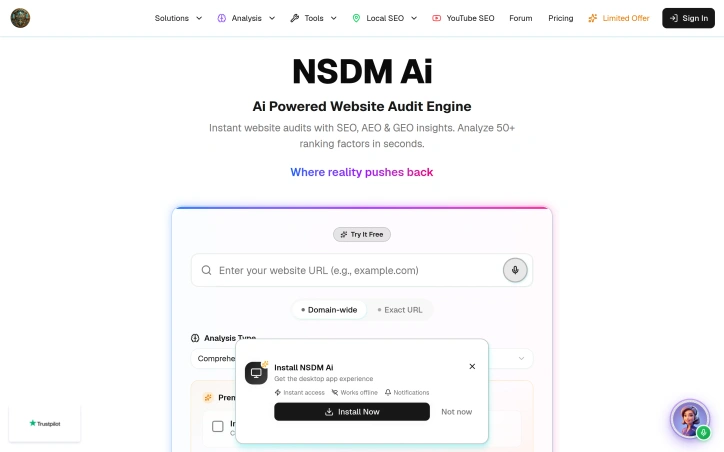
Optimizing a website for search engines is a complex task that involves analyzing numerous factors to improve visibility and ranking. NSDM Ai addresses this challenge by providing an AI-powered website audit engine that assesses SEO, AEO, and GEO in a single click. The tool is designed for a diverse range of users, including freelance SEO consultants, marketing agencies, business owners, content creators, and startup founders. What stands out about NSDM Ai is its comprehensive analysis capabilities, which go beyond traditional SEO by also considering AEO and GEO. This is particularly valuable in today's digital landscape, where AI-powered answer engines and voice search are becoming increasingly important. The tool's AI-powered engine analyzes over 50 ranking factors in real-time, providing instant and actionable insights that are backed by visual evidence and competitive benchmarking. The key features of NSDM Ai include its ability to crawl actual HTML, measure Core Web Vitals, and validate structured data, all of which are presented in a detailed report with priority-ranked findings and step-by-step fixing methods. Users can also export PDF reports with white-label options, making it a useful tool for agencies and consultants. Notably, NSDM Ai offers its core features for free, with no requirement for credit cards or subscriptions, making it an attractive option for those looking to improve their website's performance without incurring significant costs. Overall, NSDM Ai is a powerful tool that simplifies the process of optimizing a website for search engines and AI-powered answer engines.

Organizing personal and professional relationships can be a daunting task, particularly when it comes to recalling important details about individuals and planning meaningful interactions. MatchMGT addresses this challenge by providing a personal CRM that leverages AI to help users stay on top of their connections. The platform is geared towards individuals who struggle to keep track of their contacts and relationships, often finding themselves sending messages to the wrong person or struggling to recall important details. What stands out about MatchMGT is its use of AI to analyze conversations and extract relevant information. Users can import their WhatsApp chats, and the AI will identify interests, personality traits, and suggest plans and conversation topics. This feature is particularly useful for those who want to deepen their connections with others. The platform also provides a calendar feature to track availability and schedule plans, as well as suggestions for local events and activities based on the user's interests. The platform's capabilities are further enhanced by its ability to provide recordatorios, or reminders, to help users stay in touch with their contacts. Additionally, MatchMGT offers a horoscope compatibility feature, which provides a fun and lighthearted way to explore relationships. The platform is powered by Claude, an AI technology from Anthropic, which enables the analysis of conversations and generation of insights. In terms of pricing, MatchMGT offers a free plan that includes up to five contacts, full profiles, a calendar of availability, chat analysis with AI, and suggestions for local plans. The platform does not explicitly outline its paid plans, but it is clear that the free plan is designed to give users a taste of the platform's capabilities. Overall, MatchMGT is a thoughtful solution for individuals looking to organize their relationships and deepen their connections with others.


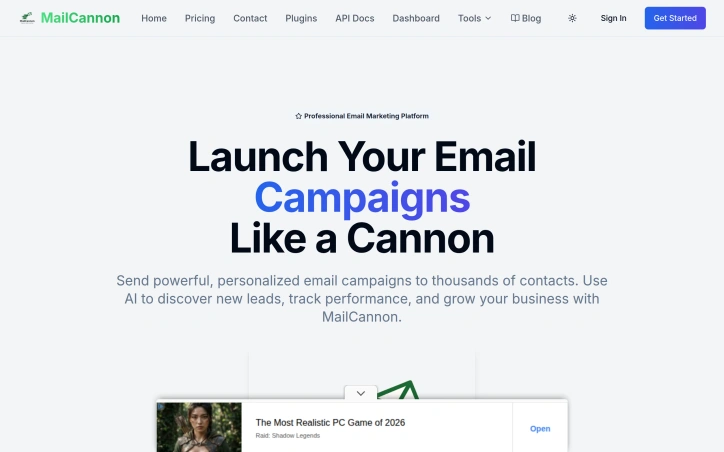
Email marketing is a crucial aspect of business growth, and managing it effectively can be a daunting task. MailCannon addresses this challenge by providing a comprehensive platform that enables businesses to launch powerful, personalized email campaigns to thousands of contacts. The platform is designed for businesses looking to streamline their email marketing efforts and leverage AI technology to discover new leads and track performance. What stands out about MailCannon is its robust use of AI-powered technology to simplify and enhance email marketing. The platform's AI agent can automatically extract contact information from multiple sources, including websites, Google Maps, and targeted audience criteria. This intelligent contact discovery capability saves businesses hours of manual work and enables them to focus on crafting effective email campaigns. The platform offers a range of key features that make email marketing effortless and effective. These include bulk email campaigns with advanced template customization and merge fields, contact management with CSV import and intelligent segmentation, and real-time analytics and tracking. Additionally, MailCannon allows users to utilize their own SMTP settings for complete control over email delivery and sender reputation. MailCannon offers a free forever plan with no credit card required, and setup can be completed in just two minutes. The platform also provides a range of other plans, with pricing details available on their website. With 10,000+ active users and over 1 million emails sent, MailCannon has established itself as a trusted solution for businesses worldwide. Overall, MailCannon is a powerful email marketing platform that is well-suited to businesses looking to scale their email campaigns and drive growth through AI-powered technology.

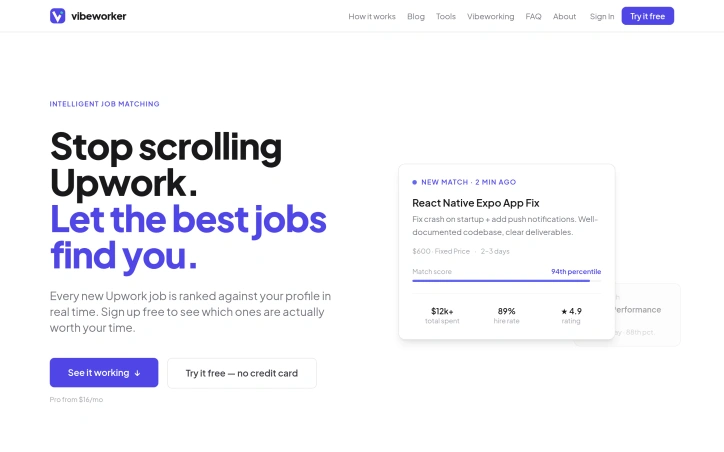
Freelancers on Upwork often struggle to find the right job opportunities before they're swamped with competition. The process of constantly refreshing the feed and sifting through numerous listings can be tedious and time-consuming, causing them to miss out on high-quality jobs. Vibeworker's AI-powered job matching technology addresses this issue by analyzing every new Upwork posting and identifying the ones that best match a freelancer's skills, experience, and strategy. What stands out about Vibeworker is its ability to look beyond mere keyword matching, instead evaluating factors such as client quality, scope clarity, and risk indicators to determine whether a job is a good opportunity. This approach enables freelancers to focus on the most promising jobs and avoid those that are vague or unprofitable. The platform offers different modes to suit various strategies, including Quick Wins for new freelancers looking to build their reputation, Skill Match for those seeking well-fitting work, and High Value for experienced freelancers who can be selective about the projects they take on. Vibeworker's matching technology is reportedly similar to that used by major companies like Google, Netflix, and Spotify, and it can pick up new job postings within minutes of their appearance on Upwork. The platform offers a free sign-up option, with its Pro version available from $16 per month. Overall, Vibeworker has the potential to save freelancers a significant amount of time and effort, and help them land better jobs on Upwork. By streamlining the job search process and providing more targeted opportunities, Vibeworker is well-suited to freelancers looking to optimize their workflow and build a successful career on the platform.
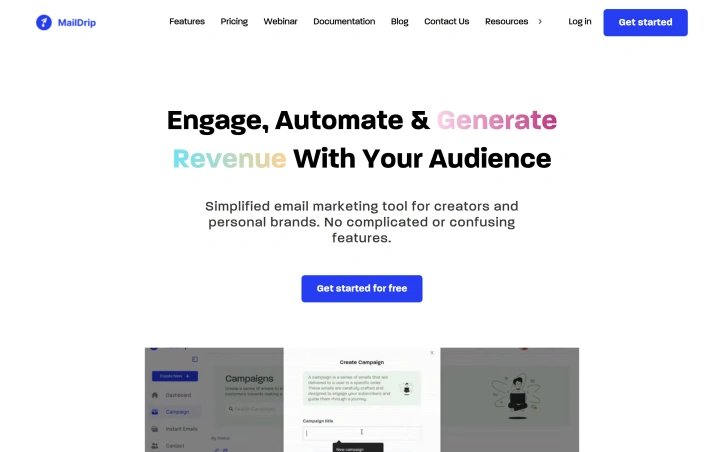
Simplifying email marketing for small businesses and creators is a crucial task, and MailDrip is a tool that aims to accomplish this. The problem it solves is the complexity of automation tools that often hinder businesses from effectively leveraging email marketing. It is designed for everyone from small business owners and solopreneurs to digital marketers and software developers, essentially anyone who believes in the power of email marketing. What stands out about MailDrip is its focus on simplicity and ease of use. It is designed with a clean and intuitive interface that allows users to write and create email campaigns freely and creatively. The tool is geared towards driving revenue and helping businesses reach their goals by streamlining email marketing efforts with automation and workflow capabilities. Key features of MailDrip include the ability to segment subscribers based on various criteria such as geo-location and interests, and to automate messages that are delivered to customers' inboxes at set intervals. It also offers robust analytics and reporting tools to track the performance of email campaigns. Additionally, MailDrip is designed to generate recurring revenue through drip campaign emails that can be set up to sell digital products and subscriptions over time. MailDrip's pricing model is noteworthy, as it offers a free account with access to 1,000 free emails and unlimited contacts, along with free in-built templates and email scheduling. The platform also operates on a Pay As You Go (PAYG) addon model, where users only pay for what they need. This flexible pricing strategy makes it accessible to businesses of various sizes and stages.

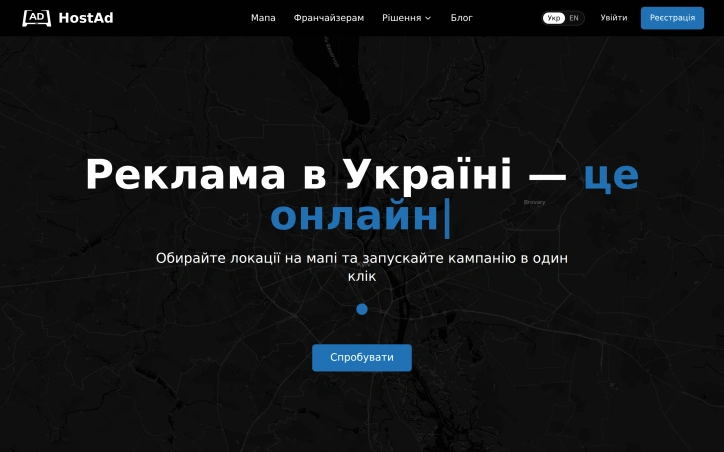
Digital advertising on public screens is a crowded and complex space, but one Ukrainian company is working to simplify the process for advertisers. HostAd is designed to make it easy for businesses to reach thousands of people daily with a streamlined and transparent process. At its core, the platform is geared towards advertisers in the offline sector, providing a straightforward way to launch targeted campaigns across various digital screens. What stands out about HostAd is its emphasis on ease of use and efficiency. The platform allows users to browse and select ad locations on a map, pay online, and track results in real-time, all within a single, user-friendly interface. This end-to-end digital experience eliminates the need for manual paperwork and minimizes the time required to launch a campaign. HostAd's intelligent scaling capabilities also enable advertisers to manage multiple campaigns from a single dashboard, automating routine tasks and freeing up resources for more strategic activities. The platform offers a range of features that support effective advertising, including detailed analytics, audience targeting options, and 24/7 support. Advertisers can access their campaign data and manage their accounts from anywhere, using a mobile device or computer. HostAd's transparent pricing model is also noteworthy, with no hidden fees or charges. While specific pricing details are not provided, the platform's minimum campaign budget is explicitly mentioned, giving advertisers a clear understanding of the costs involved. Overall, HostAd is a compelling solution for businesses looking to harness the power of digital advertising on public screens.

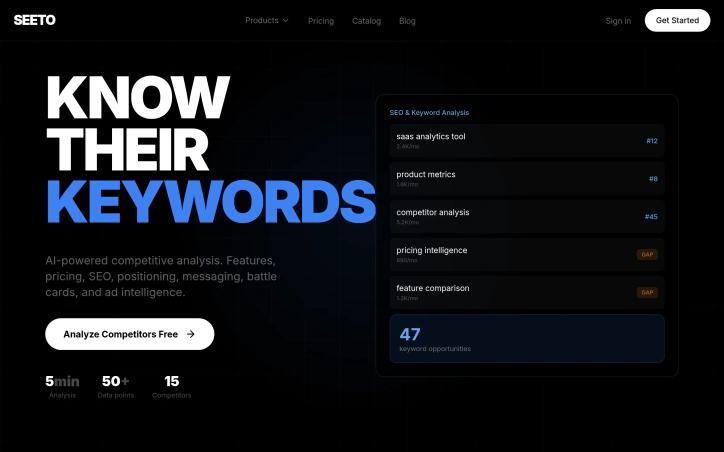
Competitor analysis is a crucial task for businesses, but it can be a tedious and time-consuming process. Seeto's AI-powered solution simplifies this task, providing actionable insights in minutes. The platform is designed for product teams, founders, CEOs, and marketing teams who need to stay ahead of the competition. What stands out about Seeto is its ability to automate the data collection process, eliminating the need for manual browsing, copying, and pasting into spreadsheets. The AI agent explores competitor websites, extracts relevant data, and compares it with the user's own product, providing a comprehensive analysis. The level of accuracy is impressive, with sources verified to ensure reliability. Seeto's key features include a feature comparison matrix, pricing intelligence, SEO insights, positioning analysis, and messaging differentiation. The platform provides a side-by-side comparison of features across competitors, helping teams identify gaps and opportunities. The data is presented in an interactive dashboard, making it easy to navigate and understand. The testimonials from satisfied customers demonstrate the value that Seeto brings to businesses. The feature comparison alone is worth the investment, according to one product manager. Others have reported significant benefits, including improved roadmap planning, 10x ROI on SEO insights, and avoiding underpricing by 40%. By streamlining competitor analysis, Seeto enables businesses to make informed decisions and stay competitive in their markets. With its robust capabilities and user-centric design, Seeto is an essential tool for teams that ship fast and compete to win.
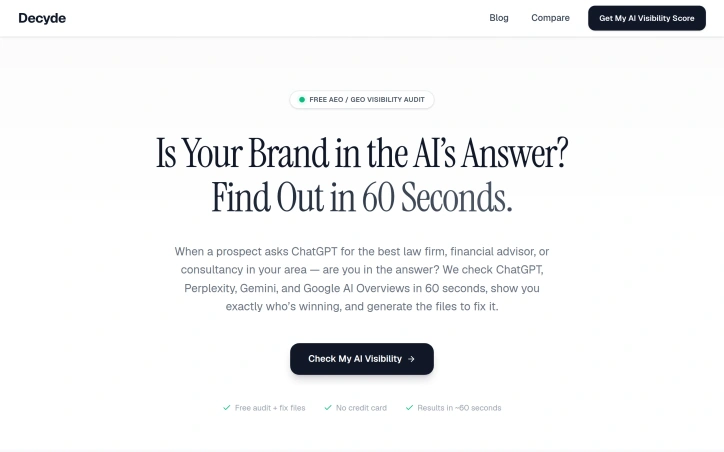
In today's digital landscape, businesses are increasingly reliant on AI platforms to drive customer engagement. However, manually monitoring brand visibility across these platforms is a time-consuming and incomplete task. Decyde's innovative solution addresses this issue by providing businesses with a comprehensive AI visibility tracking and AEO platform. The platform is particularly suited to local businesses and industries with high competition, such as law firms, financial advisors, and consultancies. What stands out about Decyde is its ability to scan multiple AI platforms, including ChatGPT, Perplexity, Gemini, and Google AI Overviews, in a mere 60 seconds. This rapid scanning capability provides businesses with a clear snapshot of their AI visibility score, benchmarked against their top competitors. The platform's detailed analysis includes a citation source map, highlighting the exact articles, Reddit threads, and review sites that each AI model is citing when recommending competitors. Decyde's key features include a personalized JSON-LD schema and llms.txt file generated for each business, allowing for easy implementation of recommended fixes to improve AI visibility. The platform also offers a local audit feature tailored to local businesses. By automating the process of tracking AI visibility, Decyde saves businesses time and provides actionable insights to enhance their online presence. Notably, Decyde offers a free AI visibility audit with no credit card required, giving businesses a risk-free opportunity to assess their AI visibility. While pricing details are not explicitly stated, the availability of a free audit suggests a potentially tiered business model. Overall, Decyde equips businesses with the tools necessary to optimize their AI visibility and stay ahead of the competition.

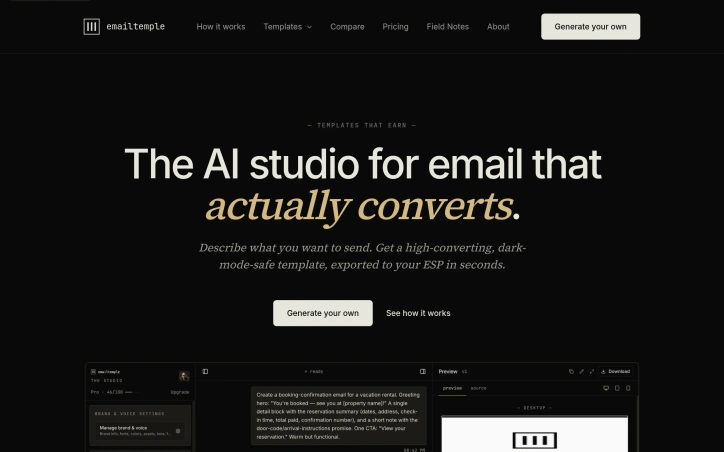
Crafting effective email campaigns can be a significant challenge for businesses, particularly when it comes to creating visually appealing and high-converting templates. EmailTemple addresses this issue by providing a streamlined solution for generating customized email templates that integrate seamlessly with various email service providers. The platform is designed for businesses that want to enhance their email marketing efforts without getting bogged down in the technical details of template creation. What stands out about EmailTemple is its AI-driven studio, which handles the intricacies of template design, including voice, color, images, and subject lines. Users can describe their email goals and audience, and the studio generates a polished template that reflects their brand's tone and style. The platform's ability to export templates in native syntax for popular email platforms like Mailchimp, ActiveCampaign, and MailerLite, as well as clean HTML for other providers, ensures compatibility and ease of use. EmailTemple's key features include a tone of voice setting that allows users to customize the language and style of their emails, a prompt library with pre-written briefs for common email types, and a media library that hosts user-uploaded images. The platform also applies brand colors and styles consistently throughout the template, ensuring a professional finish. By taking care of the technical aspects of template creation, EmailTemple enables businesses to focus on crafting compelling email content that resonates with their audience. The founder's frustration with existing AI email tools that failed to deliver on their promises of ease and compatibility is evident in EmailTemple's design. By rebuilding the pipeline around the specific needs of various email service providers, the platform delivers on its promise of a seamless, one-click export process. While pricing details are not explicitly mentioned, the platform's focus on delivering high-quality, brand-consistent templates that integrate with existing email workflows makes it an attractive solution for businesses looking to elevate their email marketing efforts.

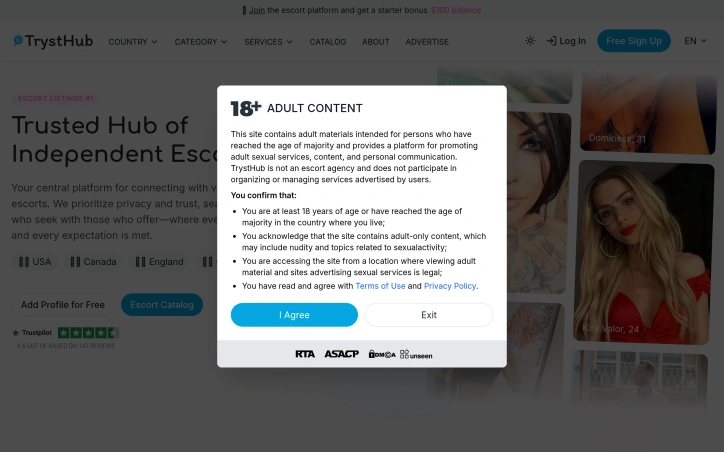
A centralized marketplace for independent escorts, TrystHub positions itself as a verified directory addressing the fragmentation and trust gaps that characterize the contemporary escort booking landscape. The platform serves both service providers seeking to build client bases and clients seeking vetted companions, operating across major markets in North America and Europe. The core appeal centers on verification. The platform emphasizes authenticated profiles—a notable differentiator in an industry historically plagued by scams and misrepresentation. TrystHub claims to verify profiles with real photos and guarantees service authenticity, a direct answer to client hesitation around fraudulent listings. The directory spans six escort categories: female, male, transgender, BDSM specialists, Asian, and same-day availability options, allowing users to filter by both service type and geographic proximity. Geographic coverage is substantial. Beyond broad regional categorization—USA, Canada, England, Germany—the platform supports local city-level search, with dedicated listings for Houston, Los Angeles, Washington, and multiple UK cities including London, Cambridge, and Manchester, alongside German markets like Berlin, Munich, and Hamburg. This geographic breadth suggests infrastructure designed for multinational operation and user convenience. From a business model perspective, TrystHub monetizes through provider acquisition. New users receive a $100 starter bonus upon joining, an incentive targeting both escorts establishing presence and clients discovering the platform. Beyond this promotional offer, specific pricing tiers and transaction fees remain unstated in available materials. The business model appears oriented toward commission or booking-based revenue, though explicit details are absent. The emphasis on privacy and trust recurs throughout messaging, addressing regulatory and reputational sensitivities central to this market segment. Real-time scheduling capabilities are positioned as a reliability signal, distinguishing active, responsive listings from outdated or non-responsive directories. What remains unclear is TrystHub's regulatory compliance strategy across fragmented jurisdictions. Escort service legality and platform liability vary significantly between the US, Canada, and European markets it serves. The platform's ability to sustain operations while navigating these legal variations will ultimately determine its viability. The verification infrastructure represents genuine technical and operational strength, yet broader platform success depends on regulatory resilience rather than feature set alone.
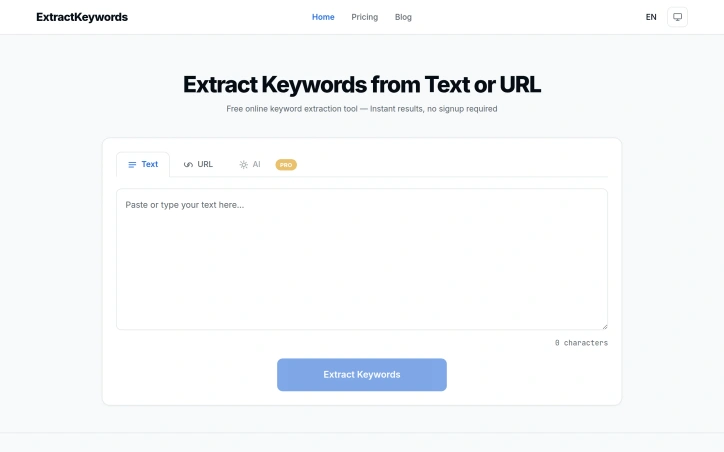
Keyword extraction is a crucial task for businesses and individuals focused on search engine optimization and content analysis, but manually sifting through text to identify key terms can be a tedious and time-consuming process. ExtractKeywords is designed to simplify this task, providing a straightforward solution for extracting keywords from text or URLs. The tool is geared towards individuals and businesses seeking to optimize their content and understand the dominant themes within their text. What stands out about ExtractKeywords is its ability to simplify the keyword extraction process without requiring users to sign up or navigate complex interfaces. The tool is designed to be user-friendly, allowing users to paste their text or enter a URL and receive instant results. The use of artificial intelligence for semantic extraction is also noteworthy, although this feature is reserved for Pro users. The tool's capabilities include word frequency analysis, stop-word filtering, and multi-word phrase detection, providing a comprehensive picture of a text's keyword profile. Users can view results sorted by frequency and density, filter by one-word, two-word, or three-word phrases, and export their findings as a CSV file or copy them to the clipboard. For URL extractions, the tool fetches the publicly accessible HTML of the webpage, respects robots.txt directives, and extracts the main text content before running the same keyword analysis used in text mode. The website does mention a Pro version with AI-powered extraction, indicating a freemium business model, but details on pricing are not provided. Overall, ExtractKeywords offers a valuable resource for those seeking to streamline their keyword extraction process and gain insights into their content.

The rise of AI-powered search engines is changing the way businesses approach online visibility. As traditional search results are replaced by AI-generated answers, companies must adapt to remain relevant. Engagemii's AEO Score addresses this challenge by assessing a website's visibility to AI engines like ChatGPT, Claude, and Perplexity. The tool is designed for businesses that want to stay ahead of the curve and ensure their online presence is optimized for the AI era. What stands out about AEO Score is its focus on the specific signals that AI engines use to determine which sources to cite. By analyzing 30 signals across six categories, the tool provides a comprehensive picture of a website's AI visibility. The score, ranging from 0 to 10, gives businesses a clear indication of their online presence and identifies areas for improvement. The tool's key features include instant scoring, detailed audit reports, and actionable recommendations for improvement. Businesses can receive a free AEO score in under a minute, without requiring an account or credit card. For those seeking more in-depth analysis, a $29 audit report is available, providing a breakdown of issues with severity tags. Additionally, a $99 + $49/month Fix-It kit offers customized JSON-LD, llms.txt, and robots.txt patches to help businesses optimize their websites. AEO Score highlights the differences between traditional SEO and AEO, emphasizing that the signals AI engines weight are distinct from those used by Google's 10-blue-links algorithm. As AI continues to reshape the search landscape, businesses that prioritize AEO will be better positioned to maintain their online visibility. With Engagemii's AEO Score, companies can take the first step towards optimizing their websites for the AI era.


Content creators face a consistent friction point: the moment of upload. With a finished video in hand, they scramble to write titles, descriptions, tags, and thumbnails across multiple platforms—often guessing at keywords before they even hit record, or panicking with generic text that doesn't match what viewers will actually see. VidSeeds.ai tackles this by analyzing finished video footage and generating platform-specific launch copy before posting. The product works as a three-step workflow: upload a completed video, receive AI-drafted titles (five options), thumbnail concepts (three options), descriptions, and tags tailored for six platforms (YouTube, TikTok, Instagram, Facebook, LinkedIn, and X), then edit and approve before anything goes live. The approach differs from keyword-optimization tools by anchoring all suggestions to what the video actually shows—the footage, spoken words, and scenes—rather than pre-guessed terms. This timing matters: creators can refine generated content while their video is still private, before commitment. The product includes some notable constraints designed for transparency. Videos aren't used to train public AI models. The company showcases only real creator examples from those who opted in, explicitly stating it does not use fake proof or inflated view counts. Human judgment remains central; the AI suggests, but creators choose what publishes. The free tier offers 50 "seeds" without requiring a credit card, letting users test the product on their own clips. A paid model exists with a 14-day money-back guarantee, though specific pricing tiers aren't detailed in the public messaging. The product supports 85 languages, expanding its potential addressable market beyond English-speaking creators. What's genuinely distinctive here is the shift in when and how metadata gets decided. Rather than asking creators to predict their audience's search behavior, VidSeeds asks them to approve text drafted from observed reality. For creators managing multiple platforms, the time savings of getting platform-specific versions in one upload could meaningfully reduce friction at a high-stakes moment—right before going live.