Catalyst Healthspan Audit
Personal trainers typically sell training sessions. This startup reversed the equation by building assessment first, mak...
Launchory
We built Launchory to solve the discoverability problem for startups. Our platform offers instant approval, permanent do...
Best Marketing & Sales Startups & Tools
Recently Listed
84 launches
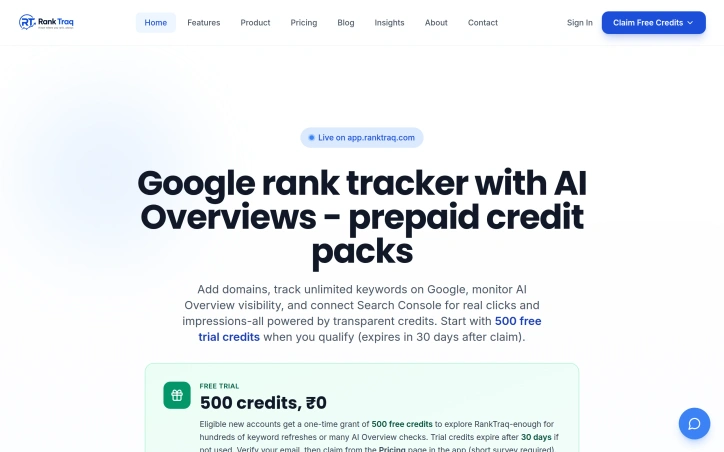
For SEO professionals in India, managing keyword positions and tracking visibility on Google has just gotten more straightforward. RankTraq addresses the issue of rigid subscription models and opaque pricing that often accompanies rank tracking tools. The platform is geared towards SEO teams who require a more flexible and transparent solution, particularly those dealing with fluctuating workloads or multiple client domains. What sets RankTraq apart is its prepaid credit system, allowing users to pay only for the services they need. This model is specifically tailored to the needs of Indian SEO agencies, freelancers, and in-house teams, who can top up their credits as required, avoiding unnecessary expenses during periods of low activity. The tool also integrates with Search Console, providing a more comprehensive view of keyword performance by pairing rank tracking with actual clicks and impressions. The platform's key features include the ability to track unlimited keywords across multiple domains from a single workspace, with a shared credit balance. Users can also monitor their visibility in Google's AI Overviews, a feature that is becoming increasingly important as Google's generative summaries alter how visibility is measured. Additionally, the transparent credit economics ensure that users are only charged for successful refreshes, with clear costs displayed before each run. New users can start with a one-time grant of 500 free trial credits, which is valid for 30 days. After that, they can purchase credit packs as needed, with the option to pay in rupees via Razorpay. The cost per credit varies, with keyword position checks using one credit per track and AI Overview checks using two credits per run. Overall, RankTraq offers a flexible and cost-effective solution for SEO teams seeking to manage their keyword tracking and visibility monitoring without the burden of inflexible subscription plans.

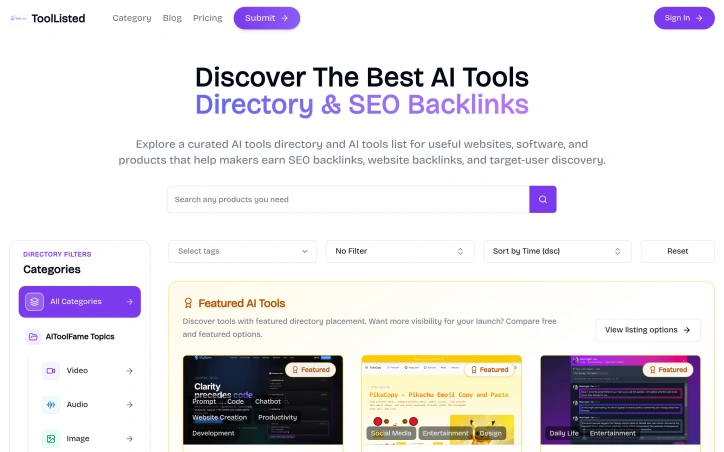
Independent developers and SaaS teams often struggle to get their products discovered by the right audience, and to improve their SEO visibility. ToolListed addresses this challenge by providing a curated directory for AI tools, web tools, and SaaS products, where makers can list their offerings and reach high-intent users. The platform is designed to help products stand out through structured listings that facilitate discovery and earn credible backlinks to support SEO growth. What sets ToolListed apart is its focus on creating a useful directory that is both human-friendly and optimized for search engines. By organizing listings into clear categories and tags, the platform enables users to browse and compare products with ease. The directory is not just a repository of links; it's a carefully curated collection of products that are presented in a way that complements the makers' own content and supports their SEO efforts. The platform offers features such as category-first navigation, which ensures that product pages and SEO backlinks remain aligned with search queries. Makers can submit their products once and refine their listings to reach the right users. The directory is particularly useful for indie maker tools, SaaS directory traffic, and AI tools list placement, as it provides a launch surface for early teams and supports startup directory storytelling. While the pricing details are not explicitly stated, eligible plans on the platform can earn contextual links that support off-page SEO signals. Overall, ToolListed provides a valuable resource for makers looking to increase their product's visibility and reach their target audience. By combining a directory experience with practical benefits for SEO visibility, ToolListed is a go-to platform for those seeking to get their products discovered.

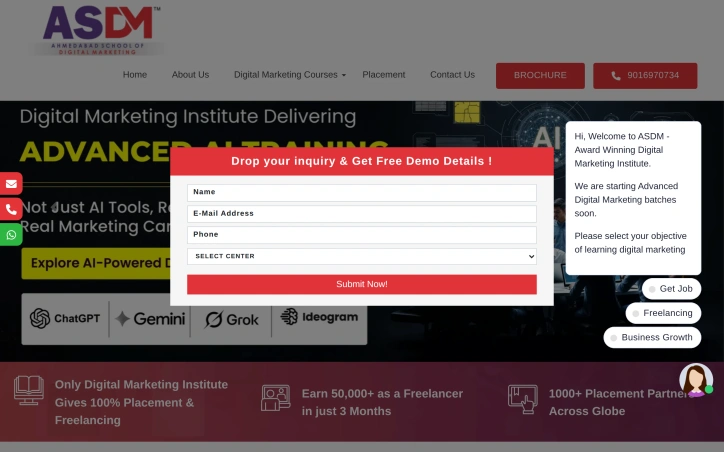
In today's competitive job market, acquiring the right skills is crucial for individuals looking to succeed in the digital marketing industry. ASDM's digital marketing course in Ahmedabad addresses this need by providing practical, job-oriented training designed to build real careers. The institute's expertise spans 14 years, with a proven track record of training over 2,00,000 students and achieving 50,000 successful placements. The standout aspect of ASDM's offering is its emphasis on hands-on training in areas such as SEO, social media marketing, Google Ads, and AI marketing tools, complemented by real client projects. This approach enables students to gain execution-ready skills, making them more attractive to potential employers. The institute's 100% placement support and freelancing opportunities further enhance its value proposition. ASDM's courses cater to a diverse range of learners, including students, working professionals, entrepreneurs, and business owners, with flexible batch timings to accommodate different schedules. The institute offers two primary programs: a 5-month AI-integrated advanced digital marketing program and a 1-year premium professional digital marketing course with advanced AI training. Both programs include features such as classroom training, practical assignments, interview preparation, and mentorship support. With a strong reputation as a leading digital marketing institute in Ahmedabad, ASDM has garnered a 4.9+ rating, underscoring its commitment to delivering high-quality education. By providing a comprehensive and industry-focused curriculum, ASDM equips its students with the skills necessary to succeed in the digital marketing landscape, with average packages ranging from 4L to 6L per annum for its premium course. Overall, ASDM's digital marketing course is a compelling option for individuals seeking to acquire in-demand skills and launch a successful career in the industry.

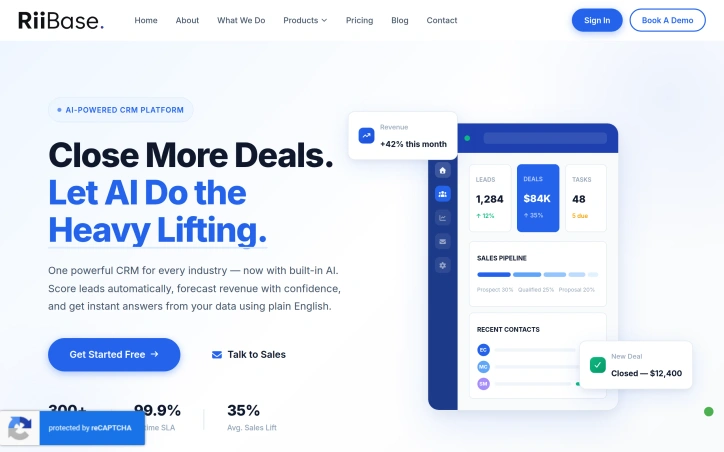
Businesses struggling to manage fragmented customer data and inefficient sales processes have a potent solution in Riibase, a comprehensive CRM platform designed to streamline customer relationships and boost sales. The creator's vision is to empower businesses to make smarter decisions and drive growth through intelligent insights and automation. Riibase is geared towards modern businesses across various industries, including e-commerce, insurance, and healthcare, who need a unified platform to manage customer interactions and sales processes. What sets Riibase apart is its built-in AI capabilities that work directly on customer data without requiring integrations or setup. The AI-powered features, including lead scoring, forecasting, and an AI assistant, enable businesses to score leads automatically, forecast revenue with confidence, and get instant answers to queries about their data using plain English. The platform's ability to provide human-readable reasons for every lead score and generate downloadable PDF reports for forecasting adds to its utility. Riibase offers a complete CRM solution, encompassing customer contact management, sales pipeline automation, and multi-channel integration. The platform's predictive analytics and customer behavior insights powered by machine learning facilitate informed decision-making. With 300+ businesses already trusting Riibase, the platform claims an average sales increase of 35% and a 99.9% uptime SLA. While pricing details are not explicitly stated, Riibase invites potential customers to "Get Started Free" or "Talk to Sales," suggesting a flexible business model. Overall, Riibase is a robust CRM solution that harnesses the power of AI to drive business growth and customer engagement.

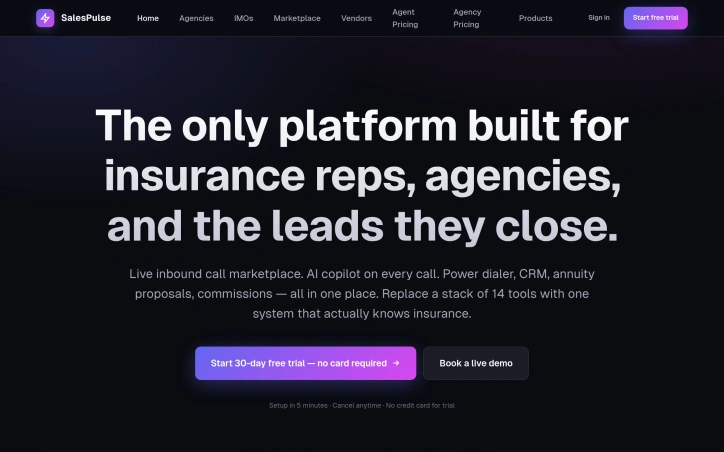
Insurance professionals often juggle multiple tools to manage their sales process, from CRM and phone systems to dialers and lead management. SalesPulse addresses this complexity by providing a single platform tailored to the needs of insurance reps and agencies. The platform is designed to streamline operations, enabling users to close more policies efficiently. What stands out about SalesPulse is its focus on the insurance industry, offering features that are built specifically for this vertical rather than being retrofitted from more generic solutions. The platform includes a live inbound call marketplace, AI-powered copilot on every call, a power dialer, CRM, and annuity proposals, all integrated into one system. The AI copilot provides real-time transcription, tone analysis, and suggested rebuttals during calls, enhancing the sales process. The platform's telephony stack is carrier-grade, and it includes features like SHAKEN/STIR and local presence out of the box. Additionally, SalesPulse offers state-license and vertical filtering on every call ping, ensuring that users receive relevant leads. The platform also includes smart quoting capabilities, allowing users to pull live rates from various carriers and compare them side-by-side. SalesPulse operates on a bill-on-bridge model, where users pay only when a call is successfully connected, with no minimums or per-lead credits required. The platform also absorbs the cost of zero-value calls, providing a transparent pricing model. Overall, SalesPulse presents a compelling solution for insurance professionals looking to simplify their tech stack and improve sales efficiency.
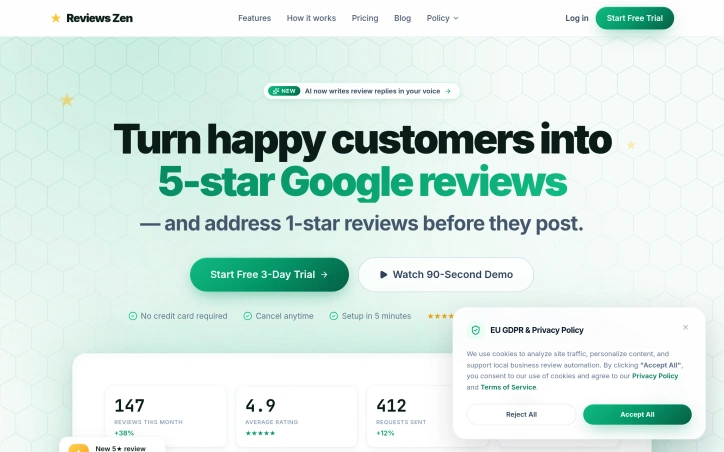
Local businesses struggle to maintain a strong online reputation, often losing customers due to a mismatch between their service quality and online reviews. Reviews Zen is designed to address this issue by automating review management for local businesses across various niches. The platform acts as a reputation autopilot, streamlining the process of generating and managing online reviews. What stands out about Reviews Zen is its use of AI to write review replies in the business owner's voice, significantly reducing the time and effort required to respond to customer feedback. The platform's ability to catch negative reviews privately and respond promptly is particularly valuable, as it helps mitigate the damage caused by unfavorable reviews. The key features of Reviews Zen include its branded email funnels, which send review requests to customers under the business's name and branding, and its negative-review interceptor, which captures low-rated feedback before it appears on Google. The platform also integrates with various business tools, such as Jobber and QuickBooks, to simplify the process of importing customer data and automating review requests. Reviews Zen offers a straightforward pricing model, with a starter plan available for $29 per month for a limited time as part of its founders' launch offer, which normally costs $79. The platform provides a three-day free trial with no credit card required, and customers can cancel their subscription at any time. Overall, Reviews Zen is a compelling solution for local businesses seeking to improve their online reputation and attract more customers through positive reviews.
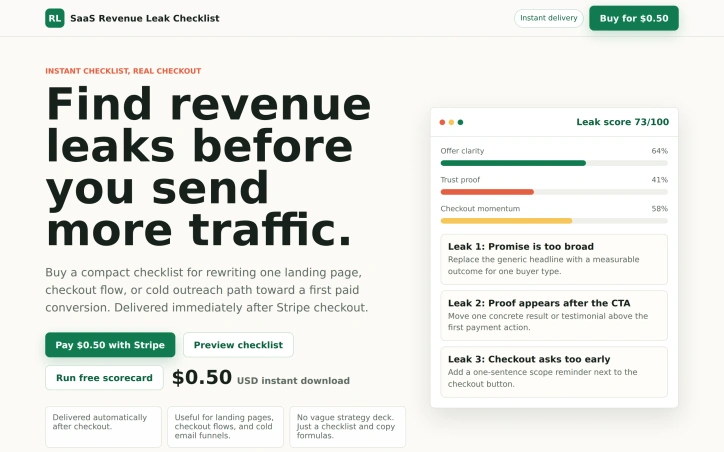
Founders and indie makers often struggle to optimize their conversion funnels, resulting in lost revenue. The Revenue Leak Scorecard is designed to help identify and fix these leaks. It is a conversion triage tool that assesses key areas such as buyer clarity, proof before checkout, and trust friction, providing a score and highlighting missing elements that hinder conversions. What stands out about this product is its straightforward and practical approach. The scorecard is free, and it provides a clear and actionable score that users can copy. For those willing to pay a minimal fee of $0.50, a comprehensive checklist is available, offering a step-by-step guide to rewriting their landing page, checkout flow, or cold outreach path. The product's key features include its ability to evaluate conversion basics, providing a score and identifying areas for improvement. The paid checklist includes copy formulas, trust checks, and paid-trigger prompts, all designed to help users tighten their conversion paths. The checklist is delivered immediately after payment via Stripe, and users can access it without providing any additional information. The pricing model is simple: the scorecard is free, and the detailed checklist costs $0.50. This low-cost upgrade offers significant value, as it provides users with a clear plan to optimize their conversion funnels. Overall, the Revenue Leak Scorecard is a valuable resource for founders and indie makers looking to maximize their revenue by identifying and fixing conversion leaks. Its practical approach, combined with its affordability, makes it an attractive solution for those seeking to improve their online sales and marketing efforts.

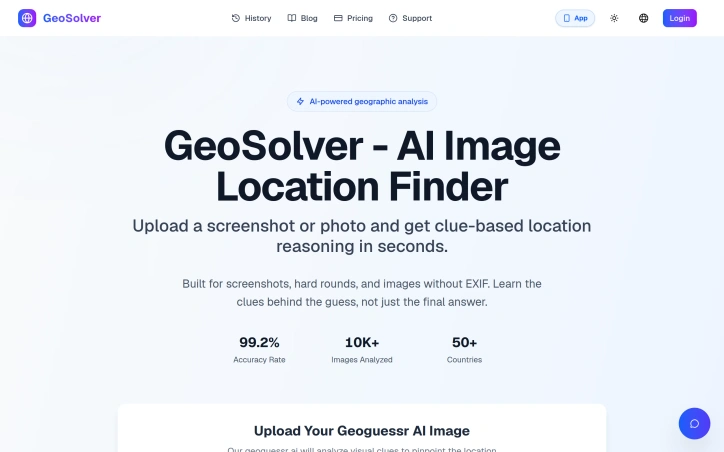
For enthusiasts of geo games and geographic analysis, manual guesswork is a thing of the past thanks to an innovative AI-powered solution. The problem it tackles is the tedious and often inaccurate process of identifying locations from images, a task that requires a deep understanding of geographic clues. This product is specifically designed for users who engage in geo games, such as Geoguessr, and need to rapidly and accurately pinpoint locations. What stands out about this solution is its ability to not only provide an answer but to explain the reasoning behind its guess. Powered by the advanced Gemini 3.1 Pro vision model, it analyzes dozens of meta clues within an image to deliver expert-level geographic analysis. With an impressive 99.2% accuracy rate in identifying the correct country, it has already been tested on over 10,000 images across 50+ countries. The level of detail it offers is remarkable, making it an invaluable tool for those looking to improve their geographic analysis skills. Key features include its capability to work with images lacking EXIF data, its systematic analysis of various geographic indicators such as road infrastructure, signage, and architecture, and its ability to provide detailed regional analysis. Users can even preview key location clues before deciding to upgrade, although full location details and complete reasoning are reserved for premium plan subscribers. By providing a learning experience rather than just a straightforward answer, this product educates users on the patterns and clues that experts rely on, effectively acting as a personal tutor for geographic analysis. The solution's focus on education and skill improvement sets it apart from being merely a 'cheat tool', instead positioning it as a serious learning aid for geo game enthusiasts.
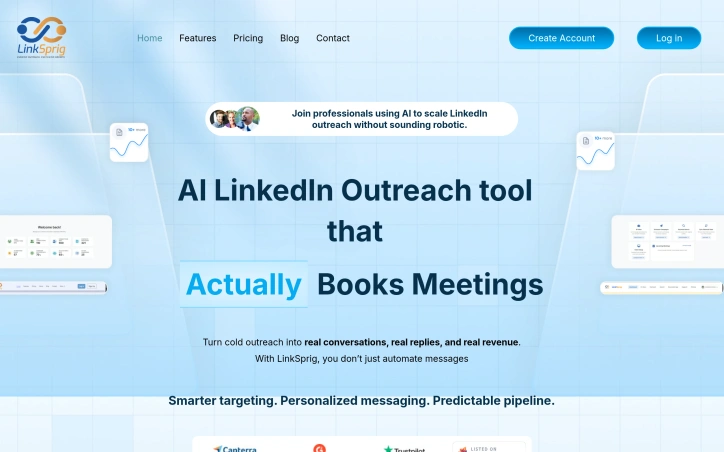
Sales teams and professionals struggling to make meaningful connections on LinkedIn can breathe a sigh of relief with the introduction of AI-powered outreach solutions. LinkSprig is one such innovative tool designed to help businesses, founders, agencies, and sales professionals simplify lead generation and grow their network efficiently. The platform is geared towards individuals tired of spending hours sending cold messages and chasing lukewarm leads, seeking a more streamlined and effective approach to LinkedIn outreach. What sets LinkSprig apart is its focus on results-driven outreach rather than sheer volume. By leveraging AI to analyze industries, roles, and interests, the platform delivers hyper-relevant leads, ensuring that users are targeting the right audience. The AI-powered personalization of messages and auto-reply assistant enable users to scale their outreach efforts without sounding robotic, making interactions feel more human-like and authentic. The platform's capabilities are geared towards making the outreach process more efficient and effective. It offers smart lead targeting, custom AI outreach messages, and an auto-reply assistant that responds to incoming messages naturally. Additionally, LinkSprig's CRM-friendly integration allows users to export leads, track responses, and monitor outreach performance seamlessly. The AI-powered analysis provides valuable insights into what works in outreach efforts, including reply rates, message performance, and conversion insights. LinkSprig is designed for founders, SDRs, and growth professionals, positioning itself as a solution that can help these individuals start real conversations, increase reply rates, and turn cold outreach into pipeline. Although the pricing details are not explicitly mentioned, the platform invites users to try it for free, giving them a chance to experience its capabilities firsthand. Overall, LinkSprig presents a compelling solution for those seeking to transform their LinkedIn outreach into a more natural and efficient business growth process.

For businesses and agencies struggling to produce high-quality ad content at scale, SodaMarketing AI offers a compelling solution. The company's AI-powered creative studio addresses the long-standing issue of "The Creative Gap," where the demand for engaging ads outstrips the capacity to produce them. By leveraging cutting-edge technology, SodaMarketing AI enables users to generate hyper-realistic UGC video ads, cinematic commercials, and branded social content in a matter of seconds. What stands out about SodaMarketing AI is its ability to transform a simple product URL into a wide range of ad creatives. The platform's AI extracts key product features, brand identity, and images, allowing users to create diverse content without extensive manual input. The quality of the generated content is also noteworthy, with features like perfect lip-sync and 4K studio photoshoots that rival professional productions. The platform's capabilities are impressive, with features such as Exclusive AI Ambassadors, Omnichannel Ad Engine, and Cinematic Product Stories that enable users to create high-performing ad content. Users can also extend their videos up to 2 minutes with a single click, allowing for more nuanced storytelling. Additionally, the Auto-Prompt Engine simplifies the content creation process by automatically generating professional-grade cinematic instructions. SodaMarketing AI's pricing is straightforward, with a Pro plan available for $29 per month after a $1 trial. The trial includes 250 high-performance credits, giving users a taste of the platform's capabilities. Annual billing is also available, with a 30% discount. Overall, SodaMarketing AI has the potential to revolutionize the way businesses and agencies approach ad content creation, offering a powerful tool that can help them dominate their market without breaking the bank.


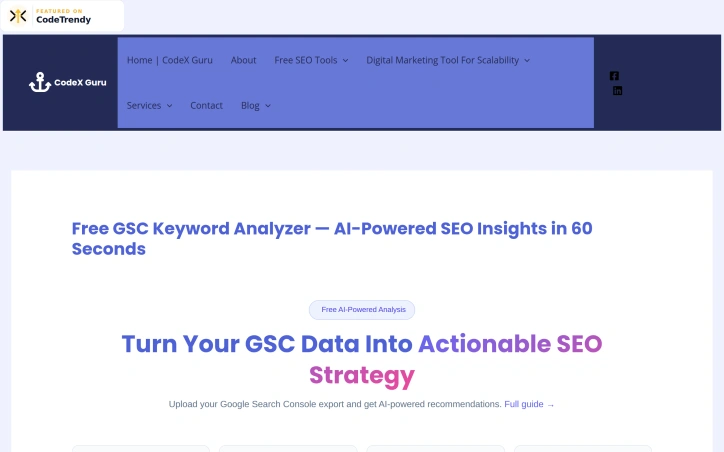
SEO practitioners drowning in raw Google Search Console data now have a way to extract actionable insights without manual analysis. CodeX Guru's free keyword analyzer transforms GSC exports into structured intelligence, using GPT-4o to recommend specific optimizations based on each site's actual search performance. The problem this solves is obvious: GSC gives you the data, but interpreting what to do with it requires expertise. Most site owners can see they rank for keywords in positions 4–20, but lack a systematic way to prioritize which ones to optimize. This tool automates that triage, categorizing keywords into "Quick Wins" (near-top-3 rankings requiring minimal effort), "Content Gaps" (high impression keywords with poor click-through rates), and other strategic buckets. The AI-generated strategy report then ties recommendations back to the actual keyword data rather than offering generic advice. What stands out is the privacy-first approach. Uploaded files are processed in memory and deleted immediately—there's no data retention, logging, or third-party sharing. For an SEO tool handling competitive search metrics, this transparency is uncommon and valuable. The tool also handles multiple file formats (CSV, XLSX, XLS) and caps file size at 10MB, making it accessible to businesses of all sizes. The interface emphasizes speed and visual clarity. Analysis completes in 30–60 seconds, and results display across six charts covering position distribution, CTR buckets, competitor benchmarks, and the relationship between rankings and click-through rates. This visual breakdown gives users the context they need to decide which keywords deserve content investment. The business model stacks a free tier (two analyses per day) against a Pro upgrade for unlimited analyses, team access, and automated weekly reporting. This is a straightforward freemium approach that lets users validate the tool's value before paying. The founder positions this as part of a broader initiative to democratize SEO expertise and help practitioners access specialized knowledge. The main limitation is the free tier's daily cap—serious SEO teams analyzing multiple sites would likely need Pro access quickly. Still, for individual site owners or small agencies testing keyword strategies, the free offering is substantial enough to determine whether the tool fits their workflow. The combination of privacy, speed, and GPT-4o-powered analysis makes this a practical addition to most SEO stacks.
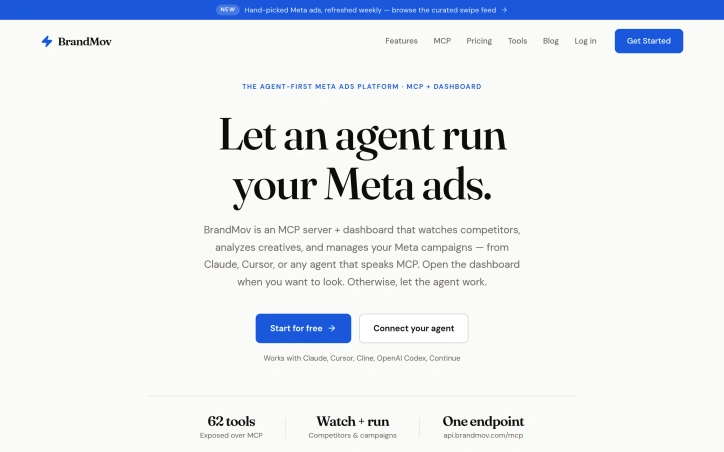
Managing Meta ad campaigns at scale combined with competitive intelligence typically demands substantial human effort—analysts spend hours tracking competitor moves, evaluating creative performance, and manually optimizing ad sets. BrandMov targets growth teams, performance marketers, and founders who want to offload this research and execution burden to AI agents while maintaining strategic control. The product takes an agent-first architecture: it's built as an MCP server with 39 exposed tools, allowing any compatible AI agent (Claude, Cursor, Cline, Continue, and others) to watch competitors, pull creatives on schedule, and manage Meta campaigns directly through a single API endpoint. This is distinctive—rather than building another dashboard-first tool that happens to work with agents, BrandMov inverts the priority. The agent is the primary interface; the dashboard is a secondary view for human review and intervention. The standout capability is real-time competitor monitoring. Teams can set up watchlists to track advertiser activity, and agents autonomously scan for new creative patterns, score them against frameworks like Hook-Hold-Click-Buy, and alert when meaningful shifts emerge. This transforms competitive intelligence from a manual research task into continuous background work. The system ships with curated DTC watchlists, reducing setup friction. The dashboard maintains alignment between human intent and agent execution. Everything an agent does—watched competitors, collected creatives, campaign changes—flows into the dashboard with AI-generated analysis already rendered. This bidirectional model lets teams steer via chat or dashboard interchangeably; they're viewing and controlling the same underlying data. The technical implementation is pragmatic. Rather than requiring SDK installation or proprietary integrations, BrandMov exposes its surface through a single streamable HTTP endpoint that speaks the MCP protocol—an emerging standard for agent tool access. This positions it to work with whatever AI platforms teams already use without vendor lock-in. The core value proposition targets a genuine pain point: growth teams spend substantial time on competitive analysis and campaign management work. By delegating routine competitor monitoring and campaign optimization to agents, teams reclaim bandwidth for strategic decisions. The architecture trusts agents to handle execution while humans maintain directional control. The product is available free to start.

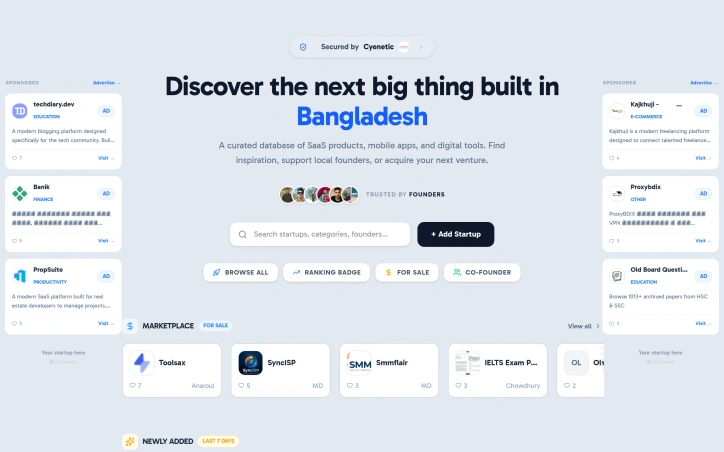
Bangladeshi SaaS builders finally have a stage that speaks their language. Home-grown ventures now face the daily struggle of getting noticed once they leave small chat groups and lean-meetup circles; global launchpads overflow with Silicon Valley flash and foreign celebrities, leaving local founders shouting into the void. BD SaaS Zone corrals that scattered audience into one easy-to-scan gallery, giving each product oxygen instead of noise. The directory is deliberately narrow in scope: real SaaS, mobile apps, and digital utilities that ship from Bangladesh. Every listing is curated first, which keeps the pixel-brochure clutter down to zero and ensures the feed stays focused on working products rather than pitch decks. Visitors come looking for quick inspiration, teammates, or acquisition targets; founders arrive to plant a flag and stay visible long after launch-day buzz fades. Nothing fancy or bloated: a simple search, taxonomy filters covering fourteen niches from AI to HR, and cleanly marked “For Sale” or “Seeking Co-Founder” tags when the listing signals intent to exit or scale. Pricing clings to reality—one advert slot in the sponsored marquee costs exactly ৳120 per month, a figure that fits better coffee than most AWS bills. Founders can also claim a discount on security audits through the site’s partnership with Cyenetic Solutions, a welcome perk at a stage where every saved taka goes toward product polish. For now the site stays refreshingly minimal: add your startup, grab the ranking badge code, and let organic traffic do the rest. Early adopters get prime category placement before every vertical is filled, making the current moment unusually favorable for anyone shipping code from Dhaka, Chittagong, or Sylhet.

Marketing teams waste thousands of hours juggling design tools, video editors, copywriting platforms, and scheduling software. Kumba consolidates these into a single AI-native workspace that handles the entire content creation pipeline—from initial concept to cross-platform publishing. The platform targets marketing departments stretched thin by rising content demands. Agencies can amplify client output without expanding headcount. Brands managing multiple product lines gain centralized control over creative consistency. Startups with limited resources access enterprise-grade content production. Retail businesses can refresh campaigns at the velocity modern commerce demands. What distinguishes Kumba is its scope. Rather than offering point solutions, it generates visuals, video, copy, and music simultaneously from simple text prompts. The platform operates through three modalities: Power Studios for rapid asset generation, Automated Workflows for structured production of product videos and professional advertisements, and AI Agents that guide users through the ideation-to-publication journey. This breadth eliminates the friction of switching between specialized tools. The publishing layer compounds the efficiency gain. Kumba adapts content for platform-specific requirements—adjusting dimensions, format, and messaging for Instagram, Facebook, LinkedIn, and TikTok. It publishes across all channels from a single action, reducing the manual labor that typically consumes half of a marketer's creative workflow. The platform demonstrates this capability by generating variations of identical product messaging tailored for each platform's audience and medium. The platform serves established users across 1500+ countries and has generated over 100,000 AI assets. Its accessibility—offering a free trial without requiring payment information—lowers the barrier to evaluation. Kumba's positioning hinges on a straightforward value exchange: it promises to compress weeks of cross-functional creative work into minutes while maintaining brand consistency. For organizations that consistently generate content, the leverage is substantial. The claim of delivering 10x output without 10x headcount rests on reducing friction at every stage, from ideation through publication. The platform operates without disclosed pricing tiers in available materials, though the free tier appears calibrated to demonstrate core capabilities. Teams evaluating Kumba will need to assess whether the AI-generated content meets their brand standards and whether the automation genuinely replaces their existing tool stack or supplements it.

Training new call center agents has historically been one of the most painful bottlenecks in customer service operations. Faced with high turnover, lengthy onboarding periods, and real damage to customer satisfaction metrics, supervisors and training managers have long needed a way to prepare agents safely before they ever touch a live call. Call Flow addresses this fundamental gap. The product is built on a founding insight grounded in eight years of hands-on call center experience. The platform creates a simulated environment where agents can practice realistic scenarios with AI-powered counterparts before facing actual customers, moving beyond script-based training alone. This addresses a critical training blind spot: most programs lack any mechanism for agents to safely fail and learn from mistakes. The founder's frustration watching talented people crumble under the pressure of their first difficult call resonates with the core pain point that the product solves. What distinguishes Call Flow is its focus on the psychological and conversational dimensions of call center work, not just product knowledge. The platform evaluates agents across empathy, clarity, objection handling, de-escalation, and compliance—dimensions that are difficult to assess in traditional training programs but critical to customer retention and reputation. This suggests the platform understands that customer service failures often stem from how something is communicated, not just what is communicated. The product also addresses the supervisor's pain in the current system. Rather than spending hours reviewing recordings after calls have already damaged relationships, managers gain visibility into agent readiness before it matters. Custom scenario building means training can be tailored to specific product lines, customer segments, or known pain points rather than relying on generic curricula. This directly bridges the gap between simulation and operational reality. The founding motivation reveals a clear market opportunity: the call center industry continues to operate training methods that lag behind other high-stakes professions. Pilots train in simulators. Surgeons practice on virtual patients. Yet the role that often determines customer lifetime value—the frontline agent—has historically remained immune to this kind of realistic, safe practice environment. Call Flow fills that void by bringing simulation-based training to an industry where the cost of learning on the job has long been accepted as inevitable.


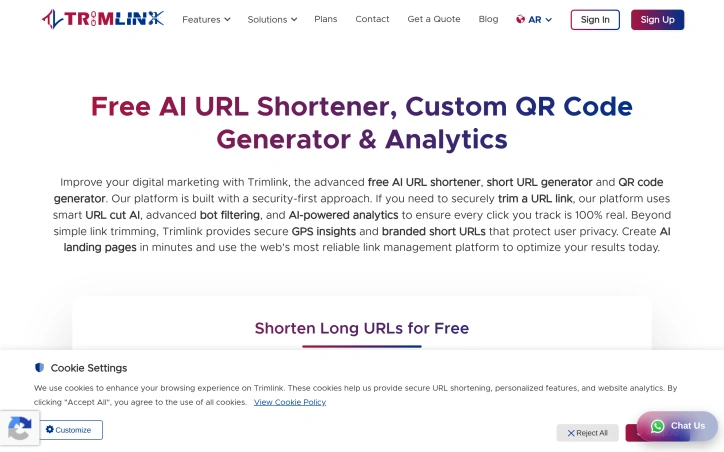
Marketing teams operating without clean analytics data make decisions in the dark. This core frustration drives Trimlink, a URL shortening platform built explicitly for professionals who refuse to act on inflated click metrics. The problem isn't new—most link shorteners fail to distinguish legitimate user clicks from bot traffic, corrupting the data that campaigns depend on. Trimlink addresses this by integrating bot filtering directly into its analytics engine, ensuring that every metric reflects real human behavior. The platform positions itself as a Bitly and Rebrandly alternative aimed at two segments: established marketing organizations that demand accuracy at scale, and startups seeking reliable link management without premium price tags. A free tier provides basic link shortening and QR code generation, with premium plans unlocking advanced capabilities. The company emphasizes this freemium model as democratizing tools previously locked behind expensive enterprise subscriptions. Beyond bot filtering, Trimlink's feature set reveals an attempt to build a complete link management ecosystem. GPS and geolocation analytics let marketers understand not just whether a link was clicked, but where. UTM parameter tracking integrates with standard campaign attribution workflows. Live traffic dashboards provide real-time engagement visibility. The platform supports branded custom domains to reinforce brand consistency in shortened links, addressing a key complaint about generic shorteners that dilute brand identity. AI-powered landing page creation and bulk import functionality extend the product's scope beyond simple link trimming. Where Trimlink distinguishes itself is in combining these features with an explicit security and privacy orientation. The company foregrounds bot detection and malicious URL checking rather than treating them as afterthoughts. For marketing teams evaluating alternatives to established players, this emphasis on data integrity could prove decisive. The integration of QR code generation, survey builders, and user access controls suggests the company is competing on comprehensiveness rather than simplicity. The platform's free tier removes friction for exploration, though specifics on premium pricing remain undisclosed in available materials. For agencies and marketing departments frustrated by click inflation and inaccurate campaign attribution, Trimlink presents a credible alternative worth testing.

Manual trend discovery on TikTok remains a time-intensive bottleneck for content creators and marketing agencies. Identifying which hashtags, sounds, and video formats are gaining momentum requires hours of platform scrolling—and by the time patterns emerge, competitors have already moved in. TrendStack automates this workflow by scraping TikTok every two days, extracting trending data from specific niches, and delivering structured reports via email. The product targets three distinct personas with differentiated messaging. Agencies receive data-backed campaign briefs complete with examples of working videos, replacing guesswork with concrete reference material. Social media managers gain pre-assembled content calendars, eliminating the "what should I post?" paralysis. Individual creators learn which sounds and video structures are ascending before saturation occurs, enabling them to adapt trends with authenticity rather than imitation. TrendStack's feature set reflects strategic prioritization. Standard reports include top hashtags with volume estimates, trending sounds with artist attribution, and emerging video formats. The Pro tier adds creator profiles and cross-referenced web context. The Premium tier introduces forward-looking tools: pre-written content scripts and 48-72 hour trend predictions. This progression from data observation to actionable templates reduces the gap between trend identification and content production. Operationally, the product's biweekly update cycle differentiates it from slower alternatives. TikTok trends accelerate at platform speed, not monthly reporting speed—and the two-day refresh rate keeps pace with that velocity. The immediate delivery of a current report upon signup removes waiting periods and allows users to extract value from day one. Pricing starts at €9.99 monthly for single-niche access, scaling across Basic, Pro, and Premium tiers to accommodate different team sizes and strategic needs. The underlying assumption—that systematized trend detection creates competitive advantage—has intuitive appeal. Whether the product delivers hinges on two critical factors: the accuracy and completeness of its underlying scraping and analysis, and how quickly users can execute on insights before broader market adoption neutralizes the lead. For fast-moving content teams, the velocity advantage may be decisive. For others, the value depends entirely on the quality of trends captured and the actionability of resulting recommendations.


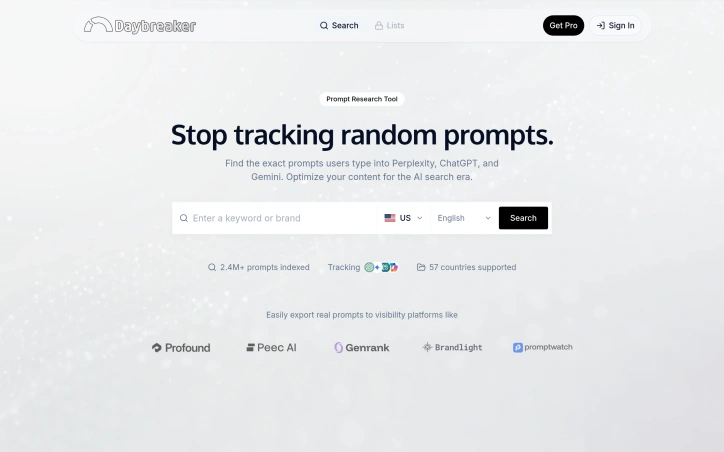
Understanding what users ask AI search engines is becoming critical for content creators and businesses navigating the rise of conversational AI. Daybreaker tackles this problem directly by aggregating and analyzing the actual prompts people enter into Perplexity, ChatGPT, and Gemini—providing visibility into search behavior that was previously hidden from most organizations. The core insight is straightforward but valuable: if content and products are to be discoverable in an AI-first world, creators need to know how people phrase their searches in these new interfaces. Traditional search engine optimization focused on keyword analysis and ranking factors. Daybreaker shifts that lens to conversational queries, revealing the natural language patterns that drive AI search results. This data becomes particularly useful for companies trying to optimize their content strategy for discovery within AI systems rather than just traditional search rankings. The target audience is content marketing teams, SEOs transitioning to AI search optimization, product teams, and publishers seeking to understand how their audience formulates questions. Rather than guessing how to position content, these users can work from actual user behavior data. The tool addresses a real gap: while keyword research tools have long served traditional search, few solutions exist for understanding the conversational dynamics of AI search engines. What distinguishes Daybreaker is its specificity. Rather than offering a generalized analytics platform, it concentrates narrowly on a single, increasingly important problem—prompt discovery. This focus is both its strength and its limitation. The tool doesn't claim to optimize AI search results or rank content; it provides the foundational data for doing so. Users will need to synthesize these insights themselves. The product arrives at a logical inflection point in internet history. As Perplexity, ChatGPT, and Gemini capture an increasing share of informational queries that once went to Google, understanding that shift becomes essential for anyone trying to reach audiences through search. Daybreaker essentially provides the research layer for the AI search era—allowing organizations to move beyond assumption-based content strategy to one grounded in actual user behavior.

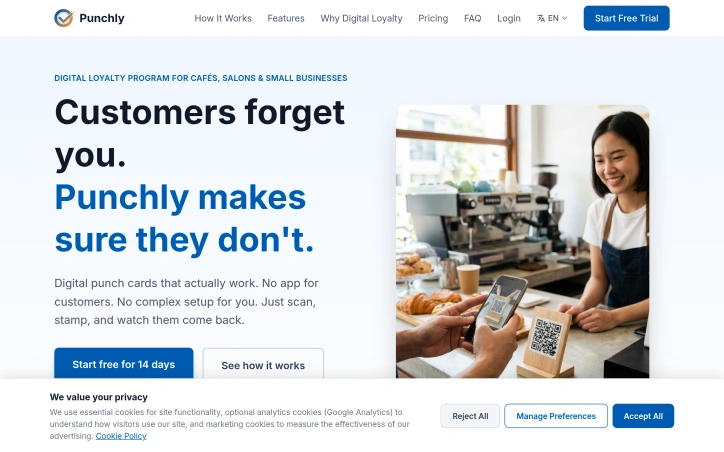
Small business owners have long struggled with loyalty programs that either fail to curb fraud or demand complicated infrastructure. Punchly addresses this gap by offering a straightforward digital punch card system that requires nothing from customers beyond a smartphone camera. The platform eliminates the friction that makes most loyalty solutions impractical for solo proprietors and lean teams. The product's core strength lies in its simplicity. Setup takes approximately two minutes with no point-of-sale integration, specialized hardware, or staff training needed. Businesses create a reward structure, print a QR code poster, and go live. Customers scan the code with any phone, and staff members complete each transaction by entering a four-digit PIN before stamping the digital card. This PIN requirement serves as a built-in fraud prevention mechanism, supplemented by velocity limits and optional geographic restrictions with complete audit trails. What distinguishes Punchly from competitors is the web-based wallet approach. Most loyalty apps fail because customers resist downloading yet another application; Punchly sidesteps this resistance entirely. Stamps arrive instantly in a web wallet accessible from any phone browser, removing friction on both sides of the transaction. The platform also handles customer re-engagement autonomously. Automated reminders tell customers when they're one stamp away from a reward or when stamps are expiring, addressing the core problem of forgotten cards through proactive outreach. Businesses gain basic analytics on visits, redemptions, and top customers, plus the ability to export email lists for independent marketing campaigns. The architecture reflects thoughtful design for regulated markets. GDPR compliance is baked in with opt-in-only collection, straightforward data export and deletion, and EU hosting. Punchly's positioning targets the specific friction points that have kept small businesses away from digital loyalty. Paper cards face document fraud; competing apps demand customers download software. Punchly avoids both traps. The reported metrics—85% email opt-in rates and 60% plus redemption rates—suggest the design resonates with actual users. The platform offers a free trial without requiring payment information, reducing barriers to experimentation. For small business owners tired of loyalty program complexity, Punchly delivers unexpected practicality.
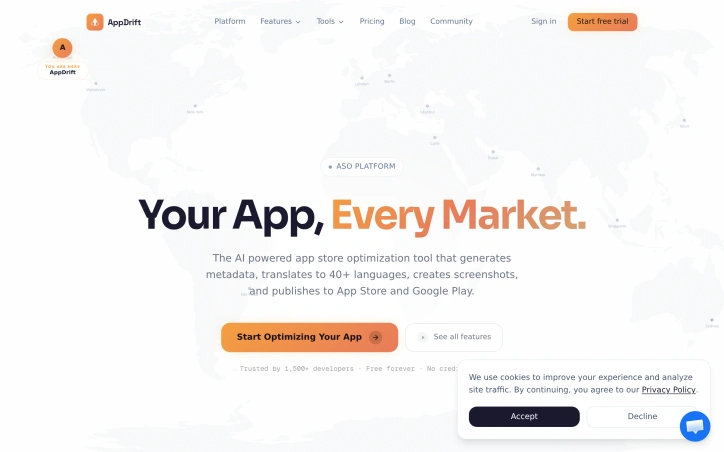
Getting an app into multiple international markets typically requires juggling translators, ASO specialists, and design tools—a workflow that can consume weeks of a small team's time or a solo developer's entire release cycle. AppDrift consolidates these steps into a single platform, automating the metadata generation, translation, and publishing process for iOS and Android simultaneously. The platform generates app store metadata—titles, subtitles, descriptions, and keywords—through AI, delivering results in under a minute with an ASO score audit attached to show optimization gaps. It then handles translation across 40+ languages and manages publication to both the App Store and Google Play in one dashboard. A screenshot generator with 50+ templates and keyword tracking with competitor analysis round out the toolkit. The offering is free to start and supported by 12,400+ connected apps. What distinguishes AppDrift is its compression of typically fragmented workflows into one interface. A solo developer or small team can move from English metadata to a global release in minutes rather than weeks. The company documents clear results: apps using the platform report significant increases in downloads and revenue alongside dramatically reduced time-to-market. These claims are grounded in actual customer usage, not theoretical projections. However, a notable limitation surfaced in real usage. One developer encountered a gap in character limit validation: translations into languages like Japanese and Arabic exceeded the App Store's subtitle field limits, yet the UI approved them with green checkmarks. The issue only emerged through manual verification before publishing. While the platform includes validation tools, running that check automatically after AI translation would catch this class of error upfront—currently, developers must actively invoke a separate checker. The team responded quickly to the feedback, a positive sign, but the gap highlights the risk of automation that still requires human oversight at critical junctures. For indie developers and scaling teams targeting international markets, AppDrift meaningfully reduces the operational friction of global deployment. The speed and one-click publishing justify the platform's foothold in the market. Solo developers or cost-conscious teams should be aware, however, that AI-generated content—especially across languages—still benefits from a human review pass before publication, and the platform's safety nets could be tighter.