Best Marketing & Sales Startups & Tools

Recently Listed

64 launches
Sort
MagicGEO

Merchants operating e-commerce and local service businesses face an increasingly critical visibility gap: they rank well in traditional search engines but remain virtually invisible to AI-powered search platforms like ChatGPT, Perplexity, and Google's Search Generative Experience. MagicGEO addresses this emerging problem head-on by enabling Shopify and WooCommerce store owners to gain citations—not just rankings—from AI search engines. The product tackles what amounts to a new search paradigm that traditional SEO alone cannot solve. While conventional optimization focuses on appearing in Google's index and organic results, AI search engines operate through different mechanisms. They train on web data but prioritize sources they recognize and cite directly. Small merchants, despite solid SEO fundamentals, fall outside this ecosystem because their content lacks the signals these systems rely on. MagicGEO bridges that gap through automated infrastructure changes: schema injection to add structured data, llms.txt file deployment, GEO scoring mechanisms, and built-in citation tracking to monitor visibility across multiple AI platforms. What distinguishes this entry is its recognition that the AI search opportunity has already arrived. Rather than positioning itself as a speculative bet on emerging technology, the product functions as a practical response to a concrete distribution problem merchants face today. The solution's strength lies in its simplicity—the founder emphasizes it works "in one click," suggesting the technical complexities of AI search optimization are abstracted away from users who lack the expertise to implement these changes manually. The product has reached functional maturity; the founder explicitly notes it is ready for use and already deployed across real store operations. This moves MagicGEO beyond concept validation into the phase where actual merchants are testing and relying on its citation capabilities. Being built by a solo founder adds a lean efficiency to the offering, though it also signals the current stage of business maturity. The stated business focus is distribution rather than product development. This positioning indicates confidence that the core technology solves the problem, and the challenge ahead lies in reaching enough merchants to build meaningful revenue and market presence. For Shopify and WooCommerce operators worried about their visibility in AI-powered search, particularly those in competitive local services or e-commerce niches, MagicGEO offers a focused tool that directly addresses a gap traditional SEO services have yet to fill.

Geo-tools
R
Rida ilyes

Merchants operating e-commerce and local service businesses face an increasingly critical visibility gap: they rank well in traditional search engines but remain virtually invisible to AI-powered search platforms like ChatGPT, Perplexity, and Google's Search Generative Experience. MagicGEO addresses this emerging problem head-on by enabling Shopify and WooCommerce store owners to gain citations—not just rankings—from AI search engines. The product tackles what amounts to a new search paradigm that traditional SEO alone cannot solve. While conventional optimization focuses on appearing in Google's index and organic results, AI search engines operate through different mechanisms. They train on web data but prioritize sources they recognize and cite directly. Small merchants, despite solid SEO fundamentals, fall outside this ecosystem because their content lacks the signals these systems rely on. MagicGEO bridges that gap through automated infrastructure changes: schema injection to add structured data, llms.txt file deployment, GEO scoring mechanisms, and built-in citation tracking to monitor visibility across multiple AI platforms. What distinguishes this entry is its recognition that the AI search opportunity has already arrived. Rather than positioning itself as a speculative bet on emerging technology, the product functions as a practical response to a concrete distribution problem merchants face today. The solution's strength lies in its simplicity—the founder emphasizes it works "in one click," suggesting the technical complexities of AI search optimization are abstracted away from users who lack the expertise to implement these changes manually. The product has reached functional maturity; the founder explicitly notes it is ready for use and already deployed across real store operations. This moves MagicGEO beyond concept validation into the phase where actual merchants are testing and relying on its citation capabilities. Being built by a solo founder adds a lean efficiency to the offering, though it also signals the current stage of business maturity. The stated business focus is distribution rather than product development. This positioning indicates confidence that the core technology solves the problem, and the challenge ahead lies in reaching enough merchants to build meaningful revenue and market presence. For Shopify and WooCommerce operators worried about their visibility in AI-powered search, particularly those in competitive local services or e-commerce niches, MagicGEO offers a focused tool that directly addresses a gap traditional SEO services have yet to fill.

MagicGEO preview

Key features

  • Schema Injection: Adds structured data to stores for AI search engine recognition
  • llms.txt Deployment: Deploys llms.txt files to improve visibility in AI search platforms
See full listing
AI Product Page Optimization

Cross-border e-commerce sellers face a persistent workflow problem: rewriting product listings across multiple marketplaces to match platform-specific search algorithms while maintaining readability for AI shopping assistants. Most existing tools treat the work as a generic copywriting task or lock sellers into a single platform. This browser extension solves that gap by automating the rewrite process directly within the product pages sellers already manage. The product tackles four major marketplaces—Amazon, Shopify, eBay, and Etsy—each with distinct search behaviors and formatting constraints. Rather than abstracting the work away from the platform, the extension operates in-browser, pulling titles, bullet points, descriptions, and images from a live listing and returning rewritten versions within 30 seconds. Sellers can review the AI-generated copy and processed images in a dashboard before publishing, preserving control over the final output while eliminating the manual rewrite cycle. What distinguishes this offering is its practical execution: it avoids the trap of being either too specialized (Amazon-only tools) or too generic (writers that ignore marketplace rules). The platform-specific approach means optimization for Amazon accounts for Rufus, its conversational shopping layer, while Etsy optimization preserves the handmade story that drives buyer intent on that platform. The browser extension model also solves a friction point—sellers don't need to export inventory, run batch jobs elsewhere, and re-import; they click Optimize on the page they're already editing. The feature set extends beyond rewrites. An image SEO checker analyzes resolution, file size, format, and filename against visual search standards. A machine-readable checker reveals which product schema fields AI search engines can parse. A community feature shows before-and-after examples from other sellers, providing both inspiration and implicit social proof. The business model is straightforward: five free credits for new users (no credit card required for trial) and a $19.90 monthly subscription. This pricing structure is aggressive enough to attract cost-conscious sellers while remaining affordable for regular optimization work. The core strength is narrow focus—the product does one thing across four platforms and does it fast. For sellers managing inventory on multiple marketplaces, the time savings alone justify the subscription.

Seo-tools
N
neo xia

Cross-border e-commerce sellers face a persistent workflow problem: rewriting product listings across multiple marketplaces to match platform-specific search algorithms while maintaining readability for AI shopping assistants. Most existing tools treat the work as a generic copywriting task or lock sellers into a single platform. This browser extension solves that gap by automating the rewrite process directly within the product pages sellers already manage. The product tackles four major marketplaces—Amazon, Shopify, eBay, and Etsy—each with distinct search behaviors and formatting constraints. Rather than abstracting the work away from the platform, the extension operates in-browser, pulling titles, bullet points, descriptions, and images from a live listing and returning rewritten versions within 30 seconds. Sellers can review the AI-generated copy and processed images in a dashboard before publishing, preserving control over the final output while eliminating the manual rewrite cycle. What distinguishes this offering is its practical execution: it avoids the trap of being either too specialized (Amazon-only tools) or too generic (writers that ignore marketplace rules). The platform-specific approach means optimization for Amazon accounts for Rufus, its conversational shopping layer, while Etsy optimization preserves the handmade story that drives buyer intent on that platform. The browser extension model also solves a friction point—sellers don't need to export inventory, run batch jobs elsewhere, and re-import; they click Optimize on the page they're already editing. The feature set extends beyond rewrites. An image SEO checker analyzes resolution, file size, format, and filename against visual search standards. A machine-readable checker reveals which product schema fields AI search engines can parse. A community feature shows before-and-after examples from other sellers, providing both inspiration and implicit social proof. The business model is straightforward: five free credits for new users (no credit card required for trial) and a $19.90 monthly subscription. This pricing structure is aggressive enough to attract cost-conscious sellers while remaining affordable for regular optimization work. The core strength is narrow focus—the product does one thing across four platforms and does it fast. For sellers managing inventory on multiple marketplaces, the time savings alone justify the subscription.

AI Product Page Optimization preview

Key features

  • Cross-Platform Optimization: Rewrites product listings for Amazon, Shopify, eBay, and Etsy with platform-specific algorithms
  • In-Browser Editor: Directly optimize listings within the platforms you already manage with instant dashboard review
See full listing
SEO Rank

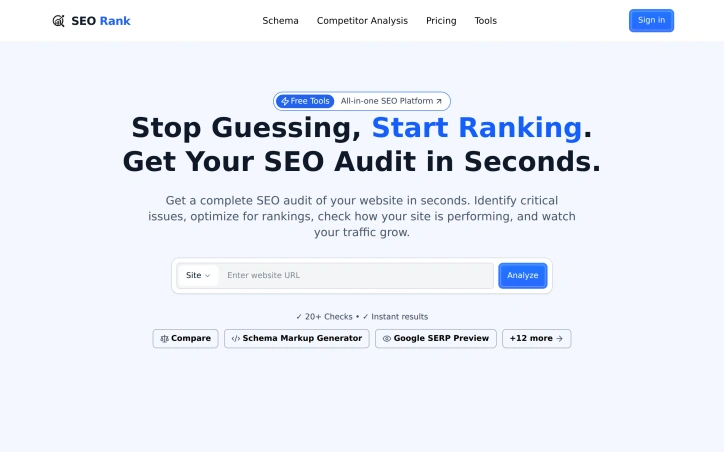
Simplifying the complexities of search engine optimization is a daunting task, but one that SEO Rank has tackled with gusto. The platform is designed to help marketers, agencies, developers, and business owners analyze and improve their website's SEO performance, providing instant insights into critical issues that may be hindering their online presence. What stands out about SEO Rank is its comprehensive approach to SEO analysis. The platform offers an all-in-one SEO audit tool that checks for over 20 different metrics, including title tags, meta descriptions, heading hierarchy, image optimization, and schema markup. This exhaustive analysis enables users to identify and address a wide range of SEO issues, from technical problems to content optimization opportunities. The platform's suite of free SEO tools is also noteworthy, with features like a schema markup generator, Google SERP preview, domain rating checker, and keyword density checker. These tools are designed to help users optimize their content and improve search rankings, and are accessible from a single platform. SEO Rank's commitment to expanding its toolkit is evident, with the promise of new features on the horizon, including an XML sitemap validator, robots.txt tester, and AI content optimizer. While pricing details are not explicitly stated, the availability of 17 free SEO tools suggests that the platform is accessible to users with varying needs and budgets. Overall, SEO Rank is a robust and user-friendly solution for anyone seeking to improve their website's SEO performance. By providing a comprehensive analysis and a range of practical tools, SEO Rank empowers users to take control of their online presence and drive traffic growth.

Seo-tools
P
Patel Yash

Simplifying the complexities of search engine optimization is a daunting task, but one that SEO Rank has tackled with gusto. The platform is designed to help marketers, agencies, developers, and business owners analyze and improve their website's SEO performance, providing instant insights into critical issues that may be hindering their online presence. What stands out about SEO Rank is its comprehensive approach to SEO analysis. The platform offers an all-in-one SEO audit tool that checks for over 20 different metrics, including title tags, meta descriptions, heading hierarchy, image optimization, and schema markup. This exhaustive analysis enables users to identify and address a wide range of SEO issues, from technical problems to content optimization opportunities. The platform's suite of free SEO tools is also noteworthy, with features like a schema markup generator, Google SERP preview, domain rating checker, and keyword density checker. These tools are designed to help users optimize their content and improve search rankings, and are accessible from a single platform. SEO Rank's commitment to expanding its toolkit is evident, with the promise of new features on the horizon, including an XML sitemap validator, robots.txt tester, and AI content optimizer. While pricing details are not explicitly stated, the availability of 17 free SEO tools suggests that the platform is accessible to users with varying needs and budgets. Overall, SEO Rank is a robust and user-friendly solution for anyone seeking to improve their website's SEO performance. By providing a comprehensive analysis and a range of practical tools, SEO Rank empowers users to take control of their online presence and drive traffic growth.

SEO Rank preview

Key features

  • SEO Audit Tool: checks for over 20 different metrics
  • Schema Markup Generator: helps optimize content
See full listing
My Intel Brief

Small businesses often struggle to stay ahead of their competitors, constantly playing catch-up as rivals make moves that impact their market share. MyIntelBrief addresses this pain point by providing daily competitor intelligence, delivered in a concise and actionable format. The platform is designed for small businesses that need to stay informed about their competitors' activities, including pricing changes, new offers, website updates, reviews, and local news. By monitoring these signals, businesses can respond promptly to changes in the market and make informed decisions to stay competitive. What stands out about MyIntelBrief is its focus on delivering clear and relevant insights, stripped of unnecessary noise. The daily brief is presented in a single page, making it easy to quickly scan and understand the key developments affecting a business. The platform's ability to detect and report on specific competitor activities, such as price changes or new website features, allows businesses to react swiftly and strategically. Key features of MyIntelBrief include daily monitoring of competitor activities, a 49-point heatmap to track local search rankings, and a business-plan gap analysis. The platform also offers a white-label resell option for agencies and consultants, enabling them to rebrand the service and offer it to their clients as a value-added proposition. For early adopters, MyIntelBrief is offering a limited-time discount of 50% off the regular price, exclusively for the first 100 customers. This founder's rate is automatically applied at checkout and is locked in for life.

Sales-enablement
C
Chuck Ahrens

Small businesses often struggle to stay ahead of their competitors, constantly playing catch-up as rivals make moves that impact their market share. MyIntelBrief addresses this pain point by providing daily competitor intelligence, delivered in a concise and actionable format. The platform is designed for small businesses that need to stay informed about their competitors' activities, including pricing changes, new offers, website updates, reviews, and local news. By monitoring these signals, businesses can respond promptly to changes in the market and make informed decisions to stay competitive. What stands out about MyIntelBrief is its focus on delivering clear and relevant insights, stripped of unnecessary noise. The daily brief is presented in a single page, making it easy to quickly scan and understand the key developments affecting a business. The platform's ability to detect and report on specific competitor activities, such as price changes or new website features, allows businesses to react swiftly and strategically. Key features of MyIntelBrief include daily monitoring of competitor activities, a 49-point heatmap to track local search rankings, and a business-plan gap analysis. The platform also offers a white-label resell option for agencies and consultants, enabling them to rebrand the service and offer it to their clients as a value-added proposition. For early adopters, MyIntelBrief is offering a limited-time discount of 50% off the regular price, exclusively for the first 100 customers. This founder's rate is automatically applied at checkout and is locked in for life.

My Intel Brief preview

Key features

  • Daily Monitoring: monitors competitor activities daily
  • Local Search Rankings: tracks local search rankings with a 49-point heatmap
See full listing
That SEO Agent

SEO professionals typically spend hours each week preparing data before AI tools can provide meaningful analysis. That SEO Agent directly addresses this inefficiency by eliminating what its creators call the "briefing tax" — the routine task of exporting metrics from Google Search Console, GA4, and PageSpeed, then manually copying and pasting them into conversation prompts. The product targets SEO consultants, particularly those managing multiple client properties. By connecting through the Model Context Protocol, the tool grants Claude, ChatGPT, and Cursor direct read-only access to a user's live Google accounts. This eliminates the need to manually assemble data exports before asking questions about rankings, traffic patterns, and technical site health. The platform distinguishes itself through scope and lack of constraints. It includes 57 native tools distributed across five functional categories: core Search Console queries, advanced GSC analysis, Google Analytics 4 reporting, technical SEO audits, and site management features. Critically, none of these tools hide behind pricing tiers or add-on fees. Users gain full access to the entire toolkit regardless of their plan. Setup requires minimal effort. After granting read-only Google OAuth access, users copy an API key and add a configuration block to their AI tool's settings in less than five minutes. The system then automatically discovers and registers sites by pulling Search Console properties directly. All communication flows through the MCP protocol, and the service never stores user credentials. The read-only architecture keeps the product strictly diagnostic. It retrieves and organizes existing data but cannot modify websites or accounts. This conservative design appeals to professionals managing client properties who need strict boundaries around account access. The core value proposition centers on workflow efficiency. By eliminating the copy-paste cycle, users avoid context-switching overhead and the contextual pollution of stuffing AI conversations with export files. For consultants managing multiple properties, this time savings compounds meaningfully. The platform explicitly promises zero additional costs per site or query, suggesting a straightforward pricing model. The product's appeal ultimately rests on a single thesis: getting live SEO data into AI conversations without manual intermediation.

SEO professionals typically spend hours each week preparing data before AI tools can provide meaningful analysis. That SEO Agent directly addresses this inefficiency by eliminating what its creators call the "briefing tax" — the routine task of exporting metrics from Google Search Console, GA4, and PageSpeed, then manually copying and pasting them into conversation prompts. The product targets SEO consultants, particularly those managing multiple client properties. By connecting through the Model Context Protocol, the tool grants Claude, ChatGPT, and Cursor direct read-only access to a user's live Google accounts. This eliminates the need to manually assemble data exports before asking questions about rankings, traffic patterns, and technical site health. The platform distinguishes itself through scope and lack of constraints. It includes 57 native tools distributed across five functional categories: core Search Console queries, advanced GSC analysis, Google Analytics 4 reporting, technical SEO audits, and site management features. Critically, none of these tools hide behind pricing tiers or add-on fees. Users gain full access to the entire toolkit regardless of their plan. Setup requires minimal effort. After granting read-only Google OAuth access, users copy an API key and add a configuration block to their AI tool's settings in less than five minutes. The system then automatically discovers and registers sites by pulling Search Console properties directly. All communication flows through the MCP protocol, and the service never stores user credentials. The read-only architecture keeps the product strictly diagnostic. It retrieves and organizes existing data but cannot modify websites or accounts. This conservative design appeals to professionals managing client properties who need strict boundaries around account access. The core value proposition centers on workflow efficiency. By eliminating the copy-paste cycle, users avoid context-switching overhead and the contextual pollution of stuffing AI conversations with export files. For consultants managing multiple properties, this time savings compounds meaningfully. The platform explicitly promises zero additional costs per site or query, suggesting a straightforward pricing model. The product's appeal ultimately rests on a single thesis: getting live SEO data into AI conversations without manual intermediation.

That SEO Agent preview

Key features

  • MCP Integration: Connects Claude, ChatGPT, and Cursor directly to live Google accounts without manual data export
  • 57 Native Tools: Provides complete toolkit for Search Console queries, GA4 reporting, technical audits, and site management
See full listing
TranAI

Communicating across borders grows harder as businesses expand internationally, especially when managing conversations in different languages across platforms like WhatsApp and Telegram. TranAI addresses this friction by combining customer relationship management with real-time translation, targeting small business owners, support teams, and companies navigating cross-border commerce. The platform's strength lies in its free tier. Rather than paywalling core features, TranAI offers genuine capabilities without requiring a credit card, including multi-account management, broadcast messaging, scheduled sends, and group joining automation. These address real needs for entrepreneurs managing customer interactions at scale without upfront investment. Real-time translation stands as the core differentiator. Supporting over 20 platforms and 200 languages, TranAI enables users to chat with customers in Spanish, Arabic, or other languages without switching apps or managing separate conversations. Voice synthesis and voice cloning allow businesses to maintain personality in customer interactions despite geography, addressing a practical gap that most translation tools ignore. The CRM functionality adds practical value beyond translation alone. Smart number filtering, cold messaging to non-contacts, unlimited message pinning, and privacy blur (auto-concealing sensitive customer information in screenshots) directly address pain points for teams managing lead databases and customer relationships. A quick-reply system helps support staff respond faster to recurring questions, compounding the time savings from consolidated account management. The freemium model reveals TranAI's confidence in its free offering, with premium translation services available for advanced capabilities. This positioning avoids the trap of "free trials that do almost nothing," instead building product momentum through genuine utility that works immediately upon signup. Testimonials from real estate agents, small business owners, and export managers suggest the tool resonates across different use cases. A customer support lead highlights hours saved daily through multi-account consolidation, while an export manager emphasizes translation reliability for maintaining fluent conversations with international clients. The product solves a concrete problem—enabling communication at scale across languages and platforms—without the complexity or cost competitors demand. For global-minded entrepreneurs or multinational businesses with lean operations teams, TranAI delivers immediate practical value without the typical friction of enterprise software adoption.

Crm-software
T
TranAI

Communicating across borders grows harder as businesses expand internationally, especially when managing conversations in different languages across platforms like WhatsApp and Telegram. TranAI addresses this friction by combining customer relationship management with real-time translation, targeting small business owners, support teams, and companies navigating cross-border commerce. The platform's strength lies in its free tier. Rather than paywalling core features, TranAI offers genuine capabilities without requiring a credit card, including multi-account management, broadcast messaging, scheduled sends, and group joining automation. These address real needs for entrepreneurs managing customer interactions at scale without upfront investment. Real-time translation stands as the core differentiator. Supporting over 20 platforms and 200 languages, TranAI enables users to chat with customers in Spanish, Arabic, or other languages without switching apps or managing separate conversations. Voice synthesis and voice cloning allow businesses to maintain personality in customer interactions despite geography, addressing a practical gap that most translation tools ignore. The CRM functionality adds practical value beyond translation alone. Smart number filtering, cold messaging to non-contacts, unlimited message pinning, and privacy blur (auto-concealing sensitive customer information in screenshots) directly address pain points for teams managing lead databases and customer relationships. A quick-reply system helps support staff respond faster to recurring questions, compounding the time savings from consolidated account management. The freemium model reveals TranAI's confidence in its free offering, with premium translation services available for advanced capabilities. This positioning avoids the trap of "free trials that do almost nothing," instead building product momentum through genuine utility that works immediately upon signup. Testimonials from real estate agents, small business owners, and export managers suggest the tool resonates across different use cases. A customer support lead highlights hours saved daily through multi-account consolidation, while an export manager emphasizes translation reliability for maintaining fluent conversations with international clients. The product solves a concrete problem—enabling communication at scale across languages and platforms—without the complexity or cost competitors demand. For global-minded entrepreneurs or multinational businesses with lean operations teams, TranAI delivers immediate practical value without the typical friction of enterprise software adoption.

TranAI preview

Key features

  • Real-Time Translation: Supports over 200 languages across 20+ platforms for seamless cross-border communication.
  • Multi-Account Management: Consolidate conversations across different messaging platforms in one interface.
See full listing
Productivity tools

Digital workers constantly switch between apps and websites to handle routine tasks like counting words, converting text cases, calculating loan payments, or compressing files. Toolvio consolidates these scattered utilities into a single, free web-based platform designed for speed and simplicity. The service offers a focused library of utilities organized across six categories: text tools, calculators, PDF tools, image tools, AI features, and SEO utilities. The text suite includes word and character counters, case converters, text cleaners, slug generators, and duplicate line removers. The calculator section covers percentages, mortgages, business loans, standard loans, age calculations, and credit card payoff projections. Several tools remain in development, including image compression, PDF compression, PDF-to-Word conversion, and AI text summarization. What distinguishes Toolvio from similar tool aggregators is its zero-friction access model. No signup required, no hidden paywalls, and no login gates prevent immediate use. The tools run client-side, meaning files process locally rather than uploading to external servers, which carries privacy implications that appeal to security-conscious users. The interface emphasizes speed, with straightforward conversions and calculations delivering results instantly. The platform targets professionals and students handling routine digital tasks without dedicated software. Someone drafting content benefits from the word counter and character tracker. Freelancers and small business owners use the loan and mortgage calculators for client estimates. Writers toggle between case conversion and text cleaning. The tools address genuine friction points in everyday workflows without requiring installation or signup. The weakness evident in the available content is incompleteness. Multiple valuable features—image compression, PDF compression, PDF-to-Word conversion, and an AI summarizer—exist only as coming-soon placeholders. Until these launch, users comparing Toolvio against other tool aggregators may find the available toolset too narrow for a primary destination. The stated growth strategy centers on continuous expansion and educational resources. As additional tools become available, Toolvio could evolve into a genuine one-stop alternative for routine document and text processing tasks. Currently, it serves as a useful collection for specific needs—particularly text analytics and simple financial calculations—rather than a comprehensive replacement for dedicated software. For anyone avoiding sign-ups and installing apps, though, Toolvio removes barriers to getting work done quickly.

Digital workers constantly switch between apps and websites to handle routine tasks like counting words, converting text cases, calculating loan payments, or compressing files. Toolvio consolidates these scattered utilities into a single, free web-based platform designed for speed and simplicity. The service offers a focused library of utilities organized across six categories: text tools, calculators, PDF tools, image tools, AI features, and SEO utilities. The text suite includes word and character counters, case converters, text cleaners, slug generators, and duplicate line removers. The calculator section covers percentages, mortgages, business loans, standard loans, age calculations, and credit card payoff projections. Several tools remain in development, including image compression, PDF compression, PDF-to-Word conversion, and AI text summarization. What distinguishes Toolvio from similar tool aggregators is its zero-friction access model. No signup required, no hidden paywalls, and no login gates prevent immediate use. The tools run client-side, meaning files process locally rather than uploading to external servers, which carries privacy implications that appeal to security-conscious users. The interface emphasizes speed, with straightforward conversions and calculations delivering results instantly. The platform targets professionals and students handling routine digital tasks without dedicated software. Someone drafting content benefits from the word counter and character tracker. Freelancers and small business owners use the loan and mortgage calculators for client estimates. Writers toggle between case conversion and text cleaning. The tools address genuine friction points in everyday workflows without requiring installation or signup. The weakness evident in the available content is incompleteness. Multiple valuable features—image compression, PDF compression, PDF-to-Word conversion, and an AI summarizer—exist only as coming-soon placeholders. Until these launch, users comparing Toolvio against other tool aggregators may find the available toolset too narrow for a primary destination. The stated growth strategy centers on continuous expansion and educational resources. As additional tools become available, Toolvio could evolve into a genuine one-stop alternative for routine document and text processing tasks. Currently, it serves as a useful collection for specific needs—particularly text analytics and simple financial calculations—rather than a comprehensive replacement for dedicated software. For anyone avoiding sign-ups and installing apps, though, Toolvio removes barriers to getting work done quickly.

Productivity tools preview

Key features

  • No Signup Required: Access all tools immediately without creating an account or providing credentials
  • Client-Side Processing: Files process locally on your device rather than uploading to external servers
See full listing
Opero POS

Restaurant and retail operators juggling order management, staff coordination, and customer analytics face fragmentation across multiple vendor platforms. Opero POS consolidates these functions into a unified system designed to eliminate that complexity. The platform targets small to mid-sized restaurants and retail establishments seeking to streamline point-of-sale operations without the overhead of enterprise solutions. The core value proposition centers on eliminating tool fragmentation: rather than bouncing between separate systems for in-house orders, online ordering, delivery management, and staff oversight, operators manage everything from one interface. Key capabilities include integrated online ordering functionality, which allows customers to place orders directly through the system without requiring external marketplace integration. The delivery management component handles order routing and fulfillment logistics, meaningful for establishments expanding beyond dine-in or walk-up sales. Team management tools provide workforce scheduling and coordination, critical for restaurants operating multi-shift service models. Analytics capabilities offer visibility into sales trends, peak periods, and operational metrics that inform inventory and staffing decisions. The all-in-one positioning distinguishes Opero POS from point-of-sale vendors requiring ancillary purchases or third-party integrations to reach comparable functionality. Rather than licensing payment processing, then bolting on an online ordering service, then contracting a separate workforce management tool, operators deploy one system. This approach reduces implementation friction and ongoing vendor management complexity. The product is positioned as free, a significant differentiation in a market where point-of-sale software traditionally operates on per-terminal licensing or monthly subscription models. This pricing structure removes an adoption barrier for cost-conscious operators testing new systems or managing tight margins. For restaurants and retail shops exhausted by platform proliferation, Opero POS promises operational simplification through consolidation. The breadth of capabilities spanning transaction processing, customer ordering, delivery logistics, staff management, and business intelligence positions it as genuine all-in-one software rather than a point-of-sale system with cosmetic add-ons. The free pricing model invites trial with minimal financial commitment, making it accessible to independent operators skeptical of vendor lock-in or unable to justify significant software expenditures.

Sales-enablement
O
Opero POS

Restaurant and retail operators juggling order management, staff coordination, and customer analytics face fragmentation across multiple vendor platforms. Opero POS consolidates these functions into a unified system designed to eliminate that complexity. The platform targets small to mid-sized restaurants and retail establishments seeking to streamline point-of-sale operations without the overhead of enterprise solutions. The core value proposition centers on eliminating tool fragmentation: rather than bouncing between separate systems for in-house orders, online ordering, delivery management, and staff oversight, operators manage everything from one interface. Key capabilities include integrated online ordering functionality, which allows customers to place orders directly through the system without requiring external marketplace integration. The delivery management component handles order routing and fulfillment logistics, meaningful for establishments expanding beyond dine-in or walk-up sales. Team management tools provide workforce scheduling and coordination, critical for restaurants operating multi-shift service models. Analytics capabilities offer visibility into sales trends, peak periods, and operational metrics that inform inventory and staffing decisions. The all-in-one positioning distinguishes Opero POS from point-of-sale vendors requiring ancillary purchases or third-party integrations to reach comparable functionality. Rather than licensing payment processing, then bolting on an online ordering service, then contracting a separate workforce management tool, operators deploy one system. This approach reduces implementation friction and ongoing vendor management complexity. The product is positioned as free, a significant differentiation in a market where point-of-sale software traditionally operates on per-terminal licensing or monthly subscription models. This pricing structure removes an adoption barrier for cost-conscious operators testing new systems or managing tight margins. For restaurants and retail shops exhausted by platform proliferation, Opero POS promises operational simplification through consolidation. The breadth of capabilities spanning transaction processing, customer ordering, delivery logistics, staff management, and business intelligence positions it as genuine all-in-one software rather than a point-of-sale system with cosmetic add-ons. The free pricing model invites trial with minimal financial commitment, making it accessible to independent operators skeptical of vendor lock-in or unable to justify significant software expenditures.

Opero POS preview

Key features

  • Integrated Online Ordering: Customers can place orders directly through the system without requiring external marketplace integration.
  • Delivery Management: Handles order routing and fulfillment logistics for establishments expanding beyond dine-in sales.
See full listing
NexiaTools

Marketing professionals frustrated by subscription sprawl have encountered a familiar pain point: managing separate services for email automation, content creation, image generation, and code assistance. NexiaTools addresses this friction by packaging over 30 specialized AI applications into a single platform designed specifically for agencies and freelancers scaling their operations. The platform targets users who lack technical expertise, offering pre-built workflows for common business tasks rather than requiring complex prompt engineering. Its feature set covers the marketing and sales workflows that agencies typically rely on: SEO-optimized article generation, proposal writing with dynamic sales structures, LinkedIn and Instagram content creation, and cold email campaign automation. Each tool accepts natural language descriptions and delivers outputs in seconds, positioning the software as a practical alternative to manually orchestrating outputs across separate AI services. The value proposition rests on consolidation economics. Rather than paying for ChatGPT Plus, Claude Pro, dedicated image generators, and copywriting specialists individually—a scenario the company quantifies at approximately 85 dollars monthly—the platform bundles these capabilities at a fraction of that cost. For freelancers and small agencies, this consolidation matters: fewer logins, consistent styling controls, and unified workflows reduce operational friction while lowering recurring software expenses. The product's strength lies in its specificity. Unlike general-purpose AI assistants, NexiaTools packages capability into task-oriented tools. A proposal generator includes templates for pricing structures and timelines; the social media tool maintains brand voice across platforms; the email automation tool focuses on high-open-rate subject lines and persuasive calls to action. This pre-structure removes decision fatigue compared to blank-canvas prompting. The marketing positioning emphasizes ease of use, a meaningful differentiator for non-technical founders who may find Claude or ChatGPT intimidating. The platform doesn't require learning prompt frameworks or API integration. Describing your goal in plain language and selecting the appropriate tool remains the primary workflow. Limitations aren't addressed in available materials—feature depth, output quality compared to standalone tools, and platform reliability remain unknowns. For agencies heavily invested in existing workflows or demanding highly specialized customization, NexiaTools' breadth-over-depth approach may not suit deeper needs. The platform represents a sensible option for teams prioritizing efficiency and cost reduction over maximum capability in any single function.

Marketing-automation-platforms
A
Antonio Estepa

Marketing professionals frustrated by subscription sprawl have encountered a familiar pain point: managing separate services for email automation, content creation, image generation, and code assistance. NexiaTools addresses this friction by packaging over 30 specialized AI applications into a single platform designed specifically for agencies and freelancers scaling their operations. The platform targets users who lack technical expertise, offering pre-built workflows for common business tasks rather than requiring complex prompt engineering. Its feature set covers the marketing and sales workflows that agencies typically rely on: SEO-optimized article generation, proposal writing with dynamic sales structures, LinkedIn and Instagram content creation, and cold email campaign automation. Each tool accepts natural language descriptions and delivers outputs in seconds, positioning the software as a practical alternative to manually orchestrating outputs across separate AI services. The value proposition rests on consolidation economics. Rather than paying for ChatGPT Plus, Claude Pro, dedicated image generators, and copywriting specialists individually—a scenario the company quantifies at approximately 85 dollars monthly—the platform bundles these capabilities at a fraction of that cost. For freelancers and small agencies, this consolidation matters: fewer logins, consistent styling controls, and unified workflows reduce operational friction while lowering recurring software expenses. The product's strength lies in its specificity. Unlike general-purpose AI assistants, NexiaTools packages capability into task-oriented tools. A proposal generator includes templates for pricing structures and timelines; the social media tool maintains brand voice across platforms; the email automation tool focuses on high-open-rate subject lines and persuasive calls to action. This pre-structure removes decision fatigue compared to blank-canvas prompting. The marketing positioning emphasizes ease of use, a meaningful differentiator for non-technical founders who may find Claude or ChatGPT intimidating. The platform doesn't require learning prompt frameworks or API integration. Describing your goal in plain language and selecting the appropriate tool remains the primary workflow. Limitations aren't addressed in available materials—feature depth, output quality compared to standalone tools, and platform reliability remain unknowns. For agencies heavily invested in existing workflows or demanding highly specialized customization, NexiaTools' breadth-over-depth approach may not suit deeper needs. The platform represents a sensible option for teams prioritizing efficiency and cost reduction over maximum capability in any single function.

NexiaTools preview

Key features

  • SEO Content Creator: Generate high-ranking, perfectly optimized blog posts in seconds.
  • Cold Email Sequencer: Build highly converting B2B outreach sequences effortlessly.
See full listing
Traffic Titans

Performance marketers navigating multi-market growth face a consistent challenge: finding reliable, high-quality traffic sources while managing partnerships across different compensation models and geographic regions. Traffic Titans addresses this by consolidating traffic acquisition, affiliate partnerships, and media buying into a unified service designed for brands seeking to expand efficiently across Tier 1, Tier 2, and emerging markets. The company positions itself as an operational backbone for performance-driven growth. Rather than serving as a traffic source itself, Traffic Titans functions as a connector between brands and vetted traffic partners, with the operational infrastructure to manage complex partnership structures. This distinction matters—the service handles the administrative and strategic work that enables performance marketers to scale without building those capabilities in-house. The platform's flexibility emerges as its strongest differentiator. Traffic Titans operates across multiple partnership models—Cost Per Action, Hybrid arrangements, and Revenue Share agreements—rather than locking partners into a single compensation structure. This adaptability means brands and affiliates can structure deals that align their incentives based on specific campaign characteristics, traffic sources, and geographic focus. The company explicitly handles SEO traffic, media-bought inventory, and affiliate-driven channels, supporting teams across multiple verticals. Geographic reach demonstrates another core strength. While many traffic acquisition platforms concentrate on Tier 1 markets, Traffic Titans deliberately serves emerging and secondary markets. This opens opportunities for brands testing new regions or affiliates seeking less saturated channels. The service supports international expansion by managing the operational complexity of working across different regulatory environments, traffic quality standards, and partnership requirements. What remains unclear is the platform's internal operations. The website offers minimal technical detail about how Traffic Titans validates traffic quality, prevents fraud, or optimizes campaign performance. There's no discussion of reporting infrastructure, data pipelines, or performance guarantees. For a company emphasizing operational precision, these blind spots feel notable. The pricing model remains entirely undisclosed. With partnership models ranging from CPA to RevShare, potential partners must engage directly to understand costs, minimums, or performance requirements. Traffic Titans serves performance marketers ready to expand across multiple markets and partnership types, but only after direct conversations about technical capabilities and terms.

Affiliate-marketing
T
TRAFFIC TITANS

Performance marketers navigating multi-market growth face a consistent challenge: finding reliable, high-quality traffic sources while managing partnerships across different compensation models and geographic regions. Traffic Titans addresses this by consolidating traffic acquisition, affiliate partnerships, and media buying into a unified service designed for brands seeking to expand efficiently across Tier 1, Tier 2, and emerging markets. The company positions itself as an operational backbone for performance-driven growth. Rather than serving as a traffic source itself, Traffic Titans functions as a connector between brands and vetted traffic partners, with the operational infrastructure to manage complex partnership structures. This distinction matters—the service handles the administrative and strategic work that enables performance marketers to scale without building those capabilities in-house. The platform's flexibility emerges as its strongest differentiator. Traffic Titans operates across multiple partnership models—Cost Per Action, Hybrid arrangements, and Revenue Share agreements—rather than locking partners into a single compensation structure. This adaptability means brands and affiliates can structure deals that align their incentives based on specific campaign characteristics, traffic sources, and geographic focus. The company explicitly handles SEO traffic, media-bought inventory, and affiliate-driven channels, supporting teams across multiple verticals. Geographic reach demonstrates another core strength. While many traffic acquisition platforms concentrate on Tier 1 markets, Traffic Titans deliberately serves emerging and secondary markets. This opens opportunities for brands testing new regions or affiliates seeking less saturated channels. The service supports international expansion by managing the operational complexity of working across different regulatory environments, traffic quality standards, and partnership requirements. What remains unclear is the platform's internal operations. The website offers minimal technical detail about how Traffic Titans validates traffic quality, prevents fraud, or optimizes campaign performance. There's no discussion of reporting infrastructure, data pipelines, or performance guarantees. For a company emphasizing operational precision, these blind spots feel notable. The pricing model remains entirely undisclosed. With partnership models ranging from CPA to RevShare, potential partners must engage directly to understand costs, minimums, or performance requirements. Traffic Titans serves performance marketers ready to expand across multiple markets and partnership types, but only after direct conversations about technical capabilities and terms.

Traffic Titans preview

Key features

  • Flexible Partnership Models: Supports Cost Per Action, Hybrid, and Revenue Share arrangements to align incentives based on campaign characteristics and traffic sources.
  • Unified Traffic Consolidation: Consolidates traffic acquisition, affiliate partnerships, and media buying into a single platform.
See full listing
Google Maps Scraper

Extracting contact information from Google Maps typically involves opening dozens of business listings, manually copying phone numbers and addresses into spreadsheets, and hoping you don't lose track of which ones you've already documented. Google Maps Scraper directly addresses this friction point, targeting sales professionals, marketing agencies, and business owners who build prospect lists from local search results. The product distinguishes itself through its no-installation approach. Rather than requiring a browser plugin or software download, the tool operates entirely through a web browser, making it accessible from any device. The core appeal is speed: the tool extracts over one thousand leads in under three minutes, including phone numbers, email addresses, business websites, and ratings. For teams that traditionally spend six or more hours on this task, even a fraction of that time saved represents meaningful efficiency gains. The feature set covers the essentials for outreach workflows. Leads export directly to Excel format with minimal formatting required, and the data arrives pre-organized for immediate use in CRM systems or email campaigns. The tool integrates with Google Maps directly through the browser without requiring an API key for the basic web interface, lowering the barrier to entry. Pricing follows a freemium model. New users receive ten free searches without providing a credit card, allowing exploration before commitment. The platform offers multiple access points: the web-based tool, a free browser extension for direct extraction from Google Maps pages, a developer API for programmatic access, and AI agent skills for integration with tools like Claude and ChatGPT. This multi-channel approach accommodates different workflows, from one-off searches to embedded automation. User feedback backs the public rating of 4.88 out of 5 stars across over one thousand customer responses. The company emphasizes the verified nature of extracted phone numbers and the clean formatting of results, suggesting attention to data quality rather than raw volume. The positioning centers on time reclamation: shifting work from manual copying to strategic outreach. For teams struggling with lead research bottlenecks, particularly those operating without dedicated research staff or budget constraints on tools, the free tier serves as a low-friction entry point to evaluate whether the tool reduces their actual workload.

Lead-generation-software
V
Vid AIGen

Extracting contact information from Google Maps typically involves opening dozens of business listings, manually copying phone numbers and addresses into spreadsheets, and hoping you don't lose track of which ones you've already documented. Google Maps Scraper directly addresses this friction point, targeting sales professionals, marketing agencies, and business owners who build prospect lists from local search results. The product distinguishes itself through its no-installation approach. Rather than requiring a browser plugin or software download, the tool operates entirely through a web browser, making it accessible from any device. The core appeal is speed: the tool extracts over one thousand leads in under three minutes, including phone numbers, email addresses, business websites, and ratings. For teams that traditionally spend six or more hours on this task, even a fraction of that time saved represents meaningful efficiency gains. The feature set covers the essentials for outreach workflows. Leads export directly to Excel format with minimal formatting required, and the data arrives pre-organized for immediate use in CRM systems or email campaigns. The tool integrates with Google Maps directly through the browser without requiring an API key for the basic web interface, lowering the barrier to entry. Pricing follows a freemium model. New users receive ten free searches without providing a credit card, allowing exploration before commitment. The platform offers multiple access points: the web-based tool, a free browser extension for direct extraction from Google Maps pages, a developer API for programmatic access, and AI agent skills for integration with tools like Claude and ChatGPT. This multi-channel approach accommodates different workflows, from one-off searches to embedded automation. User feedback backs the public rating of 4.88 out of 5 stars across over one thousand customer responses. The company emphasizes the verified nature of extracted phone numbers and the clean formatting of results, suggesting attention to data quality rather than raw volume. The positioning centers on time reclamation: shifting work from manual copying to strategic outreach. For teams struggling with lead research bottlenecks, particularly those operating without dedicated research staff or budget constraints on tools, the free tier serves as a low-friction entry point to evaluate whether the tool reduces their actual workload.

Google Maps Scraper preview

Key features

  • No-Installation Browser Tool: Operates entirely through web browsers without plugins or software downloads, accessible from any device.
  • High-Speed Lead Extraction: Extracts over 1,000 leads in under three minutes including phone numbers, emails, websites, and ratings.
See full listing
Genrank

As AI language models increasingly serve as the starting point for buyer research and discovery, a gap has emerged in how brands monitor their presence in this new search frontier. Genrank addresses this directly by helping marketing teams understand and optimize how their companies appear in AI-generated responses from systems like ChatGPT. The platform recognizes that traditional search ranking, while still relevant, no longer captures the full customer journey. When potential customers engage with conversational AI to evaluate solutions or gather information, brands need visibility into whether they appear in those generated answers and recommendations. Genrank tracks this visibility across what the company frames as a "conversational funnel" distinct from keyword-based search results. The core offering includes several interconnected capabilities. Its LLM retrieval simulator shows how AI search engines chunk, retrieve, and rank content, revealing why certain brands appear prominently while others remain invisible. The platform monitors brand sentiment across news, reviews, and discussions that feed into AI recommendation systems. Its advertising insights feature surfaces which competitors are bidding on relevant prompts and what sponsored content appears alongside organic AI mentions. Content optimization tools help marketers adjust website pages and messaging to perform better within AI model retrieval processes. The social monitoring component tracks how brand perception shifts across the internet, connecting reputation signals to visibility in AI-generated answers. Genrank maintains a database exceeding 2.2 million brands, indicating established scale and reach. The platform serves multiple verticals including marketing agencies, e-commerce companies, recruitment organizations, and financial services. For agencies, it offers a competitive lever on a new dimension of visibility. For e-commerce, it addresses product discoverability in an era where price comparisons and research happen through chat interfaces. Recruitment and financial services can use the tool to become recommended options when AI systems generate career or financial guidance. Genrank targets a widening gap in the marketing technology landscape: most infrastructure was built for the age of search bars and keyword bidding. As conversational AI reshapes how people discover products and services, the platform helps teams understand and influence where and how their brands appear in these new customer conversations. The free trial model suggests accessibility for smaller teams alongside deeper offerings for enterprises.

Geo-tools
S
Siebert

As AI language models increasingly serve as the starting point for buyer research and discovery, a gap has emerged in how brands monitor their presence in this new search frontier. Genrank addresses this directly by helping marketing teams understand and optimize how their companies appear in AI-generated responses from systems like ChatGPT. The platform recognizes that traditional search ranking, while still relevant, no longer captures the full customer journey. When potential customers engage with conversational AI to evaluate solutions or gather information, brands need visibility into whether they appear in those generated answers and recommendations. Genrank tracks this visibility across what the company frames as a "conversational funnel" distinct from keyword-based search results. The core offering includes several interconnected capabilities. Its LLM retrieval simulator shows how AI search engines chunk, retrieve, and rank content, revealing why certain brands appear prominently while others remain invisible. The platform monitors brand sentiment across news, reviews, and discussions that feed into AI recommendation systems. Its advertising insights feature surfaces which competitors are bidding on relevant prompts and what sponsored content appears alongside organic AI mentions. Content optimization tools help marketers adjust website pages and messaging to perform better within AI model retrieval processes. The social monitoring component tracks how brand perception shifts across the internet, connecting reputation signals to visibility in AI-generated answers. Genrank maintains a database exceeding 2.2 million brands, indicating established scale and reach. The platform serves multiple verticals including marketing agencies, e-commerce companies, recruitment organizations, and financial services. For agencies, it offers a competitive lever on a new dimension of visibility. For e-commerce, it addresses product discoverability in an era where price comparisons and research happen through chat interfaces. Recruitment and financial services can use the tool to become recommended options when AI systems generate career or financial guidance. Genrank targets a widening gap in the marketing technology landscape: most infrastructure was built for the age of search bars and keyword bidding. As conversational AI reshapes how people discover products and services, the platform helps teams understand and influence where and how their brands appear in these new customer conversations. The free trial model suggests accessibility for smaller teams alongside deeper offerings for enterprises.

Genrank preview

Key features

  • LLM Retrieval Simulator: Shows how AI search engines chunk, retrieve, and rank content to reveal why your brand appears or remains invisible
  • Brand Sentiment Monitoring: Monitors brand sentiment across news, reviews, and discussions that feed into AI recommendation systems
See full listing
Team24

Marketing teams today operate in a state of constant tool sprawl. They switch between ChatGPT for strategy, Claude for copy, Midjourney for visuals, and a dozen analytics dashboards, each requiring separate logins and repeated context. Every transition means re-explaining the brief, starting over with new prompts, and losing the thread of prior conversations. This creates friction that makes it harder for marketing departments to move quickly, even with AI assistance. Team24 attacks this inefficiency by consolidating an entire marketing team into Slack, the communication hub most marketing organizations already inhabit. Rather than routing requests to different tools, users message a shared Slack channel and receive work from five specialized AI agents: a strategist who sets positioning and messaging, a copywriter who produces copy and email sequences, a designer who builds landing pages and ad creatives, an analyst who tracks performance, and a manager who orchestrates the workflow. Each agent has a distinct persona and expertise, and they collaborate with each other to produce integrated deliverables without additional user guidance. The key differentiator is not the individual agents but the internal collaboration between them. A copywriter doesn't write in isolation; the strategist's positioning informs the copy, which then informs the designer's creative direction, which feeds back to the analyst's recommendations. This interdependence mirrors how a real marketing team works, except all conversation and file sharing happens in a single thread with shared context preserved throughout. The product delivers finished work, not suggestions. Users submit a brief like "Launch our Q3 product to mid-market SaaS buyers," and Team24 returns completed landing pages, ad campaigns, positioning decks, and performance reports. This stands in contrast to most AI tools that generate drafts requiring further refinement and assembly. The emphasis on delivery over iteration changes the value proposition: instead of augmenting a marketer's output, Team24 positions itself as a replacement for routine marketing work. The product covers a comprehensive marketing workflow spanning strategy, copywriting, design, paid media, email marketing, and analytics. For bootstrapped startups and small-to-mid-market companies that lack dedicated marketing teams, this consolidation could reduce both tool costs and cognitive load. For larger departments, Team24's value hinges on how well the AI's output meets brand standards and performance expectations. No pricing details are disclosed in available materials, leaving the business model unclear. Whether Team24 charges per request, by subscription, or through other models will significantly affect adoption decisions for budget-constrained teams.

Marketing-automation-platforms
R
Rustam Aliyev

Marketing teams today operate in a state of constant tool sprawl. They switch between ChatGPT for strategy, Claude for copy, Midjourney for visuals, and a dozen analytics dashboards, each requiring separate logins and repeated context. Every transition means re-explaining the brief, starting over with new prompts, and losing the thread of prior conversations. This creates friction that makes it harder for marketing departments to move quickly, even with AI assistance. Team24 attacks this inefficiency by consolidating an entire marketing team into Slack, the communication hub most marketing organizations already inhabit. Rather than routing requests to different tools, users message a shared Slack channel and receive work from five specialized AI agents: a strategist who sets positioning and messaging, a copywriter who produces copy and email sequences, a designer who builds landing pages and ad creatives, an analyst who tracks performance, and a manager who orchestrates the workflow. Each agent has a distinct persona and expertise, and they collaborate with each other to produce integrated deliverables without additional user guidance. The key differentiator is not the individual agents but the internal collaboration between them. A copywriter doesn't write in isolation; the strategist's positioning informs the copy, which then informs the designer's creative direction, which feeds back to the analyst's recommendations. This interdependence mirrors how a real marketing team works, except all conversation and file sharing happens in a single thread with shared context preserved throughout. The product delivers finished work, not suggestions. Users submit a brief like "Launch our Q3 product to mid-market SaaS buyers," and Team24 returns completed landing pages, ad campaigns, positioning decks, and performance reports. This stands in contrast to most AI tools that generate drafts requiring further refinement and assembly. The emphasis on delivery over iteration changes the value proposition: instead of augmenting a marketer's output, Team24 positions itself as a replacement for routine marketing work. The product covers a comprehensive marketing workflow spanning strategy, copywriting, design, paid media, email marketing, and analytics. For bootstrapped startups and small-to-mid-market companies that lack dedicated marketing teams, this consolidation could reduce both tool costs and cognitive load. For larger departments, Team24's value hinges on how well the AI's output meets brand standards and performance expectations. No pricing details are disclosed in available materials, leaving the business model unclear. Whether Team24 charges per request, by subscription, or through other models will significantly affect adoption decisions for budget-constrained teams.

Team24 preview

Key features

  • Slack Integration: Consolidates marketing workflow within Slack, the communication hub most marketing teams already use.
  • Five Specialized Agents: Includes strategist, copywriter, designer, analyst, and manager, each with distinct persona and expertise.
See full listing
Salonify

Salon and spa owners typically juggle contradictory demands: they want to focus on clients and service quality but find themselves drowning in administrative tasks instead. From appointment tracking to staff coordination to inventory management, the operational overhead steals time from what actually matters. Salonify targets this exact pain point, positioning itself as a unified management platform designed to free salon owners from spreadsheets and fragmented systems. The product stands out for its origin story and design philosophy. Rather than being built by consultants studying the industry from afar, Salonify grew from a direct conversation with a salon owner frustrated by no-shows and manual scheduling. This grounding in real problems shapes its approach: the company commits to ongoing development based on feedback from its 1,500+ active salon users, treating software updates as a response to operator needs rather than predetermined roadmaps. The feature set is comprehensive. The platform offers multi-branch management for chains alongside role-based access controls that let different team members operate separate applications, from owner dashboards to staff-facing interfaces. Core capabilities include point-of-sale and billing, inventory tracking, membership and package management, and payroll integration. On the operational side, Salonify provides analytics and growth reports, loyalty programs, and attendance tracking. GST-ready reporting acknowledges India's regulatory requirements directly. The AI component, called SIA, distinguishes the offering. Beyond traditional salon software, Salonify integrates voice-powered assistance with regional language support for data queries and business insights. It includes AI-driven client retention features that identify at-risk customers and initiate re-engagement, and an AI-powered hair style preview tool that lets clients visualize cuts and colors before commitment. Business WhatsApp integration keeps communication inside a branded channel rather than scattered across messaging apps. The platform emphasizes unlimited users and employees across its four applications without explicit tier-based restrictions. Over 160,000 monthly bills processed and 17 crores in monthly business managed by users suggests meaningful adoption. No pricing details appear in public materials, which is typical for India-focused SaaS but leaves purchase decision transparency unclear. The company offers free monthly growth webinars, positioning support as part of its value delivery. For salon owners struggling with legacy systems or spreadsheets, Salonify delivers operational consolidation paired with AI features that address client experience directly. The grounded approach to product development, rooted in actual user struggles, gives it credibility in a market often dominated by generic salon software.

Crm-software
S
Sunil G

Salon and spa owners typically juggle contradictory demands: they want to focus on clients and service quality but find themselves drowning in administrative tasks instead. From appointment tracking to staff coordination to inventory management, the operational overhead steals time from what actually matters. Salonify targets this exact pain point, positioning itself as a unified management platform designed to free salon owners from spreadsheets and fragmented systems. The product stands out for its origin story and design philosophy. Rather than being built by consultants studying the industry from afar, Salonify grew from a direct conversation with a salon owner frustrated by no-shows and manual scheduling. This grounding in real problems shapes its approach: the company commits to ongoing development based on feedback from its 1,500+ active salon users, treating software updates as a response to operator needs rather than predetermined roadmaps. The feature set is comprehensive. The platform offers multi-branch management for chains alongside role-based access controls that let different team members operate separate applications, from owner dashboards to staff-facing interfaces. Core capabilities include point-of-sale and billing, inventory tracking, membership and package management, and payroll integration. On the operational side, Salonify provides analytics and growth reports, loyalty programs, and attendance tracking. GST-ready reporting acknowledges India's regulatory requirements directly. The AI component, called SIA, distinguishes the offering. Beyond traditional salon software, Salonify integrates voice-powered assistance with regional language support for data queries and business insights. It includes AI-driven client retention features that identify at-risk customers and initiate re-engagement, and an AI-powered hair style preview tool that lets clients visualize cuts and colors before commitment. Business WhatsApp integration keeps communication inside a branded channel rather than scattered across messaging apps. The platform emphasizes unlimited users and employees across its four applications without explicit tier-based restrictions. Over 160,000 monthly bills processed and 17 crores in monthly business managed by users suggests meaningful adoption. No pricing details appear in public materials, which is typical for India-focused SaaS but leaves purchase decision transparency unclear. The company offers free monthly growth webinars, positioning support as part of its value delivery. For salon owners struggling with legacy systems or spreadsheets, Salonify delivers operational consolidation paired with AI features that address client experience directly. The grounded approach to product development, rooted in actual user struggles, gives it credibility in a market often dominated by generic salon software.

Salonify preview

Key features

  • Multi-Branch Management: Enables salon chains to manage multiple locations from a centralized platform with unified controls.
  • AI Assistant (SIA): Provides voice-powered assistance with regional language support for data queries and business insights.
See full listing
WhereWasTaken

Digital detectives, travel enthusiasts, and competitive GeoGuessr players now have a dedicated tool for solving one of modern photography's central mysteries: determining exactly where an image was captured when traditional metadata trails have gone cold. WhereWasTaken addresses a genuine gap in image analysis by treating photo geolocation as a visual puzzle rather than a data-retrieval problem. Where reverse image search relies on finding identical or similar images online, this tool takes a fundamentally different approach by training its AI on geographic patterns themselves. It examines landmarks, architectural styles, road signage, vegetation types, terrain characteristics, and environmental conditions visible in a photograph to triangulate the most probable location. The product targets three distinct user groups clearly. Travelers use it to verify or understand the context of photos they've captured. Content creators benefit from identifying locations in images before sharing them. GeoGuessr players, who compete by pinpointing locations from Street View screenshots and similar imagery, find it particularly useful since those images often lack usable metadata. Several features distinguish the offering. The interface emphasizes speed and accessibility through drag-and-drop upload, handling JPG, PNG, and WEBP formats up to 10MB. The system doesn't simply output a location; it provides confidence scoring and identifies the specific visual clues that informed its prediction, giving users insight into how the AI reasoning worked. The examples displayed show real analyses with confidence percentages and demonstrate the types of landmarks the system recognizes, from iconic structures like the Eiffel Tower to regional markers like road designations in Argentina. The platform claims coverage across 56 countries and cites statistics around accuracy and volume of images processed, though these figures derive from the company's own marketing materials. The offering also expands into related functionality for viewing EXIF metadata and geotagging photos, suggesting a broader strategy around photo location intelligence. The product fills a genuine need for anyone working with decontextualized images, particularly as privacy concerns push more people toward removing location data before sharing. Whether the AI's predictions hold up in rigorous independent testing remains an important question before relying on it for professional or mission-critical use cases.

Geo-tools
L
L L

Digital detectives, travel enthusiasts, and competitive GeoGuessr players now have a dedicated tool for solving one of modern photography's central mysteries: determining exactly where an image was captured when traditional metadata trails have gone cold. WhereWasTaken addresses a genuine gap in image analysis by treating photo geolocation as a visual puzzle rather than a data-retrieval problem. Where reverse image search relies on finding identical or similar images online, this tool takes a fundamentally different approach by training its AI on geographic patterns themselves. It examines landmarks, architectural styles, road signage, vegetation types, terrain characteristics, and environmental conditions visible in a photograph to triangulate the most probable location. The product targets three distinct user groups clearly. Travelers use it to verify or understand the context of photos they've captured. Content creators benefit from identifying locations in images before sharing them. GeoGuessr players, who compete by pinpointing locations from Street View screenshots and similar imagery, find it particularly useful since those images often lack usable metadata. Several features distinguish the offering. The interface emphasizes speed and accessibility through drag-and-drop upload, handling JPG, PNG, and WEBP formats up to 10MB. The system doesn't simply output a location; it provides confidence scoring and identifies the specific visual clues that informed its prediction, giving users insight into how the AI reasoning worked. The examples displayed show real analyses with confidence percentages and demonstrate the types of landmarks the system recognizes, from iconic structures like the Eiffel Tower to regional markers like road designations in Argentina. The platform claims coverage across 56 countries and cites statistics around accuracy and volume of images processed, though these figures derive from the company's own marketing materials. The offering also expands into related functionality for viewing EXIF metadata and geotagging photos, suggesting a broader strategy around photo location intelligence. The product fills a genuine need for anyone working with decontextualized images, particularly as privacy concerns push more people toward removing location data before sharing. Whether the AI's predictions hold up in rigorous independent testing remains an important question before relying on it for professional or mission-critical use cases.

WhereWasTaken preview

Key features

  • Drag-and-Drop Upload: Accepts JPG, PNG, and WEBP formats with files up to 10MB in size.
  • Confidence Scoring: Provides confidence percentages for each location prediction.
See full listing
CoachPro Tools

Managing a coaching practice involves juggling multiple moving parts—client files, session notes, appointment scheduling, follow-up exercises—that often pull attention away from actual coaching. CoachPro Tools consolidates these functions into a single platform designed specifically for the realities of coaching work. Built by a coach for coaches, the platform addresses the administrative overhead that fractures focus during and between sessions. The core value proposition is straightforward: coaches open a single tool when a client issue surfaces, work through it interactively in real time, and have everything saved to the client's file automatically. A coach using the system notes that session documentation happens live in the platform rather than requiring after-call transcription into notes. The feature set reflects this practice-focused design. Each client gets a dedicated workspace with session history, agreements tracked on a Kanban board, a timeline of progress and milestones, and access to over 249 built-in interactive tools—frameworks like the Wheel of Life and SWOT analysis, all integrated into the interface. Coaches can run tools during screen-shared sessions or send them via link for clients to complete between appointments. The platform also includes a calendar, video calling, public booking links, and practice statistics. A notable addition is WhatsApp integration powered by an AI agent. Coaches connect their WhatsApp number to the platform, configure it with their own pricing, hours, FAQs, and booking link, and an AI agent responds to client inquiries automatically. The coach continues to see and manage every conversation from within the platform. The AI can run on Claude, OpenAI, or Gemini, with the coach providing their own information so responses stay grounded in the coach's actual offerings. The onboarding claim promises zero setup time requiring no technical knowledge. The platform operates on a subscription model with plans available and a 30-day money-back guarantee, though the marketing material does not specify pricing. The company mentions lifetime access options, suggesting confidence in long-term retention. The target audience concentrates in Latin America and Spain. The integration of session tools, client management, scheduling, and AI-assisted support in one interface addresses a real operational gap for coaches managing multiple clients while handling administrative workflows.

Crm-software
C
CoachPro Tools

Managing a coaching practice involves juggling multiple moving parts—client files, session notes, appointment scheduling, follow-up exercises—that often pull attention away from actual coaching. CoachPro Tools consolidates these functions into a single platform designed specifically for the realities of coaching work. Built by a coach for coaches, the platform addresses the administrative overhead that fractures focus during and between sessions. The core value proposition is straightforward: coaches open a single tool when a client issue surfaces, work through it interactively in real time, and have everything saved to the client's file automatically. A coach using the system notes that session documentation happens live in the platform rather than requiring after-call transcription into notes. The feature set reflects this practice-focused design. Each client gets a dedicated workspace with session history, agreements tracked on a Kanban board, a timeline of progress and milestones, and access to over 249 built-in interactive tools—frameworks like the Wheel of Life and SWOT analysis, all integrated into the interface. Coaches can run tools during screen-shared sessions or send them via link for clients to complete between appointments. The platform also includes a calendar, video calling, public booking links, and practice statistics. A notable addition is WhatsApp integration powered by an AI agent. Coaches connect their WhatsApp number to the platform, configure it with their own pricing, hours, FAQs, and booking link, and an AI agent responds to client inquiries automatically. The coach continues to see and manage every conversation from within the platform. The AI can run on Claude, OpenAI, or Gemini, with the coach providing their own information so responses stay grounded in the coach's actual offerings. The onboarding claim promises zero setup time requiring no technical knowledge. The platform operates on a subscription model with plans available and a 30-day money-back guarantee, though the marketing material does not specify pricing. The company mentions lifetime access options, suggesting confidence in long-term retention. The target audience concentrates in Latin America and Spain. The integration of session tools, client management, scheduling, and AI-assisted support in one interface addresses a real operational gap for coaches managing multiple clients while handling administrative workflows.

CoachPro Tools preview

Key features

  • Client Workspace: Dedicated workspace for each client with session history, agreements tracked on Kanban board, and progress timeline with milestones.
  • Interactive Tools Library: Over 249 built-in coaching frameworks like Wheel of Life and SWOT analysis integrated into the platform.
See full listing
Email Verifier

Validating email addresses is a crucial step in maintaining a healthy mailing list and ensuring that messages reach their intended recipients. The Email Verifier tool addresses this need by providing a simple, instant, and accurate way to check whether an email address is valid. This tool is particularly useful for marketers, developers, and sales teams who need to verify email addresses as part of their daily workflow. What stands out about this product is its ease of use and high accuracy rate. The tool is designed to be used directly in the browser, with no installation or account required, making it a convenient solution for quick email checks. The advanced verification engine guarantees an accuracy rate of 99.6%, which is achieved through comprehensive checks including syntax validation, domain verification, MX record lookup, and deliverability assessment. The tool's capabilities are geared towards providing a robust email validation experience. It checks the format of the email address to ensure it conforms to RFC standards, verifies the existence and validity of the domain, and looks for technical signals that indicate whether the address can receive messages. The fact that it processes data securely, without storing or sharing email addresses, is also a notable aspect. Notably, the Email Verifier is free to use, with no signup required, making it an accessible solution for individuals and teams. By using this tool, users can reduce bounce rates, protect their websites from spam registrations, and maintain a healthy mailing list. Overall, the Email Verifier is a reliable and efficient solution for anyone looking to validate email addresses quickly and accurately.

Email-marketing
C
Craften

Validating email addresses is a crucial step in maintaining a healthy mailing list and ensuring that messages reach their intended recipients. The Email Verifier tool addresses this need by providing a simple, instant, and accurate way to check whether an email address is valid. This tool is particularly useful for marketers, developers, and sales teams who need to verify email addresses as part of their daily workflow. What stands out about this product is its ease of use and high accuracy rate. The tool is designed to be used directly in the browser, with no installation or account required, making it a convenient solution for quick email checks. The advanced verification engine guarantees an accuracy rate of 99.6%, which is achieved through comprehensive checks including syntax validation, domain verification, MX record lookup, and deliverability assessment. The tool's capabilities are geared towards providing a robust email validation experience. It checks the format of the email address to ensure it conforms to RFC standards, verifies the existence and validity of the domain, and looks for technical signals that indicate whether the address can receive messages. The fact that it processes data securely, without storing or sharing email addresses, is also a notable aspect. Notably, the Email Verifier is free to use, with no signup required, making it an accessible solution for individuals and teams. By using this tool, users can reduce bounce rates, protect their websites from spam registrations, and maintain a healthy mailing list. Overall, the Email Verifier is a reliable and efficient solution for anyone looking to validate email addresses quickly and accurately.

Email Verifier preview

Key features

  • Advanced Verification Engine: guarantees an accuracy rate of 99.6%
  • Syntax Validation: checks the format of the email address to ensure it conforms to RFC standards
See full listing
Surfaced

B2B lead generation is a challenging task, especially when relying on outdated databases that often yield stale or irrelevant results. Surfaced tackles this problem head-on by utilizing AI-powered live web searches to deliver targeted, up-to-date leads. This is particularly beneficial for businesses seeking to connect with newer, niche, or regional companies that may not be listed in traditional databases. What sets Surfaced apart is its ability to search the live web in real-time, rather than relying on static databases that can be months out of date. This approach ensures that the leads generated are current and relevant, giving users a significant advantage in their outreach efforts. The AI-driven search process is also refined through a series of clarifying questions, ensuring that the results closely match the user's specific needs. The platform's functionality is streamlined into a three-step process: describing the target market and industry segment, launching an AI-powered search, and receiving a structured list of leads. The resulting list includes essential company information, such as website, contact details, location, and a relevance score, which can be easily exported to a CRM or cold email sequence. Notably, Surfaced's business model includes a fair pricing structure, where unused credits are returned if a search yields no results, and a built-in mail bounce checker to ensure that only valid email addresses are suggested. Overall, Surfaced offers a robust solution for businesses seeking to identify and connect with their target audience in a more efficient and effective manner.

Lead-generation-software
M
Marble Digital

B2B lead generation is a challenging task, especially when relying on outdated databases that often yield stale or irrelevant results. Surfaced tackles this problem head-on by utilizing AI-powered live web searches to deliver targeted, up-to-date leads. This is particularly beneficial for businesses seeking to connect with newer, niche, or regional companies that may not be listed in traditional databases. What sets Surfaced apart is its ability to search the live web in real-time, rather than relying on static databases that can be months out of date. This approach ensures that the leads generated are current and relevant, giving users a significant advantage in their outreach efforts. The AI-driven search process is also refined through a series of clarifying questions, ensuring that the results closely match the user's specific needs. The platform's functionality is streamlined into a three-step process: describing the target market and industry segment, launching an AI-powered search, and receiving a structured list of leads. The resulting list includes essential company information, such as website, contact details, location, and a relevance score, which can be easily exported to a CRM or cold email sequence. Notably, Surfaced's business model includes a fair pricing structure, where unused credits are returned if a search yields no results, and a built-in mail bounce checker to ensure that only valid email addresses are suggested. Overall, Surfaced offers a robust solution for businesses seeking to identify and connect with their target audience in a more efficient and effective manner.

Surfaced preview

Key features

  • Real-Time Search: Surfaced searches the live web in real-time for leads.
  • AI-Powered Search: The platform uses AI-driven search refined through clarifying questions.
See full listing
LinkNest

SEO professionals and independent bloggers often waste a significant amount of time manually submitting links to numerous websites, a task that involves tedious repetition of copying and filling out forms. LinkNest addresses this issue by providing an AI-powered browser extension that automates the process of identifying form fields and intelligently filling them with optimized content. The extension is designed to cater to the needs of SEO professionals and independent bloggers who seek to streamline their workflow and reduce the time spent on link submission. What stands out about LinkNest is its ability to significantly reduce the time required for link submission, from hours to mere minutes. Its AI-driven approach enables it to recognize and fill out form fields accurately, eliminating the need for manual data entry. The extension's capability to generate differentiated content and automatically detect the language of the target site further enhances its utility. LinkNest offers a range of features that make it an attractive solution for those involved in link building. Its floating menu allows users to access various capabilities, including filling out site information and generating virtual data. The extension also supports multiple profiles, enabling users to manage different sites and configurations efficiently. Additionally, its BYOK (Bring Your Own Key) mode allows users to utilize their own AI API key, providing flexibility in controlling costs. The pricing model for LinkNest includes a free version with limited functionality, a Pro version at $8 per month, and a Lifetime subscription for a one-time payment of $99. The free version has restrictions on the number of submissions and the number of links that can be managed, while the Pro and Lifetime versions offer unlimited submissions and links, along with additional features such as data import and export capabilities.

Seo-tools
C
cmdragon.cn

SEO professionals and independent bloggers often waste a significant amount of time manually submitting links to numerous websites, a task that involves tedious repetition of copying and filling out forms. LinkNest addresses this issue by providing an AI-powered browser extension that automates the process of identifying form fields and intelligently filling them with optimized content. The extension is designed to cater to the needs of SEO professionals and independent bloggers who seek to streamline their workflow and reduce the time spent on link submission. What stands out about LinkNest is its ability to significantly reduce the time required for link submission, from hours to mere minutes. Its AI-driven approach enables it to recognize and fill out form fields accurately, eliminating the need for manual data entry. The extension's capability to generate differentiated content and automatically detect the language of the target site further enhances its utility. LinkNest offers a range of features that make it an attractive solution for those involved in link building. Its floating menu allows users to access various capabilities, including filling out site information and generating virtual data. The extension also supports multiple profiles, enabling users to manage different sites and configurations efficiently. Additionally, its BYOK (Bring Your Own Key) mode allows users to utilize their own AI API key, providing flexibility in controlling costs. The pricing model for LinkNest includes a free version with limited functionality, a Pro version at $8 per month, and a Lifetime subscription for a one-time payment of $99. The free version has restrictions on the number of submissions and the number of links that can be managed, while the Pro and Lifetime versions offer unlimited submissions and links, along with additional features such as data import and export capabilities.

LinkNest preview

Key features

  • AI-Powered Form Filling: Automates the process of identifying form fields and filling them with optimized content.
  • Multiple Profiles: Enables users to manage different sites and configurations efficiently.
See full listing
WebScore

For developers and agencies managing multiple websites, the task of identifying and fixing issues that impact traffic, conversions, and rankings can be overwhelming, requiring the use of multiple tools and piecing together disparate reports. WebScore addresses this challenge by providing a comprehensive website analysis and SEO audit tool that scans a site in 60 seconds, uncovering issues across seven key areas. The tool is particularly suited for teams seeking to streamline their workflow and prioritize fixes based on impact. What stands out about WebScore is its all-encompassing approach, checking not just one aspect of a website but performance, SEO, accessibility, security, best practices, domain metrics, and even AI-powered UI/UX audit. The level of detail provided in its reports is notable, offering actionable recommendations with clear explanations and impact scoring, allowing users to focus on the most critical issues first. The tool's capability to analyze Core Web Vitals with specific identification of slowing factors, along with technical and on-page SEO insights, security vulnerabilities, and accessibility issues, positions it as a versatile solution. The integration of AI for UI/UX audit, analyzing desktop and mobile screenshots to provide design improvement suggestions, further enhances its utility. WebScore offers a straightforward pricing model: users can scan their website for free, pay $3 per report, or opt for a one-time payment of $29.99 for lifetime access, with no credit card required for the initial scan. Overall, WebScore presents a compelling solution for those looking to comprehensively assess and improve their website's performance and standing across multiple dimensions.

For developers and agencies managing multiple websites, the task of identifying and fixing issues that impact traffic, conversions, and rankings can be overwhelming, requiring the use of multiple tools and piecing together disparate reports. WebScore addresses this challenge by providing a comprehensive website analysis and SEO audit tool that scans a site in 60 seconds, uncovering issues across seven key areas. The tool is particularly suited for teams seeking to streamline their workflow and prioritize fixes based on impact. What stands out about WebScore is its all-encompassing approach, checking not just one aspect of a website but performance, SEO, accessibility, security, best practices, domain metrics, and even AI-powered UI/UX audit. The level of detail provided in its reports is notable, offering actionable recommendations with clear explanations and impact scoring, allowing users to focus on the most critical issues first. The tool's capability to analyze Core Web Vitals with specific identification of slowing factors, along with technical and on-page SEO insights, security vulnerabilities, and accessibility issues, positions it as a versatile solution. The integration of AI for UI/UX audit, analyzing desktop and mobile screenshots to provide design improvement suggestions, further enhances its utility. WebScore offers a straightforward pricing model: users can scan their website for free, pay $3 per report, or opt for a one-time payment of $29.99 for lifetime access, with no credit card required for the initial scan. Overall, WebScore presents a compelling solution for those looking to comprehensively assess and improve their website's performance and standing across multiple dimensions.

WebScore preview

Key features

  • Comprehensive Scanning: Analyzes websites in 60 seconds across seven key areas including performance, SEO, accessibility, security, and domain metrics
  • Multi-Dimensional Auditing: Checks performance, SEO, accessibility, security, best practices, domain metrics, and AI-powered UI/UX in a single scan
See full listing