Catalyst Healthspan Audit
Personal trainers typically sell training sessions. This startup reversed the equation by building assessment first, mak...
Launchory
We built Launchory to solve the discoverability problem for startups. Our platform offers instant approval, permanent do...
Best PDF Editor Startups & Tools
PDF editors let you modify and manipulate PDFs: edit text, add/remove images, rearrange pages, and merge documents.
Recently Listed
16 launches
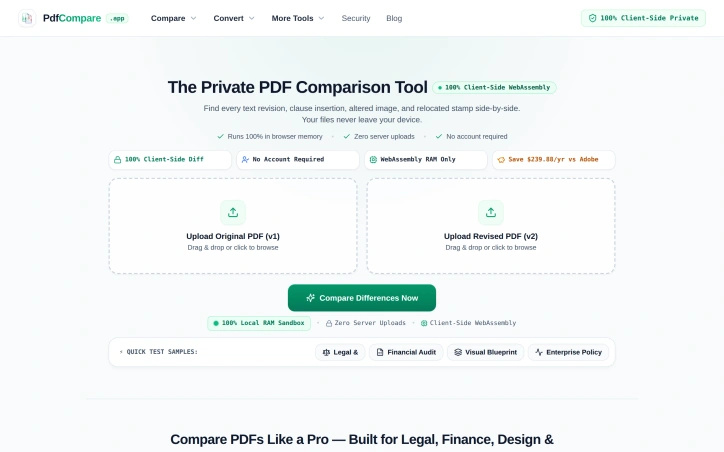
Comparing PDF versions manually invites disaster, especially when subtle changes carry legal or financial consequences. A confidentiality clause shifting from 3 to 5 years, a decimal point moved in a balance sheet, or an authorization stamp drifting 14 millimeters—these shifts demand precision detection but consume hours of tedious line-by-line review. PdfCompare addresses this friction directly by automating differential PDF analysis for legal teams, financial auditors, designers, and HR departments who cannot afford to miss critical revisions. The product's defining feature is its privacy-first architecture. All processing happens client-side in the browser using WebAssembly; files never touch a server and require no account creation. For organizations handling sensitive contracts, financial records, or proprietary designs, this eliminates a major friction point around data security and compliance. The approach is technically sound and operationally simpler than uploading to cloud-based competitors. PdfCompare's feature set is specialized for its target verticals. Legal users get targeted highlighting of textual changes within contract language. Auditors see isolated financial deltas and line-item shifts while the system filters out noise from standard document repagination—a meaningful improvement over line-by-line scanning of 50-page earnings reports. The visual design comparison mode deserves mention for its specificity: an overlay tool (marketed as an X-ray pixel slider) lets architects and designers detect moved elements, shifted logos, or altered spacing without misidentifying text reflow as a substantive change. For HR and operations teams, the tool generates transparent changelogs suitable for communicating policy updates to staff. The implementation decisions reflect a product built for actual workflows rather than generic PDF viewing. The tool recognizes that legal, finance, and design teams have distinct comparison needs—contract language requires semantic precision, financial documents need numerical isolation, and technical drawings prioritize visual layout accuracy. The quick-start samples (contract, financial, and visual) reinforce this specialization. Pricing information is minimal in the available materials, though a comparison to Adobe suggests competitive positioning around cost savings. The lack of subscription lock-in—no account required, no recurring fees mentioned—makes the product more accessible for occasional users or organizations already skeptical of SaaS sprawl. The risk is a narrow addressable market. Organizations comfortable with existing PDF workflows or less sensitive to privacy concerns may not see sufficient differentiation. For the segments it targets, however, PdfCompare solves a genuine problem with a straightforward technical approach and reasonable tradeoff: local processing for privacy and simplicity, sacrificing some advanced features or batch automation that cloud competitors offer.
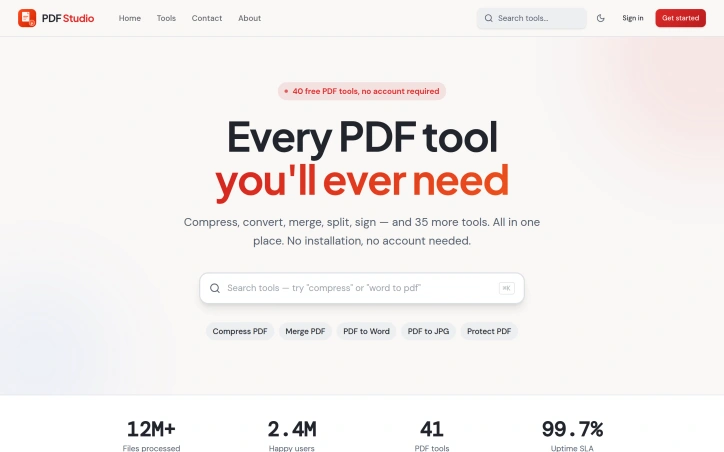
Managing PDF documents has traditionally required either expensive software subscriptions, local installations, or compromised functionality. PDF Studio addresses this gap with a web-based toolkit designed to streamline common document workflows without additional friction. The platform targets a broad audience spanning students managing academic assignments, professionals organizing business documents, and general users handling everyday PDF tasks. The core promise centers on accessibility and simplicity, removing barriers that often exist with desktop solutions or feature-restricted online alternatives. The feature set covers the essential PDF operations most users encounter. Conversion capabilities allow documents to be transformed between formats, while compression tools reduce file sizes for easier sharing. Document manipulation features include merging multiple files and splitting them into sections, along with editing functionality to modify content directly in the browser. Security features provide password protection for sensitive documents and unlocking capabilities for restricted files. What distinguishes PDF Studio in a crowded market is its fully browser-based architecture. This design choice eliminates the need for software installation entirely, allowing users to work with documents from any device with internet access. The emphasis on browser-based operation prioritizes immediacy over setup complexity. The platform has been featured on prominent AI and tools directories including AgentHunter and TakeAI, establishing recognition within tech communities. These inclusions demonstrate the service has differentiated itself enough to merit placement in curated collections. The product's architecture targets removing friction points commonly associated with PDF management. Rather than catering to power users with advanced features, the design prioritizes reliability and straightforward access to core functions. The stated commitment to security and user-friendliness reflects a focus on building trust with users handling sensitive documents. For users evaluating PDF management solutions, PDF Studio delivers a no-installation alternative that emphasizes common operations. The browser-based approach addresses a specific pain point for users who want immediate access without software setup or maintenance overhead. The platform's viability depends on execution quality relative to established competitors in the online PDF tools market, but it stakes out a clear position for users prioritizing accessibility and simplicity over advanced capabilities.
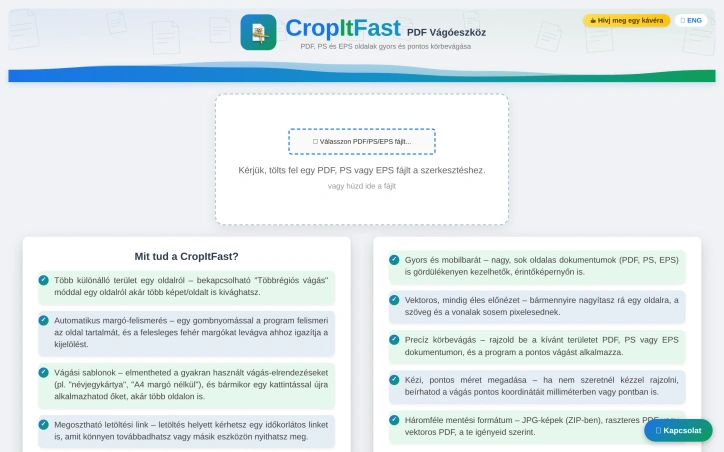
PDF cropping remains a friction point for anyone regularly handling document design, printing, or content extraction. Most available solutions force users toward bloated desktop applications or complex workflows that feel overkill for a single task. CropItFast tackles this directly by offering a streamlined browser-based alternative that prioritizes speed and precision without requiring any software installation. The product addresses a specific but genuine need: making batch document processing accessible. Whether you're preparing business cards, cutting out specific sections from longer documents, or preparing files for print, CropItFast handles these jobs without unnecessary complexity. The target audience spans designers, print professionals, content managers, and anyone who frequently manipulates PDF, PostScript, or EPS files. What distinguishes CropItFast from basic crop tools is its feature depth. Automatic margin detection eliminates manual adjustment for documents with uneven white space, a substantial time-saver when processing multiple pages. The multi-region cropping mode lets users extract several independent areas from a single page without relying on workarounds. Equally useful is the template system, which remembers frequently used crop layouts and applies them consistently across pages or even different documents. For users who prefer precision over clicking, exact coordinate input in millimeters or points ensures mathematical accuracy. The platform's output flexibility warrants attention. Users can export to JPG, raster PDF, or vector PDF depending on their downstream needs, with adjustable quality settings for DPI and JPEG compression. This adaptability matters for professionals who might need sharp screen-ready images one day and print-ready files the next. The option to generate shareable download links with time restrictions adds a collaboration layer, allowing users to distribute results without permanently hosting sensitive files. The interface shows thoughtfulness toward modern usage patterns. Vector-based preview rendering ensures crisp text and lines regardless of zoom level, while mobile support acknowledges that PDF handling increasingly happens on phones and tablets. The tool's claimed ability to handle large, multi-page documents smoothly suggests engineering attention to performance. One note: the website references missing JavaScript files required for the interface library. This indicates either outdated documentation or a production concern worth investigating before evaluating the tool. For users tired of desktop PDF editors or struggling through complex alternatives, CropItFast delivers focused functionality optimized for the actual task rather than general document editing.
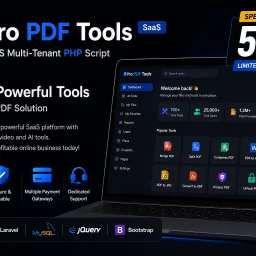
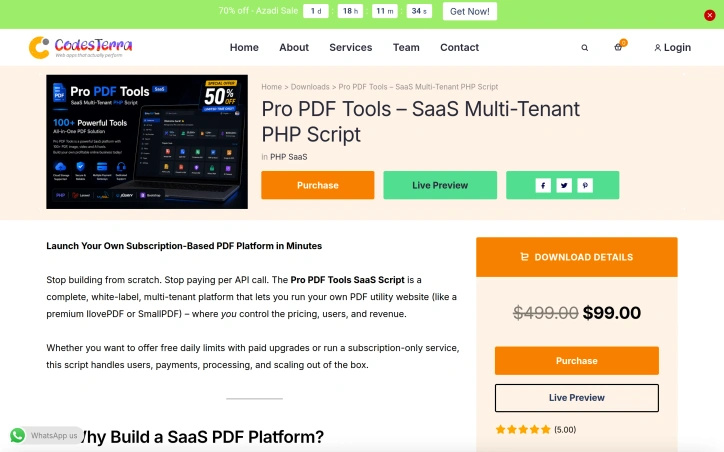
Entrepreneurs looking to launch a subscription-based PDF platform can now skip years of development with this white-label SaaS script. The product targets founders who want to capture recurring revenue from the millions of monthly PDF tool searches without investing heavily in custom infrastructure or dealing with per-transaction API costs. The script bundles over 20 PDF utilities in a single deployment, covering the most common needs: merging and splitting documents, compression at three fidelity levels, format conversion (Word, Excel, PowerPoint, and image files), security features like encryption and digital signatures, and maintenance tools such as file repair and watermarking. This breadth means operators can launch a competitive alternative to existing players in the space without building each feature from scratch. What distinguishes this offering is its focus on operational simplicity for non-technical founders. The platform includes built-in payment processing through Stripe and PayPal, multi-tenant architecture for managing multiple users, and white-label branding so operators fully control the customer experience. The architecture treats each tool as a self-contained module, enabling operators to selectively enable features or adjust processing parameters by fidelity level. This modularity matters: a startup can launch conservatively with core features and upsell compression levels or advanced conversions as usage patterns emerge. The script also addresses the economics that trap many PDF tool operators. Running on your own infrastructure means no ongoing API charges per file processed, and the built-in subscription mechanics handle both free-tier models with paid upgrades and pure subscription tiers. Documentation mentions support for daily usage limits, which is standard for freemium PDF tools but not trivial to implement correctly. A few caveats: the provided content offers no transparency about deployment complexity, infrastructure requirements, or realistic throughput expectations. Similarly, no pricing is disclosed for the script itself. Operators should clarify licensing terms, support guarantees, and whether updates to the PDF processing engine are included long-term. The claimed feature list is comprehensive on paper, but the actual quality of conversion fidelity and PDF handling edge cases would require testing before deployment. For founders confident in the feature set and comfortable with self-hosted infrastructure, this script removes substantial development friction.

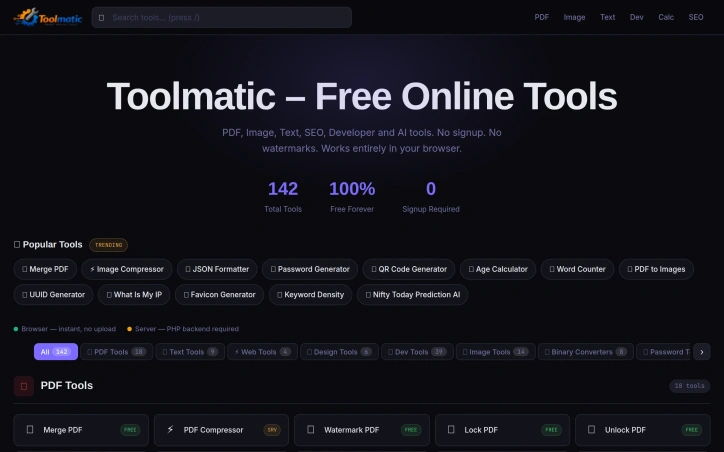
A unified collection of 142 free online tools, Toolmatic addresses a persistent friction point for developers and professionals: the need to access scattered utilities across dozens of platforms, each demanding signups, displaying watermarks, or hiding features behind paywalls. The service consolidates PDF manipulation, image conversion, code formatting, text utilities, SEO analysis, and design tools into a single browser-based environment. The product's clearest strength is its friction-free design philosophy. Every tool runs directly in the browser without account creation, watermarks, or restrictions. This approach trades complexity for accessibility, making it useful for quick, one-off tasks where spinning up an account would waste more time than completing the job itself. The breadth of the toolkit is substantial: eighteen PDF tools cover merging, compression, watermarking, and format conversion; thirty-nine developer tools handle everything from JSON and XML formatting to Base64 encoding and JWT decoding; image conversion spans formats including WEBP, HEIC, SVG, and favicon generation. The organization reflects thoughtful categorization. Tools group into logical sections like binary converters, password utilities, calculators, finance tools, and domain utilities. Popular tools such as the password generator, QR code generator, and JSON formatter are highlighted prominently, suggesting an understanding of which utilities drive traffic. The business model is straightforward: the entire suite is free indefinitely, with no signup requirement. This creates clear value for occasional users but raises immediate questions about sustainability. Some tools operate entirely in-browser, while others require a PHP backend on a user's server, suggesting a hybrid approach to computation-heavy tasks. One limitation emerges in the tool descriptions themselves. Many entries lack clarity about processing method or handling of uploaded data. Users cannot quickly determine whether their PDF remains private within their browser or transmits to Toolmatic's servers. For a tool that attracts users seeking quick access without friction, this opacity about data handling represents a missed opportunity for trust-building. The product succeeds as a practical utility collection for developers and professionals who value speed over feature depth. It occupies a useful niche: neither a specialized platform for a single task nor an overstuffed bloatware suite, but a genuinely quick answer to common conversion and formatting problems.
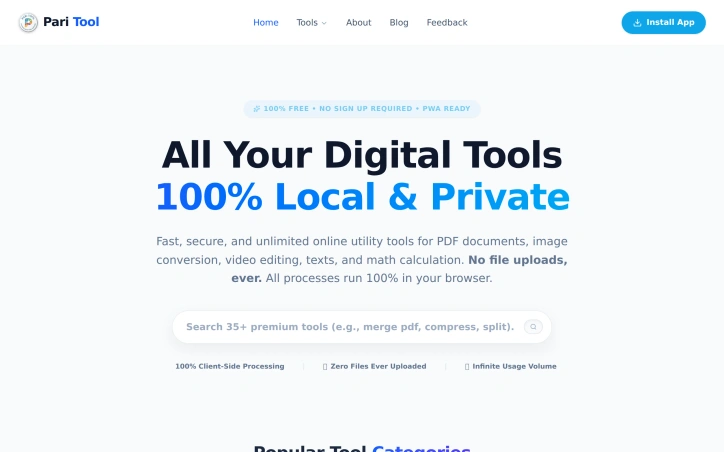
Professionals and casual users constantly face the need for quick file conversion, document manipulation, and utility operations, yet existing solutions fragment across paid subscriptions, sketchy free services that upload data to servers, and desktop software that requires installation. Pari Tool addresses this gap with a collection of over 35 browser-based utilities that operate entirely on the user's device, eliminating privacy concerns and eliminating the need for account creation or payment. The core distinction of this product lies in its execution model. All processing happens client-side within the browser, meaning files never leave the user's computer. This architecture removes the fundamental trade-off that has long plagued free online tools: either accept that your files travel to someone's server, or pay for privacy. For users managing sensitive documents—tax records, personal photos, confidential PDFs—this distinction matters considerably. The tool also operates as a progressive web application, allowing installation directly from the browser without app store intermediaries. The feature set spans practical categories. PDF functionality covers merging multiple documents, splitting or extracting specific pages, compression, format conversion to images, password protection, and annotation editing. Image tools handle resizing, cropping, background removal, watermarking, and conversion between WebP, PNG, JPG, and PDF formats. Video utilities compress footage, convert between formats (MP4 to MOV), extract audio, and transform clips into animated GIFs. Beyond media, the platform includes text utilities for word counting and reading-time analysis, case conversion, batch find-and-replace operations, and duplicate removal. Specialized tools cover QR code and barcode generation, JSON formatting, file encryption with AES protection, ZIP compression, and practical calculators for EMI and tax invoice generation. What remains unstated but obvious: the business model assumes either a future monetization pivot or funding already in place. The product explicitly commits to remaining free with unlimited usage, which creates questions about sustainability that the available information doesn't address. The strength of Pari Tool lies not in algorithmic innovation but in practical consolidation. Rather than requiring users to bounce between a dozen specialized sites, it centralizes commonly needed operations in a single, privacy-respecting interface. For anyone regularly handling documents, images, or video files, the convenience factor alone—combined with the removal of upload anxiety—positions this as a genuinely useful addition to the web utility landscape.

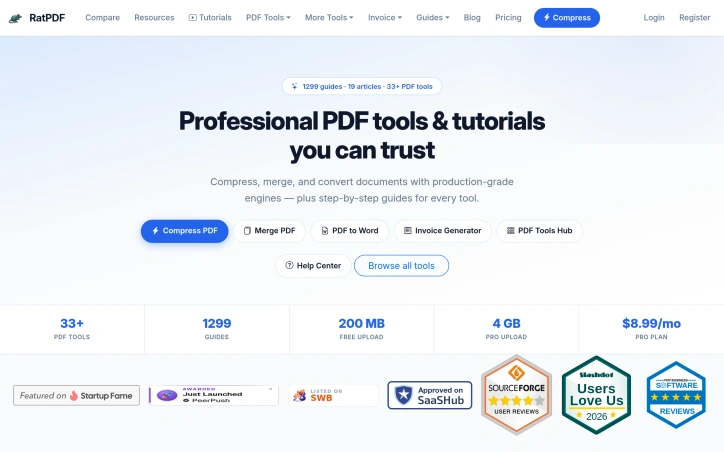
Document productivity is a common pain point for many individuals and businesses, with complicated and costly PDF editing software often being a major obstacle. RatPDF addresses this issue by providing a browser-based platform that offers a range of free and accessible PDF tools. The platform is designed to simplify document productivity, making it an ideal solution for freelancers, small businesses, and anyone looking for an easy-to-use PDF editing solution. What stands out about RatPDF is its comprehensive suite of PDF tools, which includes compression, merging, splitting, conversion to Word or Excel, OCR, signing, watermarking, and invoice generation. The platform utilizes production-grade engines such as Ghostscript, LibreOffice, pdf2docx, and iText, ensuring high-quality output. The inclusion of step-by-step guides for each tool is also a notable feature, making it easy for users to navigate and utilize the various tools. The platform offers a range of key features, including the ability to compress PDF files without losing quality, merge multiple documents into one file, and convert PDFs to editable Word documents. The invoice generator tool is also a useful feature, allowing users to create GST, VAT, and business invoices as PDF files. Additionally, the platform provides a secure PDF workflow, enabling users to watermark, sign, password-protect, and unlock their documents. RatPDF offers a mix of free and paid features, with users able to upload files up to 200 MB for free. For users requiring more capacity, the Pro plan offers 4 GB uploads for $8.99 per month. Overall, RatPDF is a versatile and user-friendly platform that provides a valuable solution for individuals and businesses looking to simplify their document productivity.
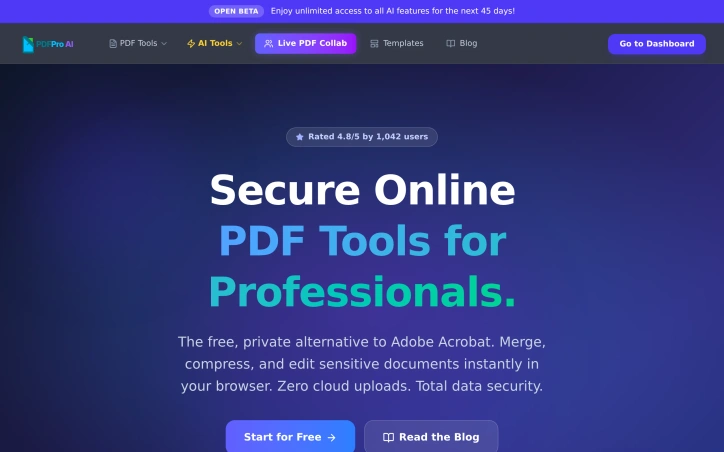
Professionals handling sensitive documents need a reliable and secure way to manage their PDFs without compromising on speed or functionality. PDF Pro addresses this need by offering a comprehensive suite of online PDF tools that are not only free but also prioritize user privacy and security. The platform is particularly suited for individuals and businesses looking for a secure alternative to Adobe Acrobat, providing features such as merging, compressing, and editing PDFs directly in the browser. What stands out about PDF Pro is its commitment to maintaining user privacy through robust security measures. It utilizes AES-256 encryption and ensures that files are automatically deleted from servers after two hours, reinforcing its "Privacy First" promise. The use of WebAssembly technology allows for instant processing of PDF tasks locally within the browser, eliminating the need for cloud uploads and thereby enhancing both speed and security. Key features of PDF Pro include a range of standard PDF tools such as merging, compressing, and editing, as well as more specialized AI-powered tools like the Medical Report Analyzer, Bank Statement Analyzer, and Resume Scanner. These tools cater to various professional needs, from document management to in-depth analysis. The platform also offers E-Sign capabilities that are ESIGN and eIDAS compliant, adding a layer of legal validity to electronically signed documents. Notably, PDF Pro operates on a completely free model with no signup required and no limits on usage, at least for the time being as indicated by a limited-time offer. This approach, combined with its robust feature set and emphasis on privacy, positions PDF Pro as a compelling option for those seeking a secure, efficient, and cost-effective PDF solution.

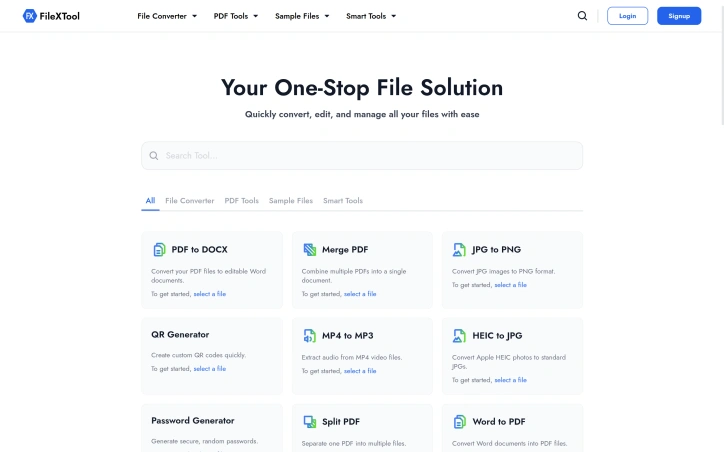
Managing and editing various file formats can be a daunting task, especially when dealing with multiple conversions and manipulations. FileXTool addresses this challenge by providing a comprehensive suite of online tools that cater to diverse file processing needs. The platform is designed for individuals who require a straightforward and efficient solution for converting, editing, and managing their files, without needing extensive technical expertise. What stands out about FileXTool is its commitment to delivering high-quality conversions and prioritizing data security. By leveraging reliable open-source technology and partnering with trusted software providers, the platform ensures accurate and customizable conversions across a wide range of formats, including audio, video, documents, and images. The emphasis on security is evident in its robust system, which features advanced encryption, secure data centers, and continuous monitoring to safeguard user data. The platform offers an impressive array of tools, including PDF conversion and manipulation utilities, image converters, and utility tools such as password generators and URL encoders. These features enable users to perform various tasks, from converting PDFs to editable Word documents to generating custom QR codes, all within a user-friendly interface that requires no technical skill or learning curve. FileXTool is entirely free to use, with no requirement to download or install software, making it an attractive solution for individuals seeking a convenient and accessible file processing tool. By providing a one-stop solution for file management and editing, FileXTool streamlines workflows and saves users time, making it an invaluable resource for those dealing with diverse file formats.

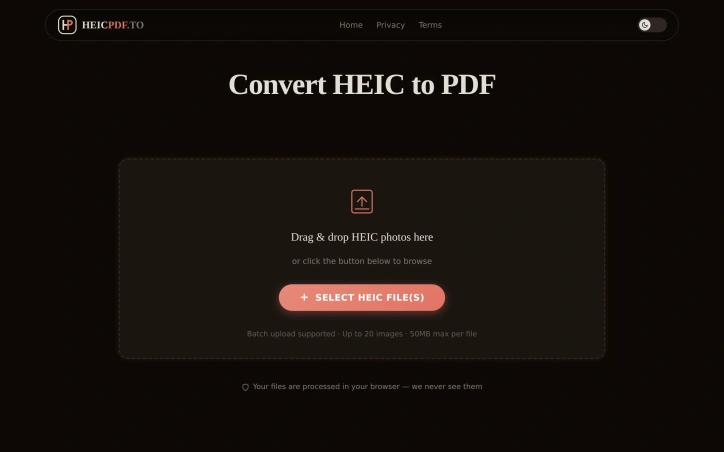
The widespread adoption of HEIC image format by iPhone users has created a compatibility issue when sharing photos with others using different devices or operating systems. HEICPDF.TO addresses this problem by providing a straightforward solution to convert HEIC files to PDFs, a widely accepted and compatible format. The site is particularly useful for iPhone users who frequently share photos with others using Windows or Android devices. What stands out about HEICPDF.TO is its simplicity and ease of use. The conversion process is entirely browser-based, ensuring that users' files are processed locally and remain private. The site allows users to drag and drop HEIC files, reorder them, and customize the output PDF's layout before exporting it. The live preview feature gives users full control over the final output. The site's capabilities are worth noting, particularly its support for batch uploads of up to 20 images, with a maximum file size of 50MB. Users can also import files directly from cloud storage services like Dropbox or Google Drive. The conversion process is quick, and users can download the resulting PDF or save it directly to cloud storage. The fact that HEICPDF.TO does not require registration or installation makes it an attractive solution for occasional users. The site's business model is not explicitly stated, but the lack of any mention of pricing or subscription suggests that it is free to use. Overall, HEICPDF.TO is a convenient and user-friendly solution for iPhone users to share their photos with others without worrying about compatibility issues. Its browser-based approach and robust feature set make it an effective tool for converting HEIC files to PDFs.

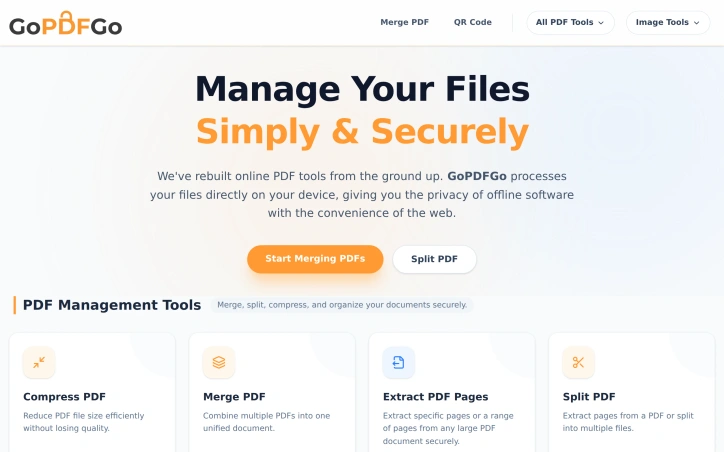
Managing PDF files can be a daunting task, especially when online tools compromise security by uploading documents to their servers for processing. GoPDFGo addresses this issue by providing a suite of PDF management tools that operate directly within the user's web browser, ensuring the security and privacy of sensitive documents. The creator's primary motivation is to offer a convenient and secure solution for managing PDF files, free from the risks associated with traditional online PDF tools. What stands out about GoPDFGo is its innovative use of advanced technologies like WebAssembly to process files locally on the user's device, eliminating the need for server uploads. This approach not only enhances security but also enables the tools to function offline once loaded. As a result, users can merge, split, compress, and convert PDFs without exposing their data to potential risks. The platform offers a range of features catering to diverse user needs, including students, professionals, and government aspirants. Users can compress PDFs without losing quality, merge multiple documents into one, extract specific pages, and even convert images to PDF. Additionally, the website provides image editing capabilities, such as resizing, cropping, and converting between various formats. GoPDFGo's user-centric design and robust feature set make it an attractive solution for individuals seeking a secure and reliable PDF management tool. By processing files locally and avoiding server uploads, GoPDFGo delivers on its promise of providing a safer alternative to traditional online PDF tools. The absence of explicit pricing details suggests that the platform is committed to offering its services free from the constraints of paid software, aligning with the creator's vision of providing a convenient and secure solution.
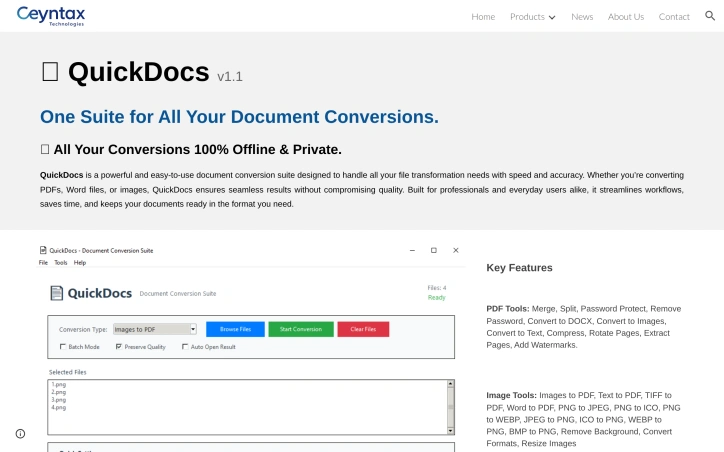
Digital clutter often hides in folders scattered with PDFs, image files, and legacy Office documents that need quick reshaping without exposing them to the open web. QuickDocs tackles that friction head-on by packaging an offline conversion studio into a single Windows download. Mid-sized firm admins, freelancers switching between client formats, and privacy-conscious home users looking to avoid cloud uploads will find a straightforward answer to that everyday grind. The suite’s primary differentiator is its insistence on on-device processing. Every merge, split, or background removal happens locally, eliminating the latency and compliance unease that accompany browser-based converters. Equally arresting is the breadth of tasks layered beneath an interface that makes no attempt to dazzle—you add a file, pick a transformation, and let the program quietly finish the job. No pop-up upsells, no sign-in preamble. PDF handling carries the heaviest load. From password-locking sensitive reports to dissecting hundred-page epubs into single-topic chapters, the toolkit covers eighteen discrete manipulations including watermarking and high-ratio compression that keeps print fidelity intact. Image chores are handled with equal precision: scan a stack of PNG screenshots into one compact PDF, crank a presentation ICO down to a 32-pixel favicon, or strip the backdrop from a product photo without opening a second application. All file-type switches—whether TEXT-to-PDF or WEBP-to-JPEG—run through the same modal, reducing the learning curve to essentially zero. CeyNTAX keeps pricing silent on the public page; the download link is unqualified, suggesting that the distribution model is either a free tier or a simple try-before-buy scheme. Until the company clarifies monetization, the only cost to the user is local disk space and the few moments it takes to decide whether this no-internet, no-nonsense engine earns a permanent spot in the taskbar.

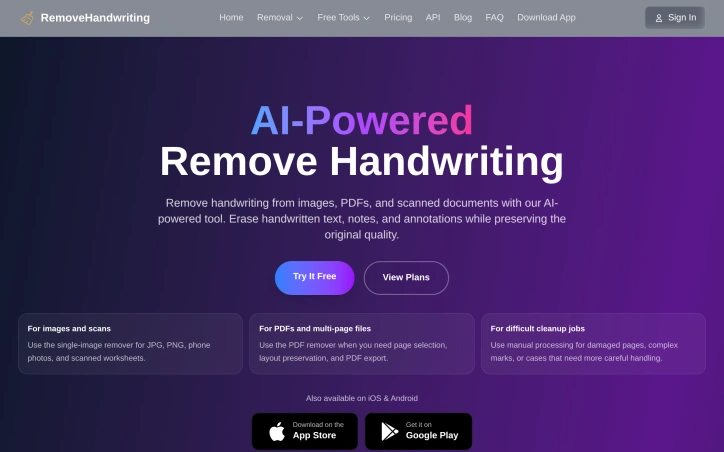
Teachers who share old exam papers, legal clerks who reuse signed agreements, and archivists who scan historical files all face the same tedious task: printing a page covered in looping ink, barely legible notes, or stubborn annotations that OCR engines confuse with text. Remove Handwriting tackles that exact pain point, turning cluttered pages back into reusable, print-ready documents. What makes the product pop is its refusal to remain a gimmicky background-eraser. Instead of simply piling on another “magic eraser” layer, it folds handwriting removal into a complete document rehabilitation kit: skew correction, curl flattening, shadow suppression, and edge trimming all operate in one pass. The underlying AI focuses on protecting words that were actually typeset, so copies of textbooks keep their formulas and tables intact while hand-scribbled exercises vanish. For day-to-day use, three workflows matter. A browser engine handles single images—snap a worksheet, drop the file, collect a clean JPG. Stretch that workload to PDFs and multi-page folders and the engine respects original page order, exports in PDF format, and lets users pick only the pages that need cleanup. When pages arrive mangled—water damage, deep folds, or overlapping ink smears that confuse the automatic pass—users flip to a manual processing channel that keeps human judgment in the loop. Mobile counterparts on iOS and Android extend the same feature set beyond the desktop, letting office scanners and classroom iPads act as clean-up stations. The front-page proposal is straightforward: start without even a credit card and use the free tier, then upgrade to paid plans whose details begin at the ‘View Plans’ button. No hidden subscription prompts trip you at the first upload, and batch or API access sits ready when file counts jump from “a few worksheets” to “full semester archives.”

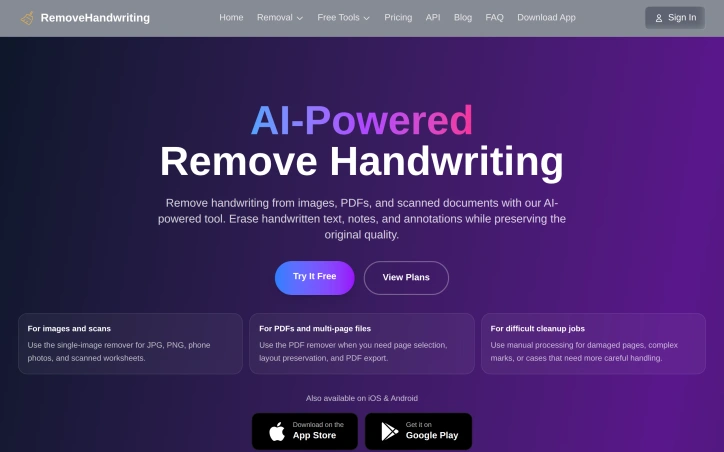
Handwritten annotations on documents—whether from exam grading, contract revisions, or archival materials—represent a persistent productivity headache for students, educators, and professionals. Cleaning them up manually consumes hours of tedious work with tools like photo editors or requires scanning documents twice. An AI-powered document processor tackles this directly: it strips handwritten text, notes, and scribbles from images, PDFs, and scanned pages while preserving printed content, tables, and diagrams intact. The tool distinguishes itself through automated document analysis that goes beyond simple handwriting detection. It performs intelligent boundary recognition to identify document edges, corrects skew and rotation automatically, unrolls curled page corners, and neutralizes uneven backgrounds and shadow artifacts. This multi-layered approach produces clean, archival-quality output suitable for reprinting or digital filing. The distinction between handwritten and printed content matters deeply here—many document cleanup solutions either over-erase legitimate text or leave behind smudges. This one prioritizes precision on that boundary. The product offers three processing paths to match different needs. A single-image remover handles individual photos and scans in common formats (JPG, PNG, JPEG). A PDF-specific mode preserves layout across multi-page documents, allows page-level selection, and exports cleaned results directly as PDFs. For damaged pages or complex marks that defeat automated detection, manual processing gives users direct control. The tool runs in a web browser, eliminating software installation friction, and native iOS and Android apps extend accessibility to mobile workflows. Business model details are minimal in public messaging. The service operates on a free tier requiring no credit card, lowering friction for trial use. Paid plans exist but their scope and pricing remain undisclosed on the available content. Batch processing and API access are mentioned as available for larger-scale workflows, suggesting infrastructure for enterprise or institutional customers—schools processing hundreds of exam papers, document management companies handling archives, or legal firms preparing discovery materials. The founder's motivation aligns cleanly with market need: the product emerged from frustration with manual erasure workflows. For students cleaning submission copies, teachers preparing answer keys for reuse, and archivists preserving historical documents without handwritten overlays, the time savings justify the free entry point. The combination of multi-format support, intelligent background preservation, and straightforward interface addresses a real but previously unglamorous gap in document processing.

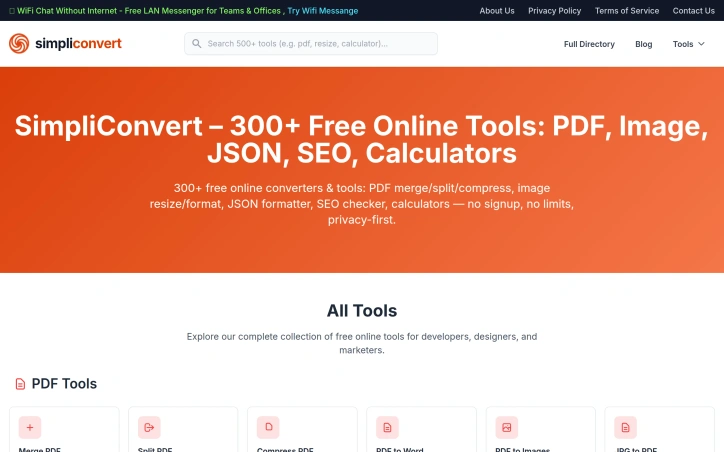
File conversion fatigue is real. Anyone who's worked across design, development, or marketing knows the pain of subscribing to multiple specialized services just to handle common tasks—resizing images, compressing PDFs, formatting JSON, or generating SEO metadata. SimpliConvert directly addresses this frustration by consolidating over 300 utility tools into a single, free, registration-free platform. The product targets developers, designers, and marketers who need quick, reliable transformations without friction. Rather than bouncing between paid SaaS platforms or dealing with upload limits and watermarked outputs, users access everything immediately and without gatekeeping. The all-free model is the core differentiator—no subscription tiers, no freemium upsell, just tools that work. The breadth of functionality is genuinely comprehensive. PDF operations span the essentials: merging, splitting, compression, and conversion to Word or images. Image tools cover resizing, format conversion across PNG, JPG, and WebP, compression, cropping, and enhancement features like blur, sharpening, and background removal. The developer-focused section includes JWT encoding and decoding, JSON formatting and minification, Base64 conversion, and code minifiers for CSS, JavaScript, and HTML. Beyond that are SEO tools for generating meta tags, sitemaps, and checking redirects; calculators for percentages, BMI, and cryptocurrency profit; and utilities like cron expression generators and chmod calculators. What distinguishes SimpliConvert from a generic toolbox is architectural intentionality. The platform emphasizes privacy-first design and enforces no artificial limits—users don't hit paywalls after a certain number of conversions. The removal of registration barriers means the tool is genuinely frictionless; there's no account creation, no email confirmation, no onboarding overhead. This makes it equally appropriate for one-off tasks and repeated use. The business model is transparent: entirely free access. This positions SimpliConvert as a utility-first product rather than a lead-generation engine, which reinforces the philosophy that quality software shouldn't require payment or privacy compromise. For users tired of subscription sprawl, SimpliConvert delivers a compelling alternative through reliable execution across a legitimate need.
Protecting sensitive information in documents has become a compliance necessity for enterprises, yet traditional redaction workflows remain cumbersome and error-prone. PDF Redaction addresses this by combining artificial intelligence with local processing to identify and remove personally identifiable and health information without sending full documents to external servers. The product targets organizations handling confidential data—particularly in regulated sectors like healthcare, finance, government, and defense—where both data protection and operational efficiency matter equally. The platform's core differentiator is its hybrid workflow. Rather than relying entirely on automation, it gives users final authority over redactions detected by its AI engine. The system identifies sensitive information across fifty-plus categories using machine learning-powered optical character recognition, but the actual removal of data remains a human decision. Users can review AI-suggested redactions, adjust boxes, search for specific terms, or add manual redactions before exporting the final document. This balance between intelligent automation and human oversight addresses the real concern that purely automated approaches sometimes overcorrect or miss context. Deployment flexibility sets it apart further. The platform exists in three forms: a free web-based tool limited to twenty-five pages per document, an on-premise enterprise version called PDF Redaction Studio positioned for air-gapped security environments, and a REST API for developers integrating redaction into larger systems. This tiered approach accommodates organizations across the spectrum, from smaller operations to those with strict data sovereignty requirements. The on-premise option explicitly targets sectors like defense and government, suggesting the vendor understands the particular security architecture some institutions require. The technical foundation rests on open-source technologies—specifically Spark-PDF and ScaleDP—which the company highlights as evidence of reliability and transparency. This choice also suggests the product benefits from community scrutiny rather than proprietary black-box architecture. Beyond standard redaction, the platform offers a custom rule engine, allowing organizations to protect data patterns unique to their industry, and professional consulting services drawing on claimed expertise in machine learning, natural language processing, and document processing. Pricing transparency is minimal on the public website. The free tier allows unlimited documents with a twenty-five-page-per-document ceiling, positioning it as a viable starting point for testing. Enterprise and API pricing requires direct engagement. This model encourages adoption at smaller scales while reserving detailed pricing for conversations with accounts teams handling larger deployments.