#saas Startups & Tools
Discover the best saas startups, tools, and products on SellWithBoost.

For developers and indie makers looking to launch their products and get discovered, Nick Launches offers a suite of tools and resources to help them succeed. The platform is designed to support those building AI products, providing practical guidance and strategic support to accelerate their launch. What stands out about Nick Launches is its focus on the AI product development community, catering to a specific niche within the broader tech landscape. The website highlights a curated list of recent product launches, showcasing a diverse range of tools and applications across categories like AI, education, content creation, and more. This suggests that the platform not only supports product launches but also fosters a community around emerging technologies. The key features of Nick Launches include its product launch services, which promise to get products in front of thousands of builders and provide a permanent backlink from a high-authority site for SEO benefits. The platform also offers a directory submission service, implying that it helps products gain visibility through targeted listings. Additionally, the website features a collection of tools and resources, including tutorials and reviews, aimed at helping developers build and launch their products more effectively. While the pricing or business model details are not explicitly stated, the platform's revenue streams can be inferred from its services. The directory submission service and product launch offerings suggest that Nick Launches generates revenue through these paid services, potentially catering to a range of budgets and needs within the developer and indie maker community. Overall, Nick Launches positions itself as a valuable resource for those looking to launch and grow their AI products, providing a combination of visibility, community, and practical support.

Designers, product managers, and developers working on SaaS products often spend a significant amount of time researching and analyzing existing solutions to inform their design and product decisions. SaaS Boat addresses this challenge by providing a curated library of real-world SaaS screenshots, user flows, and UX audits. The platform is designed to save users time and effort by offering a comprehensive resource that helps them understand how top SaaS teams design better user experiences. What stands out about SaaS Boat is its focus on depth and quality of research. With over 270 SaaS products documented, users can gain valuable insights into the design decisions behind successful products. The platform's heuristic evaluations, based on Nielsen's usability principles, allow users to identify usability issues, UX patterns, and interface decisions across various SaaS interfaces. Additionally, the high-fidelity screenshots and detailed user flow diagrams provide a rich understanding of how SaaS products are structured and how they guide users through different experiences. Key features of SaaS Boat include its library of SaaS screenshots, user flows, and UX audits, as well as its heuristic evaluations. The platform also offers a simple pricing model, with a free sign-up plan that provides limited access to its resources, allowing users to explore the platform before upgrading. Users praise SaaS Boat for improving their design and product decisions, with 92% of users reporting a positive impact. By providing a centralized resource for SaaS research, SaaS Boat enables product teams to make more informed decisions and ship better products faster. Overall, SaaS Boat is a valuable resource for anyone working on a SaaS product, offering a comprehensive and curated library of real-world examples to inform their design and product decisions.

The online proliferation of visual media has created a pressing issue for creators, agencies, publishers, and brands: maintaining control over images as they spread across the internet. As images travel, essential information such as ownership, licensing terms, and usage rules often gets lost, leading to significant time and financial losses when trying to establish provenance and enforce rights. Metapyxl addresses this challenge by providing a comprehensive rights infrastructure for visual media. At its core, the platform ensures that images are protected, tracked, and verified throughout their online journey. What stands out about Metapyxl is its proactive approach to image protection, utilizing a combination of invisible forensic watermarking, metadata, and C2PA/content credentials to preserve ownership and licensing context. Users can register their images in Metapyxl Vault, where they can add licensing terms and apply forensic watermarking, allowing them to monitor online usage effectively. The platform's Lens feature enables viewers to access creator, rights, provenance, and licensing context when protected images appear online, promoting transparency and facilitating legitimate use. Notably, Metapyxl's watermarks are designed to remain detectable even after common image alterations such as cropping, resizing, and compression, with a high success rate of 99% in tested cases. The platform's capabilities are geared towards rights holders seeking to safeguard their visual assets while promoting their legitimate use. By maintaining a connected workflow from ownership record to evidence packet, Metapyxl provides a robust solution for managing image rights. Customers, including photography agencies and individual photographers, praise Metapyxl for its innovative features, such as customizable licensing agreements and a user-friendly Chrome extension that streamlines asset tracking. Overall, Metapyxl offers a vital tool for visual media creators to protect and monetize their work in the digital age.

For Australian individuals and businesses struggling with the tedious task of manually tracking receipts for tax deductions, a much-needed solution has emerged. The burden of lost or misplaced receipts, coupled with the time-consuming process of categorizing and auditing expenses, is a common frustration for many. ReceiptClaimer is designed to alleviate this pain by providing an automated, AI-driven platform that streamlines the receipt tracking process. What stands out about ReceiptClaimer is its focus on the specific needs of Australian taxpayers, particularly landlords and sole traders. By leveraging Google's Document AI technology, the platform achieves impressive accuracy in extracting relevant information from receipts, eliminating the need for manual data entry. Users can simply forward receipts via email or snap a photo, and the AI engine categorizes expenses according to Australian Taxation Office guidelines. The platform's key features include smart categorization, multi-property tracking, and the ability to generate ATO-ready reports with ease. For landlords managing multiple rental properties, ReceiptClaimer offers a valuable tool for monitoring cash flow, expenses, and rental income per property. By automating the receipt tracking process, users can save significant time and reduce the risk of missed deductions. Notably, ReceiptClaimer offers a free tier, allowing users to start automating their tax deductions without requiring a credit card. The platform's Pro tier supports unlimited properties, making it a scalable solution for growing businesses. With its emphasis on accuracy, ease of use, and compliance with Australian tax regulations, ReceiptClaimer is poised to revolutionize the way individuals and businesses manage their tax receipts.

In today's fast-paced world, staying informed can be a daunting task, with endless news feeds and clickbait headlines vying for attention. Waves addresses this issue by providing a personalized news experience tailored to busy individuals who crave relevant information without the noise. By leveraging AI technology, it curates news into concise, 1-2 minute audio briefings that cater to users' specific interests. What sets Waves apart is its ability to distill complex news stories into their essential points, shedding unnecessary filler and presenting them in a clear, natural-sounding narrative. The platform's adaptability is also noteworthy, as it learns users' preferences over time and adjusts its daily mix of news accordingly. Furthermore, Waves offers a seamless listening experience across multiple platforms, including iOS, Android, and web, complete with features like lock screen controls, background playback, and offline support. The service also boasts a range of convenient features, including breaking news alerts and the ability to share briefings with others via public links. Users can select from a diverse range of topics, from global markets and AI breakthroughs to politics and entertainment. Notably, Waves is available for free, with no credit card required or commitment expected. Overall, Waves delivers a refreshing take on news consumption, prioritizing brevity, relevance, and user experience to foster better news habits.

Privacy-conscious writers tired of storing manuscripts in cloud services designed around data extraction will find a different proposition in CipherWrite. The application explicitly positions itself against the surveillance model embedded in mainstream writing tools, offering what the founder describes as a secure sanctuary for creative work—a space where commercial data extraction and AI training harvesting do not occur. Built initially as a personal project to organize private thoughts and early manuscripts, CipherWrite combines a diary, note-taking, and book-writing environment with encryption that locks content on the user's device before transmission. The architecture distinguishes itself through its approach to key management: encryption keys generate locally and never leave the user's machine. The service maintains no server logs, metadata tracking, or search history, and users write anonymously without providing personal information. Beyond its security infrastructure, the product includes a privacy analysis tool that flags potentially sensitive content before publication—addressing a particular concern for writers working with personal or controversial material. The application also features an AI-powered editor that evaluates clarity and depth, plus a reader fatigue predictor that visualizes precisely where reader attention drops within manuscripts. The founder's origin story emphasizes authenticity over growth theater. Developed across weekends and free time, the tool evolved from a personal diary into a comprehensive writing suite as the creator identified his own needs for additional features. This incremental approach, positioned as perpetually unfinished rather than fully optimized, reflects a product built around actual user problems rather than speculated ones. The business model follows a freemium structure, with free access to core writing features and paid upgrades for professional tools. No specific pricing is publicly disclosed. The founder's explicit rejection of what he calls predatory growth hacks and algorithmic surveillance represents a deliberate choice to abandon the dominant monetization model in productivity software—declining data extraction in favor of direct revenue from premium features. CipherWrite occupies a specific market niche rather than pursuing mainstream adoption. Writers who view manuscripts as proprietary intelligence or whose work touches sensitive subjects will recognize the product's utility. For casual writers, the security emphasis represents an expensive solution to an unfelt problem.
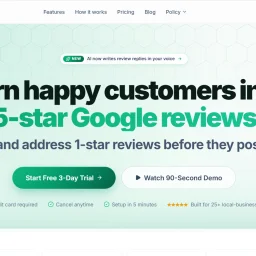
Local businesses struggle to maintain a strong online reputation, often losing customers due to a mismatch between their service quality and online reviews. Reviews Zen is designed to address this issue by automating review management for local businesses across various niches. The platform acts as a reputation autopilot, streamlining the process of generating and managing online reviews. What stands out about Reviews Zen is its use of AI to write review replies in the business owner's voice, significantly reducing the time and effort required to respond to customer feedback. The platform's ability to catch negative reviews privately and respond promptly is particularly valuable, as it helps mitigate the damage caused by unfavorable reviews. The key features of Reviews Zen include its branded email funnels, which send review requests to customers under the business's name and branding, and its negative-review interceptor, which captures low-rated feedback before it appears on Google. The platform also integrates with various business tools, such as Jobber and QuickBooks, to simplify the process of importing customer data and automating review requests. Reviews Zen offers a straightforward pricing model, with a starter plan available for $29 per month for a limited time as part of its founders' launch offer, which normally costs $79. The platform provides a three-day free trial with no credit card required, and customers can cancel their subscription at any time. Overall, Reviews Zen is a compelling solution for local businesses seeking to improve their online reputation and attract more customers through positive reviews.

Creating immersive online experiences is now more accessible than ever, thanks to innovative solutions like Space Tour's 360° virtual tour builder software. The primary challenge this product addresses is the complexity and technical expertise often required to create interactive virtual tours, which has long been a barrier for real estate agents, property developers, and interior designers. What sets Space Tour apart is its commitment to simplicity and a seamless user experience. By allowing users to build and customize 3D tours directly in the browser without needing to code or install software, it democratizes access to high-quality virtual tour creation. The platform's emphasis on design and branding is evident in its array of customization options, including custom fonts, icons, and color themes, ensuring that tours align with users' brand identities. Notable features of Space Tour include its support for high-resolution panoramas up to 32K, multiple navigation types, and integrations with Google Maps and Apple Maps. The software also offers advanced functionalities such as day/night mode, custom interactions, and analytics to track user engagement. The process of creating a tour is streamlined into straightforward steps, from preparing panoramas to publishing the final tour via a shareable link or embedding it on a website. Space Tour operates on a freemium model, with a free plan that includes essential features, allowing users to create a simple tour at no cost. For users requiring more advanced features, the Starter plan is available for $15 per month, offering a range of additional functionalities including white-label tour export, higher resolution support, and analytics integration. Overall, Space Tour presents a compelling solution for professionals seeking to present spaces in an engaging and interactive manner without the need for extensive technical knowledge.

Creators and content enthusiasts often need to download thumbnails from YouTube videos for various purposes, but the process can be cumbersome due to the lack of a straightforward download option on the platform. The YouTube Thumbnail Downloader addresses this issue by providing a simple and efficient way to extract and download high-quality thumbnails in multiple resolutions. This tool is particularly useful for creators, researchers, and marketers who need to analyze or reuse these images for legitimate purposes. What stands out about this product is its emphasis on ease of use and speed. The tool allows users to download thumbnails instantly without requiring any signup or installation, making it a convenient solution for those who need to access these images quickly. The fact that it works seamlessly on all devices, including desktop, tablet, and mobile, further enhances its accessibility. The tool's capabilities are impressive, with features such as instant extraction, multiple resolution options ranging from 120x90 to 1280x720, and unlimited downloads. The process is straightforward, involving just three steps: pasting the YouTube video URL or ID, clicking to extract thumbnails, and downloading the desired resolution. The tool also automatically detects and extracts thumbnails from various URL formats, adding to its convenience. Notably, the tool is completely free to use, with no limitations on the number of downloads. The absence of any pricing details or business model information suggests that the tool is supported by a different revenue stream, allowing users to access its features without incurring any costs. Overall, the YouTube Thumbnail Downloader is a valuable resource for anyone needing to access YouTube thumbnails, offering a fast, easy, and cost-effective solution.

Financial calculations and business tasks often require specialized tools, but accessing these can be cumbersome due to paywalls, registration requirements, and data privacy concerns. AnyServ addresses this issue by offering a suite of calculators and business tools directly in the user's browser, eliminating the need for downloads, sign-ups, or server-side data processing. The platform is geared towards individuals and businesses seeking straightforward, accurate financial and business calculations without the hassle of traditional software or online services. What stands out about AnyServ is its commitment to user privacy and simplicity. By processing all calculations locally within the browser, AnyServ ensures that user data never leaves their device, providing a high level of security and compliance with data protection regulations like GDPR. The service also boasts a clutter-free experience, allowing users to pick a tool, input their data, and receive instant results without any friction. The range of tools available on AnyServ is diverse, covering financial, tax, and business needs. Users can access a VAT calculator, mortgage calculator, salary calculator, and percentage calculator, among others, all of which are designed with transparency and accuracy in mind. The formulas behind these calculators are based on official tax and banking standards, ensuring reliability. AnyServ operates on a completely free model with no hidden costs, accounts, or paywalls. The absence of registration requirements and the local processing of data contribute to a seamless user experience. The service supports multiple languages and is accessible on mobile devices, enhancing its utility across different user bases. With new tools being added regularly, AnyServ is continually expanding its capabilities to meet a wide range of user needs.

Sales teams and professionals struggling to make meaningful connections on LinkedIn can breathe a sigh of relief with the introduction of AI-powered outreach solutions. LinkSprig is one such innovative tool designed to help businesses, founders, agencies, and sales professionals simplify lead generation and grow their network efficiently. The platform is geared towards individuals tired of spending hours sending cold messages and chasing lukewarm leads, seeking a more streamlined and effective approach to LinkedIn outreach. What sets LinkSprig apart is its focus on results-driven outreach rather than sheer volume. By leveraging AI to analyze industries, roles, and interests, the platform delivers hyper-relevant leads, ensuring that users are targeting the right audience. The AI-powered personalization of messages and auto-reply assistant enable users to scale their outreach efforts without sounding robotic, making interactions feel more human-like and authentic. The platform's capabilities are geared towards making the outreach process more efficient and effective. It offers smart lead targeting, custom AI outreach messages, and an auto-reply assistant that responds to incoming messages naturally. Additionally, LinkSprig's CRM-friendly integration allows users to export leads, track responses, and monitor outreach performance seamlessly. The AI-powered analysis provides valuable insights into what works in outreach efforts, including reply rates, message performance, and conversion insights. LinkSprig is designed for founders, SDRs, and growth professionals, positioning itself as a solution that can help these individuals start real conversations, increase reply rates, and turn cold outreach into pipeline. Although the pricing details are not explicitly mentioned, the platform invites users to try it for free, giving them a chance to experience its capabilities firsthand. Overall, LinkSprig presents a compelling solution for those seeking to transform their LinkedIn outreach into a more natural and efficient business growth process.
Cybersecurity is a complex and often daunting task for small businesses, which typically lack the resources and expertise to effectively protect themselves against ever-evolving threats. EdgeIQ Labs addresses this challenge by providing practical, business-first security monitoring solutions that help small businesses identify and address vulnerabilities before they can be exploited. The company's tools are designed to be easy to use, with simple onboarding and real support, making them accessible to business owners, security professionals, and developers alike. What stands out about EdgeIQ Labs is its focus on delivering lightweight, functional utilities that integrate seamlessly into existing workflows, avoiding the complexity and overhead often associated with enterprise security solutions. The company's approach prioritizes action-focused reporting, providing monthly summaries with prioritized fixes rather than alert spam, making it easier for small teams to manage their security posture. EdgeIQ Labs offers a range of free tools, including an SSL security scanner, headers analyzer, XSS quick scan, and subdomain scanner, which provide instant insights into potential security risks. For businesses requiring more comprehensive monitoring, the company offers paid plans, including SMB Essentials and Plus, with instant Stripe checkout. The free tools are complemented by a 13-step SMB cybersecurity checklist, which is available for free and provides a clear roadmap for improving security. The company's commitment to privacy-first practices is evident in its assurance that free scans are never stored, and its use of Stripe-secured payments provides an additional layer of security for transactions. Overall, EdgeIQ Labs provides a compelling solution for small businesses seeking to enhance their cybersecurity without the burden of complex and costly enterprise solutions.

Simplifying the billing process is a pressing need for businesses in India, particularly with the complexities introduced by GST regulations. EzyDocs addresses this issue head-on with its comprehensive invoicing solution designed for B2B billing. The platform is geared towards businesses that require an efficient, user-friendly, and customizable invoicing system. What stands out about EzyDocs is its commitment to making invoicing and e-waybill generation straightforward and hassle-free. The platform's emphasis on reliability and customizability suggests a deep understanding of the diverse needs of its clientele. By streamlining the billing process, it enables businesses to manage client invoicing effectively without requiring extensive technical expertise. The platform offers several key features that contribute to its effectiveness. It provides anytime, anywhere access to data, allowing users to generate invoices and e-waybills on the go. The robust end-to-end encryption ensures that business and client information remains safe and secure. Additionally, EzyDocs offers free, continuous support, valuing user feedback to drive improvements. EzyDocs' pricing model is notably different from its competitors. It adopts a "pay as you use" approach, charging users based on their actual usage rather than a monthly or annual subscription fee. This model is highlighted as a cost-effective solution, with claims of saving more than 60% compared to other software plans. The absence of hidden fees, annual fees, and additional charges for premium features adds to the appeal. Overall, EzyDocs presents a compelling solution for businesses navigating the complexities of GST invoicing and e-waybill generation. Its user-centric design, robust features, and flexible pricing model make it an attractive option for businesses seeking to streamline their billing processes.

For businesses and agencies struggling to produce high-quality ad content at scale, SodaMarketing AI offers a compelling solution. The company's AI-powered creative studio addresses the long-standing issue of "The Creative Gap," where the demand for engaging ads outstrips the capacity to produce them. By leveraging cutting-edge technology, SodaMarketing AI enables users to generate hyper-realistic UGC video ads, cinematic commercials, and branded social content in a matter of seconds. What stands out about SodaMarketing AI is its ability to transform a simple product URL into a wide range of ad creatives. The platform's AI extracts key product features, brand identity, and images, allowing users to create diverse content without extensive manual input. The quality of the generated content is also noteworthy, with features like perfect lip-sync and 4K studio photoshoots that rival professional productions. The platform's capabilities are impressive, with features such as Exclusive AI Ambassadors, Omnichannel Ad Engine, and Cinematic Product Stories that enable users to create high-performing ad content. Users can also extend their videos up to 2 minutes with a single click, allowing for more nuanced storytelling. Additionally, the Auto-Prompt Engine simplifies the content creation process by automatically generating professional-grade cinematic instructions. SodaMarketing AI's pricing is straightforward, with a Pro plan available for $29 per month after a $1 trial. The trial includes 250 high-performance credits, giving users a taste of the platform's capabilities. Annual billing is also available, with a 30% discount. Overall, SodaMarketing AI has the potential to revolutionize the way businesses and agencies approach ad content creation, offering a powerful tool that can help them dominate their market without breaking the bank.

SEO practitioners drowning in raw Google Search Console data now have a way to extract actionable insights without manual analysis. CodeX Guru's free keyword analyzer transforms GSC exports into structured intelligence, using GPT-4o to recommend specific optimizations based on each site's actual search performance. The problem this solves is obvious: GSC gives you the data, but interpreting what to do with it requires expertise. Most site owners can see they rank for keywords in positions 4–20, but lack a systematic way to prioritize which ones to optimize. This tool automates that triage, categorizing keywords into "Quick Wins" (near-top-3 rankings requiring minimal effort), "Content Gaps" (high impression keywords with poor click-through rates), and other strategic buckets. The AI-generated strategy report then ties recommendations back to the actual keyword data rather than offering generic advice. What stands out is the privacy-first approach. Uploaded files are processed in memory and deleted immediately—there's no data retention, logging, or third-party sharing. For an SEO tool handling competitive search metrics, this transparency is uncommon and valuable. The tool also handles multiple file formats (CSV, XLSX, XLS) and caps file size at 10MB, making it accessible to businesses of all sizes. The interface emphasizes speed and visual clarity. Analysis completes in 30–60 seconds, and results display across six charts covering position distribution, CTR buckets, competitor benchmarks, and the relationship between rankings and click-through rates. This visual breakdown gives users the context they need to decide which keywords deserve content investment. The business model stacks a free tier (two analyses per day) against a Pro upgrade for unlimited analyses, team access, and automated weekly reporting. This is a straightforward freemium approach that lets users validate the tool's value before paying. The founder positions this as part of a broader initiative to democratize SEO expertise and help practitioners access specialized knowledge. The main limitation is the free tier's daily cap—serious SEO teams analyzing multiple sites would likely need Pro access quickly. Still, for individual site owners or small agencies testing keyword strategies, the free offering is substantial enough to determine whether the tool fits their workflow. The combination of privacy, speed, and GPT-4o-powered analysis makes this a practical addition to most SEO stacks.

Cybersecurity in India's startup ecosystem is a crisis masquerading as a feature gap. With 87% of Indian SMBs operating without formal cybersecurity policies and 74% having experienced a cyberattack in the past year, the barrier isn't knowledge—it's access and affordability. Bachao.AI directly addresses this gap by automating vulnerability assessment and compliance mapping at a price point that actually fits SMB budgets. The company has identified a real arbitrage opportunity in India's security market: enterprise-grade scanning tools like Nuclei and ZAP are open source and cheap to run, but the expensive layer—human analysts interpreting findings, mapping them to regulatory frameworks, and advising on remediation—remains labour-intensive. Bachao.AI replaces that analyst tier with AI reasoning, delivering results in roughly two hours instead of weeks while undercutting traditional VAPT providers by 40–60%. The timing is precise. India's Digital Personal Data Protection Act enforcement begins May 13, 2027, with penalties up to ₹250 crore per violation. Simultaneously, the Securities and Exchange Board of India's Cyber Security & Resilience Framework mandates compliance audits across 7,500+ regulated entities. For companies in fintech, lending, healthcare, e-commerce, and regional banking—Bachao.AI's stated verticals—the product arrives at the exact moment regulation creates urgency. The feature set is comprehensive: the platform performs vulnerability assessment and penetration testing, auto-maps findings to DPDP and SEBI compliance schedules, includes phishing simulation and deepfake detection, offers dark web monitoring and cyber insurance scoring, and integrates SAST and software composition analysis. Reports are CERT-In aligned, a critical credibility signal in the Indian regulatory context. Users verify domain ownership via DNS TXT—establishing the legal authorization required under India's IT Act 2000—then receive actionable findings and remediation priorities. The first scan is free with no credit card required, lowering friction for initial adoption. The company is backed by engineers from Intuit and IDFC First Bank and holds DPDP Act certification. For an Indian SMB facing the May 2027 deadline pressure with minimal existing security infrastructure, the product's combination of automation, compliance mapping, and affordability directly solves a previously unsolved problem.

E-commerce and fast-growing SaaS brands drown in repetitive support questions: “Where is my order?”, “How do I reset my seat license?”, “Do you ship to France?”. Achille AI turns that flood into a two-tier defense system—machines handle the routine while skilled agents devote time to customers who truly need a human brain. The company explicitly targets online retailers and subscription software teams who already run Gorgias, Zendesk, Salesforce, SAP, Shopify or Zapier and want automation without ripping out their existing stack. The product’s first draw is the multilingual muscle that labels and routes tickets in over thirty languages straight within the apps teams already use. Instead of forcing merchants into yet another dashboard, data flows through an API hook in minutes. A second attraction is built-in root-cause analytics: every resolved conversation feeds a loop that surfaces product frictions, shipping gaps or billing hiccups so brands can eliminate questions instead of answering them forever. Finally, the tone set by client testimonials signals a rare pairing of speed with empathy; founders speak of peace of mind when opening the inbox, not panic at an overnight pile-up. Core capabilities include end-to-end automation that remains GDPR-compliant and stores nothing outside the customer’s own permissions, AI co-pilot assistance that suggests next-best actions inside the agent view, and 24/7 responsiveness with KPI tracking so managers measure deflection and customer satisfaction in one place. The company’s public material does not detail price tiers; it funnels visitors from the homepage to a “Request a demo” form and replaces traditional pricing pages with a call to talk to an expert. For merchants and app vendors that value speed, brand-safe traction within Europe, and the wish to answer fewer, better questions over time, Achille AI presents a plug-and-play upgrade path rather than a disruptive migration project.

Anyone staring at a closet crammed with clothes yet feeling they have “nothing to wear” is the exact customer Selion targets. By translating every hanger, shoebox, and jewelry drawer into searchable, analyzable data, the app removes the daily decision fatigue that comes with dressing well. Fashion-conscious professionals, frequent travelers, and anyone who juggles multiple dress codes in a single week will find the app particularly useful. The standout aspect is the granularity of the AI scan. Rather than lumping garments into broad buckets like “shirt” or “jeans,” it identifies fabric, exact colorway, pattern, and seasonal suitability as soon as you snap a picture. This depth of indexing lets its engine mix and match with fewer obvious repeats and a higher hit rate of genuinely fresh combinations. The step promised next—rendering any suggested look on your own body in augmented reality—turns abstract outfits into self-evident choices before you commit fabric to skin. Day-to-day, the critical feature is the micro-routine: open the app, give it thirty seconds, walk out dressed. Users also gain a virtual travel planner that pre-loads a destination-weather appropriate capsule before the suitcase gets zipped, and a usage tracker that quietly surfaces forgotten items that deserve a second run. Among these, the “never think what to wear” promise is the boldest, because the more you rely on it, the richer your decision profile becomes—effectively turning your own closet into a living lookbook that evolves faster than seasonal trends. Pricing remains refreshingly straightforward: the core app is free on iOS and Android with no paywall descriptions in the material supplied, so the initial ramp-up cost is strictly measured in photo-taking minutes.

Launching a business demands countless decisions, and choosing a memorable, available name ranks among the most consequential yet time-consuming. AI Bizname tackles this friction point by automating the creative brainstorming phase that typically consumes hours or days of entrepreneurial effort. The tool targets a broad audience: founders launching startups, small business owners seeking professional identity, content creators building blogs, and entrepreneurs who need to move quickly from concept to execution. The problem it solves is straightforward—the early-stage naming bottleneck—but the friction it removes is real. The product's core strength lies in its simplicity and speed. Users input a keyword or business concept, select an industry category and naming style, and receive hundreds of name suggestions instantly. This three-step workflow respects the user's time and acknowledges that early-stage founders operate under resource constraints. The integration of domain availability checking within the generation process adds practical value; a creative name loses its appeal if the domain is unavailable. Industry-specific result filtering distinguishes this tool from generic brainstorming. Rather than receiving names disconnected from context, users get suggestions calibrated to fashion, technology, SaaS, or other sectors. This targeting helps ensure generated names feel relevant rather than arbitrary. The emphasis on generating "brandable and domain-friendly" names shows awareness that founders care less about abstract creativity than about names they can actually build on. The free-to-use model removes a significant barrier to trial, allowing founders to test the tool without financial commitment. This positioning acknowledges that most early-stage companies have minimal budget for auxiliary tools and creates natural opportunity for future monetization if the tool establishes itself as genuinely useful. One notable concern: the website claims the tool is "used by thousands of entrepreneurs and companies worldwide," but provides no third-party validation, user testimonials, or objective metrics. Founder claims of traction without specifics warrant skepticism. The tool's actual utility ultimately depends on whether generated names feel creative and brandable rather than formulaic—a quality assessment requiring hands-on testing rather than website review alone. The fundamental value proposition is straightforward: automate away the blank-page problem in naming. Whether it executes that promise well enough to become a staple in founder toolkits depends on factors the landing page cannot convey.

Budget hemorrhage is the silent killer of every AI initiative that grew faster than the finance spreadsheet. PromptUnit attacks that problem head-on: it shows engineering teams exactly where their tokens bleed cash and then patches the wound without touching a line of code. Seed-stage startups accruing five-figure OpenAI bills and mid-market companies trying to rein in a mosaic of LLM providers finally have a single valve to turn. The product deploys like an analytics layer that refuses to stay passive. Once you swap one environment variable—yes, truly one—the proxy begins logging every request in “shadow mode,” generating real-time dashboards that break cost, latency and usage down by model, feature and even individual prompt type. After a couple of weeks it presents an itemized forecast: keep current behavior and pay $12,400 next month, or let PromptUnit route intelligently and pay $6,960 instead. Enablement happens with a toggle, revertible just as fast. Routing decisions are explained in English next to every call rather than buried in an inscrutable algorithm. If GPT-4o-mini can hit the quality bar for a routine summarization task, the dashboard explicitly credits the $0.07 saved; if a complex code-generation request stays on GPT-4o, the rationale is right there. Automatic failover means the proxy never becomes a single point of failure—it steps aside the moment it stumbles. GDPR residency controls and guarantees that your prompts never feed anyone else’s training set complete the enterprise hygiene checklist. PromptUnit is chargeable only on verified savings, skimmed at a flat 20% of the delta. No savings, no invoice; turning it off permanently is always one click away. That alignment of profit motive and customer thrift turns loose change into an obvious install, not another procurement debate.