#productivity Startups & Tools
Discover the best productivity startups, tools, and products on SellWithBoost.
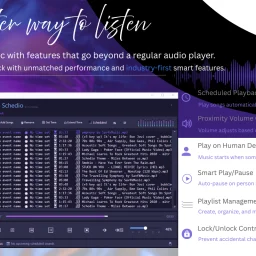
Automating audio playback based on presence and proximity, Schedio positions itself as an intelligent upgrade to standard media players for Windows users who want hands-free control over their listening environment. The application targets two distinct use cases: event organizers and presenters who need scheduled playback, and home or workspace users seeking ambient music that responds dynamically to occupancy. The product's core distinction lies in its sensor-driven features. Rather than requiring manual volume adjustments or playback commands, Schedio detects nearby movement via webcam and alters audio behavior accordingly. The proximity volume function continuously adjusts levels based on distance—playing softer as listeners approach and louder as they move away. This approach eliminates constant volume tweaking and creates a responsive listening experience that adapts in real time. The human detection feature automates play and pause entirely, starting playback when movement is detected and stopping when a space empties. For events or presentations, the scheduled playback capability lets users queue content to activate at predetermined times without oversight. The feature set extends beyond these core functions. Smart play/pause works as a persistent version of human detection, automatically resuming music when someone reenters a space. Playlist management provides standard organizational tools, while lock/unlock controls prevent accidental setting changes—useful in shared or public environments. An "extend scheduled time" feature allows single-click adjustments to ongoing playback, and the company emphasizes a professional audio engine tuned for clarity and depth. Schedio operates as a lightweight desktop application rather than a cloud-dependent service. It requires Windows 10 or 11 and needs internet connectivity only for initial setup; afterward, it functions entirely offline. A webcam and sound card are the only hardware prerequisites beyond the operating system itself. The product occupies a narrow but potentially valuable niche. Most audio players prioritize music discovery or library management. Schedio instead optimizes for environmental control and automation, making it suited for retail spaces, hospitality venues, presentation rooms, or homes where occupancy-responsive audio adds value. The execution strategy—offline-first architecture, minimal system overhead—suggests practical deployment considerations. What remains unclear from available information is pricing structure, licensing model, and whether the application serves individual consumers or targets businesses. The feature sophistication implies either paid or freemium positioning, though no details appear publicly documented.

Bangladeshi SaaS builders finally have a stage that speaks their language. Home-grown ventures now face the daily struggle of getting noticed once they leave small chat groups and lean-meetup circles; global launchpads overflow with Silicon Valley flash and foreign celebrities, leaving local founders shouting into the void. BD SaaS Zone corrals that scattered audience into one easy-to-scan gallery, giving each product oxygen instead of noise. The directory is deliberately narrow in scope: real SaaS, mobile apps, and digital utilities that ship from Bangladesh. Every listing is curated first, which keeps the pixel-brochure clutter down to zero and ensures the feed stays focused on working products rather than pitch decks. Visitors come looking for quick inspiration, teammates, or acquisition targets; founders arrive to plant a flag and stay visible long after launch-day buzz fades. Nothing fancy or bloated: a simple search, taxonomy filters covering fourteen niches from AI to HR, and cleanly marked “For Sale” or “Seeking Co-Founder” tags when the listing signals intent to exit or scale. Pricing clings to reality—one advert slot in the sponsored marquee costs exactly ৳120 per month, a figure that fits better coffee than most AWS bills. Founders can also claim a discount on security audits through the site’s partnership with Cyenetic Solutions, a welcome perk at a stage where every saved taka goes toward product polish. For now the site stays refreshingly minimal: add your startup, grab the ranking badge code, and let organic traffic do the rest. Early adopters get prime category placement before every vertical is filled, making the current moment unusually favorable for anyone shipping code from Dhaka, Chittagong, or Sylhet.

Web pages rarely look the way you want them to. Designers, content creators, and power users constantly grab screenshots, open DevTools, or drop designs into Figma just to preview the same page with a warmer palette, higher contrast, or an alternate color theme. SFM short-circuits that dance by embedding a full creative suite directly into any browser tab. Install the extension, open a site, and the page becomes your canvas—no separate editor, no third-party server, no code pushed live. Instead of forcing one universal filter, SFM gives granular control. Interactive selection boxes let you darken just the hero banner or sepia-tone the article body while leaving the navigation untouched. A slider-driven panel adjusts brightness, saturation, or vintage intensity in real time; hit save and the settings persist next time you return. If the goal is drama rather than subtle polish, animated border frames wrap elements in pulsing neon, cascading matrix characters, or glowing fire waves, all rendered on the fly with standard web APIs. Advanced users switch to the code layer. A lightweight editor accepts custom CSS or JavaScript that executes only on your machine, letting you swap fonts, add hover micro-animations, or prototype new components without touching the real codebase. Combine that with gradient map overlays or blend modes like multiply and screen and you can push a page from stock Bootstrap into surreal digital art within minutes. The absence of any mention of subscriptions, enterprise tiers, or even a paywall implies that SFM is currently offered as a free extension distributed from its Netlify site. Whether that model holds or shifts to a paid license the team has not disclosed, but for now the barrier to experimentation is exactly zero. In practice, anyone who remixes visuals for moodboards, pitch decks, or social media will find SFM a rapid-fire entry point; traditional designers gain an inspection playground; casual users can finally stop squinting at white backgrounds on dark-themed laptops.

Memory fades faster than we admit, yet we rarely pause to capture who we are at a specific moment before rushing to the next. PSFutureMail arms anyone who wants to interrupt that amnesia: students planting checkpoints before graduation, new parents scripting love letters for the day a child finishes school, couples queuing yearly anniversary notes, or anyone simply seeking an honest conversation with tomorrow’s self. UX discipline separates this from forum gimmicks or crude reminder bots. Draft once, assign an exact future send date, then close the page; nothing fires early, no awkward “oops” deliveries. You retain full editing rights right up to dispatch, so words can keep pace with shifting opinions or circumstances. A no-login write option adopts private-first encryption, while an opt-in public gallery lets strangers read anonymous letters, turning individual introspection into a light community experience. Operational muscle sits behind the minimal interface: automatic backups, multi-region database replication, and a 24/7 monitored delivery engine built on enterprise hardware give a credible promise that letters will still budge from cold storage in ten, twenty, perhaps fifty years. The closest commercial analogue, delayed email schedulers, typically limit retention to months and fold the second annual fees lapse. PSFutureMail’s value proposition instead leans on the long game, using free entry to seed critical mass and calming nervous recipients with jargon-free trust language about redundancy and uptime. No tiers, credits or subscription language appear on the site, so users begin without a credit card and presumably sustain the same zero-pressure cost as the calendar drifts forward—revenue if any must live in unannounced premium avenues or generous patrons. For anyone who has ever wished they could mail encouragement or correction to the person they will become, PSFutureMail is a quiet, sturdy mailbox that simply waits until the appointed day and rings the bell.
Teams that live inside Telegram, WhatsApp, Slack, or Discord spend their days dodging the accidental slog of opening yet another tab just to ask a bot for help. OpenClaw Direct dissolves that friction by putting a single, private AI coworker right where the messages already flow. Early adopters who lack the appetite—or hire—for DevOps but need Claude-grade intelligence on their own data can spin up a complete environment without writing a deployment script. The allure lies in the five-minute onboarding and the price lock of nineteen dollars a month, cancellable whenever the experiment loses its shine. Beyond provisioning, the platform behaves like an overstretched teammate who never forgets. It consumes inbox threads, staging deployments, support tickets, pull-request noise, SSL expirations, marketing figures, and half-written drafts, then surfaces only the decisions that still require human judgment. Code reviews happen in-chat, with critical issues patched and tests re-run before the reviewer reaches for coffee. Customer tickets get drafted replies, while feature requests bubble into a shared roadmap where community weight can be tracked with tags. Blog traffic gets analysed on the fly and turned into scheduled social threads with open rates reported back as early morning banter. Ownership stays with the customer: the assistant lives on a dedicated machine, listens exclusively to the API key they supply, and connects to the chat apps they already trust. Whatever internal context, documents, or repositories the team grants access to remains unseen by anyone else. The built-in dashboard simply tracks the number of messages, workflows completed, and time reclaimed—enough data to justify the monthly coffee budget the tool replaces.

Transcription has long been the bane of knowledge workers—long recordings full of umms, ums, false starts, and throat-clearing that demands hours of manual cleanup. VideoMP3Word tackles this by combining multi-format transcription with an AI that understands context and industry-specific terminology, delivering polished, usable transcripts without the editorial drudgery. The product's core insight is that transcription quality isn't just about accuracy in speech recognition; it's about producing text that actually reads like finished writing. Rather than leaving filler words and repetitive phrasing intact, the system applies domain-aware filtering that strips verbal tics while preserving technical jargon. A laparoscopic cholecystectomy stays intact in medical transcripts, while casual "you knows" disappear—a distinction that generic speech-to-text tools routinely botch. This makes the output immediately usable for legal documents, medical records, educational content, and technical research where terminology precision matters. Speed stands out as a second major differentiator: the platform processes 60-minute recordings within three minutes, timestamped and ready for review. For content creators working under deadline pressure, this converts transcription from a bottleneck into a near-real-time capability. On the features side, VideoMP3Word handles multiple input formats (MP4, MOV, AVI, MP3, WAV, M4A, YouTube, Zoom links) and outputs to an extensive list—Word documents, PDFs, plain text with speaker labels, SRT/VTT/ASS subtitle files, and FLAC/MP3/WAV audio extraction. The system includes AI-generated summaries and millisecond-accurate timestamps, making it valuable for creators repurposing content into blogs and podcasts, as well as legal teams building searchable archives. Privacy is built into the architecture rather than bolted on as a feature. The company commits to zero-knowledge design, encrypted storage, non-retention of user files, and explicit task expiry controls—a direct answer to justified skepticism many professionals harbor about uploading sensitive recordings to cloud services. For regulated industries or confidential work, these guarantees provide clear value. The product invites users to test a single conversion free, a straightforward way to evaluate whether the accuracy and formatting align with specific needs. For organizations exhausted by post-transcription cleanup cycles, or professionals in regulated fields where both accuracy and privacy are non-negotiable, it's worth the trial.

Capturing web content at scale without sacrificing privacy or simplicity is a persistent friction point for knowledge workers. Web Clipper targets this gap by offering a browser extension that lets users save text, links, and images through a single keyboard shortcut, eliminating the common workflow of bookmarking, copying, or screenshotting scattered across multiple tools. The extension is built for researchers, students, designers, and anyone who mines the web for ideas and reference material. Its core appeal lies in speed and simplicity—content capture happens in under a second, with no configuration required. Rather than forcing users into account creation or cloud syncing, the product keeps all data local, meaning users maintain complete privacy and offline access to their collected material. The feature set addresses the common pain point of digital hoarding: the ability to save selected text, full web pages, links, and images directly into a side panel accessible from any tab. A search function lets users navigate their collection without the organizational overhead that plagues other capture tools. The interface supports both dark and light themes, catering to different usage contexts and reducing friction during extended browsing sessions. What distinguishes Web Clipper from competitors like Evernote or cloud-based clippers is philosophical. Rather than positioning itself as a complex note-taking platform or knowledge management system requiring subscriptions, it prioritizes a single job done well: fast, offline, privacy-preserving capture. The developer explicitly designed around the pain of feature bloat and recurring subscription costs, positioning the tool as an antidote to the complexity users encounter elsewhere. Upcoming functionality includes Spaces, a feature for organizing clips into collections, suggesting the roadmap will gradually introduce structure without compromising the core principle of simplicity. The extension is currently free, with no monetization layer disclosed, making it an accessible entry point for users skeptical of yet another subscription service. The product's positioning on privacy, speed, and local-first architecture creates a clear niche. It serves users frustrated by the gatekeeping of cloud-based alternatives and willing to sacrifice cloud synchronization and advanced collaboration for agency over their own data.

Emotion tracking has long suffered from competing impulses: the clinical efficiency of mood logging strips the practice of meaning, while open-ended journaling can feel like shouting into the void. VibeLoop attempts to thread this needle by treating daily emotional reflection as a ritual rather than a data collection exercise. The product's core interaction is deliberately minimal. Users record a single emotion per day—their "vibe"—refining it and adding a brief note before the distinctive part begins. Rather than leaving the reflection there, the app responds with observations from a group of AI personalities. These aren't uniform analyses; instead, they represent different perspectives, from poetic reframing to analytical dissection to unflinching honesty. This multiplicity works because a single AI voice risks becoming either a bland mirror or an unwelcome therapist. Multiple voices approximate conversation, each bringing a distinct lens to the same emotional moment. Where most mood trackers dead-end at daily entry, VibeLoop builds upward. The app surfaces patterns through calendar views and weekly summaries that transform discrete emotional snapshots into narrative. This framing is deliberate: summaries "turn your moods into a story" rather than into a chart. That narrative orientation reveals what the product actually values—pattern recognition and meaning-making, not optimization or self-improvement. The positioning reflects this clarity. VibeLoop explicitly distances itself from productivity-obsessed wellness apps. There's no claim that tracking mood improves performance or that patterns enable "better choices." Instead, the value proposition is direct: understanding yourself matters. For users fatigued by apps that treat emotions as inputs to be managed, this directness refreshes. The one-entry-per-day constraint is worth questioning. For some users, emotional life moves faster; for others, daily reflection already feels like journaling, just reframed. But the constraint likely serves the product's identity by resisting the obsessive data collection that makes many tracking apps feel extractive. It keeps the ritual focused. VibeLoop targets a specific user: someone who journaled once, found it meaningful but incomplete, and wants the space between reflection and response. Whether AI companions authentically fill that gap is the product's real test. But its resistance to the self-improvement framing that dominates wellness is itself valuable—it proves you can build in this space without abandoning honesty.

Most lock screens sit idle, serving nothing but a time display and notification center. Lockscreen.Pro reframes the lock screen as a daily motivational and informational interface, converting what amounts to dead space into a dynamic tool that shifts throughout the day with progress indicators, quotes, affirmations, and facts. The product targets anyone seeking passive daily motivation or time awareness without the friction of app switching. Rather than launching a dedicated app, users get their desired content directly where they look first—their phone's lock screen—automatically refreshing on a schedule they define. The core innovation is automation without maintenance. Using Apple Shortcuts, the service rotates between different wallpaper types at different times of day. A user might see their week's progress in the morning, an affirmation at midday, and a fact in the evening—all without manual intervention. This stands out because most lock screen customization remains static; Lockscreen.Pro makes the lock screen reactive to time and user preference. The feature set centers on templated wallpaper variations. The Month Progress and Year Progress visualizations offer a running clock of time passage, appealing to users interested in time tracking or deadline awareness. The Quote Stack and Affirmation Stack options provide rotating motivational content. Visualization rounds out the offering, though the site provides limited detail on what this involves. All templates come in at least one visual style—Ember Slate—suggesting a cohesive design language, though variety in themes remains unclear. The business model follows a freemium structure with a free tier available and premium options to buy yearly or once. No explicit pricing is disclosed in the publicly available materials, which is a notable gap for potential users evaluating commitment level. The product's constraint lies in its Apple-only nature. By leveraging Apple Shortcuts, Lockscreen.Pro limits itself to iOS and macOS users and excludes the Android ecosystem entirely. For someone deeply embedded in Apple's ecosystem seeking a frictionless way to inject daily motivation into their most-viewed screen, the offering is clean and purposeful. For everyone else, it remains inaccessible.

Visual learning is gaining traction in education, yet many educators lack the technical infrastructure to monetize their expertise. Pathmind addresses this gap by allowing creators to convert mind maps directly into sellable courses without requiring video production, editing expertise, or complex course-building knowledge. The platform targets course creators, educators, and subject matter experts who want to package and distribute knowledge through a visual-first format rather than traditional lectures or text-heavy materials. The core innovation lies in its simplicity: creators map out topics as interactive nodes, enrich them with text, videos, images, and documents, then publish the entire structure as a course. Learners navigate these mind maps as interactive learning paths, creating an engaging alternative to linear course formats. This approach eliminates the high friction points that prevent many experts from becoming educators—no recording sessions, no post-production editing, no platform complexity. The setup process takes approximately fifteen minutes, a deliberately low barrier designed to encourage adoption among non-technical users. Pathmind's node-based system extends beyond basic mind mapping. The platform includes an interactive scripting layer that allows creators to add conditional logic and dynamic functionality to their maps, enabling more sophisticated course design than static diagrams alone. This technical depth is concealed beneath an accessible interface, allowing both non-technical content creators and those seeking advanced customization to work within the same tool. The business model reflects a creator-friendly philosophy. The platform operates free of charge, supporting both free course distribution and paid offerings. Creators retain full control over pricing and access, with the revenue model supporting recurring income as new learners discover and purchase courses. This removes financial barriers to entry for emerging educators while enabling established instructors to reach audiences without expensive course development platforms. The founder's evolution from browser-based productivity extension to education-focused platform indicates iterative customer discovery and willingness to pivot toward market demand. The transition to Pathmind Courses in July 2025 suggests stronger market validation in online education than in general productivity tools. Pathmind faces competition from established players like MindMeister and Miro, which offer broader collaboration features, though neither emphasizes course monetization. The platform's focus on educational content packaging distinguishes it, though may limit adoption among users seeking general-purpose diagramming tools. The interactive node system with scripting capabilities provides genuine product depth, yet market education will be crucial—users must understand how this visual approach meaningfully differs from and improves upon traditional course platforms.

Catching database performance regressions before they reach users requires both visibility into query execution and the discipline to enforce latency budgets. Queryd addresses this gap by instrumenting SQL queries in Node.js applications with measurable performance guardrails. The tool wraps database clients at multiple levels—supporting postgres.js tagged templates, raw query functions, or Prisma—to intercept queries and measure their execution time against configurable thresholds. The product solves a real pain point for teams building latency-sensitive applications. Query performance degrades gradually, and without systematic detection, slow queries often go unnoticed until they cause visible impact. Queryd brings three mechanisms to prevent this: per-query latency thresholds that flag individual slow queries, per-request query budgets that set cumulative limits on database work within a single user request, and sampling controls that keep observability costs minimal in production. What distinguishes queryd is its pragmatic design philosophy. Rather than requiring a complete database abstraction or architectural restructuring, it integrates at the query execution layer across multiple driver APIs. The sampling-first approach acknowledges that continuous monitoring of all queries in high-traffic applications becomes prohibitively expensive; instead, teams can set sampling rates to stay within their observability budget while still surfacing meaningful regressions. Optional EXPLAIN ANALYZE integration allows deeper investigation of offending queries when needed, shifting between cheap signal and expensive detail. The implementation provides useful context awareness through request-scoped budgets—tracking not just individual query times but also cumulative query volume and duration within a single request. This catches a different class of performance issues: endpoints that perform many quick queries instead of fewer optimized ones. The configurable sink architecture suggests thoughtful extensibility, allowing teams to route alerts to their existing monitoring systems rather than forcing a new workflow. As an early-stage open-source project, queryd makes a modest but useful contribution to the Node.js observability ecosystem. It fills a specific niche—SQL query latency monitoring with minimal overhead—without attempting to be a comprehensive database performance platform. Teams already running SQL databases in production and concerned with query regressions will find the tool immediately applicable to their latency budgeting workflow.

Training new call center agents has historically been one of the most painful bottlenecks in customer service operations. Faced with high turnover, lengthy onboarding periods, and real damage to customer satisfaction metrics, supervisors and training managers have long needed a way to prepare agents safely before they ever touch a live call. Call Flow addresses this fundamental gap. The product is built on a founding insight grounded in eight years of hands-on call center experience. The platform creates a simulated environment where agents can practice realistic scenarios with AI-powered counterparts before facing actual customers, moving beyond script-based training alone. This addresses a critical training blind spot: most programs lack any mechanism for agents to safely fail and learn from mistakes. The founder's frustration watching talented people crumble under the pressure of their first difficult call resonates with the core pain point that the product solves. What distinguishes Call Flow is its focus on the psychological and conversational dimensions of call center work, not just product knowledge. The platform evaluates agents across empathy, clarity, objection handling, de-escalation, and compliance—dimensions that are difficult to assess in traditional training programs but critical to customer retention and reputation. This suggests the platform understands that customer service failures often stem from how something is communicated, not just what is communicated. The product also addresses the supervisor's pain in the current system. Rather than spending hours reviewing recordings after calls have already damaged relationships, managers gain visibility into agent readiness before it matters. Custom scenario building means training can be tailored to specific product lines, customer segments, or known pain points rather than relying on generic curricula. This directly bridges the gap between simulation and operational reality. The founding motivation reveals a clear market opportunity: the call center industry continues to operate training methods that lag behind other high-stakes professions. Pilots train in simulators. Surgeons practice on virtual patients. Yet the role that often determines customer lifetime value—the frontline agent—has historically remained immune to this kind of realistic, safe practice environment. Call Flow fills that void by bringing simulation-based training to an industry where the cost of learning on the job has long been accepted as inevitable.
A Varanasi-based digital agency founded by Shashwat Maurya, Synor addresses a gap in the Indian software market where regional businesses need production-grade custom applications but have historically been forced to either hire expensive enterprise software houses or settle for template-based solutions. The agency's primary value is demonstrated through two live projects launched within six months of its founding. TheDawai is a full-stack pharmacy e-commerce platform paired with backend management software for the healthcare sector in Uttar Pradesh. Shivora Technologies operates as a multi-tenant school management system currently supporting five or more institutions with real-time data management across the state. Both systems handle production workloads—processing actual transactions, managing student and patient records, and supporting dozens of concurrent users continuously. What distinguishes Synor from the broader landscape of web agencies and freelancers in UP is the scope of what it builds. The deliverables are not websites, landing pages, or WordPress installations. Instead, Synor delivers systems designed to manage sensitive data reliably, operate under real load, and scale to institutional needs. The education and healthcare sectors demand this level of robustness, and the fact that both projects reached operational status in six months indicates engineering competence and execution efficiency uncommon in the regional market. The agency frames these two projects as proof of capability. For organizations in healthcare, education, or other sectors needing custom software, Synor claims it can deliver what previously required engagement with large enterprise vendors charging ₹20-50 lakhs over 18+ months. This represents a significant acceleration of both timeline and cost structure for institutions that historically had limited alternatives between expensive vendors and generic solutions. No specific pricing or business model details are disclosed in the available content. The agency operates on a project basis, handling the design, development, and deployment of domain-specific software platforms. For clients in UP's institutional and commercial sectors needing custom software built at industrial grade and delivered rapidly, Synor offers an alternative to both expensive enterprise consultancies and generic template solutions, backed by documented examples of execution.

Comparison fatigue in home office equipment shopping has a new antidote. The fundamental challenge isn't locating reviews—it's reconciling them. When one reviewer praises a monitor's "vivid colors" and another lauds its "excellent color reproduction," these might describe the same attribute or entirely different aspects. Add conflicting scores across different scales, YouTube videos revealing issues nobody documented, and Reddit threads flagging compatibility problems, and a simple purchase decision becomes time-consuming detective work. SetupScore addresses this by aggregating and cross-referencing 20 to 50 independent sources per product, including expert reviews, YouTube analyses, Reddit discussions, and Amazon customer feedback. Rather than asking users to synthesize conflicting opinions, the platform produces an algorithmic score that surfaces where reviewers actually agree, where they diverge, and what trade-offs exist. The scoring is explicit about limitations and doesn't hide negative findings just because they complicate the narrative. The current catalog focuses on keyboards, monitors, and headphones—the most frequently reviewed categories in home office setups. Each product listing includes a numerical verdict alongside a breakdown showing category-specific performance and how different sources evaluated particular attributes. This matters for anyone choosing equipment for specific work like photo editing versus video production, where "good color accuracy" means different things. What distinguishes SetupScore from existing review aggregators is its stated commitment to algorithmic scoring without editorial bias or pay-for-placement arrangements. The founder built it out of personal frustration with the 15-tab review process, and the product's scope reflects that origin—narrow enough to do the cross-referencing thoroughly, broad enough to cover the most-reviewed categories. There's no pretense of completeness; instead, it acknowledges what it covers and what it doesn't. For knowledge workers who value consolidated data over editorial guidance, the value proposition is straightforward: systematized comparison without the editorial noise. SetupScore's strength lies in acknowledging a genuine pain point—not finding information, but untangling contradictory information—and building a tool explicitly designed around that problem.

Indie developers encounter a recurring trap: after shipping the third or fourth SaaS product, they find themselves rebuilding authentication flows, subscription billing logic, database migrations, and CI/CD pipelines from scratch. Paid boilerplates promise to solve this by offering pre-built scaffolds, but they often lock developers into black-box abstractions that require archaeological investigation to customize. Free open-source starters suffer the opposite problem—abandoned projects with outdated dependencies and incomplete implementations that skip the genuinely difficult parts like webhook handling and billing lifecycle management. This scaffolding tool addresses that friction by automating the entire foundational setup in a single command. Rather than selling a templated solution, it generates a production-ready Next.js application with authentication, payments processing, transactional email, database schema, and CI/CD configuration already integrated and tested. The process completes in approximately 4.5 minutes. What distinguishes this approach is its breadth. Most boilerplates stop after providing a login page and a basic database schema. This offering includes the components that developers typically find most tedious to wire together: Stripe webhook handling for subscription lifecycle events, multi-provider flexibility (Clerk or NextAuth for authentication, Postgres, SQLite, or Supabase for data storage, Stripe or Lemon Squeezy for payments), and a testing suite of over 250 tests covering core flows. The generated code runs on Next.js 14 with the App Router, includes Tailwind and shadcn/ui components pre-configured, and packages production infrastructure as a Docker container with GitHub Actions workflows. The tool operates as an interactive CLI that prompts developers to select their preferred provider for each major component at initialization time, then generates a fully functional codebase based on those choices. Rather than forcing abstraction layers, the generated code is intended to be readable and modifiable—on the explicit premise that developers should understand and customize their own foundation rather than fight against prescribed patterns. Financially, the product is offered free under an MIT license with no account requirement and no commercial upsell. This positioning directly opposes the typical paid-boilerplate model and targets developers who prioritize speed to first deployment and transparency over premium support. For teams shipping consumer or B2B SaaS applications, the time savings from bootstrapping infrastructure are substantial. The real limitation is whether generated code remains maintainable through real-world scaling scenarios and customization demands beyond the initialization phase.

Developers working with large language models face a persistent cost problem: unstructured prompts generate bloated responses that demand multiple rounds of refinement, inflating API bills unnecessarily. Promptctl targets this friction with a command-line tool that converts rough natural language intent into optimized, structured prompts through a rule-based engine. The core insight is straightforward—most prompt failures stem from ambiguity, not capability. Rather than relying on an LLM to fix poorly articulated requests, Promptctl applies established prompting best practices (personas, constraints, structured output formats) automatically, locally, with no API calls required. The tool classifies user input against eleven task categories, automatically assigns expert personas and output structures, and formats everything into XML-tagged, decomposed instructions ready to execute. What distinguishes Promptctl from generic prompt-improvement services is its emphasis on cost visibility and developer workflow integration. The tool supports direct comparison across ten major models including Claude Sonnet, GPT-5 variants, Llama, DeepSeek, and Groq, showing which delivers the best value before any request executes. Cost tracking happens natively; users can send prompts directly through Promptctl, pipe them to the Claude CLI, or copy them for independent use. The engineering is cleanly executed. Promptctl ships as a single compiled binary with no dependencies—no Node.js, Python, or Docker overhead. Homebrew installation works across macOS (Intel and Apple Silicon), Linux, and Windows. Prompt generation happens instantly, deterministically, without external API calls or latency. The product claims that well-structured prompts cost roughly one-third as much as unstructured alternatives per call, with potential total savings of 55 to 71 percent depending on model selection and workload. These benchmarks are stated as validated across ten models. The tool targets developers and teams that use LLMs as production infrastructure and have direct visibility into API spending. Promptctl occupies a narrow but defensible position: it solves a genuine cost problem for a specific audience without feature sprawl. The focus remains laser-focused on three core capabilities—structure prompts efficiently, compare model costs transparently, and reduce token waste through better composition. No pricing or business model details are disclosed.

Professionals crafting their LinkedIn presence face a consistent challenge: translating authentic thoughts into the elevated corporate language that platforms like LinkedIn reward. LinkedIn Speak Translator directly addresses this friction point by automating the conversion between casual language and professional jargon, saving users time and reducing the mental overhead of constant code-switching. The product targets a straightforward market: LinkedIn users who want to maintain an active presence but dread the writing process. Rather than staring at a blank post, users can jot down raw thoughts and let the AI handle the transformation. The tool works in both directions—converting casual input to LinkedIn polish, or decoding corporate jargon back into plain English—a bidirectional approach that expands its utility beyond a one-way translator. What distinguishes this product is its granular control over voice and tone. Beyond simple professional versus casual settings, users can adjust intensity across a spectrum from light professional touches to extreme corporate hyperbole, giving them fine-grained control over how aggressively they want to adopt the platform's conventions. The styling options extend further: a polished mode for straightforward professionalism, and a satirical mode that leans into corporate excess for users who want to acknowledge the absurdity while still engaging with the format. The feature set addresses common LinkedIn post requirements. Automated hashtag generation, emoji integration, and smart formatting with bullet points and line breaks all aim to produce posts that capture attention within the platform's ecosystem. The tool positions these as best practices for social media engagement, packaging them as features rather than leaving users to figure out formatting themselves. The business model relies on freemium positioning: users get three free translations, with additional credits available after signup. The extreme intensity level is gated behind a paid tier, creating a natural upgrade path for users who want maximum creative control. Specific pricing details aren't disclosed in the available materials, suggesting a bootstrapped experiment rather than a venture-funded product with aggressive monetization targets. The core value proposition—speed and reduced friction in producing LinkedIn content—holds merit. The product is designed for professionals who understand LinkedIn's conventions but find them tedious to implement manually. Whether users ultimately prefer authentic unpolished posts or embrace the tool's translations will determine its market fit.

For small business owners and freelancers tired of paying monthly subscriptions for invoice software, a free, open-source alternative now exists that prioritizes data privacy and offline functionality. Invoiso delivers professional billing capabilities to Windows and Linux machines without requiring internet connectivity, cloud storage, or account registration. The problem this addresses is straightforward: most modern invoicing tools trap users in a choice between convenience (cloud-based, but your data lives elsewhere) and cost (expensive subscriptions for basic functionality). Invoiso eliminates both constraints by running entirely offline on your local machine. The product targets a specific but substantial segment: freelancers managing multiple clients, small shop owners in areas with spotty internet connectivity, field workers who need billing capabilities away from the office, and anyone who views data privacy as non-negotiable. For these users, the value proposition is compelling—professional invoice generation without monthly fees, plus the security of keeping customer information local. What distinguishes Invoiso is its radical simplicity in execution. The software generates polished PDF invoices, manages client and product databases, tracks payment status, and provides role-based access controls. Users can customize templates (choosing from Classic, Modern, or Minimal designs) and adjust column labels for their business type. The product includes GST readiness and UPI QR code support, making it functional for Indian markets. One-click backup and restore ensure data portability without reliance on cloud infrastructure. The feature set covers all fundamental billing needs: invoice creation and editing, payment tracking for partial or full receipts, status history, flexible line-item pricing overrides, and permission-based user roles restricting destructive actions to administrators. The offline model means instant operation without page-load delays and eliminates connectivity dependencies entirely. As an open-source project with no subscription requirement, no account setup, and no recurring costs, Invoiso's business model is simply absence: the software is free forever. This makes it particularly valuable for solo practitioners and micro-businesses working with thin margins. The product fills a genuine gap for users who've felt forced to choose between privacy and convenience, or between affordability and functionality. For small businesses and freelancers in that position, it represents a meaningful alternative to the subscription-heavy invoicing software market.

Startup founders face a persistent distribution problem: they've built something valuable, but nobody knows about it yet. LaunchVoid targets this gap directly by positioning itself as a launch platform designed to connect emerging products with potential users, investors, and the broader maker community. The service addresses founders building SaaS platforms, developer tools, and consumer applications who lack established marketing channels. The platform centers on three core offerings. First, it provides direct exposure within a community of makers and investors, framing product launches as high-signal events. Second, it generates search engine value through dofollow backlinks from its domain—a mechanism that tackles the SEO cold-start problem many new products face. Third, it includes AI-assisted tools under the LaunchForge brand, enabling founders to automatically generate landing pages, pitch decks, and growth strategies. This bundling addresses what typically requires piecing together multiple vendors: distribution channel, SEO value, and content generation. What distinguishes LaunchVoid from generic product-listing sites is its focus on solving a specific founder bottleneck: the early-stage distribution problem. Rather than positioning itself as yet another product aggregator, the messaging reframes launch as an active acceleration event. The inclusion of AI tooling moves beyond simple listing functionality, recognizing that visibility alone doesn't drive outcomes—founders also need polished positioning, clear messaging, and a growth roadmap from day one. The SEO backlink component stands out as a meaningful differentiator. Quality backlinks remain valuable for search rankings, and bundling automatic link equity into a launch event offers concrete, measurable value beyond vanity metrics. The platform essentially positions a product launch as a two-for-one: community visibility plus algorithmic lift. The combination of distribution, SEO, and marketing automation addresses multiple founder pain points in a single product. Whether the platform delivers sufficient depth across all three dimensions, or whether community exposure actually converts to meaningful customer acquisition, requires evaluation against real user outcomes. The positioning is ambitious and targets a genuine problem; execution and community quality will determine whether it becomes the go-to launchpad founders actually use.
Automating social media outreach and lead generation across multiple platforms is a time-consuming challenge for growing businesses. DataScrapify addresses this directly by bundling data extraction, email scraping, and social media automation into a single cloud-based platform. The product targets businesses and digital marketers who need to collect contact information and execute bulk messaging campaigns across Facebook, LinkedIn, Instagram, Twitter, and YouTube without managing separate tools. The platform's architecture centers on lead generation and automation. Its toolkit includes email extraction from websites and social directories, bulk message sending across social channels, scraper tools for follower and group member data, and phone number collection capabilities. These features work across major social platforms, making it possible for users to consolidate operations rather than juggling multiple specialized services. A notable differentiator is the cloud-based infrastructure, which eliminates installation and platform dependencies. Users access all tools through a web interface, removing friction for businesses that want quick onboarding. The pricing model is straightforward: a monthly subscription at $100 includes access to all 21 automation tools with unlimited campaigns and unlimited results, positioning it as cost-effective for SMBs and agencies seeking an alternative to point solutions. The platform also emphasizes accessibility through its support structure, claiming 24-hour resolution for customer issues. However, the product documentation is sparse and the website copy suggests room for improvement in presentation and clarity. The tool appears functional for its core use cases, but prospective customers should verify whether the platform's scraping capabilities align with their specific social media channels and compliance requirements. The target audience seems to be growth teams, lead generation agencies, and marketing departments seeking affordability without complexity. DataScrapify makes a clear value proposition around consolidation and cost-effectiveness. Its strength ultimately depends on the reliability and accuracy of the underlying scraping technology—details not evident from public positioning alone.