Catalyst Healthspan Audit
Personal trainers typically sell training sessions. This startup reversed the equation by building assessment first, mak...
Launchory
We built Launchory to solve the discoverability problem for startups. Our platform offers instant approval, permanent do...
Best Productivity Startups & Tools
Recently Listed
218 launches
Churn typically results from users feeling lost in unfamiliar software. Digital adoption platforms address this by embedding guided experiences directly into applications, and FlowAssist positions itself as the first such platform built to serve both traditional SaaS products and AI agents. The core offering is straightforward: a single JavaScript snippet provides lifetime access to a dashboard where teams build onboarding flows, product tours, and user surveys without touching code. These guides activate based on user segments, plans, or custom attributes, and they go live instantly without redeployment. The product tours, navigation flows, hotspot overlays, and splash screens function as standard adoption tools. Surveys and NPS collection allow direct feedback collection without leaving the application. What distinguishes FlowAssist is its positioning around AI agent interactions. As AI agents become primary user interfaces for many startups, traditional adoption platforms fall short—they assume click-based UI interactions. FlowAssist adds an agent telemetry layer that claims to detect user intent, sentiment, and frustration levels in real time. The dashboard surfaces these signals through analytics including completion rates, drop-off points, sentiment analysis, and AI-powered session summaries. This addresses a genuine gap: most adoption platforms have no mechanism to track or improve agent conversations before dissatisfied users leave. The implementation model prioritizes simplicity. Users paste a script tag, initialize with a workspace ID, and build everything from the cloud dashboard. The "zero friction setup" claim appears validated by the straightforward integration approach—no SDK installation, no complex configuration. On the business side, FlowAssist offers a 14-day free trial requiring no credit card and pricing starting at $49 per month, suggesting it targets small to mid-market SaaS companies and emerging AI agent platforms. The transparent pricing and trial structure reduce adoption friction. Gaps worth noting: the website provides no user counts, deployment numbers, or retention metrics to substantiate claims of being the "number one" platform. The analytics features sound sophisticated, but actual output and customization depth remain unclear from the public information available. The agent telemetry—arguably the most innovative component—lacks detailed explanation of how sentiment and intent detection actually work or how accurate they are in practice. The dual focus on traditional SaaS and AI agents is strategic timing. For teams building conversational interfaces and agent-first products, the absence of adoption-tracking tools elsewhere makes this differentiation meaningful. The product appears built for a real need; whether execution matches ambition depends on the quality and accuracy of those telemetry features.


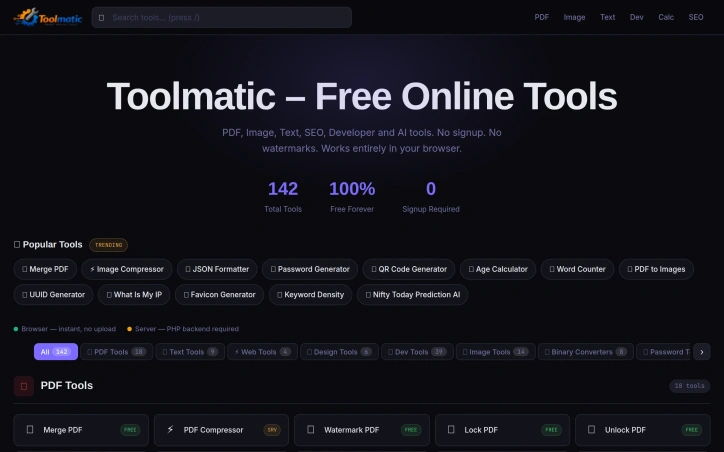
A unified collection of 142 free online tools, Toolmatic addresses a persistent friction point for developers and professionals: the need to access scattered utilities across dozens of platforms, each demanding signups, displaying watermarks, or hiding features behind paywalls. The service consolidates PDF manipulation, image conversion, code formatting, text utilities, SEO analysis, and design tools into a single browser-based environment. The product's clearest strength is its friction-free design philosophy. Every tool runs directly in the browser without account creation, watermarks, or restrictions. This approach trades complexity for accessibility, making it useful for quick, one-off tasks where spinning up an account would waste more time than completing the job itself. The breadth of the toolkit is substantial: eighteen PDF tools cover merging, compression, watermarking, and format conversion; thirty-nine developer tools handle everything from JSON and XML formatting to Base64 encoding and JWT decoding; image conversion spans formats including WEBP, HEIC, SVG, and favicon generation. The organization reflects thoughtful categorization. Tools group into logical sections like binary converters, password utilities, calculators, finance tools, and domain utilities. Popular tools such as the password generator, QR code generator, and JSON formatter are highlighted prominently, suggesting an understanding of which utilities drive traffic. The business model is straightforward: the entire suite is free indefinitely, with no signup requirement. This creates clear value for occasional users but raises immediate questions about sustainability. Some tools operate entirely in-browser, while others require a PHP backend on a user's server, suggesting a hybrid approach to computation-heavy tasks. One limitation emerges in the tool descriptions themselves. Many entries lack clarity about processing method or handling of uploaded data. Users cannot quickly determine whether their PDF remains private within their browser or transmits to Toolmatic's servers. For a tool that attracts users seeking quick access without friction, this opacity about data handling represents a missed opportunity for trust-building. The product succeeds as a practical utility collection for developers and professionals who value speed over feature depth. It occupies a useful niche: neither a specialized platform for a single task nor an overstuffed bloatware suite, but a genuinely quick answer to common conversion and formatting problems.

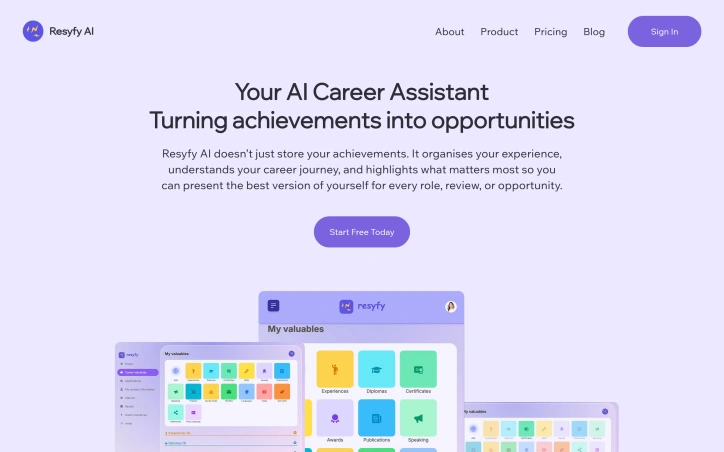
Career achievements scattered across emails and forgotten documents represent a genuine friction point in job seeking and professional advancement. Resyfy addresses this by centralizing how professionals capture, organize, and present their accomplishments. The platform targets anyone navigating career transitions, from individuals applying for new roles to professional athletes managing multiple project portfolios and those pursuing promotions or special opportunities. The core insight underpinning Resyfy is that a single static resume no longer serves modern career realities. The platform creates an adaptable digital portfolio that uses AI to match different achievements to different contexts. Rather than forcing users to manually customize their resume for each application or opportunity, the system analyzes a centralized vault of career accomplishments and surfaces relevant examples based on the specific role, award, or project in question. This targeted relevance is what distinguishes it from traditional career management tools. The product combines three essential functions. First, it provides secure storage for career achievements organized in a structured digital format. Users can log accomplishments, track milestones, and maintain a comprehensive record of their professional growth. Second, the AI engine learns from this data to understand career progression and skill development patterns. Third, the system actively recommends which accomplishments to highlight for different scenarios, whether users are applying for jobs, preparing performance reviews, pivoting careers, or pursuing sponsorships and awards. The positioning suggests ambition beyond resume building. Resyfy frames itself as a career operating system that evolves alongside a person's professional journey. This framing positions achievement tracking not as a one-time exercise but as ongoing career management infrastructure. The platform acknowledges that modern careers are nonlinear, spanning multiple projects, roles, and professional contexts simultaneously, and builds tools specifically for that complexity. The use case demonstrated with professional athletes illustrates a specific strength: professionals managing diverse accomplishments across different domains benefit significantly from an AI system that can surface relevant achievements quickly. Rather than manually constructing new portfolio documents for each opportunity, users maintain one comprehensive data source that adapts to different contexts. Resyfy offers a free tier to encourage adoption, though additional pricing details remain undisclosed from the available content. The product addresses a real productivity gap in career management and does so with a technically sensible approach: centralizing data, applying machine learning to surface relevance, and reducing the friction of portfolio customization. It competes against both static resume builders and manual spreadsheet approaches, positioning itself as an active partner in career advancement rather than a passive repository.

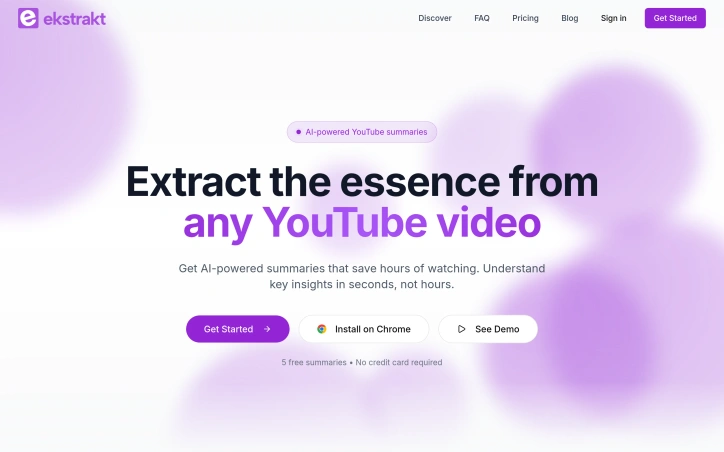
Millions of hours get consumed in video watching that nobody has time for. ekstrakt tackles this friction by offering AI-powered summaries of YouTube content, transforming lengthy videos into digestible insights. The service addresses a recognizable pain point: the two-hour lecture you need to understand, the three-hour podcast everyone's discussing but you can't fit into your week, the tutorials stuffed with filler, or the growing graveyard of saved videos you'll realistically never watch. The product distinguishes itself through flexible summary options rather than forcing viewers into a single format. Users can choose from four summary types depending on their immediate need. A quick skim mode provides the fastest overview. A detailed summary offers more comprehensive coverage. The "Straight to Answer" function targets users hunting for specific information in lengthy instructional content. The most interactive option lets users interrogate summaries by asking follow-up questions, with the system returning exact video moments and context rather than paraphrased text. Multi-language support spans 22 languages, removing the barrier of foreign-language content without requiring manual translation workflows. The platform's reach extends across web browsers, a Chrome extension that enables single-click summarization directly on YouTube, and forthcoming mobile applications. This multi-channel availability means users can engage with summaries wherever they consume content. The business model lowers friction to adoption with a free tier offering five summaries without requiring a credit card. This allows users to evaluate the service before commitment and sidesteps the common objection that summarization tools demand upfront payment for unproven value. The specifics of how summaries transition from free to paid usage remains unstated in available materials. ekstrakt competes in a growing space of video summarization tools, but its strength lies in offering user control rather than imposing a fixed output. By allowing multiple summary depths on the same content and providing query-based exploration rather than read-only text, the product acknowledges that different use cases demand different approaches. Whether someone needs a 60-second overview or wants to extract a specific claim from a 90-minute discussion, the tool adapts rather than forcing a single lens. The value proposition anchors on time savings, a compelling argument in a content-saturated world where viewers face genuine scarcity of hours. For knowledge workers, students, and anyone maintaining an aspirational backlog of educational content, ekstrakt offers a practical solution to stay informed without the time tax.
An AI-powered thumbnail generator tailored for YouTube creators, StopScroll addresses a persistent pain point in video production: choosing effective cover images that drive clicks and engagement. The tool targets content creators who want to optimize their thumbnails without extensive design experience or guesswork. The product works by accepting multiple input types. Users can paste a public YouTube URL, and the system analyzes available metadata, descriptions, chapters, and transcript signals to generate contextually relevant thumbnail concepts. Alternatively, creators can start from scratch by entering a title, niche description, and custom prompt, optionally uploading subject images. This flexibility serves both established creators looking to refresh existing videos and new producers launching content. StopScroll distinguishes itself through a generation-and-compare workflow. Rather than producing a single option, it creates multiple distinct thumbnail concepts based on the same content, allowing creators to preview and evaluate different visual approaches before downloading. This comparison-focused design reduces decision paralysis and helps users identify which direction resonates most for their audience. The feature set extends beyond core generation. The platform includes specialized YouTube utilities: a thumbnail resizer that converts designs to proper 16:9 specifications, a Shorts thumbnail downloader for extracting public preview images, and a tool for checking and downloading the highest-resolution versions of existing YouTube thumbnails in up to 4K. These ancillary features position the tool as a multipurpose suite rather than a single-purpose generator. Pricing follows a credit-based model with two explicit tiers. The Starter pack offers 40 credits for $9, approximately $0.23 per thumbnail. The Creator tier provides 140 credits for $29, bringing per-image cost to roughly $0.21. Credits do not expire, and users retain access to generation history indefinitely. This structure caters to both casual creators running occasional experiments and prolific producers generating thumbnails frequently. The product positions thumbnail optimization as solved through iteration and comparison rather than through algorithmic perfection, a pragmatic stance acknowledging that thumbnails ultimately serve viewer attention and require human judgment to validate effectiveness.


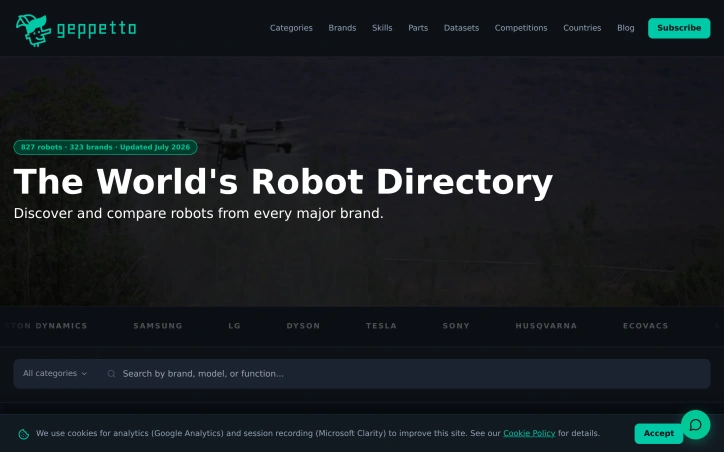
Navigating the robotics market has long been a fragmented experience, with specifications, pricing, and performance data scattered across manufacturer websites and trade publications. Geppetto addresses this fragmentation by consolidating information on over 800 robot models spanning 30+ categories into a single discovery platform. The service targets both commercial buyers evaluating robotic solutions and researchers mapping the landscape of available automation technology. The core value proposition centers on comparison and discovery. Rather than cobbling together information from multiple sources, users can access standardized specifications and pricing data across a broad range of robots. This centralization eliminates the manual research burden that typically precedes robotic procurement decisions. The platform's coverage across dozens of categories reflects an effort to serve diverse segments of the robotics market, from manufacturing and logistics to service and research applications. What distinguishes Geppetto from a simple product listing is its explicit focus on comparison functionality. The platform positions itself not merely as a directory but as an active research tool where users can meaningfully evaluate options side by side. This approach recognizes that robotic systems purchasing decisions involve complex technical tradeoffs and that buyers need structured data to compare performance characteristics and costs effectively. Rather than relying on isolated product pages, the platform enables systematic evaluation across multiple dimensions. The breadth of the catalog—800+ robots across 30+ categories—represents substantial curation work. Maintaining current specifications and pricing across such a range requires ongoing relationships with manufacturers and regular data verification. The platform must navigate the continuous product cycles that characterize robotics, where new models and capabilities emerge regularly. Staying current is essential to maintaining user value. The consolidation strategy addresses a genuine market need. Fragmentation currently forces buyers and researchers to conduct labor-intensive searches across disparate sources, consuming time and increasing the risk of incomplete evaluation. For anyone in the robotics procurement workflow, Geppetto offers a centralized alternative. In a market expanding rapidly with new entrants and capabilities, a unified reference point carries particular value.

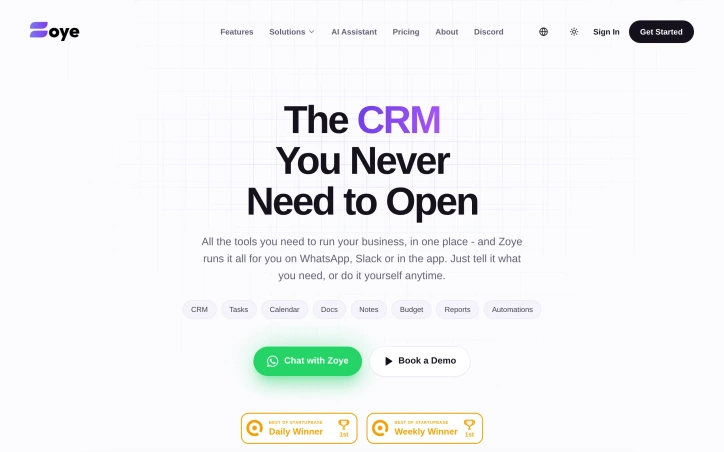
A fundamental frustration among founders and small business operators is the sprawl and complexity of managing multiple specialized software tools. Rather than forcing users to hop between platforms for CRM, task management, calendars, documents, and reporting, Zoye consolidates these functions into a unified interface accessible through conversational channels like WhatsApp and Slack, complemented by a traditional web application. The core innovation is architectural. Instead of requiring users to learn and navigate another complex dashboard, Zoye delegates operational workflows to an AI agent that executes tasks based on natural language instructions or predefined automations. A user can communicate with the system through existing communication channels rather than opening yet another browser tab. This directly addresses a pain point that resonates across the productivity software industry: tool fatigue and the cognitive overhead of context-switching between applications. The platform bundles traditional business functions—customer relationship management, task tracking, calendars, document storage, notes, budgeting, and reporting—alongside automation capabilities. This breadth positions it as a centralized operational hub rather than a single-purpose CRM. The company's blog content reveals vertical-specific marketing efforts, including targeted guides for real estate agents, fitness professionals, legal practitioners, and event organizers, indicating the product has been adapted to support workflows beyond generic sales and customer service. Zoye targets a specific niche: resource-constrained startups and small businesses where hiring dedicated operations staff remains impractical. For this audience, the value proposition is compelling. An AI-managed CRM eliminates the traditional setup and ongoing management burden that discourages many founders from implementing structured customer workflows at all. Notably, the positioning emphasizes what the product does not require: opening the application itself. This inverts the typical software experience where the application is the primary interface. Whether this approach proves sufficient for teams needing deeper analysis, complex custom workflows, or extensive collaboration remains an open question. The reliance on conversational interfaces depends heavily on the quality and consistency of the underlying AI, which directly determines whether the system reliably interprets and executes business-critical operations. The company provides a live preview and demo booking, though no pricing is disclosed publicly, suggesting a sales-driven motion typical of B2B SaaS targeting SMBs.

Securing online transactions before they happen addresses a real gap in consumer safety. Fraudly tackles the moment between seeing a link or storefront and deciding whether to trust it with money, credentials, or personal information. The product targets everyday internet users—shoppers, email checkers, QR code scanners, social media link-followers—who encounter suspicious websites constantly but lack reliable tools to evaluate legitimacy in seconds. The core differentiator centers on explainability. Rather than hiding behind opaque risk scores, Fraudly breaks down trust signals across specific dimensions like website safety, business reputation, and shopping intelligence. Users see the reasoning behind each assessment, enabling them to make informed judgments rather than blindly accepting automated warnings. This design philosophy extends beyond marketing; the company explicitly positions itself against unnecessary fear-mongering, acknowledging that not every website fits neatly into safe or unsafe categories. The product reaches users across multiple contexts. The web interface handles website checks with one free analysis daily, no signup required. A mobile app extends functionality to pasted links from messages and emails, QR code scanning in parking lots and cafes, and screenshot analysis—catching suspicious links embedded in images users receive. Browser extensions for Chrome and Microsoft Edge offer passive protection, warning users during normal browsing rather than forcing manual checks. Privacy forms another stated pillar. Unlike many security tools that build detailed browsing profiles, Fraudly commits to not tracking users or commercializing their activity data. This matters because trust products themselves become targets if they collect and monetize user behavior. The Trust Profile synthesizes analysis from multiple established security sources using AI, combining rather than inventing conclusions. The company positions this as stronger than manually researching across separate services. The website reveals little about accuracy rates, false positive performance, or how it handles emerging scams. A sample Trust Profile shows a four-star rating with an 84 confidence score, but public examples don't illuminate edge case handling. The free tier caps users at one daily check, which may frustrate power users or security professionals needing unlimited access. No premium pricing appears on the site. For consumers tired of making trust decisions blindly, the product delivers focused value that explains itself.


Addressing a genuine gap in first-time job seeker support, this free application helps youth identify their strengths and translate them into employability. Created by parents frustrated with their own children's readiness for work, the app targets the 15-plus crowd who feel lost navigating the job market without guidance on what they're actually good at. The core offering centers on a Skill Profile generated in about 60 seconds. Rather than forcing users through lengthy personality quizzes, the app identifies personal archetypes—like "The Spark," characterized by quick thinking and initiative—and frames these natural tendencies as marketable strengths. This reframing is the product's clever insight: young people don't need fixing; they need to see themselves clearly and understand where their instincts take them. Beyond self-discovery, the application builds practical job-readiness skills through short daily exercises. The focus lands on concrete capabilities employers actually care about: crafting interview answers that sound natural, writing effective emails, and articulating personal strengths without cringing. This moves beyond generic career advice into specific skill-building. The product pipeline flows logically from profile to application. An auto-generated resume pulls from the Skill Profile in plain language, avoiding the buzzword-laden templates that frustrate both hiring algorithms and hiring managers alike. Job recommendations appear curated to user strengths rather than presented as an overwhelming feed. An integrated application tracker consolidates every submission in one place, replacing spreadsheets and lost threads. Design-wise, the app explicitly targets a neurodivergent and anxious audience. The emphasis on calm interfaces, step-by-step clarity, and minimal busywork stands out in a job-search market typically designed for users comfortable with complexity and self-direction. There's no infinite scroll, no gamification fatigue, just progression: discover, train, build, apply. The business model removes friction entirely: the app is free, requires no credit card, and asks nothing upfront. For teens and young adults with minimal financial resources, this eliminates a common barrier to trying new tools. User testimonials hint at meaningful outcomes. One user credits the app with finding direction and pursuing an international opportunity. While sample sizes matter for drawing conclusions, these narratives suggest the product delivers results beyond engagement metrics. For first-time job seekers overwhelmed by traditional career platforms, the application offers a genuinely different approach grounded in practical psychology and realistic skill development.


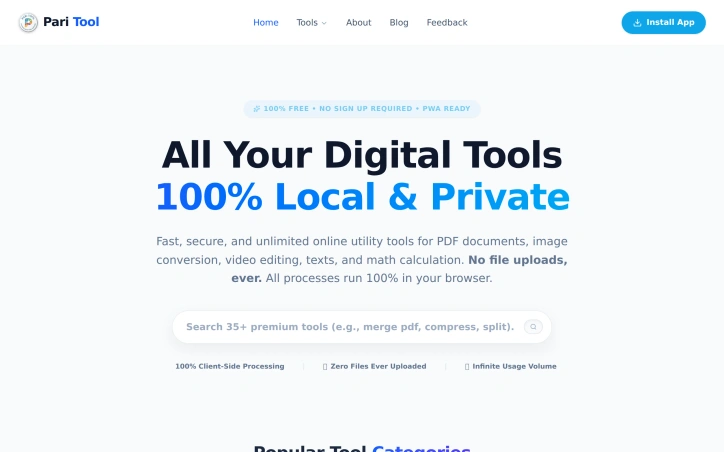
Professionals and casual users constantly face the need for quick file conversion, document manipulation, and utility operations, yet existing solutions fragment across paid subscriptions, sketchy free services that upload data to servers, and desktop software that requires installation. Pari Tool addresses this gap with a collection of over 35 browser-based utilities that operate entirely on the user's device, eliminating privacy concerns and eliminating the need for account creation or payment. The core distinction of this product lies in its execution model. All processing happens client-side within the browser, meaning files never leave the user's computer. This architecture removes the fundamental trade-off that has long plagued free online tools: either accept that your files travel to someone's server, or pay for privacy. For users managing sensitive documents—tax records, personal photos, confidential PDFs—this distinction matters considerably. The tool also operates as a progressive web application, allowing installation directly from the browser without app store intermediaries. The feature set spans practical categories. PDF functionality covers merging multiple documents, splitting or extracting specific pages, compression, format conversion to images, password protection, and annotation editing. Image tools handle resizing, cropping, background removal, watermarking, and conversion between WebP, PNG, JPG, and PDF formats. Video utilities compress footage, convert between formats (MP4 to MOV), extract audio, and transform clips into animated GIFs. Beyond media, the platform includes text utilities for word counting and reading-time analysis, case conversion, batch find-and-replace operations, and duplicate removal. Specialized tools cover QR code and barcode generation, JSON formatting, file encryption with AES protection, ZIP compression, and practical calculators for EMI and tax invoice generation. What remains unstated but obvious: the business model assumes either a future monetization pivot or funding already in place. The product explicitly commits to remaining free with unlimited usage, which creates questions about sustainability that the available information doesn't address. The strength of Pari Tool lies not in algorithmic innovation but in practical consolidation. Rather than requiring users to bounce between a dozen specialized sites, it centralizes commonly needed operations in a single, privacy-respecting interface. For anyone regularly handling documents, images, or video files, the convenience factor alone—combined with the removal of upload anxiety—positions this as a genuinely useful addition to the web utility landscape.

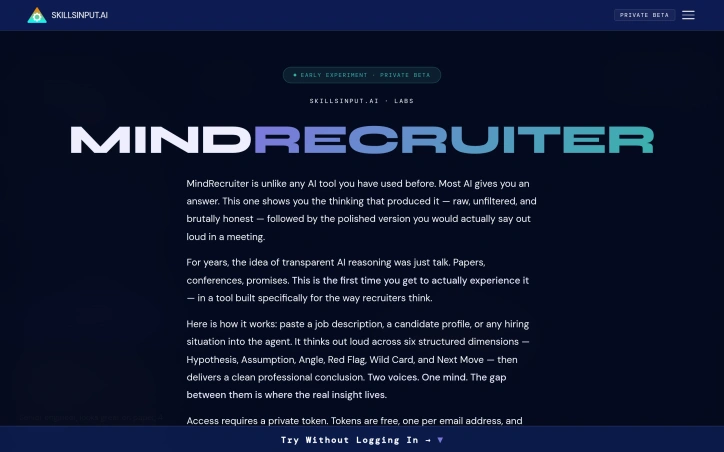
Recruiting decisions rest on incomplete information, yet most AI tools compound the problem by hiding their reasoning under a layer of polish. MindRecruiter addresses the core frustration: recruiters who want to understand why an AI system reached a particular conclusion before trusting it with a hiring decision. The product breaks this down into a two-stage thinking model. First, it surfaces raw reasoning across six structured dimensions: an initial hypothesis, underlying assumptions that might be flawed, an alternative evaluation angle, potential red flags, unexpected considerations, and a recommended next step. Only then does it synthesize these into a professional-grade conclusion suitable for documentation or stakeholder communication. The theory is sound—that gap between unfiltered reasoning and polished output contains the actual decision-making insight. The interface is designed for speed and flexibility. Users paste job descriptions, candidate profiles, or hiring scenarios directly into a web interface. A Chrome extension adds one-click analysis for LinkedIn profiles and job postings without scraping or storing data. File uploads support PDFs, Word documents, and images. The entry barrier is deliberately low: four free analyses available immediately without authentication. For extended use, the token system removes friction while maintaining privacy. Free tokens last 30 days and persist only on the user's device—no account creation, no email tracking, no data transmission. This is a genuine technical choice rather than marketing language. Every session remains local, and the company states it doesn't log or store anything, a rare commitment in an industry where data hoarding has become default practice. The ambitions here are measured rather than grandiose. MindRecruiter is explicitly positioned as a private beta experiment rather than a polished product, which signals genuine research into how AI transparency in hiring could work rather than a rush to market. It's part of a broader free suite under SKILLSINPUT.AI that includes resume generation, salary tools, and career roadmaps. What's genuinely missing are real constraints: evidence of how the reasoning holds up on complex hiring decisions, whether six dimensions exhaust all recruiting scenarios, or what the actual output quality looks like beyond template prompts. The transparency promise is the entire product—if that reasoning is shallow or misses domain-specific nuance, the tool fails immediately. For recruiters skeptical of black-box AI but willing to experiment with something genuinely transparent, this is worth testing. For those seeking a production-ready system, it's still too experimental.

Developers and security teams need to make real-time decisions about incoming IP addresses—whether to allow a transaction, flag it for review, or block it outright. GeoPatrol simplifies this by packaging IP intelligence into a single API call that returns location, network metadata, and a risk score in under 15 milliseconds. The platform stands out through its commitment to live data assembly rather than relying on stale, precompiled databases. Instead of serving old snapshots, GeoPatrol queries routing tables, regional registries, threat feeds, and global probes on each request, then cross-references the results to produce more granular and accurate answers. Published benchmarks claim 99.6% location accuracy and responses in 12 ms at the p95, substantially faster than the 85 ms median from traditional database-driven services. The API returns over 40 data fields per lookup, compared to roughly 15 from typical alternatives. GeoPatrol's feature set is built for fraud and security workflows. Pinpoint geolocation covers city-level precision with latitude, longitude, timezone, and currency. A single 0–100 risk score condenses signals from blocklists, darknet feeds, and historical abuse patterns. Privacy detection flags VPNs, proxies, Tor exits, private relays, and datacenter IPs—critical for identifying obfuscated traffic. Network and ASN data reveal the operator and announced BGP routes behind each address. The platform supports both IPv4 and IPv6. The platform distributes queries across 42 edge nodes globally, delivering sub-15 millisecond responses backed by a 99.99% uptime SLA. The API is designed for compliance, requiring no personal data and offering GDPR-ready, versioned responses with stable field definitions. GeoPatrol operates as a cloud-based SaaS platform billed on recurring subscriptions; specific pricing is not publicly disclosed. A no-signup demo lets prospective users test resolution of their own IP without credentials, reducing friction for evaluation. The product serves businesses handling authentication, payment processing, account security, or fraud-sensitive workflows where understanding an IP's provenance and risk profile directly informs access decisions. Developers find it valuable as a pre-built alternative to assembling intelligence from multiple disparate sources or maintaining custom geolocation infrastructure.


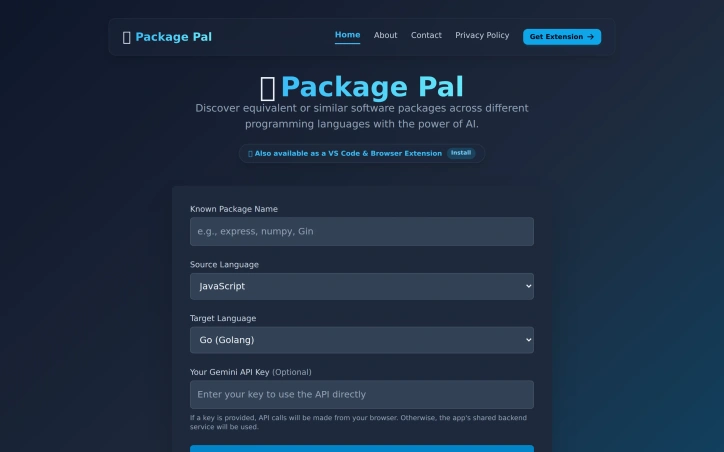
Developers frequently face a significant hurdle when switching between programming languages, namely finding equivalent libraries and packages. Package Pal addresses this challenge by providing a platform that instantly suggests alternatives across multiple languages. The tool is specifically designed for developers who need to migrate projects, refactor legacy services, or learn new frameworks. What stands out about Package Pal is its use of state-of-the-art AI to bridge the gap between different package ecosystems. By leveraging this technology, it enables developers to map their existing knowledge from one language to another seamlessly. The tool's ability to provide instant translations, complete with documentation URLs, installation commands, and usage examples, is particularly noteworthy. The key features of Package Pal include cross-language support for over 15 popular languages, an IDE extension that allows for in-editor package discovery, and the option to run queries client-side using a user's own Gemini API key. This last feature is especially useful for users who require higher rate limits. Additionally, the tool provides a sidebar explorer that automatically scans the active file and lists all dependencies and their alternatives in a clean tree view. Package Pal is available as a free VS Code extension, with a clear emphasis on privacy. The tool is committed to protecting user data and provides transparent information about its data collection practices and use of third-party cookies. Users have control over their data, and the option to opt out of personalized advertising is available through Google Ad Settings or aboutads.info. Overall, Package Pal is a valuable resource for developers navigating the complexities of cross-language development.
Organizations operating industrial control systems and operational technology infrastructure face a pressing concern: identifying and monitoring internet-exposed devices that could be vulnerable to cyber threats. ICS Tracker's solution directly addresses this issue by scanning the internet for exposed ICS and OT devices, effectively creating a digital fingerprint of these assets. This intelligence is crucial for entities responsible for securing critical infrastructure, as it enables them to pinpoint potential entry points for attackers. What distinguishes ICS Tracker is its methodical approach to detecting industrial protocols and subsequently examining web applications associated with these devices. By doing so, it provides a detailed insight into the online presence of ICS and OT infrastructure, a critical step in managing and mitigating associated risks. The product's capability to identify specific industrial protocol responses and then comprehensively scan associated web applications stands out as a key feature. This level of scrutiny suggests a thorough understanding of the complexities involved in securing industrial infrastructure, where the stakes are high due to the potential for significant disruption or damage. Unfortunately, the available information does not detail the pricing or business model adopted by ICS Tracker, making it difficult to assess its accessibility to potential users. Nonetheless, the focus on delivering actionable intelligence on internet-exposed ICS and OT devices positions ICS Tracker as a valuable resource for those tasked with safeguarding critical infrastructure against cyber threats. Its unique scanning and monitoring capabilities make it a noteworthy solution in the industrial cybersecurity landscape.


Fraudulent signups remain a persistent issue in the digital landscape, bleeding resources from businesses through unnecessary transactional emails and wasted onboarding efforts. TrueUser offers a solution to this problem with its email verification API, specifically designed for businesses suffering from fake and disposable signups. By integrating TrueUser into their signup flow, companies can verify the authenticity of user email addresses in under 80 milliseconds. What stands out about TrueUser is its comprehensive approach to email verification, checking 14 signals that include disposable domain matching, MX and SMTP probing, and batch-velocity fingerprinting. This robust verification process enables businesses to identify not only disposable email addresses but also coordinated batch signup attacks. The company's dedication to staying ahead of emerging threats is evident in its active tracking of disposable domains, with over 5,439 domains monitored and a list that is updated regularly to include new providers. TrueUser provides businesses with a flexible system, allowing them to either directly use the verdict provided by the API or create their own policy based on the raw signals returned. Every API call is streamed to the company's dashboard, facilitating replay and tuning. The live verification stream demonstrates the API's effectiveness in real-time, showcasing its ability to quickly identify and block suspicious signups. The service starts free, with 1,000 free checks available, indicating a freemium model that allows potential customers to test the API before committing to a paid plan. Overall, TrueUser presents a compelling solution for businesses seeking to mitigate the financial and operational impacts of fake signups.


Simplifying complex concepts is a daunting task, but one that iHateReading tackles with ease. The website's mission is to make learning more accessible by deconstructing intricate topics into bite-sized, easy-to-follow guides. By doing so, it aims to alleviate the issue of information overwhelm that often plagues individuals seeking to understand how products are built. The site's approach is straightforward, presenting technical information in a clear and concise manner. The content is well-structured, allowing users to navigate through topics with ease. The idea is to empower users with a deeper understanding of complex subjects, and the site's simple, uncluttered design facilitates this goal. While still a relatively new resource, iHateReading demonstrates significant potential in making technical knowledge more approachable. Its unique value proposition lies in its ability to distill complicated information into manageable chunks. For individuals seeking to expand their knowledge without getting bogged down in technical jargon, iHateReading is a valuable resource worth exploring. With its clean presentation and focused content, it's a site that could become a go-to destination for those looking to learn without the overwhelm.

Content creation is a crucial aspect of digital marketing, and tools that streamline the process are in high demand. Inkgest has emerged as a potential game-changer for writers and content creators. By leveraging AI-driven technology, the platform aims to simplify the writing process while ensuring that the output is optimized for search engines. The tool's primary function is to assist writers in crafting content that is not only engaging but also rich in relevant backlinks and hyperlinks. This approach is designed to improve the content's visibility and credibility online. By integrating SEO principles into the writing process, Inkgest helps creators produce high-quality content that resonates with their target audience. While exploring the platform, it's clear that Inkgest is designed to be a collaborative tool, rather than a replacement for human writers. The user interface is intuitive, and the features are geared towards supporting the creative process. For content creators looking to enhance their workflow and produce SEO-friendly content, Inkgest is definitely worth exploring. Its potential to become an indispensable asset for writers worldwide is evident, making it a promising addition to the content creation landscape.


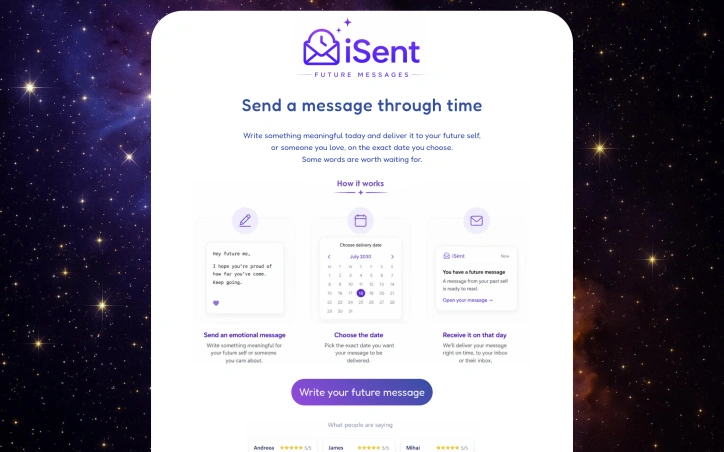
Sending meaningful messages to loved ones or one's future self can be a thoughtful and personal gesture, and iSent.co.uk provides a straightforward way to do just that. The platform caters to individuals seeking to schedule messages for future delivery, allowing users to write or record something meaningful today and have it delivered on a chosen date. What stands out about this product is its simplicity and the emotional value it offers. The service is designed for personal use and entertainment, suggesting that it is targeting individuals looking for a unique way to connect with others or reflect on their own thoughts and experiences over time. The platform allows users to compose a message and schedule it for delivery via email on a specific date. Users also have the option to upload an audio file to accompany their message, provided they own the rights to the content. The service is not without its limitations, however, as the company explicitly states that it does not guarantee timely or uninterrupted delivery due to factors outside its control, such as technical issues or problems with email providers. Each message requires a payment of £1, processed securely through Stripe, and payments are non-refundable except as required by law. This straightforward pricing model is clear and easy to understand. Overall, iSent.co.uk offers a novel way for individuals to send messages to themselves or others at a future date, making it a unique offering for those seeking a thoughtful and personal way to connect with others or reflect on their own experiences over time.

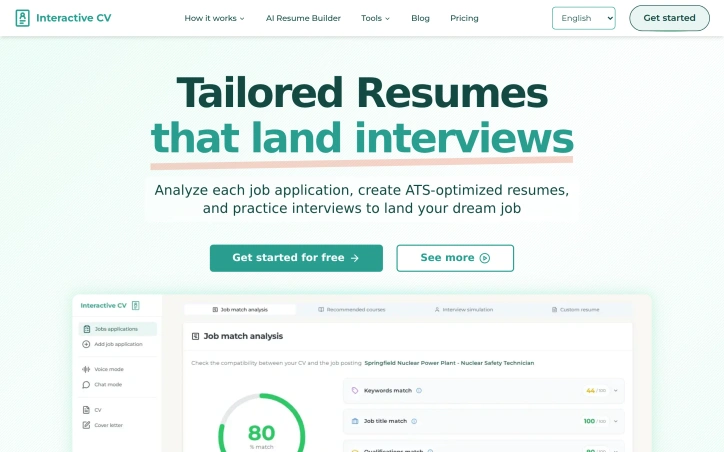
Job seekers struggling to get past the automated gatekeepers of the hiring process now have a potent ally in their corner. The creator of Interactive CV recognized that a significant hurdle lies in crafting resumes that not only pass through applicant tracking systems (ATS) but also effectively showcase a candidate's relevant skills to potential employers. To tackle this, the platform employs AI-driven tools to help job seekers tailor their resumes for each application, a task that can be incredibly time-consuming when done manually. What stands out about Interactive CV is its comprehensive approach to job hunting. It's not just about resume building; the platform offers a suite of tools designed to enhance every aspect of the job search process. The ATS-optimized resume builder provides real-time suggestions and score improvements, ensuring that a candidate's resume is as relevant as possible to the job at hand. Furthermore, the AI-powered interview simulator allows users to practice and refine their interview skills, receiving instant feedback on their performance. The platform's capabilities extend to resume and job match analysis, a job application tracker that organizes applications in a visual Kanban board, and metrics and analytics that provide insights into a user's job search progress. Additionally, users can share their CV link with recruiters, facilitating engagement through chat or voice, and generate AI-optimized cover letters tailored to each job opportunity. Interactive CV is geared towards individuals looking to maximize their chances of success in a competitive job market. By leveraging AI technology to personalize and optimize various components of the job search process, it offers a robust solution to common challenges faced by job seekers. The platform invites users to get started for free, though specific details about its pricing model are not immediately clear.

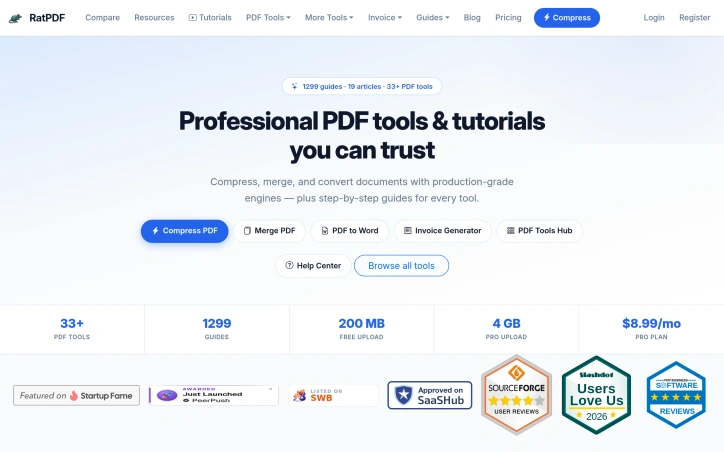
Document productivity is a common pain point for many individuals and businesses, with complicated and costly PDF editing software often being a major obstacle. RatPDF addresses this issue by providing a browser-based platform that offers a range of free and accessible PDF tools. The platform is designed to simplify document productivity, making it an ideal solution for freelancers, small businesses, and anyone looking for an easy-to-use PDF editing solution. What stands out about RatPDF is its comprehensive suite of PDF tools, which includes compression, merging, splitting, conversion to Word or Excel, OCR, signing, watermarking, and invoice generation. The platform utilizes production-grade engines such as Ghostscript, LibreOffice, pdf2docx, and iText, ensuring high-quality output. The inclusion of step-by-step guides for each tool is also a notable feature, making it easy for users to navigate and utilize the various tools. The platform offers a range of key features, including the ability to compress PDF files without losing quality, merge multiple documents into one file, and convert PDFs to editable Word documents. The invoice generator tool is also a useful feature, allowing users to create GST, VAT, and business invoices as PDF files. Additionally, the platform provides a secure PDF workflow, enabling users to watermark, sign, password-protect, and unlock their documents. RatPDF offers a mix of free and paid features, with users able to upload files up to 200 MB for free. For users requiring more capacity, the Pro plan offers 4 GB uploads for $8.99 per month. Overall, RatPDF is a versatile and user-friendly platform that provides a valuable solution for individuals and businesses looking to simplify their document productivity.