
Best Productivity Startups & Tools

Recently Listed

218 launches

Sort
ClickToGuide

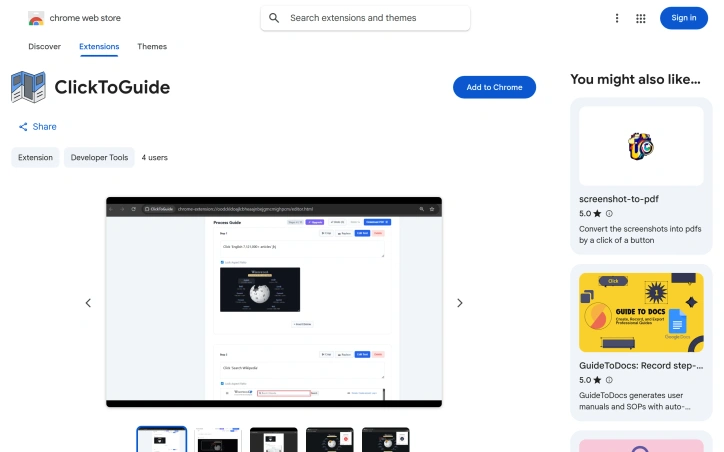
Automating the tedious process of documenting workflows, this Chrome extension captures user interactions and transforms them into PDF guides complete with annotated screenshots. The tool addresses a genuine pain point: professionals across support, quality assurance, training, and product documentation spend considerable time manually taking screenshots, pasting them into documents, and writing descriptions for each step. ClickToGuide eliminates this friction by recording clicks and automatically generating corresponding visual content. The extension markets itself to a diverse audience. QA teams can quickly generate evidence for bug reports, HR departments can assemble onboarding materials, customer support representatives can create visual troubleshooting guides, and developers can document features before handoff. This multi-use positioning reflects a well-understood problem that spans multiple job functions within organizations. Several design choices set this apart from generic screen recording tools. The interface emphasizes simplicity: users record a workflow, review and edit the captured steps, then export directly to PDF. The extension highlights where users clicked with a red box, providing context without cluttering the visual. A built-in crop tool lets users focus on specific UI elements, and standard keyboard shortcuts for undo, redo, and clipboard image insertion keep the workflow fast. The editing interface is built for quick iteration rather than deep customization. The privacy model represents a conscious architectural decision. All processing happens locally in the browser rather than on remote servers, meaning users never transmit screen data to company infrastructure. For teams handling sensitive information or operating under strict data governance, this is a meaningful differentiator from cloud-dependent competitors. The business model centers on a lifetime license with cosmetic unlocks—removing watermarks and supporting unlimited steps. A launch promotion offered $5 off the license price. The extension remains early-stage; the Chrome Web Store listing shows only two users and the most recent version update dates to February 2026. The small user base suggests limited market penetration so far, though the product addresses real workflow problems that users across industries encounter daily.

Screenshots-and-screen-recording-apps
N
Neha Pawar

Automating the tedious process of documenting workflows, this Chrome extension captures user interactions and transforms them into PDF guides complete with annotated screenshots. The tool addresses a genuine pain point: professionals across support, quality assurance, training, and product documentation spend considerable time manually taking screenshots, pasting them into documents, and writing descriptions for each step. ClickToGuide eliminates this friction by recording clicks and automatically generating corresponding visual content. The extension markets itself to a diverse audience. QA teams can quickly generate evidence for bug reports, HR departments can assemble onboarding materials, customer support representatives can create visual troubleshooting guides, and developers can document features before handoff. This multi-use positioning reflects a well-understood problem that spans multiple job functions within organizations. Several design choices set this apart from generic screen recording tools. The interface emphasizes simplicity: users record a workflow, review and edit the captured steps, then export directly to PDF. The extension highlights where users clicked with a red box, providing context without cluttering the visual. A built-in crop tool lets users focus on specific UI elements, and standard keyboard shortcuts for undo, redo, and clipboard image insertion keep the workflow fast. The editing interface is built for quick iteration rather than deep customization. The privacy model represents a conscious architectural decision. All processing happens locally in the browser rather than on remote servers, meaning users never transmit screen data to company infrastructure. For teams handling sensitive information or operating under strict data governance, this is a meaningful differentiator from cloud-dependent competitors. The business model centers on a lifetime license with cosmetic unlocks—removing watermarks and supporting unlimited steps. A launch promotion offered $5 off the license price. The extension remains early-stage; the Chrome Web Store listing shows only two users and the most recent version update dates to February 2026. The small user base suggests limited market penetration so far, though the product addresses real workflow problems that users across industries encounter daily.

ClickToGuide preview

Key features

  • Automated Screenshot Capture: Records user interactions and automatically captures corresponding screenshots
  • PDF Guide Generation: Transforms captured workflow steps into annotated PDF documents
See full listing
Time Capsule - Memory Vault

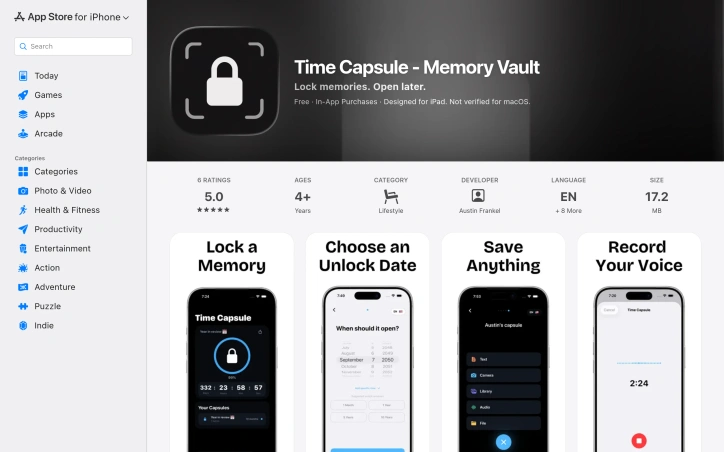
Capturing memories for future reflection has become increasingly common, but most solutions treat time capsules as an afterthought. This app tackles the specific use case of sealing away meaningful moments—photos, videos, voice recordings, notes, and files—to be opened at a predetermined date, preserved exactly as they were locked away. The target audience is broad but specific: people marking milestones who want to freeze a moment in time. This includes high school graduates saving photos and letters for their adult selves, parents recording a child's early moments to be revisited at 18, friend groups documenting shared trips, and individuals tracking personal goals for yearly review. What distinguishes this offering is its uncompromising stance on privacy. The application stores everything on-device using AES-256 encryption, avoids cloud servers entirely, requires no account creation, and collects no analytics or user data. This approach appeals to users skeptical of tech companies' data practices, though it carries a trade-off: responsibility for manually backing up capsules as encrypted files to prevent device loss from becoming data loss. The interface emphasizes simplicity. Users name a capsule, choose an unlock date ranging from one day to decades away, add their content, and press and hold to seal it. A countdown timer displays time remaining until each capsule unlocks. The app supports flexible content types, from imported media to built-in voice recording and text composition. Sharing encrypted capsules with others requires a premium subscription. The service operates on a freemium model with in-app purchases. Core capsule creation and storage is free, while premium access unlocks capsule sharing and some advanced features. The documentation doesn't clearly distinguish what exactly requires payment, which prospective users should clarify before relying on the app for long-term memory storage. One practical consideration: since everything is local and unsynced, device loss means capsule loss unless backups exist as external encrypted files. The developer emphasizes this backup requirement, suggesting they understand the inherent risks of an entirely on-device architecture. For users prioritizing privacy over convenience, who accept responsibility for backups, and who find meaning in time-delayed memory capture, this fills a genuine gap in the app ecosystem.

Note-and-writing-apps
A
Austin Frankel

Capturing memories for future reflection has become increasingly common, but most solutions treat time capsules as an afterthought. This app tackles the specific use case of sealing away meaningful moments—photos, videos, voice recordings, notes, and files—to be opened at a predetermined date, preserved exactly as they were locked away. The target audience is broad but specific: people marking milestones who want to freeze a moment in time. This includes high school graduates saving photos and letters for their adult selves, parents recording a child's early moments to be revisited at 18, friend groups documenting shared trips, and individuals tracking personal goals for yearly review. What distinguishes this offering is its uncompromising stance on privacy. The application stores everything on-device using AES-256 encryption, avoids cloud servers entirely, requires no account creation, and collects no analytics or user data. This approach appeals to users skeptical of tech companies' data practices, though it carries a trade-off: responsibility for manually backing up capsules as encrypted files to prevent device loss from becoming data loss. The interface emphasizes simplicity. Users name a capsule, choose an unlock date ranging from one day to decades away, add their content, and press and hold to seal it. A countdown timer displays time remaining until each capsule unlocks. The app supports flexible content types, from imported media to built-in voice recording and text composition. Sharing encrypted capsules with others requires a premium subscription. The service operates on a freemium model with in-app purchases. Core capsule creation and storage is free, while premium access unlocks capsule sharing and some advanced features. The documentation doesn't clearly distinguish what exactly requires payment, which prospective users should clarify before relying on the app for long-term memory storage. One practical consideration: since everything is local and unsynced, device loss means capsule loss unless backups exist as external encrypted files. The developer emphasizes this backup requirement, suggesting they understand the inherent risks of an entirely on-device architecture. For users prioritizing privacy over convenience, who accept responsibility for backups, and who find meaning in time-delayed memory capture, this fills a genuine gap in the app ecosystem.

Time Capsule - Memory Vault preview

Key features

  • On-Device Encryption: Uses AES-256 encryption to store all memories locally without cloud servers
  • Multiple Content Types: Supports photos, videos, voice recordings, notes, and files in a single capsule
See full listing
DropAI.zone

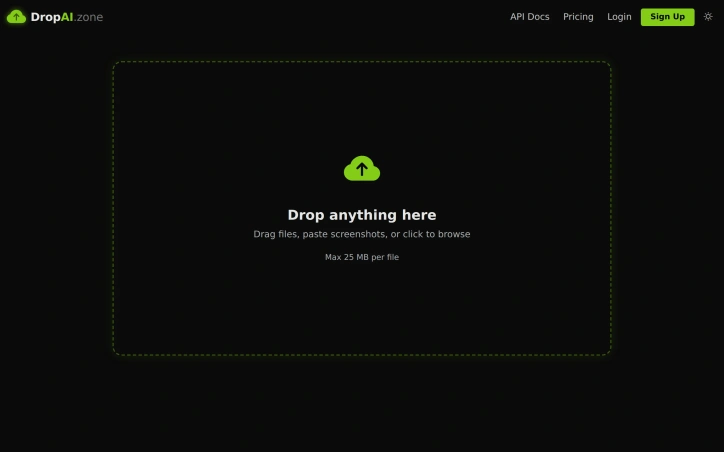
Ephemeral file sharing strips friction from digital workflows. DropAI.zone addresses a specific pain point: getting a file to someone else's inbox in seconds, without signing up or navigating clunky interfaces. The service emphasizes simplicity. Users drag files, paste screenshots, or call an API, and immediately receive a shareable URL. Files auto-delete by default after 12 to 72 hours, addressing digital clutter anxiety. This ephemerality differentiates it from conventional file hosting, which defaults to permanence. What stands out is its dual architecture. The graphical interface prioritizes speed—no login, no forms, just drag-and-drop. Simultaneously, a REST API and MCP integration allow Claude, GPT, and other AI agents to programmatically upload and retrieve files. This targets a useful edge case: AI workflows generating logs and screenshots needing rapid, temporary storage without persistent infrastructure. The feature set scales with commitment. Guest users get 25 MB per file and 50 daily drops. Free accounts extend to 50 MB files and 200 drops daily, with a dashboard and one MCP API key. The Pro tier ($9 monthly) adds permanent storage options, encrypted drops, password protection, and analytics. The pricing strategy is transparent: the service works as genuinely free for casual users, then monetizes developers and power users willing to pay for higher quotas, storage, and API keys. No deceptive restrictions; the tiers honestly reflect different use cases. Beyond auto-deletion and URL sharing, DropAI.zone's feature novelty is limited. The appeal rests on execution—how seamlessly it handles the upload-to-share flow—rather than categorically new functionality. For users valuing simplicity and ephemerality over comprehensive file management, that's exactly the point. For others, it's a useful shortcut for a specific workflow.

File-storage-and-sharing-apps
R
R. Davis

Ephemeral file sharing strips friction from digital workflows. DropAI.zone addresses a specific pain point: getting a file to someone else's inbox in seconds, without signing up or navigating clunky interfaces. The service emphasizes simplicity. Users drag files, paste screenshots, or call an API, and immediately receive a shareable URL. Files auto-delete by default after 12 to 72 hours, addressing digital clutter anxiety. This ephemerality differentiates it from conventional file hosting, which defaults to permanence. What stands out is its dual architecture. The graphical interface prioritizes speed—no login, no forms, just drag-and-drop. Simultaneously, a REST API and MCP integration allow Claude, GPT, and other AI agents to programmatically upload and retrieve files. This targets a useful edge case: AI workflows generating logs and screenshots needing rapid, temporary storage without persistent infrastructure. The feature set scales with commitment. Guest users get 25 MB per file and 50 daily drops. Free accounts extend to 50 MB files and 200 drops daily, with a dashboard and one MCP API key. The Pro tier ($9 monthly) adds permanent storage options, encrypted drops, password protection, and analytics. The pricing strategy is transparent: the service works as genuinely free for casual users, then monetizes developers and power users willing to pay for higher quotas, storage, and API keys. No deceptive restrictions; the tiers honestly reflect different use cases. Beyond auto-deletion and URL sharing, DropAI.zone's feature novelty is limited. The appeal rests on execution—how seamlessly it handles the upload-to-share flow—rather than categorically new functionality. For users valuing simplicity and ephemerality over comprehensive file management, that's exactly the point. For others, it's a useful shortcut for a specific workflow.

DropAI.zone preview

Key features

  • Drag-and-drop Sharing: Upload files instantly without signup or forms
  • Auto-deletion: Files automatically delete after 12-72 hours to reduce digital clutter
See full listing
VeilDB

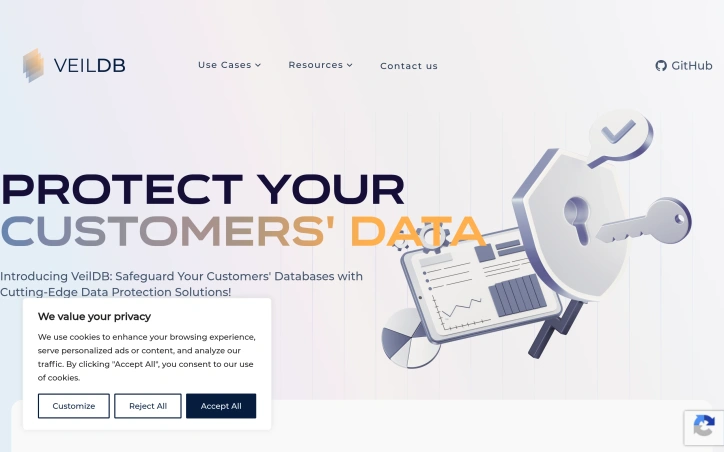
Protecting sensitive customer data during database operations remains a fundamental challenge for development teams. VeilDB addresses this by automating the process of masking and removing personally identifiable information from database backups, allowing teams to safely share sanitized copies without compromising data privacy or security. The platform targets development and QA teams that regularly need access to production-like data for testing and debugging but face compliance and privacy constraints. Rather than forcing developers to request backups from technical leads or work with artificial datasets, VeilDB enables self-service access to masked data through a straightforward workflow: connect your database, scan its contents, configure masking rules, and distribute sanitized backups to team members with appropriate access controls. What distinguishes VeilDB is its emphasis on practical usability. The platform features a visual rule builder that abstracts away technical complexity, letting teams define how to handle sensitive columns without writing code. Configuration rules can replace, update, or remove data based on user-defined parameters. The solution also introduces a scheduling system that automates backup creation and masking on a recurring basis, reducing manual intervention and ensuring teams always have access to current sanitized data. The access control model reflects a team-centric philosophy. Rather than a simple binary structure, VeilDB implements group-based permissions that allow organizations to segment database access across multiple team members with varying privilege levels. This is particularly valuable in larger organizations where developers working on different features or services require different data views. Integration appears straightforward. The platform supplies a command-line tool that developers can install locally, reducing friction compared to solutions requiring database-level modifications or complex deployment steps. The four-stage setup flow—application setup, database scanning, rule configuration, and team distribution—suggests a focus on reducing implementation complexity. One limitation evident from the available information is the absence of concrete pricing details or a published cost model. The website mentions documentation and a GitHub repository, suggesting some level of technical transparency, but specifics on whether the offering is open-source, subscription-based, or usage-metered remain unstated. Interested teams must request a demo to understand licensing terms. VeilDB occupies a practical niche in the data security landscape. For teams struggling with the tension between needing realistic data for development while maintaining privacy obligations, it offers a plausible solution that prioritizes ease of use alongside security fundamentals. The product's success will depend on how well the claimed integration simplicity holds up under real-world deployment.

Security-software
I
Ihor Klymchuk

Protecting sensitive customer data during database operations remains a fundamental challenge for development teams. VeilDB addresses this by automating the process of masking and removing personally identifiable information from database backups, allowing teams to safely share sanitized copies without compromising data privacy or security. The platform targets development and QA teams that regularly need access to production-like data for testing and debugging but face compliance and privacy constraints. Rather than forcing developers to request backups from technical leads or work with artificial datasets, VeilDB enables self-service access to masked data through a straightforward workflow: connect your database, scan its contents, configure masking rules, and distribute sanitized backups to team members with appropriate access controls. What distinguishes VeilDB is its emphasis on practical usability. The platform features a visual rule builder that abstracts away technical complexity, letting teams define how to handle sensitive columns without writing code. Configuration rules can replace, update, or remove data based on user-defined parameters. The solution also introduces a scheduling system that automates backup creation and masking on a recurring basis, reducing manual intervention and ensuring teams always have access to current sanitized data. The access control model reflects a team-centric philosophy. Rather than a simple binary structure, VeilDB implements group-based permissions that allow organizations to segment database access across multiple team members with varying privilege levels. This is particularly valuable in larger organizations where developers working on different features or services require different data views. Integration appears straightforward. The platform supplies a command-line tool that developers can install locally, reducing friction compared to solutions requiring database-level modifications or complex deployment steps. The four-stage setup flow—application setup, database scanning, rule configuration, and team distribution—suggests a focus on reducing implementation complexity. One limitation evident from the available information is the absence of concrete pricing details or a published cost model. The website mentions documentation and a GitHub repository, suggesting some level of technical transparency, but specifics on whether the offering is open-source, subscription-based, or usage-metered remain unstated. Interested teams must request a demo to understand licensing terms. VeilDB occupies a practical niche in the data security landscape. For teams struggling with the tension between needing realistic data for development while maintaining privacy obligations, it offers a plausible solution that prioritizes ease of use alongside security fundamentals. The product's success will depend on how well the claimed integration simplicity holds up under real-world deployment.

VeilDB preview

Key features

  • Data Masking Automation: Automatically masks and removes PII from database backups
  • Visual Rule Builder: Define masking rules without code through an intuitive interface
See full listing
iOS Live Face Cam Screen Recorder

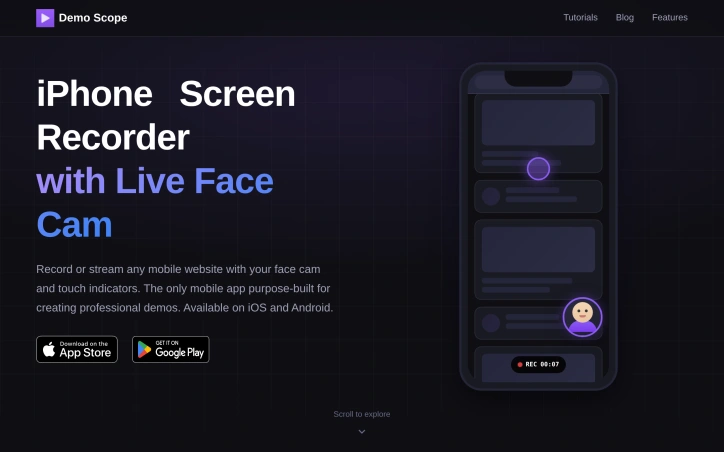
Professional mobile demos have historically required desktop recording software or awkward workarounds that compromise the viewing experience. DemoScope solves this by building a purpose-built screen recording app specifically for capturing mobile web interactions alongside live commentary, making it particularly valuable for startup founders pitching to investors, content creators launching on platforms like Product Hunt, and developers documenting user workflows. The standout feature is the integrated face cam overlay with positioning and resizing controls, paired with touch indicator visualization. Rather than relying on viewers to infer what actions are happening on screen, the app makes every tap, swipe, and gesture visible with customizable animations and colors. This combination addresses a real friction point in mobile demos—without these cues, viewers often struggle to follow along with rapid interactions or multi-step workflows. Beyond recording, DemoScope supports live streaming directly to Twitch, YouTube, and Facebook, along with custom RTMP servers, which extends the tool's utility to real-time use cases like product launches, tutorials, and gaming content. The app accepts input from any website loaded in its built-in browser, video playback, or photo slideshows, giving creators flexibility in what they choose to record. Features like URL favorites and browsing history are included, acknowledging that many recording sessions involve navigation or comparison work. The product positioning targets multiple audiences simultaneously—investor-focused founders who need polished pitch materials, streamers and live content creators, and educators building tutorial content for YouTube or online courses. Each use case gets explicit attention in the marketing, suggesting the creators have deliberately built for this spectrum rather than trying to serve everyone generically. The app is available on both iOS and Android, which is a meaningful differentiation from desktop-only solutions, since it positions recording and streaming as native mobile workflows rather than desktop adjacent tasks. The face cam customization (circular, square, or rectangular shapes with dragging and pinching controls) suggests attention to usability details that matter for on-the-fly content creation. No pricing or subscription model is mentioned in the available content, making it unclear whether this is a freemium offering, one-time purchase, or subscription service. That omission is notable for a product clearly targeting creators and entrepreneurs who evaluate tools partly on cost structure.

Screenshots-and-screen-recording-apps
A
Adam Tal

Professional mobile demos have historically required desktop recording software or awkward workarounds that compromise the viewing experience. DemoScope solves this by building a purpose-built screen recording app specifically for capturing mobile web interactions alongside live commentary, making it particularly valuable for startup founders pitching to investors, content creators launching on platforms like Product Hunt, and developers documenting user workflows. The standout feature is the integrated face cam overlay with positioning and resizing controls, paired with touch indicator visualization. Rather than relying on viewers to infer what actions are happening on screen, the app makes every tap, swipe, and gesture visible with customizable animations and colors. This combination addresses a real friction point in mobile demos—without these cues, viewers often struggle to follow along with rapid interactions or multi-step workflows. Beyond recording, DemoScope supports live streaming directly to Twitch, YouTube, and Facebook, along with custom RTMP servers, which extends the tool's utility to real-time use cases like product launches, tutorials, and gaming content. The app accepts input from any website loaded in its built-in browser, video playback, or photo slideshows, giving creators flexibility in what they choose to record. Features like URL favorites and browsing history are included, acknowledging that many recording sessions involve navigation or comparison work. The product positioning targets multiple audiences simultaneously—investor-focused founders who need polished pitch materials, streamers and live content creators, and educators building tutorial content for YouTube or online courses. Each use case gets explicit attention in the marketing, suggesting the creators have deliberately built for this spectrum rather than trying to serve everyone generically. The app is available on both iOS and Android, which is a meaningful differentiation from desktop-only solutions, since it positions recording and streaming as native mobile workflows rather than desktop adjacent tasks. The face cam customization (circular, square, or rectangular shapes with dragging and pinching controls) suggests attention to usability details that matter for on-the-fly content creation. No pricing or subscription model is mentioned in the available content, making it unclear whether this is a freemium offering, one-time purchase, or subscription service. That omission is notable for a product clearly targeting creators and entrepreneurs who evaluate tools partly on cost structure.

iOS Live Face Cam Screen Recorder preview

Key features

  • Integrated Face Cam Overlay: Customizable face camera with positioning, resizing controls, and shape options (circular, square, rectangular)
  • Touch Indicator Visualization: Makes all taps, swipes, and gestures visible with customizable animations and colors
See full listing
Curalo - Best Tools & Services for Consultants

Planning tool overload has become a genuine problem for solo consultants and growing firms. With hundreds of software solutions vying for attention and wallet space, the decision fatigue of choosing between CRM platforms that cost $200 monthly, automation tools, scheduling apps, and analytics software can consume valuable billable hours. Curalo addresses this friction head-on by functioning as a curated directory and recommendation engine specifically built for the consulting industry. The platform positions itself as the antidote to tool sprawl. Rather than presenting an exhaustive catalog of options, Curalo takes a curation stance, reviewing and scoring 126+ tools while packaging them into pre-built "stacks" — bundled workflows designed to solve specific consultant pain points. The Day One Stack guides new practitioners through initial setup with tools like Calendly, Bonsai, and Notion AI. The Proposal-to-Payment Stack combines Bonsai and QuickBooks to streamline deal closure. Those drowning in administrative overhead can adopt the Billable Hours Stack, which integrates scheduling, time tracking, accounting, and workflow automation into a unified system. What differentiates Curalo from a simple tool review site is this stack-centric approach. Each bundle isn't just a collection of vetted tools but a pre-thought workflow designed to be implemented in minutes. The platform also publishes 19+ playbooks and guides — including a noteworthy resource titled "From Solo to Firm: Scaling Your Consulting Practice" that acknowledges how technology needs shift across growth stages. A 60-second quiz helps consultants identify their immediate needs, making discovery frictionless. The review component is straightforward. Tools receive numerical scores (Calendly earns 89/100) alongside brief, plainspoken descriptions. For Calendly, Curalo emphasizes the core value proposition: eliminating scheduling back-and-forth through shared availability links. Pricing details are sparse in the available content, with only Calendly's $10/month baseline mentioned alongside its five-minute setup claim. The platform's positioning against expensive CRM solutions suggests the broader philosophy: recommend effective tools at reasonable cost rather than enterprise software with premium price tags. Curalo serves consultants at all practice stages who value their time over exploring every available option. It's most relevant for practitioners making their first technology decisions or those seeking to replace expensive, bloated platforms with focused, affordable alternatives.
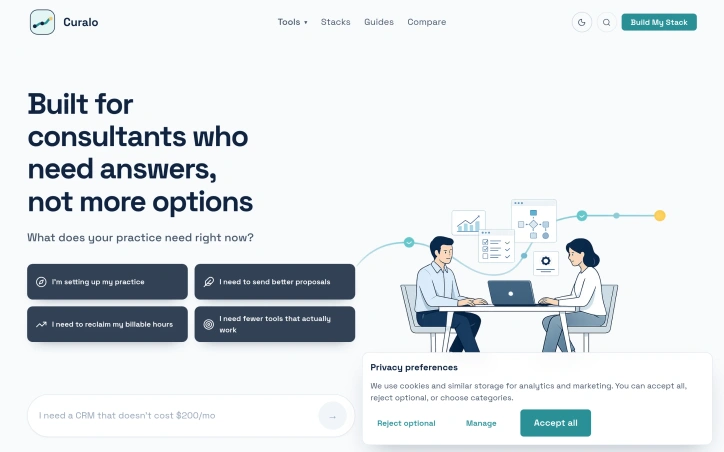

Planning tool overload has become a genuine problem for solo consultants and growing firms. With hundreds of software solutions vying for attention and wallet space, the decision fatigue of choosing between CRM platforms that cost $200 monthly, automation tools, scheduling apps, and analytics software can consume valuable billable hours. Curalo addresses this friction head-on by functioning as a curated directory and recommendation engine specifically built for the consulting industry. The platform positions itself as the antidote to tool sprawl. Rather than presenting an exhaustive catalog of options, Curalo takes a curation stance, reviewing and scoring 126+ tools while packaging them into pre-built "stacks" — bundled workflows designed to solve specific consultant pain points. The Day One Stack guides new practitioners through initial setup with tools like Calendly, Bonsai, and Notion AI. The Proposal-to-Payment Stack combines Bonsai and QuickBooks to streamline deal closure. Those drowning in administrative overhead can adopt the Billable Hours Stack, which integrates scheduling, time tracking, accounting, and workflow automation into a unified system. What differentiates Curalo from a simple tool review site is this stack-centric approach. Each bundle isn't just a collection of vetted tools but a pre-thought workflow designed to be implemented in minutes. The platform also publishes 19+ playbooks and guides — including a noteworthy resource titled "From Solo to Firm: Scaling Your Consulting Practice" that acknowledges how technology needs shift across growth stages. A 60-second quiz helps consultants identify their immediate needs, making discovery frictionless. The review component is straightforward. Tools receive numerical scores (Calendly earns 89/100) alongside brief, plainspoken descriptions. For Calendly, Curalo emphasizes the core value proposition: eliminating scheduling back-and-forth through shared availability links. Pricing details are sparse in the available content, with only Calendly's $10/month baseline mentioned alongside its five-minute setup claim. The platform's positioning against expensive CRM solutions suggests the broader philosophy: recommend effective tools at reasonable cost rather than enterprise software with premium price tags. Curalo serves consultants at all practice stages who value their time over exploring every available option. It's most relevant for practitioners making their first technology decisions or those seeking to replace expensive, bloated platforms with focused, affordable alternatives.

Curalo - Best Tools & Services for Consultants preview

Key features

  • Tool Directory and Scoring: Reviews and scores 126+ tools specifically for consultants with numerical ratings
  • Pre-built Stacks: Curated bundles of tools designed to solve specific consultant pain points
See full listing
Car File

Managing vehicle records shouldn't require juggling spreadsheets, receipts, and scattered maintenance notes. Car File addresses this problem directly by consolidating UK vehicle data, service history, and expense tracking into a single application, serving individual drivers, fleet managers, and anyone responsible for multiple vehicles. The product's core strength lies in its integration with the Driver and Vehicle Licensing Agency (DVLA). Rather than manually entering vehicle details, users input a registration number or VIN and retrieve official vehicle information instantly. This removes friction from onboarding and establishes a reliable data foundation. Beyond data retrieval, the app organizes the ongoing responsibilities of vehicle ownership. Users log fuel consumption to track efficiency patterns and identify cost optimization opportunities. Automated alerts notify owners of upcoming MOT tests and insurance renewals—critical compliance dates that are easy to overlook. A service history module consolidates maintenance records, parts, and provider information in one location. Expense tracking enables owners to categorize and report all vehicle-related costs, with built-in report generation for tax purposes and business analysis. The analytics component transforms scattered data into actionable insights. Rather than thinking in isolation about individual expenses, users can identify trends across their fleet and make informed decisions about vehicle usage and maintenance spending. Car File's approach to transparency is notable. The company publicly reports a 99.9% uptime figure and displays a 4.4 out of 5 rating on Trustpilot, with reviews highlighting the reduction in forgotten maintenance tasks and the practical benefits for fleet operators managing multiple vehicles. Pricing is straightforward and tiered. The entry-level Basic plan covers a single vehicle at £69 annually. The Pro tier scales to three vehicles for £149 yearly, while the Premium option unlocks unlimited vehicles for £279 annually. All plans include DVLA integration and core features, though Premium adds advanced analytics, CSV export, priority support, and multi-user family sharing for up to five people. The company offers a 14-day free trial at the Premium level and a 30-day money-back guarantee, reducing adoption friction. The platform succeeds by solving a genuine administrative burden—vehicle management across data retrieval, compliance, maintenance, and costs. Its DVLA integration and structured expense tracking differentiate it from generic note-taking solutions, positioning it as a specialized tool for a specific audience rather than a general-purpose application.


Scheduling-software
I
Iliya Hristov

Managing vehicle records shouldn't require juggling spreadsheets, receipts, and scattered maintenance notes. Car File addresses this problem directly by consolidating UK vehicle data, service history, and expense tracking into a single application, serving individual drivers, fleet managers, and anyone responsible for multiple vehicles. The product's core strength lies in its integration with the Driver and Vehicle Licensing Agency (DVLA). Rather than manually entering vehicle details, users input a registration number or VIN and retrieve official vehicle information instantly. This removes friction from onboarding and establishes a reliable data foundation. Beyond data retrieval, the app organizes the ongoing responsibilities of vehicle ownership. Users log fuel consumption to track efficiency patterns and identify cost optimization opportunities. Automated alerts notify owners of upcoming MOT tests and insurance renewals—critical compliance dates that are easy to overlook. A service history module consolidates maintenance records, parts, and provider information in one location. Expense tracking enables owners to categorize and report all vehicle-related costs, with built-in report generation for tax purposes and business analysis. The analytics component transforms scattered data into actionable insights. Rather than thinking in isolation about individual expenses, users can identify trends across their fleet and make informed decisions about vehicle usage and maintenance spending. Car File's approach to transparency is notable. The company publicly reports a 99.9% uptime figure and displays a 4.4 out of 5 rating on Trustpilot, with reviews highlighting the reduction in forgotten maintenance tasks and the practical benefits for fleet operators managing multiple vehicles. Pricing is straightforward and tiered. The entry-level Basic plan covers a single vehicle at £69 annually. The Pro tier scales to three vehicles for £149 yearly, while the Premium option unlocks unlimited vehicles for £279 annually. All plans include DVLA integration and core features, though Premium adds advanced analytics, CSV export, priority support, and multi-user family sharing for up to five people. The company offers a 14-day free trial at the Premium level and a 30-day money-back guarantee, reducing adoption friction. The platform succeeds by solving a genuine administrative burden—vehicle management across data retrieval, compliance, maintenance, and costs. Its DVLA integration and structured expense tracking differentiate it from generic note-taking solutions, positioning it as a specialized tool for a specific audience rather than a general-purpose application.

Car File preview

Key features

  • DVLA Integration: Retrieve official vehicle information instantly by entering registration number or VIN
  • Service History Tracking: Consolidates maintenance records, parts, and provider information in one location
See full listing
CodeSol Technologies

For businesses struggling to manage disconnected tools, repetitive manual processes, and outdated systems, CodeSol Technologies positions itself as a modernization partner for companies across industries. The Austin-based software development firm targets mid-market and enterprise clients seeking to streamline operations through digital transformation, with particular focus on healthcare, professional services, and home improvement sectors, though it claims to serve organizations of all sizes. The company's core offering centers on eliminating operational friction through automation and system consolidation. Rather than positioning itself as a single-product vendor, CodeSol emphasizes custom solutions tailored to specific workflow challenges. Their service portfolio spans custom website development, e-commerce platforms, workflow automation, and cloud infrastructure setup. This breadth suggests they function more as a systems integrator and development shop than a SaaS platform provider. What distinguishes their approach is an explicit emphasis on measurable business outcomes. The company references improvements in e-commerce checkout completion rates of 20 to 30 percent and explicitly frames solutions around efficiency gains and error reduction rather than technology for its own sake. Their marketing language consistently connects technical implementations back to business KPIs—reduced manual work translates to team capacity freed for revenue-generating activities, and data integration enables better decision-making. The company maintains a 5/5 Trustpilot rating, though the website doesn't specify review volume or time period, making this metric difficult to independently verify. Their claimed target regions include Texas and nationwide, suggesting both local and remote engagement capability. One notable limitation is the absence of transparent pricing information. All service offerings are presented as custom engagements requiring a consultation to quote, which is typical for professional services but leaves prospective clients without cost benchmarks. Similarly, the website lacks specific case studies with concrete metrics, customer testimonials beyond ratings, or details on typical project timelines and team composition. The company's positioning as a "data-driven" transformation partner is somewhat generic—most modern development firms make similar claims. However, their focus on workflow-specific automation and system integration rather than off-the-shelf solutions suggests genuine specialization. For businesses with genuine operational inefficiencies and budget for custom development, CodeSol appears to target a real need. Whether they deliver measurable ROI depends on execution and team expertise, factors the marketing materials don't adequately demonstrate.


Ai-workflow-automation
M
Muhammad Awais

For businesses struggling to manage disconnected tools, repetitive manual processes, and outdated systems, CodeSol Technologies positions itself as a modernization partner for companies across industries. The Austin-based software development firm targets mid-market and enterprise clients seeking to streamline operations through digital transformation, with particular focus on healthcare, professional services, and home improvement sectors, though it claims to serve organizations of all sizes. The company's core offering centers on eliminating operational friction through automation and system consolidation. Rather than positioning itself as a single-product vendor, CodeSol emphasizes custom solutions tailored to specific workflow challenges. Their service portfolio spans custom website development, e-commerce platforms, workflow automation, and cloud infrastructure setup. This breadth suggests they function more as a systems integrator and development shop than a SaaS platform provider. What distinguishes their approach is an explicit emphasis on measurable business outcomes. The company references improvements in e-commerce checkout completion rates of 20 to 30 percent and explicitly frames solutions around efficiency gains and error reduction rather than technology for its own sake. Their marketing language consistently connects technical implementations back to business KPIs—reduced manual work translates to team capacity freed for revenue-generating activities, and data integration enables better decision-making. The company maintains a 5/5 Trustpilot rating, though the website doesn't specify review volume or time period, making this metric difficult to independently verify. Their claimed target regions include Texas and nationwide, suggesting both local and remote engagement capability. One notable limitation is the absence of transparent pricing information. All service offerings are presented as custom engagements requiring a consultation to quote, which is typical for professional services but leaves prospective clients without cost benchmarks. Similarly, the website lacks specific case studies with concrete metrics, customer testimonials beyond ratings, or details on typical project timelines and team composition. The company's positioning as a "data-driven" transformation partner is somewhat generic—most modern development firms make similar claims. However, their focus on workflow-specific automation and system integration rather than off-the-shelf solutions suggests genuine specialization. For businesses with genuine operational inefficiencies and budget for custom development, CodeSol appears to target a real need. Whether they deliver measurable ROI depends on execution and team expertise, factors the marketing materials don't adequately demonstrate.

CodeSol Technologies preview

Key features

  • Custom Solutions: Tailored automation and system consolidation across industries
  • Workflow Automation: Eliminates operational friction through custom automation and system integration
See full listing
Remote.Team - secure chat & tasks

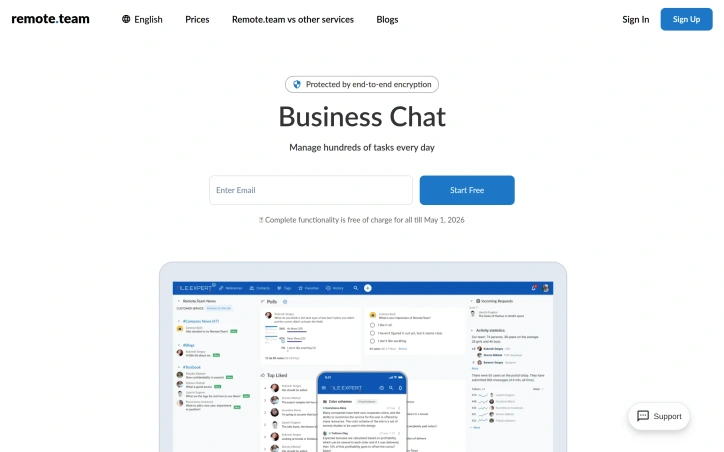
Positioned as a stripped-down alternative to heavier platforms like Basecamp and Bitrix, this secure chat and task management tool targets small-to-medium remote teams seeking simplicity over feature richness. The product's defining feature is end-to-end encryption for all communications—an unusual emphasis in the team chat space that directly addresses organizations handling sensitive information. Finance, legal, and healthcare firms can discuss confidential matters without concern that internal administrators might access message content. Operationally, the platform centers on three core capabilities: asynchronous chat, task assignment, and comment-based collaboration. Users assign work to specific team members, request urgent responses, and thread discussions directly within tasks. The interface is consistently praised as intuitive and non-technical-friendly, suggesting thoughtful UX design that avoids overwhelming users with excessive options. Multiple reviewers specifically highlight the absence of unnecessary features—a deliberate trade-off prioritizing speed and simplicity over breadth. Adoption appears strongest in Eastern European markets based on review languages and company references. User feedback clusters around productivity gains and practical reliability. One company reports a 20–25 percent productivity increase following implementation. The platform has accumulated 58 reviews with an "Excellent" rating, indicating solid satisfaction among early adopters, though this reflects a relatively modest user base compared to mainstream competitors. The most significant business model detail is the current pricing strategy: all functionality is free through May 1, 2026. This appears to be a launch-phase offer rather than a permanent free tier, indicating the company plans to introduce paid tiers after the promotional period. For prospects evaluating the platform, this deadline creates genuine urgency to test features before pricing changes take effect. Remote.Team succeeds as a focused product for teams with specific needs: organizations that prioritize security and simplicity over integrations and advanced features. It's neither attempting to be an enterprise platform nor reinventing team communication from first principles. The deliberate restraint in scope, combined with strong end-to-end encryption and demonstrated productivity improvements, makes it a credible option for organizations whose actual needs align with its design philosophy rather than aspirational enterprise requirements.

Team-collaboration-software
S
Stanislav Dmitruk

Positioned as a stripped-down alternative to heavier platforms like Basecamp and Bitrix, this secure chat and task management tool targets small-to-medium remote teams seeking simplicity over feature richness. The product's defining feature is end-to-end encryption for all communications—an unusual emphasis in the team chat space that directly addresses organizations handling sensitive information. Finance, legal, and healthcare firms can discuss confidential matters without concern that internal administrators might access message content. Operationally, the platform centers on three core capabilities: asynchronous chat, task assignment, and comment-based collaboration. Users assign work to specific team members, request urgent responses, and thread discussions directly within tasks. The interface is consistently praised as intuitive and non-technical-friendly, suggesting thoughtful UX design that avoids overwhelming users with excessive options. Multiple reviewers specifically highlight the absence of unnecessary features—a deliberate trade-off prioritizing speed and simplicity over breadth. Adoption appears strongest in Eastern European markets based on review languages and company references. User feedback clusters around productivity gains and practical reliability. One company reports a 20–25 percent productivity increase following implementation. The platform has accumulated 58 reviews with an "Excellent" rating, indicating solid satisfaction among early adopters, though this reflects a relatively modest user base compared to mainstream competitors. The most significant business model detail is the current pricing strategy: all functionality is free through May 1, 2026. This appears to be a launch-phase offer rather than a permanent free tier, indicating the company plans to introduce paid tiers after the promotional period. For prospects evaluating the platform, this deadline creates genuine urgency to test features before pricing changes take effect. Remote.Team succeeds as a focused product for teams with specific needs: organizations that prioritize security and simplicity over integrations and advanced features. It's neither attempting to be an enterprise platform nor reinventing team communication from first principles. The deliberate restraint in scope, combined with strong end-to-end encryption and demonstrated productivity improvements, makes it a credible option for organizations whose actual needs align with its design philosophy rather than aspirational enterprise requirements.

Remote.Team - secure chat & tasks preview

Key features

  • End-to-End Encryption: all communications encrypted to prevent administrator access to message content
  • Task Assignment: assign work to specific team members with integrated task-based collaboration
See full listing
Talks4You

Consolidating scattered scheduling, payment, and communication systems into a single interface addresses a persistent friction point for solo service providers. Talks4You targets professionals who sell time—coaches, therapists, lawyers, tutors, consultants—by bundling booking, video conferencing, and payment collection into one browser-based platform. The product's most distinctive feature is its integration of live video calls directly within the booking experience. Rather than directing clients to external conferencing software, Talks4You runs sessions in encrypted private rooms accessible through any browser, eliminating setup friction and creating a self-contained user journey from scheduling through payment to the actual call. This architectural choice meaningfully simplifies onboarding for both providers and clients. The pricing structure is built around immediate payment rather than invoicing cycles. Clients pay upfront through Stripe or PayPal before scheduling, which Talks4You positions as removing awkward financial conversations from the session itself. The commission model scales inversely with session price: 20% for rates under $50, 15% for $50–$100, and 10% above $100. For professionals running higher-ticket services, the fee structure becomes genuinely competitive. Setup is deliberately frictionless. New providers get ten free video invitations to test the platform, and the company claims providers can be operational within five minutes. Optional Google Calendar synchronization keeps provider schedules current without manual updates. A tiered offering called Talks4You Exclusive provides white-label customization with domain branding and additional compliance features like HIPAA readiness, targeting established practices willing to pay for fuller control over their digital presence. The platform's feature set addresses practical pain points: guest links for consultations, browser-based operation avoiding client software installation, and real-time translation as an optional add-on. Payment processing goes directly to provider accounts rather than sitting in escrow, reducing settlement friction. What remains unclear from the available information is the breadth of integrations beyond Google Calendar, support quality, or how the encrypted video infrastructure scales. For solo providers tired of juggling Calendly, Stripe, and Zoom—and wanting revenue captured immediately—Talks4You offers genuine operational consolidation at reasonable commissions. The combination of integrated payments, built-in video conferencing, and transparent pricing creates a compelling alternative to assembling tooling from disparate vendors.

Meeting-software
L
Laszlo Miltenyi

Consolidating scattered scheduling, payment, and communication systems into a single interface addresses a persistent friction point for solo service providers. Talks4You targets professionals who sell time—coaches, therapists, lawyers, tutors, consultants—by bundling booking, video conferencing, and payment collection into one browser-based platform. The product's most distinctive feature is its integration of live video calls directly within the booking experience. Rather than directing clients to external conferencing software, Talks4You runs sessions in encrypted private rooms accessible through any browser, eliminating setup friction and creating a self-contained user journey from scheduling through payment to the actual call. This architectural choice meaningfully simplifies onboarding for both providers and clients. The pricing structure is built around immediate payment rather than invoicing cycles. Clients pay upfront through Stripe or PayPal before scheduling, which Talks4You positions as removing awkward financial conversations from the session itself. The commission model scales inversely with session price: 20% for rates under $50, 15% for $50–$100, and 10% above $100. For professionals running higher-ticket services, the fee structure becomes genuinely competitive. Setup is deliberately frictionless. New providers get ten free video invitations to test the platform, and the company claims providers can be operational within five minutes. Optional Google Calendar synchronization keeps provider schedules current without manual updates. A tiered offering called Talks4You Exclusive provides white-label customization with domain branding and additional compliance features like HIPAA readiness, targeting established practices willing to pay for fuller control over their digital presence. The platform's feature set addresses practical pain points: guest links for consultations, browser-based operation avoiding client software installation, and real-time translation as an optional add-on. Payment processing goes directly to provider accounts rather than sitting in escrow, reducing settlement friction. What remains unclear from the available information is the breadth of integrations beyond Google Calendar, support quality, or how the encrypted video infrastructure scales. For solo providers tired of juggling Calendly, Stripe, and Zoom—and wanting revenue captured immediately—Talks4You offers genuine operational consolidation at reasonable commissions. The combination of integrated payments, built-in video conferencing, and transparent pricing creates a compelling alternative to assembling tooling from disparate vendors.

Talks4You preview

Key features

  • Integrated Video Conferencing: Live encrypted video calls run directly within the booking interface in private rooms
  • Unified Payment Processing: Single platform combining scheduling, payment collection through Stripe or PayPal, and video conferencing
See full listing
W

Analyzing text in real time without uploading your data to the cloud has become a practical necessity in an era of privacy concerns and AI integration. WordCounter.vip addresses this squarely by offering a browser-based text analysis tool that performs comprehensive linguistic and computational analysis entirely client-side, with no login required and no data retention. The platform's core appeal lies in its breadth. Beyond standard word and character counting, it tackles use cases that rival paid alternatives: readability scoring via Flesch-Kincaid metrics, sentiment analysis, keyword density measurement for SEO optimization, and notably, AI token estimation for models including ChatGPT and Claude. This last feature fills a genuine gap for developers and content creators working with large language models who need to verify whether text fits within context windows before submission. The inclusion of speaking pace selection—letting users calculate reading time based on slow, normal, or fast delivery speeds—shows awareness of how text gets consumed across different contexts. The feature set extends beyond analysis into utility. A secondary toolkit includes a words-per-page calculator, website word counter for bulk analysis, text comparison function, random word generator, case converter, and text reversal tool. These additions position the product as something more than a niche analyzer; it functions as a lightweight writing utility belt. What distinguishes WordCounter.vip from Google Docs and Microsoft Word, according to its own positioning, is the combination of instant load speed and no-friction onboarding. The tool trades the full feature set of comprehensive word processors for speed and immediate usability. For someone who needs to quickly measure text properties without context-switching into heavier applications, this tradeoff favors the simpler tool. The real-time dashboard showing metrics as text is entered creates immediate feedback, important for writers iterating on readability or SEO-conscious creators monitoring keyword distribution. The product is free and explicitly positions data privacy as a differentiator. Whether running entirely on local computation or relying on modern JavaScript analysis libraries, the claim of 100% privacy without data transmission is a material advantage over cloud-based competitors. Device compatibility across mobile, tablet, and desktop means the tool remains accessible across the writing workflows people actually use. For writers, SEO practitioners, content marketers, and anyone wrestling with text length constraints on platforms like Twitter or academic submissions, WordCounter.vip removes friction from a task most other tools bury in menus.


Writing-assistants
R
raviraje bhosale

Analyzing text in real time without uploading your data to the cloud has become a practical necessity in an era of privacy concerns and AI integration. WordCounter.vip addresses this squarely by offering a browser-based text analysis tool that performs comprehensive linguistic and computational analysis entirely client-side, with no login required and no data retention. The platform's core appeal lies in its breadth. Beyond standard word and character counting, it tackles use cases that rival paid alternatives: readability scoring via Flesch-Kincaid metrics, sentiment analysis, keyword density measurement for SEO optimization, and notably, AI token estimation for models including ChatGPT and Claude. This last feature fills a genuine gap for developers and content creators working with large language models who need to verify whether text fits within context windows before submission. The inclusion of speaking pace selection—letting users calculate reading time based on slow, normal, or fast delivery speeds—shows awareness of how text gets consumed across different contexts. The feature set extends beyond analysis into utility. A secondary toolkit includes a words-per-page calculator, website word counter for bulk analysis, text comparison function, random word generator, case converter, and text reversal tool. These additions position the product as something more than a niche analyzer; it functions as a lightweight writing utility belt. What distinguishes WordCounter.vip from Google Docs and Microsoft Word, according to its own positioning, is the combination of instant load speed and no-friction onboarding. The tool trades the full feature set of comprehensive word processors for speed and immediate usability. For someone who needs to quickly measure text properties without context-switching into heavier applications, this tradeoff favors the simpler tool. The real-time dashboard showing metrics as text is entered creates immediate feedback, important for writers iterating on readability or SEO-conscious creators monitoring keyword distribution. The product is free and explicitly positions data privacy as a differentiator. Whether running entirely on local computation or relying on modern JavaScript analysis libraries, the claim of 100% privacy without data transmission is a material advantage over cloud-based competitors. Device compatibility across mobile, tablet, and desktop means the tool remains accessible across the writing workflows people actually use. For writers, SEO practitioners, content marketers, and anyone wrestling with text length constraints on platforms like Twitter or academic submissions, WordCounter.vip removes friction from a task most other tools bury in menus.

Word Counter preview
W

Key features

  • Word & Character Counting: Analyzes text metrics including word count, character count, and character count without spaces
  • AI Token Estimation: Estimates tokens for ChatGPT and Claude models to verify text fits within LLM context windows before submission
See full listing
PDF Redaction

Protecting sensitive information in documents has become a compliance necessity for enterprises, yet traditional redaction workflows remain cumbersome and error-prone. PDF Redaction addresses this by combining artificial intelligence with local processing to identify and remove personally identifiable and health information without sending full documents to external servers. The product targets organizations handling confidential data—particularly in regulated sectors like healthcare, finance, government, and defense—where both data protection and operational efficiency matter equally. The platform's core differentiator is its hybrid workflow. Rather than relying entirely on automation, it gives users final authority over redactions detected by its AI engine. The system identifies sensitive information across fifty-plus categories using machine learning-powered optical character recognition, but the actual removal of data remains a human decision. Users can review AI-suggested redactions, adjust boxes, search for specific terms, or add manual redactions before exporting the final document. This balance between intelligent automation and human oversight addresses the real concern that purely automated approaches sometimes overcorrect or miss context. Deployment flexibility sets it apart further. The platform exists in three forms: a free web-based tool limited to twenty-five pages per document, an on-premise enterprise version called PDF Redaction Studio positioned for air-gapped security environments, and a REST API for developers integrating redaction into larger systems. This tiered approach accommodates organizations across the spectrum, from smaller operations to those with strict data sovereignty requirements. The on-premise option explicitly targets sectors like defense and government, suggesting the vendor understands the particular security architecture some institutions require. The technical foundation rests on open-source technologies—specifically Spark-PDF and ScaleDP—which the company highlights as evidence of reliability and transparency. This choice also suggests the product benefits from community scrutiny rather than proprietary black-box architecture. Beyond standard redaction, the platform offers a custom rule engine, allowing organizations to protect data patterns unique to their industry, and professional consulting services drawing on claimed expertise in machine learning, natural language processing, and document processing. Pricing transparency is minimal on the public website. The free tier allows unlimited documents with a twenty-five-page-per-document ceiling, positioning it as a viable starting point for testing. Enterprise and API pricing requires direct engagement. This model encourages adoption at smaller scales while reserving detailed pricing for conversations with accounts teams handling larger deployments.

Protecting sensitive information in documents has become a compliance necessity for enterprises, yet traditional redaction workflows remain cumbersome and error-prone. PDF Redaction addresses this by combining artificial intelligence with local processing to identify and remove personally identifiable and health information without sending full documents to external servers. The product targets organizations handling confidential data—particularly in regulated sectors like healthcare, finance, government, and defense—where both data protection and operational efficiency matter equally. The platform's core differentiator is its hybrid workflow. Rather than relying entirely on automation, it gives users final authority over redactions detected by its AI engine. The system identifies sensitive information across fifty-plus categories using machine learning-powered optical character recognition, but the actual removal of data remains a human decision. Users can review AI-suggested redactions, adjust boxes, search for specific terms, or add manual redactions before exporting the final document. This balance between intelligent automation and human oversight addresses the real concern that purely automated approaches sometimes overcorrect or miss context. Deployment flexibility sets it apart further. The platform exists in three forms: a free web-based tool limited to twenty-five pages per document, an on-premise enterprise version called PDF Redaction Studio positioned for air-gapped security environments, and a REST API for developers integrating redaction into larger systems. This tiered approach accommodates organizations across the spectrum, from smaller operations to those with strict data sovereignty requirements. The on-premise option explicitly targets sectors like defense and government, suggesting the vendor understands the particular security architecture some institutions require. The technical foundation rests on open-source technologies—specifically Spark-PDF and ScaleDP—which the company highlights as evidence of reliability and transparency. This choice also suggests the product benefits from community scrutiny rather than proprietary black-box architecture. Beyond standard redaction, the platform offers a custom rule engine, allowing organizations to protect data patterns unique to their industry, and professional consulting services drawing on claimed expertise in machine learning, natural language processing, and document processing. Pricing transparency is minimal on the public website. The free tier allows unlimited documents with a twenty-five-page-per-document ceiling, positioning it as a viable starting point for testing. Enterprise and API pricing requires direct engagement. This model encourages adoption at smaller scales while reserving detailed pricing for conversations with accounts teams handling larger deployments.

PDF Redaction preview

Key features

  • AI-Powered Detection: Identifies 50+ categories of sensitive information using machine learning-powered optical character recognition.
  • Human-in-the-Loop Approval: Users review and approve all AI-suggested redactions before final document export.
See full listing
Timeco

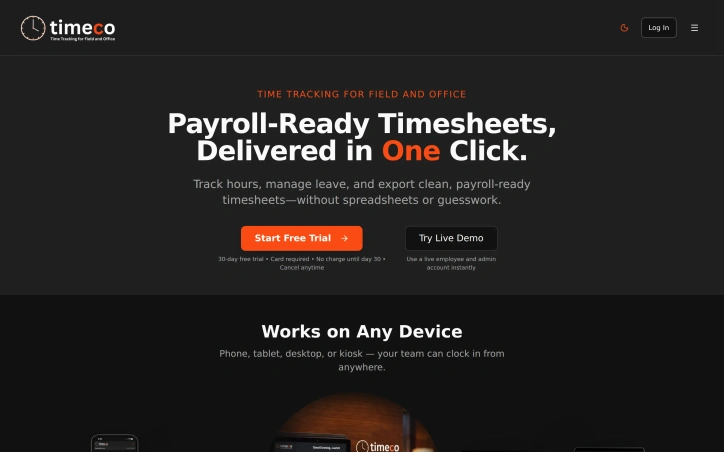
Distributed teams face a genuine operational challenge: accurately tracking hours across multiple locations while minimizing administrative overhead. Timeco targets this gap with time tracking software built explicitly for field and office workforces operating across dispersed locations. The core value proposition centers on operational simplicity. Teams can streamline clock-in and clock-out workflows through a single platform rather than juggling multiple systems or relying on manual entry. Real-time visibility into hours worked across locations directly impacts payroll accuracy and eliminates friction typical in distributed workforce management. What distinguishes Timeco is its targeted focus on field team operations. Many time tracking tools build from office-first assumptions; Timeco grounds itself in the specific constraints of teams operating across physical locations. This specialization—rather than attempting broad feature coverage—signals a product designed around genuine operational needs rather than generic capabilities. The platform emphasizes seamless integration into existing workflows. The founders position the shift from complexity to clarity: teams move from wrestling with fragmented systems to managing hours through a centralized, real-time environment. For businesses scaling distributed operations, this consolidation directly reduces administrative costs and creates a single authoritative source for payroll processing. Timeco positions itself at the intersection of operational simplicity and compliance accuracy. Time tracking isn't a glamorous problem, but it directly affects cash flow, payroll compliance, and labor law adherence. For companies with field operations—construction, logistics, home services, field sales—the promise of accurate, frictionless tracking carries clear business value and operational leverage. The product strategy reflects a purpose-built approach rather than a generic adaptation. Teams operating across multiple locations receive software designed for their specific workflows rather than office templates retrofitted for field use. This specialization can provide differentiation in a crowded market segment. The decisive factor for potential customers remains whether Timeco's feature depth and user experience justify adoption relative to established competitors. The positioning is clear and strategically sound, but the market will ultimately determine whether this specialized approach resonates with distributed workforce operators actively seeking change.
Time-tracking-apps
J
Justin David Howard

Distributed teams face a genuine operational challenge: accurately tracking hours across multiple locations while minimizing administrative overhead. Timeco targets this gap with time tracking software built explicitly for field and office workforces operating across dispersed locations. The core value proposition centers on operational simplicity. Teams can streamline clock-in and clock-out workflows through a single platform rather than juggling multiple systems or relying on manual entry. Real-time visibility into hours worked across locations directly impacts payroll accuracy and eliminates friction typical in distributed workforce management. What distinguishes Timeco is its targeted focus on field team operations. Many time tracking tools build from office-first assumptions; Timeco grounds itself in the specific constraints of teams operating across physical locations. This specialization—rather than attempting broad feature coverage—signals a product designed around genuine operational needs rather than generic capabilities. The platform emphasizes seamless integration into existing workflows. The founders position the shift from complexity to clarity: teams move from wrestling with fragmented systems to managing hours through a centralized, real-time environment. For businesses scaling distributed operations, this consolidation directly reduces administrative costs and creates a single authoritative source for payroll processing. Timeco positions itself at the intersection of operational simplicity and compliance accuracy. Time tracking isn't a glamorous problem, but it directly affects cash flow, payroll compliance, and labor law adherence. For companies with field operations—construction, logistics, home services, field sales—the promise of accurate, frictionless tracking carries clear business value and operational leverage. The product strategy reflects a purpose-built approach rather than a generic adaptation. Teams operating across multiple locations receive software designed for their specific workflows rather than office templates retrofitted for field use. This specialization can provide differentiation in a crowded market segment. The decisive factor for potential customers remains whether Timeco's feature depth and user experience justify adoption relative to established competitors. The positioning is clear and strategically sound, but the market will ultimately determine whether this specialized approach resonates with distributed workforce operators actively seeking change.

Timeco preview

Key features

  • Streamlined Clock-in/Clock-out: Single platform for managing clock-in and clock-out workflows across multiple locations
  • Real-time Hour Visibility: Provides real-time visibility into hours worked across dispersed locations
See full listing
F

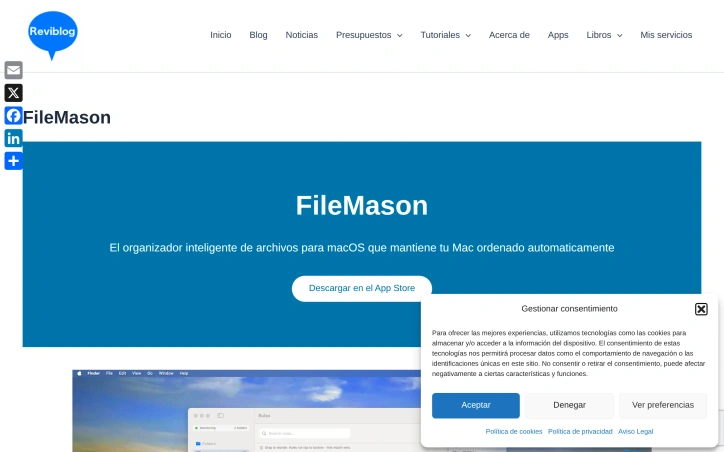
Keeping a Mac organized requires either constant manual effort or technical prowess. FileMason aims to solve this by automating file organization through a visual, code-free interface. The tool targets macOS users who accumulate files across their systems but lack the inclination or skill to script custom solutions. The product distinguishes itself through a visual rule builder that lets users define file organization logic without writing code. Users select conditions and actions from dropdown menus, then apply them automatically to their file system. Real-time monitoring means new files are sorted according to rules as soon as they appear, eliminating the need for manual intervention. What sets FileMason apart is its priority system. Rules can be reordered by dragging, and the first matching rule wins, giving users fine-grained control over how files get processed. This prevents conflicts and allows for layered organization logic. The application includes smart tracking that processes each file only once, avoiding the duplicate operations that plague less thoughtful automation tools. FileMason offers eleven pre-built templates for common scenarios like organizing screenshots, PDFs, photos, music, and documents. Users can build custom rules by choosing from fourteen condition types based on filename, extension, file type, size, creation date, modification date, and Finder tags, combined with nine action types covering move, copy, rename, tag, compress, and delete operations. The renaming functionality supports variables like {name}, {date}, {year}, {month}, and {counter}, enabling dynamic naming schemes. Beyond automation, the application includes full undo history, allowing users to reverse any operation with a single click. A menu bar widget provides quick access without opening the main window. Language support extends to six languages: English, Spanish, German, French, Japanese, and Chinese. The tool requires macOS 13.0 or later and is distributed through the Mac App Store. Specific pricing details aren't disclosed in available materials, though its App Store distribution positions it as a consumer-facing application. For Mac users frustrated with file clutter but uncomfortable with terminal-based automation, FileMason delivers a practical middle ground between manual organization and scripting.

File-storage-and-sharing-apps
E
Eduardo Revilla Vaquero

Keeping a Mac organized requires either constant manual effort or technical prowess. FileMason aims to solve this by automating file organization through a visual, code-free interface. The tool targets macOS users who accumulate files across their systems but lack the inclination or skill to script custom solutions. The product distinguishes itself through a visual rule builder that lets users define file organization logic without writing code. Users select conditions and actions from dropdown menus, then apply them automatically to their file system. Real-time monitoring means new files are sorted according to rules as soon as they appear, eliminating the need for manual intervention. What sets FileMason apart is its priority system. Rules can be reordered by dragging, and the first matching rule wins, giving users fine-grained control over how files get processed. This prevents conflicts and allows for layered organization logic. The application includes smart tracking that processes each file only once, avoiding the duplicate operations that plague less thoughtful automation tools. FileMason offers eleven pre-built templates for common scenarios like organizing screenshots, PDFs, photos, music, and documents. Users can build custom rules by choosing from fourteen condition types based on filename, extension, file type, size, creation date, modification date, and Finder tags, combined with nine action types covering move, copy, rename, tag, compress, and delete operations. The renaming functionality supports variables like {name}, {date}, {year}, {month}, and {counter}, enabling dynamic naming schemes. Beyond automation, the application includes full undo history, allowing users to reverse any operation with a single click. A menu bar widget provides quick access without opening the main window. Language support extends to six languages: English, Spanish, German, French, Japanese, and Chinese. The tool requires macOS 13.0 or later and is distributed through the Mac App Store. Specific pricing details aren't disclosed in available materials, though its App Store distribution positions it as a consumer-facing application. For Mac users frustrated with file clutter but uncomfortable with terminal-based automation, FileMason delivers a practical middle ground between manual organization and scripting.

FileMason preview
F

Key features

  • Visual Rule Builder: Define file organization logic without writing code using dropdown menus and selection
  • Priority System: Reorder rules by dragging to ensure the first matching rule applies, providing fine-grained control
See full listing
BabyKeeper

Finding reliable childcare quickly remains one of the most painful problems parents face. BabyKeeper's solution is radical in its simplicity: connect with a vetted babysitter in one click. The French-based platform targets the underserved market of parents seeking casual childcare without friction, positioning speed and trust as its primary differentiators. The tagline's emphasis on "confiance" (trust) signals that the founders understand a fundamental market truth: parents won't use a babysitter platform unless they believe the vetting is rigorous. This focus distinguishes the service from bulletin boards or classified sites where anyone can post. By building trust verification into the core product promise rather than burying it in terms of service, BabyKeeper stakes its reputation on the quality of its screening process. The one-click connection model appeals to time-poor families. Rather than sifting through profiles, communicating with multiple candidates, and managing complex logistics, parents can move from need to booked sitter in moments. This simplicity benefits babysitters too by putting them directly in front of customers without requiring them to build personal brands or manage their own marketing. The timing and geography of BabyKeeper's launch reflect a real market opportunity. Childcare hiring in Europe has been fragmented across word-of-mouth networks, nanny agencies, and informal classifieds. Digital platforms have revolutionized every consumer service sector—from transportation to dining—yet babysitter hiring stubbornly resists disruption. Mobile penetration across Europe, combined with rising childcare costs pushing parents toward flexible alternatives, creates ideal conditions for a well-executed platform. The French domain and language reflect positioning in France and broader European markets. This localization strategy matters: childcare regulations, employment law, and cultural expectations around vetting vary significantly across countries. Babysitting in Paris operates under different rules than in Berlin or London, giving a Europe-first platform potential advantages over US-centric competitors. The website provides minimal detail about pricing, team backgrounds, or verification methodology. Without knowing whether vetting involves background checks, reference verification, or community ratings, it's impossible to evaluate whether BabyKeeper delivers on its trust promise or merely claims it. In a market where safety is paramount, execution details matter as much as positioning.

Hiring-software
V
Vianney Bds

Finding reliable childcare quickly remains one of the most painful problems parents face. BabyKeeper's solution is radical in its simplicity: connect with a vetted babysitter in one click. The French-based platform targets the underserved market of parents seeking casual childcare without friction, positioning speed and trust as its primary differentiators. The tagline's emphasis on "confiance" (trust) signals that the founders understand a fundamental market truth: parents won't use a babysitter platform unless they believe the vetting is rigorous. This focus distinguishes the service from bulletin boards or classified sites where anyone can post. By building trust verification into the core product promise rather than burying it in terms of service, BabyKeeper stakes its reputation on the quality of its screening process. The one-click connection model appeals to time-poor families. Rather than sifting through profiles, communicating with multiple candidates, and managing complex logistics, parents can move from need to booked sitter in moments. This simplicity benefits babysitters too by putting them directly in front of customers without requiring them to build personal brands or manage their own marketing. The timing and geography of BabyKeeper's launch reflect a real market opportunity. Childcare hiring in Europe has been fragmented across word-of-mouth networks, nanny agencies, and informal classifieds. Digital platforms have revolutionized every consumer service sector—from transportation to dining—yet babysitter hiring stubbornly resists disruption. Mobile penetration across Europe, combined with rising childcare costs pushing parents toward flexible alternatives, creates ideal conditions for a well-executed platform. The French domain and language reflect positioning in France and broader European markets. This localization strategy matters: childcare regulations, employment law, and cultural expectations around vetting vary significantly across countries. Babysitting in Paris operates under different rules than in Berlin or London, giving a Europe-first platform potential advantages over US-centric competitors. The website provides minimal detail about pricing, team backgrounds, or verification methodology. Without knowing whether vetting involves background checks, reference verification, or community ratings, it's impossible to evaluate whether BabyKeeper delivers on its trust promise or merely claims it. In a market where safety is paramount, execution details matter as much as positioning.

BabyKeeper preview

Key features

  • One-Click Booking: Connect with a vetted babysitter in moments without sifting through profiles
  • Trust Verification: Rigorous vetting process built into the core product promise
See full listing
IndieRoadmaps

Building in public has become a defining trend among indie makers, but most lack an organized way to involve their community in product decisions. IndieRoadmaps addresses this gap by providing a dedicated platform where solo founders and small teams can publish their product roadmaps, collect feature requests through voting, and gather feedback from a community of people genuinely invested in their success. The platform targets indie hackers explicitly, recognizing that this audience operates differently from venture-backed startups. They're building for themselves first, iterating quickly, and often making decisions based on direct community input rather than internal product roadmaps. By centralizing roadmaps in one place, IndieRoadmaps creates a discoverable ecosystem where makers can showcase their direction and potential users can find products aligned with their needs. What distinguishes IndieRoadmaps is its focus on the indie maker community as both its audience and its value proposition. The site showcases successful indie products across multiple categories—everything from AI tools and productivity software to developer tools and design apps. This curatorial approach positions IndieRoadmaps not just as a feature-tracking tool but as a community hub. The voting mechanism lets users express genuine demand for features, providing founders with real-time market validation before investing engineering resources. The platform itself practices what it preaches. IndieRoadmaps runs its own public roadmap on the site, allowing users to see upcoming features like multiple roadmaps per user, public roadmap pages, and Google OAuth integration. This transparency about their own development reinforces the building-in-public philosophy they're promoting. The feature set remains straightforward and focused. Users can create roadmaps, collect votes on planned features, enable community comments, and sign in via Google. There's no mention of advanced collaboration features, custom branding, or enterprise pricing tiers—suggesting the product is designed for individual makers rather than larger organizations. This clarity of purpose is a strength, not a limitation. For indie makers seeking validation and community engagement before launch, IndieRoadmaps provides a purpose-built solution embedded within a supportive ecosystem of peers. It's a platform that understands its audience's workflows and philosophy, built by people navigating the same challenges.

Project-management-software
C
Chris X

Building in public has become a defining trend among indie makers, but most lack an organized way to involve their community in product decisions. IndieRoadmaps addresses this gap by providing a dedicated platform where solo founders and small teams can publish their product roadmaps, collect feature requests through voting, and gather feedback from a community of people genuinely invested in their success. The platform targets indie hackers explicitly, recognizing that this audience operates differently from venture-backed startups. They're building for themselves first, iterating quickly, and often making decisions based on direct community input rather than internal product roadmaps. By centralizing roadmaps in one place, IndieRoadmaps creates a discoverable ecosystem where makers can showcase their direction and potential users can find products aligned with their needs. What distinguishes IndieRoadmaps is its focus on the indie maker community as both its audience and its value proposition. The site showcases successful indie products across multiple categories—everything from AI tools and productivity software to developer tools and design apps. This curatorial approach positions IndieRoadmaps not just as a feature-tracking tool but as a community hub. The voting mechanism lets users express genuine demand for features, providing founders with real-time market validation before investing engineering resources. The platform itself practices what it preaches. IndieRoadmaps runs its own public roadmap on the site, allowing users to see upcoming features like multiple roadmaps per user, public roadmap pages, and Google OAuth integration. This transparency about their own development reinforces the building-in-public philosophy they're promoting. The feature set remains straightforward and focused. Users can create roadmaps, collect votes on planned features, enable community comments, and sign in via Google. There's no mention of advanced collaboration features, custom branding, or enterprise pricing tiers—suggesting the product is designed for individual makers rather than larger organizations. This clarity of purpose is a strength, not a limitation. For indie makers seeking validation and community engagement before launch, IndieRoadmaps provides a purpose-built solution embedded within a supportive ecosystem of peers. It's a platform that understands its audience's workflows and philosophy, built by people navigating the same challenges.

IndieRoadmaps preview

Key features

  • Public Roadmaps: Founders can publish product roadmaps to share their development direction with the community.
  • Feature Voting: Users vote on planned features to signal demand and provide real-time market validation.
See full listing
Product Conference Matchmaker

Choosing the right conference to attend consumes valuable time and mental energy for product professionals already stretched thin. This conference discovery tool addresses that friction by automating the shortlisting process, eliminating the need to manually research dozens of events across different regions and formats. The platform targets product managers, UX designers, and engineering leaders seeking to invest their conference budgets strategically without wasting time on events that don't align with their priorities. The product's core innovation is its rapid evaluation mechanism. Rather than forcing users to browse hundreds of conferences or rely on word-of-mouth recommendations, the tool delivers a curated shortlist within three minutes based on stated goals and budget constraints. This speed removes a significant barrier to decision-making that typically plagues conference discovery. The transparent scoring system differentiates it from black-box recommendation engines, showing users exactly why specific conferences were selected and allowing them to trust the logic behind the recommendations. Distribution mechanics reflect a sophisticated understanding of how professionals actually share information. By offering shareable shortlists that don't require recipients to log into a dashboard, the platform removes friction from the recommendations. A colleague can send you a list of recommended conferences without creating extra onboarding work, making the tool more likely to spread through professional networks organically. The fact that 2,816 professionals have used the matchmaker suggests the approach resonates with its target audience. The platform also acknowledges the browsing use case for less certain users. A regional browse view organizes the full conference lineup geographically, with upcoming events prioritized, enabling casual exploration for those who haven't committed to the matchmaking tool. This dual-path approach accommodates both goal-driven professionals and those still forming their conference strategy. Complete transparency about which events are included in the tool reinforces credibility, addressing a legitimate concern that any filtering algorithm might be opaque or biased toward certain sponsors. The product succeeds by solving a legitimate pain point with focused simplicity. Rather than attempting to be a comprehensive conference platform, it specializes in the discovery phase, which is where most friction exists. The emphasis on speed, transparency, and frictionless sharing positions it as a utilitarian tool optimized for how professionals actually make conference decisions, making it a practical addition to the conference-planning workflow for tech-focused organizations looking to maximize their learning investment.


Meeting-software
A
AJ

Choosing the right conference to attend consumes valuable time and mental energy for product professionals already stretched thin. This conference discovery tool addresses that friction by automating the shortlisting process, eliminating the need to manually research dozens of events across different regions and formats. The platform targets product managers, UX designers, and engineering leaders seeking to invest their conference budgets strategically without wasting time on events that don't align with their priorities. The product's core innovation is its rapid evaluation mechanism. Rather than forcing users to browse hundreds of conferences or rely on word-of-mouth recommendations, the tool delivers a curated shortlist within three minutes based on stated goals and budget constraints. This speed removes a significant barrier to decision-making that typically plagues conference discovery. The transparent scoring system differentiates it from black-box recommendation engines, showing users exactly why specific conferences were selected and allowing them to trust the logic behind the recommendations. Distribution mechanics reflect a sophisticated understanding of how professionals actually share information. By offering shareable shortlists that don't require recipients to log into a dashboard, the platform removes friction from the recommendations. A colleague can send you a list of recommended conferences without creating extra onboarding work, making the tool more likely to spread through professional networks organically. The fact that 2,816 professionals have used the matchmaker suggests the approach resonates with its target audience. The platform also acknowledges the browsing use case for less certain users. A regional browse view organizes the full conference lineup geographically, with upcoming events prioritized, enabling casual exploration for those who haven't committed to the matchmaking tool. This dual-path approach accommodates both goal-driven professionals and those still forming their conference strategy. Complete transparency about which events are included in the tool reinforces credibility, addressing a legitimate concern that any filtering algorithm might be opaque or biased toward certain sponsors. The product succeeds by solving a legitimate pain point with focused simplicity. Rather than attempting to be a comprehensive conference platform, it specializes in the discovery phase, which is where most friction exists. The emphasis on speed, transparency, and frictionless sharing positions it as a utilitarian tool optimized for how professionals actually make conference decisions, making it a practical addition to the conference-planning workflow for tech-focused organizations looking to maximize their learning investment.

Product Conference Matchmaker preview

Key features

  • Rapid Evaluation: Delivers curated conference shortlist within three minutes based on stated goals and budget constraints.
  • Transparent Scoring: Shows users exactly why specific conferences were selected, differentiating from black-box recommendation engines.
See full listing
JumpNotes — The missing notebook for Youtube

Learning from YouTube videos presents a common challenge: how to capture meaningful notes and timestamps without relying on external services that harvest your data. JumpNotes addresses this directly with a Chrome extension that keeps all note-taking activity local to the browser, eliminating cloud dependencies and privacy concerns entirely. The product targets students, educators, and anyone seeking to extract knowledge from video content while maintaining full control over their information. The extension distinguishes itself through its uncompromising privacy stance. Rather than syncing data across servers, JumpNotes stores everything in the browser's local storage, with no tracking infrastructure or third-party access. This design choice reflects a broader commitment to user autonomy that informs the entire product architecture. The feature set reflects careful attention to the learning workflow. Chapter Autopilot automatically detects native YouTube chapters and imports them into a jump-list, providing instant structural context for any video. The timestamp system allows single-click note capture tied to exact video moments, with instant navigation back to those points. A Smart Archive feature groups all notes by video, making it easy to browse past learning sessions. Comment Detection extracts useful timestamps from YouTube's comment section and incorporates them into personal notes, leveraging community insights without manual curation. For those who work across multiple tools or prefer different formats, the extension offers text export in both plain text and Markdown formats. The interface prioritizes keyboard efficiency, allowing users to pause, note, and continue without touching a mouse. This optimization pays dividends for power users and those seeking to maintain focus during learning sessions. JumpNotes succeeds because it solves a specific problem with minimal friction and no privacy tradeoffs. For learners unwilling to compromise data security for functionality, it represents a rare product that delivers both without compromise. The extension avoids the bloat and surveillance mechanisms common in competing solutions, instead betting that students and educators value control over convenience.


Note-and-writing-apps
.
.fahrvergnuegen

Learning from YouTube videos presents a common challenge: how to capture meaningful notes and timestamps without relying on external services that harvest your data. JumpNotes addresses this directly with a Chrome extension that keeps all note-taking activity local to the browser, eliminating cloud dependencies and privacy concerns entirely. The product targets students, educators, and anyone seeking to extract knowledge from video content while maintaining full control over their information. The extension distinguishes itself through its uncompromising privacy stance. Rather than syncing data across servers, JumpNotes stores everything in the browser's local storage, with no tracking infrastructure or third-party access. This design choice reflects a broader commitment to user autonomy that informs the entire product architecture. The feature set reflects careful attention to the learning workflow. Chapter Autopilot automatically detects native YouTube chapters and imports them into a jump-list, providing instant structural context for any video. The timestamp system allows single-click note capture tied to exact video moments, with instant navigation back to those points. A Smart Archive feature groups all notes by video, making it easy to browse past learning sessions. Comment Detection extracts useful timestamps from YouTube's comment section and incorporates them into personal notes, leveraging community insights without manual curation. For those who work across multiple tools or prefer different formats, the extension offers text export in both plain text and Markdown formats. The interface prioritizes keyboard efficiency, allowing users to pause, note, and continue without touching a mouse. This optimization pays dividends for power users and those seeking to maintain focus during learning sessions. JumpNotes succeeds because it solves a specific problem with minimal friction and no privacy tradeoffs. For learners unwilling to compromise data security for functionality, it represents a rare product that delivers both without compromise. The extension avoids the bloat and surveillance mechanisms common in competing solutions, instead betting that students and educators value control over convenience.

JumpNotes — The missing notebook for Youtube preview

Key features

  • Local Storage Privacy: stores all note-taking activity locally in the browser with no tracking or third-party access
  • Chapter Autopilot: automatically detects native YouTube chapters and imports them into a jump-list for structural context
See full listing
Click to Save the World

In a rapidly changing world where environmental concerns are increasingly pressing, Click to Save the World emerges as a novel solution for everyday individuals seeking to make a tangible impact. By harnessing the power of click-based fundraising, this platform empowers users to contribute to various eco-friendly initiatives and charitable causes with minimal effort. What stands out about Click to Save the World is its straightforward, user-friendly approach. The website's design is intuitive, guiding users through a simple process that encourages engagement and sustained participation. This ease of use is a significant strength, as it helps overcome common barriers to online activism, such as feeling overwhelmed or uncertain about where to start. Key features worth noting include the platform's curated selection of reputable organizations focused on environmental conservation and social welfare. Click to Save the World's partnerships with established charities and advocacy groups ensure that users' contributions are invested in meaningful initiatives. Additionally, the platform's gamification elements – including rewards and leaderboards – provide a sense of accomplishment and community engagement. The pricing model for Click to Save the World is straightforward: there are no upfront costs or subscription fees required. Users can contribute as much or as little as they wish, making it accessible to everyone, regardless of financial means. This inclusive approach reflects the platform's commitment to democratizing the power to create positive change.


Presentation-software
N
Nick G

In a rapidly changing world where environmental concerns are increasingly pressing, Click to Save the World emerges as a novel solution for everyday individuals seeking to make a tangible impact. By harnessing the power of click-based fundraising, this platform empowers users to contribute to various eco-friendly initiatives and charitable causes with minimal effort. What stands out about Click to Save the World is its straightforward, user-friendly approach. The website's design is intuitive, guiding users through a simple process that encourages engagement and sustained participation. This ease of use is a significant strength, as it helps overcome common barriers to online activism, such as feeling overwhelmed or uncertain about where to start. Key features worth noting include the platform's curated selection of reputable organizations focused on environmental conservation and social welfare. Click to Save the World's partnerships with established charities and advocacy groups ensure that users' contributions are invested in meaningful initiatives. Additionally, the platform's gamification elements – including rewards and leaderboards – provide a sense of accomplishment and community engagement. The pricing model for Click to Save the World is straightforward: there are no upfront costs or subscription fees required. Users can contribute as much or as little as they wish, making it accessible to everyone, regardless of financial means. This inclusive approach reflects the platform's commitment to democratizing the power to create positive change.

Click to Save the World preview

Key features

  • Click-Based Fundraising: Users contribute to eco-friendly initiatives and charitable causes with minimal effort through simple clicks
  • Curated Charity Partnerships: The platform partners with reputable organizations focused on environmental conservation and social welfare
See full listing
Snippetly

Developer productivity often suffers when scattered code snippets hide across old projects, browser bookmarks, and local files. Snippetly addresses this friction directly by providing a centralized vault for managing code fragments, designed for individual developers and teams who want to spend less time digging through archives and more time actually coding. The product targets aspiring developers and SaaS builders seeking a lightweight code management solution. Rather than inventing entirely new features, Snippetly executes on the fundamentals with particular attention to speed and usability. The interface emphasizes quick capture and retrieval—saving snippets with syntax highlighting across 50+ languages takes minimal effort, and searching across titles, tags, and code content returns results instantly. Users can organize their collection through tags, favorites, folders, and language filters, building a structure that adapts to their workflow rather than imposing rigid taxonomy. What distinguishes Snippetly is its GitHub integration, which enables two-way synchronization between the platform and repositories. Developers can push snippets to GitHub or import existing code directly, with the system automatically organizing content by language and preserving folder hierarchy. This bridges the gap between ad-hoc snippet storage and version-controlled backup, addressing a real pain point for developers who want both convenience and preservation. The feature set includes team collaboration capabilities (currently listed as coming soon), boilerplate templates, version control with change tracking, and encryption for stored credentials. The combination of individual productivity tools with team-ready infrastructure signals positioning for growth beyond solo developers into small teams. Pricing follows a straightforward freemium model. The free tier caps users at 50 snippets across 5 folders, supporting basic use cases without requiring payment. The $29 one-time Pro tier removes all limits and unlocks advanced features, making it accessible for price-conscious developers. Notably, this is a one-time purchase rather than recurring subscription—an unusual choice in SaaS that removes friction but limits recurring revenue. Snippetly is early in its lifecycle, with a user base of 40+ developers. The emphasis on core functionality over unnecessary complexity, combined with strong integration capabilities and transparent pricing, positions it as a straightforward alternative to scattered file management and paid notes platforms. Traction will depend on execution of promised team features and how well the GitHub integration resonates with developers already embedded in that ecosystem.

Project-management-software

Developer productivity often suffers when scattered code snippets hide across old projects, browser bookmarks, and local files. Snippetly addresses this friction directly by providing a centralized vault for managing code fragments, designed for individual developers and teams who want to spend less time digging through archives and more time actually coding. The product targets aspiring developers and SaaS builders seeking a lightweight code management solution. Rather than inventing entirely new features, Snippetly executes on the fundamentals with particular attention to speed and usability. The interface emphasizes quick capture and retrieval—saving snippets with syntax highlighting across 50+ languages takes minimal effort, and searching across titles, tags, and code content returns results instantly. Users can organize their collection through tags, favorites, folders, and language filters, building a structure that adapts to their workflow rather than imposing rigid taxonomy. What distinguishes Snippetly is its GitHub integration, which enables two-way synchronization between the platform and repositories. Developers can push snippets to GitHub or import existing code directly, with the system automatically organizing content by language and preserving folder hierarchy. This bridges the gap between ad-hoc snippet storage and version-controlled backup, addressing a real pain point for developers who want both convenience and preservation. The feature set includes team collaboration capabilities (currently listed as coming soon), boilerplate templates, version control with change tracking, and encryption for stored credentials. The combination of individual productivity tools with team-ready infrastructure signals positioning for growth beyond solo developers into small teams. Pricing follows a straightforward freemium model. The free tier caps users at 50 snippets across 5 folders, supporting basic use cases without requiring payment. The $29 one-time Pro tier removes all limits and unlocks advanced features, making it accessible for price-conscious developers. Notably, this is a one-time purchase rather than recurring subscription—an unusual choice in SaaS that removes friction but limits recurring revenue. Snippetly is early in its lifecycle, with a user base of 40+ developers. The emphasis on core functionality over unnecessary complexity, combined with strong integration capabilities and transparent pricing, positions it as a straightforward alternative to scattered file management and paid notes platforms. Traction will depend on execution of promised team features and how well the GitHub integration resonates with developers already embedded in that ecosystem.

Snippetly preview

Key features

  • Centralized Code Vault: Provides a centralized repository for managing code fragments with quick capture and retrieval.
  • GitHub Integration: Enables two-way synchronization between the platform and repositories for automatic organization and backup.
See full listing