Catalyst Healthspan Audit
Personal trainers typically sell training sessions. This startup reversed the equation by building assessment first, mak...

Xtra Hands Family Chore App
Household chore management remains one of parenting's persistent friction points, and Xtra Hands positions itself as the...
Recently Listed
1,034 launches
Repetitive business processes drain team productivity and divert focus from strategic work. Innovexa AI addresses this friction point by enabling organizations to build and deploy intelligent agents that automate routine workflows without requiring deep technical expertise. The platform targets teams across marketing, sales, customer support, and operations who want to leverage AI automation but lack the resources to hire specialized AI engineers. Rather than requiring users to understand machine learning fundamentals or write complex code, Innovexa AI abstracts those complexities behind a configuration-driven interface. This democratization of AI agent creation is the core value proposition—making automation accessible to business teams, not just technical ones. Several capabilities distinguish the offering. The platform supports customizable agents designed for specific industries, whether finance, healthcare, or IT, suggesting a modular approach to multi-tenant deployment. Agents can integrate with existing business tools and CRM systems, indicating a focus on fitting into established workflows rather than forcing organizations to rebuild their stacks. The marketing and sales use cases highlight concrete applications: lead qualification, CRM follow-ups, and customer support triage, which are legitimate pain points where automation delivers measurable time savings. The platform emphasizes agent quality and performance, claiming that its automation can match human-level execution on critical tasks. While this is a common benchmark claim in the AI space, the emphasis suggests the product aims for reliability beyond simple task routing—handling nuanced interactions in customer support or lead qualification rather than just parsing simple data. Scalability is positioned as built-in, meaning organizations shouldn't need to rearchitect as they expand agent usage. Innovexa also highlights an active developer community, which can be valuable for troubleshooting and sharing patterns, though this is often a proxy for product maturity. The website text indicates the product handles use cases like generating leads, managing administrative overhead, and freeing up team time for higher-value work. The positioning is straightforward: automate the tedious parts so teams focus on strategy and creativity. One significant gap in the available information is pricing and deployment model. There is no mention of costs, licensing structure, or whether the platform runs on-premise, cloud-hosted, or as a hybrid. For procurement teams evaluating the product, this absence is a notable omission. Overall, Innovexa AI targets a real problem—the usability barrier between AI's promise and business adoption—with a market-focused solution. Whether it delivers on these claims would require testing, but the positioning reflects genuine customer friction points in workflow automation.


Transparency into corporate cryptocurrency holdings has been fragmented and delayed—a market gap that CorpStacking fills by automating the tracking of Bitcoin, Ethereum, and Solana movements across public companies, governments, and ETFs. The platform targets investors, analysts, and traders who need to act on institutional treasury changes faster than traditional news cycles allow. The product's core differentiation centers on sourcing and verification rigor. Rather than aggregating secondhand data, CorpStacking traces each transaction to its origin—SEC filings, press releases, or on-chain records—and runs a daily cross-source audit that flags discrepancies before publishing. This approach appeals to analysts and writers who need quotable numbers backed by primary sources, not speculation or inference. Real-time delivery is a second strength. The platform promises alerts within minutes of SEC disclosure, with multiple channels available: email, push notifications, Telegram for free, and Slack or Discord integration for paid subscribers. Users can set size thresholds per company to filter noise, a practical feature for anyone tracking dozens of entities simultaneously. The feature set extends beyond alerts. The platform includes a live terminal showing prices for twelve tokens alongside refreshing corporate holdings, a Treasury Signals feed aggregating SEC purchases and sales alongside wire service announcements in paid tiers, and an AI analyst that answers queries in plain English while citing its data sources. For personal use, the "My Stack" feature lets users track their own holdings alongside the corporate leaderboard, log purchases with cost basis, import from major exchanges, and export tax reports. The platform tracks 239 entities holding over 2.9 million Bitcoin, 13 million Ethereum, and 36 million Solana collectively, with 8,595 transactions logged to date. A 5 percent cross-source tolerance guards against flagging minor discrepancies as errors. Pricing follows a free-to-paid model with no credit card required to start. The free tier includes email, push, and Telegram alerts. Pro adds Slack, Discord, and webhook support. Pro+ unlocks wire news access and an AI analyst with 1,500 monthly queries, alongside extended treasury tracking across all three blockchains. For institutional investors or independent analysts monitoring corporate crypto accumulation closely, the combination of speed, verifiability, and source attribution makes this a functional addition to research workflows rather than a novelty tracker.


Many website owners focus on Google rankings without considering how AI systems understand their brand. A growing group of startups and established businesses now face an unfamiliar problem: they rank well in traditional search but remain invisible to ChatGPT, Gemini, Copilot, and Perplexity. These AI-powered search engines rely on different signals than Google, and most businesses have no insight into where their visibility breaks down. This audit service directly addresses that blind spot. Rather than guessing why AI systems overlook a business, founders and business owners can run a comprehensive assessment that measures how AI systems interpret their website. The assessment covers six key dimensions: technical readiness (crawlability, indexing, structured data, metadata), entity clarity (who you are and what you offer), citation signals, content architecture, authority and trust signals, and competitor positioning relative to AI recommendations. The audit produces a measurable AI Visibility Score paired with specific findings rather than vague observations. This appeals to founders who want concrete data instead of assumptions. The underlying framework emphasizes clarity (defining what the business is), answer-driven content (pages structured around buyer questions), authority (building citations and trusted mentions), and technical fundamentals (schema, hierarchy, internal links). The target audience is clear: D2C and ecommerce brands, service consultants, agencies, and small businesses building visibility beyond Google. These segments typically invest in search optimization but lack strategies for AI discovery. The service fills a genuine gap in how businesses think about discoverability, moving beyond a single search engine to a landscape where multiple AI systems drive traffic. What makes this particularly relevant is timing. As AI-powered search gains adoption, early-moving businesses can optimize for these systems before competition intensifies. The audit enables that, providing both a snapshot of current AI visibility and a roadmap for improvement. The founder's positioning reflects a clear conviction: AI visibility should be measurable, not mysterious. In a market where most business owners still treat AI visibility as an afterthought, this service offers a practical entry point for businesses ready to get ahead of the shift.

Direct-to-consumer wellness commerce has become increasingly competitive, but most players default to generic supplement positioning. Nahfa Store stands apart by focusing on a narrower, more curated product line centered on Talbina—a barley-based porridge mix—paired with honey and targeted nutritional supplements under the HTWO Healthcare brand. The store serves health-conscious consumers in India seeking authenticated natural nutrition with transparent sourcing claims. Rather than chasing SKU expansion across every conceivable supplement category, the company has built depth within a specific product family, offering Talbina formulated for different life stages and health needs: versions for women, babies, seniors, and general wellness, each positioned as addressing distinct nutritional requirements. This segmentation reflects actual customer demand differentiation rather than arbitrary product proliferation. The catalog emphasizes combo offerings that bundle honey with Talbina variants at discounted price points—a practical value proposition that reduces decision friction for customers new to the category while encouraging larger basket sizes. Pricing anchors around Rs. 270 per unit with combo packages discounted from Rs. 650 to Rs. 585, positioning the products as accessible premium rather than luxury wellness. From a business model standpoint, the company employs a clear incentive structure: free shipping on orders exceeding Rs. 999, which works mathematically for their price point and encourages customers to cross the threshold through complementary product selection. This pricing architecture simultaneously improves unit economics and basket size without requiring artificial promotions. The site demonstrates competent execution in e-commerce fundamentals—clean product hierarchy, social media presence, straightforward navigation. However, the messaging reflects patterns familiar across most wellness retailers, with differentiation claims centered on authenticity and natural positioning rather than distinctive brand narrative or innovation in product development. The store's competitive advantage rests in product curation and fulfillment reliability rather than marketing distinctiveness. For customers in India specifically seeking certified Talbina and honey products with reliable delivery, Nahfa Store removes friction from the purchase journey. The narrower focus versus sprawling supplement shops creates clarity about what the brand represents, though broader market expansion would require either deeper product development or meaningful category expansion beyond the current HTWO Healthcare portfolio.


Social media management at scale has historically required juggling multiple platforms and tools. Groniz addresses this fragmentation by centralizing posting and scheduling across 32+ networks—from X and Instagram to niche platforms like Bluesky, Mastodon, and Farcaster—accessible directly from Claude Code or any MCP client. The core insight driving Groniz is that creators and agencies increasingly rely on AI agents to handle repetitive tasks. Rather than building yet another dashboard, the platform inverts the traditional model: AI agents post natively through MCP and CLI integrations, treating social distribution as a programmable task rather than a human-centric workflow. For solo creators, this means telling Claude Code to cross-post a thread in one command. For agencies managing multiple client accounts, the Codex scripting capability enables batch scheduling across an entire client roster. What distinguishes Groniz is its dual-mode architecture. The same core powers both agent-driven automation and a traditional web console—not as an afterthought, but as a full-featured social suite. The console includes drag-and-drop visual scheduling, AI-assisted caption generation tuned per platform, automatic image and video sizing for each network, and comprehensive analytics. This flexibility matters: creators who prefer clicking can adopt the same connectors their AI teammates use, creating a unified ecosystem rather than forcing teams to pick between automation and human control. The product's AI layer goes beyond scheduling. Captions are formatted platform-specifically (threads for X, carousels for Instagram), and the system handles authentication and network-specific formatting transparently. The analytics consolidate reach, engagement, and growth across networks into shareable reports. For teams, Groniz layers in workspace management, role-based permissions, approval workflows for content review, and "auto actions" that trigger engagement boosts when posts hit engagement milestones. The shared content calendar keeps collaborators synchronized. The platform supports an unusually broad network roster. Beyond the obvious players, Groniz connects to Discord, Telegram, Slack, Reddit, Pinterest, Twitch, dev.to, Nostr, and others—a depth that addresses genuine pain points for communities operating across fragmented spaces. Pricing details remain sparse in available materials, though the platform advertises no credit card required and month-to-month cancellation, suggesting a freemium or paid trial approach. The multiworkspace framing hints at tiered plans scaled to individual creators, agencies, and team use cases.


For anyone tired of juggling multiple services to handle everyday file work, a free, no-account toolkit offers a surprisingly complete alternative. Launched in 2022, ChangeMyFile consolidates PDF editing, image manipulation, video trimming, and audio extraction into one interface—eliminating the friction of installing software or managing login credentials. The platform's core appeal centers on simplicity and privacy. Many operations run directly in the browser, keeping files on your device rather than uploading to servers. When server-side processing is necessary—particularly for video conversion—the work runs through FFmpeg in isolated containers, limiting exposure. Files automatically delete within 24 hours, and download links expire after an hour. This architecture reflects a deliberate privacy stance that distinguishes it from competitors baked into subscription models. The toolset spans 16 PDF capabilities (editing, merging, splitting, compression, format conversion, password protection, signing, and redaction), 8 image tools (AI-powered background removal and restoration, resizing, cropping), 7 video functions (cutting, compression, audio extraction, merging), and 5 audio tools (cutting, merging, compression, transcription, and voice recording). A separate converter module handles transformations across more than 700 format pairs. Coverage is broad enough for routine tasks without requiring power-user knowledge. The approach to monetization is refreshingly direct: ads fund operations, no account is required, and no watermarks are added to processed files. This model inverts the typical SaaS pattern where users grant personal data in exchange for free tools. Here, the trade is exposure to advertising in exchange for functionality. Since its launch, the service has processed over one million files, suggesting the model resonates with users seeking straightforward, temporary file processing without account overhead. The integration of AI tools like image upscaling indicates responsiveness to emerging capabilities. Gaps exist. The reliance on advertising creates a user experience tension—fast, simple workflows interrupted by ad placements. Offline functionality is absent; internet access is required for all server-side work. The 24-hour deletion policy, while privacy-protective, offers no recourse for users who miscalculate download timing. For routine, casual file work with privacy as a priority, though, the tradeoffs register as reasonable.


Hosting that prioritizes both performance and accessibility defines this platform's core value proposition. VavaHost targets creators, developers, and small business owners who need reliable web infrastructure without navigating complex technical setups or absorbing enterprise-level costs. The service addresses a genuine gap: offering competent hosting to those who want to launch WordPress sites, e-commerce storefronts, or custom applications without getting bogged down in infrastructure management. The offering centers on three technical anchors: LiteSpeed Enterprise as the web server, NVMe SSD storage for speed, and Imunify360 for security. These aren't trendy choices—they're mature, proven technologies that directly affect user experience. Combined with free SSL certificates and cPanel access, the platform provides the tools developers expect without requiring separate subscriptions or additional fees. The ability to run Node.js, Python, and Discord bots alongside WordPress suggests a platform designed for modern, diverse workloads rather than pure WordPress hosting. Support for PHP versions 7.4 through 8.5 gives users reasonable flexibility without excessive version sprawl. What distinguishes VavaHost commercially is the risk-free trial structure. A three-day free trial requiring no credit card removes the primary friction point for prospective users deciding whether to migrate or launch their projects. This is paired with a 30-day money-back guarantee and no setup fees—a combination that signals confidence in the product and reduces customer acquisition friction. The pricing strategy remains straightforward. The published Bronze plan starts at $0.99 monthly, paired with core features like one-click WordPress deployment, weekly backups, and full cPanel access. While specific allocations for CPU, RAM, and bandwidth vary by tier, the disclosed resource limits in the trial interface suggest transparent pricing rather than surprise overages. The 24/7 VIP support claim carries weight in a market where budget hosting often means minimal support. The company frames itself as engineering-forward—emphasizing LiteSpeed performance, enterprise-grade security tools, and developer-focused features—while maintaining price positioning that appeals to cost-conscious builders. Whether this balance holds during scaling or feature expansion remains a longer-term question, but the current offering competently addresses the intersection of performance, security, and price for its stated audience.


Video editing services for creators have traditionally focused on technical polish and aesthetics, but Clipfox takes a different approach: optimizing for viewer retention and conversion. The platform targets content creators and brands across YouTube, Instagram Reels, and LinkedIn who want to scale their audiences into actual paying customers, addressing a fundamental gap between getting views and driving real business results. What distinguishes Clipfox is its emphasis on retention psychology over raw cutting technique. Rather than treating video editing as a technical craft divorced from marketing outcomes, the service designs edits specifically to keep viewers watching and push them toward conversion. This philosophy reflects recognition that creators often struggle not with production quality but with translating attention into revenue. The client roster demonstrates broad reach. The platform lists featured creators with audiences ranging from 10,000 to 556,000 followers across YouTube and LinkedIn, including content creators, founders, and professionals in education and technology. Client testimonials consistently highlight speed, responsiveness, and reliability. One creator noted that consulting from the team alone justified their investment. Another client tied $300,000 in monthly revenue partly to videos produced through the service, pointing to measurable business impact. The company maintains a 4.8 out of 5 star rating across 264 reviews, with clients praising fast turnaround times, clear understanding of briefs, and consistent quality. The testimonials come primarily from founders and creators rather than agencies or enterprises, indicating the core market is individual builders trying to grow their influence and business. One prominent case involves sales velocity: a CEO reported 580-plus calendar meetings generated over six months using Clipfox-produced videos. This points to the service targeting high-value creators focused on B2B or high-ticket sales. Pricing information is not publicly available on the website, requiring a direct inquiry through their discovery call booking. The business model is managed service-based editing rather than a self-serve platform or software tool. This positions Clipfox as a specialist service for creators who prioritize professional attention over DIY tools. The fundamental pitch to prospects is straightforward: specialized editing drives measurable business results. Whether those results transfer to new clients depends on alignment with Clipfox's track record and the creator's existing audience quality and engagement dynamics.


Unexpected baggage fees at the airport are one of travel's most frustrating surprises, with carriers charging $50 to $100 or more for oversized luggage. Luggage Validator addresses this problem head-on by letting travelers verify whether their bags comply with specific airlines' limits before they pack or head to the airport. The product is built for anyone flying with multiple carriers or connecting between airlines, where baggage rules can differ significantly. Its core offering is straightforward: input your luggage dimensions and weight, select your airlines and cabin classes, and get an instant yes-or-no answer on compliance across each leg of your journey. What distinguishes Luggage Validator is its commitment to accuracy. The founder, who built the tool after personally experiencing gate fees, has verified baggage rules across 185 airlines against their official websites and commits to weekly updates to catch policy changes. The data isn't just aspirational—it's grounded in real airport experiences, with over 510 travelers contributing actual incidents they've encountered. This human-sourced feedback layer adds credibility that purely algorithmic rule databases often lack. Beyond the calculator itself, the platform includes an airline baggage strictness scoring system that rates carriers on a 1-to-10 scale based on allowance size, weight limits, gate enforcement practices, and fees. Guides comparing baggage policies across airlines and explainers on emerging regulations—such as the 2027 EU free cabin bag mandate—give travelers context around the numbers. The tool is free and requires no account creation, removing friction for casual users checking a single trip. The interface lets users input multiple trip segments with different airlines and cabin classes, auto-saving data between sessions. A compliance checker delivers the verdict users actually need: will my specific bags work? The founder's approach reflects a refreshingly direct philosophy: publish the airline's official website as the source of truth on each page and invite corrections from users when rules drift. This transparency about data provenance and willingness to crowdsource updates suggests a product built in response to real traveler frustration rather than abstract market positioning. For anyone who has fought with an airline over baggage dimensions, the value proposition is immediate.


AI-powered motion control technology removes friction from video creation by letting non-technical users transform still photos into dance videos. The platform targets creators working within the constraints of short-form social feeds, from TikTok enthusiasts to cosplayers looking for quick, shareable content. RenderPop's approach is direct: a static image becomes a moving subject by applying a dance template or custom motion reference. Users select from trending dances or upload their own reference footage, add a clear photo, and generate a video in roughly two minutes. The process skips both timeline editing and prompt engineering, replacing manual work with template selection. The service operates in a browser and charges credits based on video duration. What distinguishes the product is its philosophy around reducing barriers to entry. The founder emphasizes building without requiring signup friction—the tool lets users explore freely before committing. This positioning reflects a deliberate approach to democratizing AI creation tools rather than gatekeeping access behind registration walls. The platform addresses multiple creator personas: social media viewers recreating trending dances with personal photos, professional content creators making reels and shorts, dancers workshopping choreography, fanfiction creators animating character images, and avatar designers adding motion without full 3D rigging expertise. The repeated emphasis on user permissions signals responsible legal positioning in a space where copyright concerns run high. Portrait-oriented templates show design thinking around existing social platforms rather than generic video creation. The motion-control model—where templates define movement and photos define identity—frames the tool as complementary to trending content rather than requiring original choreography. Pricing follows a consumption model, with regular users paying more per second than Pro subscribers. The site provides limited detail on subscription specifics or upgrade mechanics, but the credit-based approach aligns with casual creator workflows rather than seat-based licensing. RenderPop succeeds at solving a narrow, well-defined problem: making dance video creation accessible to non-animators without manual animation work. Whether that translates to sustained adoption depends on the velocity of trending dances and whether creators find enduring value beyond novelty appeal.


Automated discount delivery is replacing the outdated coupon code model in WooCommerce stores, and this free plugin directly challenges the promotional status quo. Built to address a fundamental gap in how ecommerce platforms handle discounts, GT BOGO Engine automatically applies targeted offers based on cart contents and customer behavior, eliminating the friction that stops shoppers mid-purchase. The core problem the product solves is significant: customers frequently abandon their carts when forced to manually enter coupon codes. Beyond that friction, coupon codes inadvertently train customers to wait for discounts before purchasing, eroding full-price sales over time. Traditional coupons also reveal nothing about customer behavior or purchase patterns, making it impossible to optimize promotions based on data. GT BOGO Engine sidesteps all three issues by firing discounts invisibly and automatically the moment a cart meets predefined rules. The targeting capabilities span value thresholds, product types, order quantities, and customer lifecycle tiers, allowing store owners to craft segment-specific strategies without ongoing manual intervention. Once a campaign is activated, the system runs hands-off throughout the year. Pre-built campaign packs are available for 19 industries, meaning new users can activate templates designed for their sector rather than starting from scratch. What distinguishes the product is its technical restraint. Rather than injecting code across product pages and creating theme conflicts, it hooks exclusively into WooCommerce cart filters and checkout processes. This minimalist architecture keeps the plugin compatible with any WordPress theme, including luxury brands where design consistency is critical. The white-label design means customers experience only the promotional benefit, never the plugin itself, which makes it especially valuable for agencies reselling the service as part of their offering. Store owners get automatic customer intelligence from every interaction, building a data foundation for loyalty programs and VIP tier assignments. Developers appreciate the clean integration surface and ready-made admin interface that clients can manage independently post-setup. The tool handles BOGO deals, bundles, flash sales, loyalty rewards, and dynamic VIP pricing through the same underlying mechanism. The free lite version installs in 60 seconds with no credit card required, removing the friction of evaluation and setup for prospective users.


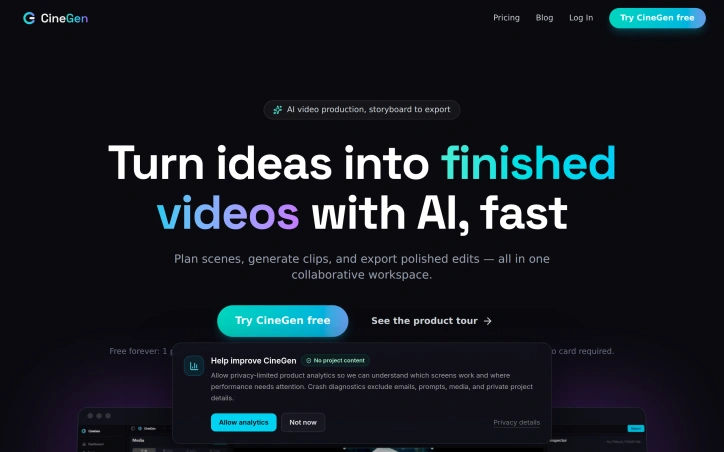
Creating videos with artificial intelligence typically requires jumping between specialized tools—some for planning, others for character design, generation, editing, and feedback. CineGen consolidates this fragmented workflow into a single browser-based workspace where creators and small teams can move from concept to finished edit without switching applications or managing scattered files. The product targets independent creators, studios, and marketing teams who need to produce video content quickly but find existing solutions either too specialized or too disconnected. CineGen's approach centers on efficiency: by keeping all production steps in one place, the platform lets users focus on storytelling rather than file management. Several capabilities distinguish CineGen's offering. The AI Storyboarder accepts story prompts and generates multi-scene sequences with specified shot types, descriptions, and dialogue that feed directly into the editing timeline. The Character Creator allows users to define a character once—including appearance, voice, and personality traits—and maintains consistency across every generated scene. This solves a genuine pain point in AI video work, where character drift across clips undermines narrative coherence. The timeline editor is a genuine production tool rather than a cosmetic interface. It offers multi-track editing, a media bin, live preview, clip inspection, keyframes, transforms, and one-click export. For teams, CineGen includes collaboration features: shareable review links that require no account, timestamped comments on clips, role-based project permissions, and auto-rendering triggered by approval. Currently in beta is a 3D scene creator that lets users load gaussian-splat environments, position characters with camera keyframes, and have the platform interpolate the camera movement into finished footage with cost estimates before rendering. This capability indicates the team is actively expanding creative possibilities. The business model is subscription-based. A free tier includes one project, access to the full timeline editor, watermarked 720p exports, and 100 bonus AI tokens, with no credit card required. This allows potential users to evaluate the core editing and collaboration experience before committing financially. CineGen's core strength lies in integration. Rather than positioning itself as the best storyboarding tool or the best character generator, it positions itself as the workspace where these pieces fit together seamlessly. For teams managing creative projects with consistent visual elements, that integration addresses a real workflow problem.

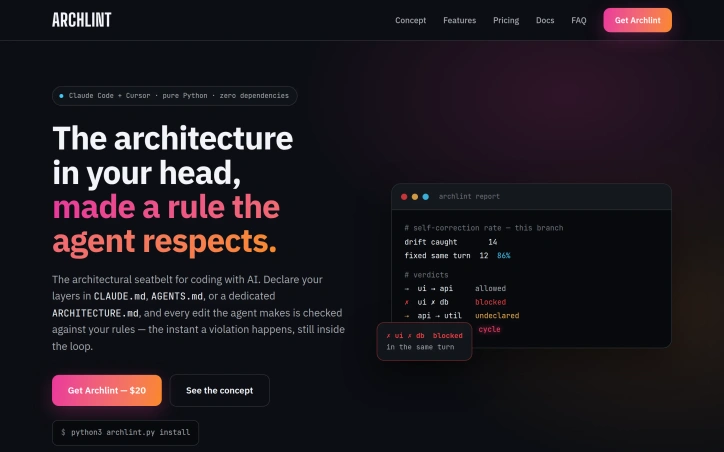
Architectural decay in AI-assisted coding happens fast. As code agents like Claude Code and Cursor generate multiple edits across dozens of tool-calls in a single session, violations of project structure can slip through undetected until they accumulate into technical debt. Archlint addresses this by moving architectural validation from the CI pipeline into the agent's editing loop, catching violations the moment they occur so corrections happen immediately rather than weeks later during code review. The tool works by declaring a project's layer structure and dependency rules upfront—defining which components can import from which others—then validating every edit the agent makes against those rules in real time. It supports six languages: Python, TypeScript and JavaScript, Go, Rust, Java, and C#, with import resolution sophisticated enough to handle real-world complications like tsconfig path aliases, Python src/ layouts, and Go module paths. The system doesn't require an architectural blueprint; teams new to Archlint can run its initialization tool to generate rules from their existing directory structure and import patterns, then refine them in minutes. What distinguishes Archlint is its positioning as a guardrail for AI agents rather than a general architecture linter. The product's own telemetry shows an 86 percent self-correction rate—meaning the agent detects violations and fixes them within the same session 14 times out of roughly 16 when drift is introduced. This metric captures something important: the tool's value isn't primarily about stopping bad code but about catching it early enough that remediation is trivial. The implementation is spare. Archlint is pure Python with no external dependencies, keeping deployment friction low and the attack surface minimal. It integrates with both Claude Code and Cursor, delivering per-edit feedback in Claude Code and end-of-turn summaries in Cursor. For teams adopting it into existing codebases with established architectural violations, the baseline mode allows rules to be adopted gradually—flagging only new drift rather than demanding immediate compliance with historical violations. The product is sold at a flat $20 price, making it accessible to individual developers and teams. For organizations where architectural integrity matters—teams managing microservices, plugin architectures, or domain-driven designs where layer violations compound into significant problems—the cost justifies itself through prevented rework.

Indian e-commerce and consumer brands operate largely blind to their presence in AI-generated search results, a gap that Pallix addresses head-on. The platform monitors how brands appear across AI engines, maps the sources and communities influencing those recommendations, and surfaces the most impactful fixes to improve visibility and competitive positioning. The core insight driving Pallix's approach is radical transparency. Rather than serving up opaque visibility scores, the platform shows the exact domains, URLs, and communities that shaped each AI recommendation. When MuscleBlaze or Fire-Bolt receives a mention in an AI-generated answer, marketers see precisely where that citation came from, whether it was a Reddit thread, YouTube video, or news article. This source-level granularity transforms abstract metrics into actionable intelligence. The workflow Pallix enforces moves teams from observation to measurement in a structured cycle. After tracking visibility metrics and citation patterns, the platform identifies gaps in sourcing, competitive blind spots, and technical issues blocking AI crawlers. It then ranks these opportunities by predicted impact, effort required, and supporting evidence, converting the evidence layer into a prioritized work queue. The final step closes the loop by measuring whether visibility shifted after fixes were deployed. The platform targets marketing teams, agencies, and brands directly, positioning itself as infrastructure for managing AI search visibility much as SEO tools manage organic search. Brands including Mama Earth, The Whole Truth, and Yoga Bar have used Pallix to analyze their positioning, indicating traction among scaled Indian consumer brands. A free audit is available, and the platform offers a trial, though permanent pricing details remain undisclosed. The emphasis on transparency in both product design and business model—a corrective to the opaque tools already in the market—sets a different tone for the space. For any brand whose buyers ask questions of AI systems, Pallix translates black-box recommendations into visible, addressable problems backed by real sources and measurable outcomes.


Language barriers and content complexity limit how much of the internet a person can meaningfully engage with. Whether navigating technical documentation, dense research papers, or simply encountering unfamiliar terminology while browsing, many readers hit a wall. WDTM tackles this by offering in-place explanations without context switching. This Chrome extension addresses a practical friction point in digital reading. Users highlight confusing text or right-click on images, charts, and diagrams to receive instant AI-powered explanations without leaving the page or copying content elsewhere. The tool acknowledges that confusion often stems not from laziness but from legitimate language gaps, unfamiliar terminology, or visual content that lacks adequate context. The product targets a distinctly segmented audience: students wrestling with academic sources, researchers parsing dense literature, developers decoding documentation and error messages, non-native English speakers encountering colloquial or complex prose, and visual learners who benefit from interpretation of screenshots and diagrams. This specificity suggests the founder understands that different users encounter different barriers. What distinguishes WDTM from generic AI chatbots is its laser focus on staying in context. Explaining an image or paragraph without tab-switching removes a major friction point in research workflows. The ability to handle both text and visual explanations, plus full page summaries, positions it as a tool for sustained reading sessions rather than isolated lookups. The pricing structure follows a sensible freemium model. The free tier allows 30 explanations daily with a 500k monthly token ceiling, suitable for casual research. The Pro tier costs five dollars monthly and raises limits to 150 daily explanations and five million monthly tokens, targeting heavier users without aggressive upselling. One limitation worth noting: the tool remains browser-dependent. Users working with PDFs, physical documents, or offline content fall outside its scope. The explanation quality inherently depends on the underlying AI model's capabilities, which the marketing materials do not disclose. The founder's motivation is transparent and relatable: removing barriers for non-native speakers navigating English-dominated digital spaces. That personal stake often translates to products that solve real problems rather than imagined ones. For the defined user segment, WDTM delivers genuine utility in an underserved space where generic chatbots create friction rather than solving it.

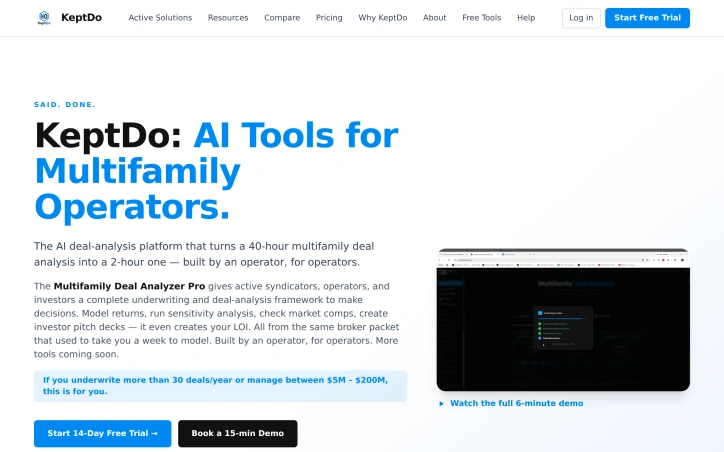
Multifamily deal analysis has a speed problem. Syndicators managing active pipelines routinely invest 40 hours normalizing broker packets, cleaning rent rolls, and building underwriting models for a single deal. KeptDo Multifamily Deal Analyzer Pro attacks this bottleneck by automating the grunt work and compressing that analysis into a two-hour workflow. The platform targets syndicators and operators underwriting more than 30 deals annually and managing between $5 million and $200 million in assets. The value proposition is straightforward: take a broker offering memorandum, T-12, T-3, and rent roll, upload them, and receive a production-ready underwriting package including returns models, sensitivity analysis, market comparables, and even a drafted letter of intent. What distinguishes KeptDo is that it was built by Manny Del Val, a syndicator and IT professional with 25 years of technology experience, rather than by software engineers unfamiliar with multifamily operations. This pedigree shows in the product's workflow. It normalizes data across disparate sources, flags inconsistencies and discrepancies, generates five-year projections, and produces investor pitch decks—the entire stack of deliverables deal sponsors need. The system recognizes that speed matters in competitive deal environments. When twenty operators are reviewing the same offering memorandum, the ones who can present a defensible LOI Wednesday afternoon outmaneuver those still formatting tabs Thursday night. The platform is already in use by operators across Arizona, California, Florida, Tennessee, Kentucky, South Carolina, and Texas. Pricing starts at $99 monthly, with a 14-day free trial available to prospective customers. The company, founded in 2026 and based in Satellite Beach, Florida, plans to expand its offering with additional tools for multifamily operators. KeptDo addresses a real pain point in commercial real estate—the conversion of raw broker data into actionable underwriting. By automating data normalization and model construction, it removes a major friction point from the deal pipeline, freeing operators to focus on strategic decision-making rather than spreadsheet hygiene.

Creators building an audience spend considerable time researching and comparing tools for everything from video editing to newsletter platforms to affiliate networks. CloutStack consolidates this research into a single directory of 594 platforms organized across 49 categories, covering the entire creator economy stack from design and editing through publishing, analytics, monetization, and financial management. The directory's structure reflects real creator workflows. Rather than generic categorization, it groups tools by function and use case: design tools, video platforms, email marketing services, project management software, payment processors, and specialized creator-focused services like UGC work platforms and merch vendors. Each tool listing includes transparent pricing, target audience information, and user reviews, reducing the guesswork in tool selection. What distinguishes CloutStack is its coverage of the less glamorous but essential parts of creator business. Beyond the obvious video editing and publishing tools, the directory includes sections for accounting, legal, hiring, and brand deals—the administrative and commercial infrastructure creators often discover only through expensive trial and error. The inclusion of free tiers and pricing starting points, ranging from free with paid upgrades to one-time purchases like Procreate's $12.99, helps creators at different revenue stages find appropriate solutions. The platform functions as a browsable reference rather than a sales platform. A search function and categorized views make systematic exploration possible, while the inclusion of alternatives within each category prevents single-option thinking. Tool listings focus on functionality and cost rather than marketing language. CloutStack addresses a real friction point in creator workflows—the time spent evaluating tools is time not spent creating or building an audience. By aggregating pricing, reviews, and functionality in one place, it reduces the cognitive load of tool discovery. The directory proves particularly valuable for newer creators who lack networks for tool recommendations and for established creators filling gaps in their workflow. The breadth of coverage means creators at various stages and in different niches will find relevant options rather than defaulting to whatever tools rank highest in generic software reviews.


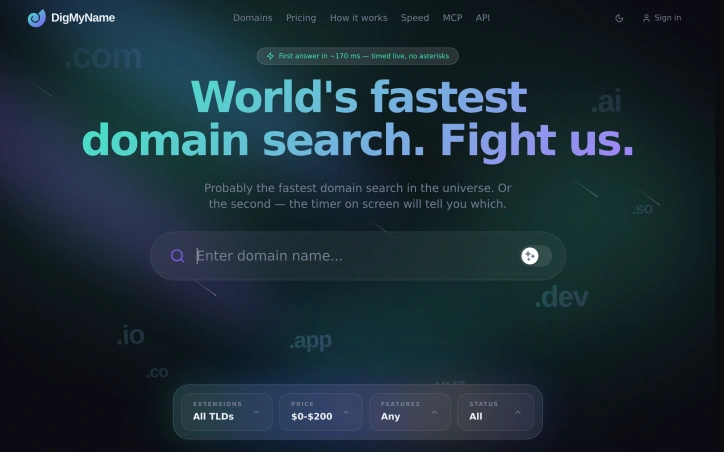
Domain acquisition remains a friction point for anyone launching a startup or brand. DigMyName targets the inefficiency that emerges when searchers need to check availability across multiple domain extensions and registrars simultaneously. Rather than bouncing between registrar websites or using disconnected tools, the platform consolidates the process by querying over 50 top-level domains and comparing pricing across multiple registration services in a single interface. The core value proposition hinges on speed. The site explicitly claims to offer the fastest domain search the company has measured, suggesting a direct response to the tedium of manual lookups. For someone trying to lock down a domain name quickly—whether for a business launch, personal brand, or creative project—this acceleration matters. The ability to see both availability and price variations across registrars and TLDs simultaneously eliminates the need for multiple searches and manual price tracking. The feature set focuses on breadth and comparison. By indexing 50+ TLDs rather than restricting users to the handful of most common extensions, the platform opens possibilities for finding available alternatives when a .com or .net is already taken. The instant price comparison across registrars addresses a real pain point: registrar pricing can vary significantly for the same domain, and discovering the best deal typically requires switching between sites. DigMyName consolidates this competitive pricing into a single view. The positioning suggests an audience spanning individual founders and small businesses who need to move quickly without getting bogged down in registrar navigation. The emphasis on speed and ease indicates the founders recognized that domain acquisition should be a solved problem—a quick decision rather than an hours-long research session. The company's narrative about simplifying domain discovery identifies a clear market frustration with existing workflows. The product spots a genuine gap between the importance of finding the right domain and the poor experience of actually doing so. Whether the search speed claim withstands comparison against dedicated registrar searches, and whether the tool integrates smoothly into actual purchase workflows, would shape real-world utility. But the core premise stands: domain hunting deserves better tools than the fragmented landscape currently offers.

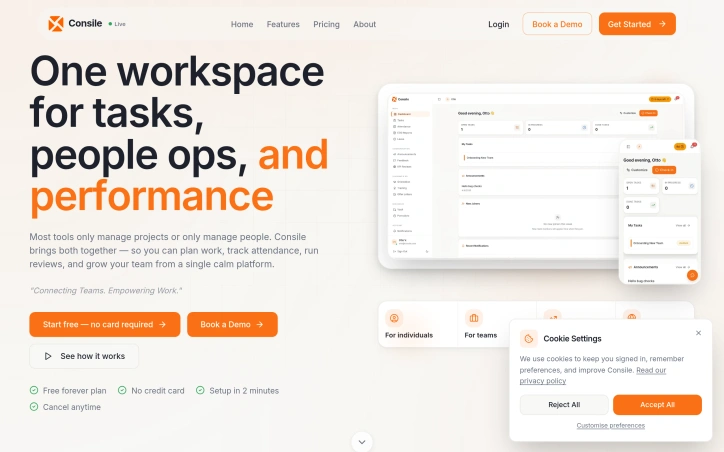
Growing companies waste enormous time coordinating operations through email, spreadsheets, and fragmented tools that rarely communicate with each other. Consile consolidates this sprawl into a single workspace, handling everything from task management and daily attendance tracking to leave approvals, payroll generation, and recruitment pipelines. The product targets expanding teams and individual professionals who have outgrown the chaos of ad-hoc coordination but haven't necessarily justified custom enterprise systems. It replaces the typical pattern where HR lives in one platform, tasks in another, attendance in a spreadsheet, and approvals happen via WhatsApp threads. Consile's architecture spans multiple operational domains. The task module offers Kanban and list views with recurring schedules and co-assignees. Attendance captures one-click check-ins with custom holiday calendars and exportable timesheets. Leave management handles delegation, half-day requests, and hierarchical approval flows. Beyond that, it includes KPI review cycles, onboarding workflows with verifiable certificates, an ATS for recruitment, and automated payslip generation. Otto, a role-aware AI assistant, sits across the platform alongside public APIs and MCP integrations for customization. What distinguishes Consile is its integrated approach to problems that typically require point solutions. Most companies string together a payroll tool, an HR system, a task tracker, and a time-tracking app, then manually thread data between them. Consile attempts to eliminate those handoffs. The blog content signals ambition beyond basic task management, covering employee self-service portals, performance improvement plans, job specifications, and compliance considerations for specific markets like South Africa and Nigeria. This suggests the team is thinking about deep operational workflows, not just surface-level coordination. On security, Consile emphasizes multi-tenant isolation, row-level security, TOTP MFA, IP allowlists, signed webhooks, and immutable audit logs. It offers SCIM provisioning for enterprise deployments, indicating it's designed to scale beyond small teams. The company offers a 14-day free trial with full feature access and no credit card required, though specific pricing details aren't exposed upfront. Multiple plan tiers exist, but pricing remains hidden until signup, a common pattern for vertically integrated platforms where configuration varies significantly across customer size. The core value proposition is consolidation: reducing tool fatigue and manual coordination. Whether Consile executes deeply enough across all these domains to truly replace specialized tools depends on implementation depth, but the scope is comprehensive.

Most water quality checkers reduce the complexity of contamination risk to a single number, leaving residents with incomplete information about what's actually flowing from their taps. PurityRadar addresses this gap by transforming fragmented EPA and USGS data into personalized safety reports that span historical trends, localized advisories, and traceable sourcing. The platform targets homeowners and renters concerned about water quality—particularly those on private wells, where most existing tools provide no data at all. By modeling contamination risk across geographic areas using USGS datasets, PurityRadar extends beyond municipal systems to serve populations typically excluded from water quality monitoring. What distinguishes this product is its fundamental commitment to transparency. Rather than presenting opaque scores, each reported figure links directly to its original EPA or USGS source, stamped with publication dates and expert reviewer attribution. This sourcing architecture removes the black box element that undermines trust in competing tools. For users, this means tracing the chain from their address down to the actual data collection point—no anonymous algorithms, no hidden adjustments. The feature set reflects this philosophy throughout. Historical trend visualization shows how water quality has shifted over years rather than capturing a static snapshot. Live local advisories for boil-water orders and main breaks arrive geographically targeted, avoiding the false certainty of stale information. The 0-100 safety scoring framework remains accessible for quick assessment, but it functions as an entry point rather than the entire answer. Contaminant-specific filters let users focus on substances relevant to their location and risk profile. Coverage spans major US cities—the site samples New York, Los Angeles, Chicago, Houston, and others, breaking down contamination profiles by specific systems and flagged facilities within each region. Private well modeling represents a competitive advantage, as most water quality tools omit this segment entirely. The platform builds on public data sources—EPA Safe Drinking Water Information System records and USGS databases—creating a sustainable foundation that sidesteps the common bottleneck of proprietary testing requirements. Users cannot debate the underlying facts, only their interpretation, which refocuses the conversation toward actionable decision-making rather than score-chasing and brand loyalty.