
iCV.ge
iCV.ge targets a common frustration for job seekers: building a polished CV takes time, and many applicants never learn...

My2Do
My2Do takes aim at a familiar frustration: task managers that demand a form for every entry and then bury the reminder b...
Categories
Recently Listed
1,287 launchesA resource designed for people entering the AI landscape, AITestGuide tackles the documented problem of information overwhelm that beginners face when trying to understand artificial intelligence concepts and navigate the growing ecosystem of tools. The site functions as a hybrid educational and review platform, combining explainer content on AI fundamentals with comparative analysis of existing tools. The content strategy reflects a practical approach to demystification. Rather than theoretical AI concepts alone, the site covers applied topics that intersect with daily life and business decisions: how AI affects agriculture, travel, procurement workflows, and home automation. Articles like "AI Arbitrage" and "How to Make Money With AI" suggest the platform addresses both curiosity-driven learning and transactional interests where readers might implement AI solutions. This breadth indicates the creator understood that newcomers often want answers to specific questions about real-world application rather than pure technical education. The product's architecture supports multiple user intent patterns. A visitor seeking educational content finds guides explaining AI basics, while someone evaluating tools can browse structured comparisons and reviews across categories. The site hosts both foundational content (explaining what AI appliances are, for instance) and deeper dives into sector-specific applications like IoT systems or edge computing. The alternative-tools section serves users already committed to exploring options within a category, reviewing everything from video generation platforms to image editors to roleplay applications. Review coverage spans both mainstream and niche AI products, suggesting comprehensive market tracking. The published dates show active content production, with articles ranging from recent posts to back-catalog material still accessible to readers, which supports long-term discoverability. The stated mission emphasizes honest, jargon-free analysis. This positioning matters in a crowded space where many guides either oversimplify to the point of uselessness or overcomplicate for the stated audience. The site's content suggests commitment to this balance rather than promotional puffery, given that reviews cover both established platforms and smaller alternatives with apparent equity in coverage. No explicit pricing model appears in the available content, suggesting either a free-access model or monetization details not emphasized in public marketing material. The business model remains unstated, though the comprehensive review archive and production cadence indicate sustained operation. For someone starting to engage with AI technology without prior expertise, the platform offers a curated entry point that avoids both oversimplification and technical jargon while providing actionable tool comparisons.

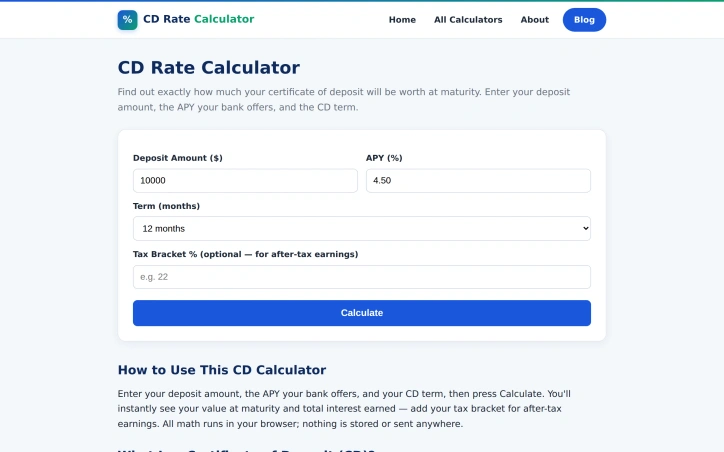
Anyone frustrated by the opaque process of comparing certificate of deposit rates across institutions will recognize the immediate appeal of this calculator. The tool addresses a genuine friction point: banks advertise CD rates inconsistently, and manually calculating compound interest across multiple terms and deposit amounts is tedious enough that many people skip the comparison altogether. The product positions itself as a solution for savers trying to maximize returns on money they don't plan to touch for months or years. That audience spans from risk-averse investors seeking alternatives to volatile markets to people parking emergency funds while still earning better yields than traditional savings accounts. What distinguishes this offering is its deliberate simplicity and transparency. The tool runs entirely in the browser, eliminating any data collection or transmission to servers. This design choice doubles as both a privacy feature and a speed advantage—users get instant calculations without waiting for network requests. The calculator accepts standard inputs: deposit amount, annual percentage yield, and term length ranging from three months to five years. An optional tax bracket field lets users see after-tax earnings, acknowledging that interest income carries tax implications many calculators ignore. The supporting content provides genuine educational value beyond the calculator itself. The site explains how CD interest compounds and why even small APY differences accumulate significantly on larger deposits. A reference table showing earnings across common deposit amounts and terms gives context for comparing real-world scenarios. The explanation of how CDs sit between savings accounts and investments frames the product for its intended audience. The underlying mathematics relies on the standard compound interest formula, which the site explicitly displays. This transparency around methodology builds credibility—users can verify calculations themselves. The business model appears to be free-to-use with no mention of premium tiers, subscriptions, or hidden monetization. The founder's motivation, stated as frustration with manual rate comparisons, aligns with the product's straightforward utility. One limitation worth noting: the tool assumes users already know their bank's offered APY and CD terms. It solves the earnings calculation problem but not the rate discovery problem—users still need to shop their bank's offerings separately. For savers serious about optimization, this represents only one step in the process rather than a complete solution. The calculator fills a genuine gap in the financial tools landscape by making CD earnings transparent and comparable without requiring a spreadsheet or calculator app.

Getting discovered as a founder is one of the hardest parts of launching a product, and LaunchAF tackles this directly by offering permanent backlinks and AI citations in exchange for a simple submission. The platform is built specifically for founders and builders seeking visibility through both traditional search engine rankings and AI model training datasets. The core value proposition is straightforward: submit your product URL in roughly 30 seconds and receive a permanent dofollow backlink from a domain rated 52 by Ahrefs. This alone provides meaningful SEO weight for new launches. Beyond the backlink, products get cited by ChatGPT and Gemini, addressing a growing need for visibility in AI search and AI-generated recommendations as these systems become primary discovery channels. LaunchAF operates a weekly rotation model where founders compete for attention through community voting. Each week features multiple launches across categories like jobs, careers, marketing, and education. The platform maintains an active community of over 500 founders and builders, supported by a newsletter reaching more than 6,000 subscribers. This creates a self-reinforcing discovery mechanism where products gain visibility not just through backlinks and AI citations, but also through peer recognition and community engagement. The submission process is deliberately frictionless. The platform uses AI prefill to speed up the form, removing friction that typically prevents quick submissions. This low-barrier approach makes sense given that the service is completely free—founders pay nothing to launch and receive the backlink and AI citations at no cost. The business model relies entirely on sponsorship. The platform offers rotating sponsored slots at $49 per month, keeping the core product free while generating revenue from companies wanting consistent visibility alongside organic product launches. The main trade-off LaunchAF makes is choosing quantity of submissions over strict curation. With a free model and minimal friction, the platform could accumulate many marginal products, potentially diluting the credibility of the backlink over time. The voting mechanism appears designed to surface quality launches, but it depends on community participation to work effectively. For serious founders seeking both search visibility and AI discoverability, however, the immediate value—a permanent backlink plus AI citations—justifies the submission time investment, especially at zero cost.


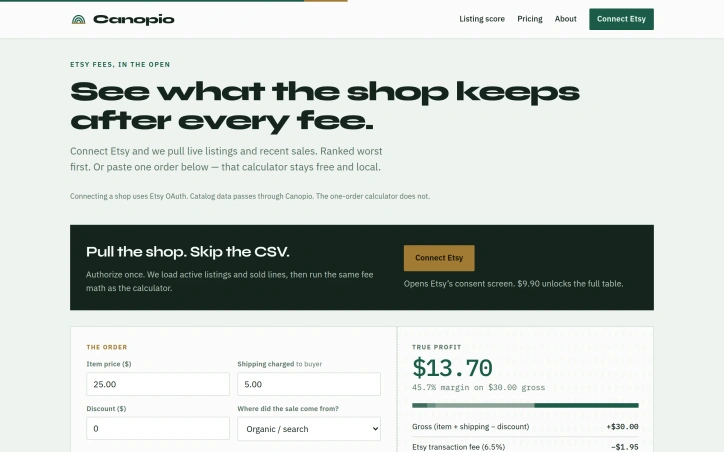
Etsy sellers operate in a complex fee environment that obscures actual profitability. A transaction fee of 6.5 percent applies to both item price and shipping. Listing fees accumulate across inventory. Offsite Ads can silently consume 12 to 15 percent of order value. The cumulative effect leaves sellers guessing at their true margins, often pricing based on intuition rather than data. Canopio addresses this directly with a free fee calculator that breaks down what a single order actually generates in profit. Unlike generic margin calculators, this one accounts for Etsy's specific fee structure and shows the impact of different traffic sources—organic search, paid Etsy ads, and Offsite Ads. A seller can paste an order and immediately see how a shift from organic to Offsite traffic cuts margin by a third or more. For sellers who want to optimize an entire catalog, Canopio offers a shop audit for a one-time 9.90 dollar payment. Connect via Etsy's read-only OAuth, and the tool ranks every listing by actual margin, surfacing the worst performers first. The product includes a pricing matrix, 365-day backtest against historical sales, and suggested price adjustments for thin-margin items. There is no subscription required; the purchase is permanent. The listing optimization component extends further. A listing score runs free in-browser; generating a rewritten title, 13 tags, and description costs 2.99 dollars per 10 attempts or 9.99 dollars for 40. Failed rewrites are not charged, reducing risk for sellers experimenting with positioning. What distinguishes Canopio is its focus on transparency and one-time pricing. Fee structures are documented against current Etsy rates as of September 2026, with an invitation for sellers to flag any changes. The free calculator remains fully functional—it does not gate core utility behind payment or require shop connection. The data model is explicit: a single order stays client-side; connecting a shop to Etsy passes catalog data through Canopio's servers. The 14-day refund policy on the shop audit reduces purchase friction. The target user is a mid-to-experienced Etsy seller who understands that margin optimization drives profitability but lacks visibility into how Etsy's multi-layer fee structure affects individual listings. Canopio converts that hidden complexity into actionable ranking and pricing guidance, eliminating the guesswork that leads sellers to underprice their work.
Privacy-focused Instagram browsing without creating an account addresses a genuine friction point in social media consumption. InstaPV positions itself as a solution for users who want to view Instagram content—stories, posts, and reels—without the platform's login requirements and without the digital footprint that comes with account creation. The core problem the platform tackles is Instagram's intentional friction. The social network locks most content behind authentication and deliberately obscures recently followed accounts, creating real barriers for casual browsing and discovery. InstaPV removes these gates entirely, enabling direct browser-based access to public Instagram content without authentication or account creation of any kind. What distinguishes InstaPV among similar tools is its deliberate positioning around anonymity and privacy. The emphasis on operating "without traces" suggests the platform commits to not tracking or storing user identity, a stance that appeals to users concerned about data collection. This privacy-first approach resonates strongly in a market landscape where social media platforms routinely monetize user data and behavior tracking. The feature set aligns closely with actual Instagram consumption patterns. Users can watch stories, browse posts, view reels, and importantly, track recent follows without logging in. This combination addresses both passive consumption and social discovery, demonstrating understanding of how people actually use Instagram beyond simply posting content. The product's distribution strategy reveals strategic confidence. InstaPV has secured partnerships and official badges across numerous AI directories, startup registries, and tech blogs including Ship, Growth, PostMake, Dang.ai, Startup Fame, and many others. This extensive partnership network across discovery platforms suggests either strong traction or successful outreach within the tech community. The consistent presence on curated directories for AI tools and trending software indicates the platform markets itself to a tech-forward audience, not just casual Instagram users. The lightweight architecture removes traditional adoption friction. No installation required, no account signup, pure browser-direct access means users can immediately test the service without commitment or setup burden. This frictionless onboarding stands in direct contrast to the friction Instagram deliberately introduces, creating a clean value proposition for the target user seeking simple, anonymous content discovery.


Many UK workers operate under a dangerous misconception: they guess their monthly take-home rather than calculate it. Income tax, National Insurance, student loans, and pensions interact in ways that confuse even financially literate employees. True Take-Home addresses this knowledge gap directly, providing a transparent breakdown of what actually lands in your bank account. The calculator handles genuine complexity across the UK's four tax systems. Scotland imposes different bands than England, Wales, and Northern Ireland, yet most payroll tools either oversimplify or ignore these distinctions. True Take-Home covers all regional variations through 51 distinct calculators, spanning everything from basic salaries to self-employment and contractor scenarios. Each calculator reflects the 2026/27 rates, verified against HMRC guidance from August 2026. What distinguishes this tool is its commitment to transparency without friction. The interface updates every figure instantly as you type, eliminating the friction of form submissions. The calculation runs entirely in your browser—no data travels to servers, addressing legitimate privacy concerns. There is no account creation, no email capture, no upsell. You input your salary, specify your region and tax code, and receive a complete breakdown showing not just take-home but also your marginal tax rate on the next pound earned and your effective tax rate overall. The presentation goes beyond raw numbers. The tool shows where each deduction goes—income tax, National Insurance, pensions—broken down across annual, monthly, weekly, and daily pay periods. Comparative context appears automatically, showing how your situation changed from the previous tax year and how close you are to the next rate threshold. For hourly workers, it calculates equivalent hourly take-home based on a standard working week. The trade-off inherent in such specificity is cognitive load. A calculator covering this much ground demands more input than simpler tools. Users must understand their tax code, decide whether to model their pension contribution, and select among loan repayment plans if applicable. This complexity mirrors the actual tax system rather than sanitizing it, which serves users seeking accuracy over simplicity. True Take-Home fills a genuine need for UK employees seeking to understand their actual disposable income. It makes the implicit mathematics of payroll explicit, removing the guesswork that leads workers to mistrust their paychecks.


Finding the right AI tool among thousands of options has become a genuine problem for professionals and businesses entering the AI-powered workflow era. The sheer proliferation of AI applications, models, and platforms has transformed discovery into a time-consuming task that demands expertise many users don't have. ToolPotion addresses this friction by positioning itself as a specialized directory and recommendation engine for the rapidly expanding AI ecosystem. The platform serves a broad audience: business leaders evaluating AI adoption, developers exploring technical capabilities, knowledge workers automating routine tasks, and curious professionals wanting to understand what's available. Rather than treating tool selection as a simple keyword matching problem, ToolPotion's distinguishing feature is its AI Advisor, a recommendation system that incorporates context about user roles, industries, responsibilities, and specific goals to surface relevant solutions. This context-aware matching sets it apart from basic searchable databases that rely on traditional filters and categories. The underlying infrastructure includes a comprehensive directory cataloging over 15,000 AI applications alongside agents, models, platforms, and resources. The platform organizes this volume through multiple discovery paths: categorical browsing, industry-specific filtering, job-based recommendations, and task-oriented searches. For users who want to compare options before committing, ToolPotion offers direct comparison tools. Leaderboards and rankings help surface leading solutions across different specializations like chatbots, image generators, and coding agents. What makes ToolPotion noteworthy is its recognition that AI tool selection requires more than keyword search. The founder emphasizes moving beyond simple discovery to help users find solutions that actually matter to their workflow. The platform seems positioned to evolve with the AI landscape itself, claiming a continuously growing directory that presumably updates as new tools emerge. The platform accepts free submissions from tool creators, suggesting a community-driven catalog model rather than purely editorial curation. This approach could accelerate growth but also introduces questions about discoverability in a crowded directory. No pricing information appears in the available content, suggesting the platform may operate as a free discovery service, potentially monetizing through partnerships, premium features, or creator networks later. For professionals tired of manually evaluating dozens of AI tools or uncertain where to begin with AI adoption, ToolPotion offers a structured entry point. The AI Advisor represents the most substantive differentiator, though its real-world effectiveness hinges on how well it learns from user profiles and refines recommendations over time.


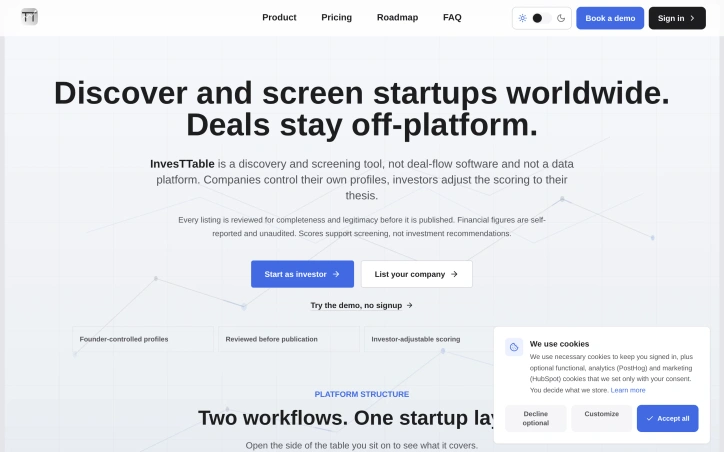
Matching investors with the right startups has long been a friction point for both sides. Investors filter through dozens of unqualified leads, while founders pursue funds with misaligned theses, wasting everyone's time. InvesTTable tackles this discovery problem head-on by creating a dual-sided screening platform where investors find scored, benchmarked startups and founders build discoverable profiles that reach aligned capital. The platform's architecture reflects deliberate design choices. Rather than positioning itself as deal-flow software or an investment platform, InvesTTable focuses narrowly on discovery and screening. Founders control their own profiles completely, deciding what to share down to full stealth mode. Every company listing undergoes review for completeness and legitimacy before publication, addressing a core trust issue in startup discovery. Investors receive structured data without gatekeeping; they make their own outreach decisions directly. What distinguishes InvesTTable from generic startup databases is its scoring transparency. The platform shows five analytical layers for each evaluated startup, revealing how scores are calculated rather than presenting them as black boxes. Investors can adjust scoring criteria to match their own investment thesis, turning a generic benchmark into a personalized screening tool. Data freshness and status are disclosed alongside profiles, so investors know how current the information is. The feature set serves both sides' workflows. Investors access discovery tools, scoring systems, watchlists, and alerts to track interesting companies. Startups receive a free quality score highlighting their two most impactful improvements, along with visibility into percentile rankings and real investor interest signals. The founders are explicit about what the platform does not do: it neither brokers introductions nor manages deal pipelines. Every transaction happens off-platform between parties. The value proposition hinges on precision over volume. Rather than drowning in hundreds of unread applications, investors see fifty qualified profiles. Rather than scattering applications across networks, startups maintain one living profile. This specificity appeals to a particular operator: the independent scout who values structured signal and works on their own terms. InvesTTable's constraint is deliberate. By refusing to manage deals, handle funding rounds, or sit in the middle of transactions, it simplifies the product and keeps both investors and founders in control. That focus also means it does not replace existing deal-flow infrastructure for larger funds. The platform succeeds by being clear about what it is and what it is not, solving the matching problem without overreaching into deal management.

A browser-based video generator that transforms a single portrait into a 19-second vertical freestyle performance represents a narrow but strategic bet on the longevity of an internet trend. This tool capitalizes on the viral Bulin 47 and Kevin Wai freestyle clip that has inspired countless TikTok recasts, removing friction from creating variations without requiring video editing skills or dance ability. The core mechanism is straightforward: upload a clear frontal photograph, select whether to use the original supporting cast or add custom background performers, and the system generates a video where the face and clothing from your photo grafts onto a reference body performing choreographed movements. The 19-second length mirrors the popular segment from the original performance, and output options include 480p or 720p quality, both with audio. Everything runs in a web browser with no app installation required and no watermark on the final file. What distinguishes this from generic video synthesis tools is its unflinching embrace of a specific cultural moment. The product openly acknowledges its reliance on the source material and original performers, making realistic disclosures about limitations. Lip movements may not sync syllable-for-syllable, hands can shift position, and source accessories may persist. This transparency about limitations actually builds credibility in an AI space otherwise flooded with overstated claims. The business model is straightforward: new users get credit to explore, but full video generation requires purchased credits. The entry package at $9.90 covers a single 480p video, keeping the trial barrier low. Support for English and Spanish pages suggests awareness of the trend's geographic reach. The product is explicitly positioned as an unofficial fan tool unaffiliated with Bulin 47 or TikTok, a choice that limits legal exposure while managing expectations. For creators invested in the trend, this focus is its strength. Success depends on the trend's longevity, an inherently unpredictable variable.


Fragmented tools plague local service businesses—most juggle separate platforms for customer messaging, appointment scheduling, payment collection, and reputation management. DMly consolidates these functions into a unified WhatsApp-first system designed specifically for the needs of small shops, salons, and service providers who want to automate customer interactions without losing the personal touch that builds loyalty. The platform's defining strength is its multi-channel approach. Rather than forcing customers toward WhatsApp exclusively, DMly operates across seven channels—WhatsApp, Instagram, Messenger, TikTok, Telegram, SMS, and live chat—bringing all conversations into a single inbox. This design choice meets customers where they already spend time rather than demanding they switch apps. At its core, DMly combines three essential capabilities. The automation layer uses no-code flows, triggers, and AI-generated responses trained on each business's operations to handle routine inquiries around the clock. The inbox unifies all channel conversations so teams can assign chats, leave notes, and hand off from bot to human seamlessly. The CRM component tracks customer journeys, visualizes sales pipelines with drag-and-drop management, and ties contacts to bookings and payment history in one profile. The booking and payments functionality handles the operational backbone—appointment scheduling, class registrations, invoices, and payment collection all happen within conversations, eliminating the friction of external checkout flows. Broadcast features let businesses send promotions with delivery and engagement tracking, while segments and custom fields enable targeted messaging without manual list-building. The business model emphasizes accessibility for early adopters: free trial access with no credit card requirement lowers barriers to testing, though specific pricing tiers remain undisclosed. The positioning toward "local businesses" targets the underserved SMB segment that large platforms often overlook. DMly's central bet is that local service businesses don't want to become software operators—they want their tools to work harder. By bundling messaging, automation, scheduling, CRM, and payments into a single interface anchored to channels customers already use, it consolidates multiple point solutions into one opinionated system. Whether that consolidation actually simplifies operations for users rather than shifting fragmentation elsewhere will determine its long-term stickiness.


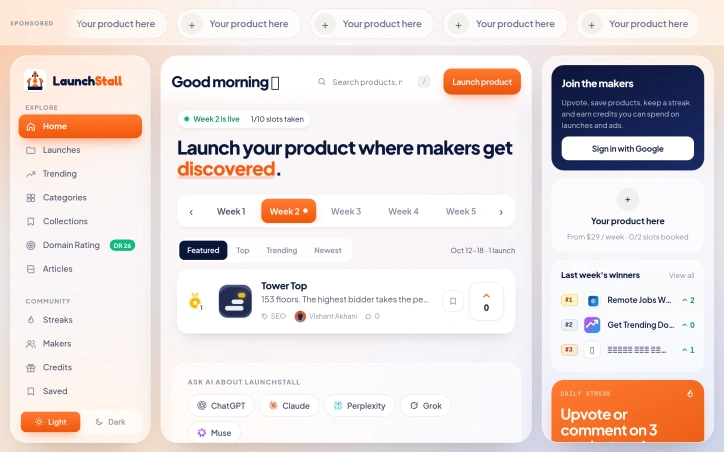
Product discovery remains a persistent challenge for independent makers and product creators launching new projects. This weekly product showcase addresses that friction by offering a structured, community-driven launch platform that handles the mechanics of distribution and visibility. The service differs from broader sharing platforms by concentrating launches into cohesive weekly batches and tying reputation to ongoing community participation. The core offering consists of ten weekly product slots, which creators can book to reach an engaged audience. The platform addresses the visibility problem through multiple angles. It generates permanent product pages that serve as persistent landing points, provides SEO backlinks to help with search rankings, and maintains a community-driven discovery system where users upvote and engage with launches. This combination transforms the platform from a passive listing service into an active discovery engine where products compete for attention within a structured weekly window. The engagement model centers on a streak system that rewards consistent participation. Users who upvote or comment on products three times daily unlock access to premium features, including priority launch slots and featured ad placements. This creates dual incentives where community members benefit from frequent engagement while creators gain access to better positioning. The platform also introduces a "Tower" ranking system where higher bids secure more prominent placement, functioning as a bidding mechanism for top-tier visibility. The product includes infrastructure designed to help creators understand performance. Analytics tracking and categorization across lifestyle, business, developer tools, AI, education, and productivity allow makers to see where their product fits relative to competitors. A domain rating feature provides another signal for evaluating competitive strength and positioning. The weekly cadence matters significantly. By concentrating launches rather than spreading them continuously, the platform creates natural windows of focused attention. This prevents the audience fatigue common in high-volume platforms and gives each product genuine opportunity for discovery within its assigned week. Pricing starts at $29 per week for ad placements, with premium features tied to community participation streaks. This model aligns incentives between the platform, creators seeking visibility, and community members seeking engagement rewards. The approach fills a specific niche: makers launching software, tools, apps, and digital products who want structured visibility within a supportive community rather than algorithmic distribution in a vast network. It's particularly well-suited to creators where backlinks and community signals carry tangible value for discoverability.

Personalization of notification sounds is typically constrained by pre-built libraries, but Notify Sound eliminates that limitation by letting users generate custom tones through AI assistance. The service addresses a straightforward frustration: most mobile phones ship with generic notification sounds, and existing alternatives offer little flexibility without technical expertise. Notify Sound is built for anyone who wants their alerts to sound distinctly theirs without requiring audio engineering skills. The core innovation centers on using AI assistants as a collaborative design tool. Users describe the sound they want—a soft two-note chime, a retro coin pickup, or something that cuts through background noise—and an AI agent builds the sound layer by layer, returning a link to an interactive editor. This approach bridges the gap between imagination and execution. The editor features real-time playback, so changes take effect instantly. Users hear the result of softening a sharp ping or extending a bell's resonance before committing to the final version. Every sound is synthesized from layered components rather than sampled recordings. This architecture creates depth: users stack bright layers for sparkle and low ones for weight, building complexity from discrete elements. The system ships with over 200 ready-made sounds—ranging from classic beeps to cash register tones—serving as either finished products or starting points for further customization. Integration with major AI platforms amplifies the product's reach. Notify Sound operates as an MCP server for Claude, ChatGPT, Codex, and VS Code, allowing users to request sound generation directly within their preferred assistant. Setup involves pasting a single URL into the assistant's configuration. The sounds themselves are fully portable: users download them as files and set them as notification tones, text alerts, or ringtones on iPhones, Android devices, and Samsung phones. Android allows different apps to have distinct notification sounds, enabling truly granular customization. The business model is straightforward: the service is entirely free, with no account requirement. This removes barriers to experimentation. The product's strength lies in combining AI-assisted generation, hands-on editing, and broad platform support into a unified tool. For users fatigued by generic notification sounds, Notify Sound offers genuine personalization without requiring audio production knowledge.


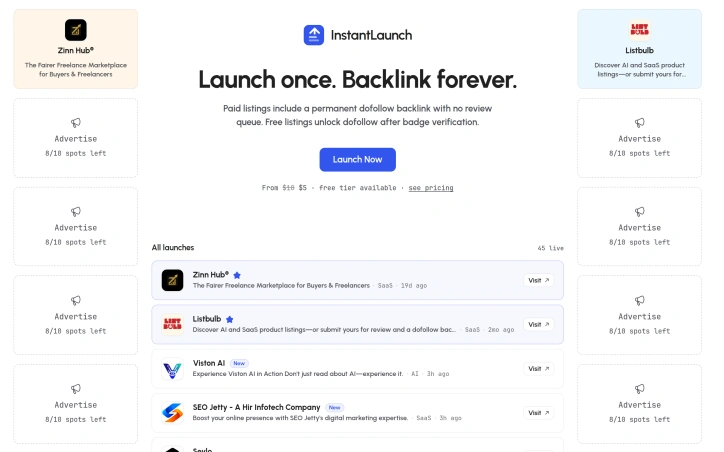
Founders launching new products face a genuine tension: rushing to market often means sacrificing search engine visibility, while traditional product directories demand lengthy review processes that delay public debut. InstantLaunch directly targets this friction by offering immediate listing placement for AI and SaaS products, bundled with permanent search-friendly backlinks. The core proposition is straightforward. Paid listings skip review queues entirely and arrive with a dofollow backlink attached—one that remains active indefinitely and never degrades to nofollow status. Free listings work differently: they enter a verification pathway where badge confirmation unlocks the same backlink benefit, creating a clear incentive structure without forcing every founder into a paid tier. What distinguishes this approach from comparable directories is the permanence emphasis. Most product directories treat backlinks as temporary promotional assets, removing them after feature periods end or downgrading them to nofollow. InstantLaunch's decision to keep links active perpetually reframes the value proposition from transactional visibility to lasting SEO equity. For founders publishing once with the expectation of remaining listed indefinitely, this model carries real appeal. The directory itself operates as a curated marketplace rather than an open submission feed. Every listing receives human review before publication, establishing quality control without necessarily slowing paid submissions. The interface surfaces metadata about product categories—AI, SaaS, Productivity, Dev Tools—alongside submission timestamps, helping founders gauge both competitive density and marketplace momentum. The current roster shows active listings with recent additions, indicating ongoing use. Pricing starts at $5 with higher tiers available, making access feasible for bootstrapped teams while accommodating scaling operations. The actual limitations center on two critical points. First, a backlink's SEO value depends on the linking domain's authority and Google's continued indexing of the directory itself. Neither condition receives explicit guarantee in available materials. Second, the scope is narrow—AI and SaaS products only—limiting utility for founders building outside these categories. InstantLaunch succeeds in its core mission: eliminating the review queue penalty that traditionally accompanies directory credibility. Whether the permanent backlink claim justifies the cost depends entirely on users' SEO priorities and confidence in the directory's long-term sustainability.

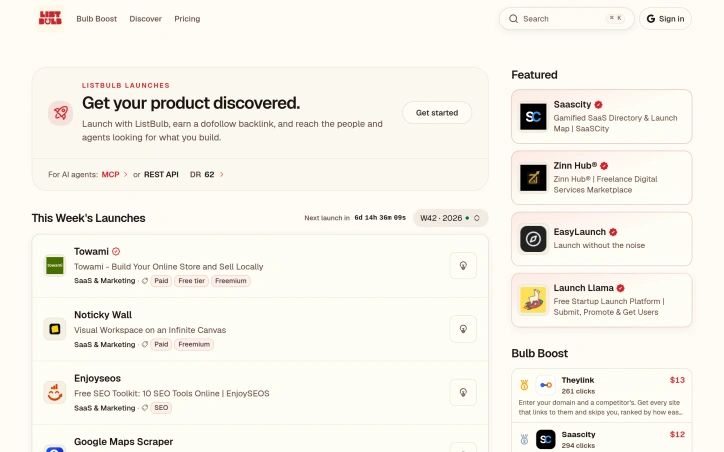
Founders seeking product discovery and SEO value will find a focused alternative in this hand-curated directory for AI and SaaS tools. ListBulb addresses a real gap: while product launch platforms have proliferated, most treat discovery as secondary to promotion noise. This platform inverts that priority by emphasizing editorial curation and direct connections between builders and both human and AI-powered searchers. The product differentiates itself through two mechanisms. First, it positions itself explicitly for AI agent discovery through both MCP and REST API integrations, recognizing that increasingly, AI systems are the ones researching and evaluating tools. This forward-thinking approach acknowledges how purchasing decisions actually work in 2026. Second, every listing comes with a dofollow backlink—a tangible SEO benefit that most competing launch platforms reserve for premium tiers or don't offer at all. The featured section reveals the business model in action. Prominent placement rotates among products like Saascity, a gamified SaaS directory with voting mechanics; Zinn Hub, a freelance services marketplace; and Launch Llama, a competitor platform itself. Each listing shows engagement metrics, suggesting transparency about what visibility actually produces. The "pay what you want" approach to featuring suggests flexible pricing over rigid paywalls. The directory's curation claim matters more than it initially appears. Spam is the endemic problem of product directories—at a certain scale, unmoderated listings become worthless. Hand-reviewed entries mean a founder submitting their tool goes into a curated set, not a firehose. This appeals to both builders wanting legitimate discovery and to the serious users who browse there. The integration of tools like Theylink in the featured section underscores ListBulb's positioning within an ecosystem of discovery and growth products. Theylink itself solves competitive backlink analysis, which complements a platform focused on earning backlinks. The obvious constraint is that a hand-curated directory grows more slowly than community-driven alternatives. Curation requires labor, and scaling it becomes a question of unit economics. The platform's explicit focus on AI and SaaS also narrows its addressable market compared to general product launches, though this narrowness is precisely what makes curation defensible. For founders building AI and SaaS products, ListBulb presents a legitimate alternative to the noise-to-signal ratio of larger launch platforms, with the added incentive of actual SEO value. Whether hand-curation translates to meaningful discovery depends on whether the platform can attract the right audience of both humans and AI agents seeking solutions in this space.

Dividing expenses among roommates, travel companions, or romantic partners remains one of those friction points that modern apps haven't fully resolved. CoolMeow addresses this gap by packaging expense tracking, photo attachment, and settlement calculations into a single ledger that syncs across iOS and Android. The product targets groups that need ongoing financial accounting: couples managing household costs, friend groups splitting trips, or roommates tracking shared utilities and groceries. The core functionality is straightforward—users log expenses, assign who paid and who benefited, and the app calculates resulting balances. Where it distinguishes itself from basic expense splitters is the attention to supporting context. Expenses can include photos and notes, keeping receipts and justifications alongside transactions rather than scattered across email or messaging apps. Several features demonstrate thoughtful design. Receipt scanning extracts amounts, merchants, dates, and times directly from photos, returning a draft for verification before commitment. Spending reports break down costs by date, category, and individual, with each total linking back to underlying transactions. Support for multiple currencies within a single ledger addresses the friction of international trips or cross-border payments, converting everything to a primary currency for settlement calculations. The architecture acknowledges payment logistics: CoolMeow calculates who owes whom but leaves actual transfers outside the app, avoiding the complexity and regulation of processing payments directly. One practical element is governance—the ledger creator controls who can add or view expenses and what role participants play. The business model reflects this philosophy. Personal expense tracking is free. Sharing requires the creator to hold an active Basic subscription, though invited participants join without paying. Receipt scanning also requires a subscription and carries usage limits. Cloud synchronization and ledger restoration similarly depend on an active subscription. This creates clear monetization while lowering initial friction for new users exploring the product. A notable addition is MCP support, allowing AI tools to query ledgers, check splits, and preview changes. This positions CoolMeow at the intersection of expense tracking and AI integration, though it currently applies only to cloud ledgers and requires separate AI service subscriptions.


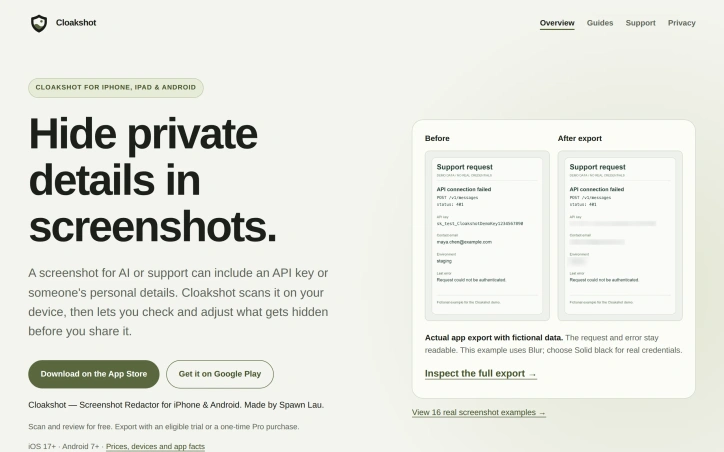
Accidental data exposure through screenshots has become a genuine security concern as teams increasingly share images with AI assistants and support teams. Cloakshot addresses this gap by providing on-device redaction specifically designed to catch what people often miss when manually blurring sensitive information. The app scans screenshots to identify potentially problematic content including API keys, passwords, phone numbers, email addresses, faces, QR codes, and photo metadata like GPS coordinates and EXIF information. Rather than redacting automatically, it flags candidates and lets users decide what actually needs hiding, preserving context that might be valuable for troubleshooting or communication. The redaction happens locally on the device, with no image uploads required and no account creation necessary. What sets Cloakshot apart is its verification workflow. After users apply masks and choose which metadata to remove, the app scans the redacted copy again to catch anything missed in the first pass. This second look acknowledges an uncomfortable truth: single-pass redaction tools are fallible, and users need help spotting remaining high-risk details. The final image is saved as a separate PNG file with masks baked in rather than stored as editable layers, which prevents accidental unmasking. The editing experience allows fine-grained control. Users can select individual characters rather than whole words, move or resize masks to adjust coverage, and switch between blur and solid black effects. This granularity matters when hiding an API key but keeping surrounding error messages readable, or covering one person's name in a group photo while leaving others visible. The pricing model reflects the app's positioning as a utility rather than a platform. Scanning and mask editing are free, which lowers the friction for trying the product. Export requires either a fourteen-day free trial with no credit card or a one-time purchase for Cloakshot Pro Lifetime. This approach avoids recurring subscription costs and eliminates the common frustration of free-tier apps with expiring trials or automatic renewals. The fact that no account is required removes another friction point for privacy-conscious users. The straightforward positioning targets both individuals and teams who regularly handle screenshots containing sensitive information. Support staff, security researchers, security engineers, and knowledge workers who document processes with screenshots would all find value. For a market segment where many people still manually blur sensitive data or avoid sharing screenshots entirely, an app that does local scanning, invites human judgment, and prices as a one-time purchase represents a practical improvement to an existing workflow.
Fashion brands face a persistent challenge: creating diverse product imagery across multiple platforms requires expensive shoots, model bookings, and post-production work. Visnova addresses this by automating the conversion of garment reference photos into photorealistic runway videos and studio shots. The platform targets apparel ecommerce sellers, DTC brands, and creative teams who need rapid iteration across different models, settings, and variations without the cost and logistics of traditional photoshoots. The product's core strength lies in its combination of speed and technical specificity. Generation completes in under 30 seconds at 4K 60fps resolution, designed specifically for short-form video platforms and ecommerce storefronts. Rather than treating garment visualizations as 2D overlays or graphic manipulations, Visnova models actual fabric physics, preserving silk sheen, denim stiffness, and fabric drape under gravity. This distinction matters for fashion, where material authenticity influences purchase decisions. Several features differentiate Visnova from general video generation tools. The platform includes global model representation across Caucasian, Asian, Afro, Latino, and Middle Eastern ethnicities, allowing one-click model switching without re-engineering outputs. It enforces platform-specific compliance automatically, handling aspect ratio and background requirements for TikTok Shop (9:16), Amazon (1:1), SHEIN, and Temu (3:4) simultaneously. The workflow separates rapid single-shot generation from batch production pipelines, accommodating both quick iterations and agency-scale operations. Commercial rights appear central to the positioning. Visnova grants 100 percent perpetual commercial usage rights on all generated content, including licensed background music, distinguishing it from competitors that impose tier-dependent or platform-restricted usage terms. The public comparison emphasizes this advantage alongside native 4K output and pattern fidelity against cutout tools and general video models. The platform offers a free trial for single garment generation, with pricing plans available but unspecified on the public site. A testimonial from LUMIA Fashion highlights claimed productivity gains: replacing weeks of shoot coordination with one-hour batches of 50-plus runway variations. The product positions itself around practical fashion commerce rather than artistic video generation, keeping garments as the primary subject with human review of color, fit, and brand consistency as an expected step before publication.

Swipe fatigue has become the defining frustration of modern dating apps. This service attacks that problem directly by replacing endless profiles with a curated, human-driven approach. Built for people in Atlanta seeking substantial relationships rather than another scroll through superficial options, the platform combines personality archetypes with personal matchmaking to create a fundamentally different experience. The core mechanic centers on eight personality archetypes—Spark, Navigator, Anchor, Hearth, Dreamer, Captain, Trailblazer, and Firefly—that users discover through a free assessment. Rather than matching algorithms alone, a real person (the founder Matthew) personally reviews compatibility between verified members before sending match reports. This human layer distinguishes the offering from algorithm-driven competitors. Each match arrives with reasoning: shared values, complementary temperaments, aligned life plans, and specific details about how the pairing works in practice. The platform emphasizes data privacy. Profiles remain anonymous until both parties explicitly consent to connect. Every member undergoes identity and age verification, and responses are reviewed by real people rather than auto-matched and auto-sent. The company states data stays private and is never sold—important credibility in an industry skeptical of data practices. The user experience delivers immediate value: answering a short questionnaire generates an instant archetype report explaining who you are and your ideal match profile, requiring no login or account creation. Once registered, members receive a limited number of match reports from the platform's human reviewer, replacing the infinite-scroll model that breeds decision paralysis. The service is currently accepting founding members in Atlanta, positioning itself as a premium alternative to mass-market apps. No explicit pricing information appears in the materials, though the "founding member" language signals a membership structure rather than an ad-supported or freemium model. What stands out most is the philosophical inversion: instead of empowering users with tools to swipe, NexSpark removes that choice and replaces it with expert curation. Success depends on whether people embrace this constraint or resent the limits it imposes.


Freelancers squander time and money on invoice management, transforming what should be a simple administrative task into a recurring friction point. Invoala addresses this directly with a free invoice generator that combines professional PDF output, payment processing, and client management in a single interface. The product removes friction at every turn. The setup requires no account creation, no credit card, and no paywall. Freelancers describe their work in plain language and let AI complete the invoice with correct totals, or manually fill in details that the system saves for future use. The resulting PDFs are polished and brandable, generating professional-looking documents in seconds rather than minutes. Beyond document generation, Invoala bundles features that most freelancers assemble from multiple tools. A payment button on each invoice lets clients pay directly via card, Apple Pay, or Google Pay without leaving the document. The dashboard tracks which invoices remain open, which are due, and which are overdue, giving freelancers a clear view of cash flow. Client records persist across invoices so context doesn't get lost. Reusable service templates eliminate repetitive data entry for retainers and recurring line items. Tax rates and discount calculations happen automatically, avoiding manual arithmetic errors. Team workspaces allow agencies to collaborate and share client relationships. The sharing model stands out. Rather than sending static PDFs, freelancers can generate live share links that display real-time payment status, letting clients see at a glance whether an invoice has been settled. This transparency likely accelerates payments. The business model remains unencumbered. The tool is free forever with no sign-up friction, suggesting a play toward ubiquity and eventual monetization through payment processing fees or higher-tier features. Nothing in the public materials suggests hidden costs or upselling mechanics. User feedback clusters around simplicity and focus. Reviewers note the uncluttered interface and appreciate the decision to build a single, well-executed tool rather than a bloated bundle. For freelancers tired of juggling spreadsheets and email reminders, Invoala eliminates the overhead around invoicing while keeping money flowing in.


Generating floor plans from text descriptions isn't new, but FloorPlanBot brings a particular clarity to how AI can help homeowners and renters think through space before investing in professional design work. The tool takes a written brief about room needs and spatial priorities, then produces a conceptual layout in minutes, complete with dimensions and area calculations. What distinguishes the product is its honesty about its own limitations. The interface and documentation emphasize repeatedly that these are drafts requiring human review and professional scrutiny. This isn't marketed as a replacement for architects or detailed measured drawings, but rather as a conversation starter and exploration tool. That framing is rare in AI products and builds credibility. The feature set covers the practical workflow: users describe their desired layout in natural language, the system generates a 2K concept image, and they can then edit with AI or proceed to a 2D schematic. Export options span PNG, PDF, and CAD-compatible DXF files, giving users flexibility in how they share or develop the output further. The interface offers blueprint style variations and includes basic measurement tools like grid and ortho snapping, suggesting the creators thought about how these plans would actually be used. The business model is straightforward. New users receive three free credits upon signup, plus one additional credit per day through a check-in system. Each successful generation costs one credit. This creates a genuine free tier without aggressive monetization barriers, though the long-term pricing for heavier use remains undisclosed. The workspace is private, allowing users to save and revisit designs over time. Sample presets like Modern 2-Story Farmhouse and Studio Loft help new users understand what's possible without starting from scratch. FloorPlanBot targets a genuine need. Homeowners weighing renovation approaches, renters trying to visualize furniture arrangements, and anyone exploring a layout before committing resources benefit from quick AI-generated concepts. The product doesn't oversell its capabilities or pretend to replace professional work. Instead it occupies a specific position in the design workflow: the exploratory phase where ideas take rough visual form. For that purpose, it delivers a competent tool at a fair price point.