
1,034 startups launched 12,714 upvotes cast 60 submitted this week

Recently Listed

1,034 launches
Sort
A

For developers managing multiple AI coding agents simultaneously, tracking active sessions and monitoring usage across Claude Code, Codex, Antigravity, Grok, and Cursor presents a constant friction. Agent Island addresses this directly—a local-first status companion that lives in your menu bar and keeps session state, quotas, and costs visible without requiring cloud infrastructure or user telemetry. What distinguishes Agent Island is its architectural stance: the application runs entirely on your machine, reads transcript files your tools already generate, and maintains zero dependency on external servers or Agent Island accounts. This design choice matters. It means your coding patterns stay private, API integrations leverage tokens you already control, and the tool's benefit doesn't hinge on a company's continued operation. The code is open source under the MIT license with every line public on GitHub. The feature set addresses genuine workflow pain points. Real-time session monitoring surfaces when an agent is working, waiting, or stalled—the distinction that determines whether you should check on progress. Usage tracking combines token counts with estimated API costs and displays weekly summaries breaking down model preferences and ranking your consumption against other users. The application integrates deeply with the operating system: on macOS it occupies the notch, on Windows it hooks into the taskbar, and both implementations alert you when your next turn arrives rather than requiring you to poll manually. Installation is straightforward—one Homebrew command on macOS or a single executable download on Windows. The macOS version ships with ad-hoc signing rather than a paid developer certificate, which triggers a one-time security prompt on first launch; subsequent updates are verified using EdDSA signatures before installation. The product has accumulated significant adoption across numerous community directories and "awesome" lists, with over three thousand reported active users. No pricing exists by design—this is open source software with no commercial licensing, subscriptions, or freemium upsells. Agent Island fills a specific but real niche: developers who work across multiple AI coding agents and need centralized visibility into session state and spending patterns. The commitment to local processing, transparent code, and zero telemetry will resonate with users who prioritize privacy. For those already managing these tools, the menu bar integration makes monitoring frictionless enough to justify installation.


Observability-tools
T
Tristan Tang

For developers managing multiple AI coding agents simultaneously, tracking active sessions and monitoring usage across Claude Code, Codex, Antigravity, Grok, and Cursor presents a constant friction. Agent Island addresses this directly—a local-first status companion that lives in your menu bar and keeps session state, quotas, and costs visible without requiring cloud infrastructure or user telemetry. What distinguishes Agent Island is its architectural stance: the application runs entirely on your machine, reads transcript files your tools already generate, and maintains zero dependency on external servers or Agent Island accounts. This design choice matters. It means your coding patterns stay private, API integrations leverage tokens you already control, and the tool's benefit doesn't hinge on a company's continued operation. The code is open source under the MIT license with every line public on GitHub. The feature set addresses genuine workflow pain points. Real-time session monitoring surfaces when an agent is working, waiting, or stalled—the distinction that determines whether you should check on progress. Usage tracking combines token counts with estimated API costs and displays weekly summaries breaking down model preferences and ranking your consumption against other users. The application integrates deeply with the operating system: on macOS it occupies the notch, on Windows it hooks into the taskbar, and both implementations alert you when your next turn arrives rather than requiring you to poll manually. Installation is straightforward—one Homebrew command on macOS or a single executable download on Windows. The macOS version ships with ad-hoc signing rather than a paid developer certificate, which triggers a one-time security prompt on first launch; subsequent updates are verified using EdDSA signatures before installation. The product has accumulated significant adoption across numerous community directories and "awesome" lists, with over three thousand reported active users. No pricing exists by design—this is open source software with no commercial licensing, subscriptions, or freemium upsells. Agent Island fills a specific but real niche: developers who work across multiple AI coding agents and need centralized visibility into session state and spending patterns. The commitment to local processing, transparent code, and zero telemetry will resonate with users who prioritize privacy. For those already managing these tools, the menu bar integration makes monitoring frictionless enough to justify installation.

Agent Island preview
A

Key features

  • Real-time Session Monitoring: Surfaces when an agent is working, waiting, or stalled to determine workflow priorities
  • Usage Tracking & Cost Analysis: Combines token counts with estimated API costs and displays weekly consumption summaries
See full listing
Voicetta, Inc.

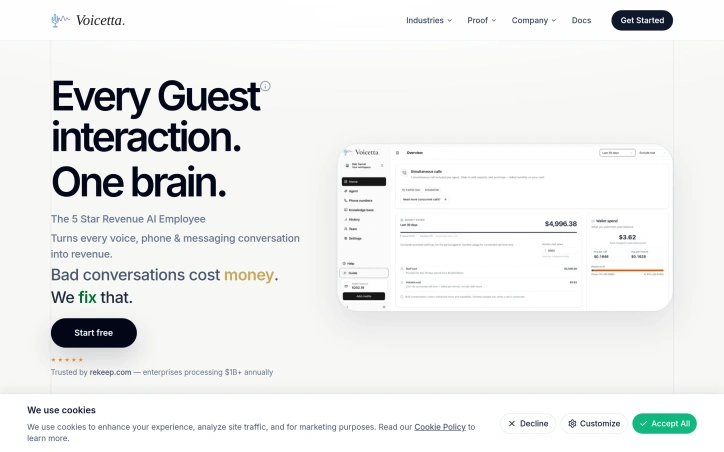
Fragmented communication channels cost organizations money in missed context and lost efficiency. When customer conversations span voice calls, SMS, and WhatsApp but live in separate systems, critical information vanishes between handoffs. Teams waste hours reconstructing customer history, escalations happen without context, and revenue opportunities slip away. Voicetta addresses this by consolidating every customer interaction—voice, SMS, WhatsApp, and messaging—into a unified conversation brain accessible across teams and systems. Rather than asking employees to piece together context from multiple platforms, teams see a complete, searchable timeline of every exchange with a customer, automatically transcribed and graded for quality. The product targets organizations where customer interaction quality directly impacts revenue: hotels managing guest experiences across booking and arrival, healthcare providers juggling patient calls and routine inquiries, real estate teams fielding leads at all hours, and enterprises deploying AI agents or hybrid human-AI support. The unifying thread is scale—managing high volumes of interactions across channels without losing context or growing headcount proportionally. What distinguishes Voicetta is its treatment of conversations as learnable assets rather than ephemeral events. The platform maintains a centralized "brain" that learns from interactions, grades them against defined standards, and surfaces performance patterns. The product also emphasizes it's API-first and works with any AI provider, appealing to organizations wanting to integrate into existing infrastructure rather than wholesale replacement. Core capabilities include automatic recording and transcription, performance grading with reasoning, pipeline visibility, and the ability to define behavior standards that consistently evaluate interactions. Teams access customer context at a glance—what a guest mentioned in SMS, what they asked in a call, what they've done across all channels—without asking around. Early adopters report measurable outcomes. One customer scaled call volume without adding headcount and achieved a 42 percent increase in close rates on inbound leads. A healthcare organization reduced time spent on routine inquiries, freeing specialists for complex cases, while providing 24/7 automated response coverage. Voicetta operates on a freemium model and is already running in production across hospitality, healthcare, and real estate.

Ai-voice-agents
R
Rafał Florek

Fragmented communication channels cost organizations money in missed context and lost efficiency. When customer conversations span voice calls, SMS, and WhatsApp but live in separate systems, critical information vanishes between handoffs. Teams waste hours reconstructing customer history, escalations happen without context, and revenue opportunities slip away. Voicetta addresses this by consolidating every customer interaction—voice, SMS, WhatsApp, and messaging—into a unified conversation brain accessible across teams and systems. Rather than asking employees to piece together context from multiple platforms, teams see a complete, searchable timeline of every exchange with a customer, automatically transcribed and graded for quality. The product targets organizations where customer interaction quality directly impacts revenue: hotels managing guest experiences across booking and arrival, healthcare providers juggling patient calls and routine inquiries, real estate teams fielding leads at all hours, and enterprises deploying AI agents or hybrid human-AI support. The unifying thread is scale—managing high volumes of interactions across channels without losing context or growing headcount proportionally. What distinguishes Voicetta is its treatment of conversations as learnable assets rather than ephemeral events. The platform maintains a centralized "brain" that learns from interactions, grades them against defined standards, and surfaces performance patterns. The product also emphasizes it's API-first and works with any AI provider, appealing to organizations wanting to integrate into existing infrastructure rather than wholesale replacement. Core capabilities include automatic recording and transcription, performance grading with reasoning, pipeline visibility, and the ability to define behavior standards that consistently evaluate interactions. Teams access customer context at a glance—what a guest mentioned in SMS, what they asked in a call, what they've done across all channels—without asking around. Early adopters report measurable outcomes. One customer scaled call volume without adding headcount and achieved a 42 percent increase in close rates on inbound leads. A healthcare organization reduced time spent on routine inquiries, freeing specialists for complex cases, while providing 24/7 automated response coverage. Voicetta operates on a freemium model and is already running in production across hospitality, healthcare, and real estate.

Voicetta, Inc. preview

Key features

  • Unified Conversation Timeline: Consolidates voice, SMS, WhatsApp, and messaging into one searchable location
  • Automatic Transcription: Records and transcribes all customer interactions across channels
See full listing
QueryTrace

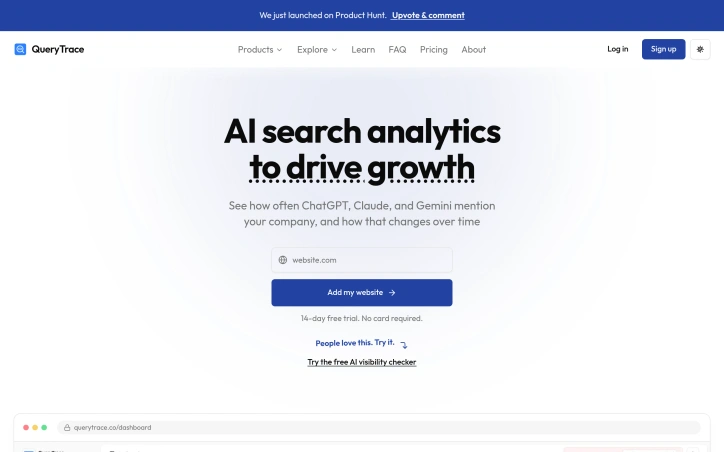
As AI models become primary discovery channels for consumers researching companies, brand visibility within these systems has become a measurable business concern. QueryTrace addresses this emerging need by providing the first platform designed to systematically track how AI mentions specific brands across multiple models. The product tackles a genuine gap in the market. While companies obsess over Google rankings, they have no insight into whether ChatGPT, Claude, Gemini, Perplexity, or other models mention their brand when users ask related questions. QueryTrace closes that gap by running queries against multiple AI models on a schedule, tracking mention rates, and surfacing trends over time. What distinguishes QueryTrace is its multi-model approach and competitive context. Rather than existing in isolation, users can benchmark their mention rate against specific competitors, seeing side-by-side comparisons and weekly trends that reveal whether recent business changes actually moved the needle. The platform adds sentiment and response quality analysis to raw mention counts, providing a more nuanced picture of how AI models frame references to the company. The feature set reflects practical needs. Users start by adding their domain and selecting the specific queries they want tracked—questions people actually ask in ChatGPT or Gemini about their industry. The platform then runs these queries on a schedule and displays results across crawling patterns, mentions in live chats, and referral traffic. For teams wanting deeper integration, QueryTrace connects to Cloudflare, AWS CloudFront, and Google Cloud CDN to track which AI models crawl pages and link to them. The company offers free tools to lower friction: an AI Visibility Checker, an AI Readiness Audit that verifies whether AI crawlers can read your site, and utilities for checking and generating llms.txt files. A 14-day free trial of the full platform requires no credit card. The business model targets companies concerned with AI discoverability but remains vague on pricing tiers or feature gates. The free trial period and no-credit-card requirement lower activation friction, though potential customers will need to contact sales for long-term cost details. QueryTrace fills a real void in brand monitoring tooling. As AI-driven discovery continues to grow, companies will increasingly need to measure and optimize their presence within these systems—making this a timely solution for marketing and product teams who view AI visibility as a material business factor.

Website-analytics
D
Devin Lester

As AI models become primary discovery channels for consumers researching companies, brand visibility within these systems has become a measurable business concern. QueryTrace addresses this emerging need by providing the first platform designed to systematically track how AI mentions specific brands across multiple models. The product tackles a genuine gap in the market. While companies obsess over Google rankings, they have no insight into whether ChatGPT, Claude, Gemini, Perplexity, or other models mention their brand when users ask related questions. QueryTrace closes that gap by running queries against multiple AI models on a schedule, tracking mention rates, and surfacing trends over time. What distinguishes QueryTrace is its multi-model approach and competitive context. Rather than existing in isolation, users can benchmark their mention rate against specific competitors, seeing side-by-side comparisons and weekly trends that reveal whether recent business changes actually moved the needle. The platform adds sentiment and response quality analysis to raw mention counts, providing a more nuanced picture of how AI models frame references to the company. The feature set reflects practical needs. Users start by adding their domain and selecting the specific queries they want tracked—questions people actually ask in ChatGPT or Gemini about their industry. The platform then runs these queries on a schedule and displays results across crawling patterns, mentions in live chats, and referral traffic. For teams wanting deeper integration, QueryTrace connects to Cloudflare, AWS CloudFront, and Google Cloud CDN to track which AI models crawl pages and link to them. The company offers free tools to lower friction: an AI Visibility Checker, an AI Readiness Audit that verifies whether AI crawlers can read your site, and utilities for checking and generating llms.txt files. A 14-day free trial of the full platform requires no credit card. The business model targets companies concerned with AI discoverability but remains vague on pricing tiers or feature gates. The free trial period and no-credit-card requirement lower activation friction, though potential customers will need to contact sales for long-term cost details. QueryTrace fills a real void in brand monitoring tooling. As AI-driven discovery continues to grow, companies will increasingly need to measure and optimize their presence within these systems—making this a timely solution for marketing and product teams who view AI visibility as a material business factor.

QueryTrace preview

Key features

  • Multi-Model Tracking: Monitors brand mentions across ChatGPT, Claude, Gemini, Perplexity, and other AI models.
  • Competitive Benchmarking: Compares mention rates against specific competitors with side-by-side comparisons and weekly trends.
See full listing
SEO Rank

Website optimization has traditionally demanded either expensive agency engagement or significant technical expertise. SEO Rank addresses this friction by delivering comprehensive site analysis through a free platform accessible to marketers, agencies, developers, and business owners of any skill level. The product bundles over twenty automated checks and seventeen tools into a single interface designed for speed. Rather than requiring hours of investigation, users receive instant insights into on-page optimization, content quality, technical SEO health, and mobile usability. The tool evaluates title tags, meta descriptions, heading structure, image alt text, Open Graph and Twitter Card setup, canonical tag usage, internal link quality, schema markup, security protocols, and accessibility compliance among other factors. What distinguishes this platform within the crowded SEO audit space is its integrated Google Search Console connection. This addition directly addresses a critical gap that frustrated early users: audit scores revealed problems, but offered no visibility into whether fixes actually improved performance. By surfacing real metrics like search impressions, clicks, and keyword rankings alongside audit results, the platform enables users to quantify the impact of their optimization efforts and compare performance across time periods. The feature roster also includes practical utilities beyond site auditing. A schema markup generator helps users create properly formatted structured data for articles, products, FAQs, and local business listings. A Google SERP preview tool shows how page titles and meta descriptions render in search results across desktop and mobile. Additional offerings include domain rating assessment, meta tag generation, and keyword density analysis. The roadmap indicates expansion is planned, with XML sitemap validators, robots.txt testing, backlink checking, and AI-powered content optimization flagged as coming features. This signals an ambition to evolve beyond diagnostic tools toward a more complete optimization suite. By eliminating cost barriers and condensing extensive analysis into seconds rather than days, SEO Rank targets a market segment genuinely underserved by premium SEO platforms. For small agencies and independent marketers managing multiple sites, or for business owners seeking baseline performance metrics without professional consultant fees, the product delivers clear utility. The Search Console integration particularly strengthens its position by connecting diagnostic data to real-world search performance, transforming audit scores from abstract recommendations into measurable outcomes.


Seo-tools
P
Patel Yash

Website optimization has traditionally demanded either expensive agency engagement or significant technical expertise. SEO Rank addresses this friction by delivering comprehensive site analysis through a free platform accessible to marketers, agencies, developers, and business owners of any skill level. The product bundles over twenty automated checks and seventeen tools into a single interface designed for speed. Rather than requiring hours of investigation, users receive instant insights into on-page optimization, content quality, technical SEO health, and mobile usability. The tool evaluates title tags, meta descriptions, heading structure, image alt text, Open Graph and Twitter Card setup, canonical tag usage, internal link quality, schema markup, security protocols, and accessibility compliance among other factors. What distinguishes this platform within the crowded SEO audit space is its integrated Google Search Console connection. This addition directly addresses a critical gap that frustrated early users: audit scores revealed problems, but offered no visibility into whether fixes actually improved performance. By surfacing real metrics like search impressions, clicks, and keyword rankings alongside audit results, the platform enables users to quantify the impact of their optimization efforts and compare performance across time periods. The feature roster also includes practical utilities beyond site auditing. A schema markup generator helps users create properly formatted structured data for articles, products, FAQs, and local business listings. A Google SERP preview tool shows how page titles and meta descriptions render in search results across desktop and mobile. Additional offerings include domain rating assessment, meta tag generation, and keyword density analysis. The roadmap indicates expansion is planned, with XML sitemap validators, robots.txt testing, backlink checking, and AI-powered content optimization flagged as coming features. This signals an ambition to evolve beyond diagnostic tools toward a more complete optimization suite. By eliminating cost barriers and condensing extensive analysis into seconds rather than days, SEO Rank targets a market segment genuinely underserved by premium SEO platforms. For small agencies and independent marketers managing multiple sites, or for business owners seeking baseline performance metrics without professional consultant fees, the product delivers clear utility. The Search Console integration particularly strengthens its position by connecting diagnostic data to real-world search performance, transforming audit scores from abstract recommendations into measurable outcomes.

SEO Rank preview

Key features

  • Automated Site Checks: Bundles over twenty automated checks for instant insights into on-page optimization, technical SEO, and mobile usability.
  • Search Console Integration: Connects audit scores with real search metrics like impressions, clicks, and keyword rankings.
See full listing
Artik Mart

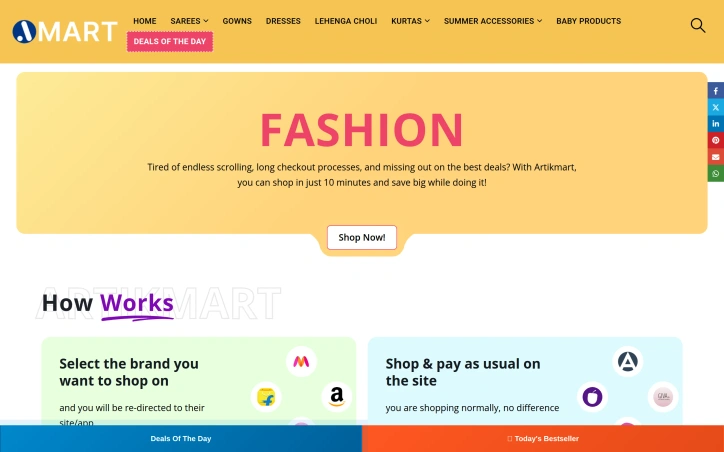
Navigating India's sprawling e-commerce marketplace exhausts fashion shoppers overwhelmed by choice. Artik Mart addresses this friction through curation, offering a streamlined path to Indian fashion staples and contemporary wear. The platform targets women seeking traditional and contemporary Indian garments—lehengas, sarees, kurtis, and dresses alongside shapewear and swimwear. Its mission centers on filtering the noise endemic to Indian e-commerce through product curation and honest comparisons, building shopper confidence in selections made. Rather than holding inventory, Artik Mart operates as an aggregation layer, redirecting customers to partner brand sites where they complete purchases directly. This approach eliminates transaction friction while maintaining lean operations. What distinguishes the platform is editorial focus paired with speed. The claimed ten-minute shopping window reflects an interface built for rapid browsing, while curated selections establish Artik Mart as an intentional filter in a market drowning in inventory. Categories—traditional Indian wear, contemporary dresses, activewear—organize products crisply compared to generalist marketplaces that bury Indian fashion brands under sprawling catalogs. Editorial curation isn't just selection; it's selection with reasoning behind it. The product catalog serves a specific market: Indian women seeking occasion wear, everyday clothing, and intimate apparel. Categories encompass wedding lehengas and formal sarees to shapewear and high-waisted athletic leggings, covering both traditional and modern Indian fashion in one destination. The range reflects the founder's stated focus on wellness, beauty, and fashion, though the website emphasizes apparel heavily. The business model relies on partnerships and affiliate arrangements, indicated by "Co-Powered By" branding throughout the site. The platform charges users nothing—revenue flows through partner commissions or referral fees. The specific terms and commission structures remain proprietary. For Indian fashion shoppers drowning in e-commerce choice, Artik Mart delivers a focused alternative rooted in editorial judgment. It trades breadth for intentionality, betting that expert curation reduces decision fatigue and builds purchase confidence. Success depends entirely on whether the curated selections genuinely reflect audience taste and whether referred traffic converts at partner brands. The platform lives or dies by the accuracy of its selections and the relevance of its partnerships.
Ecommerce-platforms
A
Artik Mart

Navigating India's sprawling e-commerce marketplace exhausts fashion shoppers overwhelmed by choice. Artik Mart addresses this friction through curation, offering a streamlined path to Indian fashion staples and contemporary wear. The platform targets women seeking traditional and contemporary Indian garments—lehengas, sarees, kurtis, and dresses alongside shapewear and swimwear. Its mission centers on filtering the noise endemic to Indian e-commerce through product curation and honest comparisons, building shopper confidence in selections made. Rather than holding inventory, Artik Mart operates as an aggregation layer, redirecting customers to partner brand sites where they complete purchases directly. This approach eliminates transaction friction while maintaining lean operations. What distinguishes the platform is editorial focus paired with speed. The claimed ten-minute shopping window reflects an interface built for rapid browsing, while curated selections establish Artik Mart as an intentional filter in a market drowning in inventory. Categories—traditional Indian wear, contemporary dresses, activewear—organize products crisply compared to generalist marketplaces that bury Indian fashion brands under sprawling catalogs. Editorial curation isn't just selection; it's selection with reasoning behind it. The product catalog serves a specific market: Indian women seeking occasion wear, everyday clothing, and intimate apparel. Categories encompass wedding lehengas and formal sarees to shapewear and high-waisted athletic leggings, covering both traditional and modern Indian fashion in one destination. The range reflects the founder's stated focus on wellness, beauty, and fashion, though the website emphasizes apparel heavily. The business model relies on partnerships and affiliate arrangements, indicated by "Co-Powered By" branding throughout the site. The platform charges users nothing—revenue flows through partner commissions or referral fees. The specific terms and commission structures remain proprietary. For Indian fashion shoppers drowning in e-commerce choice, Artik Mart delivers a focused alternative rooted in editorial judgment. It trades breadth for intentionality, betting that expert curation reduces decision fatigue and builds purchase confidence. Success depends entirely on whether the curated selections genuinely reflect audience taste and whether referred traffic converts at partner brands. The platform lives or dies by the accuracy of its selections and the relevance of its partnerships.

Artik Mart preview

Key features

  • Editorial Curation: Expert-selected Indian fashion with transparent reasoning to reduce shopping decision fatigue.
  • Rapid Shopping Interface: Designed for fast browsing with a claimed ten-minute shopping window to find products quickly.
See full listing
W

Managing emergency WordPress issues can derail site owners—unexpected outages, plugin conflicts, and security breaches demand immediate expert attention, yet finding reliable developers who won't overcharge or drag out repairs remains difficult. WordPress Bug Fix Service addresses this pain point directly, positioning itself as a fast-response alternative for both acute problems and broader customization work. The service maintains senior developers available around the clock with a stated average response time of five minutes. Their scope extends beyond emergency repairs to encompass theme customization, Figma-to-WordPress conversions, custom plugin development, WooCommerce store builds, malware cleanup, and performance optimization. This breadth indicates the team handles everything from quick surgical fixes to complete rebuilds, reducing the operational friction of juggling multiple vendors for different WordPress tasks. The payment structure sets itself apart from subscription-based support models. Clients pay 25 percent upfront to initiate work, then the remaining 75 percent only after the fix ships and performs as expected. This arrangement distributes financial risk and eliminates hidden fees—a departure from traditional WordPress agencies that charge retainers or require long-term commitments. The service credits 1,200 resolved bugs and maintains a 100 percent satisfaction guarantee, though these claims lack independent verification in the available materials. The workflow emphasizes transparency: initial assessment includes reproducing the issue and providing a flat-rate quote before any major work begins. Developers work on staging environments first, minimizing production risk. The diagnostic approach shown in their marketing materials depicts systematic problem-solving rather than a black-box operation. Practical considerations merit attention. The service requires clients to provide temporary access to wp-admin and hosting credentials, introducing security decisions that conscientious site owners must evaluate. Additionally, five-minute average response times assume developers are genuinely staffed to handle demand spikes; such averages mask variation across queue depths and time zones. The product targets site owners facing unexpected downtime who value speed and predictable costs over traditional agency relationships. For WordPress professionals or shops managing multiple sites, the per-fix pricing model costs significantly more over time than annual retainers. For isolated problems requiring expert diagnosis, however, the approach delivers clear value.


Website-builders
S
sachin nagpal

Managing emergency WordPress issues can derail site owners—unexpected outages, plugin conflicts, and security breaches demand immediate expert attention, yet finding reliable developers who won't overcharge or drag out repairs remains difficult. WordPress Bug Fix Service addresses this pain point directly, positioning itself as a fast-response alternative for both acute problems and broader customization work. The service maintains senior developers available around the clock with a stated average response time of five minutes. Their scope extends beyond emergency repairs to encompass theme customization, Figma-to-WordPress conversions, custom plugin development, WooCommerce store builds, malware cleanup, and performance optimization. This breadth indicates the team handles everything from quick surgical fixes to complete rebuilds, reducing the operational friction of juggling multiple vendors for different WordPress tasks. The payment structure sets itself apart from subscription-based support models. Clients pay 25 percent upfront to initiate work, then the remaining 75 percent only after the fix ships and performs as expected. This arrangement distributes financial risk and eliminates hidden fees—a departure from traditional WordPress agencies that charge retainers or require long-term commitments. The service credits 1,200 resolved bugs and maintains a 100 percent satisfaction guarantee, though these claims lack independent verification in the available materials. The workflow emphasizes transparency: initial assessment includes reproducing the issue and providing a flat-rate quote before any major work begins. Developers work on staging environments first, minimizing production risk. The diagnostic approach shown in their marketing materials depicts systematic problem-solving rather than a black-box operation. Practical considerations merit attention. The service requires clients to provide temporary access to wp-admin and hosting credentials, introducing security decisions that conscientious site owners must evaluate. Additionally, five-minute average response times assume developers are genuinely staffed to handle demand spikes; such averages mask variation across queue depths and time zones. The product targets site owners facing unexpected downtime who value speed and predictable costs over traditional agency relationships. For WordPress professionals or shops managing multiple sites, the per-fix pricing model costs significantly more over time than annual retainers. For isolated problems requiring expert diagnosis, however, the approach delivers clear value.

WordPress Bug Fix Service preview
W

Key features

  • 24/7 Senior Developer Support: Available around the clock for emergency WordPress issues.
  • Five Minute Average Response: Stated average response time of five minutes to initial inquiries.
See full listing
Guitar Setup Lab

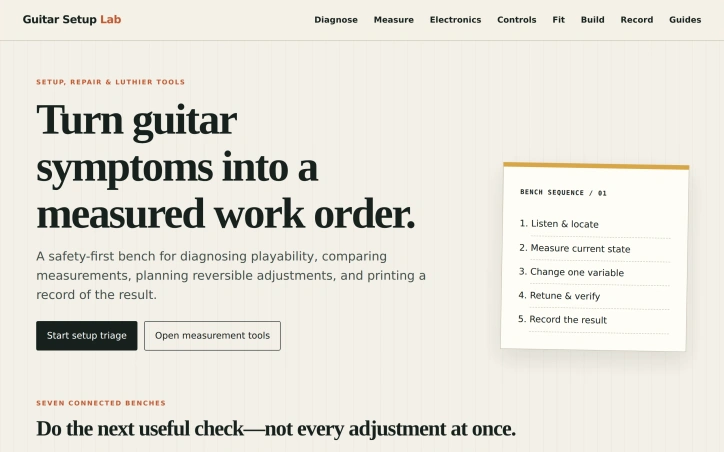
Diagnosing and repairing guitar problems systematically has long been the domain of experienced technicians working from intuition and acquired knowledge. Guitar Setup Lab transforms setup and repair work by replacing guesswork with measurement-based diagnostics, structured workflows, and documented records that reduce the risk of permanent damage to instruments. The platform organizes work around logical dependencies: stable strings and tuning come before adjusting neck relief; relief settings precede bridge action; pickup clearance follows the determined string path. This sequenced approach prevents the common mistake of adjusting multiple variables simultaneously, which obscures cause and effect. Seven interconnected diagnostic benches guide users through measurement, adjustment planning, and documentation according to this dependency chain rather than attempting every possible fix at once. The tool excels in breadth. Beyond basic playability diagnostics like fret buzz and action height, it handles specialized measurements for pickup compatibility, control hardware fit, electronics troubleshooting, and geometry planning for instrument builders. Built-in guides interpret measurements in context—converting between units, explaining what values mean for playability, and suggesting appropriate next steps. For professionals, the software generates shop-ready intake forms, quotes, job records, and condition documentation that create accountability and improve client communication. A standout feature is the geometry bench for instrument building, which calculates fret coordinates, spacing, multiscale layouts, and tremolo balance from measured physical datums. This bridges the gap between design intent and fabrication, eliminating the import errors and label misreadings that plague aftermarket component sourcing. Users can project string spread to verify pickup compatibility before ordering parts, or check control cavity geometry against manufacturer specifications. The product targets both independent guitarists managing their own instruments and professional luthiers running repair shops. Guitarists gain confidence in basic setup decisions; luthiers gain structured workflows that reduce liability and improve shop efficiency through systematic documentation. One notable aspect is the emphasis on reversibility—setup is framed as a series of measured checks and isolated adjustments rather than permanent modifications. This philosophy permeates the tool's design, from the diagnostic flow to the printed records that serve as before-and-after evidence of work completed. The offering sits at the intersection of professional tooling and accessibility, assuming users lack formal training but care about precision and process. It provides the measurement guidance, conversion logic, and decision frameworks that separate confident adjustment from guesswork.

Knowledge-base-software
C
canghun13

Diagnosing and repairing guitar problems systematically has long been the domain of experienced technicians working from intuition and acquired knowledge. Guitar Setup Lab transforms setup and repair work by replacing guesswork with measurement-based diagnostics, structured workflows, and documented records that reduce the risk of permanent damage to instruments. The platform organizes work around logical dependencies: stable strings and tuning come before adjusting neck relief; relief settings precede bridge action; pickup clearance follows the determined string path. This sequenced approach prevents the common mistake of adjusting multiple variables simultaneously, which obscures cause and effect. Seven interconnected diagnostic benches guide users through measurement, adjustment planning, and documentation according to this dependency chain rather than attempting every possible fix at once. The tool excels in breadth. Beyond basic playability diagnostics like fret buzz and action height, it handles specialized measurements for pickup compatibility, control hardware fit, electronics troubleshooting, and geometry planning for instrument builders. Built-in guides interpret measurements in context—converting between units, explaining what values mean for playability, and suggesting appropriate next steps. For professionals, the software generates shop-ready intake forms, quotes, job records, and condition documentation that create accountability and improve client communication. A standout feature is the geometry bench for instrument building, which calculates fret coordinates, spacing, multiscale layouts, and tremolo balance from measured physical datums. This bridges the gap between design intent and fabrication, eliminating the import errors and label misreadings that plague aftermarket component sourcing. Users can project string spread to verify pickup compatibility before ordering parts, or check control cavity geometry against manufacturer specifications. The product targets both independent guitarists managing their own instruments and professional luthiers running repair shops. Guitarists gain confidence in basic setup decisions; luthiers gain structured workflows that reduce liability and improve shop efficiency through systematic documentation. One notable aspect is the emphasis on reversibility—setup is framed as a series of measured checks and isolated adjustments rather than permanent modifications. This philosophy permeates the tool's design, from the diagnostic flow to the printed records that serve as before-and-after evidence of work completed. The offering sits at the intersection of professional tooling and accessibility, assuming users lack formal training but care about precision and process. It provides the measurement guidance, conversion logic, and decision frameworks that separate confident adjustment from guesswork.

Guitar Setup Lab preview

Key features

  • Measurement-Based Diagnostics: Replaces guesswork with precise measurement-based diagnostics and structured workflows.
  • Sequential Diagnostic Benches: Seven interconnected diagnostic benches guide users through measurements and adjustments following logical dependencies.
See full listing
Data Storage Lab

Storage planning typically requires navigating a fragmented ecosystem of product catalogs, vendor websites, and single-purpose calculators, each addressing only one dimension of the problem. Data Storage Lab consolidates this scattered process into a cohesive planning tool designed for households and small organizations that need to handle backup and recovery without vendor lock-in. The tool addresses a genuine friction point in how people approach storage decisions. Most users start with capacity questions but lack a structured way to think about protection, backup, and recovery together. Data Storage Lab guides planners through describing their data, setting recovery priorities, and reviewing a complete configuration that connects these decisions. This systematic approach distinguishes it from tools that isolate one question at a time. A core insight embedded in the tool's design is clarity about what RAID actually protects against. The product explicitly rejects the common misconception that RAID redundancy serves as backup. Instead, it frames array protection as a hedge against downtime from drive failure while emphasizing that independent backup copies protect against deletion, ransomware, theft, and site-wide failure. This distinction forces more rigorous thinking about recovery architecture. The planning paths accommodate different scenarios: families managing photos and video, media creators with growing storage needs, freelancers protecting work files, home lab builders, and small offices with multiple users. For each scenario, the tool produces guidance on usable capacity, bay and drive ranges, protection strategies, backup allocation, network specifications, and equipment categories. The vendor-neutral stance removes pressure to choose specific brands during planning, letting users focus on functional requirements first. The output is a configuration brief and equipment checklist, enabling users to shop for hardware independently after understanding what they actually need. The tool does not attempt to replace hardware decisions with formulas. Instead, it bridges the gap between abstract storage requirements and concrete equipment selection, providing enough specificity to guide purchasing without prescribing products. This positions it as infrastructure planning for people who would otherwise assemble their knowledge from scattered sources or make reactive decisions at purchase time.


Project-management-software
C
canghun13

Storage planning typically requires navigating a fragmented ecosystem of product catalogs, vendor websites, and single-purpose calculators, each addressing only one dimension of the problem. Data Storage Lab consolidates this scattered process into a cohesive planning tool designed for households and small organizations that need to handle backup and recovery without vendor lock-in. The tool addresses a genuine friction point in how people approach storage decisions. Most users start with capacity questions but lack a structured way to think about protection, backup, and recovery together. Data Storage Lab guides planners through describing their data, setting recovery priorities, and reviewing a complete configuration that connects these decisions. This systematic approach distinguishes it from tools that isolate one question at a time. A core insight embedded in the tool's design is clarity about what RAID actually protects against. The product explicitly rejects the common misconception that RAID redundancy serves as backup. Instead, it frames array protection as a hedge against downtime from drive failure while emphasizing that independent backup copies protect against deletion, ransomware, theft, and site-wide failure. This distinction forces more rigorous thinking about recovery architecture. The planning paths accommodate different scenarios: families managing photos and video, media creators with growing storage needs, freelancers protecting work files, home lab builders, and small offices with multiple users. For each scenario, the tool produces guidance on usable capacity, bay and drive ranges, protection strategies, backup allocation, network specifications, and equipment categories. The vendor-neutral stance removes pressure to choose specific brands during planning, letting users focus on functional requirements first. The output is a configuration brief and equipment checklist, enabling users to shop for hardware independently after understanding what they actually need. The tool does not attempt to replace hardware decisions with formulas. Instead, it bridges the gap between abstract storage requirements and concrete equipment selection, providing enough specificity to guide purchasing without prescribing products. This positions it as infrastructure planning for people who would otherwise assemble their knowledge from scattered sources or make reactive decisions at purchase time.

Data Storage Lab preview

Key features

  • Consolidated Planning: combines fragmented storage resources, vendor catalogs, and calculators into one cohesive tool
  • RAID vs Backup Clarity: explicitly distinguishes array protection from backup and explains what RAID actually protects against
See full listing
RacoonDR

Getting domain rating data has traditionally required either expensive SEO tools or signing up for accounts you might not want. RacoonDR addresses this friction by offering free, instant DR checks without requiring any registration, plus daily tracking once you create an account. The service targets website owners and SEO professionals who want to monitor how their domain rating evolves over time without paying subscription fees or dealing with signup barriers. The product's core appeal lies in its simplicity and the incentive structure built around it. Rather than charging upfront, RacoonDR offers its tracking service free and generates value by placing lightweight SVG badges on participating sites. When a user displays the badge on their website, RacoonDR automatically verifies its placement and converts the link to the site into a dofollow backlink. This creates a mutually beneficial exchange where site owners gain free tracking and a small badge, while RacoonDR builds a network of dofollow links. For users unwilling to display the badge, a Pro tier priced at $5.99 per month provides 15 dofollow links without any badge requirement. The feature set supports the core use case effectively. Users can look up any domain's rating instantly and view historical charts tracking how that rating changes. Each checked domain gets its own public page, and the service displays global rank and domain age alongside the rating. A leaderboard highlights top gainers each month, adding a competitive element. The badge itself is impressively lightweight at under 3 kilobytes, reducing performance impact for sites that choose to display it. By making DR lookup and tracking free and frictionless, RacoonDR democratizes access to domain rating intelligence that competitors often gate behind paywalls. The badge-for-backlink model is clever, turning users into advocates who actively market the tool by hosting its badge. This approach bootstraps both user growth and SEO value simultaneously. For websites with modest domains seeking free tracking or those willing to trade a small badge display for a dofollow link, RacoonDR presents a genuine alternative to paid SEO tools.


Seo-tools
N
Noah

Getting domain rating data has traditionally required either expensive SEO tools or signing up for accounts you might not want. RacoonDR addresses this friction by offering free, instant DR checks without requiring any registration, plus daily tracking once you create an account. The service targets website owners and SEO professionals who want to monitor how their domain rating evolves over time without paying subscription fees or dealing with signup barriers. The product's core appeal lies in its simplicity and the incentive structure built around it. Rather than charging upfront, RacoonDR offers its tracking service free and generates value by placing lightweight SVG badges on participating sites. When a user displays the badge on their website, RacoonDR automatically verifies its placement and converts the link to the site into a dofollow backlink. This creates a mutually beneficial exchange where site owners gain free tracking and a small badge, while RacoonDR builds a network of dofollow links. For users unwilling to display the badge, a Pro tier priced at $5.99 per month provides 15 dofollow links without any badge requirement. The feature set supports the core use case effectively. Users can look up any domain's rating instantly and view historical charts tracking how that rating changes. Each checked domain gets its own public page, and the service displays global rank and domain age alongside the rating. A leaderboard highlights top gainers each month, adding a competitive element. The badge itself is impressively lightweight at under 3 kilobytes, reducing performance impact for sites that choose to display it. By making DR lookup and tracking free and frictionless, RacoonDR democratizes access to domain rating intelligence that competitors often gate behind paywalls. The badge-for-backlink model is clever, turning users into advocates who actively market the tool by hosting its badge. This approach bootstraps both user growth and SEO value simultaneously. For websites with modest domains seeking free tracking or those willing to trade a small badge display for a dofollow link, RacoonDR presents a genuine alternative to paid SEO tools.

RacoonDR preview

Key features

  • Instant DR Checks: Check any domain's rating without registration or signup barriers
  • Daily Tracking: Monitor domain rating changes over time with historical charts after account creation
See full listing
Font Generator

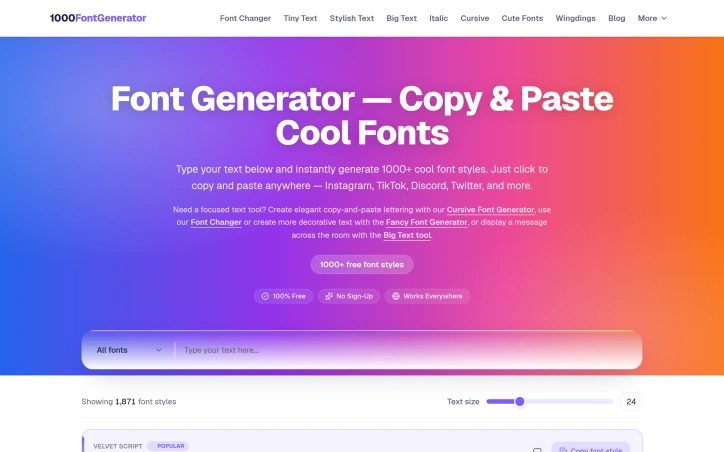
Stylish text formatting on social media typically requires either design skills or third-party tools that demand sign-ups. Font Generator strips away both barriers by offering a free, no-registration font transformation service with an unusually large collection of styling options. The core value proposition targets social media users across Instagram, TikTok, Discord, and Twitter who want to differentiate their usernames, bios, and captions with distinctive typography. The product eliminates the friction of learning design software by letting users type text, browse from over 1,800 available styles, and copy the formatted result directly to their clipboard. The breadth of the font library stands out as the primary differentiator. Rather than offering a small curated set, Font Generator organizes 1,871 styles into purpose-built categories: cursive and script fonts for elegant applications, bold and heavy typefaces for impact, gothic and blackletter fonts for dramatic effect, bubble and cute fonts for playful contexts, glitch and Zalgo text for distorted aesthetics, vaporwave styles for retro-inspired bios, small caps for compact text, and decorative symbols for additional customization. This categorical organization allows users to browse by intent rather than sorting through an overwhelming flat list. The interface prioritizes speed. Popular fonts receive prominent placement, copy buttons sit directly next to previews, and users preview results with their own text before committing to a selection. The product handles decision fatigue by surfacing trending styles upfront while exposing the full collection for deeper exploration. Font Generator operates as a completely free service with no explicit monetization model disclosed. No pricing tiers, subscriptions, or premium features appear on the site, suggesting revenue may derive from advertising, affiliate arrangements, or other indirect channels. A technical constraint worth noting is that Font Generator relies on Unicode character substitution rather than embedding actual font files. This approach enables copy-paste functionality across platforms without compatibility issues but limits visual possibilities to what Unicode supports. The trade-off is intentional and sensible for the use case. For social media users seeking quick visual differentiation without design expertise or registration requirements, Font Generator delivers direct utility through a low-barrier, comprehensive option library.

Writing-assistants
C
Chuan Yu

Stylish text formatting on social media typically requires either design skills or third-party tools that demand sign-ups. Font Generator strips away both barriers by offering a free, no-registration font transformation service with an unusually large collection of styling options. The core value proposition targets social media users across Instagram, TikTok, Discord, and Twitter who want to differentiate their usernames, bios, and captions with distinctive typography. The product eliminates the friction of learning design software by letting users type text, browse from over 1,800 available styles, and copy the formatted result directly to their clipboard. The breadth of the font library stands out as the primary differentiator. Rather than offering a small curated set, Font Generator organizes 1,871 styles into purpose-built categories: cursive and script fonts for elegant applications, bold and heavy typefaces for impact, gothic and blackletter fonts for dramatic effect, bubble and cute fonts for playful contexts, glitch and Zalgo text for distorted aesthetics, vaporwave styles for retro-inspired bios, small caps for compact text, and decorative symbols for additional customization. This categorical organization allows users to browse by intent rather than sorting through an overwhelming flat list. The interface prioritizes speed. Popular fonts receive prominent placement, copy buttons sit directly next to previews, and users preview results with their own text before committing to a selection. The product handles decision fatigue by surfacing trending styles upfront while exposing the full collection for deeper exploration. Font Generator operates as a completely free service with no explicit monetization model disclosed. No pricing tiers, subscriptions, or premium features appear on the site, suggesting revenue may derive from advertising, affiliate arrangements, or other indirect channels. A technical constraint worth noting is that Font Generator relies on Unicode character substitution rather than embedding actual font files. This approach enables copy-paste functionality across platforms without compatibility issues but limits visual possibilities to what Unicode supports. The trade-off is intentional and sensible for the use case. For social media users seeking quick visual differentiation without design expertise or registration requirements, Font Generator delivers direct utility through a low-barrier, comprehensive option library.

Font Generator preview

Key features

  • Large Font Library: Over 1,800 styles organized into categories including cursive, bold, gothic, bubble, glitch, vaporwave, small caps, and decorative symbols.
  • Free and Registration-Free: Completely free service with no sign-up required to access the formatting tool.
See full listing
Mini PC Price

Buying a mini computer typically demands opening dozens of retailer tabs, copying specifications into spreadsheets, and cross-referencing prices across multiple platforms. Mini PC Price eliminates this friction by consolidating every available listing into a single searchable, filterable database where buyers compare specifications and prices without context switching. The tool serves multiple buyer personas with distinct research patterns. Office managers seeking budget systems with specific RAM and storage configurations can layer filters by price and memory specifications. Gamers hunting high-performance compact systems prioritize GPU capabilities and CPU boost clocks. Those interested in upgrading components can compare RAM maximums and storage interfaces. Rather than forcing a universal view, the tool lets each cohort toggle only the columns that matter for their decision. Several design choices distinguish Mini PC Price from conventional price comparison sites. It functions as a comprehensive parameter database rather than a curated top-ten list, capturing the full catalog across brands including Beelink, Minisforum, Intel NUC, ASUS, Lenovo, and HP. Listings source from real marketplace data with daily price refreshes. Specifications undergo manual verification where it matters—RAM type, GPU classification, OS bundling, and upgrade paths—rather than relying on auto-scraped data prone to inconsistency. The feature set prioritizes rapid discovery and precision. Search operates on type-ahead, accepting brand names, chip identifiers like 7840HS or N100, port counts, or product title fragments. Structured filters stack together, enabling queries like "mini computer under $600 with discrete GPU" without requiring review aggregator browsing. Sorting defaults to price but pivots to RAM, storage capacity, or processor speed on demand. Condition filtering toggles between new, used, renewed, and refurbished inventory without disrupting the filtered view. A sharing mechanism enables users to save groups and distribute links, particularly useful for forum recommendations or team purchasing scenarios. The emphasis on customization—column selection, filter stacking, search precision—reflects a product built around actual buyer workflows rather than editorial taste-making. The free model removes acquisition barriers for individual shoppers and procurement professionals alike. Without explicit monetization details in available materials, the zero-cost entry positions Mini PC Price as a utility resource for anyone shopping mini computers.
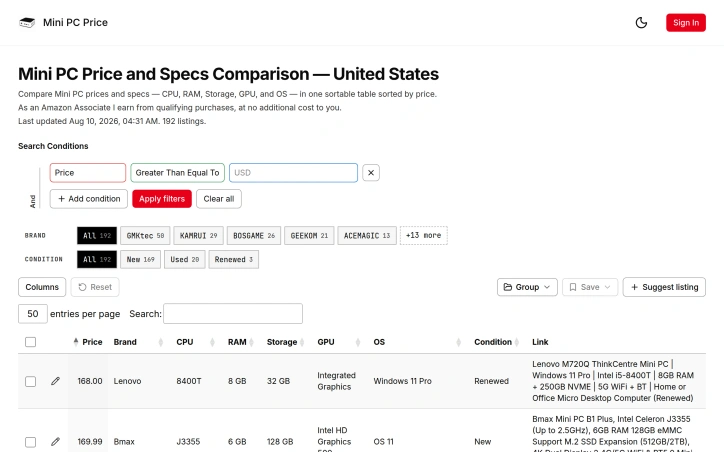

Buying a mini computer typically demands opening dozens of retailer tabs, copying specifications into spreadsheets, and cross-referencing prices across multiple platforms. Mini PC Price eliminates this friction by consolidating every available listing into a single searchable, filterable database where buyers compare specifications and prices without context switching. The tool serves multiple buyer personas with distinct research patterns. Office managers seeking budget systems with specific RAM and storage configurations can layer filters by price and memory specifications. Gamers hunting high-performance compact systems prioritize GPU capabilities and CPU boost clocks. Those interested in upgrading components can compare RAM maximums and storage interfaces. Rather than forcing a universal view, the tool lets each cohort toggle only the columns that matter for their decision. Several design choices distinguish Mini PC Price from conventional price comparison sites. It functions as a comprehensive parameter database rather than a curated top-ten list, capturing the full catalog across brands including Beelink, Minisforum, Intel NUC, ASUS, Lenovo, and HP. Listings source from real marketplace data with daily price refreshes. Specifications undergo manual verification where it matters—RAM type, GPU classification, OS bundling, and upgrade paths—rather than relying on auto-scraped data prone to inconsistency. The feature set prioritizes rapid discovery and precision. Search operates on type-ahead, accepting brand names, chip identifiers like 7840HS or N100, port counts, or product title fragments. Structured filters stack together, enabling queries like "mini computer under $600 with discrete GPU" without requiring review aggregator browsing. Sorting defaults to price but pivots to RAM, storage capacity, or processor speed on demand. Condition filtering toggles between new, used, renewed, and refurbished inventory without disrupting the filtered view. A sharing mechanism enables users to save groups and distribute links, particularly useful for forum recommendations or team purchasing scenarios. The emphasis on customization—column selection, filter stacking, search precision—reflects a product built around actual buyer workflows rather than editorial taste-making. The free model removes acquisition barriers for individual shoppers and procurement professionals alike. Without explicit monetization details in available materials, the zero-cost entry positions Mini PC Price as a utility resource for anyone shopping mini computers.

Mini PC Price preview

Key features

  • Consolidated Database: Aggregates mini PC listings from multiple brands into a single searchable, filterable database.
  • Type-Ahead Search: Search accepts brand names, chip identifiers like 7840HS or N100, port counts, and product fragments.
See full listing
EdgePhishGuard

Mobile phishing campaigns have moved beyond simple email tricks. They arrive as text messages that impersonate banks, QR codes that redirect to credential-harvesting pages, notifications from seemingly trusted apps, and links embedded in screenshots shared across messaging platforms. EdgePhishGuard tackles this expanding threat surface by placing a security checkpoint directly on the user's Android device, where the decision happens fastest. The product addresses a genuine gap in mobile security. Most anti-phishing solutions operate on the server side, requiring users to upload suspicious content to cloud services before they get a verdict. EdgePhishGuard inverts this model. Its core analysis runs locally using TensorFlow Lite models that identify linguistic and structural phishing patterns without leaving the device. The approach protects privacy while reducing latency and eliminating friction. What distinguishes this tool is its breadth of input modes. Users can paste suspicious links or text directly, scan QR codes through the camera, extract URLs from screenshots via OCR, or share content from notification bars and messaging apps. This multi-modal design acknowledges how phishing actually reaches people in practice: rarely as a bare URL, often embedded in context that requires extraction or interpretation. The OCR and QR reading capabilities transform the app from a link validator into a content analyzer that handles the obfuscation tactics modern attackers use. The product doesn't attempt to make decisions for users. Instead, it surfaces the reasoning behind its risk assessment, showing detected language, identified patterns, domain reputation signals, and specific recommendations. Users can adjust the alert threshold themselves, creating a control mechanism rather than an on-off switch. This approach aligns with security best practices that favor informed decision-making over black-box automation. Support for multiple languages, with language detection routing content to the appropriate local model, suggests consideration for non-English-speaking populations who may face phishing tailored to their linguistic and cultural context. This practical detail distinguishes EdgePhishGuard from larger security platforms that often overlook regional variations in attack patterns. The absence of pricing information on the landing page leaves questions about the business model unanswered. Whether this will be free, subscription-based, or ad-supported matters to potential users considering adoption. Regardless, the local-processing architecture and transparent risk scoring represent a meaningful departure from the surveillance-heavy approach many mobile security tools take. For users skeptical of uploading sensitive information to cloud services, EdgePhishGuard offers a credible alternative.


Security-software
E
EdgePhishGuard

Mobile phishing campaigns have moved beyond simple email tricks. They arrive as text messages that impersonate banks, QR codes that redirect to credential-harvesting pages, notifications from seemingly trusted apps, and links embedded in screenshots shared across messaging platforms. EdgePhishGuard tackles this expanding threat surface by placing a security checkpoint directly on the user's Android device, where the decision happens fastest. The product addresses a genuine gap in mobile security. Most anti-phishing solutions operate on the server side, requiring users to upload suspicious content to cloud services before they get a verdict. EdgePhishGuard inverts this model. Its core analysis runs locally using TensorFlow Lite models that identify linguistic and structural phishing patterns without leaving the device. The approach protects privacy while reducing latency and eliminating friction. What distinguishes this tool is its breadth of input modes. Users can paste suspicious links or text directly, scan QR codes through the camera, extract URLs from screenshots via OCR, or share content from notification bars and messaging apps. This multi-modal design acknowledges how phishing actually reaches people in practice: rarely as a bare URL, often embedded in context that requires extraction or interpretation. The OCR and QR reading capabilities transform the app from a link validator into a content analyzer that handles the obfuscation tactics modern attackers use. The product doesn't attempt to make decisions for users. Instead, it surfaces the reasoning behind its risk assessment, showing detected language, identified patterns, domain reputation signals, and specific recommendations. Users can adjust the alert threshold themselves, creating a control mechanism rather than an on-off switch. This approach aligns with security best practices that favor informed decision-making over black-box automation. Support for multiple languages, with language detection routing content to the appropriate local model, suggests consideration for non-English-speaking populations who may face phishing tailored to their linguistic and cultural context. This practical detail distinguishes EdgePhishGuard from larger security platforms that often overlook regional variations in attack patterns. The absence of pricing information on the landing page leaves questions about the business model unanswered. Whether this will be free, subscription-based, or ad-supported matters to potential users considering adoption. Regardless, the local-processing architecture and transparent risk scoring represent a meaningful departure from the surveillance-heavy approach many mobile security tools take. For users skeptical of uploading sensitive information to cloud services, EdgePhishGuard offers a credible alternative.

EdgePhishGuard preview

Key features

  • Local Processing: TensorFlow Lite models run on-device to identify phishing patterns without uploading to cloud services
  • Multi-Modal Input: Analyzes suspicious links, QR codes, screenshot text via OCR, and content from messaging apps and notifications
See full listing
Stackivo

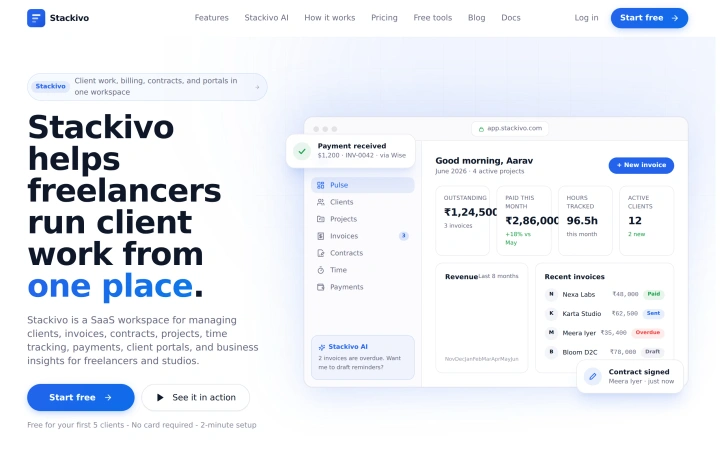
Freelancers and studios operating in India face a common problem: their business processes are spread across a half-dozen disconnected applications. Invoices live in spreadsheets, client communication happens on WhatsApp, contracts sit in Word documents, time tracking happens in notes apps, and payment information stays trapped in banking portals. Each handoff between tools creates friction: invoices don't get sent, follow-ups slip through the cracks, and billable hours disappear without becoming revenue. Stackivo consolidates this fragmented workflow into a single workspace designed specifically for independent professionals—designers, developers, consultants, writers, video editors, architects, and small studios. The platform brings together client management, invoicing, contracts, time tracking, and payments in one place where everything is connected. What distinguishes Stackivo is its deep understanding of the Indian freelancer's specific needs. Rather than forcing a generic global workflow, the product handles GST compliance as a core feature. Freelancers can toggle between simple invoices and GST mode, and Stackivo automatically calculates the correct CGST/SGST/IGST split based on the client's location. This removes a source of constant friction for registered businesses. The workflow integration sets Stackivo apart from generic project tools. A signed contract kicks off a project, hours tracked within the platform automatically become line items on invoices, and payments land back on the dashboard where they're automatically reconciled. Invoices can be created in under a minute, shared via link, email, or WhatsApp, and Stackivo handles payment reminders automatically when invoices become overdue. The core feature set covers the essentials: contracts can be e-signed in the browser, each client gets a branded portal, time tracking integrates with billing, and the platform accepts UPI and card payments. The interface hints at AI-powered assistance, such as drafting payment reminder templates. Stackivo launches with a freemium model where the first five clients are free with no credit card required and roughly two minutes to set up. This structure lets freelancers test the core workflow before committing financially. The specificity of the product—built for independent professionals across India rather than attempting global coverage—signals a focused approach to product-market fit rather than premature scaling.

Invoicing-tools
S
Stackivo Super Admin

Freelancers and studios operating in India face a common problem: their business processes are spread across a half-dozen disconnected applications. Invoices live in spreadsheets, client communication happens on WhatsApp, contracts sit in Word documents, time tracking happens in notes apps, and payment information stays trapped in banking portals. Each handoff between tools creates friction: invoices don't get sent, follow-ups slip through the cracks, and billable hours disappear without becoming revenue. Stackivo consolidates this fragmented workflow into a single workspace designed specifically for independent professionals—designers, developers, consultants, writers, video editors, architects, and small studios. The platform brings together client management, invoicing, contracts, time tracking, and payments in one place where everything is connected. What distinguishes Stackivo is its deep understanding of the Indian freelancer's specific needs. Rather than forcing a generic global workflow, the product handles GST compliance as a core feature. Freelancers can toggle between simple invoices and GST mode, and Stackivo automatically calculates the correct CGST/SGST/IGST split based on the client's location. This removes a source of constant friction for registered businesses. The workflow integration sets Stackivo apart from generic project tools. A signed contract kicks off a project, hours tracked within the platform automatically become line items on invoices, and payments land back on the dashboard where they're automatically reconciled. Invoices can be created in under a minute, shared via link, email, or WhatsApp, and Stackivo handles payment reminders automatically when invoices become overdue. The core feature set covers the essentials: contracts can be e-signed in the browser, each client gets a branded portal, time tracking integrates with billing, and the platform accepts UPI and card payments. The interface hints at AI-powered assistance, such as drafting payment reminder templates. Stackivo launches with a freemium model where the first five clients are free with no credit card required and roughly two minutes to set up. This structure lets freelancers test the core workflow before committing financially. The specificity of the product—built for independent professionals across India rather than attempting global coverage—signals a focused approach to product-market fit rather than premature scaling.

Stackivo preview

Key features

  • GST Compliance: Automatically calculates correct CGST/SGST/IGST splits based on client location
  • Contract Management: E-sign contracts in the browser and track them within the platform
See full listing
ChainHint

Access to professional-grade blockchain investigation tools has remained locked behind a paywall reserved for government agencies and enterprise compliance departments. ChainHint breaks that gatekeeping by offering forensics and fund tracing capabilities at prices independent investigators and mid-sized exchanges can actually afford. The platform targets a clear market gap: when major cryptocurrency exchanges suffer breaches, stolen assets leave traceable on-chain footprints. The challenge has always been that specialized tools to follow those trails demand subscriptions exceeding $30,000 annually, effectively pricing out smaller organizations. ChainHint addresses this through tiered pricing starting at $79 monthly for individual investigators and scaling to $499 for agency-grade operations, with a free tier for basic access. The core functionality focuses on tracing funds across fragmented blockchain networks. The platform supports multi-hop tracking across six EVM-compatible chains (Ethereum, BSC, Polygon, Arbitrum, Optimism, Avalanche) plus Bitcoin, allowing investigators to follow assets as they hop between networks. Integration with Chainalysis enables real-time screening against OFAC sanctions lists, while pattern recognition detects mixing service usage and Tornado Cash interactions. What differentiates ChainHint is its depth of address intelligence. The platform maintains a database of over 86,000 labeled addresses representing known cryptocurrency exchanges, decentralized protocols, bridges, and identified exploiters. This foundation enables entity resolution—mapping transactions back to known actors rather than stopping at wallet addresses. The addition of AI-generated incident reports incorporating MITRE ATT&CK threat frameworks suggests the product aims to bridge technical analysis and formal security documentation. Operational features include continuous wallet monitoring with alert mechanisms, the ability to share investigations with external stakeholders through read-only access, and PDF export capabilities for formal reporting. The founder's description points to real-world validation through testing against documented breaches including the Bybit exploit, establishing that the product functions against actual attack scenarios rather than theoretical cases. The positioning is notably specific: rather than competing with Chainalysis or Elliptic on features or attempting to serve enterprise compliance teams, ChainHint occupies a middle tier where boutique security firms, academic researchers, and smaller exchanges can access investigation tools previously unavailable at accessible price points. That strategic positioning, combined with demonstrated functionality on known cases, suggests a product designed around practical constraints in the cryptocurrency security market rather than aspirational feature lists.

Crypto-tools
K
Kir

Access to professional-grade blockchain investigation tools has remained locked behind a paywall reserved for government agencies and enterprise compliance departments. ChainHint breaks that gatekeeping by offering forensics and fund tracing capabilities at prices independent investigators and mid-sized exchanges can actually afford. The platform targets a clear market gap: when major cryptocurrency exchanges suffer breaches, stolen assets leave traceable on-chain footprints. The challenge has always been that specialized tools to follow those trails demand subscriptions exceeding $30,000 annually, effectively pricing out smaller organizations. ChainHint addresses this through tiered pricing starting at $79 monthly for individual investigators and scaling to $499 for agency-grade operations, with a free tier for basic access. The core functionality focuses on tracing funds across fragmented blockchain networks. The platform supports multi-hop tracking across six EVM-compatible chains (Ethereum, BSC, Polygon, Arbitrum, Optimism, Avalanche) plus Bitcoin, allowing investigators to follow assets as they hop between networks. Integration with Chainalysis enables real-time screening against OFAC sanctions lists, while pattern recognition detects mixing service usage and Tornado Cash interactions. What differentiates ChainHint is its depth of address intelligence. The platform maintains a database of over 86,000 labeled addresses representing known cryptocurrency exchanges, decentralized protocols, bridges, and identified exploiters. This foundation enables entity resolution—mapping transactions back to known actors rather than stopping at wallet addresses. The addition of AI-generated incident reports incorporating MITRE ATT&CK threat frameworks suggests the product aims to bridge technical analysis and formal security documentation. Operational features include continuous wallet monitoring with alert mechanisms, the ability to share investigations with external stakeholders through read-only access, and PDF export capabilities for formal reporting. The founder's description points to real-world validation through testing against documented breaches including the Bybit exploit, establishing that the product functions against actual attack scenarios rather than theoretical cases. The positioning is notably specific: rather than competing with Chainalysis or Elliptic on features or attempting to serve enterprise compliance teams, ChainHint occupies a middle tier where boutique security firms, academic researchers, and smaller exchanges can access investigation tools previously unavailable at accessible price points. That strategic positioning, combined with demonstrated functionality on known cases, suggests a product designed around practical constraints in the cryptocurrency security market rather than aspirational feature lists.

ChainHint preview

Key features

  • Multi-Chain Fund Tracing: Tracks cryptocurrency across Ethereum, BSC, Polygon, Arbitrum, Optimism, Avalanche, and Bitcoin networks.
  • OFAC Sanctions Screening: Real-time integration with Chainalysis for sanctions list compliance checking.
See full listing
C

Finding the right discount code for hosting, VPN, or AI tools often means jumping between dozens of vendor websites and hoping the codes actually work. Coupons1 aggregates verified promo codes across these categories, centralizing what would otherwise be a frustrating scavenger hunt into a single searchable directory. The service targets two audiences: cost-conscious developers and businesses looking to reduce infrastructure and software spending, as well as vendors seeking to distribute promotional offers to relevant buyers. The core value proposition centers on verification—each code is tested and confirmed active before listing, directly addressing the common frustration of expired or non-functional coupon codes littering the internet. The platform catalogs over 500 active deals spanning more than 50 providers, ranging from established services like Hostinger and DigitalOcean to specialized offerings like Proxy-Seller and various VPN providers. The breadth is notable: discounts cover hosting infrastructure, privacy tools, data services, and generative AI products, making the service useful across multiple buyer personas. Featured weekly deals highlight specific savings opportunities, with discounts reaching up to 90 percent on certain services. The site displays individual vendor ratings—Hetzner at 4.9 stars, ExpressVPN at 4.8, Hostinger at 4.8—providing quality signals that extend beyond coupon availability alone. A subtle design choice reinforces credibility: codes include usage counts showing how many times each has been redeemed, which serves as implicit social proof that the code works. This transforms the platform from a simple listing into a minimal feedback mechanism. The pricing model remains implicit from the available content. No subscription fees or freemium tiers are mentioned, suggesting a free-to-use model likely supported by affiliate commissions when users click through to vendors. This aligns naturally with incentives: the platform benefits when users successfully complete purchases through its links. The execution is straightforward and functional, avoiding unnecessary complexity. Codes are presented with savings amounts and vendor information without excessive marketing language. For developers and teams managing multiple software subscriptions, Coupons1 offers genuine convenience—consolidated savings without the overhead of independently tracking down working discounts. The platform succeeds by removing friction from a specific but real pain point in software purchasing. Whether verification consistency holds at scale or how the service differentiates as competitors enter the space remains to be seen, but the foundation addresses a legitimate problem.


Affiliate-marketing
V
VPS Rated

Finding the right discount code for hosting, VPN, or AI tools often means jumping between dozens of vendor websites and hoping the codes actually work. Coupons1 aggregates verified promo codes across these categories, centralizing what would otherwise be a frustrating scavenger hunt into a single searchable directory. The service targets two audiences: cost-conscious developers and businesses looking to reduce infrastructure and software spending, as well as vendors seeking to distribute promotional offers to relevant buyers. The core value proposition centers on verification—each code is tested and confirmed active before listing, directly addressing the common frustration of expired or non-functional coupon codes littering the internet. The platform catalogs over 500 active deals spanning more than 50 providers, ranging from established services like Hostinger and DigitalOcean to specialized offerings like Proxy-Seller and various VPN providers. The breadth is notable: discounts cover hosting infrastructure, privacy tools, data services, and generative AI products, making the service useful across multiple buyer personas. Featured weekly deals highlight specific savings opportunities, with discounts reaching up to 90 percent on certain services. The site displays individual vendor ratings—Hetzner at 4.9 stars, ExpressVPN at 4.8, Hostinger at 4.8—providing quality signals that extend beyond coupon availability alone. A subtle design choice reinforces credibility: codes include usage counts showing how many times each has been redeemed, which serves as implicit social proof that the code works. This transforms the platform from a simple listing into a minimal feedback mechanism. The pricing model remains implicit from the available content. No subscription fees or freemium tiers are mentioned, suggesting a free-to-use model likely supported by affiliate commissions when users click through to vendors. This aligns naturally with incentives: the platform benefits when users successfully complete purchases through its links. The execution is straightforward and functional, avoiding unnecessary complexity. Codes are presented with savings amounts and vendor information without excessive marketing language. For developers and teams managing multiple software subscriptions, Coupons1 offers genuine convenience—consolidated savings without the overhead of independently tracking down working discounts. The platform succeeds by removing friction from a specific but real pain point in software purchasing. Whether verification consistency holds at scale or how the service differentiates as competitors enter the space remains to be seen, but the foundation addresses a legitimate problem.

Coupons1 preview
C

Key features

  • Verified Promo Codes: Each code is tested and confirmed active before listing to address expired or non-functional coupons
  • Centralized Directory: Aggregates verified promo codes across hosting, VPN, and AI tools in one searchable location
See full listing
X-Streamify

Privacy-conscious media management remains a persistent need for households drowning in files scattered across phones, computers, and competing cloud services. X-Streamify addresses this directly by consolidating personal video libraries, photo collections, and important documents into a single encrypted vault designed for long-term ownership rather than subscription dependence. The service targets families and individuals who prioritize control over convenience. It operates on a straightforward ownership model that promises no recurring fees, no licensing restrictions, and no risk of losing access if a service shuts down or changes terms. This contrasts sharply with mainstream alternatives that typically extract recurring revenue and hold user content hostage behind subscription walls. What distinguishes X-Streamify is its explicit commitment to privacy through encryption, both in transit and at rest, with strict access controls ensuring only the account holder and invited family members can view uploaded content. The platform supports a broad range of common formats—MP4, MKV, AVI, and MOV for video; standard image formats; and document files—enabling users to consolidate without compatibility concerns. Cross-device streaming works across phones, tablets, smart TVs, and computers globally, removing friction from accessing personal libraries across locations. The family sharing feature allows multiple profiles with granular permission controls, solving a practical problem for households managing shared memories while maintaining individual privacy boundaries. This moves beyond simple owner-and-guest models toward a more nuanced permission system. Regarding business model, X-Streamify operates on a flat-rate pricing structure with no upgrade tiers or hidden fees explicitly called out. While the actual price point remains absent from available marketing materials, the commitment to a single price tier signals a deliberate choice toward simplicity and predictability. The main limitation from available information is lack of detail on storage capacity, pricing specifics, or technical specifications about vault redundancy and disaster recovery. For a service positioning itself as a permanent, trustworthy archive, these operational details matter significantly for potential users evaluating long-term reliability. X-Streamify positions itself as an antidote to the fragmented, subscription-driven media storage landscape. It bets that privacy, ownership, and simplicity resonate with users tired of algorithmic feeds and recurring charges.


File-storage-and-sharing-apps
H
Hector Zuniga

Privacy-conscious media management remains a persistent need for households drowning in files scattered across phones, computers, and competing cloud services. X-Streamify addresses this directly by consolidating personal video libraries, photo collections, and important documents into a single encrypted vault designed for long-term ownership rather than subscription dependence. The service targets families and individuals who prioritize control over convenience. It operates on a straightforward ownership model that promises no recurring fees, no licensing restrictions, and no risk of losing access if a service shuts down or changes terms. This contrasts sharply with mainstream alternatives that typically extract recurring revenue and hold user content hostage behind subscription walls. What distinguishes X-Streamify is its explicit commitment to privacy through encryption, both in transit and at rest, with strict access controls ensuring only the account holder and invited family members can view uploaded content. The platform supports a broad range of common formats—MP4, MKV, AVI, and MOV for video; standard image formats; and document files—enabling users to consolidate without compatibility concerns. Cross-device streaming works across phones, tablets, smart TVs, and computers globally, removing friction from accessing personal libraries across locations. The family sharing feature allows multiple profiles with granular permission controls, solving a practical problem for households managing shared memories while maintaining individual privacy boundaries. This moves beyond simple owner-and-guest models toward a more nuanced permission system. Regarding business model, X-Streamify operates on a flat-rate pricing structure with no upgrade tiers or hidden fees explicitly called out. While the actual price point remains absent from available marketing materials, the commitment to a single price tier signals a deliberate choice toward simplicity and predictability. The main limitation from available information is lack of detail on storage capacity, pricing specifics, or technical specifications about vault redundancy and disaster recovery. For a service positioning itself as a permanent, trustworthy archive, these operational details matter significantly for potential users evaluating long-term reliability. X-Streamify positions itself as an antidote to the fragmented, subscription-driven media storage landscape. It bets that privacy, ownership, and simplicity resonate with users tired of algorithmic feeds and recurring charges.

X-Streamify preview

Key features

  • Encrypted Vault: Securely stores your photos, videos, and documents in one private digital vault.
  • Privacy Protection: End-to-end encryption with complete control over who can access your content.
See full listing
Audit Pilot

Repetitive manual work plagues ISO auditing workflows. Auditors and consultants spend hours transferring data across checklists, findings documents, and final reports—retyping the same information in different formats for different stakeholders. AuditPilot targets this inefficiency by consolidating the entire audit execution pipeline into a single source of truth, designed specifically for certification bodies, lead auditors, and compliance consultants. The product consolidates four workflows that traditionally require separate document handling: evidence gathering, finding generation, nonconformity tracking, and report compilation. The core value proposition is straightforward—input once, generate everything else. A checklist becomes the foundation for findings, corrective action tracking, closure verification, and the final audit report, all without manual re-entry. What distinguishes AuditPilot from generic AI writing assistants is its commitment to evidence grounding. Rather than generating findings from thin air, the system drafts claims directly from site notes and flags any assertions it cannot source to a document. This addresses a real concern in audit work: hallucinated findings carry regulatory risk and fail accreditation scrutiny. Building this product around cited evidence rather than plausible inference reflects the founder's domain expertise as a lead auditor. The platform includes an enforced separation between auditor and consultant work, enforcing ISO/IEC 17021-1 impartiality requirements. The system actively prevents the same user from acting as both consultant and auditor for an organization, reducing compliance exposure for certification bodies operating under accreditation rules. Two features expand the addressable market beyond active audit execution. A pre-certification readiness module lets consultants benchmark current state against requirements before formal audits begin. Custom report templates let certification bodies upload their own Word formats once, and the system populates audit-specific data automatically—eliminating the formatting step that typically consumes hours at audit close. The platform spans 11 standards and supports five languages, with a bilingual Turkish-English interface highlighted explicitly. A human-in-the-loop design keeps the auditor as the decision-maker; the AI drafts and organizes but never issues certifications independently. The company offers a 14-day money-back guarantee, which signals confidence in initial user experience, though specific pricing tiers remain behind an account creation wall. For auditors drowning in copy-paste work, the promise of consolidating four workflows into one pass has real appeal. The product's specificity to ISO audit requirements and regulatory sensibilities—rather than a generic "AI for compliance"—suggests the builder understands the customer's actual constraints.


Productivity
�
Özcan Arslan

Repetitive manual work plagues ISO auditing workflows. Auditors and consultants spend hours transferring data across checklists, findings documents, and final reports—retyping the same information in different formats for different stakeholders. AuditPilot targets this inefficiency by consolidating the entire audit execution pipeline into a single source of truth, designed specifically for certification bodies, lead auditors, and compliance consultants. The product consolidates four workflows that traditionally require separate document handling: evidence gathering, finding generation, nonconformity tracking, and report compilation. The core value proposition is straightforward—input once, generate everything else. A checklist becomes the foundation for findings, corrective action tracking, closure verification, and the final audit report, all without manual re-entry. What distinguishes AuditPilot from generic AI writing assistants is its commitment to evidence grounding. Rather than generating findings from thin air, the system drafts claims directly from site notes and flags any assertions it cannot source to a document. This addresses a real concern in audit work: hallucinated findings carry regulatory risk and fail accreditation scrutiny. Building this product around cited evidence rather than plausible inference reflects the founder's domain expertise as a lead auditor. The platform includes an enforced separation between auditor and consultant work, enforcing ISO/IEC 17021-1 impartiality requirements. The system actively prevents the same user from acting as both consultant and auditor for an organization, reducing compliance exposure for certification bodies operating under accreditation rules. Two features expand the addressable market beyond active audit execution. A pre-certification readiness module lets consultants benchmark current state against requirements before formal audits begin. Custom report templates let certification bodies upload their own Word formats once, and the system populates audit-specific data automatically—eliminating the formatting step that typically consumes hours at audit close. The platform spans 11 standards and supports five languages, with a bilingual Turkish-English interface highlighted explicitly. A human-in-the-loop design keeps the auditor as the decision-maker; the AI drafts and organizes but never issues certifications independently. The company offers a 14-day money-back guarantee, which signals confidence in initial user experience, though specific pricing tiers remain behind an account creation wall. For auditors drowning in copy-paste work, the promise of consolidating four workflows into one pass has real appeal. The product's specificity to ISO audit requirements and regulatory sensibilities—rather than a generic "AI for compliance"—suggests the builder understands the customer's actual constraints.

Audit Pilot preview

Key features

  • Evidence Grounding: Drafts findings directly from site notes and flags assertions that cannot be sourced to documents, preventing hallucinated findings.
  • Consolidated Audit Pipeline: Consolidates evidence gathering, finding generation, nonconformity tracking, and report compilation into a single source of truth.
See full listing
AIBeat.dev — The Pulse of Artificial Intelligence

Staying informed about the latest developments in artificial intelligence is a challenge for founders, developers, and innovators. With the rapid pace of advancements in AI, it is crucial to have a reliable source of news, insights, and tool reviews. AIBeat.dev delivers on this need, providing a one-stop destination for AI enthusiasts to stay ahead of the curve. What stands out about AIBeat.dev is its comprehensive coverage of the AI landscape, featuring breaking news, in-depth analysis, and reviews of over 500 AI tools. The platform's content is curated to cater to the needs of its target audience, providing valuable insights into the implications of AI on various industries and aspects of business. The daily brief is a key feature of AIBeat.dev, offering subscribers a concise summary of the most important AI news and tool picks every morning. With a subscriber base of over 8,400 founders and freelancers, this feature has clearly resonated with the AI community. The platform also showcases top tools, categorized by their applications and ratings, making it easier for users to discover and evaluate AI solutions. AIBeat.dev is built using modern technology, leveraging Next.js and TypeScript to deliver a seamless user experience. The platform's commitment to providing high-quality content is evident in its in-depth articles and analysis, such as its coverage of the impact of AI safety features on cybersecurity research. The service is offered free of charge, with no spam, and users can unsubscribe at any time. Overall, AIBeat.dev is a valuable resource for anyone looking to stay informed about the latest developments in AI and discover new tools and solutions to drive innovation.


Newsletter-platforms
N
Nomoz Fayzullaev

Staying informed about the latest developments in artificial intelligence is a challenge for founders, developers, and innovators. With the rapid pace of advancements in AI, it is crucial to have a reliable source of news, insights, and tool reviews. AIBeat.dev delivers on this need, providing a one-stop destination for AI enthusiasts to stay ahead of the curve. What stands out about AIBeat.dev is its comprehensive coverage of the AI landscape, featuring breaking news, in-depth analysis, and reviews of over 500 AI tools. The platform's content is curated to cater to the needs of its target audience, providing valuable insights into the implications of AI on various industries and aspects of business. The daily brief is a key feature of AIBeat.dev, offering subscribers a concise summary of the most important AI news and tool picks every morning. With a subscriber base of over 8,400 founders and freelancers, this feature has clearly resonated with the AI community. The platform also showcases top tools, categorized by their applications and ratings, making it easier for users to discover and evaluate AI solutions. AIBeat.dev is built using modern technology, leveraging Next.js and TypeScript to deliver a seamless user experience. The platform's commitment to providing high-quality content is evident in its in-depth articles and analysis, such as its coverage of the impact of AI safety features on cybersecurity research. The service is offered free of charge, with no spam, and users can unsubscribe at any time. Overall, AIBeat.dev is a valuable resource for anyone looking to stay informed about the latest developments in AI and discover new tools and solutions to drive innovation.

AIBeat.dev — The Pulse of Artificial Intelligence preview

Key features

  • Daily Brief: Offers subscribers a concise summary of the most important AI news and tool picks every morning.
  • Comprehensive Coverage: Features breaking news, in-depth analysis, and reviews of over 500 AI tools.
See full listing
Live Font Generator

Typography tools have fragmented into two extremes: bloated font libraries with hundreds of unusable styles or bare-bones generators that offer little visual variety. Live Font Generator addresses a genuine friction point in social media—the disconnect between wanting distinctive text styling and the awkward reality that most platforms strip out custom fonts, leaving users with basic Unicode symbols as their only option. The product targets creators across social platforms: Instagram users wanting standout bios, Discord communities seeking custom usernames, TikTok personalities, and gaming communities. Anyone who has noticed that custom fonts render as empty boxes on phones understands the genuine problem the founder identified—tools that look good on desktop often fail in practice. What distinguishes Live Font Generator from competitors is its organizational approach. Rather than dumping 300+ styles in random order and leaving users to scroll endlessly, the tool categorizes its 200+ Unicode text styles by aesthetic type: cursive, gothic, bold, gaming, and others. This categorization directly solves the discoverability problem that makes most font generators frustrating. The founder's emphasis on cross-device compatibility testing also reflects practical thinking—ensuring styles render correctly across platforms, not just in the initial preview. The feature set is straightforward: users type text, preview how it appears in different styles instantly, and copy results with a single click. No registration gates access, no software installation required, and no fees. The browser-based model means accessibility from any device. The product covers most major platforms that accept Unicode symbols: Instagram, Facebook, TikTok, Discord, WhatsApp, Telegram, and Reddit all work with the generated text. According to the founder, the tool serves over 10,000 daily users across 150+ countries, suggesting it has found genuine product-market fit within a specific niche. The addition of newly launched style categories indicates active development. The limitations are inherent to the approach: this solves only the styling problem on platforms that accept Unicode but restrict custom fonts. The business model remains implicit, with the free tool presumably monetizing through advertising or future premium features. For the specific use case of social media text styling, the product delivers on its promise with a more thoughtful interface than most competitors in a crowded category.
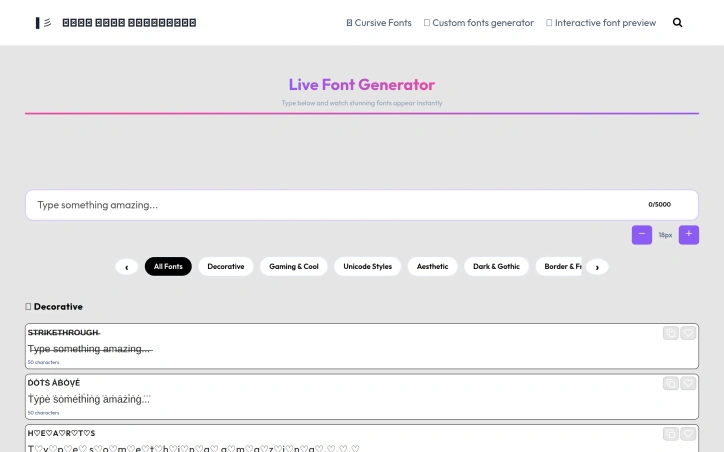

Design-creative
M
Mohsin Qureshi

Typography tools have fragmented into two extremes: bloated font libraries with hundreds of unusable styles or bare-bones generators that offer little visual variety. Live Font Generator addresses a genuine friction point in social media—the disconnect between wanting distinctive text styling and the awkward reality that most platforms strip out custom fonts, leaving users with basic Unicode symbols as their only option. The product targets creators across social platforms: Instagram users wanting standout bios, Discord communities seeking custom usernames, TikTok personalities, and gaming communities. Anyone who has noticed that custom fonts render as empty boxes on phones understands the genuine problem the founder identified—tools that look good on desktop often fail in practice. What distinguishes Live Font Generator from competitors is its organizational approach. Rather than dumping 300+ styles in random order and leaving users to scroll endlessly, the tool categorizes its 200+ Unicode text styles by aesthetic type: cursive, gothic, bold, gaming, and others. This categorization directly solves the discoverability problem that makes most font generators frustrating. The founder's emphasis on cross-device compatibility testing also reflects practical thinking—ensuring styles render correctly across platforms, not just in the initial preview. The feature set is straightforward: users type text, preview how it appears in different styles instantly, and copy results with a single click. No registration gates access, no software installation required, and no fees. The browser-based model means accessibility from any device. The product covers most major platforms that accept Unicode symbols: Instagram, Facebook, TikTok, Discord, WhatsApp, Telegram, and Reddit all work with the generated text. According to the founder, the tool serves over 10,000 daily users across 150+ countries, suggesting it has found genuine product-market fit within a specific niche. The addition of newly launched style categories indicates active development. The limitations are inherent to the approach: this solves only the styling problem on platforms that accept Unicode but restrict custom fonts. The business model remains implicit, with the free tool presumably monetizing through advertising or future premium features. For the specific use case of social media text styling, the product delivers on its promise with a more thoughtful interface than most competitors in a crowded category.

Live Font Generator preview

Key features

  • Unicode Text Styling: Users preview and copy custom Unicode text styles instantly
  • Categorized Styles: 200+ Unicode text styles organized by aesthetic type including cursive, gothic, bold, and gaming
See full listing
PDF Inspector

Converting PDFs to Markdown has long frustrated researchers, technical writers, and knowledge workers who need structured text from documents designed for print. The fundamental problem is straightforward: PDF format specifies where content appears visually on a page, not how that content should read linearly. A two-column research paper, a sidebar annotation, or a right-to-left passage can easily get tangled when extracted naively. Tables drawn from lines and positioned text rather than stored as actual data structures present another common failure mode. Most conversion tools ignore these complexities and apply a single extraction method uniformly across an entire document, often producing garbled or incomplete results. PDF Inspector addresses this by doing what its name suggests: analyzing page structure before conversion begins. The service identifies document type, flags complex layouts, detects pages requiring OCR, and spots potential font-encoding issues. This inspection phase leads to selective processing, where embedded text gets extracted directly while scanned or image-based pages route through OCR only when necessary. The approach respects that many real-world PDFs are patchworks of different content types—a digital report might mix selectable text, scanned appendices, pure images, and hybrid pages all in one file. What distinguishes PDF Inspector is both technical and practical. On the technical side, the service preserves reading order by accounting for font and coordinate context, not just visual position. It reconstructs tables from layout signals rather than assuming they exist as structured data. The user-facing workflow is similarly thoughtful: upload a file or provide a public URL, let the inspection run, convert with selective OCR, then preview and download the Markdown result. All processing happens in the browser, so files never leave the user's device—a privacy win that doubles as a performance feature since no server round-trip occurs for every page. The free tier allows three OCR conversions, with an upgrade option providing thirty. This freemium structure lets newcomers validate the tool before committing. For anyone regularly converting PDFs to Markdown, especially those working with mixed document types or complex layouts, PDF Inspector offers a refreshing alternative to generic converters. It's built on the understanding that PDFs are hard to read programmatically because they describe visual design, not semantic content. That starting assumption drives everything else.
Product-add-ons
U
Udvdh Shdhb

Converting PDFs to Markdown has long frustrated researchers, technical writers, and knowledge workers who need structured text from documents designed for print. The fundamental problem is straightforward: PDF format specifies where content appears visually on a page, not how that content should read linearly. A two-column research paper, a sidebar annotation, or a right-to-left passage can easily get tangled when extracted naively. Tables drawn from lines and positioned text rather than stored as actual data structures present another common failure mode. Most conversion tools ignore these complexities and apply a single extraction method uniformly across an entire document, often producing garbled or incomplete results. PDF Inspector addresses this by doing what its name suggests: analyzing page structure before conversion begins. The service identifies document type, flags complex layouts, detects pages requiring OCR, and spots potential font-encoding issues. This inspection phase leads to selective processing, where embedded text gets extracted directly while scanned or image-based pages route through OCR only when necessary. The approach respects that many real-world PDFs are patchworks of different content types—a digital report might mix selectable text, scanned appendices, pure images, and hybrid pages all in one file. What distinguishes PDF Inspector is both technical and practical. On the technical side, the service preserves reading order by accounting for font and coordinate context, not just visual position. It reconstructs tables from layout signals rather than assuming they exist as structured data. The user-facing workflow is similarly thoughtful: upload a file or provide a public URL, let the inspection run, convert with selective OCR, then preview and download the Markdown result. All processing happens in the browser, so files never leave the user's device—a privacy win that doubles as a performance feature since no server round-trip occurs for every page. The free tier allows three OCR conversions, with an upgrade option providing thirty. This freemium structure lets newcomers validate the tool before committing. For anyone regularly converting PDFs to Markdown, especially those working with mixed document types or complex layouts, PDF Inspector offers a refreshing alternative to generic converters. It's built on the understanding that PDFs are hard to read programmatically because they describe visual design, not semantic content. That starting assumption drives everything else.

PDF Inspector preview

Key features

  • Document Analysis: Analyzes page structure before conversion, identifying document type and flagging complex layouts.
  • Selective OCR Processing: Routes embedded text directly while processing scanned pages through OCR only when necessary.
See full listing