
1,034 startups launched 12,714 upvotes cast 58 submitted this week

Recently Listed

1,034 launches
Sort
C Media Player

Developers seeking a distraction-free media solution have an increasingly rare option in C Media Player, which sidesteps feature bloat and monetization schemes in favor of straightforward playback. The cross-platform application—available on Windows and Android—delivers essential media capabilities without the advertising and telemetry tracking that encumber many consumer players. The feature set reflects practical design priorities. Users access standard codecs, subtitle handling through both embedded and external sources, multi-track audio selection, and customizable playback controls including variable-speed playback and aspect ratio modification. The inclusion of equalizer controls and video effects distinguishes it from minimalist competitors, while hardware acceleration addresses performance on resource-constrained devices. The philosophy prioritizes user agency over corporate data extraction. Network stream support and playlist functionality accommodate both casual consumption and demanding use cases. The development team explicitly acknowledges user input as a roadmap driver, positioning the project as responsive to community needs. Limitations warrant acknowledgment: platform availability remains restricted to two major operating systems, and the absence of published benchmarks leaves performance claims unverified. Furthermore, standalone media players face structural headwinds from bundled offerings in mainstream operating systems. Still, in a landscape increasingly dominated by surveillance-enabled alternatives, C Media Player's commitment to core functionality without data harvesting represents meaningful differentiation. Whether this positioning sustains commercial viability depends on cultivating sufficient user loyalty to overcome platform incumbency.


Product-demo
C
C Media Player

Developers seeking a distraction-free media solution have an increasingly rare option in C Media Player, which sidesteps feature bloat and monetization schemes in favor of straightforward playback. The cross-platform application—available on Windows and Android—delivers essential media capabilities without the advertising and telemetry tracking that encumber many consumer players. The feature set reflects practical design priorities. Users access standard codecs, subtitle handling through both embedded and external sources, multi-track audio selection, and customizable playback controls including variable-speed playback and aspect ratio modification. The inclusion of equalizer controls and video effects distinguishes it from minimalist competitors, while hardware acceleration addresses performance on resource-constrained devices. The philosophy prioritizes user agency over corporate data extraction. Network stream support and playlist functionality accommodate both casual consumption and demanding use cases. The development team explicitly acknowledges user input as a roadmap driver, positioning the project as responsive to community needs. Limitations warrant acknowledgment: platform availability remains restricted to two major operating systems, and the absence of published benchmarks leaves performance claims unverified. Furthermore, standalone media players face structural headwinds from bundled offerings in mainstream operating systems. Still, in a landscape increasingly dominated by surveillance-enabled alternatives, C Media Player's commitment to core functionality without data harvesting represents meaningful differentiation. Whether this positioning sustains commercial viability depends on cultivating sufficient user loyalty to overcome platform incumbency.

C Media Player preview

Key features

  • Distraction-Free Design: No advertising or telemetry tracking, prioritizing user agency over corporate data extraction.
  • Advanced Playback Controls: Variable-speed playback and customizable controls including aspect ratio modification.
See full listing
Dating App Photos

Poor lighting and awkward framing sabotage many dating profiles before a conversation even starts. Dating App Photos tackles this directly, using AI to rehabilitate everyday photos into polished profile images without requiring a professional photographer or extensive editing. The service lets users upload one or two casual photos and, after answering a few quick questions, receive a complete gallery of enhanced versions. The core transformation focuses on three technical improvements: correcting harsh lighting conditions, reframing awkward compositions, and removing visual clutter from backgrounds. What distinguishes this product is its emphasis on preserving the user's recognizable appearance while applying these adjustments. The results maintain a natural aesthetic rather than pushing toward an unrealistic or heavily filtered look. Dating App Photos offers six distinct scene templates that anchor transformations to believable everyday contexts: a coffee shop vibe, outdoor activity shots, smart casual styling, energetic poses suggesting an active lifestyle, cozy indoor settings, and candid street scenes. This approach sidesteps the artificiality that undermines many AI photo services, grounding results in scenarios that feel authentic to how users actually live. The product's positioning emphasizes speed and convenience. Traditional approaches require hiring a photographer and coordinating availability; this service compresses the workflow from hours or days to minutes. Users also retain full control, reviewing each generated image before committing it to their profile. On the business model front, Dating App Photos operates on a simple one-time payment structure with no recurring subscription fees. Users receive 30-day download access to completed images. The privacy stance is straightforward: photos are processed privately and never displayed publicly or used for other purposes. For people struggling with poor-quality existing photos but hesitant to hire professional photography services, this fills a genuine gap. Dating app users face real pressure to present themselves effectively, and lighting and framing issues create a barrier regardless of actual appearance. By automating these specific corrections while preserving identity, Dating App Photos addresses a real frustration in the user journey without requiring expensive alternatives.


Ai-generative-media
P
perry vv

Poor lighting and awkward framing sabotage many dating profiles before a conversation even starts. Dating App Photos tackles this directly, using AI to rehabilitate everyday photos into polished profile images without requiring a professional photographer or extensive editing. The service lets users upload one or two casual photos and, after answering a few quick questions, receive a complete gallery of enhanced versions. The core transformation focuses on three technical improvements: correcting harsh lighting conditions, reframing awkward compositions, and removing visual clutter from backgrounds. What distinguishes this product is its emphasis on preserving the user's recognizable appearance while applying these adjustments. The results maintain a natural aesthetic rather than pushing toward an unrealistic or heavily filtered look. Dating App Photos offers six distinct scene templates that anchor transformations to believable everyday contexts: a coffee shop vibe, outdoor activity shots, smart casual styling, energetic poses suggesting an active lifestyle, cozy indoor settings, and candid street scenes. This approach sidesteps the artificiality that undermines many AI photo services, grounding results in scenarios that feel authentic to how users actually live. The product's positioning emphasizes speed and convenience. Traditional approaches require hiring a photographer and coordinating availability; this service compresses the workflow from hours or days to minutes. Users also retain full control, reviewing each generated image before committing it to their profile. On the business model front, Dating App Photos operates on a simple one-time payment structure with no recurring subscription fees. Users receive 30-day download access to completed images. The privacy stance is straightforward: photos are processed privately and never displayed publicly or used for other purposes. For people struggling with poor-quality existing photos but hesitant to hire professional photography services, this fills a genuine gap. Dating app users face real pressure to present themselves effectively, and lighting and framing issues create a barrier regardless of actual appearance. By automating these specific corrections while preserving identity, Dating App Photos addresses a real frustration in the user journey without requiring expensive alternatives.

Dating App Photos preview

Key features

  • AI Photo Enhancement: Corrects harsh lighting, reframes compositions, and removes visual clutter from backgrounds.
  • Scene Templates: Offers six distinct everyday contexts including coffee shop, outdoor, smart casual, active lifestyle, cozy indoor, and street scenes.
See full listing
MatchBuddy

Isolated sports fans searching for community at match time have long had limited options beyond screaming at a television alone. This app directly addresses that isolation by connecting viewers who want to watch fixtures together on the same night, particularly serving supporters of teams without local fanbases or people living far from their established friend groups. The core experience centers on several distinctive mechanics. Users browse upcoming fixtures and select a match they want to watch. The central "wave" feature functions as a mutual opt-in connection: potential viewers can anonymously signal nearby fans with the same fixture in mind, and only after hosts approve their waves does a real conversation unlock. This approval gate deliberately manages the friction and risk of inviting strangers into a home, addressing a genuine safety concern that blocks many people from trying communal viewing. Hosts list watch parties with granular detail: vibe categorization (Loud, Chill, Family), screen specifications, available extras like snacks and projectors, house rules, and spot availability. Addresses remain hidden until approval, creating a progressive trust model rather than forcing transparency upfront. Listings accumulate ratings, and profiles display verification status and hosting history, establishing reputation signals common to peer-to-peer platforms. The location layer is well-integrated. Search returns nearby fans within a specific radius, indexed by area or self-identified vibe, making discovery hyper-local and event-centric. The product never tries to build abstract community; it purely answers one question: who wants to watch this specific match within walking distance of me, right now? The design choices reflect pragmatic thinking about how people actually consume sports. Match Day Mode surfaces only active fixtures, and the interface prioritizes upcoming games chronologically. The temporary nature of watch parties—they exist for a few hours around kickoff, then dissolve—eliminates the onboarding friction of joining persistent communities. There's no social graph to build, no feed to maintain; you engage once per match you care about. One listing shows venues available for free with shared snack costs, though no explicit pricing model or commission structure is mentioned in the available materials. This event-driven matching fills a real gap for people who love sports but lack the circumstantial luck of compatible friends nearby. The friction reduction through gradual approval and anonymity makes it substantially more viable than simply inviting acquaintances into your living room.


Social-networking
M
Muhammad Ahad

Isolated sports fans searching for community at match time have long had limited options beyond screaming at a television alone. This app directly addresses that isolation by connecting viewers who want to watch fixtures together on the same night, particularly serving supporters of teams without local fanbases or people living far from their established friend groups. The core experience centers on several distinctive mechanics. Users browse upcoming fixtures and select a match they want to watch. The central "wave" feature functions as a mutual opt-in connection: potential viewers can anonymously signal nearby fans with the same fixture in mind, and only after hosts approve their waves does a real conversation unlock. This approval gate deliberately manages the friction and risk of inviting strangers into a home, addressing a genuine safety concern that blocks many people from trying communal viewing. Hosts list watch parties with granular detail: vibe categorization (Loud, Chill, Family), screen specifications, available extras like snacks and projectors, house rules, and spot availability. Addresses remain hidden until approval, creating a progressive trust model rather than forcing transparency upfront. Listings accumulate ratings, and profiles display verification status and hosting history, establishing reputation signals common to peer-to-peer platforms. The location layer is well-integrated. Search returns nearby fans within a specific radius, indexed by area or self-identified vibe, making discovery hyper-local and event-centric. The product never tries to build abstract community; it purely answers one question: who wants to watch this specific match within walking distance of me, right now? The design choices reflect pragmatic thinking about how people actually consume sports. Match Day Mode surfaces only active fixtures, and the interface prioritizes upcoming games chronologically. The temporary nature of watch parties—they exist for a few hours around kickoff, then dissolve—eliminates the onboarding friction of joining persistent communities. There's no social graph to build, no feed to maintain; you engage once per match you care about. One listing shows venues available for free with shared snack costs, though no explicit pricing model or commission structure is mentioned in the available materials. This event-driven matching fills a real gap for people who love sports but lack the circumstantial luck of compatible friends nearby. The friction reduction through gradual approval and anonymity makes it substantially more viable than simply inviting acquaintances into your living room.

MatchBuddy preview

Key features

  • Wave Feature: Anonymous signal to nearby fans interested in watching the same match
  • Host Approval System: Hosts approve connection requests before revealing their address location
See full listing
Rukn Ecommerce

An Arabic-focused e-commerce platform, Rukn positions itself as a no-code solution for entrepreneurs and small business owners across the Middle East. It addresses a clear pain point: the challenge of launching a professional online storefront without technical expertise or significant capital investment. The target audience spans small retailers, home-based entrepreneurs, restaurant owners, and traditional businesses looking to establish or expand their digital presence. Rukn's value proposition centers on speed and simplicity—stores go live in minutes rather than weeks, with users selecting from over 100 pre-built templates and customizing without writing code. What distinguishes Rukn from competitors is its deliberate omnichannel strategy. Rather than treating the online store as isolated, Rukn integrates it with physical retail operations and social commerce, allowing merchants to manage inventory, orders, and customers across their website, in-store system, Facebook, and Instagram from a single dashboard. This unified control eliminates the fragmentation that typically plagues multi-channel sellers. The platform bundles practical necessities into its offering: domain registration, SSL certificates, payment processing via Visa and Mastercard, and cash-on-delivery options suited to regional preferences. Built-in marketing tools—discount mechanisms, promotional features, and advertising integration—reduce the need for expensive third-party services during early growth stages. Rukn emphasizes its progression from launch to scale. Rather than positioning itself as a basic store builder, the platform markets itself as capable of growing with merchants, handling diverse product types and business models through flexibility in design and functionality. The company claims its users see a 250% improvement in success rates, though this figure lacks context around methodology or comparative baseline. The platform operates on a freemium model with premium tiers available, and current promotion offers a 20% discount on annual packages. Free trials are explicitly mentioned, lowering the barrier to testing the product. Rukn's success hinges on execution of these promises and support quality for its target market. Omnichannel capability is genuinely valuable for retailers, and the no-code thesis has proven across other geographies. The regional focus—designing explicitly for Arabic commerce patterns including cash-on-delivery prominence—suggests thoughtful localization rather than generic globalization. Whether this translates to competitive advantage depends on how well the platform delivers on speed-of-setup claims and ongoing merchant support.


Ecommerce-platforms
A
Alaa A Jarwan

An Arabic-focused e-commerce platform, Rukn positions itself as a no-code solution for entrepreneurs and small business owners across the Middle East. It addresses a clear pain point: the challenge of launching a professional online storefront without technical expertise or significant capital investment. The target audience spans small retailers, home-based entrepreneurs, restaurant owners, and traditional businesses looking to establish or expand their digital presence. Rukn's value proposition centers on speed and simplicity—stores go live in minutes rather than weeks, with users selecting from over 100 pre-built templates and customizing without writing code. What distinguishes Rukn from competitors is its deliberate omnichannel strategy. Rather than treating the online store as isolated, Rukn integrates it with physical retail operations and social commerce, allowing merchants to manage inventory, orders, and customers across their website, in-store system, Facebook, and Instagram from a single dashboard. This unified control eliminates the fragmentation that typically plagues multi-channel sellers. The platform bundles practical necessities into its offering: domain registration, SSL certificates, payment processing via Visa and Mastercard, and cash-on-delivery options suited to regional preferences. Built-in marketing tools—discount mechanisms, promotional features, and advertising integration—reduce the need for expensive third-party services during early growth stages. Rukn emphasizes its progression from launch to scale. Rather than positioning itself as a basic store builder, the platform markets itself as capable of growing with merchants, handling diverse product types and business models through flexibility in design and functionality. The company claims its users see a 250% improvement in success rates, though this figure lacks context around methodology or comparative baseline. The platform operates on a freemium model with premium tiers available, and current promotion offers a 20% discount on annual packages. Free trials are explicitly mentioned, lowering the barrier to testing the product. Rukn's success hinges on execution of these promises and support quality for its target market. Omnichannel capability is genuinely valuable for retailers, and the no-code thesis has proven across other geographies. The regional focus—designing explicitly for Arabic commerce patterns including cash-on-delivery prominence—suggests thoughtful localization rather than generic globalization. Whether this translates to competitive advantage depends on how well the platform delivers on speed-of-setup claims and ongoing merchant support.

Rukn Ecommerce preview

Key features

  • No-Code Store Builder: Stores go live in minutes with over 100 pre-built templates requiring no coding knowledge.
  • Omnichannel Dashboard: Manage inventory, orders, and customers across website, physical retail, Facebook, and Instagram from one unified interface.
See full listing
Helix

Measuring soft skills within organizations remains a persistent challenge, typically relying on cumbersome self-assessments and surveys that drain time and rarely capture authentic behavioral patterns. Helix targets both individual professionals seeking personal development and organizations trying to understand and improve team capabilities through data-backed insights rather than subjective evaluation. What sets this offering apart is its passive measurement approach. Rather than requiring employees to complete questionnaires, Helix joins video meetings on Microsoft Teams, Zoom, and Google Meet to analyze behavioral signals in real time. Using a combination of OpenAI's capabilities and a proprietary scoring engine, the tool identifies patterns in soft skills—communication, collaboration, leadership, and others from a set of nine core competencies—then delivers personalized insights within minutes of a call ending. The product's feature set addresses a gap in existing talent development workflows. Weekly summaries aggregate trends over time, visual dashboards let individuals track their own progress, and a built-in AI coaching tool recommends targeted learning resources based on identified growth areas. For HR and L&D leaders, a company-wide dashboard surfaces skills gaps across teams and measures the return on learning investments, providing strategic visibility into organizational capability. The non-intrusive design stands out as particularly valuable. By operating silently within existing communication tools rather than asking employees to adopt new platforms or complete additional surveys, Helix reduces friction that typically limits engagement with development initiatives. The inclusion of actual meeting transcript snippets alongside recommendations adds specificity that generic coaching often lacks. One consideration worth noting: the product's effectiveness depends on the accuracy of its behavioral analysis engine. The marketing materials emphasize that the 3Q Engine weighs quantitative signals, qualitative patterns, and sentiment analysis, yet independent validation of these scoring mechanisms remains unavailable from the information provided. For organizations serious about moving beyond vanity metrics in talent development and individuals looking for objective feedback on professional growth, Helix presents a compelling shift toward behavioral measurement over self-reported assessment.


Online-learning
K
Kayleigh Tanner

Measuring soft skills within organizations remains a persistent challenge, typically relying on cumbersome self-assessments and surveys that drain time and rarely capture authentic behavioral patterns. Helix targets both individual professionals seeking personal development and organizations trying to understand and improve team capabilities through data-backed insights rather than subjective evaluation. What sets this offering apart is its passive measurement approach. Rather than requiring employees to complete questionnaires, Helix joins video meetings on Microsoft Teams, Zoom, and Google Meet to analyze behavioral signals in real time. Using a combination of OpenAI's capabilities and a proprietary scoring engine, the tool identifies patterns in soft skills—communication, collaboration, leadership, and others from a set of nine core competencies—then delivers personalized insights within minutes of a call ending. The product's feature set addresses a gap in existing talent development workflows. Weekly summaries aggregate trends over time, visual dashboards let individuals track their own progress, and a built-in AI coaching tool recommends targeted learning resources based on identified growth areas. For HR and L&D leaders, a company-wide dashboard surfaces skills gaps across teams and measures the return on learning investments, providing strategic visibility into organizational capability. The non-intrusive design stands out as particularly valuable. By operating silently within existing communication tools rather than asking employees to adopt new platforms or complete additional surveys, Helix reduces friction that typically limits engagement with development initiatives. The inclusion of actual meeting transcript snippets alongside recommendations adds specificity that generic coaching often lacks. One consideration worth noting: the product's effectiveness depends on the accuracy of its behavioral analysis engine. The marketing materials emphasize that the 3Q Engine weighs quantitative signals, qualitative patterns, and sentiment analysis, yet independent validation of these scoring mechanisms remains unavailable from the information provided. For organizations serious about moving beyond vanity metrics in talent development and individuals looking for objective feedback on professional growth, Helix presents a compelling shift toward behavioral measurement over self-reported assessment.

Helix preview

Key features

  • AI-powered measurement of soft skills, customisable to 90+ validated skills or internal frameworks
  • Real-time progress tracking with visual dashboards and data-backed insights
See full listing
QuickMagic

Motion capture has long been gatekept by expensive hardware and specialized studios. QuickMagic disrupts this by extracting skeletal data and facial movement directly from standard video or text prompts, eliminating the need for suits, markers, sensors, or multi-camera setups. The platform targets creators, animators, game developers, and roboticists who need motion data but lack access to traditional capture infrastructure. What sets QuickMagic apart is its accessibility. Users can upload footage from smartphones, webcams, or standard cameras and receive editable 3D animation data within minutes. The system handles full-body, hand, and facial motion simultaneously and supports both single and multi-subject workflows. It processes footage regardless of camera movement, though results depend on subject visibility and motion clarity. The text-to-motion feature expands possibilities further, allowing designers to generate motion from descriptions alone—useful for storyboarding, prototyping, and character ideation before expensive production begins. The export ecosystem is comprehensive. QuickMagic outputs to FBX, BVH, BIP, C4D, VMD and proprietary formats for Mixamo, UE4, UE5.5, UE5.6, Character Creator, iClone, Roblox, and OnlyFace. Integration extends across Blender, Maya, 3ds Max, MotionBuilder, Unity, Unreal Engine, and MikuMikuDance. For roboticists, specialized presets support Unitree humanoid models. This breadth means captured data fits into existing pipelines without major conversion friction. The platform includes post-capture refinement controls—users can adjust pose, frame rate, and apply motion cleanup to polish results. For VTubers and digital-human creators, this bridges the gap between automatic capture and manual polish. The addition of robot motion generation and focus on imitation-learning workflows signals expansion beyond traditional animation into emerging AI and robotics use cases. QuickMagic operates on a freemium model with both free and paid tiers, lowering the barrier to experimentation. Export capabilities vary by plan, so advanced integrations require subscription. The web-based delivery means no software installation, supporting rapid adoption among distributed teams. The core trade-off is quality. Results depend on camera work, lighting, and subject visibility. Users working with fast motion, heavy occlusion, or complex interactions may find capture less reliable. Still, for typical performances and character work, QuickMagic compresses weeks of motion-capture setup into minutes of processing—a meaningful shift in production velocity for the creators it reaches.


3d-animation
Q
QuickMagic Team

Motion capture has long been gatekept by expensive hardware and specialized studios. QuickMagic disrupts this by extracting skeletal data and facial movement directly from standard video or text prompts, eliminating the need for suits, markers, sensors, or multi-camera setups. The platform targets creators, animators, game developers, and roboticists who need motion data but lack access to traditional capture infrastructure. What sets QuickMagic apart is its accessibility. Users can upload footage from smartphones, webcams, or standard cameras and receive editable 3D animation data within minutes. The system handles full-body, hand, and facial motion simultaneously and supports both single and multi-subject workflows. It processes footage regardless of camera movement, though results depend on subject visibility and motion clarity. The text-to-motion feature expands possibilities further, allowing designers to generate motion from descriptions alone—useful for storyboarding, prototyping, and character ideation before expensive production begins. The export ecosystem is comprehensive. QuickMagic outputs to FBX, BVH, BIP, C4D, VMD and proprietary formats for Mixamo, UE4, UE5.5, UE5.6, Character Creator, iClone, Roblox, and OnlyFace. Integration extends across Blender, Maya, 3ds Max, MotionBuilder, Unity, Unreal Engine, and MikuMikuDance. For roboticists, specialized presets support Unitree humanoid models. This breadth means captured data fits into existing pipelines without major conversion friction. The platform includes post-capture refinement controls—users can adjust pose, frame rate, and apply motion cleanup to polish results. For VTubers and digital-human creators, this bridges the gap between automatic capture and manual polish. The addition of robot motion generation and focus on imitation-learning workflows signals expansion beyond traditional animation into emerging AI and robotics use cases. QuickMagic operates on a freemium model with both free and paid tiers, lowering the barrier to experimentation. Export capabilities vary by plan, so advanced integrations require subscription. The web-based delivery means no software installation, supporting rapid adoption among distributed teams. The core trade-off is quality. Results depend on camera work, lighting, and subject visibility. Users working with fast motion, heavy occlusion, or complex interactions may find capture less reliable. Still, for typical performances and character work, QuickMagic compresses weeks of motion-capture setup into minutes of processing—a meaningful shift in production velocity for the creators it reaches.

QuickMagic preview

Key features

  • Video Motion Capture: Extracts skeletal and facial motion from standard video, smartphones, or webcams without expensive hardware, suits, or markers.
  • Multi-Format Export: Supports export to FBX, BVH, BIP, C4D, VMD, and proprietary formats for Unreal Engine, Maya, Blender, Unity, and other major software.
See full listing
Leumos AI

Color grading has long been a bottleneck in video production, consuming disproportionate amounts of time relative to its creative impact. Leumos AI targets this inefficiency by automating the technical legwork that consumes hours on every substantial project: scene detection, exposure correction, color matching across shots, and final rendering. The platform operates entirely in the cloud, eliminating a critical barrier to entry for independent filmmakers and editors working with limited hardware. Rather than requiring expensive GPU workstations, users can upload timelines from any laptop and receive finished 4K masters via email. This accessibility is the product's central value proposition, democratizing tools previously restricted to well-equipped post houses. The technical approach centers on four core capabilities. Scene cut detection runs automatically, identifying every transition and shot boundary without manual scrubbing. An AI color grading engine then applies consistent looks across entire sequences, avoiding the tedium of clip-by-clip curve adjustments. A third component handles shot matching, aligning exposure and color temperature across footage shot with different cameras and lighting setups. Finally, the cloud rendering pipeline outputs finished masters in ProRes, H.265, or as graded XML back into editing software. What distinguishes Leumos from simpler color automation is its sequence awareness. Rather than processing shots in isolation, the AI understands continuity across an edit, maintaining visual consistency without requiring editors to sacrifice creative control. The interface presents multiple aesthetic treatments from a single clip, allowing users to experiment with different looks before committing to a final grade. The closed beta launched in late summer 2026, with access via waitlist. The company accepts multiple source formats including ProRes, H.264, H.265, and RAW, accommodating a range of production pipelines. The core premise addresses a genuine inefficiency in modern video production. For editors and filmmakers constrained by hardware limitations, where tool access has traditionally been a barrier to professional-grade work, this cloud-native approach expands the practical possibilities of independent production.


Video-editing
L
Leumos AI

Color grading has long been a bottleneck in video production, consuming disproportionate amounts of time relative to its creative impact. Leumos AI targets this inefficiency by automating the technical legwork that consumes hours on every substantial project: scene detection, exposure correction, color matching across shots, and final rendering. The platform operates entirely in the cloud, eliminating a critical barrier to entry for independent filmmakers and editors working with limited hardware. Rather than requiring expensive GPU workstations, users can upload timelines from any laptop and receive finished 4K masters via email. This accessibility is the product's central value proposition, democratizing tools previously restricted to well-equipped post houses. The technical approach centers on four core capabilities. Scene cut detection runs automatically, identifying every transition and shot boundary without manual scrubbing. An AI color grading engine then applies consistent looks across entire sequences, avoiding the tedium of clip-by-clip curve adjustments. A third component handles shot matching, aligning exposure and color temperature across footage shot with different cameras and lighting setups. Finally, the cloud rendering pipeline outputs finished masters in ProRes, H.265, or as graded XML back into editing software. What distinguishes Leumos from simpler color automation is its sequence awareness. Rather than processing shots in isolation, the AI understands continuity across an edit, maintaining visual consistency without requiring editors to sacrifice creative control. The interface presents multiple aesthetic treatments from a single clip, allowing users to experiment with different looks before committing to a final grade. The closed beta launched in late summer 2026, with access via waitlist. The company accepts multiple source formats including ProRes, H.264, H.265, and RAW, accommodating a range of production pipelines. The core premise addresses a genuine inefficiency in modern video production. For editors and filmmakers constrained by hardware limitations, where tool access has traditionally been a barrier to professional-grade work, this cloud-native approach expands the practical possibilities of independent production.

Leumos AI preview

Key features

  • Scene Cut Detection: Automatically identifies every transition and shot boundary without manual scrubbing
  • AI Color Grading Engine: Applies consistent looks across entire sequences to avoid clip-by-clip curve adjustments
See full listing
JobResume

Managing multiple job applications without a coherent system creates friction that stalls career momentum. JobResume addresses this by consolidating the entire job search workflow into one free, browser-based toolkit that requires no account signup. The core value proposition centers on continuity. Rather than toggling between a resume editor, job board, email drafts, and interview prep materials, the platform treats your CV and job applications as interconnected data. Upload or build an ATS-optimized resume once, then feed it through a pipeline: save job postings to a tracking board, automatically tailor your CV to each posting's language and requirements, generate matching cover letters, and practice with an AI that simulates hiring manager questions. The AI tailoring function stands out as the primary differentiator. Instead of manually rewording your bullet points for each application, the system rewrites them to echo the job description's terminology while preserving accuracy. This addresses the practical reality that many resume-screening tools are keyword-sensitive. The matching score helps applicants gauge how well their background aligns with posted requirements. The platform spans job seekers across experience levels. Example outputs cover software engineers, marketing professionals, and fresh graduates. The sample materials demonstrate substantive output: tailored resumes reference specific accomplishments, cover letters tie achievements to job requirements, and the AI interviewer asks role-specific follow-up questions rooted in the candidate's resume. Privacy is built into the architecture. The marketing explicitly states that data remains in the browser and never reaches external servers, addressing concerns about resume data handling that plague many free career tools. This browser-native storage model removes a common barrier to adopting free career services. The no-signup, browser-based design removes friction at entry. Users can test the platform's output quality before deciding whether to trust it with sensitive career documents. Pricing is entirely free. The website does not detail how the service is funded or whether paid features are planned, raising questions about long-term sustainability that remain unanswered. The product targets a genuine pain point in job hunting. Whether the AI output quality and tailoring algorithms deliver on the promise of higher application success rates depends on results that the website cannot demonstrate without user testimonials or outcome data.

Resume-tools
E
Eren Dhoheiri

Managing multiple job applications without a coherent system creates friction that stalls career momentum. JobResume addresses this by consolidating the entire job search workflow into one free, browser-based toolkit that requires no account signup. The core value proposition centers on continuity. Rather than toggling between a resume editor, job board, email drafts, and interview prep materials, the platform treats your CV and job applications as interconnected data. Upload or build an ATS-optimized resume once, then feed it through a pipeline: save job postings to a tracking board, automatically tailor your CV to each posting's language and requirements, generate matching cover letters, and practice with an AI that simulates hiring manager questions. The AI tailoring function stands out as the primary differentiator. Instead of manually rewording your bullet points for each application, the system rewrites them to echo the job description's terminology while preserving accuracy. This addresses the practical reality that many resume-screening tools are keyword-sensitive. The matching score helps applicants gauge how well their background aligns with posted requirements. The platform spans job seekers across experience levels. Example outputs cover software engineers, marketing professionals, and fresh graduates. The sample materials demonstrate substantive output: tailored resumes reference specific accomplishments, cover letters tie achievements to job requirements, and the AI interviewer asks role-specific follow-up questions rooted in the candidate's resume. Privacy is built into the architecture. The marketing explicitly states that data remains in the browser and never reaches external servers, addressing concerns about resume data handling that plague many free career tools. This browser-native storage model removes a common barrier to adopting free career services. The no-signup, browser-based design removes friction at entry. Users can test the platform's output quality before deciding whether to trust it with sensitive career documents. Pricing is entirely free. The website does not detail how the service is funded or whether paid features are planned, raising questions about long-term sustainability that remain unanswered. The product targets a genuine pain point in job hunting. Whether the AI output quality and tailoring algorithms deliver on the promise of higher application success rates depends on results that the website cannot demonstrate without user testimonials or outcome data.

JobResume preview

Key features

  • AI Resume Tailoring: Automatically rewrites resume bullets to match job description language and keywords while preserving accuracy
  • Job Application Board: Consolidates saved job postings in one centralized tracking system
See full listing
U

Finding a unique username that works across multiple social platforms represents a genuine friction point for creators, gamers, and casual users alike. Username Ideas Generator addresses this friction head-on with an AI-powered solution designed to streamline the brainstorming process. Rather than cycling through variations manually or settling for usernames already claimed elsewhere, users can leverage the tool to generate aesthetic and memorable options tailored to their needs. The tool targets the workflow across major platforms: Instagram, TikTok, YouTube, and gaming communities. This multi-platform focus recognizes the reality that many creators maintain presence across several channels and need consistency. The AI-driven approach to generation distinguishes it from simpler random generators or availability checkers; the tool produces suggestions aimed at being both memorable and visually appealing, rather than defaulting to number combinations or special character strings that clutter most username fields. What makes the product compelling is its directness. The founder built this after experiencing the tedium firsthand, and that clarity of purpose translates into a focused scope. Rather than attempting to solve username management broadly, it concentrates on the initial generation phase where most of the creative friction occurs. The tool saves users from repetitive manual searching and the cognitive load of balancing originality against availability constraints. The positioning as "aesthetic" and "memorable" also signals an understanding of platform culture. A good TikTok username differs substantially from a gaming handle, and an effective Instagram name requires different sensibilities than a YouTube channel. The tool's ability to generate ideas specific to each platform reflects this distinction. What remains unclear from the available information is how the AI determines what constitutes an aesthetic username in context-specific ways, or how it validates availability across platforms. The speed advantage is evident in the problem statement, but the actual user workflow and learning curve remain undescribed. Despite these questions, Username Ideas Generator solves a real problem with a straightforward approach that could save creators meaningful time during the account setup phase.


Ai-generative-media
Q
qing wang

Finding a unique username that works across multiple social platforms represents a genuine friction point for creators, gamers, and casual users alike. Username Ideas Generator addresses this friction head-on with an AI-powered solution designed to streamline the brainstorming process. Rather than cycling through variations manually or settling for usernames already claimed elsewhere, users can leverage the tool to generate aesthetic and memorable options tailored to their needs. The tool targets the workflow across major platforms: Instagram, TikTok, YouTube, and gaming communities. This multi-platform focus recognizes the reality that many creators maintain presence across several channels and need consistency. The AI-driven approach to generation distinguishes it from simpler random generators or availability checkers; the tool produces suggestions aimed at being both memorable and visually appealing, rather than defaulting to number combinations or special character strings that clutter most username fields. What makes the product compelling is its directness. The founder built this after experiencing the tedium firsthand, and that clarity of purpose translates into a focused scope. Rather than attempting to solve username management broadly, it concentrates on the initial generation phase where most of the creative friction occurs. The tool saves users from repetitive manual searching and the cognitive load of balancing originality against availability constraints. The positioning as "aesthetic" and "memorable" also signals an understanding of platform culture. A good TikTok username differs substantially from a gaming handle, and an effective Instagram name requires different sensibilities than a YouTube channel. The tool's ability to generate ideas specific to each platform reflects this distinction. What remains unclear from the available information is how the AI determines what constitutes an aesthetic username in context-specific ways, or how it validates availability across platforms. The speed advantage is evident in the problem statement, but the actual user workflow and learning curve remain undescribed. Despite these questions, Username Ideas Generator solves a real problem with a straightforward approach that could save creators meaningful time during the account setup phase.

Username Ideas Generator preview
U

Key features

  • AI-Powered Generation: Uses artificial intelligence to generate aesthetic and memorable username options tailored to user needs.
  • Multi-Platform Support: Works across Instagram, TikTok, YouTube, and gaming communities.
See full listing
Tentare Pilates Software

Managing a Pilates studio means juggling reservations, instructor schedules, payments, and last-minute cancellations across multiple disconnected apps. Tentare consolidates this fragmentation into a single platform purpose-built for studio operations, addressing a real operational crisis that studio owners face daily. The core problem Tentare solves is the chaos of last-minute instructor cancellations. The platform contrasts a typical crisis—40 minutes of phone calls, miscommunications in WhatsApp groups, and a class potentially being cancelled—with an automated resolution that takes minutes. When an instructor cancels, the system identifies available replacements based on their certified class types and availability, gets approval instantly, and notifies already-enrolled students without the studio owner lifting a finger. This single feature alone justifies the platform for many studios. What distinguishes Tentare is its granular understanding of Pilates operations. It manages capacity not just by class size but by individual reformer availability, preventing the common scheduling error where two classes overlap in the same room. It recognizes that Pilates classes require specific instructor certifications—reformer, mat, prenatal—and only suggests substitutes who are qualified. Most studio management software treats classes generically; Tentare is built by people who understand the industry. The platform integrates the full business workflow. Students reserve and cancel through their phones, triggering automatic waitlist promotions. Communication happens through the channel students prefer, with automated reminders and updates. Billing handles recurring memberships, single-class passes, and failed payment retries without manual intervention. Instructors log their hours directly. The studio owner sees daily metrics—revenue, occupancy, renewal rates—on the same interface on mobile or desktop. Payment processing runs through Stripe without additional commission from Tentare, keeping economics transparent. Invoicing is legal and compliant from the first transaction. The platform stores complete student history, class attendance, membership status, and communication in one place, eliminating the spreadsheet archaeology that plagues studios today. The platform targets mid-size studios—those large enough to need coordination but small enough to feel the pain of fragmentation acutely. Studios with a handful of instructors and 50 to 200 active students gain the most immediate relief from automating instructor substitution and student communication. Tentare is built iteratively with studio feedback, prioritizing practical workflow over feature sprawl.


Scheduling-software
M
Marcos Roca Rodríguez

Managing a Pilates studio means juggling reservations, instructor schedules, payments, and last-minute cancellations across multiple disconnected apps. Tentare consolidates this fragmentation into a single platform purpose-built for studio operations, addressing a real operational crisis that studio owners face daily. The core problem Tentare solves is the chaos of last-minute instructor cancellations. The platform contrasts a typical crisis—40 minutes of phone calls, miscommunications in WhatsApp groups, and a class potentially being cancelled—with an automated resolution that takes minutes. When an instructor cancels, the system identifies available replacements based on their certified class types and availability, gets approval instantly, and notifies already-enrolled students without the studio owner lifting a finger. This single feature alone justifies the platform for many studios. What distinguishes Tentare is its granular understanding of Pilates operations. It manages capacity not just by class size but by individual reformer availability, preventing the common scheduling error where two classes overlap in the same room. It recognizes that Pilates classes require specific instructor certifications—reformer, mat, prenatal—and only suggests substitutes who are qualified. Most studio management software treats classes generically; Tentare is built by people who understand the industry. The platform integrates the full business workflow. Students reserve and cancel through their phones, triggering automatic waitlist promotions. Communication happens through the channel students prefer, with automated reminders and updates. Billing handles recurring memberships, single-class passes, and failed payment retries without manual intervention. Instructors log their hours directly. The studio owner sees daily metrics—revenue, occupancy, renewal rates—on the same interface on mobile or desktop. Payment processing runs through Stripe without additional commission from Tentare, keeping economics transparent. Invoicing is legal and compliant from the first transaction. The platform stores complete student history, class attendance, membership status, and communication in one place, eliminating the spreadsheet archaeology that plagues studios today. The platform targets mid-size studios—those large enough to need coordination but small enough to feel the pain of fragmentation acutely. Studios with a handful of instructors and 50 to 200 active students gain the most immediate relief from automating instructor substitution and student communication. Tentare is built iteratively with studio feedback, prioritizing practical workflow over feature sprawl.

Tentare Pilates Software preview

Key features

  • Instructor Substitution: Automatically identifies qualified replacements when instructors cancel and notifies students instantly.
  • Reformer Availability: Tracks individual reformer booking to prevent scheduling conflicts across multiple studio rooms.
See full listing
LogoSpawn.com

The repetitive work of logo exporting represents genuine friction in the design workflow. LogoSpawn addresses this directly, automating the moment after a logo design is finalized, when the designer must deliver variants across dozens of sizes and formats to meet client requirements. The product's mechanism is straightforward: upload an Adobe Illustrator file and receive 61 export-ready logo files in seconds. This breadth is the genuine differentiator. Rather than manually adjusting crop points, scaling, and exporting file by file—a process that consumes significant time—designers get a complete, production-ready asset bundle instantly. The founder's quarter-century of design experience lends immediate credibility. The pain of handling logo exports is ubiquitous across the profession. Every finalized logo requires delivery in standard sizes (favicon, app icon, social media, web headers) across multiple formats (PNG, SVG, PDF). This is necessary but low-value work that regularly consumes time in every project cycle. LogoSpawn's constraints reveal intentional design. It accepts only Adobe Illustrator files, keeping the product focused rather than attempting universal file conversion. The interface is minimal—a drag-and-drop zone, file browser, and single action button. This simplicity indicates the team understands that designers prioritize speed over configuration options. The bundle includes a branding style guide alongside the files, hinting at additional functionality beyond raw exports. This suggests an attempt to produce structured, client-ready deliverables rather than just isolated assets. Pricing operates on a token system, with specific costs undisclosed in the public-facing copy. Token-based models typically suit variable usage patterns—designers might export logos monthly or only several times annually. This approach accommodates both light and heavy users without forcing fixed monthly commitments. LogoSpawn occupies a deliberate niche. It solves one specific, repeated problem without attempting to replace logo design tools or offer comprehensive branding services. Its value centers on accelerating the final export phase of the design workflow. For independent designers, design agencies, or in-house teams that regularly finalize logos, the tool offers straightforward utility. The calculation for potential users comes down to whether the speed gains and export consistency justify recurring token expenditure.


Design-mockups
T
Tommy Owen

The repetitive work of logo exporting represents genuine friction in the design workflow. LogoSpawn addresses this directly, automating the moment after a logo design is finalized, when the designer must deliver variants across dozens of sizes and formats to meet client requirements. The product's mechanism is straightforward: upload an Adobe Illustrator file and receive 61 export-ready logo files in seconds. This breadth is the genuine differentiator. Rather than manually adjusting crop points, scaling, and exporting file by file—a process that consumes significant time—designers get a complete, production-ready asset bundle instantly. The founder's quarter-century of design experience lends immediate credibility. The pain of handling logo exports is ubiquitous across the profession. Every finalized logo requires delivery in standard sizes (favicon, app icon, social media, web headers) across multiple formats (PNG, SVG, PDF). This is necessary but low-value work that regularly consumes time in every project cycle. LogoSpawn's constraints reveal intentional design. It accepts only Adobe Illustrator files, keeping the product focused rather than attempting universal file conversion. The interface is minimal—a drag-and-drop zone, file browser, and single action button. This simplicity indicates the team understands that designers prioritize speed over configuration options. The bundle includes a branding style guide alongside the files, hinting at additional functionality beyond raw exports. This suggests an attempt to produce structured, client-ready deliverables rather than just isolated assets. Pricing operates on a token system, with specific costs undisclosed in the public-facing copy. Token-based models typically suit variable usage patterns—designers might export logos monthly or only several times annually. This approach accommodates both light and heavy users without forcing fixed monthly commitments. LogoSpawn occupies a deliberate niche. It solves one specific, repeated problem without attempting to replace logo design tools or offer comprehensive branding services. Its value centers on accelerating the final export phase of the design workflow. For independent designers, design agencies, or in-house teams that regularly finalize logos, the tool offers straightforward utility. The calculation for potential users comes down to whether the speed gains and export consistency justify recurring token expenditure.

LogoSpawn.com preview

Key features

  • Batch Logo Export: Generates 61 export-ready logo files in multiple sizes and formats from a single Illustrator file.
  • Minimal Interface: Provides a drag-and-drop upload zone with minimal configuration for maximum speed.
See full listing
eLabelCropper

Shipping label processing represents a persistent friction point for e-commerce sellers, consuming time that could be spent on core business operations. eLabelCropper targets this specific bottleneck by offering a browser-based toolkit that automates the tedious work of preparing PDFs for thermal printers across multiple marketplaces. The product's core strength lies in its frictionless approach to a real operational problem. Rather than requiring software installation or account creation, sellers upload shipping label PDFs and receive output optimized for standard 4x6 thermal printers. The tool handles cropping, splitting, rotation, and formatting automatically. For sellers working across multiple platforms—whether Indian marketplaces like Meesho and Flipkart or global platforms such as Shopify and Etsy—supporting 35+ utilities across 16+ platforms eliminates the need to learn different workarounds for each service. The privacy model warrants emphasis. All processing occurs locally within the browser using native web technologies, meaning shipping labels and customer data remain on the user's device rather than transiting through external servers. This addresses a legitimate concern for sellers handling sensitive customer information at scale. Bulk processing capability extends the tool's utility beyond single-label workflows. Users can upload multiple PDFs simultaneously, and the system merges them into a single ready-to-print file. For sellers processing dozens or hundreds of shipments daily, this represents meaningful time savings. Platform-specific tooling adds further value—the system automatically separates packing slips from shipping labels on supported marketplaces like Meesho and Amazon, reducing manual sorting. The positioning as a completely free offering with no signup requirements and no feature limits distinguishes it in a space where shipping label tools typically operate on subscription or freemium models. This accessibility appears deliberate, lowering barriers to adoption among price-sensitive seller communities in emerging markets. The product's scope is narrow and purposeful. It does not attempt to be a comprehensive shipping management system or inventory platform. This focus suggests the developers understand their users' immediate pain point—label formatting—rather than building feature bloat around it. The tool works across Chrome, Firefox, Safari, and Edge, ensuring broad browser compatibility. The claimed user base of over 10,000 sellers suggests real market traction, though the product remains positioned as a utility rather than a platform. For sellers seeking a straightforward, zero-friction solution to daily label processing, eLabelCropper fills a genuine operational need.


Shipping label processing represents a persistent friction point for e-commerce sellers, consuming time that could be spent on core business operations. eLabelCropper targets this specific bottleneck by offering a browser-based toolkit that automates the tedious work of preparing PDFs for thermal printers across multiple marketplaces. The product's core strength lies in its frictionless approach to a real operational problem. Rather than requiring software installation or account creation, sellers upload shipping label PDFs and receive output optimized for standard 4x6 thermal printers. The tool handles cropping, splitting, rotation, and formatting automatically. For sellers working across multiple platforms—whether Indian marketplaces like Meesho and Flipkart or global platforms such as Shopify and Etsy—supporting 35+ utilities across 16+ platforms eliminates the need to learn different workarounds for each service. The privacy model warrants emphasis. All processing occurs locally within the browser using native web technologies, meaning shipping labels and customer data remain on the user's device rather than transiting through external servers. This addresses a legitimate concern for sellers handling sensitive customer information at scale. Bulk processing capability extends the tool's utility beyond single-label workflows. Users can upload multiple PDFs simultaneously, and the system merges them into a single ready-to-print file. For sellers processing dozens or hundreds of shipments daily, this represents meaningful time savings. Platform-specific tooling adds further value—the system automatically separates packing slips from shipping labels on supported marketplaces like Meesho and Amazon, reducing manual sorting. The positioning as a completely free offering with no signup requirements and no feature limits distinguishes it in a space where shipping label tools typically operate on subscription or freemium models. This accessibility appears deliberate, lowering barriers to adoption among price-sensitive seller communities in emerging markets. The product's scope is narrow and purposeful. It does not attempt to be a comprehensive shipping management system or inventory platform. This focus suggests the developers understand their users' immediate pain point—label formatting—rather than building feature bloat around it. The tool works across Chrome, Firefox, Safari, and Edge, ensuring broad browser compatibility. The claimed user base of over 10,000 sellers suggests real market traction, though the product remains positioned as a utility rather than a platform. For sellers seeking a straightforward, zero-friction solution to daily label processing, eLabelCropper fills a genuine operational need.

eLabelCropper preview

Key features

  • Browser-Based Processing: Upload shipping labels directly without installing software
  • Automatic Formatting: Handles cropping, splitting, rotation, and optimization for 4x6 thermal printers
See full listing
MealGeni

Household meal coordination consumes countless hours for families juggling diverse dietary requirements, and the resulting food waste and budget overruns compound the frustration. MealGeni addresses this friction by automating the entire workflow from recipe generation through shopping list creation, powered by AI trained to handle the complexity of multi-generational households. The product's scope is remarkably comprehensive. Rather than treating meal planning as a single-person concern, MealGeni extends its intelligence across breakfast, lunch, dinner, snacks, baby food, toddler meals, school lunchboxes, and even pet meals. This breadth matters because most existing solutions either force families to use multiple apps or ignore certain household members' needs entirely. By unifying these requirements, the platform eliminates the context-switching that drives planning fatigue. The personalization engine absorbs meaningful constraints: dietary preferences, health goals, household budget, number of people to feed, available ingredients, and cooking time. This nuanced approach means the generated meal plans aren't generic templates but plans actually tethered to a family's real life. The speed of generation—creating full weekly plans in seconds—converts an afternoon chore into a few-minute task. Integration across the planning pipeline strengthens the product's value proposition. Generating recipes is useful; automatically converting those recipes into an organized, deduplicated shopping list is where the platform becomes genuinely useful. Users get recommendations structured for actual grocery shopping rather than scattered ingredients. The system also tracks nutrition and flags food waste, lending itself to both health-conscious families and those motivated by environmental or budget concerns. MealGeni positions itself as free to start, suggesting a freemium model that lets families test core functionality without initial commitment. The publicly available recipe library and monthly dinner planners provide additional content touchpoints beyond the core app. The primary strength lies in synthesis: most meal-planning apps handle one or two parts of the problem well, while MealGeni attempts to close the entire loop from decision-making through execution. Whether that ambition translates into a cohesive product experience depends on execution quality, but the surface value proposition is clear. For households spending time and money on meal coordination, the app makes a compelling case that AI can genuinely simplify a persistent household task.

Household meal coordination consumes countless hours for families juggling diverse dietary requirements, and the resulting food waste and budget overruns compound the frustration. MealGeni addresses this friction by automating the entire workflow from recipe generation through shopping list creation, powered by AI trained to handle the complexity of multi-generational households. The product's scope is remarkably comprehensive. Rather than treating meal planning as a single-person concern, MealGeni extends its intelligence across breakfast, lunch, dinner, snacks, baby food, toddler meals, school lunchboxes, and even pet meals. This breadth matters because most existing solutions either force families to use multiple apps or ignore certain household members' needs entirely. By unifying these requirements, the platform eliminates the context-switching that drives planning fatigue. The personalization engine absorbs meaningful constraints: dietary preferences, health goals, household budget, number of people to feed, available ingredients, and cooking time. This nuanced approach means the generated meal plans aren't generic templates but plans actually tethered to a family's real life. The speed of generation—creating full weekly plans in seconds—converts an afternoon chore into a few-minute task. Integration across the planning pipeline strengthens the product's value proposition. Generating recipes is useful; automatically converting those recipes into an organized, deduplicated shopping list is where the platform becomes genuinely useful. Users get recommendations structured for actual grocery shopping rather than scattered ingredients. The system also tracks nutrition and flags food waste, lending itself to both health-conscious families and those motivated by environmental or budget concerns. MealGeni positions itself as free to start, suggesting a freemium model that lets families test core functionality without initial commitment. The publicly available recipe library and monthly dinner planners provide additional content touchpoints beyond the core app. The primary strength lies in synthesis: most meal-planning apps handle one or two parts of the problem well, while MealGeni attempts to close the entire loop from decision-making through execution. Whether that ambition translates into a cohesive product experience depends on execution quality, but the surface value proposition is clear. For households spending time and money on meal coordination, the app makes a compelling case that AI can genuinely simplify a persistent household task.

MealGeni preview

Key features

  • AI Recipe Generation: Automatically creates recipes tailored to household dietary requirements and preferences
  • Smart Shopping Lists: Converts recipes into organized, deduplicated shopping lists structured for grocery shopping
See full listing
C

Technical SEO auditing has long suffered from a fundamental mismatch: tools measure lab-based scores that don't correlate with what actual users experience or whether a business makes money. Creeper tackles this disconnect by pairing automated site audits with real user monitoring, giving teams both the technical roadmap and the conversion data they need. The product identifies over 300 technical SEO issues—crawl errors, indexability problems, on-page structure flaws—that traditional audits cover. But the differentiator is its emphasis on real user data. Rather than chasing artificial 100/100 lab scores, teams monitor the Web Vitals that matter: largest contentful paint, interaction to next paint, and cumulative layout shift, measured across actual devices and locations. This grounds optimization work in what users experience, not what simulators predict. Creeper explicitly positions itself against the health score trap that dominates the SEO tool market. That framing works because many site owners have chased perfect scores only to watch conversions stagnate. The core insight is sound: real users and real conversions matter more than algorithm-pleasing metrics. The product operates as both self-service and services-led. The self-service layers include site audits and RUM dashboards. For teams that prefer outsourced work, Creeper offers done-for-you speed optimization and SEO audit implementation, both backed by guarantees. Case studies demonstrate results: one small software vendor saw organic traffic climb 458 percent over six months; a construction materials company recovered 73 percent of decayed traffic and fixed over 130 technical issues in the same timeframe. The value proposition is clear for mid-market and enterprise sites struggling with technical debt or performance. Small startups with minimal traffic might find the RUM component less critical, but any site running meaningful user volumes stands to benefit. The integration of audit and monitoring under one roof beats forcing teams to manage separate tools. Pricing is handled through direct contact, a consultative approach that suits the done-for-you services but creates friction for self-serve buyers wanting a quick trial.


Technical SEO auditing has long suffered from a fundamental mismatch: tools measure lab-based scores that don't correlate with what actual users experience or whether a business makes money. Creeper tackles this disconnect by pairing automated site audits with real user monitoring, giving teams both the technical roadmap and the conversion data they need. The product identifies over 300 technical SEO issues—crawl errors, indexability problems, on-page structure flaws—that traditional audits cover. But the differentiator is its emphasis on real user data. Rather than chasing artificial 100/100 lab scores, teams monitor the Web Vitals that matter: largest contentful paint, interaction to next paint, and cumulative layout shift, measured across actual devices and locations. This grounds optimization work in what users experience, not what simulators predict. Creeper explicitly positions itself against the health score trap that dominates the SEO tool market. That framing works because many site owners have chased perfect scores only to watch conversions stagnate. The core insight is sound: real users and real conversions matter more than algorithm-pleasing metrics. The product operates as both self-service and services-led. The self-service layers include site audits and RUM dashboards. For teams that prefer outsourced work, Creeper offers done-for-you speed optimization and SEO audit implementation, both backed by guarantees. Case studies demonstrate results: one small software vendor saw organic traffic climb 458 percent over six months; a construction materials company recovered 73 percent of decayed traffic and fixed over 130 technical issues in the same timeframe. The value proposition is clear for mid-market and enterprise sites struggling with technical debt or performance. Small startups with minimal traffic might find the RUM component less critical, but any site running meaningful user volumes stands to benefit. The integration of audit and monitoring under one roof beats forcing teams to manage separate tools. Pricing is handled through direct contact, a consultative approach that suits the done-for-you services but creates friction for self-serve buyers wanting a quick trial.

SocioMee AI

Creators managing multiple social platforms face an exhausting choice: spread attention across YouTube, Instagram, LinkedIn and others, or hire a team to handle distribution. SocioMee AI circumvents this tradeoff by automating content generation and cross-platform publishing for solo operators and small teams who need consistent presence without additional headcount. The core feature addresses the time bottleneck directly. Enter a topic and the system generates platform-specific scripts, captions, hashtags and opening hooks across up to 12 different platforms in 30 seconds. The AI adapts messaging for each platform's unique format and audience conventions rather than recycling generic content. Users get YouTube scripts, Instagram captions, LinkedIn posts and tailored content for Reddit, Threads, Pinterest, Telegram, Discord and others from a single input, powered by Google's Vertex AI. Beyond generation, the platform handles scheduling and direct publishing, eliminating the tedium of manual uploads to each account. Its multi-platform analytics dashboard consolidates performance data from YouTube, Instagram, Pinterest and Threads into one view, sparing users from constant tab-switching across services. An AI-powered viral predictor scores content before publication and identifies which elements need adjustment for maximum engagement. Smaller features reinforce the creator focus. A festival calendar alerts users about trending cultural moments a week in advance. The caption and bio writer generates copy in English, Hindi or Hinglish, acknowledging its likely appeal to South Asian creators. Hashtag and hook generators promise platform-optimized tagging and opening lines. The pricing model removes barriers to entry. A free tier includes 20 credits monthly for AI content generation, letting potential users test the core feature without commitment. Paid plans activate as needs scale, with annual pricing offering a 33 percent discount over monthly billing. With 12 platforms integrated into a single ecosystem, SocioMee positions itself as a genuine operating system for creators managing scattered audiences. Whether the AI consistently produces publication-ready content and how accurately its viral predictions correlate with real performance remain open questions, but the fundamental value is clear: dramatically reducing the time from idea to multi-platform execution.


Social-media-management-tools
Y
Yash Agrawal

Creators managing multiple social platforms face an exhausting choice: spread attention across YouTube, Instagram, LinkedIn and others, or hire a team to handle distribution. SocioMee AI circumvents this tradeoff by automating content generation and cross-platform publishing for solo operators and small teams who need consistent presence without additional headcount. The core feature addresses the time bottleneck directly. Enter a topic and the system generates platform-specific scripts, captions, hashtags and opening hooks across up to 12 different platforms in 30 seconds. The AI adapts messaging for each platform's unique format and audience conventions rather than recycling generic content. Users get YouTube scripts, Instagram captions, LinkedIn posts and tailored content for Reddit, Threads, Pinterest, Telegram, Discord and others from a single input, powered by Google's Vertex AI. Beyond generation, the platform handles scheduling and direct publishing, eliminating the tedium of manual uploads to each account. Its multi-platform analytics dashboard consolidates performance data from YouTube, Instagram, Pinterest and Threads into one view, sparing users from constant tab-switching across services. An AI-powered viral predictor scores content before publication and identifies which elements need adjustment for maximum engagement. Smaller features reinforce the creator focus. A festival calendar alerts users about trending cultural moments a week in advance. The caption and bio writer generates copy in English, Hindi or Hinglish, acknowledging its likely appeal to South Asian creators. Hashtag and hook generators promise platform-optimized tagging and opening lines. The pricing model removes barriers to entry. A free tier includes 20 credits monthly for AI content generation, letting potential users test the core feature without commitment. Paid plans activate as needs scale, with annual pricing offering a 33 percent discount over monthly billing. With 12 platforms integrated into a single ecosystem, SocioMee positions itself as a genuine operating system for creators managing scattered audiences. Whether the AI consistently produces publication-ready content and how accurately its viral predictions correlate with real performance remain open questions, but the fundamental value is clear: dramatically reducing the time from idea to multi-platform execution.

SocioMee AI preview

Key features

  • Cross-Platform Generation: Generates platform-specific scripts, captions, hashtags and opening hooks across up to 12 different platforms in 30 seconds.
  • Multi-Platform Analytics: Consolidates performance data from YouTube, Instagram, Pinterest and Threads into a single unified dashboard.
See full listing
CareerHunt

Navigating the UAE job market presents a unique set of challenges that most traditional job boards fail to address. Professionals seeking positions across the emirates contend with a fragmented search experience, visa sponsorship confusion, and inconsistent salary transparency. CareerHunt consolidates these pain points into a single platform designed specifically for the UAE labor market. The platform aggregates job listings across the major employment hubs—Dubai, Abu Dhabi, Sharjah, and Ajman—while layering in visa guidance that explains the distinctions between employment visas, golden visas, family sponsorship, and work permits. This dual focus on job discovery and regulatory navigation directly addresses the core friction point for professionals relocating to or working in the UAE: the need to understand both opportunity and immigration mechanics simultaneously. Beyond basic job posting, CareerHunt structures its offering around salary transparency and career development. The platform includes a salary guide with emirate-by-emirate comparisons and role-specific benchmarks, reducing the information asymmetry that disadvantages job seekers. Featured company pages for major employers like DHL, Noon, and Emirates Group provide deeper organizational context alongside available positions. Current postings span industries from e-commerce and telesales to construction and financial services, indicating real employer participation across sectors. The resource section extends the platform's utility beyond simple job matching. Resume checklists, interview preparation guides, and networking advice position CareerHunt as an end-to-end career navigation tool. Career guides addressing resume strategy, interview technique, and professional networking acknowledge that successful job placement in the UAE requires more than applying to openings—it demands cultural and procedural literacy that candidates often lack. For professionals serious about UAE employment, the platform solves a genuine coordination problem. It consolidates labor market data with the regulatory knowledge required to work in the region. The execution emphasizes practical utility—salary ranges, visa explanations, and curated employer profiles—over aspirational marketing, which aligns well with an audience seeking clarity and efficiency. The emirate-based organization and transparent salary comparisons reflect an understanding of how UAE employment actually works, rather than forcing candidates into generic global job board workflows.
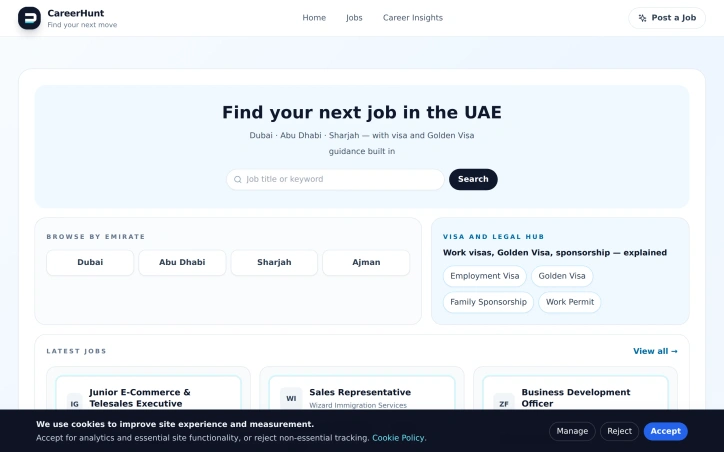

Job-boards
C
Career Hunt

Navigating the UAE job market presents a unique set of challenges that most traditional job boards fail to address. Professionals seeking positions across the emirates contend with a fragmented search experience, visa sponsorship confusion, and inconsistent salary transparency. CareerHunt consolidates these pain points into a single platform designed specifically for the UAE labor market. The platform aggregates job listings across the major employment hubs—Dubai, Abu Dhabi, Sharjah, and Ajman—while layering in visa guidance that explains the distinctions between employment visas, golden visas, family sponsorship, and work permits. This dual focus on job discovery and regulatory navigation directly addresses the core friction point for professionals relocating to or working in the UAE: the need to understand both opportunity and immigration mechanics simultaneously. Beyond basic job posting, CareerHunt structures its offering around salary transparency and career development. The platform includes a salary guide with emirate-by-emirate comparisons and role-specific benchmarks, reducing the information asymmetry that disadvantages job seekers. Featured company pages for major employers like DHL, Noon, and Emirates Group provide deeper organizational context alongside available positions. Current postings span industries from e-commerce and telesales to construction and financial services, indicating real employer participation across sectors. The resource section extends the platform's utility beyond simple job matching. Resume checklists, interview preparation guides, and networking advice position CareerHunt as an end-to-end career navigation tool. Career guides addressing resume strategy, interview technique, and professional networking acknowledge that successful job placement in the UAE requires more than applying to openings—it demands cultural and procedural literacy that candidates often lack. For professionals serious about UAE employment, the platform solves a genuine coordination problem. It consolidates labor market data with the regulatory knowledge required to work in the region. The execution emphasizes practical utility—salary ranges, visa explanations, and curated employer profiles—over aspirational marketing, which aligns well with an audience seeking clarity and efficiency. The emirate-based organization and transparent salary comparisons reflect an understanding of how UAE employment actually works, rather than forcing candidates into generic global job board workflows.

CareerHunt preview

Key features

  • Job Aggregation: Consolidates listings across Dubai, Abu Dhabi, Sharjah, and Ajman into one platform
  • Visa Guidance: Explains employment visas, golden visas, family sponsorship, and work permit distinctions
See full listing
Prism

Scattered AI tools fracture workflows, forcing users to juggle browser tabs, separate applications, and disconnected windows just to access different models. Prism consolidates this chaos into a unified macOS workspace, eliminating the friction of context-switching and letting users stay focused on their actual work. Built natively in SwiftUI for macOS, Prism brings together multiple AI models, code assistance, local model support, and agent automation into one integrated environment. Users invoke the application via a single hotkey from any app, gaining instant access to a suite of tools without leaving their current workspace. The product targets knowledge workers and developers who rely on AI for writing, coding, and analysis—anyone drowning in scattered tools who wants a streamlined alternative. The standout capabilities center on flexibility and consolidation. Prism allows users to compare leading AI providers within a single thread, switching between models mid-conversation without disrupting context. This is a practical solution to the lock-in problem: users aren't forced to commit to one provider but can instead evaluate and swap based on task requirements. The application also supports local GGUF models with minimal setup friction, appealing to privacy-conscious users or those with specific model preferences. Beyond chat, Prism includes a native code companion with an integrated terminal, bringing development workflows into the same environment. The platform's agent features—AI that watches, summarizes, and acts automatically—suggest a system designed to anticipate user needs rather than simply respond to them. Integration with MCP and custom tools enables connections to files, databases, and APIs, expanding what users can accomplish without leaving the application. User testimonials highlight the experience as seamless integration with macOS itself. One key differentiator is the frictionless interaction model: hitting a hotkey, asking a question, and returning to work creates a flow that respects user attention rather than demanding it. The ability to swap models mid-session without breaking conversation context directly addresses a common pain point in multi-model workflows. Prism operates under a paid licensing model, with promotional messaging around limited-time lifetime access offers paired with cloud credits. Specific pricing details remain behind a link, though the site references tiered options. For macOS users struggling with AI tool fragmentation, Prism presents a consolidated alternative that prioritizes native integration, model flexibility, and minimal friction in the core interaction loop.


Ai-chatbots
A
Aarav Goyal

Scattered AI tools fracture workflows, forcing users to juggle browser tabs, separate applications, and disconnected windows just to access different models. Prism consolidates this chaos into a unified macOS workspace, eliminating the friction of context-switching and letting users stay focused on their actual work. Built natively in SwiftUI for macOS, Prism brings together multiple AI models, code assistance, local model support, and agent automation into one integrated environment. Users invoke the application via a single hotkey from any app, gaining instant access to a suite of tools without leaving their current workspace. The product targets knowledge workers and developers who rely on AI for writing, coding, and analysis—anyone drowning in scattered tools who wants a streamlined alternative. The standout capabilities center on flexibility and consolidation. Prism allows users to compare leading AI providers within a single thread, switching between models mid-conversation without disrupting context. This is a practical solution to the lock-in problem: users aren't forced to commit to one provider but can instead evaluate and swap based on task requirements. The application also supports local GGUF models with minimal setup friction, appealing to privacy-conscious users or those with specific model preferences. Beyond chat, Prism includes a native code companion with an integrated terminal, bringing development workflows into the same environment. The platform's agent features—AI that watches, summarizes, and acts automatically—suggest a system designed to anticipate user needs rather than simply respond to them. Integration with MCP and custom tools enables connections to files, databases, and APIs, expanding what users can accomplish without leaving the application. User testimonials highlight the experience as seamless integration with macOS itself. One key differentiator is the frictionless interaction model: hitting a hotkey, asking a question, and returning to work creates a flow that respects user attention rather than demanding it. The ability to swap models mid-session without breaking conversation context directly addresses a common pain point in multi-model workflows. Prism operates under a paid licensing model, with promotional messaging around limited-time lifetime access offers paired with cloud credits. Specific pricing details remain behind a link, though the site references tiered options. For macOS users struggling with AI tool fragmentation, Prism presents a consolidated alternative that prioritizes native integration, model flexibility, and minimal friction in the core interaction loop.

Prism preview

Key features

  • Unified Workspace: Consolidates multiple AI tools, code assistance, local models, and agent automation into a single macOS application
  • Model Switching: Compare different AI providers and swap between models within a single conversation thread without losing context
See full listing
SkipBait

Watching long YouTube videos consumes hours that busy professionals and learners often don't have. SkipBait tackles this friction by letting viewers extract essential information without sitting through entire runtime. The Chrome extension generates AI-powered summaries, searchable transcripts, and an interactive chat interface that grounds answers in both video content and web search results. The product's core innovation lies in its approach to summarization. Rather than generic bullet points, SkipBait produces "honest titles" that capture what the video is actually about, paired with one-sentence summaries and topic-by-topic breakdowns anchored to exact timestamps. This timestamping is crucial: viewers can jump directly to relevant sections rather than scrubbing through minutes of content. The actionables feature goes further, converting speaker recommendations into concrete to-dos tied to specific quotes and moments in the video. What distinguishes SkipBait from simpler transcript tools is its AI chat functionality. Users ask questions and receive answers grounded in both the video's content and current web search results. This prevents the hallucinations and generic responses that plague transcript-only search, delivering answers that connect video insights to real-world context. Chat operates across 50+ languages, removing language barriers for global audiences. The feature set addresses multiple workflows. Students reviewing lectures benefit from timestamped breakdowns and actionables. Professionals researching industry talks gain searchable transcripts and web-informed Q&A. Content creators analyzing competitor videos access viewing history for quick reference. The expanded view mode offers focused reading without video distractions, while transcripts are available in 20+ languages for non-English content. The extension works across all Chromium-based browsers—Chrome, Brave, Edge, Arc, Opera, and Vivaldi—expanding accessibility beyond Chrome alone. Live videos and content without transcript data won't work, a natural limitation given YouTube's transcript availability. On pricing, SkipBait offers a free tier providing 2 AI summary bundles daily, unlimited transcript access, and monthly quotas for chat and translation. This freemium model lets casual users test value with real videos before committing to paid tiers. The product solves a genuine problem for a large audience: anyone tired of watching entire videos to extract a few useful insights. By combining honest summaries, timestamped breakdowns, actionable takeaways, and grounded AI chat, SkipBait makes long-form video consumption efficient rather than time-taxing. For information workers and students drowning in video content, this delivers a meaningful productivity unlock.


Chrome-extensions
S
SkipBait Labs

Watching long YouTube videos consumes hours that busy professionals and learners often don't have. SkipBait tackles this friction by letting viewers extract essential information without sitting through entire runtime. The Chrome extension generates AI-powered summaries, searchable transcripts, and an interactive chat interface that grounds answers in both video content and web search results. The product's core innovation lies in its approach to summarization. Rather than generic bullet points, SkipBait produces "honest titles" that capture what the video is actually about, paired with one-sentence summaries and topic-by-topic breakdowns anchored to exact timestamps. This timestamping is crucial: viewers can jump directly to relevant sections rather than scrubbing through minutes of content. The actionables feature goes further, converting speaker recommendations into concrete to-dos tied to specific quotes and moments in the video. What distinguishes SkipBait from simpler transcript tools is its AI chat functionality. Users ask questions and receive answers grounded in both the video's content and current web search results. This prevents the hallucinations and generic responses that plague transcript-only search, delivering answers that connect video insights to real-world context. Chat operates across 50+ languages, removing language barriers for global audiences. The feature set addresses multiple workflows. Students reviewing lectures benefit from timestamped breakdowns and actionables. Professionals researching industry talks gain searchable transcripts and web-informed Q&A. Content creators analyzing competitor videos access viewing history for quick reference. The expanded view mode offers focused reading without video distractions, while transcripts are available in 20+ languages for non-English content. The extension works across all Chromium-based browsers—Chrome, Brave, Edge, Arc, Opera, and Vivaldi—expanding accessibility beyond Chrome alone. Live videos and content without transcript data won't work, a natural limitation given YouTube's transcript availability. On pricing, SkipBait offers a free tier providing 2 AI summary bundles daily, unlimited transcript access, and monthly quotas for chat and translation. This freemium model lets casual users test value with real videos before committing to paid tiers. The product solves a genuine problem for a large audience: anyone tired of watching entire videos to extract a few useful insights. By combining honest summaries, timestamped breakdowns, actionable takeaways, and grounded AI chat, SkipBait makes long-form video consumption efficient rather than time-taxing. For information workers and students drowning in video content, this delivers a meaningful productivity unlock.

SkipBait preview

Key features

  • AI Summaries: Generates honest titles and one-sentence summaries capturing what the video is actually about
  • Timestamped Breakdowns: Provides topic-by-topic breakdowns anchored to exact timestamps for direct navigation
See full listing
Calculora

Calculating the interest on a loan, converting currencies, or checking retirement savings shouldn't require creating accounts, tolerating advertisements, or worrying about personal data collection. Calculora eliminates these friction points by offering over a hundred calculators and converters that operate entirely within the user's browser, requiring no signup or tracking. The product spans multiple domains: financial planning tools like mortgage and loan calculators, scientific and engineering resources including resistor color codes and electrical calculations, health assessments such as BMI and sleep cycle tracking, and specialized Islamic tools for prayer times and Qibla direction. This breadth positions the platform as a catch-all solution for calculation needs rather than a specialized niche tool. What differentiates Calculora is its uncompromising stance on privacy and accessibility. Every calculator runs locally in the browser without transmitting data to external servers, and the service explicitly operates without advertisements, paywalls, or subscription tiers. The founder built the platform around a core philosophy: people deserve dependable calculation tools that remain free and private. This approach contrasts sharply with many online calculator sites that have become increasingly monetized through ads, premium tiers, or data harvesting. The breadth of offerings across categories like personal finance, mathematics, business tools, developer utilities, and even sustainability calculators suggests thoughtful curation beyond a generic toolkit. The inclusion of niche categories such as Islamic tools—with resources for prayer times, Zakat calculations, and Qibla direction—demonstrates attention to underserved user segments often overlooked by mainstream calculator applications. From a usability perspective, the reliance on browser-based computation means no lag from server requests and complete functionality for users with inconsistent internet. The absence of login requirements removes a common barrier to casual usage. The primary consideration for potential users is discovery: with such a large collection, finding the specific calculator needed isn't obvious from browsing. A search function or smarter categorization might help users navigate the catalog more efficiently. Additionally, while the free model is sustainable and admirable, details about the underlying technology stack and calculation methodologies would strengthen confidence in accuracy, particularly for financial or health-related tools where precision matters. Calculora represents a principled approach to online calculators: comprehensive, private, and genuinely free. It serves anyone from engineers to entrepreneurs to everyday users who simply need a reliable computation tool without the baggage modern web services typically demand.


Spreadsheets
Y
Youssef Bedoui

Calculating the interest on a loan, converting currencies, or checking retirement savings shouldn't require creating accounts, tolerating advertisements, or worrying about personal data collection. Calculora eliminates these friction points by offering over a hundred calculators and converters that operate entirely within the user's browser, requiring no signup or tracking. The product spans multiple domains: financial planning tools like mortgage and loan calculators, scientific and engineering resources including resistor color codes and electrical calculations, health assessments such as BMI and sleep cycle tracking, and specialized Islamic tools for prayer times and Qibla direction. This breadth positions the platform as a catch-all solution for calculation needs rather than a specialized niche tool. What differentiates Calculora is its uncompromising stance on privacy and accessibility. Every calculator runs locally in the browser without transmitting data to external servers, and the service explicitly operates without advertisements, paywalls, or subscription tiers. The founder built the platform around a core philosophy: people deserve dependable calculation tools that remain free and private. This approach contrasts sharply with many online calculator sites that have become increasingly monetized through ads, premium tiers, or data harvesting. The breadth of offerings across categories like personal finance, mathematics, business tools, developer utilities, and even sustainability calculators suggests thoughtful curation beyond a generic toolkit. The inclusion of niche categories such as Islamic tools—with resources for prayer times, Zakat calculations, and Qibla direction—demonstrates attention to underserved user segments often overlooked by mainstream calculator applications. From a usability perspective, the reliance on browser-based computation means no lag from server requests and complete functionality for users with inconsistent internet. The absence of login requirements removes a common barrier to casual usage. The primary consideration for potential users is discovery: with such a large collection, finding the specific calculator needed isn't obvious from browsing. A search function or smarter categorization might help users navigate the catalog more efficiently. Additionally, while the free model is sustainable and admirable, details about the underlying technology stack and calculation methodologies would strengthen confidence in accuracy, particularly for financial or health-related tools where precision matters. Calculora represents a principled approach to online calculators: comprehensive, private, and genuinely free. It serves anyone from engineers to entrepreneurs to everyday users who simply need a reliable computation tool without the baggage modern web services typically demand.

Calculora preview

Key features

  • Browser-Based Computation: All calculations run locally in the browser without transmitting data to external servers
  • No Signup Required: Access over a hundred calculators without account creation or login barriers
See full listing
ProofEcho

Collecting authentic customer testimonials has long been the bane of modern marketing. Businesses know peer-generated social proof converts better than any brand messaging, yet gathering and displaying testimonials falls perpetually to the bottom of the to-do list. ProofEcho tackles this friction head-on with a stripped-down testimonial platform designed for founders and marketing teams without bandwidth for traditional outreach campaigns. The core problem is real and well-articulated: glowing customer feedback languishes in inboxes and private messages, never reaching decision-making pages where it could drive conversions. ProofEcho addresses this by making the full testimonial lifecycle effortless. Users create a branded collection form in minutes, share it with customers, and receive responses in whatever format feels natural—text, video, or audio. Submissions flow into a central studio for review and curation, where teams can approve entries, organize them by product or use case, and surface patterns through AI analysis. What sets ProofEcho apart is its emphasis on speed and polish. The company claims customers move from first form to embedded widget in under five minutes, backed by pre-built display options including carousels, quote callouts, hero sections, notification toasts, and trust badges. A Wall of Love page template offers an alternative showcase format. All widgets embed with a single code snippet, eliminating technical friction. The founder's approach to authenticity also stands out. Rather than seeding the platform with fake testimonials during early stages—a temptation many new tools succumb to—ProofEcho invites real customers to become the first entries in its social proof library. On pricing, the platform offers a free forever tier with no credit card required, lowering trial barriers. This suggests a freemium model, though paid plan features remain unspecified. The business case is straightforward: convert trust into transactions by making social proof collection and display trivially easy. ProofEcho solves a recognized gap in the typical SaaS marketing stack. For teams drowning in scattered customer praise and lacking operational overhead for formal testimonial programs, it offers a pragmatic shortcut from idea to execution.

Lead-generation-software
R
robi

Collecting authentic customer testimonials has long been the bane of modern marketing. Businesses know peer-generated social proof converts better than any brand messaging, yet gathering and displaying testimonials falls perpetually to the bottom of the to-do list. ProofEcho tackles this friction head-on with a stripped-down testimonial platform designed for founders and marketing teams without bandwidth for traditional outreach campaigns. The core problem is real and well-articulated: glowing customer feedback languishes in inboxes and private messages, never reaching decision-making pages where it could drive conversions. ProofEcho addresses this by making the full testimonial lifecycle effortless. Users create a branded collection form in minutes, share it with customers, and receive responses in whatever format feels natural—text, video, or audio. Submissions flow into a central studio for review and curation, where teams can approve entries, organize them by product or use case, and surface patterns through AI analysis. What sets ProofEcho apart is its emphasis on speed and polish. The company claims customers move from first form to embedded widget in under five minutes, backed by pre-built display options including carousels, quote callouts, hero sections, notification toasts, and trust badges. A Wall of Love page template offers an alternative showcase format. All widgets embed with a single code snippet, eliminating technical friction. The founder's approach to authenticity also stands out. Rather than seeding the platform with fake testimonials during early stages—a temptation many new tools succumb to—ProofEcho invites real customers to become the first entries in its social proof library. On pricing, the platform offers a free forever tier with no credit card required, lowering trial barriers. This suggests a freemium model, though paid plan features remain unspecified. The business case is straightforward: convert trust into transactions by making social proof collection and display trivially easy. ProofEcho solves a recognized gap in the typical SaaS marketing stack. For teams drowning in scattered customer praise and lacking operational overhead for formal testimonial programs, it offers a pragmatic shortcut from idea to execution.

ProofEcho preview

Key features

  • Branded Collection Forms: Users can create branded testimonial collection forms in minutes.
  • Multi-Format Submissions: Customers can submit testimonials as text, video, or audio.
See full listing