
BLACK FRIDAY Premium $99 $69 Ends in 1 week 2 days See the deal →
1,261 startups launched 15,421 upvotes cast 57 submitted this week

Recently Listed

1,261 launches
Sort
MakerPrintTools

Makers and 3D printing shops waste time converting slicer estimates into real-world decisions through spreadsheets or trial-and-error. MakerPrintTools replaces that friction with a collection of specialized calculators designed for shop-floor problems, each combining measurements you already have into actionable results. The platform targets anyone running a 3D printing operation—whether a one-person hobby shop or small production facility—who needs to calculate costs before quoting jobs, verify that a printer can actually achieve a design's settings, or estimate material waste. No account is required, so users can jump directly from measuring part geometry to making confident decisions. What distinguishes the product is its deliberate scope. Rather than a generic calculator, each tool solves a specific question: How much does this print actually cost? How many grams of filament does a particular length represent? Will my hotend flow capacity handle these settings? This focused design makes each calculator faster and more useful than generic spreadsheets. The platform also explains its math—showing formulas and assumptions—so users understand the reasoning behind every result. The toolkit spans the full production cycle. Cost calculators combine filament consumption, electricity usage, labor time, machine wear, and failure allowance into practical job pricing. Filament converters switch between meters and grams using actual material density. A volumetric flow checker validates that hotend capacity matches intended print parameters. Geometry tools handle model scaling and build volume constraints. Planning tools look beyond individual prints to estimate total material use, support requirements, and the production volume needed to break even on setup work. The product positioning emphasizes transparency over convenience. There's no cloud storage, no project management, no growth features—just clear math applied to shop measurements. The design assumes makers already know what they're measuring and what they'll do with the results; the calculators simply eliminate error and guessing from the conversion. This approach creates a practical, single-purpose tool that integrates into existing workflows rather than requiring process change. For small and mid-scale 3D printing operations, that efficiency compounds across hundreds of decisions. The frictionless entry point—no login, no free trial cutoff, no marketing emails—removes barriers to trying calculators that genuinely answer shop questions.


3d-animation
C
canghun13

Makers and 3D printing shops waste time converting slicer estimates into real-world decisions through spreadsheets or trial-and-error. MakerPrintTools replaces that friction with a collection of specialized calculators designed for shop-floor problems, each combining measurements you already have into actionable results. The platform targets anyone running a 3D printing operation—whether a one-person hobby shop or small production facility—who needs to calculate costs before quoting jobs, verify that a printer can actually achieve a design's settings, or estimate material waste. No account is required, so users can jump directly from measuring part geometry to making confident decisions. What distinguishes the product is its deliberate scope. Rather than a generic calculator, each tool solves a specific question: How much does this print actually cost? How many grams of filament does a particular length represent? Will my hotend flow capacity handle these settings? This focused design makes each calculator faster and more useful than generic spreadsheets. The platform also explains its math—showing formulas and assumptions—so users understand the reasoning behind every result. The toolkit spans the full production cycle. Cost calculators combine filament consumption, electricity usage, labor time, machine wear, and failure allowance into practical job pricing. Filament converters switch between meters and grams using actual material density. A volumetric flow checker validates that hotend capacity matches intended print parameters. Geometry tools handle model scaling and build volume constraints. Planning tools look beyond individual prints to estimate total material use, support requirements, and the production volume needed to break even on setup work. The product positioning emphasizes transparency over convenience. There's no cloud storage, no project management, no growth features—just clear math applied to shop measurements. The design assumes makers already know what they're measuring and what they'll do with the results; the calculators simply eliminate error and guessing from the conversion. This approach creates a practical, single-purpose tool that integrates into existing workflows rather than requiring process change. For small and mid-scale 3D printing operations, that efficiency compounds across hundreds of decisions. The frictionless entry point—no login, no free trial cutoff, no marketing emails—removes barriers to trying calculators that genuinely answer shop questions.

MakerPrintTools preview

Key features

  • Cost Calculators: Combine filament consumption, electricity usage, labor time, machine wear, and failure allowance into practical job pricing
  • Filament Converters: Switch between meters and grams using actual material density
See full listing
ReliabilityBench

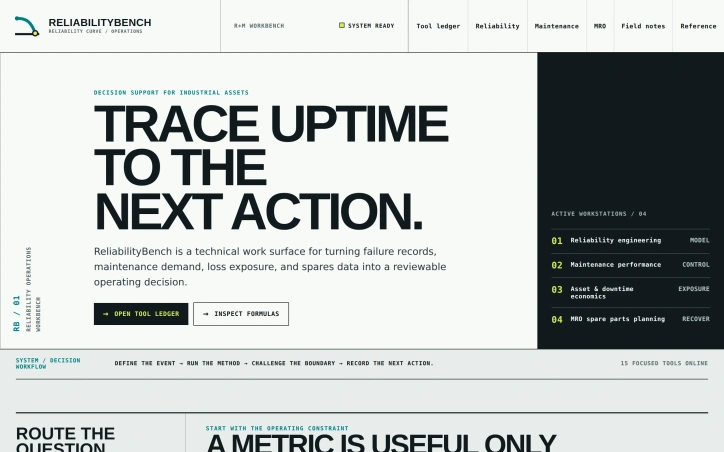
Industrial operations teams sit on vast repositories of failure data and maintenance records but struggle to convert them into concrete decisions. ReliabilityBench addresses this disconnect by creating a transparent calculation surface that links reliability metrics, maintenance performance, equipment economics, and spare parts planning into a single workbench. The platform targets reliability engineers, maintenance supervisors, production leaders, and asset management teams who need rapid calculations during active work. Rather than attempting to replace comprehensive CMMS systems or detailed engineering studies, ReliabilityBench positions itself as a decision-support layer that lives alongside existing tools. What distinguishes the product is its deliberate focus on decision-making rather than data collection. The interface organizes work around a clear problem-solving sequence: define the failure event, apply a specified calculation method, validate the result against operational reality, and route the output into concrete work assignments or planning. This workflow frames the calculator not as an isolated number-generator but as the middle step in a larger decision chain. The platform offers fifteen focused calculators distributed across four workstations. The Reliability Engineering station includes tools for normalizing failure history into operating intervals. Maintenance Performance handles availability, performance, and quality loss tracking. Asset & Downtime Economics exposes cost contribution and recovery expenses. MRO Spare Parts Planning connects lead-time demand with safety buffers. Specific tools include MTBF calculators, OEE tracking, downtime cost analysis, repair-versus-replace comparisons, and reorder point calculations. A striking design choice is the open tool ledger—each calculation displays its inputs, methodology, worked examples, interpretation guidance, and stated limitations directly adjacent to the result. This transparency invites teams to audit assumptions before treating a number as operational truth, surfacing where a calculation may diverge from actual site conditions. The platform records a complete operational chain through five stages: failure definition, response documentation, consequence quantification, recovery readiness, and review for the next action. This evidence trail preserves context across decisions, helping teams validate whether repeated comparisons remain consistent. ReliabilityBench addresses a genuine operational need—turning data into decisions—with a deliberately scoped tool that complements rather than displaces existing infrastructure. Its emphasis on formula transparency and decision context distinguishes it from pure data collection systems.

Business-intelligence-software
C
canghun13

Industrial operations teams sit on vast repositories of failure data and maintenance records but struggle to convert them into concrete decisions. ReliabilityBench addresses this disconnect by creating a transparent calculation surface that links reliability metrics, maintenance performance, equipment economics, and spare parts planning into a single workbench. The platform targets reliability engineers, maintenance supervisors, production leaders, and asset management teams who need rapid calculations during active work. Rather than attempting to replace comprehensive CMMS systems or detailed engineering studies, ReliabilityBench positions itself as a decision-support layer that lives alongside existing tools. What distinguishes the product is its deliberate focus on decision-making rather than data collection. The interface organizes work around a clear problem-solving sequence: define the failure event, apply a specified calculation method, validate the result against operational reality, and route the output into concrete work assignments or planning. This workflow frames the calculator not as an isolated number-generator but as the middle step in a larger decision chain. The platform offers fifteen focused calculators distributed across four workstations. The Reliability Engineering station includes tools for normalizing failure history into operating intervals. Maintenance Performance handles availability, performance, and quality loss tracking. Asset & Downtime Economics exposes cost contribution and recovery expenses. MRO Spare Parts Planning connects lead-time demand with safety buffers. Specific tools include MTBF calculators, OEE tracking, downtime cost analysis, repair-versus-replace comparisons, and reorder point calculations. A striking design choice is the open tool ledger—each calculation displays its inputs, methodology, worked examples, interpretation guidance, and stated limitations directly adjacent to the result. This transparency invites teams to audit assumptions before treating a number as operational truth, surfacing where a calculation may diverge from actual site conditions. The platform records a complete operational chain through five stages: failure definition, response documentation, consequence quantification, recovery readiness, and review for the next action. This evidence trail preserves context across decisions, helping teams validate whether repeated comparisons remain consistent. ReliabilityBench addresses a genuine operational need—turning data into decisions—with a deliberately scoped tool that complements rather than displaces existing infrastructure. Its emphasis on formula transparency and decision context distinguishes it from pure data collection systems.

ReliabilityBench preview

Key features

  • Decision-Support Layer: Complements existing CMMS and engineering systems without replacing them.
  • Transparent Tool Ledger: Each calculation displays inputs, methodology, worked examples, interpretation guidance, and stated limitations.
See full listing
PlasticsCalc

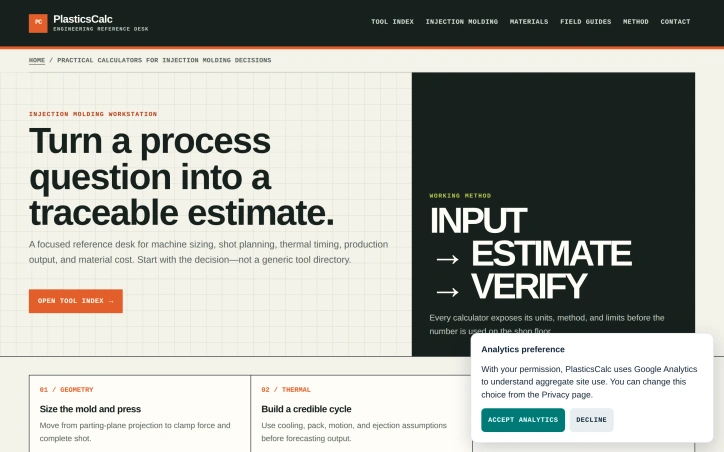
Injection molding engineers face a persistent challenge: converting design and process questions into reliable machine specifications and production forecasts before committing to expensive tooling and equipment. PlasticsCalc addresses this by providing a structured set of calculators that move engineers through three distinct phases—geometry sizing, thermal cycle planning, and economic validation—with methodology transparent at every step. The product serves a specific audience: manufacturing professionals responsible for mold design, machine selection, and production planning. Rather than presenting a generic calculator directory, PlasticsCalc anchors each tool to a concrete decision point. An engineer asking "What clamp tonnage do I need?" starts with parting-plane geometry and material assumptions, not a blank form. The workflow reflects actual injection molding constraints: cavity pressure, cooling time, uptime, scrap rates, and material handling all factor into the complete picture. What distinguishes the product is its commitment to transparency and traceability. Each calculator exposes its units, methodology, and computational limits before results leave the desktop. The interface is structured around record-keeping: a parting-plane record captures mold geometry and pressure basis; a shot and process record documents part mass and observed cycles; a production and cost record ties material consumption to utilization. This record-keeping focus signals that PlasticsCalc treats estimates as decision artifacts, not one-off calculations. The core toolset covers six areas: machine sizing via clamp tonnage and shot weight; process planning through cycle and cooling time; production output per hour; and material costs per part. Beyond these foundation tools, the platform supports expanded workflow checks including cold-runner accounting, machine screening across multiple constraints (clamp, injection unit, platen, tie-bar, mold height), and material planning that carries resin recovery policy and purchase packaging into the estimate. The strength lies not in computational novelty but in workflow structure. Injection molding sits at the intersection of geometry, thermal physics, and production economics; many engineers lack the confidence to bridge all three without external reference. By sequencing decisions and making assumptions explicit, PlasticsCalc reduces the risk of costly miscalculation and rework. Pricing and licensing details are not disclosed in available materials. The tool positions itself as a reference desk rather than a simulation suite, suggesting it targets practitioners who need quick, credible first-pass estimates rather than finite-element analysis or production simulation.

Web-browsers
C
canghun13

Injection molding engineers face a persistent challenge: converting design and process questions into reliable machine specifications and production forecasts before committing to expensive tooling and equipment. PlasticsCalc addresses this by providing a structured set of calculators that move engineers through three distinct phases—geometry sizing, thermal cycle planning, and economic validation—with methodology transparent at every step. The product serves a specific audience: manufacturing professionals responsible for mold design, machine selection, and production planning. Rather than presenting a generic calculator directory, PlasticsCalc anchors each tool to a concrete decision point. An engineer asking "What clamp tonnage do I need?" starts with parting-plane geometry and material assumptions, not a blank form. The workflow reflects actual injection molding constraints: cavity pressure, cooling time, uptime, scrap rates, and material handling all factor into the complete picture. What distinguishes the product is its commitment to transparency and traceability. Each calculator exposes its units, methodology, and computational limits before results leave the desktop. The interface is structured around record-keeping: a parting-plane record captures mold geometry and pressure basis; a shot and process record documents part mass and observed cycles; a production and cost record ties material consumption to utilization. This record-keeping focus signals that PlasticsCalc treats estimates as decision artifacts, not one-off calculations. The core toolset covers six areas: machine sizing via clamp tonnage and shot weight; process planning through cycle and cooling time; production output per hour; and material costs per part. Beyond these foundation tools, the platform supports expanded workflow checks including cold-runner accounting, machine screening across multiple constraints (clamp, injection unit, platen, tie-bar, mold height), and material planning that carries resin recovery policy and purchase packaging into the estimate. The strength lies not in computational novelty but in workflow structure. Injection molding sits at the intersection of geometry, thermal physics, and production economics; many engineers lack the confidence to bridge all three without external reference. By sequencing decisions and making assumptions explicit, PlasticsCalc reduces the risk of costly miscalculation and rework. Pricing and licensing details are not disclosed in available materials. The tool positions itself as a reference desk rather than a simulation suite, suggesting it targets practitioners who need quick, credible first-pass estimates rather than finite-element analysis or production simulation.

PlasticsCalc preview

Key features

  • Geometry Sizing: Captures parting-plane geometry and material specifications for mold design decisions
  • Thermal Cycle Planning: Calculates cooling time and cavity pressure impacts on production feasibility
See full listing
CogniFocus

Distraction management has largely been a one-dimensional problem, with app blockers treating phone usage like an on-off switch. CogniFocus reframes the issue for Android users caught in compulsive social media loops, recognizing that technical barriers alone fail to address the psychological habit patterns that keep people scrolling for hours after a "quick check" of Instagram or TikTok. The product pivots around an anthropomorphic accountability system: a Goblin companion that reacts to your behavior during focus sessions. Rather than silently blocking apps, the Goblin responds visibly to distraction attempts, creating social pressure and a layer of real-time feedback. Early access users reported substantial behavioral shifts, moving from multiple distraction breaks per session to one or fewer, with the streak mechanics cited as primary motivation for maintaining clean focus windows. What distinguishes CogniFocus from conventional timer-plus-blocker combinations is its recovery framework. The system acknowledges that slipping back into blocked apps happens and reframes a single lapse as a recovery opportunity rather than session failure. Users earn progression currency—streaks, XP, Focus Shards, and companion affinity—that accumulates across sessions, turning focus maintenance into an ongoing progression loop with visible rewards. This gamification design addresses a core behavioral insight: people respond to measurable progress and social cues more reliably than punitive restrictions. The Shield component handles the technical enforcement, blocking designated apps before "one quick check" stretches into lost hours. A roadmap signals planned escalation through uninstall protection, Ghost Mode, Do Not Disturb integration, and stricter focus modes, suggesting the team is iterating toward making the Goblin's interventions progressively harder to circumvent. The companion expansion roadmap introduces Monk, Buddy, and Wizard variants, hinting that variety in accountability personalities may serve different user psychology or focus contexts. This signals awareness that one accountability archetype won't sustain long-term behavioral change. Pricing details remain sparse—the site advertises free access for Android launch with an iOS waitlist—suggesting either a freemium model or promotional entry pricing. The product is currently Android-only, making it inaccessible to the substantial iOS user base despite parallel demand. CogniFocus targets a specific subset of users: those whose distraction struggles stem from compulsive checking behaviors rather than external interruptions, and who respond to gamification and social accountability mechanics. For that audience, the psychological intervention layer adds meaningful differentiation to an otherwise crowded space.


Time-tracking-apps
C
CogniElevate

Distraction management has largely been a one-dimensional problem, with app blockers treating phone usage like an on-off switch. CogniFocus reframes the issue for Android users caught in compulsive social media loops, recognizing that technical barriers alone fail to address the psychological habit patterns that keep people scrolling for hours after a "quick check" of Instagram or TikTok. The product pivots around an anthropomorphic accountability system: a Goblin companion that reacts to your behavior during focus sessions. Rather than silently blocking apps, the Goblin responds visibly to distraction attempts, creating social pressure and a layer of real-time feedback. Early access users reported substantial behavioral shifts, moving from multiple distraction breaks per session to one or fewer, with the streak mechanics cited as primary motivation for maintaining clean focus windows. What distinguishes CogniFocus from conventional timer-plus-blocker combinations is its recovery framework. The system acknowledges that slipping back into blocked apps happens and reframes a single lapse as a recovery opportunity rather than session failure. Users earn progression currency—streaks, XP, Focus Shards, and companion affinity—that accumulates across sessions, turning focus maintenance into an ongoing progression loop with visible rewards. This gamification design addresses a core behavioral insight: people respond to measurable progress and social cues more reliably than punitive restrictions. The Shield component handles the technical enforcement, blocking designated apps before "one quick check" stretches into lost hours. A roadmap signals planned escalation through uninstall protection, Ghost Mode, Do Not Disturb integration, and stricter focus modes, suggesting the team is iterating toward making the Goblin's interventions progressively harder to circumvent. The companion expansion roadmap introduces Monk, Buddy, and Wizard variants, hinting that variety in accountability personalities may serve different user psychology or focus contexts. This signals awareness that one accountability archetype won't sustain long-term behavioral change. Pricing details remain sparse—the site advertises free access for Android launch with an iOS waitlist—suggesting either a freemium model or promotional entry pricing. The product is currently Android-only, making it inaccessible to the substantial iOS user base despite parallel demand. CogniFocus targets a specific subset of users: those whose distraction struggles stem from compulsive checking behaviors rather than external interruptions, and who respond to gamification and social accountability mechanics. For that audience, the psychological intervention layer adds meaningful differentiation to an otherwise crowded space.

CogniFocus preview

Key features

  • Goblin Accountability: An anthropomorphic companion that reacts visibly to distraction attempts, creating social pressure during focus sessions.
  • Focus Shield: Technical enforcement component that blocks designated apps to prevent compulsive checking.
See full listing
Aripsy

Converting textbooks and lecture notes into effective study materials consumes enormous time for students preparing for exams. Aripsy tackles this friction by using AI to instantly transform PDFs, pasted text, and lecture notes into structured study content: notes, flashcards, multiple-choice questions, and practice tests tailored to specific exam boards and curricula. The product targets students across educational tiers—GCSE, A-Level, IB Diploma, AP, SAT, and university students, including those in medical and law programs. Its curriculum-specific approach means the output respects the actual exam formats and content depth students encounter, rather than generic study aids. What distinguishes Aripsy from broader AI tools is its singular focus on exam preparation workflows. The interface accepts a single input (PDF or pasted text) and outputs multiple study formats, eliminating the need to prompt an AI repeatedly or copy-paste between tools. A student can upload a 500-page textbook and receive both searchable summary notes and a set of multiple-choice questions designed to identify knowledge gaps. The product offers mark schemes for practice exams, grounding self-assessment in actual curriculum standards. The design philosophy reinforces active recall over passive consumption—the core mechanism of effective learning. Rather than relying on gamification or engagement-maximizing dark patterns, Aripsy positions itself as a straightforward study aid. This restraint is notable in edtech, where many competitors drive engagement through reward systems or social competition. The technical implementation handles substantial documents efficiently. The product processes large PDFs in seconds and generates structured outputs that mirror how actual study notes are organized—by topic, concept, and difficulty level. The flashcard and MCQ generators produce multiple attempts from a single source, extending the utility of each upload. Pricing follows a freemium model. The free tier allows pasted text and free PDFs, making the service fully functional for basic use. Pro accounts cost $4.99 per month and unlock PDF uploads plus 300 monthly AI generations. The company explicitly positions Pro as optional, keeping the free tier genuinely useful for evaluating the service. Aripsy succeeds because it narrows scope ruthlessly. Rather than attempting to be a general study app with chat, note-taking, scheduling, and social features, it handles one job: converting source material into multiple exam-ready formats. For students drowning in reading materials and short on study time, that specificity has clear value.


Ai-notetakers
A
Amin Mudassir

Converting textbooks and lecture notes into effective study materials consumes enormous time for students preparing for exams. Aripsy tackles this friction by using AI to instantly transform PDFs, pasted text, and lecture notes into structured study content: notes, flashcards, multiple-choice questions, and practice tests tailored to specific exam boards and curricula. The product targets students across educational tiers—GCSE, A-Level, IB Diploma, AP, SAT, and university students, including those in medical and law programs. Its curriculum-specific approach means the output respects the actual exam formats and content depth students encounter, rather than generic study aids. What distinguishes Aripsy from broader AI tools is its singular focus on exam preparation workflows. The interface accepts a single input (PDF or pasted text) and outputs multiple study formats, eliminating the need to prompt an AI repeatedly or copy-paste between tools. A student can upload a 500-page textbook and receive both searchable summary notes and a set of multiple-choice questions designed to identify knowledge gaps. The product offers mark schemes for practice exams, grounding self-assessment in actual curriculum standards. The design philosophy reinforces active recall over passive consumption—the core mechanism of effective learning. Rather than relying on gamification or engagement-maximizing dark patterns, Aripsy positions itself as a straightforward study aid. This restraint is notable in edtech, where many competitors drive engagement through reward systems or social competition. The technical implementation handles substantial documents efficiently. The product processes large PDFs in seconds and generates structured outputs that mirror how actual study notes are organized—by topic, concept, and difficulty level. The flashcard and MCQ generators produce multiple attempts from a single source, extending the utility of each upload. Pricing follows a freemium model. The free tier allows pasted text and free PDFs, making the service fully functional for basic use. Pro accounts cost $4.99 per month and unlock PDF uploads plus 300 monthly AI generations. The company explicitly positions Pro as optional, keeping the free tier genuinely useful for evaluating the service. Aripsy succeeds because it narrows scope ruthlessly. Rather than attempting to be a general study app with chat, note-taking, scheduling, and social features, it handles one job: converting source material into multiple exam-ready formats. For students drowning in reading materials and short on study time, that specificity has clear value.

Aripsy preview

Key features

  • AI-Powered Conversion: Transforms PDFs and pasted text into study materials instantly
  • Curriculum-Specific Output: Generates content aligned to GCSE, A-Level, IB, AP, SAT, and university exam standards
See full listing
FlowReserve

Appointment scheduling doesn't sound like a business problem until you're a service professional hemorrhaging revenue because clients can't book you easily. FlowReserve targets exactly this friction point: the back-and-forth messaging, the spreadsheet chaos, the double-bookings, the no-shows that waste billable hours. The product positions itself as the operational backbone that lets service professionals stop managing calendars and start managing their business. The platform's core insight is straightforward but effective: make booking so frictionless and binding that it changes client behavior. Clients book through a dedicated link, not via DM threads or email chains. The system prevents double-bookings at the database level, eliminating the scheduling errors that damage reputation. By collecting deposits at booking time, FlowReserve acknowledges a behavioral reality: upfront payment correlates with show rates. Clients who commit financially show up. What sets FlowReserve apart is how it addresses the cascading problems of manual scheduling in one system. Cancellations automatically notify a waitlist, keeping calendar slots from going dark. Clients can reschedule themselves through a secure link, removing the need for renegotiation calls. The system surfaces analytics on demand patterns—busiest hours, top services, conversion data—giving professionals visibility into their business that manual scheduling never provided. The product launches with effective positioning focused on outcomes rather than features. The comparison between a chaotic Monday morning and one powered by automated booking resonates: wake up to six DMs versus three confirmed, paid bookings. The setup itself removes friction: no credit card required, two-minute onboarding, free to start. This aligns with FlowReserve's core philosophy of eliminating barriers to adoption. One meaningful gap: the marketing material concentrates on the emotional and financial costs of current workflows but remains vague on pricing structure, feature limits, and long-term economics. For professionals evaluating sustained adoption, the costs beyond the free tier remain opaque. That said, the zero-friction entry point is strategically sound for a scheduling tool targeting solopreneurs and small service businesses. The product itself addresses the exact problem it promises to solve: eliminate the friction between client intent and confirmed booking.


Scheduling-software
A
AutomyxAutomations

Appointment scheduling doesn't sound like a business problem until you're a service professional hemorrhaging revenue because clients can't book you easily. FlowReserve targets exactly this friction point: the back-and-forth messaging, the spreadsheet chaos, the double-bookings, the no-shows that waste billable hours. The product positions itself as the operational backbone that lets service professionals stop managing calendars and start managing their business. The platform's core insight is straightforward but effective: make booking so frictionless and binding that it changes client behavior. Clients book through a dedicated link, not via DM threads or email chains. The system prevents double-bookings at the database level, eliminating the scheduling errors that damage reputation. By collecting deposits at booking time, FlowReserve acknowledges a behavioral reality: upfront payment correlates with show rates. Clients who commit financially show up. What sets FlowReserve apart is how it addresses the cascading problems of manual scheduling in one system. Cancellations automatically notify a waitlist, keeping calendar slots from going dark. Clients can reschedule themselves through a secure link, removing the need for renegotiation calls. The system surfaces analytics on demand patterns—busiest hours, top services, conversion data—giving professionals visibility into their business that manual scheduling never provided. The product launches with effective positioning focused on outcomes rather than features. The comparison between a chaotic Monday morning and one powered by automated booking resonates: wake up to six DMs versus three confirmed, paid bookings. The setup itself removes friction: no credit card required, two-minute onboarding, free to start. This aligns with FlowReserve's core philosophy of eliminating barriers to adoption. One meaningful gap: the marketing material concentrates on the emotional and financial costs of current workflows but remains vague on pricing structure, feature limits, and long-term economics. For professionals evaluating sustained adoption, the costs beyond the free tier remain opaque. That said, the zero-friction entry point is strategically sound for a scheduling tool targeting solopreneurs and small service businesses. The product itself addresses the exact problem it promises to solve: eliminate the friction between client intent and confirmed booking.

FlowReserve preview

Key features

  • Frictionless Booking Link: Clients book through a dedicated link instead of DM threads or email chains
  • Double-Booking Prevention: Prevents double-bookings at the database level to eliminate scheduling errors
See full listing
ArtiGrid - PHP CRUD Generator & Admin Panel Builder for PHP

Developers building backend systems spend countless hours recreating the same database interfaces across projects: grids to list records, forms to add and edit entries, modals for data capture, export buttons. ArtiGrid targets this inefficiency by automatically generating complete CRUD interfaces from database table structures, converting what typically takes hours of manual coding into a configuration task. The tool addresses a real pain point for PHP developers working in Laravel, CodeIgniter, or vanilla PHP who need to expose database tables to internal teams or end users. Whether managing customer records, product catalogs, appointment schedules, or inventory systems, teams can configure ArtiGrid once and generate a working admin interface immediately rather than hand-building grids, forms, validation, and AJAX calls for every table. What distinguishes ArtiGrid from conventional CRUD generators is its framework-agnostic design. Rather than locking developers into a specific framework, it integrates into existing codebases without requiring architectural restructuring. The generated interfaces use an MVC-friendly approach, meaning teams can adopt it incrementally without rewriting their applications. The product goes beyond basic CRUD functionality. It includes AJAX-powered data grids that load without full page refreshes, built-in search and filtering, pagination, column sorting, and instant export to Excel, PDF, and CSV formats. More sophisticated use cases benefit from support for charts, dashboards, nested tables, and fields that understand database relationships. Automatic CRUD forms inside modals handle create and edit operations without requiring custom markup. For teams seeking an even faster workflow, ArtiGrid Builder Pro shifts the experience from code-based configuration to visual database browsing. Users point the tool at a table and receive a working admin panel ready for review and deployment, eliminating configuration code entirely. The tool supports PHP 8 and emphasizes fast load times through AJAX interactions that avoid full-page reloads. This focus on responsiveness applies even to generated admin panels that might traditionally feel sluggish. ArtiGrid solves a legitimate problem for PHP teams building administrative interfaces repetitively. Its framework flexibility and feature scope beyond simple CRUD make it a compelling option for back-office development workflows.


Website-builders
D
Daniel Huerta

Developers building backend systems spend countless hours recreating the same database interfaces across projects: grids to list records, forms to add and edit entries, modals for data capture, export buttons. ArtiGrid targets this inefficiency by automatically generating complete CRUD interfaces from database table structures, converting what typically takes hours of manual coding into a configuration task. The tool addresses a real pain point for PHP developers working in Laravel, CodeIgniter, or vanilla PHP who need to expose database tables to internal teams or end users. Whether managing customer records, product catalogs, appointment schedules, or inventory systems, teams can configure ArtiGrid once and generate a working admin interface immediately rather than hand-building grids, forms, validation, and AJAX calls for every table. What distinguishes ArtiGrid from conventional CRUD generators is its framework-agnostic design. Rather than locking developers into a specific framework, it integrates into existing codebases without requiring architectural restructuring. The generated interfaces use an MVC-friendly approach, meaning teams can adopt it incrementally without rewriting their applications. The product goes beyond basic CRUD functionality. It includes AJAX-powered data grids that load without full page refreshes, built-in search and filtering, pagination, column sorting, and instant export to Excel, PDF, and CSV formats. More sophisticated use cases benefit from support for charts, dashboards, nested tables, and fields that understand database relationships. Automatic CRUD forms inside modals handle create and edit operations without requiring custom markup. For teams seeking an even faster workflow, ArtiGrid Builder Pro shifts the experience from code-based configuration to visual database browsing. Users point the tool at a table and receive a working admin panel ready for review and deployment, eliminating configuration code entirely. The tool supports PHP 8 and emphasizes fast load times through AJAX interactions that avoid full-page reloads. This focus on responsiveness applies even to generated admin panels that might traditionally feel sluggish. ArtiGrid solves a legitimate problem for PHP teams building administrative interfaces repetitively. Its framework flexibility and feature scope beyond simple CRUD make it a compelling option for back-office development workflows.

ArtiGrid - PHP CRUD Generator & Admin Panel Builder for PHP preview

Key features

  • AJAX Data Grids: Automatic interfaces that load without page refreshes, featuring search, filtering, pagination, and column sorting.
  • Multi-Format Export: Export data instantly to Excel, PDF, and CSV formats.
See full listing
PhotoProof

Distinguishing authentic photographs from AI-generated or manipulated content has become a critical challenge as synthetic media proliferates. PhotoProof addresses this need with an automated detection system that evaluates images for signs of artificial generation, editing, deepfaking, and other forms of manipulation. The platform targets a diverse audience: journalists and researchers verifying source material, marketplaces and platforms combating fraudulent listings, educators teaching media literacy, and individuals checking social media profiles or dating app photos. A text detector identifies AI-writing patterns, while video analysis is announced as forthcoming. What differentiates PhotoProof is its multi-layered analytical approach. Every image undergoes five complementary forensic checks: visual pattern analysis searching for synthetic textures and unnatural lighting, metadata inspection examining camera and software records, scene consistency evaluation to identify anatomical or compositional anomalies, source type classification to determine whether an image originated as a camera capture or screenshot, and recompression detection to find traces of editing or manipulation. The system trains on over ten generative models including Midjourney, DALL-E 3, Stable Diffusion, Adobe Firefly, and others. The platform prioritizes speed and privacy. Analysis completes in under 45 seconds. Files are not retained beyond necessity, and all data transfer is encrypted. Rather than presenting definitive verdicts, PhotoProof delivers probabilistic confidence scores with clear explanations of the forensic signals supporting each assessment. The company transparently acknowledges that no detection tool can identify every model with certainty, and that both false positives and false negatives occur. The business model follows a freemium structure. New users receive three free image or text checks without providing credit card information, lowering barriers to casual verification while establishing a path to paid tiers for regular users. This approach allows individuals and organizations to trial the service before committing financially. PhotoProof fills a genuine gap in digital verification for an era where synthetic media rivals authentic photography in quality and distribution speed. The service provides practical forensic analysis accessible to users without specialized expertise in digital forensics, making image verification a realistic task for journalists, investigators, marketplace operators, and concerned individuals alike.

Security-software
P
PhotoProof

Distinguishing authentic photographs from AI-generated or manipulated content has become a critical challenge as synthetic media proliferates. PhotoProof addresses this need with an automated detection system that evaluates images for signs of artificial generation, editing, deepfaking, and other forms of manipulation. The platform targets a diverse audience: journalists and researchers verifying source material, marketplaces and platforms combating fraudulent listings, educators teaching media literacy, and individuals checking social media profiles or dating app photos. A text detector identifies AI-writing patterns, while video analysis is announced as forthcoming. What differentiates PhotoProof is its multi-layered analytical approach. Every image undergoes five complementary forensic checks: visual pattern analysis searching for synthetic textures and unnatural lighting, metadata inspection examining camera and software records, scene consistency evaluation to identify anatomical or compositional anomalies, source type classification to determine whether an image originated as a camera capture or screenshot, and recompression detection to find traces of editing or manipulation. The system trains on over ten generative models including Midjourney, DALL-E 3, Stable Diffusion, Adobe Firefly, and others. The platform prioritizes speed and privacy. Analysis completes in under 45 seconds. Files are not retained beyond necessity, and all data transfer is encrypted. Rather than presenting definitive verdicts, PhotoProof delivers probabilistic confidence scores with clear explanations of the forensic signals supporting each assessment. The company transparently acknowledges that no detection tool can identify every model with certainty, and that both false positives and false negatives occur. The business model follows a freemium structure. New users receive three free image or text checks without providing credit card information, lowering barriers to casual verification while establishing a path to paid tiers for regular users. This approach allows individuals and organizations to trial the service before committing financially. PhotoProof fills a genuine gap in digital verification for an era where synthetic media rivals authentic photography in quality and distribution speed. The service provides practical forensic analysis accessible to users without specialized expertise in digital forensics, making image verification a realistic task for journalists, investigators, marketplace operators, and concerned individuals alike.

PhotoProof  preview

Key features

  • Multi-Layered Forensic Analysis: Evaluates images through five complementary checks including visual pattern analysis, metadata inspection, scene consistency evaluation, source type classification, and recompression detection.
  • AI Model Training: Trained on over ten generative models including Midjourney, DALL-E 3, Stable Diffusion, and Adobe Firefly.
See full listing
M

Understanding facial features has traditionally been either superficial (makeup tips) or clinical (orthodontic assessment). My Face Blueprint positions itself between these poles, offering structured analysis of facial structure, symmetry, and proportions through an AI analyzer that runs entirely in a user's browser. The problem the tool addresses is twofold. First, many people lack a clear framework for understanding their own facial geometry beyond casual observation. Second, camera distortion creates persistent confusion; a wide-angle selfie makes cheeks appear broader while a longer-distance camera narrows the face. My Face Blueprint attempts to solve both by separating true facial structure from photographic artifacts. The product delivers eight distinct analyses from a single portrait: face shape classification, symmetry testing, golden ratio calculations, canthal tilt measurement, jawline rating, eye shape detection, hunter eyes assessment, and facial width-to-height ratio computation. These feed into a comprehensive Face Blueprint that synthesizes cheekbone width, jawline angle, eye spacing, and facial thirds into a visual map. The tool includes practical guidance on proper camera distance, lighting, and angle to capture more accurate portraits. Privacy receives prominent treatment. Photos never leave the browser, no login is required, and results remain accessible without payment. The product targets photography enthusiasts, people interested in facial structure, and anyone curious about how camera conditions distort their appearance rather than those seeking cosmetic improvement or medical assessment. The business model relies on a one-time $7.99 purchase for premium insights, which expands the free analysis with a downloadable PDF report and high-resolution keepsake card. The credit system (100 credits per purchase, with complete blueprints consuming 10) suggests room for additional premium analyses. Notably, free analysis remains functional and permanently visible, reducing friction for trial and exploration. The tool's positioning avoids cosmetic or self-esteem framing, instead emphasizing technical understanding and practical photography guidance. For those genuinely interested in facial geometry rather than vanity metrics, My Face Blueprint offers structured, accessible analysis without data harvesting or mandatory subscriptions.


Photo-editing
N
Nuco Z

Understanding facial features has traditionally been either superficial (makeup tips) or clinical (orthodontic assessment). My Face Blueprint positions itself between these poles, offering structured analysis of facial structure, symmetry, and proportions through an AI analyzer that runs entirely in a user's browser. The problem the tool addresses is twofold. First, many people lack a clear framework for understanding their own facial geometry beyond casual observation. Second, camera distortion creates persistent confusion; a wide-angle selfie makes cheeks appear broader while a longer-distance camera narrows the face. My Face Blueprint attempts to solve both by separating true facial structure from photographic artifacts. The product delivers eight distinct analyses from a single portrait: face shape classification, symmetry testing, golden ratio calculations, canthal tilt measurement, jawline rating, eye shape detection, hunter eyes assessment, and facial width-to-height ratio computation. These feed into a comprehensive Face Blueprint that synthesizes cheekbone width, jawline angle, eye spacing, and facial thirds into a visual map. The tool includes practical guidance on proper camera distance, lighting, and angle to capture more accurate portraits. Privacy receives prominent treatment. Photos never leave the browser, no login is required, and results remain accessible without payment. The product targets photography enthusiasts, people interested in facial structure, and anyone curious about how camera conditions distort their appearance rather than those seeking cosmetic improvement or medical assessment. The business model relies on a one-time $7.99 purchase for premium insights, which expands the free analysis with a downloadable PDF report and high-resolution keepsake card. The credit system (100 credits per purchase, with complete blueprints consuming 10) suggests room for additional premium analyses. Notably, free analysis remains functional and permanently visible, reducing friction for trial and exploration. The tool's positioning avoids cosmetic or self-esteem framing, instead emphasizing technical understanding and practical photography guidance. For those genuinely interested in facial geometry rather than vanity metrics, My Face Blueprint offers structured, accessible analysis without data harvesting or mandatory subscriptions.

My Face Blueprint preview
M

Key features

  • AI Facial Analysis: Provides eight distinct measurements including face shape, symmetry, golden ratio, canthal tilt, jawline rating, eye shape, hunter eyes, and facial width-to-height ratio.
  • Face Blueprint Synthesis: Combines cheekbone width, jawline angle, eye spacing, and facial thirds into a comprehensive visual map.
See full listing
Noise Decibel Meter

Sound level measurement traditionally requires expensive hardware or specialized applications, creating friction for anyone who simply needs a quick decibel reading. This free browser-based decibel meter addresses that gap by eliminating installation friction entirely—users open a webpage, grant microphone access, and begin measuring immediately. The tool targets a broad audience: homeowners investigating ambient noise, professionals conducting informal noise assessments, students exploring acoustics, and facility managers conducting quick environmental checks. While the website acknowledges that OSHA compliance work requires calibrated hardware, the tool serves as a practical first step for identifying noise problems before investing in professional-grade measurement. Several aspects distinguish this offering. Its privacy-first architecture processes all audio locally using the Web Audio API, never transmitting sound data to servers. This design choice eliminates both privacy concerns and the latency of cloud processing, delivering truly instantaneous readings. Cross-device compatibility extends functionality across laptops, desktops, tablets, and phones through any modern browser—no app ecosystem lock-in required. The feature set covers practical measurement needs. Users toggle between dBA weighting, which mimics human hearing sensitivity, and dBC weighting for capturing lower-frequency sounds. A 60-second historical graph reveals noise patterns and spikes rather than just snapshot values. Min, average, and maximum tracking provides statistical context for a measurement session. CSV export enables logging and analysis beyond the browser interface. Supplementing the tool itself, the website includes a reference chart mapping sound levels to real-world environments—from anechoic chambers at 0 dB through jets approaching 140 dB. This context helps users interpret whether measured levels are normal, concerning, or in the damage-risk zone typically above 85 dB. The pricing model requires no elaboration: the service is entirely free with no accounts, no upgrades, and no recorded data. This removes all barrier to trying the tool for the first time. The primary value proposition rests on convenience and accessibility. For environments where precise calibration matters, professional hardware remains necessary. For detecting whether a work environment exceeds reasonable thresholds, whether a venue is dangerously loud, or whether a neighbor's activity warrants attention, this tool provides an immediate answer without friction.


Productivity
A
Arijeet Singh

Sound level measurement traditionally requires expensive hardware or specialized applications, creating friction for anyone who simply needs a quick decibel reading. This free browser-based decibel meter addresses that gap by eliminating installation friction entirely—users open a webpage, grant microphone access, and begin measuring immediately. The tool targets a broad audience: homeowners investigating ambient noise, professionals conducting informal noise assessments, students exploring acoustics, and facility managers conducting quick environmental checks. While the website acknowledges that OSHA compliance work requires calibrated hardware, the tool serves as a practical first step for identifying noise problems before investing in professional-grade measurement. Several aspects distinguish this offering. Its privacy-first architecture processes all audio locally using the Web Audio API, never transmitting sound data to servers. This design choice eliminates both privacy concerns and the latency of cloud processing, delivering truly instantaneous readings. Cross-device compatibility extends functionality across laptops, desktops, tablets, and phones through any modern browser—no app ecosystem lock-in required. The feature set covers practical measurement needs. Users toggle between dBA weighting, which mimics human hearing sensitivity, and dBC weighting for capturing lower-frequency sounds. A 60-second historical graph reveals noise patterns and spikes rather than just snapshot values. Min, average, and maximum tracking provides statistical context for a measurement session. CSV export enables logging and analysis beyond the browser interface. Supplementing the tool itself, the website includes a reference chart mapping sound levels to real-world environments—from anechoic chambers at 0 dB through jets approaching 140 dB. This context helps users interpret whether measured levels are normal, concerning, or in the damage-risk zone typically above 85 dB. The pricing model requires no elaboration: the service is entirely free with no accounts, no upgrades, and no recorded data. This removes all barrier to trying the tool for the first time. The primary value proposition rests on convenience and accessibility. For environments where precise calibration matters, professional hardware remains necessary. For detecting whether a work environment exceeds reasonable thresholds, whether a venue is dangerously loud, or whether a neighbor's activity warrants attention, this tool provides an immediate answer without friction.

Noise Decibel Meter preview

Key features

  • Local Audio Processing: All sound analysis happens in your browser using the Web Audio API, with no data sent to servers.
  • Cross-Device Compatibility: Works on laptops, desktops, tablets, and phones through any modern browser without requiring an app.
See full listing
Compliance Chronicle

Navigating India's regulatory landscape—particularly the enforcement of the DPDP Act 2023 alongside requirements from the RBI, SEBI, and IRDAI—consumes significant time and expertise for founders and compliance teams across regulated industries. Compliance Chronicle addresses this friction by automating the compliance review process. The platform scans policies, contracts, and marketing materials against sector-specific regulatory requirements and delivers findings in under 30 seconds, identifying exactly what needs correction before regulators take notice. What distinguishes Compliance Chronicle from generic compliance tools is its precision focus on Indian regulations. Rather than relying on broad keyword matching, the platform operates from 70+ hand-mapped rule sets directly sourced from regulatory documents including the DPDP Act, RBI circulars, SEBI notifications, and IRDAI guidelines. Each flagged issue links directly to specific section references, removing ambiguity about what a business needs to fix and why. The product serves a defined set of Indian verticals—fintech and lending platforms, healthtech and telemedicine, insurtech, legaltech, edtech, and e-commerce. For each sector, the platform adjusts its rules and flagging logic to match that industry's specific compliance obligations. A fintech NBFC and an edtech platform receive fundamentally different scans, not a one-size-fits-all assessment. Operationally, the platform monitors regulatory publications continuously. When the RBI issues a new circular or the gazette updates DPDP rules, Compliance Chronicle updates its mappings automatically, ensuring scans remain current without manual reconfiguration by users. On the business model front, the platform offers a free tier with no credit card requirement, reducing friction for early-stage founders. Payment options include UPI and GST-compliant invoicing, tailoring the transaction experience for the Indian market. Support is founder-led, suggesting direct access to decision-makers rather than templated help systems. The platform remains in early access, onboarding founders selectively across its target verticals. For compliance teams drowning in regulatory complexity and startups facing tight DPDP enforcement deadlines, this represents a meaningful shortcut to baseline compliance coverage.


Compliance-software
S
Shubhankar Srivastava

Navigating India's regulatory landscape—particularly the enforcement of the DPDP Act 2023 alongside requirements from the RBI, SEBI, and IRDAI—consumes significant time and expertise for founders and compliance teams across regulated industries. Compliance Chronicle addresses this friction by automating the compliance review process. The platform scans policies, contracts, and marketing materials against sector-specific regulatory requirements and delivers findings in under 30 seconds, identifying exactly what needs correction before regulators take notice. What distinguishes Compliance Chronicle from generic compliance tools is its precision focus on Indian regulations. Rather than relying on broad keyword matching, the platform operates from 70+ hand-mapped rule sets directly sourced from regulatory documents including the DPDP Act, RBI circulars, SEBI notifications, and IRDAI guidelines. Each flagged issue links directly to specific section references, removing ambiguity about what a business needs to fix and why. The product serves a defined set of Indian verticals—fintech and lending platforms, healthtech and telemedicine, insurtech, legaltech, edtech, and e-commerce. For each sector, the platform adjusts its rules and flagging logic to match that industry's specific compliance obligations. A fintech NBFC and an edtech platform receive fundamentally different scans, not a one-size-fits-all assessment. Operationally, the platform monitors regulatory publications continuously. When the RBI issues a new circular or the gazette updates DPDP rules, Compliance Chronicle updates its mappings automatically, ensuring scans remain current without manual reconfiguration by users. On the business model front, the platform offers a free tier with no credit card requirement, reducing friction for early-stage founders. Payment options include UPI and GST-compliant invoicing, tailoring the transaction experience for the Indian market. Support is founder-led, suggesting direct access to decision-makers rather than templated help systems. The platform remains in early access, onboarding founders selectively across its target verticals. For compliance teams drowning in regulatory complexity and startups facing tight DPDP enforcement deadlines, this represents a meaningful shortcut to baseline compliance coverage.

Compliance Chronicle preview

Key features

  • Rapid Compliance Scanning: Delivers compliance findings for policies, contracts, and marketing materials in under 30 seconds.
  • Regulatory Rule Engine: Operates from 70+ hand-mapped rule sets sourced from the DPDP Act, RBI circulars, SEBI notifications, and IRDAI guidelines.
See full listing
My Sleepy Tale

Bedtime storytelling is a treasured tradition for many families, but finding engaging and diverse stories that cater to their child's cultural background can be a challenge. My Sleepy Tale addresses this issue by providing a vast library of personalized bedtime stories that reflect a wide range of cultural traditions. The platform is designed for families with children aged 3-10, offering a gentle and calming experience that is free from screens during storytelling. What sets it apart is its extensive collection of over 200 audio bedtime stories, available in English, French, and Spanish, and spanning more than 20 cultural traditions, including Hindu, Islamic, Sikh, Christian, and Buddhist, among others. The stories are not only entertaining but also educational, teaching valuable lessons such as kindness, courage, gratitude, and respect. The platform's content is diverse, ranging from popular series like Panchatantra Tales and Stories of the Prophets to more contemporary themes like FIFA World Cup and Tallest Towers in the World. Notably, the platform is entirely free, with no credit card required, making it accessible to a wide audience. The absence of any catch or subscription model is a significant advantage, allowing families to explore the content without any financial commitment. The platform's value proposition is further enhanced by its adoption in not just homes but also in daycares, schools, and camps, underscoring its versatility and appeal to a broader audience.


Bedtime storytelling is a treasured tradition for many families, but finding engaging and diverse stories that cater to their child's cultural background can be a challenge. My Sleepy Tale addresses this issue by providing a vast library of personalized bedtime stories that reflect a wide range of cultural traditions. The platform is designed for families with children aged 3-10, offering a gentle and calming experience that is free from screens during storytelling. What sets it apart is its extensive collection of over 200 audio bedtime stories, available in English, French, and Spanish, and spanning more than 20 cultural traditions, including Hindu, Islamic, Sikh, Christian, and Buddhist, among others. The stories are not only entertaining but also educational, teaching valuable lessons such as kindness, courage, gratitude, and respect. The platform's content is diverse, ranging from popular series like Panchatantra Tales and Stories of the Prophets to more contemporary themes like FIFA World Cup and Tallest Towers in the World. Notably, the platform is entirely free, with no credit card required, making it accessible to a wide audience. The absence of any catch or subscription model is a significant advantage, allowing families to explore the content without any financial commitment. The platform's value proposition is further enhanced by its adoption in not just homes but also in daycares, schools, and camps, underscoring its versatility and appeal to a broader audience.

My Sleepy Tale preview

Key features

  • Cultural Diversity: Stories reflect a wide range of cultural traditions.
  • Personalized Stories: Vast library of bedtime stories tailored to child's background.
See full listing
Aura Social | Freelance Marketplace

Freelancers and businesses in South Africa now have a dedicated marketplace purpose-built for local talent networks and ZAR-denominated work. Aura Social addresses a genuine friction point in freelance marketwork by enabling transactions entirely in South African Rand through PayFast, sidestepping the currency conversion overhead and international banking delays that characterize competing platforms. For freelancers operating outside major talent hubs, this localization removes barriers to cash flow and makes income more predictable. The platform serves two distinct audiences: service providers offering design, development, writing, and marketing expertise who want steady work without geographic arbitrage pressure, and project owners seeking vetted talent without navigating global platforms designed for different labor markets. The core mechanism is simple—businesses post work free of charge and hire from a verified freelancer pool, while service providers build income and reputation through completed projects. Several design choices distinguish Aura Social from the broader marketplace category. The escrow protection mechanism builds confidence for both sides, particularly important when establishing trust in newer platforms. The verification layer for freelancers creates a quality signal that reduces hiring friction for businesses unfamiliar with portfolio evaluation across borders. The dual approach—accepting both project postings and service listings—accommodates different working styles, whether participants prefer discrete projects or ongoing arrangements. The platform covers necessary marketplace mechanics: project browsing, service discovery, profile building, and portfolio documentation. This breadth keeps the feature set focused without attempting to compete on ancillary services like accounting or contract templates that larger competitors offer. Pricing structure shows product discipline. The free project posting model eliminates activation friction for new businesses testing the platform. The founder emphasizes escrow protection and local currency payment, suggesting the revenue model operates on transaction fees rather than listings or membership tiers, though specific rates remain unstated. Aura Social succeeds by constraining scope to a real market gap rather than trying to be a global competitor. Local currency, domestic verification, and regional payment infrastructure are not marginal features for South African workers—they are often deal-breakers on international platforms. By solving for that specific context, the marketplace creates conditions for sustainable freelance work rather than gig economy extraction, which is a distinct value proposition in emerging markets where earning power and payment reliability matter as much as opportunity volume.


Freelancers and businesses in South Africa now have a dedicated marketplace purpose-built for local talent networks and ZAR-denominated work. Aura Social addresses a genuine friction point in freelance marketwork by enabling transactions entirely in South African Rand through PayFast, sidestepping the currency conversion overhead and international banking delays that characterize competing platforms. For freelancers operating outside major talent hubs, this localization removes barriers to cash flow and makes income more predictable. The platform serves two distinct audiences: service providers offering design, development, writing, and marketing expertise who want steady work without geographic arbitrage pressure, and project owners seeking vetted talent without navigating global platforms designed for different labor markets. The core mechanism is simple—businesses post work free of charge and hire from a verified freelancer pool, while service providers build income and reputation through completed projects. Several design choices distinguish Aura Social from the broader marketplace category. The escrow protection mechanism builds confidence for both sides, particularly important when establishing trust in newer platforms. The verification layer for freelancers creates a quality signal that reduces hiring friction for businesses unfamiliar with portfolio evaluation across borders. The dual approach—accepting both project postings and service listings—accommodates different working styles, whether participants prefer discrete projects or ongoing arrangements. The platform covers necessary marketplace mechanics: project browsing, service discovery, profile building, and portfolio documentation. This breadth keeps the feature set focused without attempting to compete on ancillary services like accounting or contract templates that larger competitors offer. Pricing structure shows product discipline. The free project posting model eliminates activation friction for new businesses testing the platform. The founder emphasizes escrow protection and local currency payment, suggesting the revenue model operates on transaction fees rather than listings or membership tiers, though specific rates remain unstated. Aura Social succeeds by constraining scope to a real market gap rather than trying to be a global competitor. Local currency, domestic verification, and regional payment infrastructure are not marginal features for South African workers—they are often deal-breakers on international platforms. By solving for that specific context, the marketplace creates conditions for sustainable freelance work rather than gig economy extraction, which is a distinct value proposition in emerging markets where earning power and payment reliability matter as much as opportunity volume.

Aura Social | Freelance Marketplace preview

Key features

  • Escrow Protection: builds confidence for both sides
  • Local Currency Payment: enables transactions entirely in South African Rand
See full listing
Tools Network

Finding the right AI tool has become genuinely difficult. With hundreds of options launching monthly, researchers and business teams waste considerable time evaluating scattered reviews, outdated comparisons, and fragmented recommendations across multiple sources. Tools Network consolidates the AI tool landscape into a searchable, regularly updated directory designed for rapid discovery and comparison. The product indexes 157 tools across 25 categories, spanning chatbots and code assistants to video generation and SEO platforms. What distinguishes Tools Network from a static list is its commitment to daily updates and user-generated ratings. Each tool carries star ratings alongside vote counts from thousands of reviews, creating both numerical assessment and market consensus signals. The featured and trending sections help users identify momentum in product development without needing to independently predict or evaluate emerging options. This curation layer saves time for teams overwhelmed by the sheer volume of launches. The interface emphasizes practical comparison. Users browse by category, search the directory, and review multiple tools side by side. Rating data across thousands of reviews per tool creates a filtering mechanism that surfaces genuinely popular options rather than marketing-driven positioning. Daily updates address a core pain point: the AI tools landscape shifts remarkably quickly as new capabilities launch and incumbent products evolve their positioning. Yesterday's cutting-edge becomes outdated within weeks. The business model remains unspecified in available materials, though users encounter no apparent paywall browsing tools or filtering by category. This accessibility reduces friction for discovery, particularly valuable for teams and creators evaluating tools for the first time. The primary trade-off is one of scale and curation. With 157 tools across 25 categories, the directory remains selective rather than exhaustive. This is arguably deliberate, since comprehensive coverage of every AI tool released daily would recreate the very discovery problem the product addresses. Teams seeking obscure or highly specialized tools may need to look elsewhere. Tools Network targets anyone experiencing decision fatigue in the AI tools market. For teams tired of scattered reviews and outdated comparisons, the consolidated, regularly updated directory offers a more efficient path to finding the right choice.


Finding the right AI tool has become genuinely difficult. With hundreds of options launching monthly, researchers and business teams waste considerable time evaluating scattered reviews, outdated comparisons, and fragmented recommendations across multiple sources. Tools Network consolidates the AI tool landscape into a searchable, regularly updated directory designed for rapid discovery and comparison. The product indexes 157 tools across 25 categories, spanning chatbots and code assistants to video generation and SEO platforms. What distinguishes Tools Network from a static list is its commitment to daily updates and user-generated ratings. Each tool carries star ratings alongside vote counts from thousands of reviews, creating both numerical assessment and market consensus signals. The featured and trending sections help users identify momentum in product development without needing to independently predict or evaluate emerging options. This curation layer saves time for teams overwhelmed by the sheer volume of launches. The interface emphasizes practical comparison. Users browse by category, search the directory, and review multiple tools side by side. Rating data across thousands of reviews per tool creates a filtering mechanism that surfaces genuinely popular options rather than marketing-driven positioning. Daily updates address a core pain point: the AI tools landscape shifts remarkably quickly as new capabilities launch and incumbent products evolve their positioning. Yesterday's cutting-edge becomes outdated within weeks. The business model remains unspecified in available materials, though users encounter no apparent paywall browsing tools or filtering by category. This accessibility reduces friction for discovery, particularly valuable for teams and creators evaluating tools for the first time. The primary trade-off is one of scale and curation. With 157 tools across 25 categories, the directory remains selective rather than exhaustive. This is arguably deliberate, since comprehensive coverage of every AI tool released daily would recreate the very discovery problem the product addresses. Teams seeking obscure or highly specialized tools may need to look elsewhere. Tools Network targets anyone experiencing decision fatigue in the AI tools market. For teams tired of scattered reviews and outdated comparisons, the consolidated, regularly updated directory offers a more efficient path to finding the right choice.

Tools Network preview

Key features

  • Searchable Directory: Indexes 157 AI tools across 25 categories for rapid discovery and comparison.
  • Daily Updates: Directory updates daily to keep pace with new capabilities and evolving product positioning.
See full listing
AIQualityHQ

Teams that rely on AI models face a consistent risk: the quality of outputs depends directly on prompt quality. Poor prompts introduce hallucinations, leave systems vulnerable to injection attacks, and can inadvertently expose sensitive information. AIQualityHQ tackles this problem by providing instant validation for AI prompts before they reach production. The product is designed for developers and technical teams building AI-powered applications who need to ensure prompt safety and consistency without additional API costs or complexity. Its primary appeal is speed and transparency—the analysis engine runs locally in the browser within milliseconds, using deterministic structural rules rather than calling out to additional AI services. What distinguishes this product is its emphasis on deterministic analysis. Rather than relying on machine learning models or external APIs, AIQualityHQ uses rule-based heuristics and syntax checking to evaluate prompts across six dimensions: structure, memory, context, trust, privacy, and security. This approach means faster analysis (under 10 milliseconds), no privacy concerns from uploading prompts elsewhere, and results that do not depend on third-party API availability. The core workflow is straightforward: paste a prompt, run analysis, and receive both a quality score and specific recommendations for improvement. The platform flags common failure modes—prompt injection vectors, missing output constraints, exposed PII variables, and absent system instruction locks. For each issue detected, the tool provides actionable optimization suggestions rather than just reporting problems. Key capabilities include a diff view for comparing before-and-after versions of prompts and the ability to export results. The platform requires no signup and charges no fees, making experimentation low-friction. The product ships with example prompts to help users understand the analysis format. The main limitation appears to be scope: the tool focuses specifically on prompt quality rather than broader concerns like model selection, fine-tuning, or inference optimization. Users seeking comprehensive AI system auditing would need additional tools. Additionally, while browser-based analysis ensures privacy, it also means analysis is confined to what static rules can detect—issues that emerge only at runtime or in specific model behaviors may not surface. For teams managing multiple AI prompts in production or developing new AI features, this fills a genuine gap. The combination of zero cost, instant results, and focus on preventable failures makes it a practical addition to an AI development workflow.


Prompt-engineering-tools
P
Puneet Kralia

Teams that rely on AI models face a consistent risk: the quality of outputs depends directly on prompt quality. Poor prompts introduce hallucinations, leave systems vulnerable to injection attacks, and can inadvertently expose sensitive information. AIQualityHQ tackles this problem by providing instant validation for AI prompts before they reach production. The product is designed for developers and technical teams building AI-powered applications who need to ensure prompt safety and consistency without additional API costs or complexity. Its primary appeal is speed and transparency—the analysis engine runs locally in the browser within milliseconds, using deterministic structural rules rather than calling out to additional AI services. What distinguishes this product is its emphasis on deterministic analysis. Rather than relying on machine learning models or external APIs, AIQualityHQ uses rule-based heuristics and syntax checking to evaluate prompts across six dimensions: structure, memory, context, trust, privacy, and security. This approach means faster analysis (under 10 milliseconds), no privacy concerns from uploading prompts elsewhere, and results that do not depend on third-party API availability. The core workflow is straightforward: paste a prompt, run analysis, and receive both a quality score and specific recommendations for improvement. The platform flags common failure modes—prompt injection vectors, missing output constraints, exposed PII variables, and absent system instruction locks. For each issue detected, the tool provides actionable optimization suggestions rather than just reporting problems. Key capabilities include a diff view for comparing before-and-after versions of prompts and the ability to export results. The platform requires no signup and charges no fees, making experimentation low-friction. The product ships with example prompts to help users understand the analysis format. The main limitation appears to be scope: the tool focuses specifically on prompt quality rather than broader concerns like model selection, fine-tuning, or inference optimization. Users seeking comprehensive AI system auditing would need additional tools. Additionally, while browser-based analysis ensures privacy, it also means analysis is confined to what static rules can detect—issues that emerge only at runtime or in specific model behaviors may not surface. For teams managing multiple AI prompts in production or developing new AI features, this fills a genuine gap. The combination of zero cost, instant results, and focus on preventable failures makes it a practical addition to an AI development workflow.

AIQualityHQ preview

Key features

  • Deterministic Engine: Get consistent prompt quality scores in under 10 milliseconds without relying on random or expensive LLM API calls.
  • Six-Dimension Analysis: Evaluate your prompts instantly across structure, memory, context, trust, privacy, and security criteria.
See full listing
GainTrail

Athletes who track their workouts often face a familiar problem: fitness apps excel at logging sets and reps, but fall short in answering the questions that matter most. Why isn't progress accelerating? Which muscle groups need more attention? Does this training plan actually balance the intended stimulus? GainTrail tackles this gap by combining workout logging with performance analytics designed for athletes serious about data-driven training. The app targets strength athletes, powerlifters, and conditioning-focused trainers who follow structured programs. Whether someone is running a hypertrophy block, a powerlifting cycle, or mixed strength and conditioning work, GainTrail captures the complexity: sets, reps, weight, rest timing, and program structure. The workout builder supports five advanced block types—Standard, EMOM, Pyramid, Cluster, and Superset—allowing users to replicate real-world programming within the app. A library of over 1,000 exercises speeds setup and reduces friction between planning and execution. The standout capability is the analytics layer. After each session, GainTrail breaks down performance at the set level, tracking total volume, time under tension, and muscle activation by group. Users see weekly volume distributions across muscle groups, which exercises generate the most load, and where programming may emphasize or neglect certain patterns. These visualizations—including muscle heatmaps and interactive charts—transform raw workout data into actionable patterns. A secondary feature adds an AI layer: users can submit a training plan against stated goals (muscle growth, strength, endurance, or general fitness), and the system returns a scored review with feedback on exercise selection, muscle balance, and weekly structure. This functions as a second opinion on programming before committing weeks to training. Sync across devices means a workout logged at the gym appears instantly on other phones or tablets, removing the friction of manual entry across platforms. The app also tracks personal records and strength curves over custom time windows, surfacing trends that inform future programming decisions. GainTrail is free to download on iOS and Android, with no mention of premium tiers or paywalls in the promotional material. This positions it as an accessible entry point for athletes already thinking analytically about their training. The product is purposeful: it doesn't attempt to be a social fitness network or a general wellness tracker. It narrows focus to athletes who understand their program structure and want quantitative feedback on their execution. That specificity is its strength.

Activity-tracking
C
CodeMiner

Athletes who track their workouts often face a familiar problem: fitness apps excel at logging sets and reps, but fall short in answering the questions that matter most. Why isn't progress accelerating? Which muscle groups need more attention? Does this training plan actually balance the intended stimulus? GainTrail tackles this gap by combining workout logging with performance analytics designed for athletes serious about data-driven training. The app targets strength athletes, powerlifters, and conditioning-focused trainers who follow structured programs. Whether someone is running a hypertrophy block, a powerlifting cycle, or mixed strength and conditioning work, GainTrail captures the complexity: sets, reps, weight, rest timing, and program structure. The workout builder supports five advanced block types—Standard, EMOM, Pyramid, Cluster, and Superset—allowing users to replicate real-world programming within the app. A library of over 1,000 exercises speeds setup and reduces friction between planning and execution. The standout capability is the analytics layer. After each session, GainTrail breaks down performance at the set level, tracking total volume, time under tension, and muscle activation by group. Users see weekly volume distributions across muscle groups, which exercises generate the most load, and where programming may emphasize or neglect certain patterns. These visualizations—including muscle heatmaps and interactive charts—transform raw workout data into actionable patterns. A secondary feature adds an AI layer: users can submit a training plan against stated goals (muscle growth, strength, endurance, or general fitness), and the system returns a scored review with feedback on exercise selection, muscle balance, and weekly structure. This functions as a second opinion on programming before committing weeks to training. Sync across devices means a workout logged at the gym appears instantly on other phones or tablets, removing the friction of manual entry across platforms. The app also tracks personal records and strength curves over custom time windows, surfacing trends that inform future programming decisions. GainTrail is free to download on iOS and Android, with no mention of premium tiers or paywalls in the promotional material. This positions it as an accessible entry point for athletes already thinking analytically about their training. The product is purposeful: it doesn't attempt to be a social fitness network or a general wellness tracker. It narrows focus to athletes who understand their program structure and want quantitative feedback on their execution. That specificity is its strength.

GainTrail preview

Key features

  • Advanced Workout Builder: Supports five block types (Standard, EMOM, Pyramid, Cluster, Superset) to replicate real-world training programs.
  • Performance Analytics: Tracks set-level volume, time under tension, and muscle activation to identify training patterns and gaps.
See full listing
CartLens

Overpaying at the grocery store happens constantly, often without shoppers realizing it. CartLens solves this by enabling consumers to scan receipts and price tags with their phone camera, instantly surfacing whether they paid fair prices and identifying cheaper alternatives at nearby stores. The product targets price-conscious shoppers who want to maximize savings on everyday shopping without manually researching competitor pricing. This includes budget-minded households, deal-seekers, and anyone monitoring household spending efficiency. What distinguishes CartLens from generic price comparison tools is its commitment to crowdsourced data from actual shoppers rather than merchant APIs or web scrapers. This ground-truth approach captures real market conditions as they exist on store shelves, not outdated catalog information. The company layers this foundation with sophisticated computer vision powered by Gemini Embedding 2, fusing pixel-level data with semantic text into a unified vector representation. The system achieves 99.8% accuracy on receipt parsing across items, prices, and quantities. The feature set reflects comprehensive ambition for the category. Beyond price scanning, CartLens includes basket comparison across multiple stores, price spike detection for sudden local increases, direct store-to-store comparison, and an AI shopping assistant. The spending insights dashboard aggregates purchase history across categories and stores, creating visibility into money flow. The company supports 11 languages natively with automatic currency and unit adaptation when travelers cross borders. Privacy and data sovereignty are core to the product architecture. CartLens builds in GDPR and CCPA compliance, carries SOC2 Type II certification, and offers full data portability through downloadable JSON archives. Users can decommission accounts entirely, triggering automated anonymization that strips personal information while preserving price data in the network. The underlying infrastructure, which CartLens calls the Price Lattice, maps local pricing across physical retail locations in real time. The model strengthens with each scan, creating network effects where denser user concentration in a geography yields better savings potential for participants. The company positions this as ground-truth mapping of the physical economy rather than simple price comparison. No pricing model is disclosed in available materials.
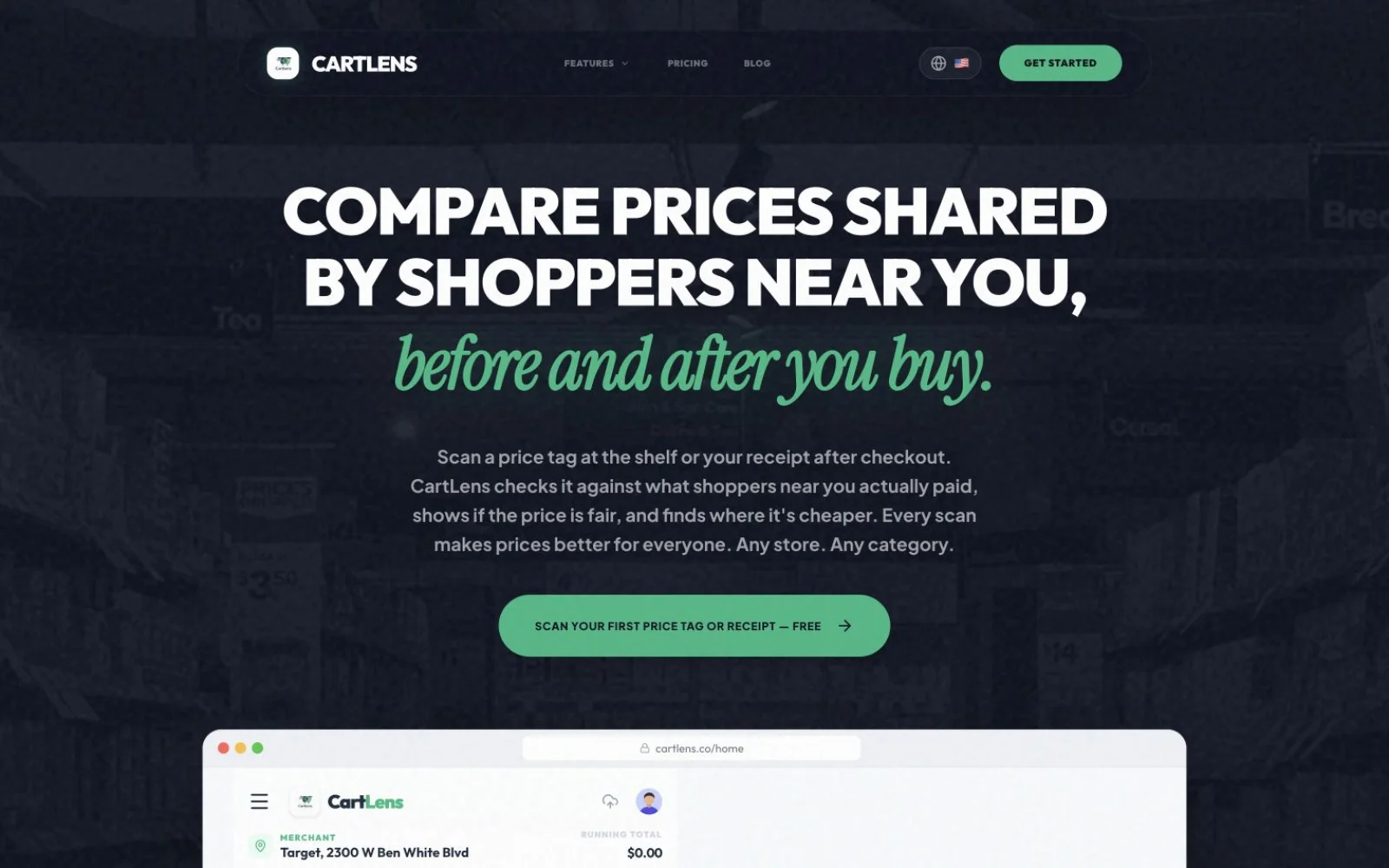

Overpaying at the grocery store happens constantly, often without shoppers realizing it. CartLens solves this by enabling consumers to scan receipts and price tags with their phone camera, instantly surfacing whether they paid fair prices and identifying cheaper alternatives at nearby stores. The product targets price-conscious shoppers who want to maximize savings on everyday shopping without manually researching competitor pricing. This includes budget-minded households, deal-seekers, and anyone monitoring household spending efficiency. What distinguishes CartLens from generic price comparison tools is its commitment to crowdsourced data from actual shoppers rather than merchant APIs or web scrapers. This ground-truth approach captures real market conditions as they exist on store shelves, not outdated catalog information. The company layers this foundation with sophisticated computer vision powered by Gemini Embedding 2, fusing pixel-level data with semantic text into a unified vector representation. The system achieves 99.8% accuracy on receipt parsing across items, prices, and quantities. The feature set reflects comprehensive ambition for the category. Beyond price scanning, CartLens includes basket comparison across multiple stores, price spike detection for sudden local increases, direct store-to-store comparison, and an AI shopping assistant. The spending insights dashboard aggregates purchase history across categories and stores, creating visibility into money flow. The company supports 11 languages natively with automatic currency and unit adaptation when travelers cross borders. Privacy and data sovereignty are core to the product architecture. CartLens builds in GDPR and CCPA compliance, carries SOC2 Type II certification, and offers full data portability through downloadable JSON archives. Users can decommission accounts entirely, triggering automated anonymization that strips personal information while preserving price data in the network. The underlying infrastructure, which CartLens calls the Price Lattice, maps local pricing across physical retail locations in real time. The model strengthens with each scan, creating network effects where denser user concentration in a geography yields better savings potential for participants. The company positions this as ground-truth mapping of the physical economy rather than simple price comparison. No pricing model is disclosed in available materials.

CartLens preview

Key features

  • Receipt Scanning: Scan receipts and price tags with your phone camera to check if you paid fair prices
  • Price Comparison: Find cheaper alternatives at nearby stores instantly
See full listing
BaseballStatsTracker

Parents managing youth baseball rosters spend far too much time reconstructing box scores from memory and crumpled scorecards. Baseball Stats Tracker solves this squarely by putting live game scoring on a smartphone, turning bleacher moments into permanent statistical records. The app targets youth baseball and softball families who track games but lack systematic infrastructure to do so. The founder, self-identified as a baseball dad, built the product to address a real gap: thousands of at-bats and notable performances vanish each season because paper scorebooks are never consulted again. The app captures every plate appearance in real time, synced across devices and accessible to coaches and relatives watching from home. What distinguishes this product is its pricing model. At 39 dollars one time with no recurring subscription, it positions itself against both free solutions and apps with monthly fees. The developer offers a free trial to score an entire game and backs the paid version with a thirty-day money-back guarantee, reducing friction for buyers uncertain whether the tool fits their situation. The feature set reflects actual use at the field. Live scoring works from a phone in the bleachers with large buttons and readable text in sunlight. The app automatically calculates batting statistics including average, on-base percentage, slugging percentage, and OPS, eliminating manual math. Spray charts display where players actually hit the ball across individual games and full seasons. Pitcher statistics track innings pitched, ERA, strikeouts, and walk counts. Splits analysis breaks performance down by opponent pitcher handedness and specific opponents, moving beyond gut feeling to data-driven observation. Supporting features include opponent roster preloading, live sync across devices, inning-by-inning box scores, and unlimited teams and seasons within the single purchase. The app also generates a shareable live link that allows grandparents and other family to follow a game in real time without attending. The product targets a specific frustration in youth baseball culture and prices itself accessibly against both paper-based alternatives and software-as-a-service competitors. By focusing on bleacher usability rather than complex analytics, the app addresses its audience directly.


Activity-tracking
C
Carl Andrews

Parents managing youth baseball rosters spend far too much time reconstructing box scores from memory and crumpled scorecards. Baseball Stats Tracker solves this squarely by putting live game scoring on a smartphone, turning bleacher moments into permanent statistical records. The app targets youth baseball and softball families who track games but lack systematic infrastructure to do so. The founder, self-identified as a baseball dad, built the product to address a real gap: thousands of at-bats and notable performances vanish each season because paper scorebooks are never consulted again. The app captures every plate appearance in real time, synced across devices and accessible to coaches and relatives watching from home. What distinguishes this product is its pricing model. At 39 dollars one time with no recurring subscription, it positions itself against both free solutions and apps with monthly fees. The developer offers a free trial to score an entire game and backs the paid version with a thirty-day money-back guarantee, reducing friction for buyers uncertain whether the tool fits their situation. The feature set reflects actual use at the field. Live scoring works from a phone in the bleachers with large buttons and readable text in sunlight. The app automatically calculates batting statistics including average, on-base percentage, slugging percentage, and OPS, eliminating manual math. Spray charts display where players actually hit the ball across individual games and full seasons. Pitcher statistics track innings pitched, ERA, strikeouts, and walk counts. Splits analysis breaks performance down by opponent pitcher handedness and specific opponents, moving beyond gut feeling to data-driven observation. Supporting features include opponent roster preloading, live sync across devices, inning-by-inning box scores, and unlimited teams and seasons within the single purchase. The app also generates a shareable live link that allows grandparents and other family to follow a game in real time without attending. The product targets a specific frustration in youth baseball culture and prices itself accessibly against both paper-based alternatives and software-as-a-service competitors. By focusing on bleacher usability rather than complex analytics, the app addresses its audience directly.

BaseballStatsTracker preview

Key features

  • Live Game Scoring: Captures every plate appearance in real time with large buttons and readable text designed for bleacher use.
  • Automatic Stats Calculation: Automatically calculates batting average, on-base percentage, slugging percentage, and OPS without manual math.
See full listing
ListFlow – Crosslist to Poshmark, eBay, Mercari & More

Resellers juggling multiple online marketplaces face a familiar pain point: manually recreating listings across Poshmark, eBay, Mercari, and beyond consumes hours each week, forcing many to pay premium subscription fees just to automate the process. ListFlow tackles this head-on with a stripped-down Chrome extension that eliminates both the busywork and the cost barrier. The product's core premise is straightforward. Users visit any listing on their source marketplace, click the ListFlow icon, select which platforms to cross-list to, and execute a single action. The extension handles the heavy lifting by copying product photos, descriptions, titles, and pricing across to eight supported marketplaces including Poshmark, eBay, Mercari, Depop, Etsy, Vinted, Grailed, and Facebook Marketplace. Setup takes approximately 60 seconds, and no credit card is required. What distinguishes ListFlow in a crowded field of crosslisting competitors is its commitment to the free model. Tools like Vendoo, List Perfectly, Crosslist, and PrimeLister charge between nine and ninety-nine dollars monthly, creating ongoing friction for price-conscious resellers. ListFlow removes that friction entirely by operating as a perpetually free service. This reflects a deliberate product philosophy: simplicity over feature bloat. The extension omits inventory dashboards and advanced seller tools that incumbents bundle in. Instead, it focuses narrowly on the core job: moving a listing from one marketplace to another instantly and reliably. User reception has been positive. The product carries a 4.8-star rating and reports over 2,000 active users. Published claims cite 95 percent time savings for crosslisting workflows, a natural consequence of the one-click mechanism. ListFlow handles image transfers automatically, preserving a critical element that lesser tools sometimes mishandle. Processing happens locally rather than on remote servers, adding a privacy angle that resonates with resellers concerned about their data. The positioning explicitly rejects the bundled dashboard approach common among competitors, betting that many resellers prefer focused tools over bloated platforms. The tool's limitation lies in its intentional narrowness. It solves the crosslisting problem and nothing else. Resellers seeking broader marketplace management, inventory tracking, bulk editing, analytics, or shipping integration must layer additional services on top. For sellers whose primary friction is repetitive listing creation across multiple platforms, ListFlow removes a genuine obstacle to scaling operations. For those with more complex operational needs, it functions as a capable but limited component of a larger toolkit rather than a comprehensive solution.


Automation-tools
A
Anonymous

Resellers juggling multiple online marketplaces face a familiar pain point: manually recreating listings across Poshmark, eBay, Mercari, and beyond consumes hours each week, forcing many to pay premium subscription fees just to automate the process. ListFlow tackles this head-on with a stripped-down Chrome extension that eliminates both the busywork and the cost barrier. The product's core premise is straightforward. Users visit any listing on their source marketplace, click the ListFlow icon, select which platforms to cross-list to, and execute a single action. The extension handles the heavy lifting by copying product photos, descriptions, titles, and pricing across to eight supported marketplaces including Poshmark, eBay, Mercari, Depop, Etsy, Vinted, Grailed, and Facebook Marketplace. Setup takes approximately 60 seconds, and no credit card is required. What distinguishes ListFlow in a crowded field of crosslisting competitors is its commitment to the free model. Tools like Vendoo, List Perfectly, Crosslist, and PrimeLister charge between nine and ninety-nine dollars monthly, creating ongoing friction for price-conscious resellers. ListFlow removes that friction entirely by operating as a perpetually free service. This reflects a deliberate product philosophy: simplicity over feature bloat. The extension omits inventory dashboards and advanced seller tools that incumbents bundle in. Instead, it focuses narrowly on the core job: moving a listing from one marketplace to another instantly and reliably. User reception has been positive. The product carries a 4.8-star rating and reports over 2,000 active users. Published claims cite 95 percent time savings for crosslisting workflows, a natural consequence of the one-click mechanism. ListFlow handles image transfers automatically, preserving a critical element that lesser tools sometimes mishandle. Processing happens locally rather than on remote servers, adding a privacy angle that resonates with resellers concerned about their data. The positioning explicitly rejects the bundled dashboard approach common among competitors, betting that many resellers prefer focused tools over bloated platforms. The tool's limitation lies in its intentional narrowness. It solves the crosslisting problem and nothing else. Resellers seeking broader marketplace management, inventory tracking, bulk editing, analytics, or shipping integration must layer additional services on top. For sellers whose primary friction is repetitive listing creation across multiple platforms, ListFlow removes a genuine obstacle to scaling operations. For those with more complex operational needs, it functions as a capable but limited component of a larger toolkit rather than a comprehensive solution.

ListFlow – Crosslist to Poshmark, eBay, Mercari & More preview

Key features

  • Cross-List to Multiple Marketplaces: Extends listings to eight supported marketplaces including Poshmark, eBay, Mercari, Depop, Etsy, Vinted, Grailed, and Facebook Marketplace.
  • One-Click Listing Transfer: Click the extension icon, select target platforms, and instantly cross-list products with a single action.
See full listing
Image to Threejs

Developers and designers frequently face friction when translating visual concepts into Three.js scenes. Creating geometry, materials, lighting, and camera configurations from scratch for every new project adds setup overhead that detracts from the creative work itself. This is the core problem that Image to Threejs addresses. The product automates the initial translation step by accepting image uploads as visual references. Users provide one to three reference images, and the platform's AI generates Three.js code structured to match the visual content. Rather than claiming pixel-perfect reconstruction, the creators acknowledge that a single image cannot capture all depth details and hidden surfaces. This honest framing positions the generated model as an editable starting point rather than a final deliverable. The workflow keeps this pragmatic philosophy throughout. After generation, users encounter an interactive 3D preview where they can inspect the AI-generated model in real time. From there, they can directly edit the code, refine geometry and materials, and iterate visually without the traditional back-and-forth between reference images and development environments. Once satisfied, the model exports for integration into Three.js projects, websites, or interactive experiences. What distinguishes Image to Threejs is its integration of these typically separate concerns into one cohesive interface. Rather than managing uploaded images separately from code editors and preview tools, users stay within a single workspace. This reduces context switching and the friction of coordinating multiple tools. The target audience spans developers seeking faster iteration on 3D web projects, designers who want to prototype interactive models without deep Three.js expertise, and creative technologists exploring generative approaches to 3D design. The product makes sense for those building product visualizations, website experiences, or experimental interactive content. The core value proposition is straightforward: eliminate the tedious foundation-building phase of Three.js development. By generating working code and a realistic first draft from an image, the platform lets users reach the refinement stage faster. This appeals to teams that prioritize velocity and to individuals who want to experiment with 3D web concepts without significant setup investment. No pricing information appears in available materials, leaving the business model's specifics unclear. What is clear is that Image to Threejs solves a real friction point in visual web development, offering a practical bridge between design intent and executable Three.js code.

3d-animation
U
Udvdh Shdhb

Developers and designers frequently face friction when translating visual concepts into Three.js scenes. Creating geometry, materials, lighting, and camera configurations from scratch for every new project adds setup overhead that detracts from the creative work itself. This is the core problem that Image to Threejs addresses. The product automates the initial translation step by accepting image uploads as visual references. Users provide one to three reference images, and the platform's AI generates Three.js code structured to match the visual content. Rather than claiming pixel-perfect reconstruction, the creators acknowledge that a single image cannot capture all depth details and hidden surfaces. This honest framing positions the generated model as an editable starting point rather than a final deliverable. The workflow keeps this pragmatic philosophy throughout. After generation, users encounter an interactive 3D preview where they can inspect the AI-generated model in real time. From there, they can directly edit the code, refine geometry and materials, and iterate visually without the traditional back-and-forth between reference images and development environments. Once satisfied, the model exports for integration into Three.js projects, websites, or interactive experiences. What distinguishes Image to Threejs is its integration of these typically separate concerns into one cohesive interface. Rather than managing uploaded images separately from code editors and preview tools, users stay within a single workspace. This reduces context switching and the friction of coordinating multiple tools. The target audience spans developers seeking faster iteration on 3D web projects, designers who want to prototype interactive models without deep Three.js expertise, and creative technologists exploring generative approaches to 3D design. The product makes sense for those building product visualizations, website experiences, or experimental interactive content. The core value proposition is straightforward: eliminate the tedious foundation-building phase of Three.js development. By generating working code and a realistic first draft from an image, the platform lets users reach the refinement stage faster. This appeals to teams that prioritize velocity and to individuals who want to experiment with 3D web concepts without significant setup investment. No pricing information appears in available materials, leaving the business model's specifics unclear. What is clear is that Image to Threejs solves a real friction point in visual web development, offering a practical bridge between design intent and executable Three.js code.

Image to Threejs preview

Key features

  • AI Image-to-Code: Converts uploaded reference images into structured Three.js code automatically
  • Interactive 3D Preview: Inspect and visualize the AI-generated model in real time
See full listing