My2Do
My2Do takes aim at a familiar frustration: task managers that demand a form for every entry and then bury the reminder b...

iCV.ge
iCV.ge targets a common frustration for job seekers: building a polished CV takes time, and many applicants never learn...
Categories
Recently Listed
1,261 launches
Creative professionals and businesses struggling to generate high-quality visual content at scale now have access to a streamlined AI image generation platform that prioritizes both speed and ease of use. GeniusAI targets content creators managing production timelines, marketing teams running campaigns, and developers building AI-powered applications, offering a tiered approach that accommodates different user needs and budgets. The platform distinguishes itself through deliberate simplicity. Rather than overwhelming users with endless customization options, GeniusAI presents a three-step workflow: select from preset AI models and styles, describe what you want in natural language, and generate the image. This straightforward approach appeals to users without technical AI expertise while providing enough control for professionals seeking consistency across projects. The product features image generation with multiple model variants, photo editing tools, and image upscaling capabilities. Prompt enhancement automatically improves user descriptions before generation, reducing the friction of crafting perfect prompts. Teams can collaborate within a shared workspace, and all tiers include commercial licensing, removing legal uncertainty around using AI-generated content for business purposes. For developers, an API enables integration with existing workflows and the ability to enforce brand guidelines programmatically. GeniusAI's pricing structure reflects its market positioning. The entry-level Genius Creator tier at ten dollars monthly offers 700 monthly credits sufficient for casual creators, with images up to 896 by 896 pixels and access to eight preset styles. The Genius Studio tier at thirty-five dollars monthly jumps to 3,000 credits and increases resolution to 1024 by 1024 pixels while unlocking all 21 available styles. The Genius Pro tier at forty-five dollars monthly adds 5,000 monthly credits, extends creation history to unlimited, and includes twenty-four hour priority support. Each tier supports instant regeneration and full-size downloads. The generation process emphasizes speed; the platform can produce images in seconds rather than minutes, a meaningful advantage for professionals with tight deadlines. The inclusion of multiple generation modes allows users to balance output speed against visual polish depending on project requirements. The platform's positioning emphasizes both accessibility and professional capability, suggesting it serves as a bridge between casual users discovering AI-generated imagery and teams deploying it as part of their production workflows. The combination of competitive pricing, commercial licensing, and team features positions GeniusAI as a practical choice for businesses integrating generative AI into existing creative operations.

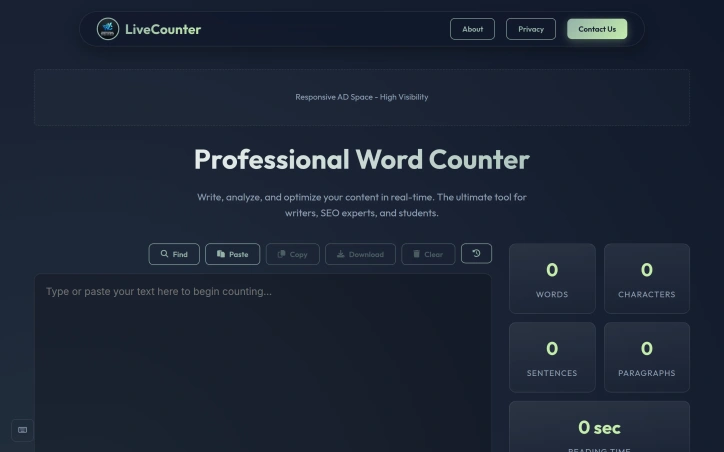
Content analysis tools have become essential for anyone publishing online, whether for search engine optimization, social media, or academic purposes. This word counter addresses a genuine need: writers and creators want instant feedback on their text's metrics without surrendering their privacy to cloud storage. The tool's core strength lies in its comprehensive real-time analysis. It delivers word, character, sentence, and paragraph counts as users type or paste content. Beyond basic metrics, it estimates both reading time using a standard 200 words per minute rate and speaking time at 130 words per minute. This dual-time feature proves particularly valuable for podcasters, presenters, and audiobook creators planning content duration. The readability scoring employs the Flesch-Kincaid scale, helping writers gauge text accessibility on a 0-100 scale where higher scores indicate easier comprehension. Combined with the character-limit tracking for Twitter/X posts, meta descriptions, and meta titles, the tool directly serves SEO practitioners optimizing content for search visibility and social media distribution. The word frequency analysis adds another layer, identifying repeated terms and helping refine content for both readability and keyword targeting. What distinguishes this offering is its commitment to privacy. The application processes all analysis client-side, meaning users' text never touches external servers. For writers working with sensitive material, confidential documents, or simply those concerned about data collection, this approach removes a significant barrier to adoption. The interface includes thoughtfully chosen shortcuts for power users: Ctrl+H for find and replace, Ctrl+Shift+C to copy, and Ctrl+Shift+D to download. The dark and light theme options accommodate different working environments and preferences. Mobile responsiveness ensures the tool functions equally well on phones and tablets, matching how many writers actually compose content today. The product positions itself at the intersection of multiple audiences. Casual Twitter users benefit from character counting. SEO professionals leverage the meta description and title length trackers alongside readability metrics. Students writing essays rely on word count verification. This multi-use approach broadens appeal without diluting focus. No pricing information appears on the site, suggesting the tool operates as a free offering, though the presence of ad space indicates an advertising-supported model rather than a premium subscription approach. For anyone seeking a straightforward, privacy-preserving text analysis solution with solid feature depth, this counter delivers practical value without friction.

Churn typically results from users feeling lost in unfamiliar software. Digital adoption platforms address this by embedding guided experiences directly into applications, and FlowAssist positions itself as the first such platform built to serve both traditional SaaS products and AI agents. The core offering is straightforward: a single JavaScript snippet provides lifetime access to a dashboard where teams build onboarding flows, product tours, and user surveys without touching code. These guides activate based on user segments, plans, or custom attributes, and they go live instantly without redeployment. The product tours, navigation flows, hotspot overlays, and splash screens function as standard adoption tools. Surveys and NPS collection allow direct feedback collection without leaving the application. What distinguishes FlowAssist is its positioning around AI agent interactions. As AI agents become primary user interfaces for many startups, traditional adoption platforms fall short—they assume click-based UI interactions. FlowAssist adds an agent telemetry layer that claims to detect user intent, sentiment, and frustration levels in real time. The dashboard surfaces these signals through analytics including completion rates, drop-off points, sentiment analysis, and AI-powered session summaries. This addresses a genuine gap: most adoption platforms have no mechanism to track or improve agent conversations before dissatisfied users leave. The implementation model prioritizes simplicity. Users paste a script tag, initialize with a workspace ID, and build everything from the cloud dashboard. The "zero friction setup" claim appears validated by the straightforward integration approach—no SDK installation, no complex configuration. On the business side, FlowAssist offers a 14-day free trial requiring no credit card and pricing starting at $49 per month, suggesting it targets small to mid-market SaaS companies and emerging AI agent platforms. The transparent pricing and trial structure reduce adoption friction. Gaps worth noting: the website provides no user counts, deployment numbers, or retention metrics to substantiate claims of being the "number one" platform. The analytics features sound sophisticated, but actual output and customization depth remain unclear from the public information available. The agent telemetry—arguably the most innovative component—lacks detailed explanation of how sentiment and intent detection actually work or how accurate they are in practice. The dual focus on traditional SaaS and AI agents is strategic timing. For teams building conversational interfaces and agent-first products, the absence of adoption-tracking tools elsewhere makes this differentiation meaningful. The product appears built for a real need; whether execution matches ambition depends on the quality and accuracy of those telemetry features.


Anyone stuck on the daily Poople word ladder, the puzzle where each step changes one letter until the word becomes POOP, will find a direct answer on this site. Each entry names the starting word, shows the par score, and lists the route, so a player can check their own progress without working out the whole chain first. The site is clearly built for casual players who want to keep a daily streak intact rather than for competitive solvers. What stands out most is the reveal design. The answer page does not dump the full solution at once. Visitors click the grid to uncover one step at a time, and matching letters are highlighted against the target word. That structure lets a stuck player nudge themselves forward with a single hint instead of spoiling the entire puzzle, which is a thoughtful choice for a game whose appeal depends on the satisfaction of solving it. The site also covers more ground than today's answer. It keeps an archive of recent puzzles, each with its starting word, par count, and a link to its step-by-step breakdown, and it posts new answers shortly after each puzzle goes live. A countdown to the next release sits on the page, reinforcing its role as a daily companion. A separate Poople Unlimited section offers endless practice rounds with a fresh random word each time, along with hints, undo, and a shortest-path reveal for when a player gets completely stuck. The site describes the practice mode as the same challenge as the daily game, which makes it a useful warm-up between puzzles. On the business side, the page explicitly describes Poople Unlimited as a free practice mode. It does not list any paid tiers, subscriptions, or charges for the answer guide itself, so readers should assume the core content is available without cost based on what the site states. The main limitation is scope. The site is a single-purpose answer resource tied to one game, and its value depends entirely on the daily puzzle continuing on the same schedule. The page also claims that its answers are computed with a breadth-first search that guarantees the shortest path, a claim that is plausible for this kind of puzzle but cannot be independently confirmed from the page alone. Even so, for players who want a clean, spoiler-controlled way to get unstuck, the site delivers a focused and easy-to-use experience.


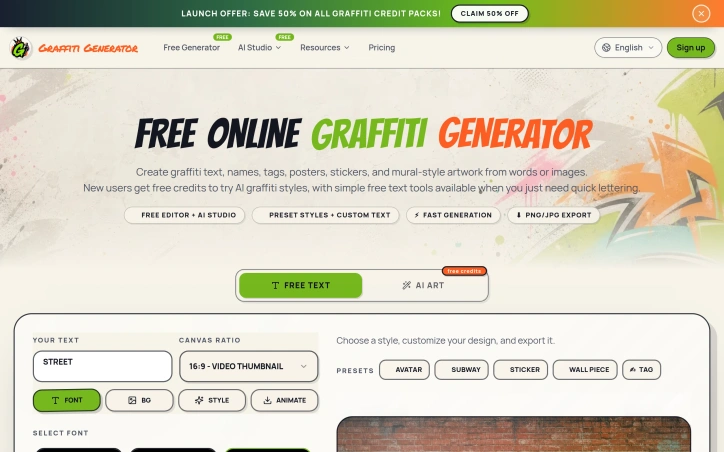
Graffiti Generator addresses a practical gap for people who want graffiti-style lettering but lack the time or training to master design software or hand-lettering. Its target audience spans creators, designers, students, content makers, small brands, and street-art enthusiasts, all of whom can type a word, name, or tag and see it rendered in a graffiti aesthetic within moments. What distinguishes the product is its narrow focus. Rather than functioning as a general-purpose image generator, it concentrates on graffiti and street-art workflows, which gives it a clearer identity than many broad AI tools. The site presents a range of entry points: a single word, a name, a tag, a letter, a full prompt, or a reference image. That flexibility lets a user start with a quick text preview and move toward a more elaborate mural-style piece without switching tools. The free text editor is the most immediately accessible feature. It offers preset styles such as Avatar, Subway, Sticker, Wall Piece, and Tag, along with custom text input. Users can adjust font, background, style, canvas ratio, font size, rotation, position, and letter spacing, and the library includes 31 fonts ranging from bubble and brush lettering to stencil, horror, and wildstyle-inspired faces. Exports are available as PNG, JPG, or GIF, and the editor supports animation and sharing. The AI side of the product handles prompt-based artwork, reference images, and additional variations. Showcased examples span neon wildstyle masks, stencil portrait posters, skate deck graphics, hoodie mockups, and sticker sheets, which demonstrate that the output extends beyond flat lettering into product-ready concepts. On pricing, the site states that free text graffiti exports require no account, while AI artwork is unlocked through one-time paid credit packs. The founder's materials add that new users receive free starter credits and that paid packs also provide higher-resolution output. The model is therefore a freemium arrangement with no subscription mentioned.

As artificial intelligence increasingly becomes the primary search method for consumers, most businesses remain invisible to these new tools. Website Auditor directly addresses this visibility gap by helping companies understand how they appear when customers use AI assistants like ChatGPT and Perplexity to research products and services. The problem the tool targets is substantive. Gartner's research predicts that half of customers will rely on AI tools rather than traditional search by 2028, creating a critical visibility challenge for businesses that haven't optimized for this shift. Website Auditor positions itself as the solution for small and medium businesses across industries, from e-commerce and SaaS to healthcare, real estate, restaurants, and legal services. What distinguishes the product is its focus on frictionless accessibility. The audit requires only two inputs—a business name and city—and delivers results in under a minute without requiring any signup or account creation. The tool scans how businesses appear in AI tools and local search results, simultaneously checking security and performance metrics. This stripped-down approach removes common barriers that prevent small business owners from adopting new tools. The execution reflects practical thinking about user friction. By eliminating login requirements and keeping the process instant, Website Auditor removes the excuses people cite for not trying new services. The interface is minimal enough that any business owner, regardless of technical sophistication, can run an audit in seconds. The product's reach across industries is notable. The company reports audits spanning 30 different sectors and over 200 websites. This breadth suggests the core problem transcends any single business type and reflects genuine cross-industry demand. Website Auditor operates on a freemium model. The basic audit is entirely free and anonymous, with no hidden paywalls. A paid tier at ten dollars monthly adds API access, allowing businesses to run up to five automated audits daily. This pricing structure makes sense for a discovery tool; it lets users validate the problem exists before committing budget. The tool's relevance will only increase as AI search becomes mainstream. By launching now and building brand awareness before this transition fully matures, Website Auditor positions itself as the obvious choice when businesses finally recognize their invisibility to AI.

Tracking parameters embedded in URLs remain one of the most pervasive nuisances on the web, silently collecting behavioral data as links travel between users. Flint addresses this friction point directly with a Chrome extension that strips away UTM tags, Facebook click identifiers, and Google tracking codes while providing transparency into where links actually lead. The product targets everyday internet users who share links frequently and value privacy, but the clean-link premise extends beyond privacy advocates. Anyone who has puzzled over where a shortened URL actually points, or questioned whether clicking a link might lead somewhere unexpected, represents the core audience. What distinguishes Flint is its architecture: the extension performs its heaviest lifting locally within the browser, only contacting external services when users explicitly request certain features like short-link expansion or optional VirusTotal checks. This approach positions privacy as a structural choice rather than a marketing claim. The three-layer local risk model runs entirely client-side, surfacing qualitative signals about URLs without shipping sensitive browsing data anywhere. The feature set stays deliberately focused. Core functionality includes parameter stripping, hover previews that reveal destinations and flagged content, right-click menu integration for one-click link copying, and a paste-and-inspect mode for URLs users want to evaluate before visiting. Pro features add QR code generation, history tracking, custom rules, bulk cleaning, and the option to bring personal API keys for advanced threat checks from VirusTotal or Google Web Risk. The business model reflects this restraint. The core cleaner runs free indefinitely with no account requirement. The Pro tier costs fourteen dollars and ninety-nine cents as a one-time purchase, sidestepping the subscription model that dominates browser extensions and making upgrades genuinely optional rather than predatory. Flint succeeds by embracing scope discipline. It strips tracking parameters from links, reveals real destinations before users click, and does both while preserving browser performance. The local-first architecture and flat pricing model reveal a philosophy that treats users as stakeholders, not extraction targets.


Communicating across borders grows harder as businesses expand internationally, especially when managing conversations in different languages across platforms like WhatsApp and Telegram. TranAI addresses this friction by combining customer relationship management with real-time translation, targeting small business owners, support teams, and companies navigating cross-border commerce. The platform's strength lies in its free tier. Rather than paywalling core features, TranAI offers genuine capabilities without requiring a credit card, including multi-account management, broadcast messaging, scheduled sends, and group joining automation. These address real needs for entrepreneurs managing customer interactions at scale without upfront investment. Real-time translation stands as the core differentiator. Supporting over 20 platforms and 200 languages, TranAI enables users to chat with customers in Spanish, Arabic, or other languages without switching apps or managing separate conversations. Voice synthesis and voice cloning allow businesses to maintain personality in customer interactions despite geography, addressing a practical gap that most translation tools ignore. The CRM functionality adds practical value beyond translation alone. Smart number filtering, cold messaging to non-contacts, unlimited message pinning, and privacy blur (auto-concealing sensitive customer information in screenshots) directly address pain points for teams managing lead databases and customer relationships. A quick-reply system helps support staff respond faster to recurring questions, compounding the time savings from consolidated account management. The freemium model reveals TranAI's confidence in its free offering, with premium translation services available for advanced capabilities. This positioning avoids the trap of "free trials that do almost nothing," instead building product momentum through genuine utility that works immediately upon signup. Testimonials from real estate agents, small business owners, and export managers suggest the tool resonates across different use cases. A customer support lead highlights hours saved daily through multi-account consolidation, while an export manager emphasizes translation reliability for maintaining fluent conversations with international clients. The product solves a concrete problem—enabling communication at scale across languages and platforms—without the complexity or cost competitors demand. For global-minded entrepreneurs or multinational businesses with lean operations teams, TranAI delivers immediate practical value without the typical friction of enterprise software adoption.


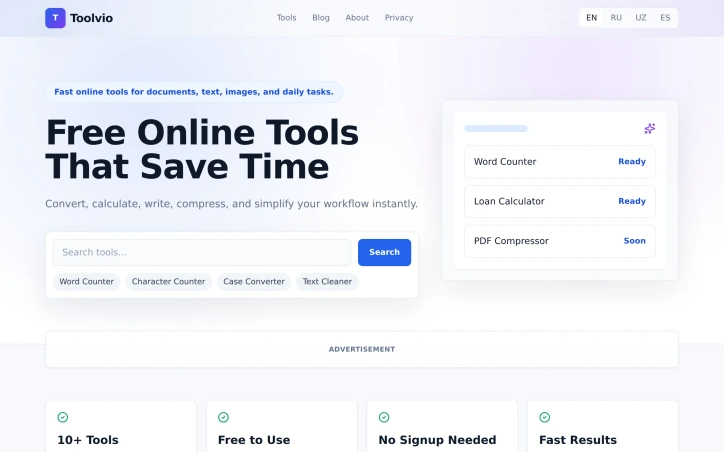
Digital workers constantly switch between apps and websites to handle routine tasks like counting words, converting text cases, calculating loan payments, or compressing files. Toolvio consolidates these scattered utilities into a single, free web-based platform designed for speed and simplicity. The service offers a focused library of utilities organized across six categories: text tools, calculators, PDF tools, image tools, AI features, and SEO utilities. The text suite includes word and character counters, case converters, text cleaners, slug generators, and duplicate line removers. The calculator section covers percentages, mortgages, business loans, standard loans, age calculations, and credit card payoff projections. Several tools remain in development, including image compression, PDF compression, PDF-to-Word conversion, and AI text summarization. What distinguishes Toolvio from similar tool aggregators is its zero-friction access model. No signup required, no hidden paywalls, and no login gates prevent immediate use. The tools run client-side, meaning files process locally rather than uploading to external servers, which carries privacy implications that appeal to security-conscious users. The interface emphasizes speed, with straightforward conversions and calculations delivering results instantly. The platform targets professionals and students handling routine digital tasks without dedicated software. Someone drafting content benefits from the word counter and character tracker. Freelancers and small business owners use the loan and mortgage calculators for client estimates. Writers toggle between case conversion and text cleaning. The tools address genuine friction points in everyday workflows without requiring installation or signup. The weakness evident in the available content is incompleteness. Multiple valuable features—image compression, PDF compression, PDF-to-Word conversion, and an AI summarizer—exist only as coming-soon placeholders. Until these launch, users comparing Toolvio against other tool aggregators may find the available toolset too narrow for a primary destination. The stated growth strategy centers on continuous expansion and educational resources. As additional tools become available, Toolvio could evolve into a genuine one-stop alternative for routine document and text processing tasks. Currently, it serves as a useful collection for specific needs—particularly text analytics and simple financial calculations—rather than a comprehensive replacement for dedicated software. For anyone avoiding sign-ups and installing apps, though, Toolvio removes barriers to getting work done quickly.

Design exploration traditionally consumes time and money through multiple revision cycles. Whether adapting a kitchen palette, exploring exterior finishes, or conceptualizing landscape layouts, professionals and homeowners have historically chosen between expensive professional renderings or rough sketches that fail to communicate the full vision. ArchOne AI addresses this friction by offering a specialized visualization engine that converts reference photos into design variation studies across interior, exterior, and landscape domains. The platform targets interior designers, architects, landscape professionals, and design-conscious homeowners—anyone who needs to explore directional options before committing resources to execution. What distinguishes ArchOne from generic image-generation tools is its deliberate focus: it generates variations tied to specific design disciplines rather than attempting to be an all-in-one creative tool. Users can examine material palettes, lighting conditions, furniture arrangements, facade colors, planting schemes, and hardscape concepts all sourced from the same project image. The company is explicit about its boundaries. ArchOne is not CAD software, not BIM, not construction documentation, and not a replacement for structural or code review. This positioning is refreshingly honest—it occupies the ideation and communication layer, not the technical delivery layer. A designer can use it to show three different material directions to a client before investing time in detailed specifications or renderings. The feature set spans three integrated modules. The interior tool handles room concepts, layouts, materials, and ambiance. The exterior module focuses on facades, entry treatments, trim, and curb appeal. The landscape tool generates planting ideas, hardscape options, outdoor room concepts, and lighting. Each operates from the same input—a photo, sketch, or reference image—and produces client-ready visual options without requiring users to operate multiple platforms. The platform offers a free tier alongside paid options, lowering the barrier to trial. The gallery demonstrates realistic outputs across residential spaces: patios, kitchens, living rooms, garden concepts, and facade studies. Visually, these show competent AI image generation anchored to specific design constraints rather than unconstrained creative generation. For design professionals managing client communication cycles or homeowners testing ideas before hiring contractors, ArchOne compresses exploration phases that typically unfold over days or weeks of revision requests into minutes of iteration.


An AI-powered mobile application for personal beauty assessment and skincare planning, Beauty Score targets users who want instant feedback on their facial appearance and actionable steps toward improved skin health. The platform transforms selfies into multidimensional beauty insights, filling a gap between casual beauty curiosity and the friction of professional dermatology consultations. The core offering combines three interdependent functions. First, it generates a numerical beauty score from zero to one hundred, providing immediate quantifiable feedback. Second, it delivers face and skin analysis covering symmetry, emotional expression, age estimation, and specific skin conditions including blemishes, acne, and dark circles. Third, it constructs personalized skincare routines derived from the scan results. This layered approach moves beyond vanity metrics toward practical guidance. What distinguishes Beauty Score is its emphasis on usability and shareability. The analysis translates into step-by-step skincare recommendations rather than abstract commentary. Users can export findings as PDF reports or share aesthetic cards in six visual formats ranging from classic to Y2K styled, treating results as both personal tools and shareable social content. This dual positioning as entertainment and skincare reference broadens its appeal across demographics and use cases. The application leverages mobile convenience as a core differentiator. Available through both Google Play and the App Store, it requires only a smartphone camera and delivers results in seconds. The emphasis on speed and accessibility contrasts with traditional beauty consultations requiring time, cost, and geographic proximity to specialists. The product exercises appropriate restraint in its positioning. The published disclaimer clarifies that AI-generated recommendations constitute skincare inspiration rather than medical guidance, explicitly stating they should not replace professional care. This framing acknowledges the tool's entertainment value while establishing boundaries around health claims. Pricing information remains absent from publicly available materials, limiting assessment of the business model. The availability across both major mobile platforms suggests either freemium distribution or paid download, though specific monetization details require further investigation. Beauty Score targets beauty enthusiasts, skincare-curious consumers, and individuals seeking confidence through personalized appearance feedback. It functions simultaneously as a self-reflection tool, a skincare planning device, and social content generator. The product's core strength lies in packaging AI analysis into both accessible assessment and actionable routine, delivered at mobile scale.


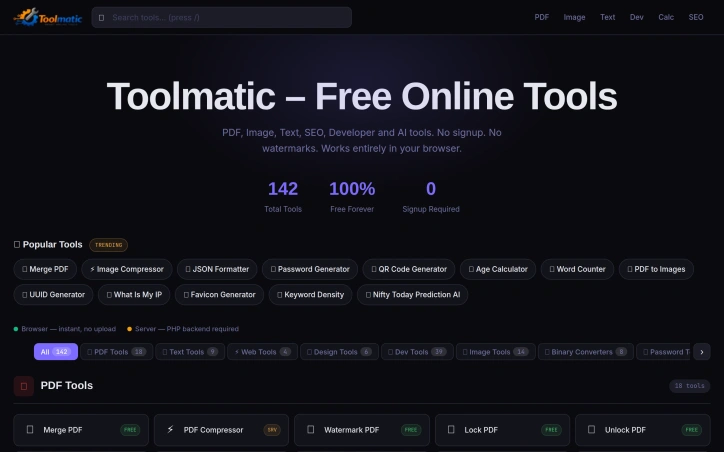
A unified collection of 142 free online tools, Toolmatic addresses a persistent friction point for developers and professionals: the need to access scattered utilities across dozens of platforms, each demanding signups, displaying watermarks, or hiding features behind paywalls. The service consolidates PDF manipulation, image conversion, code formatting, text utilities, SEO analysis, and design tools into a single browser-based environment. The product's clearest strength is its friction-free design philosophy. Every tool runs directly in the browser without account creation, watermarks, or restrictions. This approach trades complexity for accessibility, making it useful for quick, one-off tasks where spinning up an account would waste more time than completing the job itself. The breadth of the toolkit is substantial: eighteen PDF tools cover merging, compression, watermarking, and format conversion; thirty-nine developer tools handle everything from JSON and XML formatting to Base64 encoding and JWT decoding; image conversion spans formats including WEBP, HEIC, SVG, and favicon generation. The organization reflects thoughtful categorization. Tools group into logical sections like binary converters, password utilities, calculators, finance tools, and domain utilities. Popular tools such as the password generator, QR code generator, and JSON formatter are highlighted prominently, suggesting an understanding of which utilities drive traffic. The business model is straightforward: the entire suite is free indefinitely, with no signup requirement. This creates clear value for occasional users but raises immediate questions about sustainability. Some tools operate entirely in-browser, while others require a PHP backend on a user's server, suggesting a hybrid approach to computation-heavy tasks. One limitation emerges in the tool descriptions themselves. Many entries lack clarity about processing method or handling of uploaded data. Users cannot quickly determine whether their PDF remains private within their browser or transmits to Toolmatic's servers. For a tool that attracts users seeking quick access without friction, this opacity about data handling represents a missed opportunity for trust-building. The product succeeds as a practical utility collection for developers and professionals who value speed over feature depth. It occupies a useful niche: neither a specialized platform for a single task nor an overstuffed bloatware suite, but a genuinely quick answer to common conversion and formatting problems.

Restaurant and retail operators juggling order management, staff coordination, and customer analytics face fragmentation across multiple vendor platforms. Opero POS consolidates these functions into a unified system designed to eliminate that complexity. The platform targets small to mid-sized restaurants and retail establishments seeking to streamline point-of-sale operations without the overhead of enterprise solutions. The core value proposition centers on eliminating tool fragmentation: rather than bouncing between separate systems for in-house orders, online ordering, delivery management, and staff oversight, operators manage everything from one interface. Key capabilities include integrated online ordering functionality, which allows customers to place orders directly through the system without requiring external marketplace integration. The delivery management component handles order routing and fulfillment logistics, meaningful for establishments expanding beyond dine-in or walk-up sales. Team management tools provide workforce scheduling and coordination, critical for restaurants operating multi-shift service models. Analytics capabilities offer visibility into sales trends, peak periods, and operational metrics that inform inventory and staffing decisions. The all-in-one positioning distinguishes Opero POS from point-of-sale vendors requiring ancillary purchases or third-party integrations to reach comparable functionality. Rather than licensing payment processing, then bolting on an online ordering service, then contracting a separate workforce management tool, operators deploy one system. This approach reduces implementation friction and ongoing vendor management complexity. The product is positioned as free, a significant differentiation in a market where point-of-sale software traditionally operates on per-terminal licensing or monthly subscription models. This pricing structure removes an adoption barrier for cost-conscious operators testing new systems or managing tight margins. For restaurants and retail shops exhausted by platform proliferation, Opero POS promises operational simplification through consolidation. The breadth of capabilities spanning transaction processing, customer ordering, delivery logistics, staff management, and business intelligence positions it as genuine all-in-one software rather than a point-of-sale system with cosmetic add-ons. The free pricing model invites trial with minimal financial commitment, making it accessible to independent operators skeptical of vendor lock-in or unable to justify significant software expenditures.


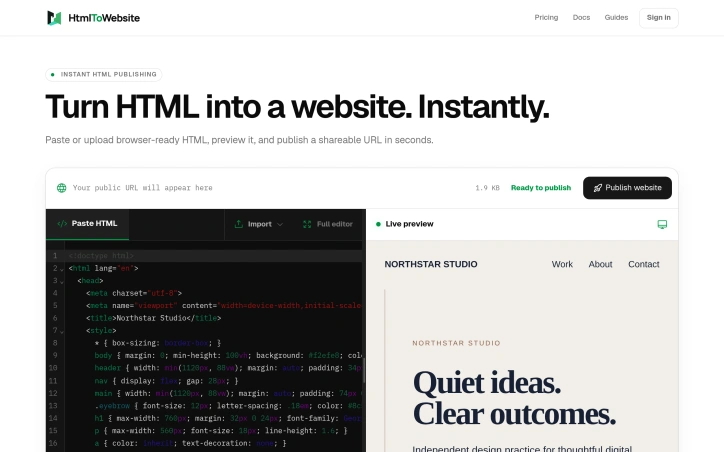
The friction point this solves is clear: developers who write HTML need a way to share their work publicly without wrestling with hosting infrastructure, deployment pipelines, or server management. HtmlToWebsite targets this gap by offering instant publication—paste your code and get a live URL, no deployment configuration required. The core value proposition centers on speed and simplicity. Rather than choosing between shared hosting platforms, containerization tools, or static site generators, users can move directly from editor to shareable link. This streamlines the typical workflow for prototyping, building demos, and iterating rapidly without backend complexity. The product handles projects of varying scope. Whether developers are publishing single HTML files or complex projects with accompanying assets, the platform manages the technical details transparently. This breadth is significant because many similar tools force users into either-or constraints—support for simple files OR full project structures, but rarely both seamlessly. Who benefits most? The platform appeals to developers building quick proof-of-concepts, designers prototyping interactive mockups, and educators demonstrating code concepts. It's also useful for teams collaborating on frontend-heavy features or anyone who needs to share executable code without asking collaborators to run a local environment. The strategic positioning is revealing. By eliminating hosting and deployment as friction points, HtmlToWebsite competes less with traditional web hosts and more with in-browser IDEs and pastebin services that now need distribution. It occupies the specific moment between code written and code running live, addressing a real bottleneck in development workflows. The product design is deliberately minimal—paste HTML, get a website—which works as both mechanic and marketing. There's no mention of pricing or business model in the available information, making it unclear how sustainable or commercially viable this approach is. Nonetheless, the core insight is sound: developers absolutely encounter this friction point, and removing it has genuine value for rapid iteration cycles and collaborative prototyping.
In an era when our digital traces accumulate silently—searches, draft posts, AI conversations—this application offers a different kind of self-reflection: analyzing your own data to understand patterns about desire, anxiety, and hidden interests. The product targets people curious about what their online behavior reveals about their deeper self, positioning itself squarely as entertainment and personal insight rather than any kind of professional guidance. The core offering is straightforward. Users provide their browser history and can optionally add AI chat logs, social media drafts, diary notes, or email excerpts. The application processes these inputs to generate a personality profile based on repeated patterns and behavioral signals. The technology identifies what matters to you through what you choose to search for, explore, and draft—treating your digital footprint as a window into unstated desires and anxieties. What distinguishes this product is its deliberate privacy stance. Rather than storing input data in a server database, the analysis happens client-side, with results cached only temporarily in the browser itself. This addresses a fundamental tension: people want insights into themselves, but hesitate to upload sensitive material to unknown servers. By keeping data local to the user's device, the tool removes that friction without requiring trust in cloud infrastructure. The application is bilingual, available in both English and Japanese. A clear disclaimer appears throughout the interface, specifying that outputs are for entertainment and self-understanding, not medical, legal, or investment advice. The tool explicitly forbids users from entering passwords, addresses, payment information, or other credentials, recognizing the risks of aggregating sensitive data. Result accuracy depends on input quality. The more concrete and specific the material provided, the sharper the analysis. Thin inputs produce thin outputs. This reflects honest positioning about algorithmic capabilities. The pricing structure remains unspecified in available materials. Whether the tool operates as free, freemium, or paid remains unclear. For now, Ura Persona AI occupies a narrow but distinct space: treating your own digital history as a source of self-knowledge, with privacy built into the architecture rather than as an afterthought.


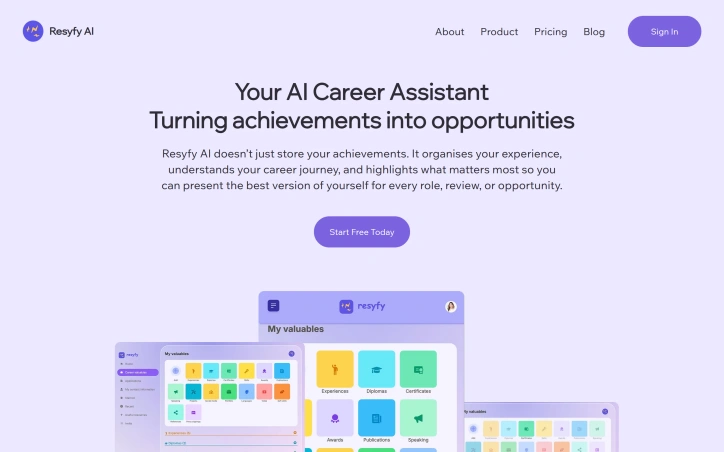
Career achievements scattered across emails and forgotten documents represent a genuine friction point in job seeking and professional advancement. Resyfy addresses this by centralizing how professionals capture, organize, and present their accomplishments. The platform targets anyone navigating career transitions, from individuals applying for new roles to professional athletes managing multiple project portfolios and those pursuing promotions or special opportunities. The core insight underpinning Resyfy is that a single static resume no longer serves modern career realities. The platform creates an adaptable digital portfolio that uses AI to match different achievements to different contexts. Rather than forcing users to manually customize their resume for each application or opportunity, the system analyzes a centralized vault of career accomplishments and surfaces relevant examples based on the specific role, award, or project in question. This targeted relevance is what distinguishes it from traditional career management tools. The product combines three essential functions. First, it provides secure storage for career achievements organized in a structured digital format. Users can log accomplishments, track milestones, and maintain a comprehensive record of their professional growth. Second, the AI engine learns from this data to understand career progression and skill development patterns. Third, the system actively recommends which accomplishments to highlight for different scenarios, whether users are applying for jobs, preparing performance reviews, pivoting careers, or pursuing sponsorships and awards. The positioning suggests ambition beyond resume building. Resyfy frames itself as a career operating system that evolves alongside a person's professional journey. This framing positions achievement tracking not as a one-time exercise but as ongoing career management infrastructure. The platform acknowledges that modern careers are nonlinear, spanning multiple projects, roles, and professional contexts simultaneously, and builds tools specifically for that complexity. The use case demonstrated with professional athletes illustrates a specific strength: professionals managing diverse accomplishments across different domains benefit significantly from an AI system that can surface relevant achievements quickly. Rather than manually constructing new portfolio documents for each opportunity, users maintain one comprehensive data source that adapts to different contexts. Resyfy offers a free tier to encourage adoption, though additional pricing details remain undisclosed from the available content. The product addresses a real productivity gap in career management and does so with a technically sensible approach: centralizing data, applying machine learning to surface relevance, and reducing the friction of portfolio customization. It competes against both static resume builders and manual spreadsheet approaches, positioning itself as an active partner in career advancement rather than a passive repository.

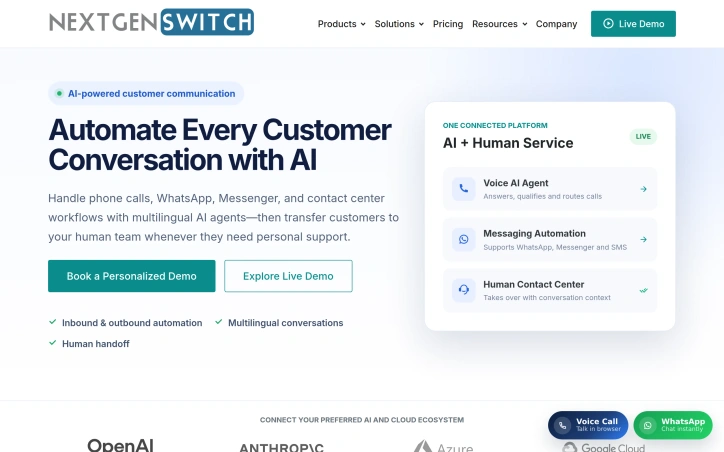
Communication fragmentation costs businesses time and money. Customer interactions splinter across phone systems, messaging apps, and contact center tools, forcing teams to juggle disconnected platforms. NextGenSwitch consolidates these channels into a unified platform that pairs AI automation with human expertise, addressing a genuine operational pain point for service-driven businesses. The platform's core strength lies in its omnichannel integration. It unifies voice calls, WhatsApp, Messenger, SMS, and contact center workflows into one system, eliminating tool-switching inefficiencies. More importantly, it doesn't automate blindly. AI agents handle initial interactions by answering questions, qualifying leads, and collecting information, then transfer qualified conversations to human agents while preserving full context. This design respects that some customer needs require human touch. NextGenSwitch targets multiple segments effectively. Small businesses use it for AI-powered reception and support. Sales teams benefit from lead qualification and automation at scale. E-commerce operations automate product questions and order confirmations. Larger enterprises get unified contact center operations. Service providers and BPOs operate isolated customer environments through multi-tenant capabilities with white-label flexibility. The feature set reflects thoughtful architecture. Multilingual voice and messaging support global customers. API-driven design lets developers build custom voice applications using XML and WebSocket streaming. The platform integrates with existing business systems rather than demanding replacement. Outbound capabilities enable automated reminders, surveys, and follow-ups that scale engagement without proportionally scaling headcount. The platform positions AI for routine work and humans for complex situations—a grounded philosophy acknowledging that customer relationships depend on human judgment and empathy, not just speed. This approach resonates with industries where trust matters more than pure automation metrics. No pricing details appear in available materials, suggesting custom enterprise sales. This model suits their positioning as infrastructure for contact centers and large customer service operations, where deployment complexity justifies direct prospect engagement.

For those drawn to spiritual exploration but uncertain where to start, Soul Karma Test offers a structured entry point into understanding one's karmic patterns and life lessons. The platform addresses a genuine gap: while interest in karma and Eastern philosophy runs deep in Western culture, accessible tools for personal exploration remain scarce. The product targets spiritually curious individuals seeking actionable insight into how their behaviors, intentions, and choices shape their life trajectory. The foundation here is substance. Rather than reducing karma to vague platitudes, the platform grounds itself in actual philosophical tradition—tracing the concept from Sanskrit roots through Vedic ritual practices, the Upanishads' evolution toward moral causation, and the Buddha's refinement emphasizing intention as the core element of karmic action. This educational backbone distinguishes it from purely entertainment-focused personality quizzes. The accompanying article walks users through karma's intellectual history, establishing credibility and context before they engage with personalized assessment. The quiz itself takes the form of a multi-question test that generates a "Soul's Karmic Profile" based on responses. This structure allows users to move beyond abstract philosophy and receive tailored interpretation of their spiritual patterns. The ability to save results and restart the test suggests the platform anticipates repeat engagement and deeper exploration across sessions. A downloadable article extends value beyond the quiz alone, positioning the tool as educational rather than merely transactional. The mention of an "enhanced version" indicates a freemium model, though specifics around pricing, features, or upgrade paths remain undisclosed in available materials. This tiered approach aligns with common monetization for spiritual and self-assessment products, though transparency around costs would strengthen positioning. What works is the marriage of accessibility and rigor. Soul Karma Test makes karma tangible without oversimplifying it. Users get both the satisfying novelty of a personalized profile and genuine philosophical grounding. The platform doesn't claim to be definitively prophetic or mystical—instead, it frames itself as a framework for self-reflection rooted in centuries-old thought traditions. The primary limitation is information scarcity regarding the actual algorithm, question design philosophy, or how profiles are generated. Users may wonder whether results reflect genuine karmic assessment or serve primarily as scaffolding for reflection. Still, for someone beginning to explore these ideas, the combination of education and personalization delivers real value.


Marketing professionals frustrated by subscription sprawl have encountered a familiar pain point: managing separate services for email automation, content creation, image generation, and code assistance. NexiaTools addresses this friction by packaging over 30 specialized AI applications into a single platform designed specifically for agencies and freelancers scaling their operations. The platform targets users who lack technical expertise, offering pre-built workflows for common business tasks rather than requiring complex prompt engineering. Its feature set covers the marketing and sales workflows that agencies typically rely on: SEO-optimized article generation, proposal writing with dynamic sales structures, LinkedIn and Instagram content creation, and cold email campaign automation. Each tool accepts natural language descriptions and delivers outputs in seconds, positioning the software as a practical alternative to manually orchestrating outputs across separate AI services. The value proposition rests on consolidation economics. Rather than paying for ChatGPT Plus, Claude Pro, dedicated image generators, and copywriting specialists individually—a scenario the company quantifies at approximately 85 dollars monthly—the platform bundles these capabilities at a fraction of that cost. For freelancers and small agencies, this consolidation matters: fewer logins, consistent styling controls, and unified workflows reduce operational friction while lowering recurring software expenses. The product's strength lies in its specificity. Unlike general-purpose AI assistants, NexiaTools packages capability into task-oriented tools. A proposal generator includes templates for pricing structures and timelines; the social media tool maintains brand voice across platforms; the email automation tool focuses on high-open-rate subject lines and persuasive calls to action. This pre-structure removes decision fatigue compared to blank-canvas prompting. The marketing positioning emphasizes ease of use, a meaningful differentiator for non-technical founders who may find Claude or ChatGPT intimidating. The platform doesn't require learning prompt frameworks or API integration. Describing your goal in plain language and selecting the appropriate tool remains the primary workflow. Limitations aren't addressed in available materials—feature depth, output quality compared to standalone tools, and platform reliability remain unknowns. For agencies heavily invested in existing workflows or demanding highly specialized customization, NexiaTools' breadth-over-depth approach may not suit deeper needs. The platform represents a sensible option for teams prioritizing efficiency and cost reduction over maximum capability in any single function.


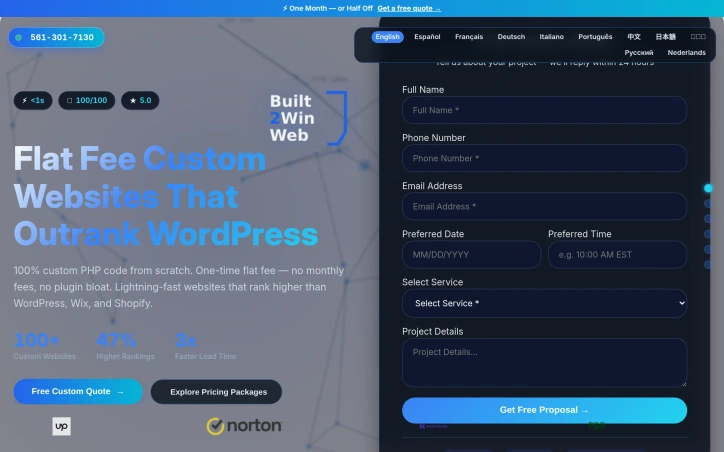
Web development has long been dominated by WordPress and drag-and-drop platforms that promise quick solutions but deliver slow, bloated sites paired with ongoing monthly fees. BuiltToWinWeb addresses this pain point by offering hand-coded PHP websites built entirely from scratch with a single flat fee and no monthly subscriptions. The service caters to businesses across industries—law firms, accounting practices, construction companies, medical clinics, and digital agencies—that need professional websites to rank competitively on Google. Rather than choosing between expensive custom development and impersonal templates, clients get custom-built solutions designed specifically for their needs. What distinguishes BuiltToWinWeb from competitors is its commitment to code quality over convenience. Every website is built from raw HTML, CSS, JavaScript, and PHP without reliance on templates, plugins, or platform-specific constraints. This approach translates to measurable results: the company highlights a portfolio of over 100 custom sites with an average PageSpeed score of 98, faster load times than WordPress alternatives, and better search rankings. The founder credits lightning-fast performance as the reason sites built this way outrank platform-based competitors. The service offerings span business websites, ecommerce storefronts, custom database applications, and WordPress migration projects. Case studies demonstrate practical features tailored to industry verticals: law firms receive intake forms and case tracking, accounting firms get client portals and appointment booking, construction companies get project galleries with quote forms. These aren't added features bolted onto a generic template—they're designed into the site architecture. The business model reinforces the no-monthly-fees positioning. Clients pay a single flat fee upfront for a complete website and own the result entirely. Package options exist for different project scopes, with quotes provided within 24 hours. The tension worth noting: custom PHP development requires more upfront thought and potentially higher initial costs than WordPress solutions, and it trades the flexibility of plugin ecosystems for specialized development. But for businesses prioritizing performance, ownership, and search ranking—and willing to pay once rather than forever—the tradeoff reads as deliberate rather than limiting. BuiltToWinWeb occupies a specific niche: businesses that view their website as a long-term asset, not a platform to rent.