
BLACK FRIDAY Premium $99 $69 Ends in 1 week 2 days See the deal →
1,261 startups launched 15,421 upvotes cast 57 submitted this week

Recently Listed

1,261 launches
Sort
Video Reels Shorts downloader

Creators constantly face friction when trying to save videos from social platforms—Instagram watermarks downloads, Facebook adds branding, and YouTube Shorts resists traditional saving. TezVid addresses this with a straightforward web tool that strips watermarks and captures original-quality footage across six major platforms in seconds. The service targets creators, marketers, and researchers who need to work with video content from Instagram, Facebook, YouTube, TikTok, Twitter, and Threads. The experience is frictionless: no extensions, no apps, no complex authentication. Copy a link, paste it, and the download arrives in your folder within 10 seconds. What distinguishes TezVid centers on speed and quality preservation. The platform maintains original HD resolution without re-encoding and processes most requests in under 10 seconds. A bulk-download feature for Pro subscribers handles up to 30 Instagram reels at once, appealing to agencies and archivists working at scale. Privacy stands out as a deliberate design choice. TezVid fetches videos in real time and never stores the actual files, only metadata for user history. This addresses legitimate concerns for creators handling copyrighted or sensitive content. The business model divides between a free tier offering 5 monthly downloads without payment information and a Pro plan starting at ₹299 per month in India, with regional pricing for Southeast Asia and Latin America. This structure targets growth markets where subscription adoption patterns differ from Western markets. The product's competitive moat is simplicity. While other video downloaders exist, the combination of multi-platform support, watermark removal, speed, and low entry friction creates clear value. TezVid reports more than 50,000 daily active users and carries a 4.9-star rating. For creators regularly working with video across multiple platforms, TezVid reduces the alternative: managing six separate tools or fighting platform limitations. The service fills that practical gap effectively.


Video-hosting-platforms
T
TezVid

Creators constantly face friction when trying to save videos from social platforms—Instagram watermarks downloads, Facebook adds branding, and YouTube Shorts resists traditional saving. TezVid addresses this with a straightforward web tool that strips watermarks and captures original-quality footage across six major platforms in seconds. The service targets creators, marketers, and researchers who need to work with video content from Instagram, Facebook, YouTube, TikTok, Twitter, and Threads. The experience is frictionless: no extensions, no apps, no complex authentication. Copy a link, paste it, and the download arrives in your folder within 10 seconds. What distinguishes TezVid centers on speed and quality preservation. The platform maintains original HD resolution without re-encoding and processes most requests in under 10 seconds. A bulk-download feature for Pro subscribers handles up to 30 Instagram reels at once, appealing to agencies and archivists working at scale. Privacy stands out as a deliberate design choice. TezVid fetches videos in real time and never stores the actual files, only metadata for user history. This addresses legitimate concerns for creators handling copyrighted or sensitive content. The business model divides between a free tier offering 5 monthly downloads without payment information and a Pro plan starting at ₹299 per month in India, with regional pricing for Southeast Asia and Latin America. This structure targets growth markets where subscription adoption patterns differ from Western markets. The product's competitive moat is simplicity. While other video downloaders exist, the combination of multi-platform support, watermark removal, speed, and low entry friction creates clear value. TezVid reports more than 50,000 daily active users and carries a 4.9-star rating. For creators regularly working with video across multiple platforms, TezVid reduces the alternative: managing six separate tools or fighting platform limitations. The service fills that practical gap effectively.

Video Reels Shorts downloader  preview

Key features

  • Watermark Removal: Strips watermarks from downloaded videos across social platforms
  • Multi-Platform Support: Works with Instagram, Facebook, YouTube Shorts, TikTok, Twitter, and Threads
See full listing
ekstrakt

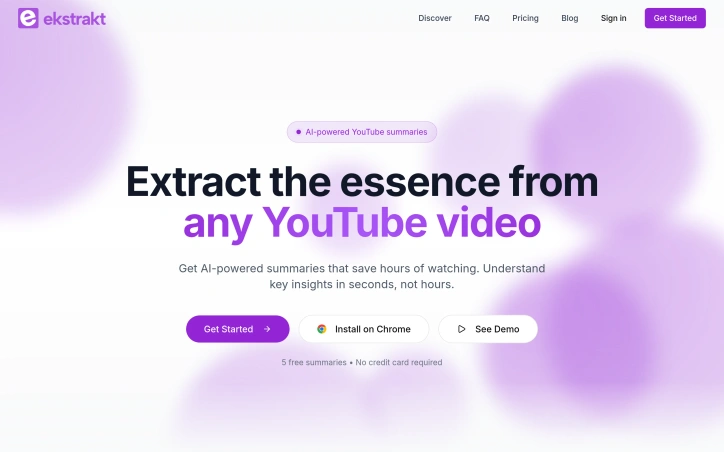
Millions of hours get consumed in video watching that nobody has time for. ekstrakt tackles this friction by offering AI-powered summaries of YouTube content, transforming lengthy videos into digestible insights. The service addresses a recognizable pain point: the two-hour lecture you need to understand, the three-hour podcast everyone's discussing but you can't fit into your week, the tutorials stuffed with filler, or the growing graveyard of saved videos you'll realistically never watch. The product distinguishes itself through flexible summary options rather than forcing viewers into a single format. Users can choose from four summary types depending on their immediate need. A quick skim mode provides the fastest overview. A detailed summary offers more comprehensive coverage. The "Straight to Answer" function targets users hunting for specific information in lengthy instructional content. The most interactive option lets users interrogate summaries by asking follow-up questions, with the system returning exact video moments and context rather than paraphrased text. Multi-language support spans 22 languages, removing the barrier of foreign-language content without requiring manual translation workflows. The platform's reach extends across web browsers, a Chrome extension that enables single-click summarization directly on YouTube, and forthcoming mobile applications. This multi-channel availability means users can engage with summaries wherever they consume content. The business model lowers friction to adoption with a free tier offering five summaries without requiring a credit card. This allows users to evaluate the service before commitment and sidesteps the common objection that summarization tools demand upfront payment for unproven value. The specifics of how summaries transition from free to paid usage remains unstated in available materials. ekstrakt competes in a growing space of video summarization tools, but its strength lies in offering user control rather than imposing a fixed output. By allowing multiple summary depths on the same content and providing query-based exploration rather than read-only text, the product acknowledges that different use cases demand different approaches. Whether someone needs a 60-second overview or wants to extract a specific claim from a 90-minute discussion, the tool adapts rather than forcing a single lens. The value proposition anchors on time savings, a compelling argument in a content-saturated world where viewers face genuine scarcity of hours. For knowledge workers, students, and anyone maintaining an aspirational backlog of educational content, ekstrakt offers a practical solution to stay informed without the time tax.

Knowledge-base-software
E
ekstrakt

Millions of hours get consumed in video watching that nobody has time for. ekstrakt tackles this friction by offering AI-powered summaries of YouTube content, transforming lengthy videos into digestible insights. The service addresses a recognizable pain point: the two-hour lecture you need to understand, the three-hour podcast everyone's discussing but you can't fit into your week, the tutorials stuffed with filler, or the growing graveyard of saved videos you'll realistically never watch. The product distinguishes itself through flexible summary options rather than forcing viewers into a single format. Users can choose from four summary types depending on their immediate need. A quick skim mode provides the fastest overview. A detailed summary offers more comprehensive coverage. The "Straight to Answer" function targets users hunting for specific information in lengthy instructional content. The most interactive option lets users interrogate summaries by asking follow-up questions, with the system returning exact video moments and context rather than paraphrased text. Multi-language support spans 22 languages, removing the barrier of foreign-language content without requiring manual translation workflows. The platform's reach extends across web browsers, a Chrome extension that enables single-click summarization directly on YouTube, and forthcoming mobile applications. This multi-channel availability means users can engage with summaries wherever they consume content. The business model lowers friction to adoption with a free tier offering five summaries without requiring a credit card. This allows users to evaluate the service before commitment and sidesteps the common objection that summarization tools demand upfront payment for unproven value. The specifics of how summaries transition from free to paid usage remains unstated in available materials. ekstrakt competes in a growing space of video summarization tools, but its strength lies in offering user control rather than imposing a fixed output. By allowing multiple summary depths on the same content and providing query-based exploration rather than read-only text, the product acknowledges that different use cases demand different approaches. Whether someone needs a 60-second overview or wants to extract a specific claim from a 90-minute discussion, the tool adapts rather than forcing a single lens. The value proposition anchors on time savings, a compelling argument in a content-saturated world where viewers face genuine scarcity of hours. For knowledge workers, students, and anyone maintaining an aspirational backlog of educational content, ekstrakt offers a practical solution to stay informed without the time tax.

ekstrakt preview

Key features

  • Quick Skim Mode: Provides the fastest overview of video content
  • Detailed Summary: Offers comprehensive coverage of videos
See full listing
Creget

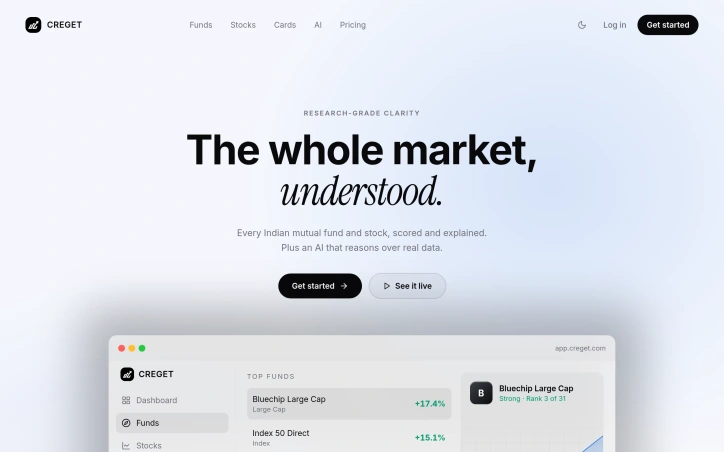
Investors navigating India's mutual fund and stock market often face a fundamental problem: too much data and insufficient guidance. Creget addresses this by providing scored, data-backed analysis of every Indian mutual fund and stock available, dramatically reducing friction in investment research. The platform's core strength lies in its comprehensive scoring system. Each fund and stock receives a 0-to-100 score derived from returns, risk, and stability metrics, with methodology transparently displayed. This transforms abstract financial data into digestible decisions. Funds are ranked within their AMFI categories, while stocks are ranked by sector, giving investors meaningful context. What distinguishes Creget beyond algorithmic scoring is its accessibility orientation. A plain-English glossary demystifies 80 finance terms, explanations accompany every recommendation, and the interface guides users through research in three straightforward steps: search, review the score and reasoning, then decide. This educational layer addresses a real gap for retail investors who cannot access professional advisory. The product bundles practical tools around core research capabilities. A portfolio tracker consolidates funds, stocks, EPF, and gold holdings in one unified view, eliminating manual data stitching across platforms. Calculators for SIPs, lumpsums, EMI, FIRE, and retirement planning add utility beyond pure analytics. Credit card recommendations based on individual spending patterns extend the scope into adjacent financial decisions. Data integrity is central to the value proposition. Creget sources from trusted institutional inputs including AMFI, SEBI, NSE, BSE, RBI, and international feeds like Alpha Vantage and Yahoo Finance, with daily updates. The platform supports live integration with AI assistants via MCP, enabling programmatic queries over market context and personal financial data. For Indian investors seeking research-backed decisions without professional advisory costs, the platform delivers measurable value by compressing weeks of manual research into searchable, scored, comparable data. It reframes investment research from a chore requiring financial expertise into an interactive workflow designed for clarity. The breadth of coverage—spanning Indian and US equities, mutual funds, and broader portfolio assets—positions it as a potential centerpiece for retail wealth management rather than a point tool.

Investors navigating India's mutual fund and stock market often face a fundamental problem: too much data and insufficient guidance. Creget addresses this by providing scored, data-backed analysis of every Indian mutual fund and stock available, dramatically reducing friction in investment research. The platform's core strength lies in its comprehensive scoring system. Each fund and stock receives a 0-to-100 score derived from returns, risk, and stability metrics, with methodology transparently displayed. This transforms abstract financial data into digestible decisions. Funds are ranked within their AMFI categories, while stocks are ranked by sector, giving investors meaningful context. What distinguishes Creget beyond algorithmic scoring is its accessibility orientation. A plain-English glossary demystifies 80 finance terms, explanations accompany every recommendation, and the interface guides users through research in three straightforward steps: search, review the score and reasoning, then decide. This educational layer addresses a real gap for retail investors who cannot access professional advisory. The product bundles practical tools around core research capabilities. A portfolio tracker consolidates funds, stocks, EPF, and gold holdings in one unified view, eliminating manual data stitching across platforms. Calculators for SIPs, lumpsums, EMI, FIRE, and retirement planning add utility beyond pure analytics. Credit card recommendations based on individual spending patterns extend the scope into adjacent financial decisions. Data integrity is central to the value proposition. Creget sources from trusted institutional inputs including AMFI, SEBI, NSE, BSE, RBI, and international feeds like Alpha Vantage and Yahoo Finance, with daily updates. The platform supports live integration with AI assistants via MCP, enabling programmatic queries over market context and personal financial data. For Indian investors seeking research-backed decisions without professional advisory costs, the platform delivers measurable value by compressing weeks of manual research into searchable, scored, comparable data. It reframes investment research from a chore requiring financial expertise into an interactive workflow designed for clarity. The breadth of coverage—spanning Indian and US equities, mutual funds, and broader portfolio assets—positions it as a potential centerpiece for retail wealth management rather than a point tool.

Creget preview

Key features

  • Comprehensive Scoring System: Each fund and stock receives a 0-to-100 score derived from returns, risk, and stability metrics with transparent methodology.
  • Financial Education & Glossary: Plain-English glossary demystifying 80 finance terms with explanations accompanying every recommendation.
See full listing
MakeImg

Transforming casual photos and idle ideas into polished visual content typically demands design skills, software expertise, and hours of editing time. MakeImg streamlines this process for creators who want fast turnaround on shareable meme packs without the friction. The core offering is straightforward: upload a portrait or describe a scene, and the platform generates a cohesive nine-image reaction set ready to download within minutes. This addresses a real gap for content creators, social media enthusiasts, and anyone who wants to produce on-brand visual assets without learning specialized tools. The service works across two main input modes—text prompts for conceptual meme packs and photo uploads for personal reaction sets—making it accessible regardless of whether a user starts with an idea or existing imagery. Beyond the headline meme-pack feature, the platform extends into adjacent creative workflows: image composition layers multiple reference photos into a single output, image editing lets users refine shots with text instructions, and photo restoration repairs old or damaged images. This breadth gives creators flexibility to complete different project types within one interface rather than toggling between specialized apps. The product philosophy appears centered on quick iteration and exploration. The platform includes a gallery of real generated outputs, positioning users to preview results before committing time, and emphasizes minute-level generation speeds. This matters for creators managing content calendars or capitalizing on trending moments. Pricing follows a familiar creator-tool playbook: a free starter tier for exploring the full workflow, a $9.99 monthly subscription pitched to regular generators, and a one-time $5 single-pack purchase for occasional users. The credit-based model allows scaling without forced subscription commitment, though the pricing page references credits without detailing exact generation costs per feature. What remains underexplored in the marketing materials is the consistency quality of output, particularly whether multi-image sets maintain visual cohesion across poses and expressions. Given the technical challenge of generating nine related images that function as true reaction options, this is worth validating before deciding if the tool fits professional creator workflows versus casual meme sharing. The positioning is solid for the target user: someone who values speed and ease over granular creative control. MakeImg occupies sensible territory between demand and execution, offering enough workflow options to feel like a complete toolkit while keeping the interface simple enough for non-technical users to generate results immediately.

Ai-generative-media
�
清峰

Transforming casual photos and idle ideas into polished visual content typically demands design skills, software expertise, and hours of editing time. MakeImg streamlines this process for creators who want fast turnaround on shareable meme packs without the friction. The core offering is straightforward: upload a portrait or describe a scene, and the platform generates a cohesive nine-image reaction set ready to download within minutes. This addresses a real gap for content creators, social media enthusiasts, and anyone who wants to produce on-brand visual assets without learning specialized tools. The service works across two main input modes—text prompts for conceptual meme packs and photo uploads for personal reaction sets—making it accessible regardless of whether a user starts with an idea or existing imagery. Beyond the headline meme-pack feature, the platform extends into adjacent creative workflows: image composition layers multiple reference photos into a single output, image editing lets users refine shots with text instructions, and photo restoration repairs old or damaged images. This breadth gives creators flexibility to complete different project types within one interface rather than toggling between specialized apps. The product philosophy appears centered on quick iteration and exploration. The platform includes a gallery of real generated outputs, positioning users to preview results before committing time, and emphasizes minute-level generation speeds. This matters for creators managing content calendars or capitalizing on trending moments. Pricing follows a familiar creator-tool playbook: a free starter tier for exploring the full workflow, a $9.99 monthly subscription pitched to regular generators, and a one-time $5 single-pack purchase for occasional users. The credit-based model allows scaling without forced subscription commitment, though the pricing page references credits without detailing exact generation costs per feature. What remains underexplored in the marketing materials is the consistency quality of output, particularly whether multi-image sets maintain visual cohesion across poses and expressions. Given the technical challenge of generating nine related images that function as true reaction options, this is worth validating before deciding if the tool fits professional creator workflows versus casual meme sharing. The positioning is solid for the target user: someone who values speed and ease over granular creative control. MakeImg occupies sensible territory between demand and execution, offering enough workflow options to feel like a complete toolkit while keeping the interface simple enough for non-technical users to generate results immediately.

MakeImg preview

Key features

  • Meme Pack Generation: Creates nine-image reaction sets from portraits or text descriptions for download within minutes.
  • Image Composition: Layers multiple reference photos into a single cohesive output.
See full listing
A

For anyone curious about an animal spotted in nature, a wildlife photo found online, or simply wondering about a creature in their yard, this browser-based identification tool fills a straightforward need. The product targets a broad audience spanning students researching wildlife, parents answering children's questions about animals, nature enthusiasts documenting sightings, and pet owners identifying unfamiliar creatures. The distinctive angle here centers on responsible wildlife interaction. Rather than simply naming animals, the platform pairs identification results with explicit safety guidance, reminding users not to approach, touch, feed, or capture animals based on photo recognition alone. This emphasis recurs throughout the interface and represents a thoughtful addition in an educational context where misidentification could lead to dangerous behavior. The core workflow is straightforward: upload an image in PNG, JPG, or WEBP format and receive the likely species identification along with supporting visual evidence. Beyond the name, users get habitat information, diet details, behavioral characteristics, regional context, and interesting facts. The platform indicates confidence levels in its guesses, an important transparency feature when stakes involve human safety around wildlife. The product addresses a common search behavior by organizing around specific user questions: "What animal is this," "Identify an animal by picture," and "What kind of animal is this." Rather than forcing all queries into a single form, these focused pages acknowledge how people actually ask these questions while maintaining the same upload-based identification mechanism. This mirrors how real search behavior works and makes the tool feel aligned with user intent rather than rigid. The decision to operate entirely in the browser eliminates friction present in traditional app-based identification tools, removing download requirements and installation steps. This approach democratizes access and positions the platform as a quick reference rather than a commitment download. The emphasis on visual explanation distinguishes this from simpler name-guessing alternatives. By showing what clues the model detected, the tool educates alongside identifying, useful for learning-focused users. The safety guidance strips away the novelty of AI identification and anchors the interaction to practical, responsible behavior. Pricing or monetization strategy receives no mention in available materials, leaving the business model unclear. The feature set and positioning suggest education and wildlife safety as core values, which shapes how the product positions itself even if commercial viability remains unstated.

Ai-generative-media
�
王二狗

For anyone curious about an animal spotted in nature, a wildlife photo found online, or simply wondering about a creature in their yard, this browser-based identification tool fills a straightforward need. The product targets a broad audience spanning students researching wildlife, parents answering children's questions about animals, nature enthusiasts documenting sightings, and pet owners identifying unfamiliar creatures. The distinctive angle here centers on responsible wildlife interaction. Rather than simply naming animals, the platform pairs identification results with explicit safety guidance, reminding users not to approach, touch, feed, or capture animals based on photo recognition alone. This emphasis recurs throughout the interface and represents a thoughtful addition in an educational context where misidentification could lead to dangerous behavior. The core workflow is straightforward: upload an image in PNG, JPG, or WEBP format and receive the likely species identification along with supporting visual evidence. Beyond the name, users get habitat information, diet details, behavioral characteristics, regional context, and interesting facts. The platform indicates confidence levels in its guesses, an important transparency feature when stakes involve human safety around wildlife. The product addresses a common search behavior by organizing around specific user questions: "What animal is this," "Identify an animal by picture," and "What kind of animal is this." Rather than forcing all queries into a single form, these focused pages acknowledge how people actually ask these questions while maintaining the same upload-based identification mechanism. This mirrors how real search behavior works and makes the tool feel aligned with user intent rather than rigid. The decision to operate entirely in the browser eliminates friction present in traditional app-based identification tools, removing download requirements and installation steps. This approach democratizes access and positions the platform as a quick reference rather than a commitment download. The emphasis on visual explanation distinguishes this from simpler name-guessing alternatives. By showing what clues the model detected, the tool educates alongside identifying, useful for learning-focused users. The safety guidance strips away the novelty of AI identification and anchors the interaction to practical, responsible behavior. Pricing or monetization strategy receives no mention in available materials, leaving the business model unclear. The feature set and positioning suggest education and wildlife safety as core values, which shapes how the product positions itself even if commercial viability remains unstated.

AI Animal Identifier preview
A

Key features

  • Image-Based Identification: Upload photos in PNG, JPG, or WEBP format to receive species identification with supporting visual evidence.
  • Safety Guidance Integration: Pairs identification results with explicit safety reminders about not approaching, touching, feeding, or capturing animals.
See full listing
A

A browser-based tool that scores facial attractiveness using AI, this service appeals to the growing cohort of internet users curious about how machine learning perceives human features. The product serves dual purposes: it offers entertainment and quick visual feedback, while simultaneously demonstrating how AI models trained on large facial datasets respond to photographic variation. The core offering is straightforward. Users upload a photo, and the system analyzes multiple dimensions beyond raw attractiveness—including smartness, confidence, trustworthiness, fun, and approachability. Results arrive within seconds, accompanied by explanations of which facial attributes influenced the scoring. The interface requires no account creation or login, lowering friction for casual experimentation. What distinguishes this product is its transparency around its own limitations and variables. The site explicitly acknowledges that results fluctuate based on image quality, lighting, angle, and expression, positioning the tool as an educational instrument for understanding AI behavior rather than an authoritative beauty assessment. This framing mitigates some of the reputational risk inherent in any attractiveness-rating product. The accompanying guidance on photo selection—emphasizing clear, front-facing shots under good lighting—reinforces the educational angle and manages user expectations effectively. Privacy appears to be a selling point. The site claims photos are neither stored nor shared, addressing the obvious concern that facial data uploaded to a web service could be harvested or retained for model retraining. Whether this promise holds up to external audit is unclear, but it's presented prominently. The product leverages claims of sophisticated facial analysis trained on millions of images, examining symmetry, proportions, and skin quality. These claims align with capabilities available in commercial computer vision APIs but lack third-party validation or technical specificity on the site itself. From a business model perspective, the service is entirely free with no subscription tiers or upsells mentioned. Revenue generation remains unstated, leaving questions about sustainability and monetization strategy. Whether the business model relies on attention, data collection, affiliate arrangements, or another mechanism is not revealed. The product succeeds most clearly as a novelty tool that scratches an itch—what would an AI think?—while incidentally teaching users about how machine learning responds to visual input. It occupies an unusual position between entertainment and education, making it accessible to curious users without demanding serious engagement or personal investment.

Ai-generative-media
�
王二狗

A browser-based tool that scores facial attractiveness using AI, this service appeals to the growing cohort of internet users curious about how machine learning perceives human features. The product serves dual purposes: it offers entertainment and quick visual feedback, while simultaneously demonstrating how AI models trained on large facial datasets respond to photographic variation. The core offering is straightforward. Users upload a photo, and the system analyzes multiple dimensions beyond raw attractiveness—including smartness, confidence, trustworthiness, fun, and approachability. Results arrive within seconds, accompanied by explanations of which facial attributes influenced the scoring. The interface requires no account creation or login, lowering friction for casual experimentation. What distinguishes this product is its transparency around its own limitations and variables. The site explicitly acknowledges that results fluctuate based on image quality, lighting, angle, and expression, positioning the tool as an educational instrument for understanding AI behavior rather than an authoritative beauty assessment. This framing mitigates some of the reputational risk inherent in any attractiveness-rating product. The accompanying guidance on photo selection—emphasizing clear, front-facing shots under good lighting—reinforces the educational angle and manages user expectations effectively. Privacy appears to be a selling point. The site claims photos are neither stored nor shared, addressing the obvious concern that facial data uploaded to a web service could be harvested or retained for model retraining. Whether this promise holds up to external audit is unclear, but it's presented prominently. The product leverages claims of sophisticated facial analysis trained on millions of images, examining symmetry, proportions, and skin quality. These claims align with capabilities available in commercial computer vision APIs but lack third-party validation or technical specificity on the site itself. From a business model perspective, the service is entirely free with no subscription tiers or upsells mentioned. Revenue generation remains unstated, leaving questions about sustainability and monetization strategy. Whether the business model relies on attention, data collection, affiliate arrangements, or another mechanism is not revealed. The product succeeds most clearly as a novelty tool that scratches an itch—what would an AI think?—while incidentally teaching users about how machine learning responds to visual input. It occupies an unusual position between entertainment and education, making it accessible to curious users without demanding serious engagement or personal investment.

AI Attractiveness Test preview
A

Key features

  • Multi-Dimensional Analysis: Analyzes attractiveness, smartness, confidence, trustworthiness, fun, and approachability from a single photo.
  • No Account Required: The interface requires no account creation or login, lowering friction for casual use.
See full listing
H

Facial analysis tools have long promised to read age from appearance, but most come wrapped in complexity or concern about data handling. This free browser-based age estimator strips away both, offering a lightweight entry point for anyone curious about how AI perceives facial age markers. The core appeal targets a broad spectrum: casual users wanting an entertaining experiment, people interested in understanding computer vision limitations, and those exploring how presentation factors influence machine perception. The tool requires nothing beyond a photo and delivers results instantly without demanding account creation or email registration. What differentiates this offering is its transparency about the mechanics and limitations of AI age estimation. The interface doesn't pretend to scientific precision; it frames the output as entertainment-oriented and explicitly acknowledges that lighting, camera angle, expression, makeup, and image quality all shape the result. This directness extends to privacy handling. The platform commits to not storing or sharing uploaded photos, addressing a common hesitation around facial analysis services. Beyond age estimation, the tool analyzes five trait attributes: smartness, confidence, trustworthiness, attractiveness, and approachability. This expands the offering from a single-metric feature into a broader personality perception experiment, adding layers to how users interpret the model's outputs. The product workflow demonstrates efficiency. Users upload a clear front-facing photo, select which traits interest them, and receive face-based scores within seconds. The browser-native experience eliminates download friction, and the inclusion of example predictions helps calibrate expectations before uploading personal images. The educational component stands out as particularly valuable. Rather than hiding how image variables affect results, the FAQ section walks through why apparent age shifts across different photos of the same person, what creates misleading outputs, and how to read scores responsibly. This approach acknowledges that engaging with AI perception demands literacy about the tool's constraints. Pricing is straightforward: the service is free with no premium tier mentioned. This positions it as genuine exploration software rather than a freemium funnel. The main limitation is inherent to the category. AI age estimation will always reflect training data bias and visible image characteristics rather than actual age. The tool handles this candidly, but users should enter with realistic expectations about accuracy and fairness. For entertainment, curiosity-driven exploration, and lightweight AI experimentation, the product delivers what it promises.

Ai-generative-media
�
王二狗

Facial analysis tools have long promised to read age from appearance, but most come wrapped in complexity or concern about data handling. This free browser-based age estimator strips away both, offering a lightweight entry point for anyone curious about how AI perceives facial age markers. The core appeal targets a broad spectrum: casual users wanting an entertaining experiment, people interested in understanding computer vision limitations, and those exploring how presentation factors influence machine perception. The tool requires nothing beyond a photo and delivers results instantly without demanding account creation or email registration. What differentiates this offering is its transparency about the mechanics and limitations of AI age estimation. The interface doesn't pretend to scientific precision; it frames the output as entertainment-oriented and explicitly acknowledges that lighting, camera angle, expression, makeup, and image quality all shape the result. This directness extends to privacy handling. The platform commits to not storing or sharing uploaded photos, addressing a common hesitation around facial analysis services. Beyond age estimation, the tool analyzes five trait attributes: smartness, confidence, trustworthiness, attractiveness, and approachability. This expands the offering from a single-metric feature into a broader personality perception experiment, adding layers to how users interpret the model's outputs. The product workflow demonstrates efficiency. Users upload a clear front-facing photo, select which traits interest them, and receive face-based scores within seconds. The browser-native experience eliminates download friction, and the inclusion of example predictions helps calibrate expectations before uploading personal images. The educational component stands out as particularly valuable. Rather than hiding how image variables affect results, the FAQ section walks through why apparent age shifts across different photos of the same person, what creates misleading outputs, and how to read scores responsibly. This approach acknowledges that engaging with AI perception demands literacy about the tool's constraints. Pricing is straightforward: the service is free with no premium tier mentioned. This positions it as genuine exploration software rather than a freemium funnel. The main limitation is inherent to the category. AI age estimation will always reflect training data bias and visible image characteristics rather than actual age. The tool handles this candidly, but users should enter with realistic expectations about accuracy and fairness. For entertainment, curiosity-driven exploration, and lightweight AI experimentation, the product delivers what it promises.

How Old Do I Look preview
H

Key features

  • Browser-Based Estimator: Free online age analysis requiring only a photo upload with no download or account setup
  • Multi-Trait Analysis: Scores five personality perception attributes including smartness, confidence, trustworthiness, attractiveness, and approachability
See full listing
S

An AI-powered thumbnail generator tailored for YouTube creators, StopScroll addresses a persistent pain point in video production: choosing effective cover images that drive clicks and engagement. The tool targets content creators who want to optimize their thumbnails without extensive design experience or guesswork. The product works by accepting multiple input types. Users can paste a public YouTube URL, and the system analyzes available metadata, descriptions, chapters, and transcript signals to generate contextually relevant thumbnail concepts. Alternatively, creators can start from scratch by entering a title, niche description, and custom prompt, optionally uploading subject images. This flexibility serves both established creators looking to refresh existing videos and new producers launching content. StopScroll distinguishes itself through a generation-and-compare workflow. Rather than producing a single option, it creates multiple distinct thumbnail concepts based on the same content, allowing creators to preview and evaluate different visual approaches before downloading. This comparison-focused design reduces decision paralysis and helps users identify which direction resonates most for their audience. The feature set extends beyond core generation. The platform includes specialized YouTube utilities: a thumbnail resizer that converts designs to proper 16:9 specifications, a Shorts thumbnail downloader for extracting public preview images, and a tool for checking and downloading the highest-resolution versions of existing YouTube thumbnails in up to 4K. These ancillary features position the tool as a multipurpose suite rather than a single-purpose generator. Pricing follows a credit-based model with two explicit tiers. The Starter pack offers 40 credits for $9, approximately $0.23 per thumbnail. The Creator tier provides 140 credits for $29, bringing per-image cost to roughly $0.21. Credits do not expire, and users retain access to generation history indefinitely. This structure caters to both casual creators running occasional experiments and prolific producers generating thumbnails frequently. The product positions thumbnail optimization as solved through iteration and comparison rather than through algorithmic perfection, a pragmatic stance acknowledging that thumbnails ultimately serve viewer attention and require human judgment to validate effectiveness.

Productivity
�
王二狗

An AI-powered thumbnail generator tailored for YouTube creators, StopScroll addresses a persistent pain point in video production: choosing effective cover images that drive clicks and engagement. The tool targets content creators who want to optimize their thumbnails without extensive design experience or guesswork. The product works by accepting multiple input types. Users can paste a public YouTube URL, and the system analyzes available metadata, descriptions, chapters, and transcript signals to generate contextually relevant thumbnail concepts. Alternatively, creators can start from scratch by entering a title, niche description, and custom prompt, optionally uploading subject images. This flexibility serves both established creators looking to refresh existing videos and new producers launching content. StopScroll distinguishes itself through a generation-and-compare workflow. Rather than producing a single option, it creates multiple distinct thumbnail concepts based on the same content, allowing creators to preview and evaluate different visual approaches before downloading. This comparison-focused design reduces decision paralysis and helps users identify which direction resonates most for their audience. The feature set extends beyond core generation. The platform includes specialized YouTube utilities: a thumbnail resizer that converts designs to proper 16:9 specifications, a Shorts thumbnail downloader for extracting public preview images, and a tool for checking and downloading the highest-resolution versions of existing YouTube thumbnails in up to 4K. These ancillary features position the tool as a multipurpose suite rather than a single-purpose generator. Pricing follows a credit-based model with two explicit tiers. The Starter pack offers 40 credits for $9, approximately $0.23 per thumbnail. The Creator tier provides 140 credits for $29, bringing per-image cost to roughly $0.21. Credits do not expire, and users retain access to generation history indefinitely. This structure caters to both casual creators running occasional experiments and prolific producers generating thumbnails frequently. The product positions thumbnail optimization as solved through iteration and comparison rather than through algorithmic perfection, a pragmatic stance acknowledging that thumbnails ultimately serve viewer attention and require human judgment to validate effectiveness.

StopScroll preview
S

Key features

  • AI-Powered Generation: Analyzes YouTube metadata, descriptions, chapters, and transcripts to create contextually relevant thumbnail concepts.
  • Multi-Concept Comparison: Generates multiple distinct thumbnail options from the same content for side-by-side evaluation.
See full listing
H

Fragmentation plagues the AI creative tools landscape. Rather than mastering dozens of standalone platforms, visual creators face constant friction: jumping between subscriptions, learning new interfaces, and managing project context across disconnected applications. HubVanta AI addresses this consolidation problem head-on by housing multiple leading image and video generation models under one roof. The platform packages access to industry models including Midjourney, Flux AI, GPT-4o, and Stable Diffusion alongside a proprietary set of AI capabilities. This breadth matters. Instead of subscribing to separate services for text-to-video, image-to-video, background removal, upscaling, voice cloning, and face analysis, creators maintain a single workspace with clear organization across workflows. The positioning targets visual professionals: content creators, marketers, founders, and product teams who value time over perfection, particularly those who prototype often. What distinguishes HubVanta AI from simple model aggregation is the emphasis on creative continuity. The interface treats the workspace as persistent context rather than disconnected tasks, allowing users to generate an asset, edit it, then seamlessly transition to repurposing it into a different format without re-explaining the project state. This reduces cognitive overhead, a real pain point for working professionals managing rapid iteration cycles. The capability roster is comprehensive. Video tools include text-to-video and image-to-video generation with reported processing times between one and five minutes for standard outputs. Image tools span generation, editing, enhancement, restoration, and specialized workflows like floor plan analysis and room decoration. Audio capabilities include voice cloning and text-to-speech. Supplementary features address practical needs: video background removal, image watermark detection, and object removal. Access begins with limited free previews on individual tools, with a paid upgrade path when users want to generate without per-tool restrictions. This freemium structure removes the commitment barrier for exploration. The core insight underlying HubVanta AI is sound: creative professionals waste efficiency on tool switching. By centralizing discovery and providing seamless transitions between visual formats, the platform attacks a genuine friction point in AI-assisted content creation.


Ai-generative-media
�
王二狗

Fragmentation plagues the AI creative tools landscape. Rather than mastering dozens of standalone platforms, visual creators face constant friction: jumping between subscriptions, learning new interfaces, and managing project context across disconnected applications. HubVanta AI addresses this consolidation problem head-on by housing multiple leading image and video generation models under one roof. The platform packages access to industry models including Midjourney, Flux AI, GPT-4o, and Stable Diffusion alongside a proprietary set of AI capabilities. This breadth matters. Instead of subscribing to separate services for text-to-video, image-to-video, background removal, upscaling, voice cloning, and face analysis, creators maintain a single workspace with clear organization across workflows. The positioning targets visual professionals: content creators, marketers, founders, and product teams who value time over perfection, particularly those who prototype often. What distinguishes HubVanta AI from simple model aggregation is the emphasis on creative continuity. The interface treats the workspace as persistent context rather than disconnected tasks, allowing users to generate an asset, edit it, then seamlessly transition to repurposing it into a different format without re-explaining the project state. This reduces cognitive overhead, a real pain point for working professionals managing rapid iteration cycles. The capability roster is comprehensive. Video tools include text-to-video and image-to-video generation with reported processing times between one and five minutes for standard outputs. Image tools span generation, editing, enhancement, restoration, and specialized workflows like floor plan analysis and room decoration. Audio capabilities include voice cloning and text-to-speech. Supplementary features address practical needs: video background removal, image watermark detection, and object removal. Access begins with limited free previews on individual tools, with a paid upgrade path when users want to generate without per-tool restrictions. This freemium structure removes the commitment barrier for exploration. The core insight underlying HubVanta AI is sound: creative professionals waste efficiency on tool switching. By centralizing discovery and providing seamless transitions between visual formats, the platform attacks a genuine friction point in AI-assisted content creation.

HubVanta AI preview
H

Key features

  • Unified Model Access: Consolidates Midjourney, Flux AI, GPT-4o, Stable Diffusion, and proprietary AI capabilities in one workspace.
  • Creative Continuity: Enables seamless workflow transitions between generating, editing, and repurposing assets without losing project context.
See full listing
Google Maps Scraper

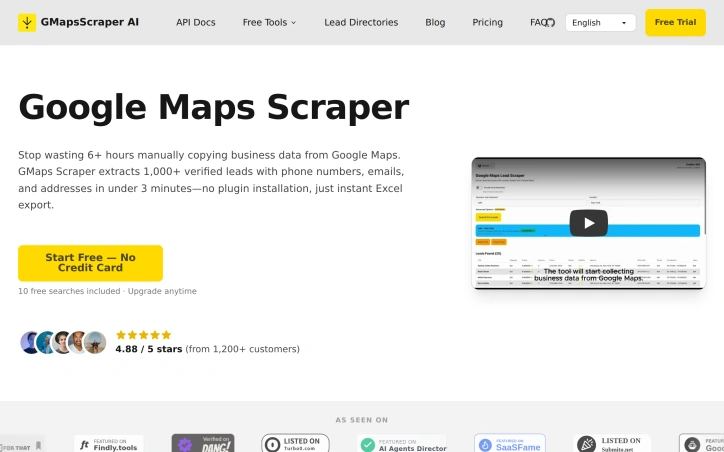
Extracting contact information from Google Maps typically involves opening dozens of business listings, manually copying phone numbers and addresses into spreadsheets, and hoping you don't lose track of which ones you've already documented. Google Maps Scraper directly addresses this friction point, targeting sales professionals, marketing agencies, and business owners who build prospect lists from local search results. The product distinguishes itself through its no-installation approach. Rather than requiring a browser plugin or software download, the tool operates entirely through a web browser, making it accessible from any device. The core appeal is speed: the tool extracts over one thousand leads in under three minutes, including phone numbers, email addresses, business websites, and ratings. For teams that traditionally spend six or more hours on this task, even a fraction of that time saved represents meaningful efficiency gains. The feature set covers the essentials for outreach workflows. Leads export directly to Excel format with minimal formatting required, and the data arrives pre-organized for immediate use in CRM systems or email campaigns. The tool integrates with Google Maps directly through the browser without requiring an API key for the basic web interface, lowering the barrier to entry. Pricing follows a freemium model. New users receive ten free searches without providing a credit card, allowing exploration before commitment. The platform offers multiple access points: the web-based tool, a free browser extension for direct extraction from Google Maps pages, a developer API for programmatic access, and AI agent skills for integration with tools like Claude and ChatGPT. This multi-channel approach accommodates different workflows, from one-off searches to embedded automation. User feedback backs the public rating of 4.88 out of 5 stars across over one thousand customer responses. The company emphasizes the verified nature of extracted phone numbers and the clean formatting of results, suggesting attention to data quality rather than raw volume. The positioning centers on time reclamation: shifting work from manual copying to strategic outreach. For teams struggling with lead research bottlenecks, particularly those operating without dedicated research staff or budget constraints on tools, the free tier serves as a low-friction entry point to evaluate whether the tool reduces their actual workload.

Lead-generation-software
V
Vid AIGen

Extracting contact information from Google Maps typically involves opening dozens of business listings, manually copying phone numbers and addresses into spreadsheets, and hoping you don't lose track of which ones you've already documented. Google Maps Scraper directly addresses this friction point, targeting sales professionals, marketing agencies, and business owners who build prospect lists from local search results. The product distinguishes itself through its no-installation approach. Rather than requiring a browser plugin or software download, the tool operates entirely through a web browser, making it accessible from any device. The core appeal is speed: the tool extracts over one thousand leads in under three minutes, including phone numbers, email addresses, business websites, and ratings. For teams that traditionally spend six or more hours on this task, even a fraction of that time saved represents meaningful efficiency gains. The feature set covers the essentials for outreach workflows. Leads export directly to Excel format with minimal formatting required, and the data arrives pre-organized for immediate use in CRM systems or email campaigns. The tool integrates with Google Maps directly through the browser without requiring an API key for the basic web interface, lowering the barrier to entry. Pricing follows a freemium model. New users receive ten free searches without providing a credit card, allowing exploration before commitment. The platform offers multiple access points: the web-based tool, a free browser extension for direct extraction from Google Maps pages, a developer API for programmatic access, and AI agent skills for integration with tools like Claude and ChatGPT. This multi-channel approach accommodates different workflows, from one-off searches to embedded automation. User feedback backs the public rating of 4.88 out of 5 stars across over one thousand customer responses. The company emphasizes the verified nature of extracted phone numbers and the clean formatting of results, suggesting attention to data quality rather than raw volume. The positioning centers on time reclamation: shifting work from manual copying to strategic outreach. For teams struggling with lead research bottlenecks, particularly those operating without dedicated research staff or budget constraints on tools, the free tier serves as a low-friction entry point to evaluate whether the tool reduces their actual workload.

Google Maps Scraper preview

Key features

  • No-Installation Browser Tool: Operates entirely through web browsers without plugins or software downloads, accessible from any device.
  • High-Speed Lead Extraction: Extracts over 1,000 leads in under three minutes including phone numbers, emails, websites, and ratings.
See full listing
Resource Tuner Console

Automating resource changes in Windows executables after compilation remains a tedious manual process for many development teams. Resource Tuner Console addresses this gap by providing a command-line interface that enables developers to modify resources in 32- and 64-bit Windows PE files without recompiling source code. The product targets Windows engineers, build managers, and DevOps leads who need to update application resources during the final stages of their build pipeline. It particularly suits mid-sized teams at companies between 20 and 500 employees that maintain dedicated release infrastructure, as well as smaller vendors and independent developers without dedicated release engineering staff. What distinguishes Resource Tuner Console is its focus on post-build workflow automation. Rather than treating resource editing as something that must happen at compile time, the tool enables teams to modify icons, version numbers, strings, manifests, and bitmaps as a scripted step after compilation completes. This separation of concerns offers concrete benefits: teams can adapt branding or patch versioning details without touching source code or recompiling, significantly reducing turnaround time for minor updates. The tool integrates into existing build automation by accepting command-line inputs and working within batch scripts or other Windows applications. The product emphasizes speed and consistency as primary value drivers. The marketing materials claim a substantial performance advantage over traditional GUI-based resource editors, positioning it as enabling teams to move faster and reduce human error when applying changes across multiple executables. For organizations that ship multiple versions of the same application or need to customize executables for different customers or partners, the ability to template these changes and apply them automatically addresses a real workflow pain point. Resource Tuner Console serves a specific use case within Windows development rather than attempting broad appeal. Its utility concentrates on scenarios where post-build resource customization offers enough friction reduction to justify the learning curve of command-line scripting. Teams already invested in build automation and release management processes will see the clearest value. Those still relying on manual resource editing or older GUI tools will find the switch worthwhile, though the tool assumes basic comfort with scripting and Windows executable formats.


Automation-tools
S
S V

Automating resource changes in Windows executables after compilation remains a tedious manual process for many development teams. Resource Tuner Console addresses this gap by providing a command-line interface that enables developers to modify resources in 32- and 64-bit Windows PE files without recompiling source code. The product targets Windows engineers, build managers, and DevOps leads who need to update application resources during the final stages of their build pipeline. It particularly suits mid-sized teams at companies between 20 and 500 employees that maintain dedicated release infrastructure, as well as smaller vendors and independent developers without dedicated release engineering staff. What distinguishes Resource Tuner Console is its focus on post-build workflow automation. Rather than treating resource editing as something that must happen at compile time, the tool enables teams to modify icons, version numbers, strings, manifests, and bitmaps as a scripted step after compilation completes. This separation of concerns offers concrete benefits: teams can adapt branding or patch versioning details without touching source code or recompiling, significantly reducing turnaround time for minor updates. The tool integrates into existing build automation by accepting command-line inputs and working within batch scripts or other Windows applications. The product emphasizes speed and consistency as primary value drivers. The marketing materials claim a substantial performance advantage over traditional GUI-based resource editors, positioning it as enabling teams to move faster and reduce human error when applying changes across multiple executables. For organizations that ship multiple versions of the same application or need to customize executables for different customers or partners, the ability to template these changes and apply them automatically addresses a real workflow pain point. Resource Tuner Console serves a specific use case within Windows development rather than attempting broad appeal. Its utility concentrates on scenarios where post-build resource customization offers enough friction reduction to justify the learning curve of command-line scripting. Teams already invested in build automation and release management processes will see the clearest value. Those still relying on manual resource editing or older GUI tools will find the switch worthwhile, though the tool assumes basic comfort with scripting and Windows executable formats.

Resource Tuner Console preview

Key features

  • Command-Line Resource Editing: Modifies resources in 32- and 64-bit Windows PE files without recompiling source code
  • Post-Build Customization: Updates icons, version numbers, strings, manifests, and bitmaps after compilation completes
See full listing
Star Chart Kids

Morning routines have become a battleground in countless households, where parents repeat themselves endlessly and children resist getting ready. Star Chart Kids addresses this friction by transforming daily tasks into a game that motivates kids to complete routines independently while keeping parents fully in control. The app targets families exhausted by negotiation loops around bedtime, breakfast, and chores. Rather than nagging, parents create visual task lists that children check off, earning stars for completion. This approach capitalizes on intrinsic motivation through immediate feedback and collectible rewards. What sets this product apart is its philosophy around monetization. It operates entirely free with no ads, subscriptions, or loot-box mechanics. Rewards unlock customizable elements like 3D pets, avatars, and interactive worlds, but parents maintain approval authority over real-life rewards like screen time or outings. This gatekeeping prevents the reward system from becoming a source of family conflict. The interface centers on simplicity. Kids see their next task, complete it with a tap, and immediately experience celebration through animations and star accrual. The app supports multiple children with separate avatars and tracking, allowing parents to manage household routines in one dashboard. Stars accumulate in a spendable bank while a lifetime progress tracker runs parallel, giving kids both immediate feedback and longer-term accomplishment. Three-dimensional pet characters serve as persistent companions, responding with happiness dances when tasks complete. This emotional anchoring appears designed to build attachment and investment in the routine loop, making the game element feel less arbitrary than a simple point counter. The product acknowledges that kids crave autonomy. Avatars, pet customization, and saving toward chosen rewards give children agency within boundaries parents control. This balance between kid empowerment and parental oversight is rare in this category. Availability spans browsers and mobile platforms, removing friction for families across devices. By eliminating subscription paywalls and ad interruptions, the app removes common obstacles to adoption that plague competitor products in the family-management space. For parents questioning whether another app will solve morning chaos, Star Chart Kids frames the problem not as tracking chores but making them feel rewarding rather than coercive. The execution reflects that belief throughout.


Apps-for-kids
A
Arijanit Jashari

Morning routines have become a battleground in countless households, where parents repeat themselves endlessly and children resist getting ready. Star Chart Kids addresses this friction by transforming daily tasks into a game that motivates kids to complete routines independently while keeping parents fully in control. The app targets families exhausted by negotiation loops around bedtime, breakfast, and chores. Rather than nagging, parents create visual task lists that children check off, earning stars for completion. This approach capitalizes on intrinsic motivation through immediate feedback and collectible rewards. What sets this product apart is its philosophy around monetization. It operates entirely free with no ads, subscriptions, or loot-box mechanics. Rewards unlock customizable elements like 3D pets, avatars, and interactive worlds, but parents maintain approval authority over real-life rewards like screen time or outings. This gatekeeping prevents the reward system from becoming a source of family conflict. The interface centers on simplicity. Kids see their next task, complete it with a tap, and immediately experience celebration through animations and star accrual. The app supports multiple children with separate avatars and tracking, allowing parents to manage household routines in one dashboard. Stars accumulate in a spendable bank while a lifetime progress tracker runs parallel, giving kids both immediate feedback and longer-term accomplishment. Three-dimensional pet characters serve as persistent companions, responding with happiness dances when tasks complete. This emotional anchoring appears designed to build attachment and investment in the routine loop, making the game element feel less arbitrary than a simple point counter. The product acknowledges that kids crave autonomy. Avatars, pet customization, and saving toward chosen rewards give children agency within boundaries parents control. This balance between kid empowerment and parental oversight is rare in this category. Availability spans browsers and mobile platforms, removing friction for families across devices. By eliminating subscription paywalls and ad interruptions, the app removes common obstacles to adoption that plague competitor products in the family-management space. For parents questioning whether another app will solve morning chaos, Star Chart Kids frames the problem not as tracking chores but making them feel rewarding rather than coercive. The execution reflects that belief throughout.

Star Chart Kids preview

Key features

  • Visual Task Lists: Children check off daily tasks and immediately earn stars upon completion
  • Spendable Star Rewards: Stars accumulate in a bank that children can spend on chosen rewards
See full listing
Geppetto

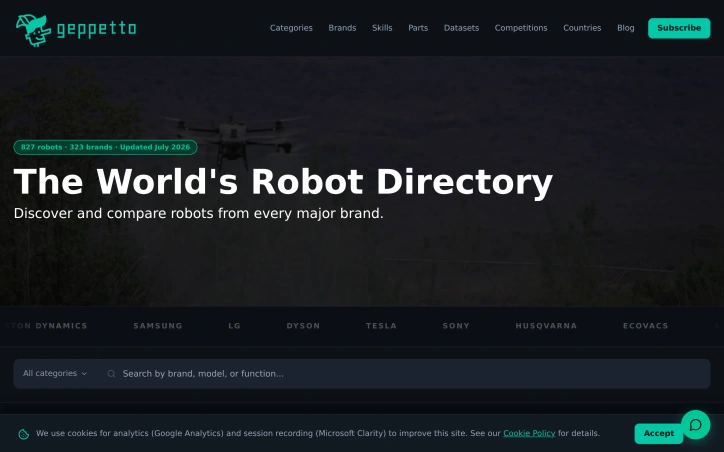
Navigating the robotics market has long been a fragmented experience, with specifications, pricing, and performance data scattered across manufacturer websites and trade publications. Geppetto addresses this fragmentation by consolidating information on over 800 robot models spanning 30+ categories into a single discovery platform. The service targets both commercial buyers evaluating robotic solutions and researchers mapping the landscape of available automation technology. The core value proposition centers on comparison and discovery. Rather than cobbling together information from multiple sources, users can access standardized specifications and pricing data across a broad range of robots. This centralization eliminates the manual research burden that typically precedes robotic procurement decisions. The platform's coverage across dozens of categories reflects an effort to serve diverse segments of the robotics market, from manufacturing and logistics to service and research applications. What distinguishes Geppetto from a simple product listing is its explicit focus on comparison functionality. The platform positions itself not merely as a directory but as an active research tool where users can meaningfully evaluate options side by side. This approach recognizes that robotic systems purchasing decisions involve complex technical tradeoffs and that buyers need structured data to compare performance characteristics and costs effectively. Rather than relying on isolated product pages, the platform enables systematic evaluation across multiple dimensions. The breadth of the catalog—800+ robots across 30+ categories—represents substantial curation work. Maintaining current specifications and pricing across such a range requires ongoing relationships with manufacturers and regular data verification. The platform must navigate the continuous product cycles that characterize robotics, where new models and capabilities emerge regularly. Staying current is essential to maintaining user value. The consolidation strategy addresses a genuine market need. Fragmentation currently forces buyers and researchers to conduct labor-intensive searches across disparate sources, consuming time and increasing the risk of incomplete evaluation. For anyone in the robotics procurement workflow, Geppetto offers a centralized alternative. In a market expanding rapidly with new entrants and capabilities, a unified reference point carries particular value.

Navigating the robotics market has long been a fragmented experience, with specifications, pricing, and performance data scattered across manufacturer websites and trade publications. Geppetto addresses this fragmentation by consolidating information on over 800 robot models spanning 30+ categories into a single discovery platform. The service targets both commercial buyers evaluating robotic solutions and researchers mapping the landscape of available automation technology. The core value proposition centers on comparison and discovery. Rather than cobbling together information from multiple sources, users can access standardized specifications and pricing data across a broad range of robots. This centralization eliminates the manual research burden that typically precedes robotic procurement decisions. The platform's coverage across dozens of categories reflects an effort to serve diverse segments of the robotics market, from manufacturing and logistics to service and research applications. What distinguishes Geppetto from a simple product listing is its explicit focus on comparison functionality. The platform positions itself not merely as a directory but as an active research tool where users can meaningfully evaluate options side by side. This approach recognizes that robotic systems purchasing decisions involve complex technical tradeoffs and that buyers need structured data to compare performance characteristics and costs effectively. Rather than relying on isolated product pages, the platform enables systematic evaluation across multiple dimensions. The breadth of the catalog—800+ robots across 30+ categories—represents substantial curation work. Maintaining current specifications and pricing across such a range requires ongoing relationships with manufacturers and regular data verification. The platform must navigate the continuous product cycles that characterize robotics, where new models and capabilities emerge regularly. Staying current is essential to maintaining user value. The consolidation strategy addresses a genuine market need. Fragmentation currently forces buyers and researchers to conduct labor-intensive searches across disparate sources, consuming time and increasing the risk of incomplete evaluation. For anyone in the robotics procurement workflow, Geppetto offers a centralized alternative. In a market expanding rapidly with new entrants and capabilities, a unified reference point carries particular value.

Geppetto preview

Key features

  • Consolidated Database: aggregates over 800 robot models from 30+ categories into a single discovery platform
  • Comparison Functionality: enables side-by-side evaluation of robotic solutions across multiple technical dimensions
See full listing
Genrank

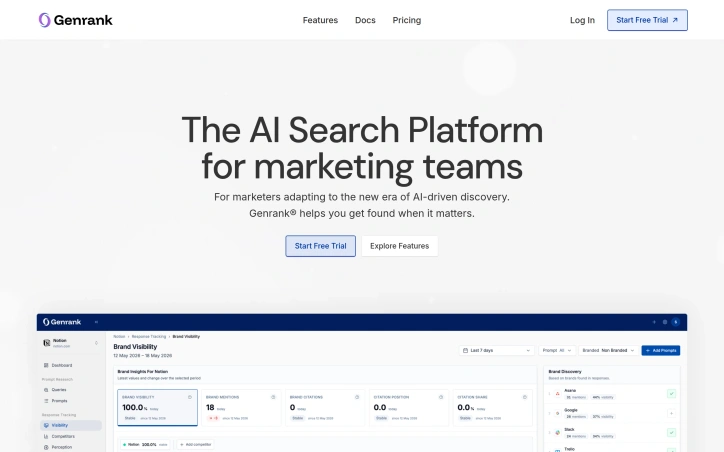
As AI language models increasingly serve as the starting point for buyer research and discovery, a gap has emerged in how brands monitor their presence in this new search frontier. Genrank addresses this directly by helping marketing teams understand and optimize how their companies appear in AI-generated responses from systems like ChatGPT. The platform recognizes that traditional search ranking, while still relevant, no longer captures the full customer journey. When potential customers engage with conversational AI to evaluate solutions or gather information, brands need visibility into whether they appear in those generated answers and recommendations. Genrank tracks this visibility across what the company frames as a "conversational funnel" distinct from keyword-based search results. The core offering includes several interconnected capabilities. Its LLM retrieval simulator shows how AI search engines chunk, retrieve, and rank content, revealing why certain brands appear prominently while others remain invisible. The platform monitors brand sentiment across news, reviews, and discussions that feed into AI recommendation systems. Its advertising insights feature surfaces which competitors are bidding on relevant prompts and what sponsored content appears alongside organic AI mentions. Content optimization tools help marketers adjust website pages and messaging to perform better within AI model retrieval processes. The social monitoring component tracks how brand perception shifts across the internet, connecting reputation signals to visibility in AI-generated answers. Genrank maintains a database exceeding 2.2 million brands, indicating established scale and reach. The platform serves multiple verticals including marketing agencies, e-commerce companies, recruitment organizations, and financial services. For agencies, it offers a competitive lever on a new dimension of visibility. For e-commerce, it addresses product discoverability in an era where price comparisons and research happen through chat interfaces. Recruitment and financial services can use the tool to become recommended options when AI systems generate career or financial guidance. Genrank targets a widening gap in the marketing technology landscape: most infrastructure was built for the age of search bars and keyword bidding. As conversational AI reshapes how people discover products and services, the platform helps teams understand and influence where and how their brands appear in these new customer conversations. The free trial model suggests accessibility for smaller teams alongside deeper offerings for enterprises.

Geo-tools
S
Siebert

As AI language models increasingly serve as the starting point for buyer research and discovery, a gap has emerged in how brands monitor their presence in this new search frontier. Genrank addresses this directly by helping marketing teams understand and optimize how their companies appear in AI-generated responses from systems like ChatGPT. The platform recognizes that traditional search ranking, while still relevant, no longer captures the full customer journey. When potential customers engage with conversational AI to evaluate solutions or gather information, brands need visibility into whether they appear in those generated answers and recommendations. Genrank tracks this visibility across what the company frames as a "conversational funnel" distinct from keyword-based search results. The core offering includes several interconnected capabilities. Its LLM retrieval simulator shows how AI search engines chunk, retrieve, and rank content, revealing why certain brands appear prominently while others remain invisible. The platform monitors brand sentiment across news, reviews, and discussions that feed into AI recommendation systems. Its advertising insights feature surfaces which competitors are bidding on relevant prompts and what sponsored content appears alongside organic AI mentions. Content optimization tools help marketers adjust website pages and messaging to perform better within AI model retrieval processes. The social monitoring component tracks how brand perception shifts across the internet, connecting reputation signals to visibility in AI-generated answers. Genrank maintains a database exceeding 2.2 million brands, indicating established scale and reach. The platform serves multiple verticals including marketing agencies, e-commerce companies, recruitment organizations, and financial services. For agencies, it offers a competitive lever on a new dimension of visibility. For e-commerce, it addresses product discoverability in an era where price comparisons and research happen through chat interfaces. Recruitment and financial services can use the tool to become recommended options when AI systems generate career or financial guidance. Genrank targets a widening gap in the marketing technology landscape: most infrastructure was built for the age of search bars and keyword bidding. As conversational AI reshapes how people discover products and services, the platform helps teams understand and influence where and how their brands appear in these new customer conversations. The free trial model suggests accessibility for smaller teams alongside deeper offerings for enterprises.

Genrank preview

Key features

  • LLM Retrieval Simulator: Shows how AI search engines chunk, retrieve, and rank content to reveal why your brand appears or remains invisible
  • Brand Sentiment Monitoring: Monitors brand sentiment across news, reviews, and discussions that feed into AI recommendation systems
See full listing
Zoye

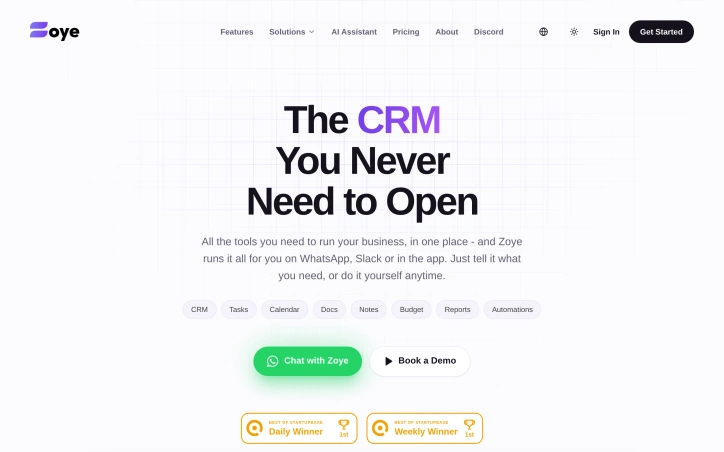
A fundamental frustration among founders and small business operators is the sprawl and complexity of managing multiple specialized software tools. Rather than forcing users to hop between platforms for CRM, task management, calendars, documents, and reporting, Zoye consolidates these functions into a unified interface accessible through conversational channels like WhatsApp and Slack, complemented by a traditional web application. The core innovation is architectural. Instead of requiring users to learn and navigate another complex dashboard, Zoye delegates operational workflows to an AI agent that executes tasks based on natural language instructions or predefined automations. A user can communicate with the system through existing communication channels rather than opening yet another browser tab. This directly addresses a pain point that resonates across the productivity software industry: tool fatigue and the cognitive overhead of context-switching between applications. The platform bundles traditional business functions—customer relationship management, task tracking, calendars, document storage, notes, budgeting, and reporting—alongside automation capabilities. This breadth positions it as a centralized operational hub rather than a single-purpose CRM. The company's blog content reveals vertical-specific marketing efforts, including targeted guides for real estate agents, fitness professionals, legal practitioners, and event organizers, indicating the product has been adapted to support workflows beyond generic sales and customer service. Zoye targets a specific niche: resource-constrained startups and small businesses where hiring dedicated operations staff remains impractical. For this audience, the value proposition is compelling. An AI-managed CRM eliminates the traditional setup and ongoing management burden that discourages many founders from implementing structured customer workflows at all. Notably, the positioning emphasizes what the product does not require: opening the application itself. This inverts the typical software experience where the application is the primary interface. Whether this approach proves sufficient for teams needing deeper analysis, complex custom workflows, or extensive collaboration remains an open question. The reliance on conversational interfaces depends heavily on the quality and consistency of the underlying AI, which directly determines whether the system reliably interprets and executes business-critical operations. The company provides a live preview and demo booking, though no pricing is disclosed publicly, suggesting a sales-driven motion typical of B2B SaaS targeting SMBs.

Ai-workflow-automation
Z
Zoye Team

A fundamental frustration among founders and small business operators is the sprawl and complexity of managing multiple specialized software tools. Rather than forcing users to hop between platforms for CRM, task management, calendars, documents, and reporting, Zoye consolidates these functions into a unified interface accessible through conversational channels like WhatsApp and Slack, complemented by a traditional web application. The core innovation is architectural. Instead of requiring users to learn and navigate another complex dashboard, Zoye delegates operational workflows to an AI agent that executes tasks based on natural language instructions or predefined automations. A user can communicate with the system through existing communication channels rather than opening yet another browser tab. This directly addresses a pain point that resonates across the productivity software industry: tool fatigue and the cognitive overhead of context-switching between applications. The platform bundles traditional business functions—customer relationship management, task tracking, calendars, document storage, notes, budgeting, and reporting—alongside automation capabilities. This breadth positions it as a centralized operational hub rather than a single-purpose CRM. The company's blog content reveals vertical-specific marketing efforts, including targeted guides for real estate agents, fitness professionals, legal practitioners, and event organizers, indicating the product has been adapted to support workflows beyond generic sales and customer service. Zoye targets a specific niche: resource-constrained startups and small businesses where hiring dedicated operations staff remains impractical. For this audience, the value proposition is compelling. An AI-managed CRM eliminates the traditional setup and ongoing management burden that discourages many founders from implementing structured customer workflows at all. Notably, the positioning emphasizes what the product does not require: opening the application itself. This inverts the typical software experience where the application is the primary interface. Whether this approach proves sufficient for teams needing deeper analysis, complex custom workflows, or extensive collaboration remains an open question. The reliance on conversational interfaces depends heavily on the quality and consistency of the underlying AI, which directly determines whether the system reliably interprets and executes business-critical operations. The company provides a live preview and demo booking, though no pricing is disclosed publicly, suggesting a sales-driven motion typical of B2B SaaS targeting SMBs.

Zoye preview

Key features

  • Unified CRM Platform: Consolidates customer relationship management, task tracking, calendars, documents, notes, budgeting, and reporting into one system.
  • Conversational AI Assistant: Executes tasks based on natural language instructions through WhatsApp, Slack, and web application channels.
See full listing
Fraudly

Securing online transactions before they happen addresses a real gap in consumer safety. Fraudly tackles the moment between seeing a link or storefront and deciding whether to trust it with money, credentials, or personal information. The product targets everyday internet users—shoppers, email checkers, QR code scanners, social media link-followers—who encounter suspicious websites constantly but lack reliable tools to evaluate legitimacy in seconds. The core differentiator centers on explainability. Rather than hiding behind opaque risk scores, Fraudly breaks down trust signals across specific dimensions like website safety, business reputation, and shopping intelligence. Users see the reasoning behind each assessment, enabling them to make informed judgments rather than blindly accepting automated warnings. This design philosophy extends beyond marketing; the company explicitly positions itself against unnecessary fear-mongering, acknowledging that not every website fits neatly into safe or unsafe categories. The product reaches users across multiple contexts. The web interface handles website checks with one free analysis daily, no signup required. A mobile app extends functionality to pasted links from messages and emails, QR code scanning in parking lots and cafes, and screenshot analysis—catching suspicious links embedded in images users receive. Browser extensions for Chrome and Microsoft Edge offer passive protection, warning users during normal browsing rather than forcing manual checks. Privacy forms another stated pillar. Unlike many security tools that build detailed browsing profiles, Fraudly commits to not tracking users or commercializing their activity data. This matters because trust products themselves become targets if they collect and monetize user behavior. The Trust Profile synthesizes analysis from multiple established security sources using AI, combining rather than inventing conclusions. The company positions this as stronger than manually researching across separate services. The website reveals little about accuracy rates, false positive performance, or how it handles emerging scams. A sample Trust Profile shows a four-star rating with an 84 confidence score, but public examples don't illuminate edge case handling. The free tier caps users at one daily check, which may frustrate power users or security professionals needing unlimited access. No premium pricing appears on the site. For consumers tired of making trust decisions blindly, the product delivers focused value that explains itself.


Security-software
R
Ronald Stel

Securing online transactions before they happen addresses a real gap in consumer safety. Fraudly tackles the moment between seeing a link or storefront and deciding whether to trust it with money, credentials, or personal information. The product targets everyday internet users—shoppers, email checkers, QR code scanners, social media link-followers—who encounter suspicious websites constantly but lack reliable tools to evaluate legitimacy in seconds. The core differentiator centers on explainability. Rather than hiding behind opaque risk scores, Fraudly breaks down trust signals across specific dimensions like website safety, business reputation, and shopping intelligence. Users see the reasoning behind each assessment, enabling them to make informed judgments rather than blindly accepting automated warnings. This design philosophy extends beyond marketing; the company explicitly positions itself against unnecessary fear-mongering, acknowledging that not every website fits neatly into safe or unsafe categories. The product reaches users across multiple contexts. The web interface handles website checks with one free analysis daily, no signup required. A mobile app extends functionality to pasted links from messages and emails, QR code scanning in parking lots and cafes, and screenshot analysis—catching suspicious links embedded in images users receive. Browser extensions for Chrome and Microsoft Edge offer passive protection, warning users during normal browsing rather than forcing manual checks. Privacy forms another stated pillar. Unlike many security tools that build detailed browsing profiles, Fraudly commits to not tracking users or commercializing their activity data. This matters because trust products themselves become targets if they collect and monetize user behavior. The Trust Profile synthesizes analysis from multiple established security sources using AI, combining rather than inventing conclusions. The company positions this as stronger than manually researching across separate services. The website reveals little about accuracy rates, false positive performance, or how it handles emerging scams. A sample Trust Profile shows a four-star rating with an 84 confidence score, but public examples don't illuminate edge case handling. The free tier caps users at one daily check, which may frustrate power users or security professionals needing unlimited access. No premium pricing appears on the site. For consumers tired of making trust decisions blindly, the product delivers focused value that explains itself.

Fraudly preview

Key features

  • Explainable Risk Assessment: Breaks down trust signals across website safety, business reputation, and shopping intelligence instead of hiding behind opaque risk scores.
  • Multi-Platform Coverage: Available as a web interface, mobile app with QR code scanning, and browser extensions for Chrome and Microsoft Edge.
See full listing
Team24

Marketing teams today operate in a state of constant tool sprawl. They switch between ChatGPT for strategy, Claude for copy, Midjourney for visuals, and a dozen analytics dashboards, each requiring separate logins and repeated context. Every transition means re-explaining the brief, starting over with new prompts, and losing the thread of prior conversations. This creates friction that makes it harder for marketing departments to move quickly, even with AI assistance. Team24 attacks this inefficiency by consolidating an entire marketing team into Slack, the communication hub most marketing organizations already inhabit. Rather than routing requests to different tools, users message a shared Slack channel and receive work from five specialized AI agents: a strategist who sets positioning and messaging, a copywriter who produces copy and email sequences, a designer who builds landing pages and ad creatives, an analyst who tracks performance, and a manager who orchestrates the workflow. Each agent has a distinct persona and expertise, and they collaborate with each other to produce integrated deliverables without additional user guidance. The key differentiator is not the individual agents but the internal collaboration between them. A copywriter doesn't write in isolation; the strategist's positioning informs the copy, which then informs the designer's creative direction, which feeds back to the analyst's recommendations. This interdependence mirrors how a real marketing team works, except all conversation and file sharing happens in a single thread with shared context preserved throughout. The product delivers finished work, not suggestions. Users submit a brief like "Launch our Q3 product to mid-market SaaS buyers," and Team24 returns completed landing pages, ad campaigns, positioning decks, and performance reports. This stands in contrast to most AI tools that generate drafts requiring further refinement and assembly. The emphasis on delivery over iteration changes the value proposition: instead of augmenting a marketer's output, Team24 positions itself as a replacement for routine marketing work. The product covers a comprehensive marketing workflow spanning strategy, copywriting, design, paid media, email marketing, and analytics. For bootstrapped startups and small-to-mid-market companies that lack dedicated marketing teams, this consolidation could reduce both tool costs and cognitive load. For larger departments, Team24's value hinges on how well the AI's output meets brand standards and performance expectations. No pricing details are disclosed in available materials, leaving the business model unclear. Whether Team24 charges per request, by subscription, or through other models will significantly affect adoption decisions for budget-constrained teams.
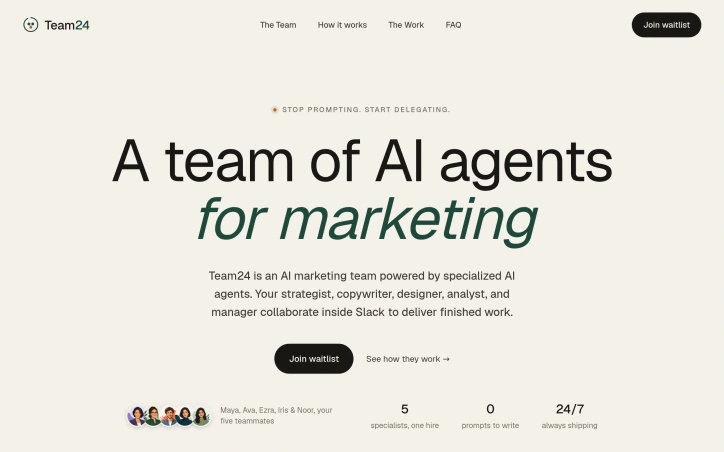

Marketing-automation-platforms
R
Rustam Aliyev

Marketing teams today operate in a state of constant tool sprawl. They switch between ChatGPT for strategy, Claude for copy, Midjourney for visuals, and a dozen analytics dashboards, each requiring separate logins and repeated context. Every transition means re-explaining the brief, starting over with new prompts, and losing the thread of prior conversations. This creates friction that makes it harder for marketing departments to move quickly, even with AI assistance. Team24 attacks this inefficiency by consolidating an entire marketing team into Slack, the communication hub most marketing organizations already inhabit. Rather than routing requests to different tools, users message a shared Slack channel and receive work from five specialized AI agents: a strategist who sets positioning and messaging, a copywriter who produces copy and email sequences, a designer who builds landing pages and ad creatives, an analyst who tracks performance, and a manager who orchestrates the workflow. Each agent has a distinct persona and expertise, and they collaborate with each other to produce integrated deliverables without additional user guidance. The key differentiator is not the individual agents but the internal collaboration between them. A copywriter doesn't write in isolation; the strategist's positioning informs the copy, which then informs the designer's creative direction, which feeds back to the analyst's recommendations. This interdependence mirrors how a real marketing team works, except all conversation and file sharing happens in a single thread with shared context preserved throughout. The product delivers finished work, not suggestions. Users submit a brief like "Launch our Q3 product to mid-market SaaS buyers," and Team24 returns completed landing pages, ad campaigns, positioning decks, and performance reports. This stands in contrast to most AI tools that generate drafts requiring further refinement and assembly. The emphasis on delivery over iteration changes the value proposition: instead of augmenting a marketer's output, Team24 positions itself as a replacement for routine marketing work. The product covers a comprehensive marketing workflow spanning strategy, copywriting, design, paid media, email marketing, and analytics. For bootstrapped startups and small-to-mid-market companies that lack dedicated marketing teams, this consolidation could reduce both tool costs and cognitive load. For larger departments, Team24's value hinges on how well the AI's output meets brand standards and performance expectations. No pricing details are disclosed in available materials, leaving the business model unclear. Whether Team24 charges per request, by subscription, or through other models will significantly affect adoption decisions for budget-constrained teams.

Team24 preview

Key features

  • Slack Integration: Consolidates marketing workflow within Slack, the communication hub most marketing teams already use.
  • Five Specialized Agents: Includes strategist, copywriter, designer, analyst, and manager, each with distinct persona and expertise.
See full listing
CostLoop

Managing software subscriptions is a daunting task for freelancers and small to medium-sized businesses, often resulting in lost renewal dates and unnecessary costs. CostLoop addresses this issue head-on by providing a straightforward dashboard to monitor recurring software costs. The product is designed specifically for freelancers, startups, and small to medium businesses, offering a simple solution to track SaaS subscriptions and manage spend. By consolidating renewal dates, monthly spend totals, invoice storage, and cancellation links in one place, CostLoop simplifies the process of keeping on top of software expenses. One standout feature is the Chrome extension, which scans the user's inbox to discover active subscriptions, eliminating the need to manually log every SaaS tool. This automation is a significant time-saver, allowing users to quickly gain a clear picture of their monthly and annual spend. Additionally, the platform provides automatic email reminders before subscriptions auto-renew, ensuring users never miss a renewal date. The product's key features include a centralized dashboard for tracking subscriptions, renewal reminders, and invoice storage. It also identifies potential savings opportunities, such as unused seats and duplicate subscriptions. Notably, the platform is free to start, with no credit card required, and setup is accomplished in just two minutes. Users can track over 100 SaaS tools, and the platform has already managed 8,200+ subscriptions, with an average savings of 18% after the first audit. While pricing details beyond the free plan are not explicitly mentioned, the absence of a required credit card upfront is a welcome feature for users hesitant to commit to new services. Overall, CostLoop presents a compelling solution for businesses seeking to streamline their software subscription management and reduce unnecessary expenses.


Accounting-software
M
Miloš Čech

Managing software subscriptions is a daunting task for freelancers and small to medium-sized businesses, often resulting in lost renewal dates and unnecessary costs. CostLoop addresses this issue head-on by providing a straightforward dashboard to monitor recurring software costs. The product is designed specifically for freelancers, startups, and small to medium businesses, offering a simple solution to track SaaS subscriptions and manage spend. By consolidating renewal dates, monthly spend totals, invoice storage, and cancellation links in one place, CostLoop simplifies the process of keeping on top of software expenses. One standout feature is the Chrome extension, which scans the user's inbox to discover active subscriptions, eliminating the need to manually log every SaaS tool. This automation is a significant time-saver, allowing users to quickly gain a clear picture of their monthly and annual spend. Additionally, the platform provides automatic email reminders before subscriptions auto-renew, ensuring users never miss a renewal date. The product's key features include a centralized dashboard for tracking subscriptions, renewal reminders, and invoice storage. It also identifies potential savings opportunities, such as unused seats and duplicate subscriptions. Notably, the platform is free to start, with no credit card required, and setup is accomplished in just two minutes. Users can track over 100 SaaS tools, and the platform has already managed 8,200+ subscriptions, with an average savings of 18% after the first audit. While pricing details beyond the free plan are not explicitly mentioned, the absence of a required credit card upfront is a welcome feature for users hesitant to commit to new services. Overall, CostLoop presents a compelling solution for businesses seeking to streamline their software subscription management and reduce unnecessary expenses.

CostLoop preview

Key features

  • Centralized Dashboard: track subscriptions in one place
  • Renewal Reminders: automatic email reminders before auto-renewal
See full listing
Summagraph

Transforming text into visually appealing infographics is a task that marketers, educators, creators, and students often struggle with, due to the need for design skills and software expertise. A new AI-powered solution addresses this challenge by enabling users to generate high-quality infographics from plain text in seconds. At its core, this product leverages artificial intelligence to read the content, understand its structure, and create a unique visual representation from scratch. This approach ensures that every output is tailored to the message being conveyed, rather than relying on recycled templates. The result is a polished and readable infographic, even when dealing with dense content. What stands out about this product is its ability to offer a high degree of customization, with 17 active visual styles and 20 layout systems that can be combined to produce 340 different combinations. The AI also provides Auto recommendations to simplify the process. Additionally, the product supports 9+ output languages, making it a versatile tool for a diverse user base. The process of creating an infographic is streamlined into three steps: pasting the text, choosing a style and layout, and publishing the visual. The product can handle various types of content, including articles, notes, and research summaries. For longer content, a Series Mode feature allows users to split it into 2-10 connected pages. Users can access the product with free starter credits, and for higher-volume usage, one-time credit packs are available in Lite and Pro options. Overall, this AI-powered infographic generator offers a powerful solution for users seeking to create professional-looking visuals without requiring extensive design experience.


Graphic-design-tools
Y
yinghao zhu

Transforming text into visually appealing infographics is a task that marketers, educators, creators, and students often struggle with, due to the need for design skills and software expertise. A new AI-powered solution addresses this challenge by enabling users to generate high-quality infographics from plain text in seconds. At its core, this product leverages artificial intelligence to read the content, understand its structure, and create a unique visual representation from scratch. This approach ensures that every output is tailored to the message being conveyed, rather than relying on recycled templates. The result is a polished and readable infographic, even when dealing with dense content. What stands out about this product is its ability to offer a high degree of customization, with 17 active visual styles and 20 layout systems that can be combined to produce 340 different combinations. The AI also provides Auto recommendations to simplify the process. Additionally, the product supports 9+ output languages, making it a versatile tool for a diverse user base. The process of creating an infographic is streamlined into three steps: pasting the text, choosing a style and layout, and publishing the visual. The product can handle various types of content, including articles, notes, and research summaries. For longer content, a Series Mode feature allows users to split it into 2-10 connected pages. Users can access the product with free starter credits, and for higher-volume usage, one-time credit packs are available in Lite and Pro options. Overall, this AI-powered infographic generator offers a powerful solution for users seeking to create professional-looking visuals without requiring extensive design experience.

Summagraph preview

Key features

  • Customization Options: 340 different combinations of visual styles and layouts
  • Auto Recommendations: Simplifies the infographic creation process
See full listing
SkillZilla🦖

Addressing a genuine gap in first-time job seeker support, this free application helps youth identify their strengths and translate them into employability. Created by parents frustrated with their own children's readiness for work, the app targets the 15-plus crowd who feel lost navigating the job market without guidance on what they're actually good at. The core offering centers on a Skill Profile generated in about 60 seconds. Rather than forcing users through lengthy personality quizzes, the app identifies personal archetypes—like "The Spark," characterized by quick thinking and initiative—and frames these natural tendencies as marketable strengths. This reframing is the product's clever insight: young people don't need fixing; they need to see themselves clearly and understand where their instincts take them. Beyond self-discovery, the application builds practical job-readiness skills through short daily exercises. The focus lands on concrete capabilities employers actually care about: crafting interview answers that sound natural, writing effective emails, and articulating personal strengths without cringing. This moves beyond generic career advice into specific skill-building. The product pipeline flows logically from profile to application. An auto-generated resume pulls from the Skill Profile in plain language, avoiding the buzzword-laden templates that frustrate both hiring algorithms and hiring managers alike. Job recommendations appear curated to user strengths rather than presented as an overwhelming feed. An integrated application tracker consolidates every submission in one place, replacing spreadsheets and lost threads. Design-wise, the app explicitly targets a neurodivergent and anxious audience. The emphasis on calm interfaces, step-by-step clarity, and minimal busywork stands out in a job-search market typically designed for users comfortable with complexity and self-direction. There's no infinite scroll, no gamification fatigue, just progression: discover, train, build, apply. The business model removes friction entirely: the app is free, requires no credit card, and asks nothing upfront. For teens and young adults with minimal financial resources, this eliminates a common barrier to trying new tools. User testimonials hint at meaningful outcomes. One user credits the app with finding direction and pursuing an international opportunity. While sample sizes matter for drawing conclusions, these narratives suggest the product delivers results beyond engagement metrics. For first-time job seekers overwhelmed by traditional career platforms, the application offers a genuinely different approach grounded in practical psychology and realistic skill development.

Hiring-software
H
Holly O'Brien

Addressing a genuine gap in first-time job seeker support, this free application helps youth identify their strengths and translate them into employability. Created by parents frustrated with their own children's readiness for work, the app targets the 15-plus crowd who feel lost navigating the job market without guidance on what they're actually good at. The core offering centers on a Skill Profile generated in about 60 seconds. Rather than forcing users through lengthy personality quizzes, the app identifies personal archetypes—like "The Spark," characterized by quick thinking and initiative—and frames these natural tendencies as marketable strengths. This reframing is the product's clever insight: young people don't need fixing; they need to see themselves clearly and understand where their instincts take them. Beyond self-discovery, the application builds practical job-readiness skills through short daily exercises. The focus lands on concrete capabilities employers actually care about: crafting interview answers that sound natural, writing effective emails, and articulating personal strengths without cringing. This moves beyond generic career advice into specific skill-building. The product pipeline flows logically from profile to application. An auto-generated resume pulls from the Skill Profile in plain language, avoiding the buzzword-laden templates that frustrate both hiring algorithms and hiring managers alike. Job recommendations appear curated to user strengths rather than presented as an overwhelming feed. An integrated application tracker consolidates every submission in one place, replacing spreadsheets and lost threads. Design-wise, the app explicitly targets a neurodivergent and anxious audience. The emphasis on calm interfaces, step-by-step clarity, and minimal busywork stands out in a job-search market typically designed for users comfortable with complexity and self-direction. There's no infinite scroll, no gamification fatigue, just progression: discover, train, build, apply. The business model removes friction entirely: the app is free, requires no credit card, and asks nothing upfront. For teens and young adults with minimal financial resources, this eliminates a common barrier to trying new tools. User testimonials hint at meaningful outcomes. One user credits the app with finding direction and pursuing an international opportunity. While sample sizes matter for drawing conclusions, these narratives suggest the product delivers results beyond engagement metrics. For first-time job seekers overwhelmed by traditional career platforms, the application offers a genuinely different approach grounded in practical psychology and realistic skill development.

SkillZilla🦖 preview

Key features

  • Skill Profile: Generated in about 60 seconds by identifying personal archetypes and natural tendencies as marketable strengths.
  • Daily Skill Exercises: Short daily exercises build concrete job-readiness skills including interview answers, email writing, and articulating strengths.
See full listing