
My2Do
My2Do takes aim at a familiar frustration: task managers that demand a form for every entry and then bury the reminder b...

iCV.ge
iCV.ge targets a common frustration for job seekers: building a polished CV takes time, and many applicants never learn...
Categories
Recently Listed
1,261 launches
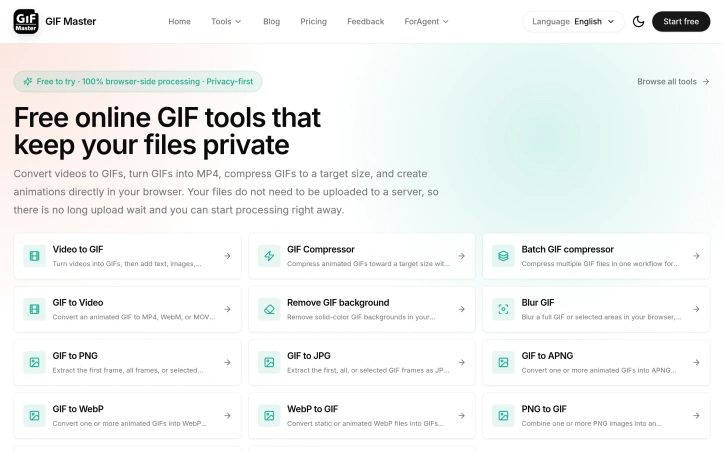
Frustrated creators and product teams dealing with animated GIFs have long faced a choice between waiting for cloud uploads or compromising their file privacy. This browser-based tool eliminates that tradeoff by processing all conversions and edits locally, without ever sending files to a server. GIF Master targets anyone who regularly works with animated images: product managers recording screen demos, developers creating tutorial animations, social media teams managing asset libraries, and marketers building countdown graphics. The core appeal is immediate processing and guaranteed privacy, since no files leave the user's device. What distinguishes this offering from existing GIF utilities is its commitment to client-side processing. Rather than the typical upload-and-wait model, users get instant results by doing all computation in their browser. This approach eliminates both the friction of server uploads and the concern that sensitive or proprietary GIFs might be retained on external servers. The feature set covers the full GIF lifecycle. Conversion tools handle video to GIF and reverse workflows, supporting formats like MP4, WebM, and MOV. For optimization, a dedicated compressor lets users set target file sizes before processing, reducing trial-and-error adjustment. The batch compressor addresses teams managing multiple GIFs for documentation or campaigns, tracking progress across files. Several editing capabilities add practical value. Background removal works best on simple, solid colors and flat compositions, with manual frame-by-frame cleanup available for difficult cases. A blur tool handles both full-image redaction and timed local areas, useful for hiding faces or sensitive text in specific frames. The batch workflow and screen recording feature feed directly into GIF creation, allowing capture-to-export in one session. The product presents itself as free to try, though detailed pricing or premium tier information isn't disclosed. The value proposition depends entirely on whether users prioritize privacy and speed over the convenience of server-based processing, which often includes more sophisticated AI-driven features. For teams with privacy requirements, embedded GIF workflows, or frequent conversions, the browser-side approach removes both technical friction and compliance concerns. The real question for potential users isn't whether GIF Master does what it claims, but whether processing speed and privacy protection outweigh the trade-offs of working locally rather than in the cloud.

Teams across industries organize their work in spreadsheets, yet spend hours each week manually rebuilding status pages, creating dashboards, and tracking progress through disconnected tools. Wisegrid solves this friction by building an application layer directly on top of existing spreadsheets, keeping the source data familiar while adding the capabilities teams actually need. The product is built for teams that have invested in spreadsheet workflows but found them incomplete. Rather than forcing migration to a new system, Wisegrid keeps sheets as the core interface where team members edit and enter data, then automatically surfaces that information through dashboards, reports, and views that stay synchronized in real time. When someone edits a row, the dashboard updates instantly without manual intervention. It's an elegant inversion of the typical SaaS model: the familiar tool is the system of record, and everything else is built on top. The feature set reflects this philosophy. Dashboards pull live data directly from spreadsheet cells and can be shared at varying permission levels. Forms with conditional logic funnel submissions into rows. Reporting tools aggregate data across multiple sheets. Automations handle notifications, row assignments, and approval workflows on configurable triggers. Permissions are granular enough to share a full project, individual sheets, or specific slices with SSO and MFA included. Two capabilities particularly stand out. Blueprints let teams save a project as a reusable template, complete with formulas, automations, and dashboards, stamping out copies in under a minute. This transforms Wisegrid from a single-project tool into a factory system for standardized workflows. The AI formula capability deserves attention: teams write formulas that classify notes, extract structured data, or summarize text directly in cells, with costs metered per usage rather than as a separate line item. The pricing model is straightforward. Editors pay $19 per person per month, with unlimited free view-only collaborators, making it accessible for large teams where only a subset needs edit access. The plan includes $5 monthly AI credit, creating a built-in allowance for AI-powered cell operations. Wisegrid fills a specific but common gap: teams who have built working processes in spreadsheets but outgrew what spreadsheets alone can provide. By strengthening rather than replacing that interface, it solves the weekly status-page rebuild without forcing organizational change.


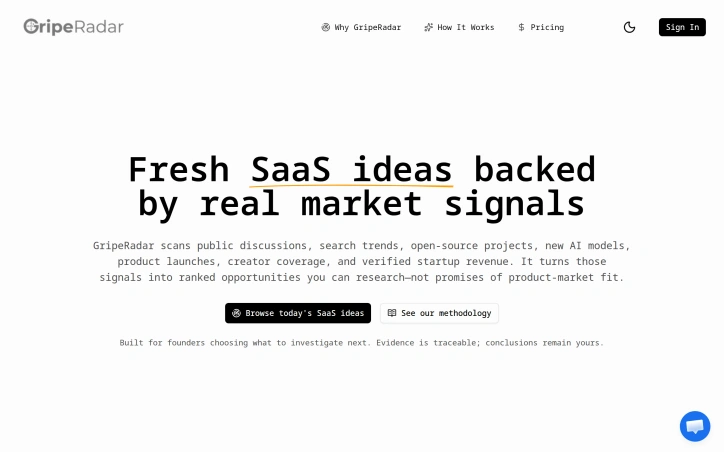
Opportunity research for founders typically follows one of two patterns: either they're overwhelmed by endless brainstorming, or they're drowning in polished lists that sound promising but reveal nothing about market validation. GripeRadar directly targets the decision paralysis that follows, offering founders a data-driven shortcut to the ideas most worth investigating. The product scans seven categories of market signals—public discussions, search trends, open-source projects, new AI models, product launches, creator coverage, and startup revenue data—then ranks opportunities by signal strength and corroboration. Rather than presenting a curated list of ideas backed by guesswork, GripeRadar surfaces ranked candidates with traceable sources and transparent confidence levels. What distinguishes GripeRadar from generic ideation tools is its commitment to separating signal from certainty. The interface offers both an Opportunity score and a Confidence rating, making clear that a high-ranked idea may still carry real uncertainty. This transparency reflects the founder's own frustration with SaaS idea lists that hide doubt behind opaque AI scoring. The company explicitly positions itself as a research starting point, not a predictor of product-market fit. The daily refresh cycle keeps the opportunity radar current, pulling from real-time market activity rather than stale snapshots. The bounded preview access lets prospective users quickly evaluate whether an opportunity is worth deeper investigation before committing to a subscription, a smart onboarding choice for a research product. The five visible examples showcase the breadth of signal detection—ranging from infrastructure gaps like deterministic testing tools, to emerging verticals such as AI for dental practice management, to security concerns around AI incident coordination. The specificity of these opportunities, tied to actual market signals rather than founder intuition, sets the product apart. One limitation: the website provides no detail on pricing or business model, making it unclear what access costs or subscription tiers exist. For a product built on the premise that quality research is worth time and attention, transparent pricing would strengthen the value proposition. For early-stage founders weighing what to build next, GripeRadar offers a structured alternative to unfounded brainstorming. It trades inspirational breadth for evidentiary depth—exactly the choice many founders need to make.

Indonesian language models have historically struggled with a fundamental structural challenge: the language's rich system of affixes and word modifications gets fractured by tokenization approaches designed for English. Veyra, a 75-million-parameter language model, addresses this problem through an alternative architecture that treats Indonesian on its own terms. The core innovation is the NMU framework—ninmeni meaning unit—which assigns a fixed ID to each character. Rather than breaking down inflected words into subword tokens, the model ingests complete words with all their affixes intact. This preserves the semantic structure that Indonesian speakers naturally recognize, training the model on authentic linguistic patterns instead of reconstructed approximations. The approach reflects a deliberate design philosophy: that language models should learn from a language's native roots, not translated or adapted paradigms. The model was built entirely from scratch using this framework, with the 75M parameter size chosen as a conscious validation point. Developers can verify model capabilities through systematic evaluation rather than selective demonstration. The focus remains deliberately narrow: Indonesian language performance shapes corpus selection, evaluation priorities, and development direction. Veyra shows unexpected capability beyond its primary scope. Despite no explicit English training, it generates grammatically sound English sentences—an artifact of how the NMU character-level encoding treats Latin characters universally across both languages. Developers treat this as an observable phenomenon rather than a marketed feature, documenting it while continuing to investigate the mechanism. The product positions itself as a tool for builders working specifically with Indonesian language applications. By rejecting the usual transfer-learning approach that adapts English-trained models for other languages, it offers a model trained in the way Indonesian actually works. This appeals to developers seeking more authentic language understanding for Indonesian, teams building primarily for Indonesian-speaking users, and researchers interested in non-English-centric language model design. The emphasis on documented evaluation and transparency about capabilities—including what remains unverified—indicates a research-first mindset that prioritizes credibility over marketing claims. No pricing information appears in available materials, suggesting this may be an open-source or research-stage project focused on validating the NMU framework before commercial deployment. That restraint itself signals maturity: the commitment to prove the approach works before scaling operations.


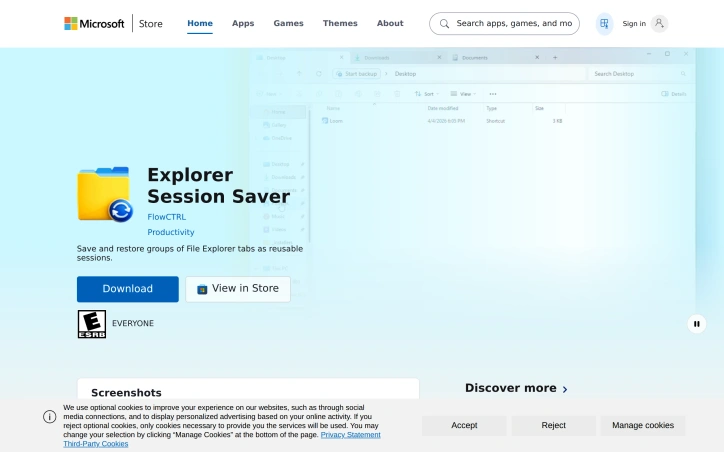
Windows users juggling multiple project folders and research sets know the friction of rebuilding the same File Explorer workspaces every time they start their day. Explorer Session Saver addresses this by capturing entire File Explorer configurations and restoring them on demand, eliminating the repetitive task of manually reopening tabs and navigating to the same directories. The tool works within Windows 11's native Explorer tabs, treating the entire window state as a snapshot. Users name and save their current workspace, then restore it later with a single action from any of three entry points: the ESS Manager interface, the system tray, or the command line. This multi-path access acknowledges that users work differently—some prefer GUI interfaces while others benefit from automation through scripting. What distinguishes Explorer Session Saver is its deliberate simplicity. Rather than attempting to be a comprehensive productivity suite, it solves one specific friction point in the daily workflow. The decision to operate as a local utility rather than a cloud-based service means workspace data stays on the user's machine and restoration happens instantly without network latency. For professionals working with sensitive files or restrictive internet conditions, this local-first architecture is a practical advantage. The free distribution model removes barriers to adoption, making it accessible to individual developers, researchers, and knowledge workers who manage complex folder hierarchies. The Windows 11 focus reflects platform-specific design rather than attempting cross-platform compatibility, suggesting the developer understood where the actual pain point lives. The application assumes users have established workspace patterns—it works best for those with consistent session layouts rather than those opening different folders each day. It targets the developer who returns to the same project folders, the researcher maintaining consistent research datasets, the analyst with a standard folder layout. For this audience, the ability to restore entire workspaces in seconds transforms a daily five-minute overhead into a one-click operation. The command-line access point opens possibilities for scripting and automation, though basic manual restoration through the GUI or system tray covers the primary use case. Explorer Session Saver delivers functional value without unnecessary complexity or monetization friction.
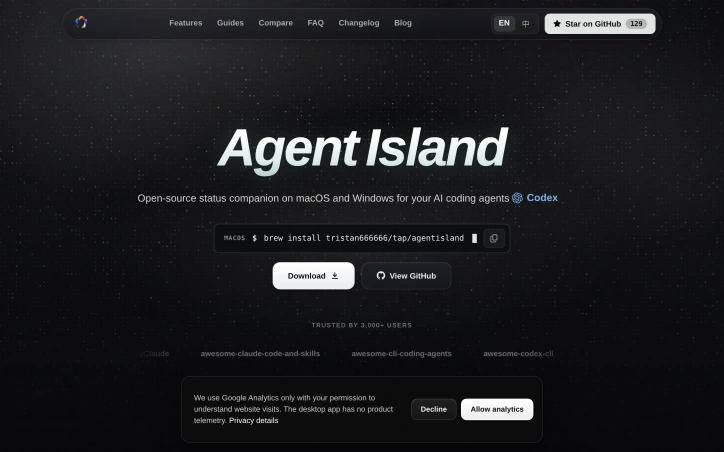
For developers managing multiple AI coding agents simultaneously, tracking active sessions and monitoring usage across Claude Code, Codex, Antigravity, Grok, and Cursor presents a constant friction. Agent Island addresses this directly—a local-first status companion that lives in your menu bar and keeps session state, quotas, and costs visible without requiring cloud infrastructure or user telemetry. What distinguishes Agent Island is its architectural stance: the application runs entirely on your machine, reads transcript files your tools already generate, and maintains zero dependency on external servers or Agent Island accounts. This design choice matters. It means your coding patterns stay private, API integrations leverage tokens you already control, and the tool's benefit doesn't hinge on a company's continued operation. The code is open source under the MIT license with every line public on GitHub. The feature set addresses genuine workflow pain points. Real-time session monitoring surfaces when an agent is working, waiting, or stalled—the distinction that determines whether you should check on progress. Usage tracking combines token counts with estimated API costs and displays weekly summaries breaking down model preferences and ranking your consumption against other users. The application integrates deeply with the operating system: on macOS it occupies the notch, on Windows it hooks into the taskbar, and both implementations alert you when your next turn arrives rather than requiring you to poll manually. Installation is straightforward—one Homebrew command on macOS or a single executable download on Windows. The macOS version ships with ad-hoc signing rather than a paid developer certificate, which triggers a one-time security prompt on first launch; subsequent updates are verified using EdDSA signatures before installation. The product has accumulated significant adoption across numerous community directories and "awesome" lists, with over three thousand reported active users. No pricing exists by design—this is open source software with no commercial licensing, subscriptions, or freemium upsells. Agent Island fills a specific but real niche: developers who work across multiple AI coding agents and need centralized visibility into session state and spending patterns. The commitment to local processing, transparent code, and zero telemetry will resonate with users who prioritize privacy. For those already managing these tools, the menu bar integration makes monitoring frictionless enough to justify installation.

Fragmented communication channels cost organizations money in missed context and lost efficiency. When customer conversations span voice calls, SMS, and WhatsApp but live in separate systems, critical information vanishes between handoffs. Teams waste hours reconstructing customer history, escalations happen without context, and revenue opportunities slip away. Voicetta addresses this by consolidating every customer interaction—voice, SMS, WhatsApp, and messaging—into a unified conversation brain accessible across teams and systems. Rather than asking employees to piece together context from multiple platforms, teams see a complete, searchable timeline of every exchange with a customer, automatically transcribed and graded for quality. The product targets organizations where customer interaction quality directly impacts revenue: hotels managing guest experiences across booking and arrival, healthcare providers juggling patient calls and routine inquiries, real estate teams fielding leads at all hours, and enterprises deploying AI agents or hybrid human-AI support. The unifying thread is scale—managing high volumes of interactions across channels without losing context or growing headcount proportionally. What distinguishes Voicetta is its treatment of conversations as learnable assets rather than ephemeral events. The platform maintains a centralized "brain" that learns from interactions, grades them against defined standards, and surfaces performance patterns. The product also emphasizes it's API-first and works with any AI provider, appealing to organizations wanting to integrate into existing infrastructure rather than wholesale replacement. Core capabilities include automatic recording and transcription, performance grading with reasoning, pipeline visibility, and the ability to define behavior standards that consistently evaluate interactions. Teams access customer context at a glance—what a guest mentioned in SMS, what they asked in a call, what they've done across all channels—without asking around. Early adopters report measurable outcomes. One customer scaled call volume without adding headcount and achieved a 42 percent increase in close rates on inbound leads. A healthcare organization reduced time spent on routine inquiries, freeing specialists for complex cases, while providing 24/7 automated response coverage. Voicetta operates on a freemium model and is already running in production across hospitality, healthcare, and real estate.


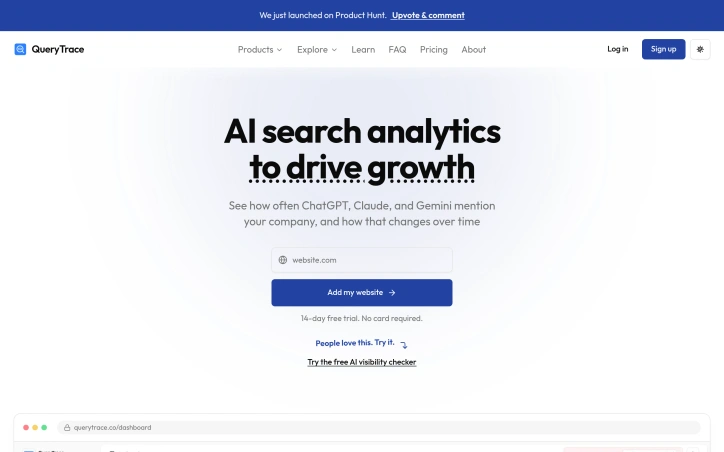
As AI models become primary discovery channels for consumers researching companies, brand visibility within these systems has become a measurable business concern. QueryTrace addresses this emerging need by providing the first platform designed to systematically track how AI mentions specific brands across multiple models. The product tackles a genuine gap in the market. While companies obsess over Google rankings, they have no insight into whether ChatGPT, Claude, Gemini, Perplexity, or other models mention their brand when users ask related questions. QueryTrace closes that gap by running queries against multiple AI models on a schedule, tracking mention rates, and surfacing trends over time. What distinguishes QueryTrace is its multi-model approach and competitive context. Rather than existing in isolation, users can benchmark their mention rate against specific competitors, seeing side-by-side comparisons and weekly trends that reveal whether recent business changes actually moved the needle. The platform adds sentiment and response quality analysis to raw mention counts, providing a more nuanced picture of how AI models frame references to the company. The feature set reflects practical needs. Users start by adding their domain and selecting the specific queries they want tracked—questions people actually ask in ChatGPT or Gemini about their industry. The platform then runs these queries on a schedule and displays results across crawling patterns, mentions in live chats, and referral traffic. For teams wanting deeper integration, QueryTrace connects to Cloudflare, AWS CloudFront, and Google Cloud CDN to track which AI models crawl pages and link to them. The company offers free tools to lower friction: an AI Visibility Checker, an AI Readiness Audit that verifies whether AI crawlers can read your site, and utilities for checking and generating llms.txt files. A 14-day free trial of the full platform requires no credit card. The business model targets companies concerned with AI discoverability but remains vague on pricing tiers or feature gates. The free trial period and no-credit-card requirement lower activation friction, though potential customers will need to contact sales for long-term cost details. QueryTrace fills a real void in brand monitoring tooling. As AI-driven discovery continues to grow, companies will increasingly need to measure and optimize their presence within these systems—making this a timely solution for marketing and product teams who view AI visibility as a material business factor.

Website optimization has traditionally demanded either expensive agency engagement or significant technical expertise. SEO Rank addresses this friction by delivering comprehensive site analysis through a free platform accessible to marketers, agencies, developers, and business owners of any skill level. The product bundles over twenty automated checks and seventeen tools into a single interface designed for speed. Rather than requiring hours of investigation, users receive instant insights into on-page optimization, content quality, technical SEO health, and mobile usability. The tool evaluates title tags, meta descriptions, heading structure, image alt text, Open Graph and Twitter Card setup, canonical tag usage, internal link quality, schema markup, security protocols, and accessibility compliance among other factors. What distinguishes this platform within the crowded SEO audit space is its integrated Google Search Console connection. This addition directly addresses a critical gap that frustrated early users: audit scores revealed problems, but offered no visibility into whether fixes actually improved performance. By surfacing real metrics like search impressions, clicks, and keyword rankings alongside audit results, the platform enables users to quantify the impact of their optimization efforts and compare performance across time periods. The feature roster also includes practical utilities beyond site auditing. A schema markup generator helps users create properly formatted structured data for articles, products, FAQs, and local business listings. A Google SERP preview tool shows how page titles and meta descriptions render in search results across desktop and mobile. Additional offerings include domain rating assessment, meta tag generation, and keyword density analysis. The roadmap indicates expansion is planned, with XML sitemap validators, robots.txt testing, backlink checking, and AI-powered content optimization flagged as coming features. This signals an ambition to evolve beyond diagnostic tools toward a more complete optimization suite. By eliminating cost barriers and condensing extensive analysis into seconds rather than days, SEO Rank targets a market segment genuinely underserved by premium SEO platforms. For small agencies and independent marketers managing multiple sites, or for business owners seeking baseline performance metrics without professional consultant fees, the product delivers clear utility. The Search Console integration particularly strengthens its position by connecting diagnostic data to real-world search performance, transforming audit scores from abstract recommendations into measurable outcomes.


Navigating India's sprawling e-commerce marketplace exhausts fashion shoppers overwhelmed by choice. Artik Mart addresses this friction through curation, offering a streamlined path to Indian fashion staples and contemporary wear. The platform targets women seeking traditional and contemporary Indian garments—lehengas, sarees, kurtis, and dresses alongside shapewear and swimwear. Its mission centers on filtering the noise endemic to Indian e-commerce through product curation and honest comparisons, building shopper confidence in selections made. Rather than holding inventory, Artik Mart operates as an aggregation layer, redirecting customers to partner brand sites where they complete purchases directly. This approach eliminates transaction friction while maintaining lean operations. What distinguishes the platform is editorial focus paired with speed. The claimed ten-minute shopping window reflects an interface built for rapid browsing, while curated selections establish Artik Mart as an intentional filter in a market drowning in inventory. Categories—traditional Indian wear, contemporary dresses, activewear—organize products crisply compared to generalist marketplaces that bury Indian fashion brands under sprawling catalogs. Editorial curation isn't just selection; it's selection with reasoning behind it. The product catalog serves a specific market: Indian women seeking occasion wear, everyday clothing, and intimate apparel. Categories encompass wedding lehengas and formal sarees to shapewear and high-waisted athletic leggings, covering both traditional and modern Indian fashion in one destination. The range reflects the founder's stated focus on wellness, beauty, and fashion, though the website emphasizes apparel heavily. The business model relies on partnerships and affiliate arrangements, indicated by "Co-Powered By" branding throughout the site. The platform charges users nothing—revenue flows through partner commissions or referral fees. The specific terms and commission structures remain proprietary. For Indian fashion shoppers drowning in e-commerce choice, Artik Mart delivers a focused alternative rooted in editorial judgment. It trades breadth for intentionality, betting that expert curation reduces decision fatigue and builds purchase confidence. Success depends entirely on whether the curated selections genuinely reflect audience taste and whether referred traffic converts at partner brands. The platform lives or dies by the accuracy of its selections and the relevance of its partnerships.

Managing emergency WordPress issues can derail site owners—unexpected outages, plugin conflicts, and security breaches demand immediate expert attention, yet finding reliable developers who won't overcharge or drag out repairs remains difficult. WordPress Bug Fix Service addresses this pain point directly, positioning itself as a fast-response alternative for both acute problems and broader customization work. The service maintains senior developers available around the clock with a stated average response time of five minutes. Their scope extends beyond emergency repairs to encompass theme customization, Figma-to-WordPress conversions, custom plugin development, WooCommerce store builds, malware cleanup, and performance optimization. This breadth indicates the team handles everything from quick surgical fixes to complete rebuilds, reducing the operational friction of juggling multiple vendors for different WordPress tasks. The payment structure sets itself apart from subscription-based support models. Clients pay 25 percent upfront to initiate work, then the remaining 75 percent only after the fix ships and performs as expected. This arrangement distributes financial risk and eliminates hidden fees—a departure from traditional WordPress agencies that charge retainers or require long-term commitments. The service credits 1,200 resolved bugs and maintains a 100 percent satisfaction guarantee, though these claims lack independent verification in the available materials. The workflow emphasizes transparency: initial assessment includes reproducing the issue and providing a flat-rate quote before any major work begins. Developers work on staging environments first, minimizing production risk. The diagnostic approach shown in their marketing materials depicts systematic problem-solving rather than a black-box operation. Practical considerations merit attention. The service requires clients to provide temporary access to wp-admin and hosting credentials, introducing security decisions that conscientious site owners must evaluate. Additionally, five-minute average response times assume developers are genuinely staffed to handle demand spikes; such averages mask variation across queue depths and time zones. The product targets site owners facing unexpected downtime who value speed and predictable costs over traditional agency relationships. For WordPress professionals or shops managing multiple sites, the per-fix pricing model costs significantly more over time than annual retainers. For isolated problems requiring expert diagnosis, however, the approach delivers clear value.


Diagnosing and repairing guitar problems systematically has long been the domain of experienced technicians working from intuition and acquired knowledge. Guitar Setup Lab transforms setup and repair work by replacing guesswork with measurement-based diagnostics, structured workflows, and documented records that reduce the risk of permanent damage to instruments. The platform organizes work around logical dependencies: stable strings and tuning come before adjusting neck relief; relief settings precede bridge action; pickup clearance follows the determined string path. This sequenced approach prevents the common mistake of adjusting multiple variables simultaneously, which obscures cause and effect. Seven interconnected diagnostic benches guide users through measurement, adjustment planning, and documentation according to this dependency chain rather than attempting every possible fix at once. The tool excels in breadth. Beyond basic playability diagnostics like fret buzz and action height, it handles specialized measurements for pickup compatibility, control hardware fit, electronics troubleshooting, and geometry planning for instrument builders. Built-in guides interpret measurements in context—converting between units, explaining what values mean for playability, and suggesting appropriate next steps. For professionals, the software generates shop-ready intake forms, quotes, job records, and condition documentation that create accountability and improve client communication. A standout feature is the geometry bench for instrument building, which calculates fret coordinates, spacing, multiscale layouts, and tremolo balance from measured physical datums. This bridges the gap between design intent and fabrication, eliminating the import errors and label misreadings that plague aftermarket component sourcing. Users can project string spread to verify pickup compatibility before ordering parts, or check control cavity geometry against manufacturer specifications. The product targets both independent guitarists managing their own instruments and professional luthiers running repair shops. Guitarists gain confidence in basic setup decisions; luthiers gain structured workflows that reduce liability and improve shop efficiency through systematic documentation. One notable aspect is the emphasis on reversibility—setup is framed as a series of measured checks and isolated adjustments rather than permanent modifications. This philosophy permeates the tool's design, from the diagnostic flow to the printed records that serve as before-and-after evidence of work completed. The offering sits at the intersection of professional tooling and accessibility, assuming users lack formal training but care about precision and process. It provides the measurement guidance, conversion logic, and decision frameworks that separate confident adjustment from guesswork.


Storage planning typically requires navigating a fragmented ecosystem of product catalogs, vendor websites, and single-purpose calculators, each addressing only one dimension of the problem. Data Storage Lab consolidates this scattered process into a cohesive planning tool designed for households and small organizations that need to handle backup and recovery without vendor lock-in. The tool addresses a genuine friction point in how people approach storage decisions. Most users start with capacity questions but lack a structured way to think about protection, backup, and recovery together. Data Storage Lab guides planners through describing their data, setting recovery priorities, and reviewing a complete configuration that connects these decisions. This systematic approach distinguishes it from tools that isolate one question at a time. A core insight embedded in the tool's design is clarity about what RAID actually protects against. The product explicitly rejects the common misconception that RAID redundancy serves as backup. Instead, it frames array protection as a hedge against downtime from drive failure while emphasizing that independent backup copies protect against deletion, ransomware, theft, and site-wide failure. This distinction forces more rigorous thinking about recovery architecture. The planning paths accommodate different scenarios: families managing photos and video, media creators with growing storage needs, freelancers protecting work files, home lab builders, and small offices with multiple users. For each scenario, the tool produces guidance on usable capacity, bay and drive ranges, protection strategies, backup allocation, network specifications, and equipment categories. The vendor-neutral stance removes pressure to choose specific brands during planning, letting users focus on functional requirements first. The output is a configuration brief and equipment checklist, enabling users to shop for hardware independently after understanding what they actually need. The tool does not attempt to replace hardware decisions with formulas. Instead, it bridges the gap between abstract storage requirements and concrete equipment selection, providing enough specificity to guide purchasing without prescribing products. This positions it as infrastructure planning for people who would otherwise assemble their knowledge from scattered sources or make reactive decisions at purchase time.


Getting domain rating data has traditionally required either expensive SEO tools or signing up for accounts you might not want. RacoonDR addresses this friction by offering free, instant DR checks without requiring any registration, plus daily tracking once you create an account. The service targets website owners and SEO professionals who want to monitor how their domain rating evolves over time without paying subscription fees or dealing with signup barriers. The product's core appeal lies in its simplicity and the incentive structure built around it. Rather than charging upfront, RacoonDR offers its tracking service free and generates value by placing lightweight SVG badges on participating sites. When a user displays the badge on their website, RacoonDR automatically verifies its placement and converts the link to the site into a dofollow backlink. This creates a mutually beneficial exchange where site owners gain free tracking and a small badge, while RacoonDR builds a network of dofollow links. For users unwilling to display the badge, a Pro tier priced at $5.99 per month provides 15 dofollow links without any badge requirement. The feature set supports the core use case effectively. Users can look up any domain's rating instantly and view historical charts tracking how that rating changes. Each checked domain gets its own public page, and the service displays global rank and domain age alongside the rating. A leaderboard highlights top gainers each month, adding a competitive element. The badge itself is impressively lightweight at under 3 kilobytes, reducing performance impact for sites that choose to display it. By making DR lookup and tracking free and frictionless, RacoonDR democratizes access to domain rating intelligence that competitors often gate behind paywalls. The badge-for-backlink model is clever, turning users into advocates who actively market the tool by hosting its badge. This approach bootstraps both user growth and SEO value simultaneously. For websites with modest domains seeking free tracking or those willing to trade a small badge display for a dofollow link, RacoonDR presents a genuine alternative to paid SEO tools.


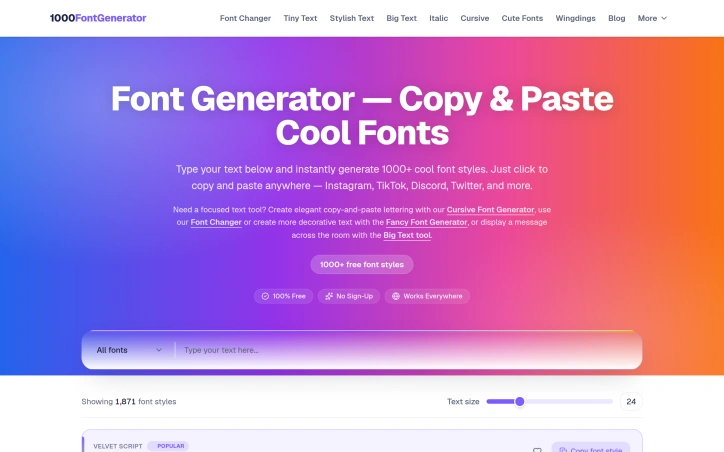
Stylish text formatting on social media typically requires either design skills or third-party tools that demand sign-ups. Font Generator strips away both barriers by offering a free, no-registration font transformation service with an unusually large collection of styling options. The core value proposition targets social media users across Instagram, TikTok, Discord, and Twitter who want to differentiate their usernames, bios, and captions with distinctive typography. The product eliminates the friction of learning design software by letting users type text, browse from over 1,800 available styles, and copy the formatted result directly to their clipboard. The breadth of the font library stands out as the primary differentiator. Rather than offering a small curated set, Font Generator organizes 1,871 styles into purpose-built categories: cursive and script fonts for elegant applications, bold and heavy typefaces for impact, gothic and blackletter fonts for dramatic effect, bubble and cute fonts for playful contexts, glitch and Zalgo text for distorted aesthetics, vaporwave styles for retro-inspired bios, small caps for compact text, and decorative symbols for additional customization. This categorical organization allows users to browse by intent rather than sorting through an overwhelming flat list. The interface prioritizes speed. Popular fonts receive prominent placement, copy buttons sit directly next to previews, and users preview results with their own text before committing to a selection. The product handles decision fatigue by surfacing trending styles upfront while exposing the full collection for deeper exploration. Font Generator operates as a completely free service with no explicit monetization model disclosed. No pricing tiers, subscriptions, or premium features appear on the site, suggesting revenue may derive from advertising, affiliate arrangements, or other indirect channels. A technical constraint worth noting is that Font Generator relies on Unicode character substitution rather than embedding actual font files. This approach enables copy-paste functionality across platforms without compatibility issues but limits visual possibilities to what Unicode supports. The trade-off is intentional and sensible for the use case. For social media users seeking quick visual differentiation without design expertise or registration requirements, Font Generator delivers direct utility through a low-barrier, comprehensive option library.

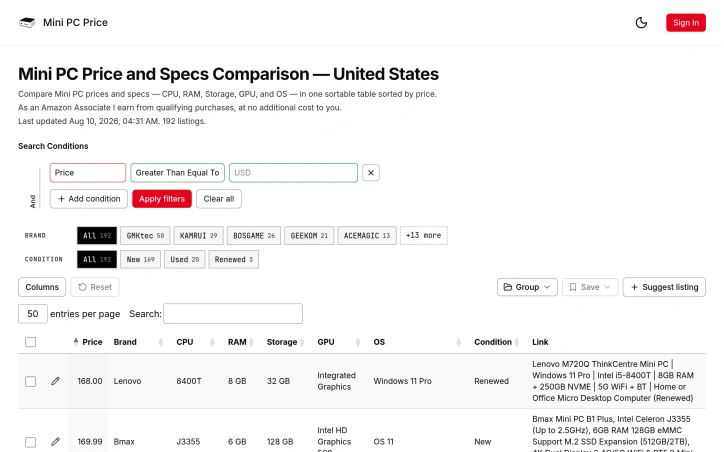
Buying a mini computer typically demands opening dozens of retailer tabs, copying specifications into spreadsheets, and cross-referencing prices across multiple platforms. Mini PC Price eliminates this friction by consolidating every available listing into a single searchable, filterable database where buyers compare specifications and prices without context switching. The tool serves multiple buyer personas with distinct research patterns. Office managers seeking budget systems with specific RAM and storage configurations can layer filters by price and memory specifications. Gamers hunting high-performance compact systems prioritize GPU capabilities and CPU boost clocks. Those interested in upgrading components can compare RAM maximums and storage interfaces. Rather than forcing a universal view, the tool lets each cohort toggle only the columns that matter for their decision. Several design choices distinguish Mini PC Price from conventional price comparison sites. It functions as a comprehensive parameter database rather than a curated top-ten list, capturing the full catalog across brands including Beelink, Minisforum, Intel NUC, ASUS, Lenovo, and HP. Listings source from real marketplace data with daily price refreshes. Specifications undergo manual verification where it matters—RAM type, GPU classification, OS bundling, and upgrade paths—rather than relying on auto-scraped data prone to inconsistency. The feature set prioritizes rapid discovery and precision. Search operates on type-ahead, accepting brand names, chip identifiers like 7840HS or N100, port counts, or product title fragments. Structured filters stack together, enabling queries like "mini computer under $600 with discrete GPU" without requiring review aggregator browsing. Sorting defaults to price but pivots to RAM, storage capacity, or processor speed on demand. Condition filtering toggles between new, used, renewed, and refurbished inventory without disrupting the filtered view. A sharing mechanism enables users to save groups and distribute links, particularly useful for forum recommendations or team purchasing scenarios. The emphasis on customization—column selection, filter stacking, search precision—reflects a product built around actual buyer workflows rather than editorial taste-making. The free model removes acquisition barriers for individual shoppers and procurement professionals alike. Without explicit monetization details in available materials, the zero-cost entry positions Mini PC Price as a utility resource for anyone shopping mini computers.

Mobile phishing campaigns have moved beyond simple email tricks. They arrive as text messages that impersonate banks, QR codes that redirect to credential-harvesting pages, notifications from seemingly trusted apps, and links embedded in screenshots shared across messaging platforms. EdgePhishGuard tackles this expanding threat surface by placing a security checkpoint directly on the user's Android device, where the decision happens fastest. The product addresses a genuine gap in mobile security. Most anti-phishing solutions operate on the server side, requiring users to upload suspicious content to cloud services before they get a verdict. EdgePhishGuard inverts this model. Its core analysis runs locally using TensorFlow Lite models that identify linguistic and structural phishing patterns without leaving the device. The approach protects privacy while reducing latency and eliminating friction. What distinguishes this tool is its breadth of input modes. Users can paste suspicious links or text directly, scan QR codes through the camera, extract URLs from screenshots via OCR, or share content from notification bars and messaging apps. This multi-modal design acknowledges how phishing actually reaches people in practice: rarely as a bare URL, often embedded in context that requires extraction or interpretation. The OCR and QR reading capabilities transform the app from a link validator into a content analyzer that handles the obfuscation tactics modern attackers use. The product doesn't attempt to make decisions for users. Instead, it surfaces the reasoning behind its risk assessment, showing detected language, identified patterns, domain reputation signals, and specific recommendations. Users can adjust the alert threshold themselves, creating a control mechanism rather than an on-off switch. This approach aligns with security best practices that favor informed decision-making over black-box automation. Support for multiple languages, with language detection routing content to the appropriate local model, suggests consideration for non-English-speaking populations who may face phishing tailored to their linguistic and cultural context. This practical detail distinguishes EdgePhishGuard from larger security platforms that often overlook regional variations in attack patterns. The absence of pricing information on the landing page leaves questions about the business model unanswered. Whether this will be free, subscription-based, or ad-supported matters to potential users considering adoption. Regardless, the local-processing architecture and transparent risk scoring represent a meaningful departure from the surveillance-heavy approach many mobile security tools take. For users skeptical of uploading sensitive information to cloud services, EdgePhishGuard offers a credible alternative.


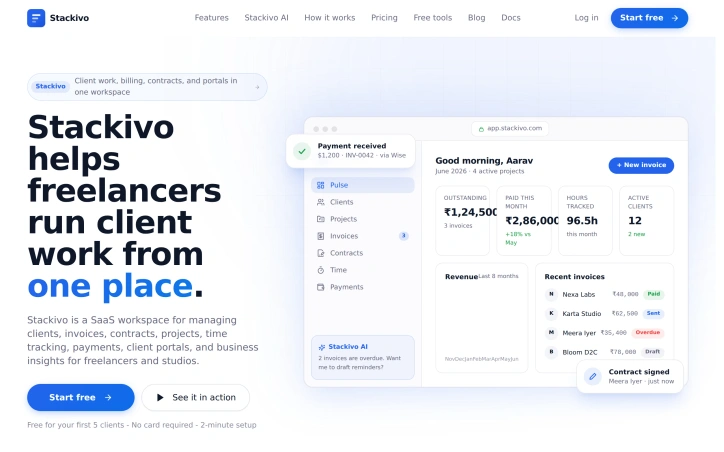
Freelancers and studios operating in India face a common problem: their business processes are spread across a half-dozen disconnected applications. Invoices live in spreadsheets, client communication happens on WhatsApp, contracts sit in Word documents, time tracking happens in notes apps, and payment information stays trapped in banking portals. Each handoff between tools creates friction: invoices don't get sent, follow-ups slip through the cracks, and billable hours disappear without becoming revenue. Stackivo consolidates this fragmented workflow into a single workspace designed specifically for independent professionals—designers, developers, consultants, writers, video editors, architects, and small studios. The platform brings together client management, invoicing, contracts, time tracking, and payments in one place where everything is connected. What distinguishes Stackivo is its deep understanding of the Indian freelancer's specific needs. Rather than forcing a generic global workflow, the product handles GST compliance as a core feature. Freelancers can toggle between simple invoices and GST mode, and Stackivo automatically calculates the correct CGST/SGST/IGST split based on the client's location. This removes a source of constant friction for registered businesses. The workflow integration sets Stackivo apart from generic project tools. A signed contract kicks off a project, hours tracked within the platform automatically become line items on invoices, and payments land back on the dashboard where they're automatically reconciled. Invoices can be created in under a minute, shared via link, email, or WhatsApp, and Stackivo handles payment reminders automatically when invoices become overdue. The core feature set covers the essentials: contracts can be e-signed in the browser, each client gets a branded portal, time tracking integrates with billing, and the platform accepts UPI and card payments. The interface hints at AI-powered assistance, such as drafting payment reminder templates. Stackivo launches with a freemium model where the first five clients are free with no credit card required and roughly two minutes to set up. This structure lets freelancers test the core workflow before committing financially. The specificity of the product—built for independent professionals across India rather than attempting global coverage—signals a focused approach to product-market fit rather than premature scaling.

ChainHint traces stolen crypto across 12 chains and shows where the funds went, which exchanges or services they reached, and who to contact next. What it does: - Multi-hop fund tracing, stopping at exchanges, bridges and mixers - Address screening against sanctions lists (US OFAC, EU, France, UK) - Risk score with an explanation of what it is based on - Freeze-request packet with the exchange's compliance channel where one is published - Monitoring of watched addresses every 6 hours - Telegram bot and API The database holds 47M+ attributed addresses. Free checks are available; paid plans start with a $19 single-case plan. Run by one independent operator.

Finding the right discount code for hosting, VPN, or AI tools often means jumping between dozens of vendor websites and hoping the codes actually work. Coupons1 aggregates verified promo codes across these categories, centralizing what would otherwise be a frustrating scavenger hunt into a single searchable directory. The service targets two audiences: cost-conscious developers and businesses looking to reduce infrastructure and software spending, as well as vendors seeking to distribute promotional offers to relevant buyers. The core value proposition centers on verification—each code is tested and confirmed active before listing, directly addressing the common frustration of expired or non-functional coupon codes littering the internet. The platform catalogs over 500 active deals spanning more than 50 providers, ranging from established services like Hostinger and DigitalOcean to specialized offerings like Proxy-Seller and various VPN providers. The breadth is notable: discounts cover hosting infrastructure, privacy tools, data services, and generative AI products, making the service useful across multiple buyer personas. Featured weekly deals highlight specific savings opportunities, with discounts reaching up to 90 percent on certain services. The site displays individual vendor ratings—Hetzner at 4.9 stars, ExpressVPN at 4.8, Hostinger at 4.8—providing quality signals that extend beyond coupon availability alone. A subtle design choice reinforces credibility: codes include usage counts showing how many times each has been redeemed, which serves as implicit social proof that the code works. This transforms the platform from a simple listing into a minimal feedback mechanism. The pricing model remains implicit from the available content. No subscription fees or freemium tiers are mentioned, suggesting a free-to-use model likely supported by affiliate commissions when users click through to vendors. This aligns naturally with incentives: the platform benefits when users successfully complete purchases through its links. The execution is straightforward and functional, avoiding unnecessary complexity. Codes are presented with savings amounts and vendor information without excessive marketing language. For developers and teams managing multiple software subscriptions, Coupons1 offers genuine convenience—consolidated savings without the overhead of independently tracking down working discounts. The platform succeeds by removing friction from a specific but real pain point in software purchasing. Whether verification consistency holds at scale or how the service differentiates as competitors enter the space remains to be seen, but the foundation addresses a legitimate problem.