
iCV.ge
iCV.ge targets a common frustration for job seekers: building a polished CV takes time, and many applicants never learn...

My2Do
My2Do takes aim at a familiar frustration: task managers that demand a form for every entry and then bury the reminder b...
Categories
Recently Listed
1,261 launches
Reverse image-to-prompt conversion is becoming a critical workflow for AI artists, and GetImageToPrompt addresses this directly. The tool analyzes uploaded images and generates detailed text prompts optimized for popular generative AI models like Midjourney, Flux, DALL-E 3, and Stable Diffusion. For creators working across multiple AI platforms, this eliminates the friction of manually describing visual references or reverse-engineering prompts from images. The product targets four distinct user segments. AI artists and character designers use it to create reusable, consistent prompts across different models. Visual designers convert reference images into structured prompts for creative workflows. Marketing teams extract visual descriptions for campaigns and social media. Developers and researchers leverage the tool's JSON output for programmatic access and analysis. What sets GetImageToPrompt apart is its privacy-first positioning. Images are processed in real-time but never stored on servers, addressing the primary concern creators have when uploading visual assets to online tools. The free, unlimited access model removes friction entirely—no credits system, no sign-up requirement, no usage caps. This approach prioritizes accessibility over monetization. The feature set reflects practical needs in prompt engineering. Beyond basic image analysis, the tool extracts subject details, compositional elements, lighting effects, and artistic style tags. An OCR feature flags text elements within images, useful for designs containing typography. The prompt override functionality lets users modify outputs with natural language instructions like "make the dress yellow" or "add cinematic lighting," enabling quick iterations without re-uploading. Output flexibility matters for different workflows. The JSON prompt mode delivers structured data suitable for developers and advanced workflows, while standard text output serves artists working directly with image generators. The product also showcases gallery examples across anime, cinematic, and photorealistic styles, demonstrating consistency across output types. The website mentions optimization for specific model versions like Midjourney v6.1 and Flux 1.1 Pro, suggesting the tool maintains awareness of evolving model strengths and syntax preferences. This targeted optimization reduces the trial-and-error cycle many creators face when adapting prompts between platforms. The core value proposition is straightforward: accelerate the creative reference-to-prompt conversion process while protecting user privacy. For a market where AI-generated content creation is becoming commonplace, a free tool that removes both technical and trust barriers fills a genuine gap.


Clinical placement matching represents one of healthcare education's persistent friction points, and Preceptor.Network proposes a direct solution to an unnecessarily manual problem. The platform targets students pursuing advanced nursing and physician assistant credentials—FNP, PMHNP, PA, DNP, and similar programs—who traditionally navigate preceptor recruitment through spreadsheets, department lists, and personal networking. Faculty coordinators simultaneously shoulder the burden of troubleshooting mismatched placements that fail to meet program requirements. The company's core insight is straightforward: institutional requirements can be codified into matching logic. Rather than treating preceptor directories as glorified listings, Preceptor.Network integrates directly with each school's clinical rules—specialty requirements, minimum hours, accepted credentials—and weights candidate preceptors against those parameters. The matching engine also factors in geographic availability and student location, producing ranked results sorted by fit score rather than undifferentiated lists. The onboarding flow underscores this automation philosophy. A student provides their school email address; the system recognizes the domain and retrieves their program enrollment automatically. This eliminates form filling and roster uploads. After selecting their course rotation, they receive preceptor recommendations ordered by relevance to their specific requirements. The three-step design feels deliberately friction-minimized, a direct counterpoint to the opaque, coordinator-dependent processes it displaces. For schools, the value proposition centers on reducing placement fulfillment burden at scale. Once program requirements are configured, the system handles cohorts ranging from twenty to thousands of students without adding administrative overhead. The platform claims to improve through repeated use—each completed match trains recommendations for future cycles. Pricing for students is direct: ten dollars per confirmed match with no subscription component. The school and preceptor business models remain less explicit, though the architecture suggests a two-sided marketplace where schools configure requirements and preceptors receive filtered requests ordered by relevance. What's notably absent is data on matching accuracy, program coverage breadth, or current adoption rates. For a product solving a coordination problem in a relatively niche market, these specifics would strengthen confidence in its claims. The email-domain auto-detection is genuinely useful, but the true value depends entirely on whether the matching algorithm actually reduces friction or simply reorders the guesswork it promises to eliminate. That gap between concept and execution remains the critical unknown.


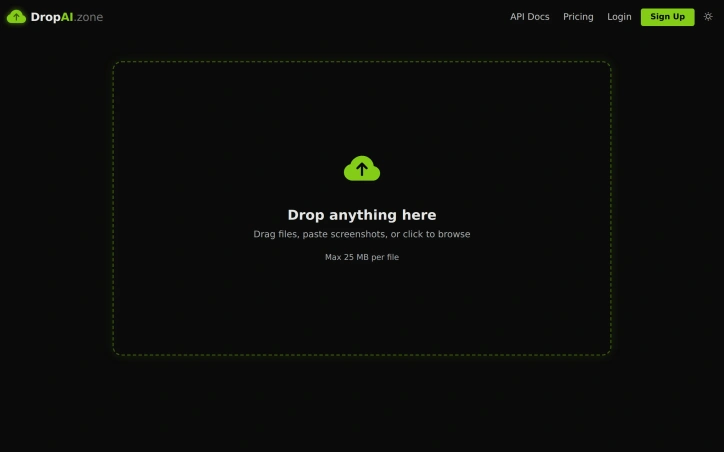
Ephemeral file sharing strips friction from digital workflows. DropAI.zone addresses a specific pain point: getting a file to someone else's inbox in seconds, without signing up or navigating clunky interfaces. The service emphasizes simplicity. Users drag files, paste screenshots, or call an API, and immediately receive a shareable URL. Files auto-delete by default after 12 to 72 hours, addressing digital clutter anxiety. This ephemerality differentiates it from conventional file hosting, which defaults to permanence. What stands out is its dual architecture. The graphical interface prioritizes speed—no login, no forms, just drag-and-drop. Simultaneously, a REST API and MCP integration allow Claude, GPT, and other AI agents to programmatically upload and retrieve files. This targets a useful edge case: AI workflows generating logs and screenshots needing rapid, temporary storage without persistent infrastructure. The feature set scales with commitment. Guest users get 25 MB per file and 50 daily drops. Free accounts extend to 50 MB files and 200 drops daily, with a dashboard and one MCP API key. The Pro tier ($9 monthly) adds permanent storage options, encrypted drops, password protection, and analytics. The pricing strategy is transparent: the service works as genuinely free for casual users, then monetizes developers and power users willing to pay for higher quotas, storage, and API keys. No deceptive restrictions; the tiers honestly reflect different use cases. Beyond auto-deletion and URL sharing, DropAI.zone's feature novelty is limited. The appeal rests on execution—how seamlessly it handles the upload-to-share flow—rather than categorically new functionality. For users valuing simplicity and ephemerality over comprehensive file management, that's exactly the point. For others, it's a useful shortcut for a specific workflow.

Modern restaurant management requires juggling multiple systems—one for orders, another for inventory, a separate billing tool, and perhaps something else entirely for reporting. Rystro addresses this fragmentation by consolidating operations into a unified platform designed specifically for small and mid-sized restaurants. The software tackles a real pain point: kitchen operations that still rely on outdated manual processes or disconnected tools that create operational friction and limit growth. What distinguishes Rystro is its practical approach to solving actual restaurant challenges. Rather than building a sprawling enterprise system, the platform focuses on core operational needs: order management, billing, inventory tracking, and analytics. The interface promises accessibility for operators without technical backgrounds, a critical feature in hospitality where tech adoption often lags due to complexity. The platform's offline-first architecture deserves particular attention. By leveraging IndexedDB, Rystro continues functioning during internet disruptions—a genuine advantage in environments where connectivity can be unreliable. This design choice reflects understanding of restaurant realities, where a system failure during lunch service creates immediate revenue loss. An interesting secondary offering rounds out the value proposition: Rystro provides SEO-optimized digital menu pages at no additional cost. This feature directly addresses restaurant visibility, allowing proprietors to reach customers online without investing in separate website infrastructure. For establishments looking to expand their digital presence, this integrated approach simplifies the path to online discoverability. The platform's positioning emphasizes affordability and ease of use—qualities that matter significantly in an industry where margins are tight and staff turnover is high. By lowering both the cost barrier and the learning curve, Rystro removes two significant obstacles to technology adoption in food service. The core proposition is straightforward: replace the scattered collection of tools restaurant operators typically manage with a single, integrated dashboard. Whether Rystro executes this vision comprehensively remains to be seen in practice, but the product conception demonstrates genuine insight into restaurant operational bottlenecks. For owners tired of managing disparate systems and looking for consolidated management tools, the platform presents a compelling alternative to the existing patchwork landscape.


Consolidating developer workflows into a single workspace remains a persistent challenge in modern software development. Pyzit addresses this fragmentation by bundling online courses, developer utilities, API access, and documentation into one integrated platform, targeting developers, students, and technical teams who spend too much time context-switching between tools and learning resources. The platform's core value proposition centers on eliminating context-switching friction. Rather than sourcing courses from one provider, utility tools from another, and documentation from yet another, developers can access a curated collection of 50-plus courses, 20-plus tools, and educational resources all within the same environment. The company operates with an explicit focus on privacy-aware design and fast execution, principles reflected in its security certifications and stated 99.9% uptime commitment. What distinguishes Pyzit among its competitors is the breadth of its feature set. The DevKit component alone comprises over 25 utilities spanning formatters, validators, encoders, and converters—the kinds of small utilities developers typically gather from scattered online sources. Beyond this, Pyzit offers specialized services like Temp Mail Detector for blocking disposable email addresses during user signup, an enterprise-grade encryption service, a code editor for testing HTML, CSS, and JavaScript snippets, and Sendit, a bulk email marketing platform with performance analytics. The company also integrates file conversion, invoice generation, and meta tag generation tools, though some of these feel more like ancillary features than core offerings. The platform has attracted over 10,000 developers and teams, with approximately 10,000 students actively using the learning resources. The company claims SOC 2 compliance and maintains 24/7 support, addressing enterprise-level trust concerns. However, the website provides limited transparency on the business model. While courses are mentioned as part of the offering, no explicit pricing is stated for individual tools, courses, or enterprise plans. The platform appears to operate a freemium model given references to free access, but the distinction between free and paid tiers remains unclear from the available information. This ambiguity could signal either a generously accessible platform or insufficient clarity about monetization strategy. Pyzit's strength lies in offering developers a genuine alternative to the fragmented tool landscape, but potential customers would benefit from clearer pricing and tier definitions before committing to the platform.

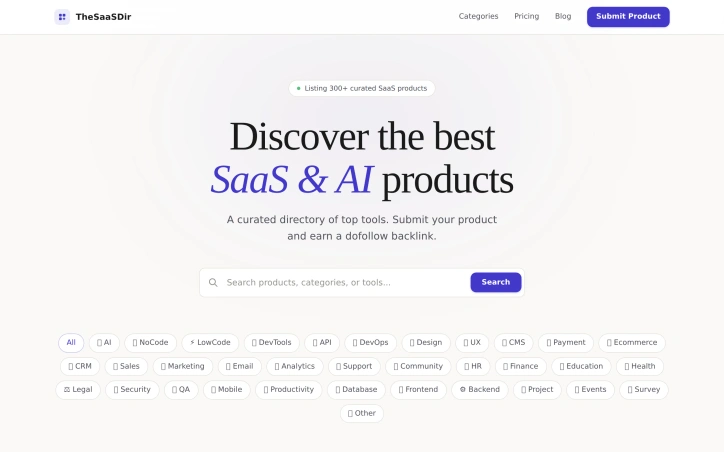
Building a curated product directory that stays organized and current poses a significant challenge in an increasingly crowded SaaS ecosystem. TheSaaSDir addresses this friction by assembling a hand-picked inventory of over 300 software and AI tools across dozens of categories, from DevTools and APIs to niche verticals like HR, Finance, and Legal technology. The directory serves dual audiences: product teams seeking visibility and discovery platforms hoping to build informed buying guides, and end users evaluating which tools fit their specific workflows. The directory's organizational approach demonstrates thoughtful categorization. Rather than a flat list, products are sorted by function and use case—separating low-code platforms from backend infrastructure, design tools from payment processors, analytics from support platforms. This taxonomy makes it realistic for a buyer to narrow from a broad search into specific needs. The inclusion of emerging categories like "No Code" and "Low Code" reflects awareness of how development practices have shifted in recent years. What distinguishes TheSaaSDir from generic product aggregators is its submission and ranking model. The directory invites software vendors to list directly, either free in exchange for referral traffic via dofollow backlinks, or paid at $25 for featured placement. This two-tier approach creates financial sustainability for the directory while staying accessible to bootstrapped startups and solopreneurs lacking dedicated marketing budgets. The backlink incentive is particularly clever for SEO-conscious founders seeking both inbound links and qualified traffic. The directory shows some limitations in presentation. The provided example—Youfiliate, an AI-driven affiliate link tool for YouTube creators—is sparse; more detailed listings would better communicate actual value delivered. The homepage emphasizes breadth over depth, listing categories without previewing typical product coverage or review quality per category. For a directory claiming curation, the distinction between listing standards remains unclear. For teams building go-to-market strategies, TheSaaSDir occupies a middle ground between exhaustive software comparison sites and vertically focused review platforms. It works best as a reference layer in the buying journey rather than as a definitive source, particularly for newer tools seeking early traction and link equity. The free submission option lowers barriers to entry, though the paid featured tier suggests the platform expects long-term viability through vendor participation and repeat submissions.

Creators without design expertise now have a viable alternative to expensive software subscriptions and steep learning curves. Berrioo packages a suite of AI-powered visual tools—from text-to-image generation to professional photo editing—into a browser-based platform designed for immediate usability. The platform addresses a clear market gap: the distance between creative intent and polished output. Most visual creation demands either specialist skills or expensive freelancers. Berrioo collapses that friction by automating execution. A food brand can generate lifestyle photography by typing a description. A social media manager can transform product photos into multiple artistic variations without adjusting presets. A marketer can remove backgrounds and upscale images to gallery-ready resolution in seconds. What distinguishes the offering is breadth wrapped in simplicity. Berrioo delivers text-to-image generation with 20 artistic styles, image-to-image transformation, batch processing, face swapping, object removal, and 4K upscaling. The interface prioritizes simplicity—each tool uses one-click or form-based workflows. The company positions these capabilities as professional-grade rather than consumer novelties, competing against commercial design software. The platform draws on established AI labs including ByteDance's Qwen and Black Forest Labs, indicating serious technical infrastructure beneath the accessible interface. Speed is emphasized throughout: "stunning visuals in seconds" and "instant iterations" matter for professionals evaluating time-saving potential. Ownership and commercial rights come included—users own what they create and can use it commercially. This addresses a significant pain point in many freemium AI tools that impose usage restrictions. The business model follows the freemium pattern: a free tier to attract users, then flexible paid plans scaled to usage. Specific pricing remains obscured on the landing page, standard practice for usage-metered tools. Berrioo enters a crowded space of AI image tools, but its emphasis on professional-grade output, simplified workflows, and full commercial licensing positions it for serious practitioners rather than casual experimenters.


Protecting sensitive customer data during database operations remains a fundamental challenge for development teams. VeilDB addresses this by automating the process of masking and removing personally identifiable information from database backups, allowing teams to safely share sanitized copies without compromising data privacy or security. The platform targets development and QA teams that regularly need access to production-like data for testing and debugging but face compliance and privacy constraints. Rather than forcing developers to request backups from technical leads or work with artificial datasets, VeilDB enables self-service access to masked data through a straightforward workflow: connect your database, scan its contents, configure masking rules, and distribute sanitized backups to team members with appropriate access controls. What distinguishes VeilDB is its emphasis on practical usability. The platform features a visual rule builder that abstracts away technical complexity, letting teams define how to handle sensitive columns without writing code. Configuration rules can replace, update, or remove data based on user-defined parameters. The solution also introduces a scheduling system that automates backup creation and masking on a recurring basis, reducing manual intervention and ensuring teams always have access to current sanitized data. The access control model reflects a team-centric philosophy. Rather than a simple binary structure, VeilDB implements group-based permissions that allow organizations to segment database access across multiple team members with varying privilege levels. This is particularly valuable in larger organizations where developers working on different features or services require different data views. Integration appears straightforward. The platform supplies a command-line tool that developers can install locally, reducing friction compared to solutions requiring database-level modifications or complex deployment steps. The four-stage setup flow—application setup, database scanning, rule configuration, and team distribution—suggests a focus on reducing implementation complexity. One limitation evident from the available information is the absence of concrete pricing details or a published cost model. The website mentions documentation and a GitHub repository, suggesting some level of technical transparency, but specifics on whether the offering is open-source, subscription-based, or usage-metered remain unstated. Interested teams must request a demo to understand licensing terms. VeilDB occupies a practical niche in the data security landscape. For teams struggling with the tension between needing realistic data for development while maintaining privacy obligations, it offers a plausible solution that prioritizes ease of use alongside security fundamentals. The product's success will depend on how well the claimed integration simplicity holds up under real-world deployment.


Cryptocurrency airdrop farming has emerged as a way for early protocol adopters to earn tokens, but identifying legitimate opportunities across dozens of blockchains and protocols remains a fragmented, time-consuming task. JeetDrops addresses this pain point for retail crypto users and active DeFi participants who want to maximize their airdrop eligibility without falling victim to scams or missing valuable distributions. The platform's core offering is straightforward: curated discovery of airdrop opportunities paired with portfolio scanning. Users can paste their wallet address to instantly scan activity across 50+ protocols, surfacing any unclaimed token allocations. The service monitors over 30 blockchain networks and claims to update its curated list daily, reducing the research burden typically required to stay informed about emerging token launches. What differentiates JeetDrops from a simple airdrop calendar is its tier-based rating system. The team assigns opportunity ratings (S, A, B, C) based on multiple dimensions: the project's funding credibility, the quality of the team behind it, and the difficulty level of the required farming activity. This structured evaluation framework makes subjective credibility assessments rather than treating all opportunities equally. The inclusion of team and credibility analysis acknowledges a real concern in the airdrop space—distinguishing legitimate projects with capable founders from speculative or fraudulent schemes. The platform's educational component merits attention as well. The FAQ addresses common farming questions and explicitly warns against scams, emphasizing that legitimate airdrops are always free and that users should verify official claim pages rather than clicking unsolicited links. This guidance-first approach indicates the team recognizes that many users are new to airdrop farming and vulnerable to basic fraud tactics. The product appeals to a specific segment: active DeFi users and crypto-native individuals who already possess multiple wallets and engage with protocols regularly. For these users, JeetDrops functions as both a discovery and verification tool, potentially saving significant time across daily chain-jumping and protocol interactions. The multi-chain approach acknowledges the fragmented reality of modern DeFi, where valuable opportunities span Ethereum, Arbitrum, Solana, Base, and dozens of other networks. Rather than forcing users to check each network individually, the platform consolidates airdrop discovery into a single interface, addressing one of the primary friction points in airdrop farming.


Creators and marketers looking to generate professional-quality visuals without design skills have a new option in Nano Banana, an AI-powered image generation and editing platform. The service tackles a real problem in the creator economy: the time and cost required to produce polished visual content at scale. What distinguishes Nano Banana from competitors is its integrated approach. Rather than offering just a text-to-image generator, it combines three distinct workflows under one roof. The platform can generate images from written descriptions, transform existing photos into new artistic variations, and edit images with AI-assisted tools like background removal, object erasure, and face swapping. This breadth means users can handle most visual tasks without jumping between multiple tools. The text-to-image engine supports 20 artistic styles and offers instant variations, allowing for rapid iteration. The image transformation feature preserves composition while changing artistic treatment or lighting, an important constraint for professional work. The photo editing suite includes batch processing, signaling that the platform is designed for workflows with volume demands, not just one-off creative experiments. All generations come with commercial licensing rights, a significant advantage for businesses and independent creators concerned with usage rights. The platform runs on multiple AI models in the background, including Google's Gemini technology, alongside systems from ByteDance and Black Forest Labs. This model diversity delivers broader coverage across different image types and styles, though the company doesn't detail how users access or prioritize different models. Pricing follows a familiar freemium model with a $12 monthly plan offering 1200 credits (equivalent to 600 images annually based on their claims) and a $29 professional tier described as the most popular option. The credits-based system creates flexibility for variable usage patterns, avoiding the fixed-generation limits of some competitors. No hidden fees are mentioned, and the free tier removes friction for initial trial. The service positions itself as requiring no prompting expertise or design background, targeting the non-technical end of the AI-generation spectrum. For teams and individuals building content operations at scale, the batch processing and commercial licensing model appear deliberately designed to address production workflows rather than casual creation. Whether this simplicity extends to the actual interface would require hands-on evaluation, but the feature set is comprehensive enough to handle serious visual content demands.


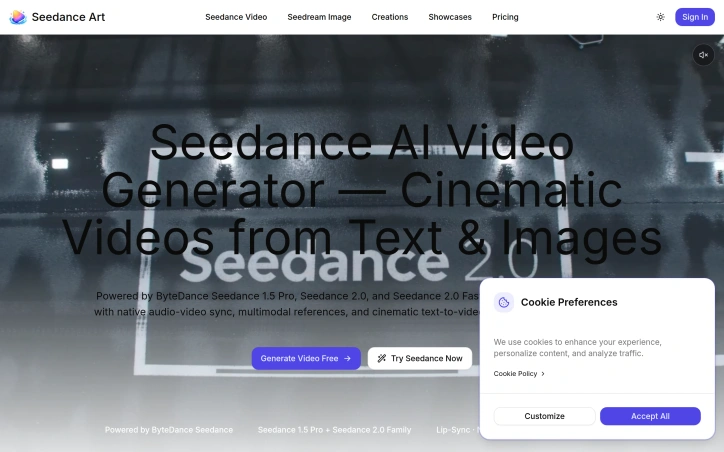
AI-powered video generation from text or images has moved beyond prototypes into production workflows, and ByteDance's Seedance represents a mature entry in this space. The platform targets three overlapping audiences: individual content creators seeking faster production cycles, marketing teams producing ads and social content at volume, and filmmakers prototyping scenes or building reference materials. For all three, the core value proposition is the same—cinematic video output without the traditional editing timeline. The standout technical achievement is millisecond-precision lip synchronization combined with native audio-video alignment. This closes a long-standing gap in AI video generation: previous tools struggled with out-of-sync dialogue and awkward mouth movement, limiting use cases to music videos or silent content. Seedance 2.0's approach to lip-sync makes presenter videos, dubbed ads, and talking-head content genuinely viable. The architecture also maintains character consistency across multiple shots, which is critical for filmmakers building narrative sequences rather than isolated clips. The feature set itself is straightforward but complete. Text-to-video generation converts descriptive prompts into cinematic footage with natural camera movement and depth. Image-to-video animation takes still images—product photos, portraits, brand assets—and generates fluid motion while preserving the original composition. Both leverage ByteDance's own Seedance models, suggesting a direct relationship between underlying infrastructure and product capability. The platform's technology stack is worth noting. Rather than building in isolation, SeedanceArt integrates multiple providers: ByteDance for video, Google Gemini and OpenAI for reasoning and text generation, and Black Forest Labs for additional image synthesis. This modular approach suggests the team is optimizing for quality over vertical integration, pulling best-in-class components where they exist. On the business side, the website mentions free generation as an entry point but provides no explicit pricing tier details, subscription structure, or usage limits. This opacity around monetization is typical for early-phase products still optimizing their growth motion. The core question for potential users isn't whether Seedance generates acceptable video—the examples suggest it does—but whether millisecond lip-sync and character consistency matter for their workflow. For dubbed content and long-form presenter material, they absolutely do. For short-form social content or concept art, generation speed may matter more than sync precision. SeedanceArt positions itself as production-grade tooling, and for that bar, the technical specificity is appropriate.

Switching between ChatGPT, Gemini, Grok, and half a dozen other AI apps takes a toll on productivity and your wallet. Omni AI consolidates access to more than 20 leading AI models into a single iOS and Android application, positioning itself as the one-stop solution for users who want to leverage multiple AI systems without maintaining separate subscriptions. The app's core appeal is straightforward: rather than juggling tabs or apps, users can access GPT-5.2, Claude Sonnet 4.5, Grok 4.1, Gemini 3, DeepSeek R1, Mistral Large 3, Llama 4 Scout, Perplexity Sonar, and others all in one place. The real differentiation comes in how the app handles model selection. Omni AI displays the strengths and optimal use cases for each model, helping users understand which one to choose for coding, writing, math, research, or creative tasks. More importantly, the app allows mid-conversation model switching, letting users compare outputs directly without starting over. Beyond chat, Omni AI bundles image generation, video creation, and AI-powered web search into the same interface. Cross-device sync means conversations and preferences carry across phones and tablets, while organizational features like chat folders and specialized "expert AI assistants" for specific tasks bring structure to what could otherwise feel chaotic. The numbers suggest adoption is gaining traction. The app has reached 200,000 downloads, maintains a 4.5-star rating, and has processed over 175 million messages. These figures sit well within the range of a serious mobile application gaining early momentum, though still short of mainstream penetration. Pricing is approachable. The app is free to download with a freemium model; premium plans start at $5.99 per week, $9.99 per month, or $59.99 per year. This positions Omni AI as cheaper than maintaining subscriptions to OpenAI, Google, and xAI separately, though the exact cost-benefit depends on which models a user actually needs and how often they access premium features. For developers, researchers, writers, and anyone who regularly switches between different AI models, Omni AI removes friction. The real test will be whether the consolidated experience actually improves workflow quality or simply trades one form of switching—between apps—for another.


Disk clutter on macOS presents a genuine problem for longtime users, whose machines accumulate cache files, developer leftovers, and forgotten downloads that consume storage and degrade performance. FixMyMacNow targets users seeking an all-in-one solution to reclaim space and restore their systems to a snappier state. The product bundles four major functional areas into a single application. The cleanup suite scans for system cache, log files, unused applications, browser caches, and development artifacts, with the vendor claiming the ability to recover up to 74 gigabytes of storage from a typical Mac. A dedicated space cleaner provides tools for identifying large files, purging old downloads, and detecting duplicates through hash-based matching. An optimization module focuses on performance by managing startup items, background applications, and maintenance scripts. A fourth component supplies real-time system monitoring, tracking CPU usage, memory pressure, disk activity, and network throughput. What distinguishes this offering is the emphasis on batch operations and simplicity. Rather than requiring users to manually navigate individual files or system settings, FixMyMacNow presents recommendations it can apply en masse—disabling multiple startup items at once or terminating background processes with a single action. The claimed 60-second scan time and the ability to perform major cleanup operations in a single click suggests the designers prioritized user convenience. The application supports macOS 12 and later. Pricing follows a freemium model. A seven-day free trial provides access to all features at no cost, after which a subscription begins at $9.99 per year. This positions the product as an economical option compared to many system utilities. The vendor emphasizes security, labeling the cleaning process as "100% secure," though the website offers no detailed explanation of what safety mechanisms protect against accidental deletion of essential files. The product's functionality overlaps significantly with established competitors, making differentiation a strategic challenge. The low entry price and breadth of tools provide potential value for users who prefer consolidated system maintenance to juggling multiple specialized utilities.


Automating invoice processing and financial data entry remains a persistent pain point across organizations of all sizes. BAGUNO tackles this challenge by acting as an AI-powered intermediary between document sources and accounting software, eliminating manual transcription work that typically consumes significant finance team capacity. The platform targets a broad spectrum of users—from freelancers drowning in expense tracking to enterprise consulting firms managing multiple client books, to SMEs running on accounting software like QuickBooks or Tally. This range reflects the founder's stated mission to remove manual data entry from finance workflows entirely. What distinguishes BAGUNO is its layered intelligence approach. The core Neural Invoice Engine handles document parsing with claimed 99.8% accuracy, but the platform extends beyond simple data extraction. Lia, its AI copilot, allows users to interact with financial data through natural language commands rather than traditional form entry—asking "Who is my most expensive vendor?" or approving purchase orders through conversational prompts. The system reportedly executes these actions directly in connected ERPs without human intervention on individual forms. Sentinel AI adds fraud prevention capabilities, algorithmically auditing documents before they reach the ledger, matching invoice line items to purchase orders, and flagging price anomalies. The platform also includes predictive liquidity forecasting, offering thirty-day cashflow visibility and alerting users to potential gaps. Integration is positioned as comprehensive, supporting Zoho Books, Odoo, QuickBooks, and Tally Prime, with the system functioning as a centralized ingestion point for quotes, purchase orders, invoices, and related documents. The platform accepts invoice submissions via email or upload, reducing the friction of onboarding financial documents. Pricing follows a freemium model with a Basic free tier capped at twenty documents monthly and supporting a single user seat, including core extraction and automated three-way matching. Paid tiers exist, with annual subscriptions discounted to the equivalent of two free months. Specific pricing for higher-tier plans isn't fully detailed in available materials, though this structure makes the product accessible to freelancers and smaller operations while remaining viable for larger teams. The platform's viability ultimately rests on the reliability of its AI models and the practical execution of automated workflows across diverse ERP systems—areas where real-world performance may diverge from stated capabilities.


Professional mobile demos have historically required desktop recording software or awkward workarounds that compromise the viewing experience. DemoScope solves this by building a purpose-built screen recording app specifically for capturing mobile web interactions alongside live commentary, making it particularly valuable for startup founders pitching to investors, content creators launching on platforms like Product Hunt, and developers documenting user workflows. The standout feature is the integrated face cam overlay with positioning and resizing controls, paired with touch indicator visualization. Rather than relying on viewers to infer what actions are happening on screen, the app makes every tap, swipe, and gesture visible with customizable animations and colors. This combination addresses a real friction point in mobile demos—without these cues, viewers often struggle to follow along with rapid interactions or multi-step workflows. Beyond recording, DemoScope supports live streaming directly to Twitch, YouTube, and Facebook, along with custom RTMP servers, which extends the tool's utility to real-time use cases like product launches, tutorials, and gaming content. The app accepts input from any website loaded in its built-in browser, video playback, or photo slideshows, giving creators flexibility in what they choose to record. Features like URL favorites and browsing history are included, acknowledging that many recording sessions involve navigation or comparison work. The product positioning targets multiple audiences simultaneously—investor-focused founders who need polished pitch materials, streamers and live content creators, and educators building tutorial content for YouTube or online courses. Each use case gets explicit attention in the marketing, suggesting the creators have deliberately built for this spectrum rather than trying to serve everyone generically. The app is available on both iOS and Android, which is a meaningful differentiation from desktop-only solutions, since it positions recording and streaming as native mobile workflows rather than desktop adjacent tasks. The face cam customization (circular, square, or rectangular shapes with dragging and pinching controls) suggests attention to usability details that matter for on-the-fly content creation. No pricing or subscription model is mentioned in the available content, making it unclear whether this is a freemium offering, one-time purchase, or subscription service. That omission is notable for a product clearly targeting creators and entrepreneurs who evaluate tools partly on cost structure.


Modern habit-tracking apps have created an unexpected problem: the anxiety of maintaining perfect daily streaks. A new entrant in the productivity space takes direct aim at this phenomenon by replacing the all-or-nothing streak model with a more forgiving monthly framework. The product is designed for people who want to build genuine habits but get discouraged when life inevitably gets in the way—missing a day shouldn't derail months of progress. SetHabits positions itself explicitly around psychological sustainability rather than gamification. Where traditional trackers emphasize consecutive-day chains, this tool sets monthly targets (like completing a habit 20 out of 30 days) and visualizes progress through a clean calendar interface. The approach reflects a fundamental understanding of behavior change: consistency matters more than perfectionism, and shame typically undermines long-term progress rather than motivating it. The product philosophy centers on aggressive simplicity. Habits can be added and logged in seconds, and the interface resists the feature bloat that plagues most productivity software. Users see their monthly progress at a glance through visual calendar data without navigating graphs or reports. The free tier supports up to five habits alongside monthly calendar views, basic statistics, and daily reminders. A weekly habit-tips email is included across all plans. The business model employs a straightforward freemium structure. The Premium tier costs $3.99 monthly or $29.99 annually and adds unlimited habits, AI-powered insights, weekly summary emails, detailed statistics, and custom habit colors. A lifetime access option at $59.99 exists with supply intentionally capped at 100 licenses—a transparent scarcity strategy targeting early adopters. The pricing is genuinely accessible for individual users while providing credible upgrade incentives. What distinguishes this product most sharply is its counter-cultural positioning. Rather than amplifying the perfectionism baked into most habit software, it explicitly rejects streak anxiety in favor of a more realistic, sustainable approach. The execution matches the philosophy: minimal interface, limited features, and transparent pricing all signal that the team grasps what struggling habit-builders actually need. For people burned out on guilt-driven productivity tools, this represents a genuinely different value proposition grounded in behavioral realism rather than motivational hype.


Planning tool overload has become a genuine problem for solo consultants and growing firms. With hundreds of software solutions vying for attention and wallet space, the decision fatigue of choosing between CRM platforms that cost $200 monthly, automation tools, scheduling apps, and analytics software can consume valuable billable hours. Curalo addresses this friction head-on by functioning as a curated directory and recommendation engine specifically built for the consulting industry. The platform positions itself as the antidote to tool sprawl. Rather than presenting an exhaustive catalog of options, Curalo takes a curation stance, reviewing and scoring 126+ tools while packaging them into pre-built "stacks" — bundled workflows designed to solve specific consultant pain points. The Day One Stack guides new practitioners through initial setup with tools like Calendly, Bonsai, and Notion AI. The Proposal-to-Payment Stack combines Bonsai and QuickBooks to streamline deal closure. Those drowning in administrative overhead can adopt the Billable Hours Stack, which integrates scheduling, time tracking, accounting, and workflow automation into a unified system. What differentiates Curalo from a simple tool review site is this stack-centric approach. Each bundle isn't just a collection of vetted tools but a pre-thought workflow designed to be implemented in minutes. The platform also publishes 19+ playbooks and guides — including a noteworthy resource titled "From Solo to Firm: Scaling Your Consulting Practice" that acknowledges how technology needs shift across growth stages. A 60-second quiz helps consultants identify their immediate needs, making discovery frictionless. The review component is straightforward. Tools receive numerical scores (Calendly earns 89/100) alongside brief, plainspoken descriptions. For Calendly, Curalo emphasizes the core value proposition: eliminating scheduling back-and-forth through shared availability links. Pricing details are sparse in the available content, with only Calendly's $10/month baseline mentioned alongside its five-minute setup claim. The platform's positioning against expensive CRM solutions suggests the broader philosophy: recommend effective tools at reasonable cost rather than enterprise software with premium price tags. Curalo serves consultants at all practice stages who value their time over exploring every available option. It's most relevant for practitioners making their first technology decisions or those seeking to replace expensive, bloated platforms with focused, affordable alternatives.

Getting an app into multiple international markets typically requires juggling translators, ASO specialists, and design tools—a workflow that can consume weeks of a small team's time or a solo developer's entire release cycle. AppDrift consolidates these steps into a single platform, automating the metadata generation, translation, and publishing process for iOS and Android simultaneously. The platform generates app store metadata—titles, subtitles, descriptions, and keywords—through AI, delivering results in under a minute with an ASO score audit attached to show optimization gaps. It then handles translation across 40+ languages and manages publication to both the App Store and Google Play in one dashboard. A screenshot generator with 50+ templates and keyword tracking with competitor analysis round out the toolkit. The offering is free to start and supported by 12,400+ connected apps. What distinguishes AppDrift is its compression of typically fragmented workflows into one interface. A solo developer or small team can move from English metadata to a global release in minutes rather than weeks. The company documents clear results: apps using the platform report significant increases in downloads and revenue alongside dramatically reduced time-to-market. These claims are grounded in actual customer usage, not theoretical projections. However, a notable limitation surfaced in real usage. One developer encountered a gap in character limit validation: translations into languages like Japanese and Arabic exceeded the App Store's subtitle field limits, yet the UI approved them with green checkmarks. The issue only emerged through manual verification before publishing. While the platform includes validation tools, running that check automatically after AI translation would catch this class of error upfront—currently, developers must actively invoke a separate checker. The team responded quickly to the feedback, a positive sign, but the gap highlights the risk of automation that still requires human oversight at critical junctures. For indie developers and scaling teams targeting international markets, AppDrift meaningfully reduces the operational friction of global deployment. The speed and one-click publishing justify the platform's foothold in the market. Solo developers or cost-conscious teams should be aware, however, that AI-generated content—especially across languages—still benefits from a human review pass before publication, and the platform's safety nets could be tighter.


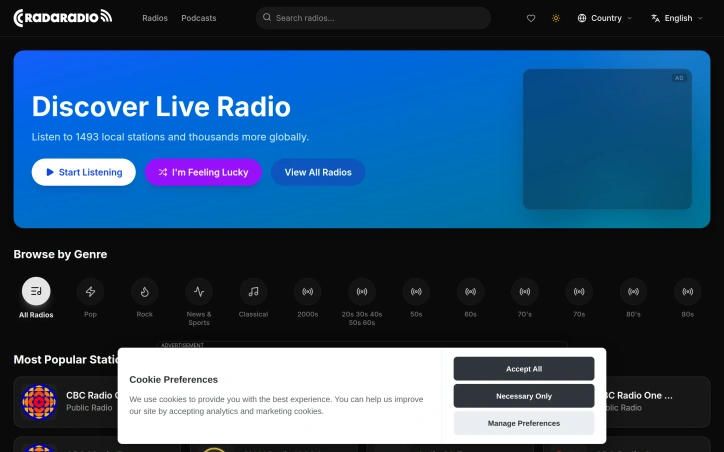
Streaming radio has fragmented across platforms, making it difficult for listeners to find quality broadcasts without subscribing to multiple services or downloading individual station apps. RadaRadio addresses this by functioning as a unified directory and player for radio stations and podcasts, aggregating content from over 150 countries into a single browsable catalog. The platform positions itself for radio enthusiasts seeking serendipitous discovery rather than just their favorite stations. This distinction shows in the product's design choices. Beyond the expected search and station browsing, RadaRadio offers a "I'm Feeling Lucky" feature that surfaces random stations, encouraging spontaneous exploration. The interface organizes content through multiple discovery paths simultaneously: by genre (Pop, Rock, Classical, News & Sports), by decade (20s through 90s), and by geography. Users can drill into local stations in specific cities like Montreal and Vancouver, or explore radio across an entire country. The geographic breadth distinguishes RadaRadio from competitors. The homepage lists nearly 200 countries, from obvious markets like the United States (9,698 stations) and France (2,777 stations) to niche territories with just one or two stations listed. This comprehensive coverage suggests the team indexed radio broadly rather than focusing on a single region or language market. Canada alone represents 1,533 stations, indicating particular depth in the home market. RadaRadio integrates podcasts alongside live radio, positioning itself as a broader audio streaming alternative to Spotify or Apple Music for listeners who value radio's format. The platform includes major podcast networks—NPR, NBC News, Barstool Sports—signaling an attempt to compete on audio content variety, not just breadth of radio stations. The product avoids the freemium complexity that plagues many streaming services. No pricing model is mentioned on the homepage, suggesting either a fully free service or a deliberate choice to hide monetization from first-time visitors. This approach lowers friction for trial but raises questions about sustainability. RadaRadio appeals to a specific audience: radio listeners who have grown frustrated with the death of local radio in their markets, expats seeking home country broadcasts, and audio enthusiasts who view radio as culturally distinct from algorithmic playlists. For travelers, the ability to stream local radio from any country creates genuine utility that generic music services cannot replicate. The platform's core limitation is execution clarity. A scraped homepage shows features but not user experience; without testing the product, it remains unclear whether the 1,518 stations stream reliably or whether the interface actually delivers the discovery promise the design suggests.

Combining the timeless appeal of tic tac toe with the spectacle of mixed martial arts, this online game targets casual and competitive players seeking lighthearted multiplayer entertainment with a thematic twist. The intersection of simple strategy gaming and fighting culture creates a niche entry point for players who might otherwise overlook traditional board game adaptations. The product distinguishes itself through an uncompromising free-to-play model. Rather than relying on advertisements or pay-to-win mechanics—common pitfalls for browser-based games—MMA XOX commits to no monetization friction. This approach lowers barriers to entry and suggests confidence in user retention through engagement alone. The decision to eliminate ads and competitive purchasing options directly addresses widespread frustration with gaming platforms that prioritize revenue over player experience. What truly sets this offering apart is its ambition toward globalization. Supporting 17 languages including Turkish, Arabic, and Mandarin Chinese signals genuine international reach, not merely English-language gaming with translation buttons. This breadth hints at a development team or publisher thinking beyond English-speaking markets from the outset. The commitment to cross-platform compatibility and mobile responsiveness ensures players access the game regardless of device, a practical necessity in markets where smartphone-first internet usage dominates. The competitive infrastructure reveals sophisticated design expectations. Ranked matchmaking systems paired with global leaderboards transform what could be a throwaway browser game into a persistence layer where player progression matters. The inclusion of seasonal tournaments and private room creation for friends suggests the developers understand that casual games thrive when they balance frictionless pickup play with goals for committed players. Fighter characters allegedly feature unique abilities, implying strategic depth beyond traditional tic tac toe's mathematical exhaustion. The social features—friends systems, private lobbies, and global matchmaking—position this as community-oriented rather than solitary. This architecture benefits both retention and word-of-mouth growth, assuming the execution matches the design intent. The requirement that JavaScript be enabled is unsurprising for real-time multiplayer but worth noting for accessibility considerations. The core tension in the pitch is whether thematic wrapping around tic tac toe generates sufficient novelty to sustain a competitive gaming community. The infrastructure supports such ambitions, but success depends entirely on execution quality and marketing reach—factors the website text cannot reveal. For players tired of monetization dark patterns, the straightforward free model alone warrants investigation.